 Confusion reigns over just who the
Chisholm Trail, the one that headed north from Texas through Indian
Territory and ultimately led to the Great Western Stockyards at Abilene,
was named for. Disputes have arisen over Thornton Chisholm, a trail
boss, who drove a herd from Gonzales northwest to Indian Territory and
then northeast by way of Topeka into St. Joseph, Missouri, in 1866. John
Chisholm of Paris, Texas has also been given credit for the origin of
the name. Adding to the confusion is John Chisum who moved his ranch
from Texas to New Mexico, trailing cattle between the two states and
thus creating the "Chisum Trail." However, it is generally
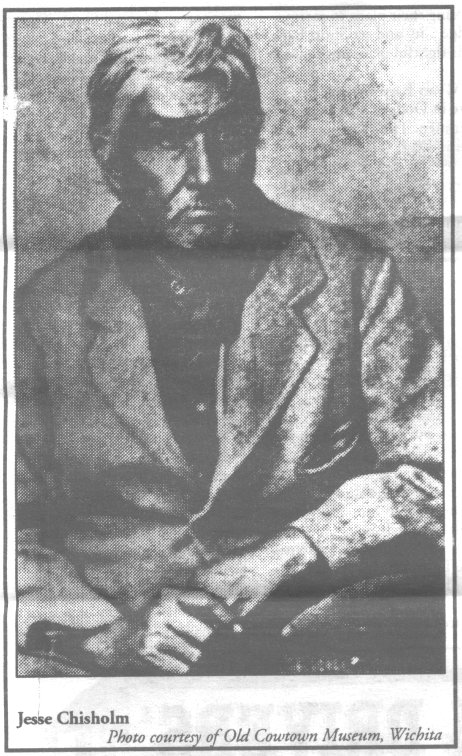
accepted that Jesse Chisholm, a trader and diplomat, is the man from
whom the trail derived its name. It could have just as easily been
dubbed the Black Beaver Trail for the Delaware scout who guided Captain
R.B. Marcy and Colonel William H. Emory’s Union forces over the same
path. Confusion reigns over just who the
Chisholm Trail, the one that headed north from Texas through Indian
Territory and ultimately led to the Great Western Stockyards at Abilene,
was named for. Disputes have arisen over Thornton Chisholm, a trail
boss, who drove a herd from Gonzales northwest to Indian Territory and
then northeast by way of Topeka into St. Joseph, Missouri, in 1866. John
Chisholm of Paris, Texas has also been given credit for the origin of
the name. Adding to the confusion is John Chisum who moved his ranch
from Texas to New Mexico, trailing cattle between the two states and
thus creating the "Chisum Trail." However, it is generally
accepted that Jesse Chisholm, a trader and diplomat, is the man from
whom the trail derived its name. It could have just as easily been
dubbed the Black Beaver Trail for the Delaware scout who guided Captain
R.B. Marcy and Colonel William H. Emory’s Union forces over the same
path.
Jesse was born to a father of Scottish
descent and a Cherokee mother in Tennessee. His date of birth is listed
as 1805 or 1806.
When Cherokees began removing themselves
from their homeIands to Arkansas, Jesse and his mother went with them.
Later they moved to Fort Gibson, in Oklahoma. At Fort Gibson, Jesse’s
aunt married the legendary Texan Sam Houston.
Jesse set up a trading post at Council
Grove, Oklahoma on the north fork of the Canadian River. Here he traded
with anyone and everyone, making forays into other regions to bring back
buffalo robes and the like to stock his post. Cattle were sometimes
included in the goods that he traded, and as such, Jesse Chisholm
probably did trail cattle over at least a portion of the trail that
would later bear his name.
Perhaps because of his mixed heritage and
the fact that he was raised among the Cherokee, Jesse was frequently
called upon as an interpreter during treaty negotiations with various
Indian tribes. Jesse could speak several Indian languages fluently
and was regarded as an one of the best guides on the Plains.
Jesse’s life encompassed extremely
turbulent times for the young nation. National policy was frequently in
direct opposition to the best interests of the Indian. In spite of all
the bigotry that surrounded him, Jesse grew up to be a very fair man and
earned the respect of both whites and
Indians. His legendary diplomatic skills frequently called him away from
his business and he found himself starting over several times.
Not all of the conflicts Jesse
was called on to mediate were between whites and Indians. As eastern
tribes were removed to Kansas and Indian Territory in Oklahoma,
conflicts arose between tribes and even within tribes as various
factions found they couldn’t agree. Jesse has been portrayed as a man
who listened to all sides of a conflict before offering his advice. He
was also aware of duplicity of the parties involved and while
interpreting managed to couch his translations so as to be most
agreeable to the parties involved.
Legend has it that when working out the
conditions to stage the Medicine Lodge Peace Treaty negotiations, Jesse
had warned General Harney that a show of
force on the part of the U.S. would be unacceptable to the Indians. When
confronted about producing a multitude of troops at the negotiations,
Harney heartily explained that the troops were necessary because of the
large numbers of news media, government personnel, foreign dignitaries
and general spectators. He offered to withdraw the troops if the Indians
were afraid to continue the conference. Jesse, the wise diplomat,
emphasized the word "fear," attributing it the white men, when
interpreting for Chief Ten Bears and Kiowa Chief Satanta. The Indians
replied, "Let the troops stay—but out of our way."
Hostage situations were common during
this episode of our history. It was common practice for
Indians to take hostages of any race. Frequently, Jesse was compelled to
buy the release of the hostages, especially when the people involved
were children. His good judgement ruled however when he encountered
situations in which a militant tribe was bargaining for guns for the
release of their hostages.
In 1836 a gold mine was purported to
exist at the mouth of the Little Arkansas, the site of present day
Wichita, Kansas. Jesse guided a group of white men up the Arkansas to
this locale but found no gold. However, Jesse liked the area and set up
a trade business there. The portion of the Chisholm Trail that Jesse
himself used was between the trading post on the Little Arkansas and his
home on the North Canadian River.
During the Civil War, great demands were placed on the Plains Indians
to take sides. It has even been reported that the results were
disastrous for those that didn’t chose one side or the other.
Apparently the old adage, "If you are not for me, then you must be
against me" was firmly ingrained
in the collective psyche of the time. Jesse, as a slaveowner, was
inclined to side with the South while attempting to remain neutral for
business purposes. In the end, he and his family joined the northern
exodus with the refugee Indians that he frequently traded with.
Some of his more famous treaty negotiations involved the ill-fated
Treaty of the Little Arkansas in the fall of 1865 and the more important
Medicine Lodge Treaty negotiations of 1867. The spring of 1868 found
Chisholm holding trade with Comanches, Kiowas, Cheyennes and Arapahos at
their consolidated encampment on the North Canadian River. It was at
this site that legend reports Jesse’s death from food poisoning
attributed to rancid bear grease. When Jesse’s friends, James R. Mead
and William Greiffenstein, two of Wichita’s founding fathers, along
with others became aware of his death
a few days later, they noted it with
the help of a small keg of Kentucky’s finest, honoring their friend
with a fitting wake ending with a salute from their guns.
A stone marker was later placed at Jesse’s grave that simply read:
Jesse Chisholm
Born 1805
Died March 4, 1868
No one left his home
cold or hungry.
Jesse’s descendants still reside in Oklahoma and Kansas. Because of
him, they can wear the name Chisholm with pride. |