|
Right in the centre of West-Mainland Orkney,
we find Maeshowe Chambered Tomb. Covered by a thick layer of turf and
grass the excellent dry stone structure is one of the major monuments of
the UNESCO World Heritage Site known as The Heart of Neolithic Orkney.
Inside the tomb, the biggest collection of
Viking runes ever found in situ survived until today. Most of the 23
inscriptions from at least 15 different hands simply show a name followed
by the characteristically "RR" for "reist runa" and thus telling us who
was the one who carved the runes on the wall. Nothing else but ancient
graffitis they are.
The more important is the rest of the
inscriptions. They tell us that those who carved the runes were very well
educated. They knew the classical futhork-alphabet with its 24 runes as
well as the Anglo-Saxon variation with up to 33 different letters. Some
used the reformed Scandinavian stile of writing with 16 different letters
that developed in the 8th century; others used at least two
different types of the so-called tree or twig runes:
- A Lady Ingibiorg is celebrated as one of
the most beautiful women of the world – this is stated in standard types
of runes, but the name of Erlingr one of her admirers is written in tree
or twig-runes.
- One of the most skilled carvers of runes
leaves his messages in a very unusual stile. He carved his runes with an
axe that killed Gauk Trandilsson, a Viking from Island, some 150 years
before. Asgrim Ellida Grimsson killed Gauk and his
Great-great-great-Grandson was Thorhall Asgrimsson. Thorhall was the
captain of the Norwegian longship that brought back the Earl Rongvald
from Bergen to Orkney on his return from the crusade.
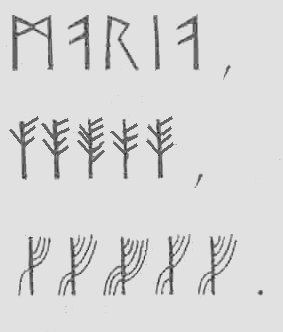 The
different stiles of writing the runes as we can find them on the walls of
Maeshowe: The
different stiles of writing the runes as we can find them on the walls of
Maeshowe:
The figure shows the Name "Maria"
– top line: standard runes of the old futhork alphabet;
centre line:
in tree or twig runes (younger futhork alphabet; twigs to the left
indicating the line, twigs to the right indication the position of the
letter within the line when grouped in the classical way of three lines
with 8 letters each); bottom line: Thorhall Asgrimsson’s personal
stile.
A woman carved one of the longest runic
inscriptions ever that survived:
 Lif.
She was a cook to Earl Rognvald and his crusading followers and she
accompanied him on his pilgrimage to Jerusalem. She tells us that the tomb
was already very old; it dates back to a time far beyond the early days
covered by the genealogy of the kings of Norway. Another crusader, a
certain Simon, leaves a note that at the time when they carved the runes
the tomb was already cleared out by Haakon. It took Haakon two days to
bring all the treasure out of the grave and to hide it in another place a
bit north of the tomb – lucky will be the man who will find the treasure. Lif.
She was a cook to Earl Rognvald and his crusading followers and she
accompanied him on his pilgrimage to Jerusalem. She tells us that the tomb
was already very old; it dates back to a time far beyond the early days
covered by the genealogy of the kings of Norway. Another crusader, a
certain Simon, leaves a note that at the time when they carved the runes
the tomb was already cleared out by Haakon. It took Haakon two days to
bring all the treasure out of the grave and to hide it in another place a
bit north of the tomb – lucky will be the man who will find the treasure.
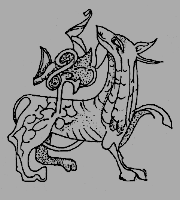
Some of the runic inscriptions are
accompanied by additional graphics: Something like a serpent, a dog’s head
(sometimes interpreted as a walrus) and the most famous of all – the
Maeshowe Dragon.
|



