|
Charles was now within the royal domains, and little more
than quarter of a mile from the royal palace of Holyrood, where his grandfather, James II,
when Duke of York, had, almost 60 years before, exercised the functions of royalty, as the
representative of his brother Charles II. Sanguine as he was, he could scarcely have
imagined that within the space of one short month, from the time he had raised his
standard in the distant vale of the Finnan, he was to obtain possession of the capital of
Scotland, and take up his residence in the ancient abode of his royal ancestors. Exulting
as he must have done, at the near prospect which such fortuitous events seemed to afford
him of realising his most ardent expectations, his feelings received a new impulse, when,
on coming within sight of the palace, he beheld the park crowded with people, who had
assembled to welcome his arrival. Attended by the Duke of Perth and Lord Elcho, and
followed by a train of gentlemen, Charles rode down the Hunter's bog, on his way to the
palace. On reaching the eminence below St. Anthony's well, he alighted from his horse for
the purpose of descending on foot into the park below. On dismounting he was surrounded by
many persons who knelt down and kissed his hand. He made suitable acknowledgements for
these marks of attachment, and after surveying for a short time the palace and the
assembled multitude which covered the intervening grounds, he descended into the park,
which, from its having been much frequented by the Duke of York, afterwards James II, when
he resided at Holyrood, obtained the name of the Duke's walk, Charles stopped for a few
minutes to exhibit himself to the people.
In person Charles appeared to great advantage. His figure and presence are described by Mr
Home, an eye-witness, as not ill-suited to his lofty pretensions. He was in the bloom of
youth, tall and handsome, and of a fair and ruddy complexion. His face, which in its
contour exhibited a perfect oval, was remarkable for the regularity of its features. His
forehead was full and high, and characteristic of his family. His eyes, which were large,
and of a light blue colour, were shaded by beautifully arched eye-brows, and his nose,
which was finely formed, approached nearer to the Roman than the Grecian model. A pointed
chin, and a mouth rather small, gave him, however, rather an effeminate appearance; but on
the whole, his exterior was extremely prepossessing, and his deportment was so graceful
and winning, that few persons could resist his attractions. The dress which he wore on the
present occasion was also calculated to set off the graces of his person to the greatest
advantage in the eyes of the vulgar. He wore a light-coloured peruke, with his hair combed
over the front. This was surmounted by a blue velvet bonnet, encircled with a band of gold
lace, and ornamented at top with a Jacobite badge, a white satin cockade. He wore a tartan
short coat, and on his breast the star of the order of St Andrews. Instead of a plaid,
which would have covered the star, he wore a blue sash wrought with gold. His small
clothes were of red velvet. To complete his costume, he wore a pair of military boots, and
a silver-hilted broadsword.
Charles remained some time in the park among the people, but as he could not be
sufficiently seen by all, he mounted his horse, a fine bay gelding which the Duke of Perth
had presented to him, and rode off slowly towards the palace. Every person was in
admiration at the splendid appearance he made on horseback, and a simultaneous huzza arose
from the vast crowd which followed the prince in triumph to Holyrood House. Overjoyed at
the noble appearance of the prince, the Jacobites set no bounds to their praises of the
royal youth. They compared him to King Robert Bruce, whom, they said, he resembled in his
figure as they hoped he would in his fortune. The Whigs, on the other hand, regarded him
differently; and though they durst not avow their opinions to the full extent, and were
forced to admit that Charles was a goodly person, yet they observed that even in that
triumphant hour when about the enter the palace of his fathers, the air of his countenance
was languid and melancholy, - that he looked like a gentleman and a man of fashion, but
not like a hero or a conqueror. Their conclusion was, that the enterprise he had
undertaken was above the pitch of his mind, and that his heart was not great enough for
the sphere in which he moved.
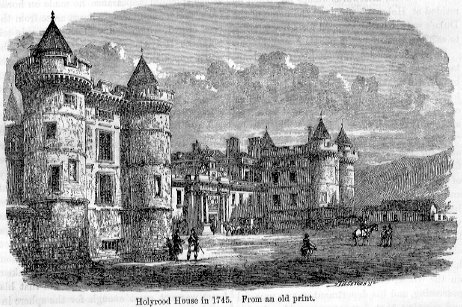
Holyrood House in 1745. From an old print.
On arriving in front of the palace Charles
alighted from his horse, and entering the gate proceeded along the piazza within the
quadrangle towards the Duke of Hamilton's apartments. When the prince was about to enter
the porch, the door of which stood open to receive him, a gentleman stepped out of the
crowd, drew his sword, and raising it aloft, walked up stairs before Charles. The person
who took this singular mode of joining the prince, was James Hepburn of Keith, a gentleman
of East Lothian. When a very young man he had been engaged in the rebellion of 1715, not
from any devoted attachment to the house of Stuart, (for he disclaimed the hereditary
indefeasible right of kings, and condemned the government of James II), but because he
considered the union, which he regarded as the result of the revolution, as injurious and
humiliating to Scotland, and believed that the only way to obtain a repeal of that
measure, was to restore the Stuarts. In speaking of the union, he said that it had made a
Scottish gentleman of small fortune nobody, and that rather than submit to it, he would
die a thousand deaths. For thirty years he had kept himself in readiness to take up arms
to assert, as he thought, the independence of his country, when an opportunity should
occur. Honoured and beloved by both Jacobites and Whigs, the accession to the Jacobite
cause of this accomplished gentleman, whom Mr Home describes as a model of ancient
simplicity, manliness, and honour, was hailed by the former with delight, and deeply
regretted by the latter, who lamented that a man whom they so highly revered, should
sacrifice himself to the visionary idea of a repeal of the union between England and
Scotland.
On his way to the palace Charles had been cheered by the acclamations of the people; and
on his entering that memorable seat of his ancestors, these acclamations were redoubled by
the crown which filled the area in front. On reaching the suite of apartments destined for
his reception, he exhibited himself again to the people from one of the windows with his
bonnet in his hand, and was greeted with loud huzzas by the multitude assembled in the
courtyard below. He replied to these congratulations by repeated bows and smiles. |



