fought in the British army under
Burgoyne at the battle of Saratoga, afterward settling in America and
joining the United States army in 1791, was sent there with his company in
1803 to build old Fort Dearborn.
John Clark, great-grandfather of
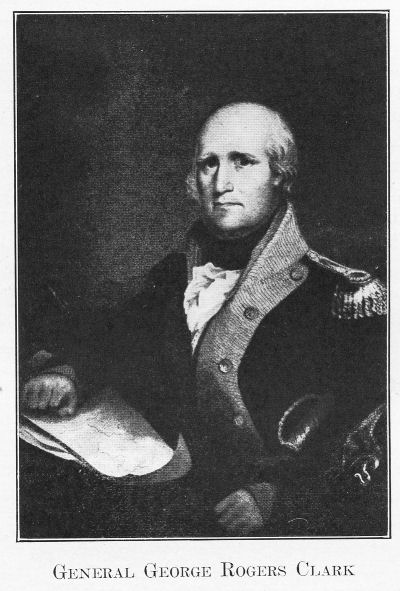
General George Rogers Clark (1752-1818,), came to Virginia in 1630 from
the southwestern part of Scotland. On both sides General Clark was
descended from Scottish ancestors. In 1778, commissioned by Governor
Patrick Henry to defend the Virginia frontiers, he made a complete
conquest of the whole rich domain between the Ohio and Mississippi rivers,
the five great States of Ohio, Indiana, Michigan, Illinois and Wisconsin,
that save for the daring of this one man would to-day probably have been a
part of the Dominion of Canada. Early in 1777 Clark had begun to gather
forces, mostly Scottish settlers like himself, on Corn Island, opposit the
present city of Louisville, and July 4, 1778, marching day and night,
captured the strong post at Kaskaskia, Illinois, without firing a shot.
Governor Hamilton with a large British force marched against him from
Detroit and in December went into winter-quarters in Vincennes, Indiana.
Saying, "I must take Hamilton or he will take me," Clark set out with less
than 170 men and marched across the submerged lands of the Wabash in
midwinter. With but scanty food, his men were often up to their armpits in
icy water. Hamilton
surprised and Vincennes surrendered,
February 24, 1779; and it was only his inadequate forces that prevented
Clark from marching on Detroit.
John Harris (1716-1791), an
Ulster-Scot, was the founder of Harrisburg, Pa. He built the first ferry
across the Susquehanna at that point and was the principal store-keeper of
the frontier. He had, by his fair dealing, the implicit confidence of the
Indians and many important councils were held at his house, which was
built in 1766 and is still standing.
John and Samuel Finley, nephews of
Rev. Samuel Finley, president of Princeton College, both served with
distinction in the Revolutionary War. John was a noted Indian trader and
in 1767 preceded Boone by two years into Kentucky.
Daniel Boone (1735-1820), the border
hero, who conquered almost singlehanded the region comprising Kentucky,
Tennessee and Missouri, was the grandson of George Boone, who landed in
Philadelphia from the North of Ireland in 1717, and a son of Squire Boone
and Sarah Morgan.
Simon Kenton (1755-1836), Boone’s
companion in many of his daring enterprises, was the son of a Scottish
mother and an Ulster-Scottish father. At the age of sixteen he ran away
beyond the Alleghenies. He joined with George Rogers Clark and was with
him at Kaskaskia. Kenton County, Ky., is named for him. He was one of the
last surviving of the early pioneers.
There were three Lewises, Andrew
(1720-1781), Colonel William (1724-1811), and Charles (Va. -1774), all but
one born in Donegal, and all of Scottish descent, who were distinguished
in the border fighting on the frontiers of Virginia, and a brother, Thomas
(1718-1790), also born in Donegal, in the House of Burgesses, where he
firmly advocated the resolution of Patrick Henry.
Col. William Crawford (1732-1782),
surveyor and friend and associate of Washington, was with Braddock at Fort
Duquesne and in the Pontiac War. In 1767 he settled in Western
Pennsylvania, but joined Washington and was in the battles of Long Island
and in New Jersey. In 1778-1882 he was sent on frontier service in Ohio
against the Indians, and was finally captured and burned to death after
terrible tortures.
Robert Patterson (1753-1827)
emigrated to Kentucky in 1775. He was with George Rogers Clark in 1778 and
with John Bowman in 1779. Patterson built the first house on the site of
the present city of Lexington, Ky., in 1779. He was one-third owner of
Cincinnati when the town site was laid out, aiid in 1804 built the first
settlement at Dayton, Ohio. He fought in many Indian campaigns and had
many narrow escapes.
The Hon. Whitelaw Reid’s grandfather
emigrated to Kentucky from the Lowlands of Scotland near the end of the
eighteenth century. Afterward he bought several hundred acres of land on
the site of the present city of Cincinnati and secured a franchise for a
ferry across the Ohio River at that point. He parted with both, however,
because his strong Covenanter conscience would not permit him to operate a
ferry on Sunday, as required, and removed to Green County, Ohio, where he
was one of the founders of Xenia.
General James Robertson (1742-1814),
born in Virginia of Scottish parents, in 1759 accompanied Daniel Boone on
his third expedition beyond the Alleghenies. General Robertson explored
Tennessee and founded settlements at Watauga, and in 1779 the city of
Nashville. His whole life was a bitter fight with the Indians. He was made
a brigadier-general by Washington in 1790. General Robertson shares with
Sevier the honour and affection of all Tennesseeans.
John Johnston (1775-1861), the
famous Indian agent of the Ohio, was a native of Ballyshannon and of
Scottish parentage. He was for eleven years canal commissioner of the
State of Ohio.
"Davy" (David) Crockett (1786-1836)
was the son of a Revolutionary veteran of Scottish birth. He joined the
Texans in their fight for liberty and was massacred at the famous defence
of the Alamo, March 6, 1836. He was a member of the state legislature of
Tennessee, pioneer, hunter, and a member of Congress.
Sam Houston (1793-1863), president
and father of Texas, was born in Rockhridge County, Virginia, and was of
Scottish descent.
"Kit" (Christopher) Carson
(1809-1868), the resourceful Indian fighter, was of Ulster-Scottish blood.



