AS has been noted elsewhere in
Colonial and Revolutionary times, the descendants of Robert Livingston of
Ancrum were at the forefront in everything that was for the patriotic and
commercial welfare of the country. For generations the family exerted a
powerful influence in shaping the destinies of New York State, and the
names of its members are associated with many of its civic and
philanthropic enterprises.
Another prominent merchant and
philanthropist of New York City in Colonial times was John Watts
(1715-1789), grandson of John Watts, of Edinburgh, Scotland. He was a
founder and the tenth president of the St. Andrew's Society of New York;
and one of the founders of the Society Library and of the New York City
Hospital, and served for fourteen years as president of the latter. He was
also one of the original subscribers to the Tontine Coffee House, and
presented a clock to the New York Exchange in 1760. His large properties
were confiscated during the Revolution on account of his British
sympathies, but were in part restored to his sons. His statue stands in
Trinity church-yard, New York.
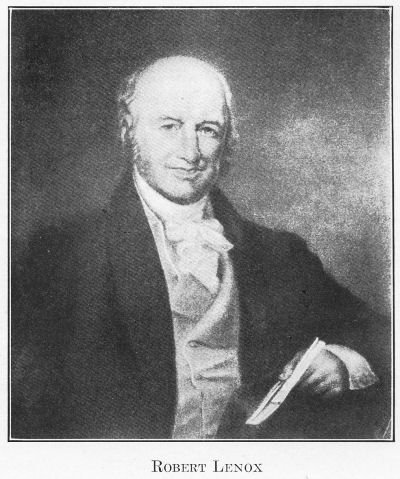
Robert Lenox (1759-1839), one of the
greatest merchants of his day, was a native of Kirkcudbright, Scotland,
and came to America with, his brothers David and William just before the
outbreak of the Revolution. His brother, Major David Lenox (——1828), was a
noted Revolutionary patriot and a
successful Philadelphia merchant. In
1817, Robert Lenox bought the so-called "Five Mile Post Farm" (between
Fourth and Fifth Avenues and Sixty-eighth and Seventy-first Streets) for
$6,420, and a few mouths later, for $500, additional parcels extending to
Seventy-fourth Street. This was afterward known as the "Lenox Farm." His
son, James Lenox (1800-1880) succeeded to the Lenox fortune and endowed
the Lenox Library and made large contributions to the Presbyterian
Hospital and other institutions. The land that Robert Lenox bought for
$6,920 in 1817 is to-day worth at least $70,000,000.
Archibald Gracie (1755-1829),
founder of the great firm of East India merchants, was born in Dumfries.
He was a lifelong friend of Robert Lenox and was associated with him in
many financial and philanthropic undertakings. Both were presidents of the
St. Andrew’s Society of New York.
Two other early presidents of the
St. Andrew’s Society of New York and noted in the commercial life of the
city were both natives of Ayr, William McAdam (1725-1779) and Robert
Halliday (1770-1840). McAdam lost practically all of his fortune by
confiscation in the Revolution. He brought up and educated his nephew,
John Loudon MacAdam, who afterward became the famous engineer and
road-builder. Halliday was a man of great physical strength and many
accomplishments and was associated with many philanthropic enterprises.
David, or "Divie" Bethune, a native
of Scotland, was another noted merchant of early New York. In 1795 he
married a daughter of the accomplished and philanthropic Mrs. Isabella
Graham, who came from Scotland to New York in 1785. David Bethune was the
father of the well-known clergyman and poet, Rev. Dr. George W. Bethune.
Archibald Russell (1811-1871) was
born in Edinburgh. His father, James Russell, was for many years president
of the Royal Society, Edinburgh. Mr. Russell was a graduate of the
University of Edinburgh and settled in New York City in 1836, where he
devoted his time and fortune to benevolent and educational enterprises. He
was founder and president of Five Points Mission for eighteen years and
aided in establishing the Half Orphan Asylum. He also gave largely to the
support of the Christian Commission during the Civil
War.
John Morin Scott (1730-1784) was
born in New York City, the grandson of Sir John Scott, of Ancrum,
Roxburghshire. His father came to New York in 1702. John Morin Scott was
graduated in 1746 from Yale and became the most noted lawyer of his day in
the Province. He was a brigadier-general with the American forces, held
many offices in the Province and State of. New York, and was a most useful
and generous citizen. He was one of the founders of the Society Library.
James Roy (1808-1888), a native of
Alva, came to West Troy, New York, in 1834 and was the first to introduce
into America the machinery for weaving fine woolen shawls. He was
prominent in the financial and civic life of Troy, and gave liberally to
many charities.
David Milne (1787-1873), of
Philadelphia, a native of Aberdeen, was another pioneer in the textile
business of the country, establishing in 1829 the large mills that are
still operated by his descendants.
John McAllister, Sr. (1753-1830) and
his son, John McAllister, Jr. (1786-1877), were also noted figures in the
business and civic history of Philadelphia.
One of the most prominent business
firms in Boston was the old house of Hogg, Brown & Taylor. They brought
over many young clerks from Scotland, who in turn opened drygoods stores
in almost every State in the Union, some of them the largest in the
country to-day.
Alexander T. Stewart (1803-1876),
the great drygoods merchant, was born of Scottish ancestry in Lisburn,
County Down, Ireland.
Peter Cooper (1791-1883), the great
New York philanthropist, was of Scottish descent; also Jay Cooke
(1821-1905), the principal financial agent of the Federal Government
during the Civil War.
The late John I. Blair, born 1802,
who was directly descended from John Blair, who came from Scotland in
1720, built the first railroads in Iowa and Nebraska following the Civil
War, and was interested in many industries. He was a liberal contributor
to Princeton, Lafayette, Blair Academy and other educational and
charitable institutions. His daughter married Charles Scribner, the New
York publisher.
The late John Crerar was born in New
York City in 1827 of Scottish parentage. He settled in Chicago in 1862,
where he became an incorporator and director of the Pullman Palace Car
Company. He contributed $2,500,000 for the library in Chicago now known by
his name, $100,000 for a statue of Abraham Lincoln, and $1,000,000 to
charitable and religious organizations, and presented the parsonage to the
Scotch Church known as the Scotch Manse, in Ninety-sixth Street, New York.
John Stewart Kennedy (1830-1909) was
a native of Blantyre, Lanarkshire, Scotland. He began business at thirteen
as a shipping clerk in Glasgow. He spent the two years following 1850 in
America as representative of an iron firm, settling finally in New York in
1856, where he rose to the forefront of American banking and railway
affairs. During his lifetime he gave $600,000 to the United Charities
Association of New York, $1,000,000 to the New York Presbyterian Hospital,
and $500,000 to Columbia University. At his death he bequeathed more than
$30,000,000 to various educational and charitable institutions, including
$100,000 to Glasgow University.
The first bank in Chicago was
founded in 1839 by George Smith, a native of Old Deer, Aberdeen, assisted
by Alexander Mitchell. The name of the firm, George Smith & Co., became
almost a household word throughout the United States.



