OF the fifty-six members of the
Continental Congress of 1776 who signed the Declaration of Independence,
James Wilson of Pennsylvania and John Witherspoon of New Jersey were
natives of Scotland. William Hooper of North Carolina, George Ross of
Delaware, Thomas Nelson, Jr., of Virginia, and Philip Livingston of New
York were of Scottish descent. Matthew Thornton of New Hampshire and James
Smith and George Taylor of Pennsylvania were natives of Ulster; and Thomas
McKean of Pennsylvania and Edward Rutledge of South Carolina were of
Ulster-Scottish descent. John Hart of Hunterdon County, N. J., and Abraham
Clark of Elizabeth, N. J., both from their names and the fact that
both were from centers of Scottish settlement, were doubtless of Scots
descent. Robert R. Livingston of New York and John Houston of Georgia,
both of Scots descent, were active members of the Congress, but were
absent on duty when the engrossed copy was signed (August 2, 1772) and
their names do not appear.
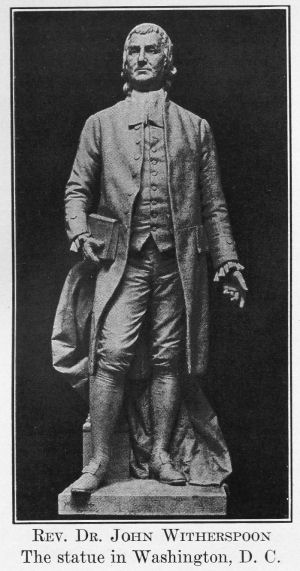
Dr. John Witherspoon, one of the
leaders in the movement for independence and one of the signers of the
Declaration of Independence, was born in the parish of Yester, February 5,
1722. He studied at the University of Edinburgh, and at the age of
twenty-one was licensed to preach. He shortly afterwards became minister
of Beith in Ayrshire, and held that charge for twelve years. He then
accepted a call to Paisley, and remained there until 1768. His position in
Scotland was a prominent one and Aberdeen University marked its
appreciation of his scholarship by conferring on him the degree of D.D. in
1764. His essays and sermons were reviewed in the leading magazines of
London and Edinburgh as often as they appeared, and a number of them were
translated into Dutch. In 1766 he received a unanimous invitation from the
trustees of the College of New Jersey to become its president. At first he
was unwilling to accept, but found it his duty to do so when the call was
repeated, and arrived in America with his family in August, 1768. When the
Continental Congress met at Philadelphia in September, 1774, he
represented his county at the New Jersey convention for the election of
delegates to that Congress. In 1776 he was elected to the New Jersey
Provincial Congress, where he played a prominent part not only in
unseating British rule in the colony, but also in the deposition of
William Franklin, New Jersey’s last royal governor. His energetic action
in these matters caused him to be elected one of the five representatives
of New Jersey in the senior body (June, 1776), with definite instructions
to vote for independence and the declaration of that independence. To a
member of the Continental Congress who said that the colonies were not yet
ripe for a declaration of independence Wither-spoon replied, "In my
judgment, sir, we are not only ripe, but rotting." He held his seat in
Congress through 1782, with the exception of the year 1780. In addition he
served on three important committees, the Committee on Clothing for the
troops, the Board of War and the Committee on Secret Correspondence. While
holding his seat in Congress he did not neglect his college, and did not
fail to attend every meeting of the Board of Trustees and presided at
every Commencement, and indeed all his time spared from public service was
devoted to his classes. On the reconstruction of the Presbyterian Church
in America after the war the task fell to him to direct the framing of the
new order. As the most prominent Presbyterian in the young Republic he was
chosen to preach the opening sermon at the meeting of the first Assembly
(May, 1789), and to preside as the first Moderator. His latter years it is
regrettable to add were clouded by financial embarrassment, by illhealth,
and for more than two years before his death by blindness. The end came
suddenly to him, November 15, 1794, in the seventy-third year of his age.
He lies buried in the Presidents’ Lot in the Princeton Cemetery.
Hon. Thomas McKean (1734-1817) was
born of Scottish parents in Chester County, Pennsylvania, and was admitted
to the bar when he was twenty-one years of age. He was for seventeen years
a member of the General Assembly; a member of the Stamp Act Congress of
1765; the only member of the Continental Congress who served continuously
from 1774 to 1783, and president in 1781; and from 1777-1779 Chief Justice
of Pennsylvania. He was elected Governor of Pennsylvania in 1799 and twice
re-elected, serving until 1808.
George Ross was born in Newcastle,
Delaware, in 1730, son of Rev. George Ross, a former Presbyterian minister
of Scotland who had entered the Church of England and came to America in
1703 as rector of the church in Newcastle. The son received the best
education the colonies afforded, was a lawyer and statesman of superior
ability, an upright judge, of singular sweetness and modesty of character,
and had been the King’s prosecutor and a member of the General Assembly of
Pennsylvania previous to the war. He was a valued member of the
Continental Congress from 1774-1777, when compelled to retire on account
of ill-health. He served on nearly all the important committees, including
that with General Washington and Robert Morris appointed to devise a
national flag. To Elizabeth Griscom, "Betsy Ross," the wife of John Ross,
nephew of George Ross and son of Rev. Aeneas Ross, the making of the first
flag was entrusted. George Ross died July 14, 1779, in Philadelphia.
Dr. Matthew Thornton was born in
Ulster about 1714. He was brought to this country by his father when only
about three years of age, the family settling first in Wicasset, Me., and
afterward in Worcester, Mass. Dr. Thornton was a noted physician and
Revolutionary patriot, and afterward was Chief Justice of Common Pleas of
New Hampshire and a member of Congress. He died in 1803.
Edward Rutledge (1749-1800) was a
brother of John Rutledge and the youngest son of the Ulster-Scot, Dr. John
Rutledge, who came to South Carolina in 1735. He was educated in law at
the Temple, London, and was a member of the Continental Congress
1774-1777. He served on many important committees, and with Benjamin
Franklin and John Adams conferred with Lord Howe at the Billopp House on
Staten Island, September, 1776, the only conference for the purpose of
arranging peace during the war. The meeting was without result, but Lord
Howe afterward wrote in the highest terms of the personality and
intellectual eminence of the commission. After the war, he held many high
offices. Another brother, Hugh Rutledge (1741-1811), also attained
prominence as a jurist in his native State, South Carolina.



