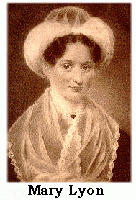
Mary Lyon's Childhood
Mary Lyon was born February 28, 1797 on a remote New England farm. The Lyon family lived
in Buckland, a town in the hills of western Massachusetts. Less then fifty years before
her birth, Lyon's
great-grandfathers had migrated from eastern Massachusetts and Connecticut to help settle
the area and to farm the rocky hilltown soil. Her father, Aaron, fought in the
Revolutionary War.Aaron Lyons was a Scot who
came to the Colonies after the Jacobite uprising in 1745. The English of
Massachusetts could not farm the rocky terrain that the Scots were used to farming
therefore the Lyons (Lyon) moved to the New England farm. Pin cushion and thimble owned by
Mary Lyon. Sewing, cooking, spinning, washing, candle and butter making, were just a few
of Mary's many duties as a young girl.
Aaron Lyon died when Mary was five, leaving his wife, Jemina, to raise seven children and
manage a
100-acre farm on her own. At her mother's side, Mary Lyon learned the skills and crafts
required of
every early 19th-century New England farm girl. She cooked on the open hearth, baked
bread, spun
and dyed wool from the family sheep, wove coverlets, sewed clothes and embroidered linens,
preserved
fruits and vegetables picked from the family garden, churned butter, made cheese, jam,
soap, and candles, cured meat, washed clothes, and swept floors. When Mrs. Lyon remarried
and moved to her
new husband's home, 13-year old Mary was left behind. Now, self-supporting, she kept house
for her
brother, Aaron, who ran the family farm. He paid his sister a weekly wage of one silver
dollar.
Mary Lyon's education began at age four in the village school, about a mile walk from her
home. When
the school was moved three years later to a more distant location, she left her family and
lived for the
school term with relatives and local families. She did chores to pay for her room and
board. Mary Lyon
was fortunate--girls could attend the Buckland school year round. The school year was
typically ten
months long and divided into winter and summer terms. In some towns, girls could only
attend during
the summer, when boys were needed to do farm work. During winter, girls were forced to sit
on the
school steps, hoping to catch bits of the teacher's lessons.
As early as 1647, the Massachusetts Bay Colony made education compulsory for children. By
the
18th century, most towns in Massachusetts had public elementary schools, which were called
common schools. Some even had academies--the term used for high schools--which prepared
young
men for college. Girls, however, did not benefit from the Colony's advanced ideas about
education. Their schooling was uneven, at best, and frequently non-existent. Many people
felt that girls did not
need to be educated to become wives and mothers and caretakers of the house. Although she
left
school when she was 13, Mary Lyon had more education than most girls, who knew little more
than
the basics of reading, writing, and math, and often not even that much.
What was life like during Mary Lyon's childhood in the early 19th century?
Nights and winter days are dark. Candles and whale oil lamps provide the only artificial
light. Roads are
dirt, and often muddy. Macadam roads are introduced in 1812, but rural roads remain mostly
dirt. There is no paper money until 1861. Coins are made of gold, silver and copper. Few
people receive mail, and if they do, they have to pay the postage. Stamps, purchased by
the sender, were not sold in the U.S. until 1847. People travel by foot, horseback,
carriage, stagecoach, and, in winter, sleigh. Quill pens made from the shaft of a feather
are used for writing. Few people own books other than the Bible. Many, especially women
and girls, do not have sufficient literacy skills to read a book or a newspaper or write
much more than their name. In 1803, the U.S. pays Spain $15 million for the Louisiana
Purchase, which doubles the size of the young nation and spurs migration west. John Adams,
Thomas Jefferson and James Madison serve as Presidents. In 1800 the U.S. population is
5,308,483; in 1809, the National Debt is $60 million. (Do you know what it is today?)
Mary Lyon, Student and Teacher
In 1814, townspeople offered Mary Lyon her first teaching job at a summer school in
Shelburne Falls, a
town next to Buckland. She was 17 years old. At the time, teachers needed no formal
training--young
Mary Lyon's reputation as an excellent student years earlier was enough of a
qualification. Female
teachers were especially in demand due to a growth in population and large numbers of men
moving west in search of better opportunities. The job paid 75 cents a week, far less than
the $10 to $12 a month a man received to teach the winter term. As was the custom of the
day, Lyon "boarded around" in her students' homes--an arrangement that meant
moving as often as every five days. For the inexperienced Mary Lyon, maintaining
discipline in the crowded one-room schoolhouse and teaching the "3 Rs" to
pupils, ages four to ten, were difficult tasks. On rainy days, when older boys came in
from the fields, the job was even harder. Nevertheless, Mary Lyon worked hard to improve
her teaching skills and her ability to keep order in the classroom.
Teaching fired Lyon's desire to continue her own education, a goal not easy to achieve in
the early 19th
century for an intelligent young woman with little money. Although private female
academies, often
called seminaries, were springing up in New England, women of modest means, like Mary
Lyon, could
not afford their fees. Moreover, the curriculums, which included "lady-like"
skills like drawing and
needlework, were far less challenging than at male schools where students studied subjects
like geometry, science, and Latin.
Despite the financial burden and a busy teaching schedule, Mary Lyon was determined to
further her
learning. In her own words, she gained "knowledge by the handfuls." She
alternated time spent in
classrooms and at lectures--sometimes traveling three days by carriage to enroll at a
school--with
teaching and running a school. Against the advice of her family, Lyon paid for her
education by cashing
in a small inheritance from her father. Ever frugal and resourceful, she saved a portion
of her small salary and traded coverlets and blankets she had woven for room and board.
Mary Lyon's reputation as a gifted teacher spread far beyond the Buckland schoolhouse.
Over the
next 20 years, she taught at schools in western and eastern Massachusetts, and in southern
New
Hampshire. She became an authority on the education of women. These were the years when
Mary
Lyon developed her educational philosophy and gained experience in managing a school.
Inspired by
her own struggles to obtain an education, she worked hard to expand academic opportunities
for young
women and to prepare them to become teachers, one of the few professions open to women.
Further reading:
Green, Elizabeth Alden. Mary Lyon and Mount Holyoke: Opening the Gates.
Hanover, NH: University Press of New England, 1979.
Notable American Women, 1607-1950: A Biographical Dictionary. Edwart T. James,
editor. Harvard
University Press, 1971. Contains an extensive biographical sketch of Mary Lyon
prepared by Sydney
R. McLean.
Mary Lyon web site (http://www.mtholyoke.edu/marylyon/),
prepared by the Mount Holyoke College
Office of Communications, 1997 |