|
| |
Women in
History of Scots Descent
Martha Graham and Modern American Dance |
by Lijntje Zandee
1. INTRODUCTION
The 1930's are very often seen as the `historical period' of Modern American Dance. In
these years modern theatre dance came to be accepted as an art form. There are a few
pioneers in
modern dance at the beginning of the century. Of them, dancer and choreographer Martha
Graham had the most lasting influence. That is why I want to focus on her choreography in
this
essay. |
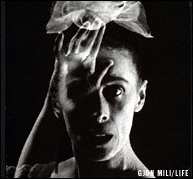 |
Martha Graham was born in 1894. In the 1920's she danced at the
Denishawn school of Ruth St. Denis and Ted Shawn, who were her forerunners in the
development of American modern dance. They had a lot of influence on Graham's ideas on
dance, for example in the way they used different dance traditions in their work to create
a new dance style. In 1923 Martha Graham left Denishawn, and started working as
choreographer of her own dances. She wanted to go further then Denishawn in creating a new
sort of dance. For Graham, modern dance in the 1920's was still too traditional and
`romantic'. Martha Graham developed a new dance-technique, and new ideas about dancing.
But in this essay I want to examine more the outer aspects. In what way did she make
modern dance more popular during the 1930s? In different ways her dances reflected
American society in the thirties. First it is important to look at Graham's forerunners in
the 1920s.
2. MODERN DANCE IN THE 1920S
Modern dance began on the east and west coasts of the United States: with Isodora Duncan,
Loie Fuller, and Ruth St. Denis. The first modern dancers revolted against the classical
ballet, which was considered European, and high culture- performance.
Isodara Duncan was, around the turn of the century, the first dancer and choreographer who
tried to change American dance. She looked at primitive dances and other cultures for
inspiration. She thought these different styles in dancing had something the European
Ballet did not have. She also used more popular sorts of dance, like tap, and jazz-dance.
With all these different influences from different cultures Duncan wanted to create a new
style. Although she was very successful, she only became popular in Europa, and not in her
native country. "Her career far remained oriented toward Europe and European
taste" (Macdonagh, 21).
The Denishawn company was developed by Ruth St. Denis and Ted Shawn, and during the 1920's
it was the chief dance force in the United States. Denishawn schools were established
across the country and the company toured in the United States and abroad. The second wave
of theatrical dance grew out of the Denishawn-school. Martha Graham, Doris Humphrey, and
Charles Weidman all left Denishawn a few years after one another, and started making their
own choreographs. Their work reflected the influence of the Denishawn school. Yet during
the 1930s they developed their own direction in modern dance. Rebellion against the exotic
romanticism of the Denishawn company was to be a major thrust of the modern dance
movement, and Denishawn was formally disbanded by the end of 1931. Modern dancers in the
1930s wanted to reach more people. They wanted to create dance as an art form, but it had
to be for the people.
3. RADICALISM AND SOCIAL REALISM
"What made the new dance `modern' was its subject matter and, along with its
revolutionary stance on stage, its progressive positions off the stage. The issues of the
Spanish people's fight against fascist takeover (1936-1939) and the worker's movement in
the United States were linked by an overarching concern for the lower ranks of
society" (Wheeler, 34). In this way it is comparable to other forms of art in the
1930s. Especially the theatre plays in these years showed a concern for social and
political issues. Dance, as a theatre art, could do the same, but is was more in a
symbolic, abstract way, since it was mostly non-verbal.
As was the case in general with `the fervent years' of the thirties, modern dancers
zealously supported unified group action as the key to humanity's struggle against
oppression, be it economic or military. Socialism also was alluded to in much of the
choreography of the period through the New Deal Dance Progam, which was part of the
Federal Theatre Project. Although Martha Graham did not take part in this project, she was
influenced by the same ideas.
Her concerns for social issues were visible in Graham's earliest works. Martha started
creating her
dances in 1929, with the dances `Heretic' and `Sketches for the people', which were
studies for mass movement. Although they were apolitical, they had a clear social message.
Some of her works were political. Between 1936 an 1939 she showed her support for the
Spanish in the Franko war. Graham's dances `Immediate tragedy' and `Deep song' were about
the Spanish war. The dances showed sympathy for Spain and commitment towards social
relevance. It meant Martha Graham's movement toward social realism.
Another subject was the support of the working man in Depression America. For some the
cause of the working man in America could not be divorced from the workers' revolution in
Soviet Russia. An example is the presentation of works of Martha Graham and other
choreographers in a concert sponsored by the International Labor defense. (Wheeler, 38) It
is not surprising to learn of modern dancers' general support for the labor movement and
of their treatment of worker's issues in their choreography, considering the fervor with
which they themselves sought dignity as workers. "Intrinsically bound up with modern
dancers" commitment to social and political statement was the disdain for the ballet
establishment, a disdain directed at the frivolousness of its concerns on stage, and at
the class of audience member capable of purchasing a high-priced ticket to support
"generously ballyhooed European artists" (Wheelder, 38)
4. PRIMITIVISM AND NATIONALISM
Some of Graham's works of the early thirties expressed a special interest in primitive
culture. In that period she made a trip to New Mexico and became interested in the
American Indian culture in that part of the country. She produced works like `Primitive
Canticles, `primitive mysteries' (), `incantation' and `Dolorosa' (all 1931), and
'ceremonials' (1932), in which she distilled a pre-Christian religious sentiment into
generally applicable terms. (MacDonagh, 31) She later began to develop a line of
choreography that dealt with the specifically American Mythic heritage. The first of these
works was `Frontier'.
There were various ways in which Martha Graham tried to express the American experience.
First of course in the subjects of the dances and the characters she created; they had to
be typical American characters. She tried to express this in the movements: the dancers
used for the public recognizable, symbolic movements, and everyday movements. But it was
also visible in the clothes and the decor. I want to show these elements with examples of
dances she created: Frontier (1935), American Document (1938) and Appalachian Spring
(1944). Frontier is one of the first dances with a typical American theme, and Appalachian
Spring is the last one; after 1944, she turned her interest to other subjects.
FRONTIER
Frontier was Graham's second direct exploration of the American theme. This dance, which
lasted only seven minutes, was a solo, danced by Martha Graham. `Frontier' used space
expansively. The solo figure in `Frontier' evoked the idea of a particular type of person,
the nineteenth-century pioneer woman, through her movement and her costume: Graham wore a
stylished version of a nineteenth-century homespun dress. (Thomas, 117). The movement was
outward-directed. In comparison with her dance `Lamentation' (1930), which was minimalist
and introspective, `Frontier' was positive and outward-going. It was the beginning of
Graham's development towards an integrated dance theatre.
This was the first time that she used decor, designed by the sculptor Isamu Noguchi. The
frontier post or fence was indicated by a short barrier of two horizontal bars at the
centre-back of the stage. "The setting evoked the vastness of the American landscape
before it was fully tamed by settlers. The sense of space that `Frontier' celebrated can
also be found in the structurally horizontal landscapes of nineteenth- century American
luminist painters such as Martin Johnson Heade and John F. Kensett" (Thomas 118)
AMERICAN DOCUMENT
Graham created a condensed history of the United States in the form of the theatrical
minstrel show tradition. This was perhaps the only time that she drew so heavily on the
recourses of popular entertainment for her art dance. It was a dance in six episodes:
`Entrance', `Declaration', `Occupation', `The Puritan', `Emancipation' and `Hold your
own'. The work witnessed the integration of costume, music drama and dance. In it, Graham
used the spoken word much more then in any other previous work. An interlocutor recited
passages from American history, such as the Declaration of Independence. "In the
Puritan episode, the interlocutor spoke alternate lines from the tongue-lashing sermons of
the new- England Puritan preacher, Jonathan Edwards, and from the sensuous `Song of
Songs'". (Thomas, 122)
APPALACHIAN SPRING
This work was not only well received in her time, but has also become a modern American
classic. The music for this dance was composed by Aaron Copland. "Simply stated, on
the surface level, Appalachian spring tells the story of a young couple being married and
taking possession of their newly built homestead". It is set in a small community on
the American frontier in the early nineteenth-century. The source of stability and support
in the small community is represented by an older pioneer woman. The wedding ceremony is
presided over by a Revivalist priest, who is accompanied by four girl followers. "The
focus is directed toward the moods and feelings of the central characters, their
strengths, religion, hopes, fears, and aspirations for the future in the newly settled
land" (Thomas, 145).
CONCLUSION
In various ways the dances of Martha Graham in the 1930s were influenced by the political
and social climate of the decade. Just as other artists in that period she had attention
for social issues, and sometimes she used explicit political issues, as in her support for
the Spanish fighting against fascism. In this way the 1930s, until the creation of
`Appalachian spring' in 1944 stand out as a different period in her career. After 1944 she
started using different subjects again, mostly from Greek mythology.
But the way in which her work in the 1930s was revolutionary, was the attention she paid
to the typical American situation, and the `American experience'. This made her famous in
America. And it also made modern dance more popular in America. For this reason she may be
called one of the most important pioneers of American Modern dance, a style of dance that
still has a big reputation in the United States, but also internationally.
BIBLIOGRAPHY
MacDonagh, Don, The rise and fall and rise of modern dance (New York, 1970)
Thomas, Hellen, Dance, modernity and culture. Explorations in the sociology of dance (New
York, 1995)
Wheeler, Mark, `New dance in a New Deal era', Overby, Lynette Y. and Humphrey, James H.
ed., Dance. Current Selected Research, vol. 2, 1990, p. 33-46. |
Return to Women in
History of Scots Descent Index
|



