|
On arriving at derby, Charles had sent forward a party on
the road to London to take possession of Swarkstone bridge, about six miles from Derby. Orders had been given to break
down his bridge, but before these orders could be put in execution, the Highlanders had
possessed themselves of it. The Duke of Cumberland, who, before this movement, had left
Stafford with the main body of his army for Stone, returned to the former place, on the
4th of December, on learning that the Highland army was at Derby. Apprehending that it was
the intention of Charles to march to London, he resolved to retire towards Northampton, in
order to intercept him; but finding that the young Chevalier remained at Derby, his royal
highness halted, and encamped on Meriden Common in the neighbourhood of Coventry.
Agreeably to a resolution which had been entered into the previous evening, the Highland
army began its retreat early on the morning of the 6th of December, before daybreak.
Scarcely any of the officers, with the exception of those of the council, were aware of
the resolution, and all the common men were entirely ignorant of the step they were about
to take. To have communicated such a resolution to the army all at once, would, in its
present disposition, have produced a mutiny. To keep the army in suspense as to its
destination, a quantity of powder and ball was distributed among the men, as if they were
going into action, and by some it was insinuated that Wade was at hand, and that they were
going to fight him; whilst by others is was said that the Duke of Cumberland's army was
the object of their attack. At the idea of meeting the enemy, the Highlanders displayed
the greatest cheerfulness; but as soon as they could discriminate by daylight the objects
around them, and could discover by an examination of the road, that they were retracing
their steps, nothing was to be heard throughout the whole army, but expressions of rage
and lamentation. Had it sustained a defeat, the grief of the army could not have been more
acute. Even some of those who were in the secret of the retreat, and thought it the only
reasonable scheme that could be adopted, could scarcely be reconciled to it when about to
be carried into effect.
Charles himself partook deeply of the distress of his men. Overcome by the intensity of
his feelings, he was unable for a time to proceed with the army, and it was not until his
men had been several hours on their march that he left Derby. Forced in spite of himself
to give a reluctant assent to a measure, which, whilst it rendered useless all the
advantages he had obtained, rendered his chance of gaining the great stake he was
contending for extremely problematic; his spirits sunk within him, and an air of
melancholy marked his exterior. In marching forwards, he had always been first up in the
morning, out his men in motion before break of day, and had generally walked on foot; but
in the retreat, his conduct was totally changed. Instead of taking the lead, he allowed
the army to start long before he left his quarters, kept the rear always behind waiting
for him, and when he came out, mounted his horse, and rode straight forward to his next
quarters with the van.
After the first burst of indignation had in some degree subsided, and then the men began
to speculate upon the reasons which could have induced the retreat, a statement was given
out that the reinforcements expected from Scotland were on the road, and had already
entered England, - that Wade was endeavouring to intercept them, - that the object of the
retrograde movement was to effect a junction with them, - and that as soon as these
reinforcements had joined the army, the march to London would be resumed. It was hinted
that they would probably meet these reinforcements about Preston or Lancaster. The
prospect this held out to them of a speedy advance upon London, tended to allay the
passions of the men, but they continued sullen and silent during the whole of the day.
The army lay the first night at Ashbourne. It reached Leek next day; but that town
being too small to accommodate the army, Elcho's and Pitsligo's horse, and Ogilvy's and
Roy Stuart's regiments of foot, went to Macclesfield, where they passed the night. The
remainder of the army came next day to Macclesfield, and the other division, which had
passed the night there, went to Stockport. On the 9th both divisions met on
the road to Manchester, and entered that town in a body. There had been considerable
rioting and confusion in Manchester on the preceding day. Imagining from the retreat that
the Highland army had sustained a reverse, a mob had collected, and, being reinforced by
great numbers of country people with arms, had insulted the Jacobite inhabitants, and
seemed disposed to dispute the entrance of the Highland army into the town; but upon the
first appearance of the van, the mob quietly dispersed, and order was restored. In the
retreat some abuses were committed by stragglers, who could not be prevented from going
into houses. As Lord George Murray found great difficulty in bringing these up, he found
it necessary to appoint an expert officer out of every regiment to assist in collecting
the men belonging to their different corps who had kept behind, a plan which he found very
useful.
It was Charles's intention to have halted a day at Manchester, and he issued orders to
that effect; but on Lord George Murray representing to him that delay might be dangerous,
the army left that town on the forenoon of the 10th, and reached Wigan that night. Next day the army
came to Preston, where it halted the whole of the
12th. From Preston the Duke of Perth was despatched north with 100 horse, to bring up the
reinforcements from Perth.
The prince arrived at Lancaster late in the evening of the 13th.
On reaching his quarters, Lord George Murray found that orders had been given out, that
the army was to halt there all the next day. On visiting Charles's quarters next morning,
Lord George was told by the prince that he had resolved to fight the enemy, and desired
him to go along with O'Sullivan, and reconnoitre the ground in the neighbourhood for the
purpose of choosing a field of battle. His lordship, contrary to the expectations of those
who had advised Charles to fight, and who supposed that Lord George would have opposed
that measure, offered no advice on the subject. He merely proposed that as the ground
suitable for regular troops might not answer the Highlanders, some Highland officers
should also inspect the ground, and as Lochiel was present, he requested that he would go
along with him, - a request with which he at once complied. With an escort of horse and
foot, and accompanied by Lochiel and O'Sullivan, Lord George returned back about two
miles, where he found a very fine field upon a rising ground sufficiently large for the
whole army, and which was so situated, that from whatever quarter the enemy could come,
the army would be completely covered till the enemy were close upon them. After surveying
these grounds very narrowly, and taking three of the enemy's rangers prisoners, the
reconnoitring party returned to Lancaster. From the prisoners Lord George received
information that the corps called the rangers was at Garstang, and that a great body of
Wade's dragoons had entered Preston a few hours after he had left it. His lordship
reported to the prince the result of the survey, and told him that if the number of his
men was sufficient to meet the enemy, he could not wish a better field of battle for the
Highlanders; but Charles informed him that he had altered his mind, and that he meant to
proceed on his march next day.
It is now necessary to notice the movements of the Duke of Cumberland and Marshal Wade. By
retaining possession of Swarkstone bridge for some time after his main body left Derby,
Charles deceived Cumberland as to his motions, and the Highland army was two day's march
distant from the duke's army before he was aware of its departure from Derby. As soon,
however, as he was apprised of the retreat, the duke put himself at the head of his horse
and dragoons, and 1,000 mounted volunteers, furnished by some the gentlemen of
Warwickshire, for the purpose of stopping the Highlanders till the royal army should come
up, or, failing in that design, of harassing them in their retreat. He marched by Uttoxeter and Cheadle; but the roads being excessively
bad, he did not arrive at Macclesfield till the night of the 10th, on which day the
Highland army had reached Wigan. At Macclesfield
the duke received intelligence
that the Highlanders had left Manchester that day. His royal highness thereupon sent
orders to the magistrates of Manchester to seize all stragglers belonging to the Highland
army; he directed Bligh's regiment, then at Chester, to march to Macclesfield, and, at the same time, ordered the
Liverpool Blues to return to Warrington, where they had been formerly posted. Early on the
11th, he detached Major Wheatley with the dragoons in pursuit of the Highlanders.
Meanwhile Marshal Wade having held a council of war on the 8th, at Ferrybridge, in Yorkshire, had resolved to
march by Wakefield and Halifax into Lancashire, in order to intercept the insurgents in
their retreat northwards. He accordingly came to Wakefield on the 10th at night, where,
learning that the van-guard of the Highland army had reached Wigan, he concluded that he
would not be able to overtake it, and therefore resolved to return to his old post at
Newcastle by easy marches. He, however, detached General Ogelthorpe with the horse to join
the duke. This officer crossed the Blackstone Edge with such expedition, that he reached Preston
on the same day that the
Highlanders left it, having marched about 100 miles in three days, over roads at any time
unfavourable, but now rendered almost impassable by frost and snow. At Preston, Ogelthorpe
found the Georgia rangers, and was joined by a detachment of Kingston's horse, commanded
by Lieutenant-colonel Mordaunt. Here these united forces halted nearly a whole day, in
consequence of an express which the Duke of Cumberland had received from London,
announcing that a French expedition from Dunkirk had put to sea, and requiring him to hold
himself in readiness to return to the capital. This information was afterwards found to
erroneous; but it was of service to the Highlanders, who, in consequence of the halt of
the royal forces, gained a whole day's march ahead of their pursuers.
In his retreat, the chief danger the prince had to apprehend was from the army of Wade,
who, by marching straight across the country into Cumberland, might have reached Penrith a
day at least before the prince; but by the information he received of the route taken by
Wade's cavalry, he saw that the danger now was that the united cavalry of both armies
might fall upon his rear before he could reach Carlisle. He therefore left Lancaster on
the 15th; but the rear of his army was scarcely out of the town when some of the enemy's
horse entered it. The town bells were then rung, and the word being given from the rear to
the front, that the enemy was approaching, the Highlanders formed in order of battle; but
the alarm turning out to be false, the army continued its march to Kendal. The enemy's horse, however,
followed for two or three miles, and appeared frequently in small parties, but attempted
nothing. The army entered Kendal that night, where they were met by the Duke of Perth and
his party. In his way north, the duke had been attacked in this town by a mob, which he
soon dispersed by firing on them; but in the neighbourhood of Penrith he met with a more serious
obstruction, having been attacked by a considerable body of militia, both horse and foot,
and being vastly outnumbered, was obliged to retreat to Kendal.
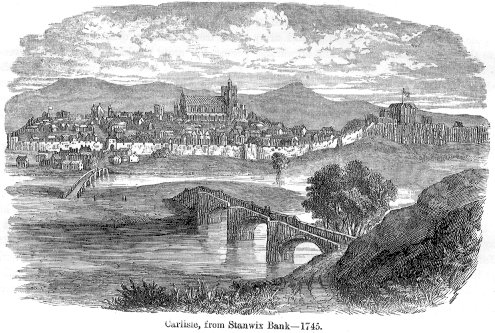
As Lord George Murray considered it impossible to transport
the four-wheeled wagons belonging to the army to Shap, he proposed to the prince to
substitute two-wheeled carts for them, and as he was afraid that no provisions could be
obtained at Shap, he suggested that the men should be desired to provide themselves with a
day's provision of bread and cheese. Orders were accordingly issued agreeably to these
suggestions, but that regarding the wagons seems not to have been attended to; and by some
oversight, the order about the provisions was not communicated to many of them till they
were on their march next morning. The consequence was, that the men who were unproved
returned to the town, and much confusion would have ensued, had not Lord George Murray
sent some detachments of the rear with officers into the town to preserve order, and to
see the men to the army. This omission retarded considerably the march of the army. The
difficulties which Lord George Murray had anticipated in transporting the wagons across
the hills were realised, and by the time he had marched four miles and got among the
hills, he was obliged to halt all night, and take up his quarters at a farm house about a
gun-shot off the road. The Glengarry men were in the rear that day, and though reckoned by
his lordship not the most patient of mortals, he says he "never was better pleased
with men in his life", having done all that was possible for men to do.
With the exception of the Glengarry regiment, the army passed the night between the 16th
and 17th at Shap. On the morning of the 17th, Lord George received two messages from
Charles, ordering him upon no account to leave the least thing, not so much as a cannon
ball behind, as he would rather return himself than that any thing should be left. Though
his lordship had undertaken to conduct the retreat on the condition that he should not be
troubled with the charge of the baggage, ammunition, &c, he promised to do all in his
power to carry ever thing along with him. To lighten the ammunition wagons, some of which
had broken down, his lordship prevailed upon the men to carry about 200 cannon balls, for
which service he gave the bearers sixpence each. With difficulty the rear-guard reached
Shap that night at a late hour. Here he found most of the cannon, an some of the
ammunition with Colonel Roy Stuart and his battalion. The same night, the prince with the
main body arrived at Penrith. Some parties of militia appeared
at intervals; but they kept at a considerable distance, without attempting hostilities. |



