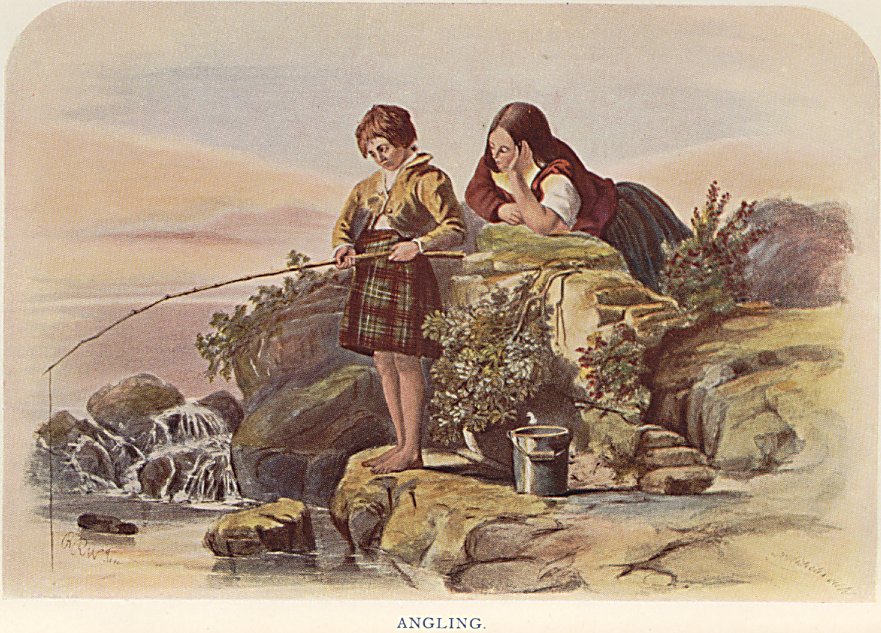
THIS sport has been denounced as a
cruel, unsocial, and foolish amusement, by many eminent writers—Johnson,
Byron, and others; but opposed to their opinion we have that of Walton,
the prince of anglers, a man of gentle and amiable nature, of Dr. Paley,
Sir Humphrey Davy, and a host of the distinguished and good. Certain,
however, it
is, that sensitive minds revolt at a pastime by which fish, guiltless of
committing any injury, as in the case of many land animals, are ensnared
and killed whilst harmlessly playing in their native element. The sport
may be well defended; but the unfeeling argument that neither the bait nor
the fish have the sensation of pain must be reprobated.
No creature is exposed so much to
the attacks of man as the inoffensive salmon. If it escapes the draught,
stake, and bag nets in the sea and lower stream, it is intercepted in
ascending by the impassable cruives, and should
it get upwards
during the ‘Saturday slap,’ when they are opened from twelve o’clock at
night until twelve next night, the devoted fish is pursued by the skilful
angler with his hook, and the poacher with his deadly trident. Indeed, so
greatly have salmon decreased in the Scottish rivers, as anglers are well
aware, that the Duke of Sutherland has just ordered them a year of jubilee
throughout his extensive northern estates; and if other proprietors do not
imitate so judicious an example, this will assuredly in time become one of
the rarer breeds of fish.
The salmon is called Bradan by the
Highlanders, and a trout is termed Breac, from its spots; and he who
angles is the lasgair, literally the fisherman.
The salmon, although properly a
sea-fish, is never caught afar off, but on the coasts adjacent to
the mouths of rivers. They are impelled to forsake this element
periodically, to get rid of vermin which attach themselves to the sides
under the fins; but ere they leave the streams, other parasites, in the
form of worms, fix themselves about the gills. The salmon possess the
wonderful instinct of undeviatingly returning to the river in which they
were spawned; but some cases have occurred in which, after floods, they
have mistaken their native stream, and been found in others, being easily
known by experienced fishers.
In making their way to the upper
streams for the purpose of depositing their spawn, they encounter
obstacles which it is surprising they surmount. After urging a passage for
many miles along the rocky channel of a rapid stream, a perpendicular
waterfall may present to the now greatly enfeebled fish, a formidable
impediment to their farther progress. The Keith, a fall on the river
Erich, in Perthshire, is a direct down pour of upwards of thirteen feet,
the water rushing through a gap of the width of a few feet only. In
seasons of drought, the channel is so ebb, that the salmon cannot attempt
the necessary leap, and they may be seen in the pool below, waiting, in
shoals two or three deep, the swelling of the waters. When the rain
produces a sufficient stream, the salmon then essay the arduous task, and
often do they leap before they get fairly a head, the falling water
dashing them back; but according to the height, they seem to calculate the
requisite force, and all at last get over the cascade. These falls are
called easan in the Highlands, and linn in the Low Country, which is the
Gaelic for the pool which they form. They occur on almost every stream,
and it is amusing to witness a shoal of salmon thus actively engaged. When
the spawning season is over, the fish pass down to the sea in a state of
such weakness as scarcely to be able to swim, even with the stream.
It is needless to give any
particular description of the tackle used in this sport, the least
expensive and perhaps the most easily acquired of all others. The rod and
line are known to almost every one; the manner of using them is, like all
other accomplishments, acquired by practice. An angler must have a
knowledge of the flies which are in existence at the different seasons;
and those found about particular streams, and the proper mode of busking
artificial ones on the hook, requires considerable skill.
No rivers are better adapted for the
enjoyment of nature and this exhilarating and health-giving amusement than
those of the Highlands. The Gaël, from early infancy, betake themselves to
angling, and at an early age become such adepts, that they will sometimes
hook and land salmon almost as big as themselves. Boys of ten or twelve
years of age have been known, in favourable streams, to kill upwards of a
hundred good trout in one day; and Coil, son of Mac Donald of Inch, a
youth equally expert with his gun as with his rod, has taken in the Spean,
which flows from Loch Laggan, six fine salmon before breakfast.
As the breed of salmon decreases, so
also does the size. The largest we recollect of late was one caught two
years ago in the Tay, which weighed forty-five pounds; but in that river,
which of all others in Scotland has produced those of greatest weight,
there have been taken beautiful fish of sixty and even seventy pounds.
Next to the majestic Tay, in this respect, ranks the beautiful Tweed.
Before the expedient of preserving
them in ice was adopted, salmon were generally boiled and pickled; the
Highlander kippers them, which is performed by cutting them open, salting
and drying them over wood or turf fires, and in this state they are to him
a convenient provision, as the bacon is to the Englishman.