 To
the rivers, friths, and lochs of Scotland, this excellent species of the
finny tribe resorts in great abundance, and the streams afford to the
angler the most excellent amusement.
To
the rivers, friths, and lochs of Scotland, this excellent species of the
finny tribe resorts in great abundance, and the streams afford to the
angler the most excellent amusement.
It was an early observation, that
among the Celtic race a prejudice to fish existed, and reference has been
made in modern times to its still lingering existence. In some old poems,
catching salmon is spoken of as a Highland sport, yet a proverb is
retained expressing something like contempt for those who feed on fish;
and certain it is that some writers of a former generation who visited the
Highlands, felt surprised to find that the trout, with which many streams
abounded, should not be molested by the natives. It is to be feared that
dire necessity, from their want of cattle and failure of their crops, has
since forced such prejudice to give way. Too happy would the hungry be to
carry home a load of trout, fattened in the moss-imbued waters of the lake
or burn.
The nature of all mountain streams
is well known: in winter and in spring they pour down in rapid torrents,
when the trout and salmon leave the sea, and urge, with amazing strength
and instinct, their passage to the upper parts, where they deposit their
spawn. Here they continue, until often they are left in numbers,
imprisoned in pools by the declining stream, thus affording a plentiful
and easy capture. The anti—game preserving ideas of the Highlander, lead
him to consider the taking of salmon little breach of moral propriety; yet
"black fishing," as it is called, is not only illegal, but lamentably
destructive to the brood of this valuable fish, as they are then foul, or
in their passage to the spawning ground.
Like all such exhilarating sports,
the young are greatly pleased when engaged in
it, and Highland
boys are often dexterous salmon spearers, even by day, when it is much
more difficult to strike a fish than by night, the usual time for
operation.
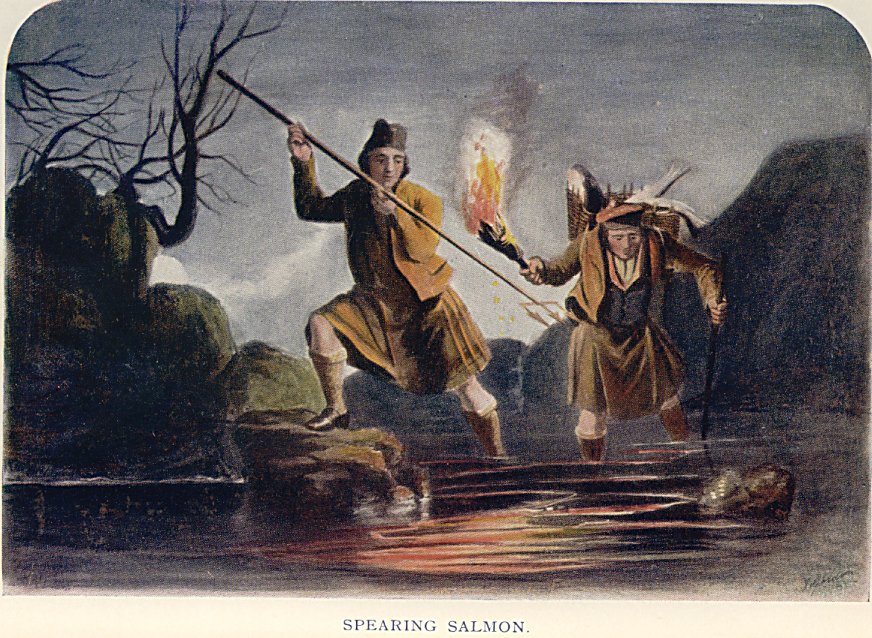
The scene represented was sketched
in Lochaber, where two men are seen busily engaged, but more may be
supposed present, as parties of ten, twenty, or thirty sometimes go out,
and pursue their occupation all night. They are generally men from a
neighbouring district, who are more likely to avoid detection; and as
those who engage in such pursuits are of determined character, no one who
values a whole head and unbroken bones would venture to molest them.
One man holds the torch, which is
composed of pieces of tar barrels, old ropes, bog fir, etc., and another
carries the instrument, which he can use with unerring dexterity; and a
company will sometimes be so successful as to carry off creels full of
fine salmon, sufficient to load several native garrons, or ponies.
The spear is called Muirgheadh in
Gaelic, but is otherwise named the leister, and, as shown in the print, it
is barbed, so that when the fish is struck its capture is sure. If the
spearman can approach so near as to transfix the salmon, he brings it up;
but the instrument is often thrown by a good marksman, with equal
certainty, and in this case it has sometimes a rope attached, to recover
it and the fish with facility. A man in Glenspean has been known to kill a
salmon nine times out of ten attempts, at a distance of forty yards. It is
best to strike at the head or middle, for if fixed by the tail, from its
great strength, the fish may give considerable trouble.
Spearing salmon affords a scene of
the most novel and striking description, the wild excitement of which must
be witnessed to be rightly appreciated. The picturesque effect of the
blazing torches on the darksome waters, on which are thrown shifting and
fantastic shadows, the lurid glare discovering the expected prey—the sound
of the rushing stream in the gloomy night—the splashing of both men and
salmon, with the shouts of laughter as some poor fellow, intent upon the
sport, slips over a stone into a sullen pool—the occasional dash of a
heavy fish as it springs from the water through the legs of the spearman,
altogether form a picture of the strangest character to the eye of one
unaccustomed to the sight.
It is a scene the more interesting,
as among other effects of refined civilization, spearing salmon may be
among those things which once have been. This valuable fish has been
decreasing for years, and if the breed continue to decline in the same
proportion, experienced fishermen say it must, ere long, become extinct.
The salmon fishery, in a national
point of view, is highly important, and although numerous Acts of
Parliament have been passed to protect it, and various individuals, as the
late Sir Francis Mac Kenzie, of Gairloch, have exerted themselves in the
discovery of means for the safety of the spawn, the root of the evil has
not been reached. It is the new, and it is believed illegal, use of
bag-nets, introduced about twenty years ago, which is the chief cause of
this result; they are not only placed in rivers, but along the whole
coast, and their effect may be seen from the fact, that in this year there
arrived in London market, of grilse or young salmon, 5100 boxes
less than in 1846, which was itself one of the worst years of fishing ever
remembered.