ATHLETIC sports form one of the favourite pastimes of
people in a state of society similar to that of the Scottish Highlanders,
the inhabitants of mountainous countries delighting in the perils of
Alpine adventures and the trials of strength and hardihood. These are the
most congenial amusements to those of masculine, agile frames, and
impetuous spirits, and they greatly promote both mental animation and
warlike prowess.
The famed Olympic games, founded in
the infancy of Greece, and instituted for the display of feats of strength
and agility, were proudly supported through after ages. The Athletes were
professional exhibitors, but the most exalted personages also entered the
heroic arena, and often carried off the prize. The Olympiads bore a close
resemblance to the Bardic festivals still maintained in Wales, and the
competition gatherings so frequently held in the Scottish Highlands.
Indoor employments are less suitable
to the taste of a Gaël, than the invigorating recreations of the field,
yet, when not called abroad, some divertisement is naturally required to
alleviate the tedium of the evening hours, during the long and darksome
winter, in which he is enwrapt. For this he is well provided with many
amusing social recreations, some of which are unknown in the low country.
Mairi, nighean Alasdair ruadh, a poetess of high renown, who flourished
about 1620, tells us that "the game of Chess and the music of the harp—the
history of the feats of the Fingalians, with the relations of the
pleasures of the chase, were what the good son of Mac Leod loved."
The antiquity of Chess among the
Highlanders is proved by a curious discovery which was made in the Isle of
Lewis 1831 of a number of the pieces, antiquely carved from the tusks of
the Walrus, and a king-piece of similar workmanship found in the ruins of
Dunstafnage Castle, Argyleshire.
The love of gambling was
particularly observable among the ancient Gauls and Irish, for the latter
would lie in wait for any one whom they might induce to play, and the
former would continue the amusement, if the term can be used for so
serious an affair, until all being lost, they staked their freedom on the
chance and would thus place themselves in slavery!
The Cymro branch of the Celtic race,
so remarkable for the minute regulation of all their customs, did not
overlook the importance of manly exercises. From ‘Proberts Welsh Laws’ as
published in the Archaeology, the following among "the twenty-four
excellencies," which formed the proper education of youth, are given as
applicable to the present subject.
Feats of strength.
Wrestling.
Running.
Jumping.
Swimming.
Horsemanship.
Archery.
Fencing with sword and buckler.
Fencing with the two handed sword. Fencing with the double pointed stick.
Coursing with grey hounds.
Fishing.
Chasing birds.
Bardism.
Playing at Chess.
The first ten only are accounted manly, the others
being either "youthful" or "trivial."
The Quinquertium, or five principal
games at the Olympian festival were running, leaping, wrestling, throwing
the javelin and quoits. Among the Highlanders, are racing, leaping, the
running leap, much practised for its usefulness, wrestling, club and foot
ball, tossing the caber, throwing the hammer, putting or throwing the
stone, lifting a heavy stone, contests in swimming and many other feats of
sheer strength and agility. The weight of the stone, called clach-neart or
the stone of strength, which was to be lifted from the ground, was
sometimes very great, and it was frequently placed near the church and
sometimes in the Kirkyard, that the men might exercise their ‘vis inertia’
after the conclusion of religious service. One of this sort, named the
Puterach, remains near the Kirk of Balquhider in Perthshire, which the
strongest may boast having raised from the ground, breast high, which is
the trial, and he is accounted a muscular man who can do so.
Clach-cuid-fir was a stone of two hundred pounds weight and upwards, which
was to be lifted from the ground and placed on another four feet high at
least, and the youth who could perform this feat was forthwith reckoned a
man.
It is judicious
in several respects
to encourage national sports and pastimes, especially when they are of a
manly and invigorating character. It affords pleasure to the tenantry who
are excited to a generous rivalry, and circulates money in localities
where it is sometimes of great use. We accordingly find throughout
Scotland, numerous associations for promoting competition in these
exercises, supported by the nobility and gentry. Besides the Highland
Society of London and its branches, the chief objects of which, are the
encouragement of Language, Literature, and ancient Music, and that of
Scotland, which is principally devoted to Agriculture, the following may
be enumerated as more particularly engaged in the patronage of athletic
games. The Celtic, the Bannockburn and Stirling, the St. Fillan, the
Athol, the Braemar, the Strathearn, the Glasgow, the Perth, the Dunkeld,
the Fort William, the Dornoch, established by the Duke of Sutherland, the
Holyrood and the Roslin Gymnastic, the Heather Club of Edinburgh, and the
St. Ronan on the border.
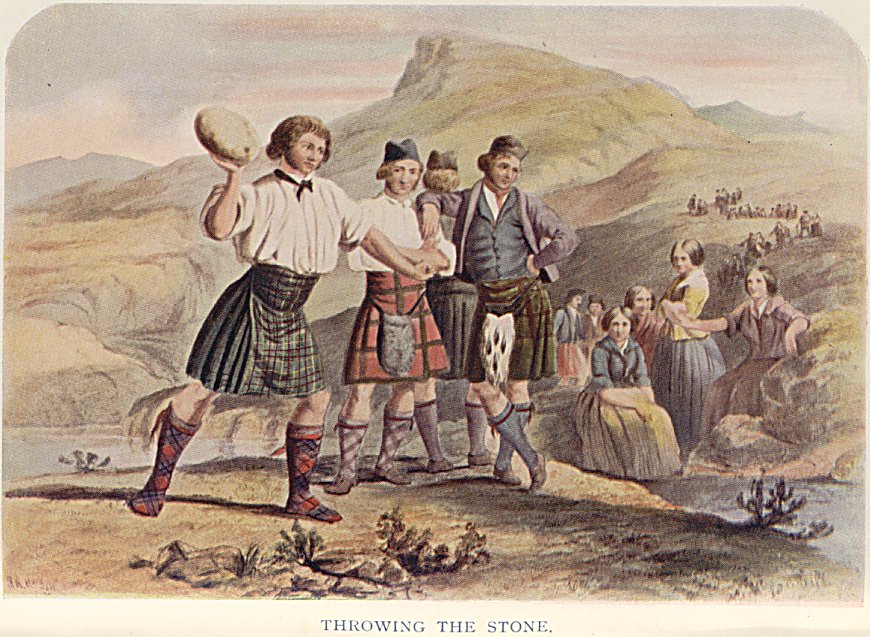
In the game here illustrated which
is called Putting, two sorts of stones are used, the light and the heavy.
The first is about sixteen pounds in weight, the latter from twenty to
twenty-four pounds; but the regulation differs in several societies.
Sometimes a few paces run is taken to increase the impetus. We have seen a
stone of twenty-two pounds thrown a distance of thirty—three feet, but
it is often
propelled considerably farther. The prizes are sometimes in money and at
others in dresses, swords, dirks, powder horns, brooches, snaoisin mulls
or snuff horns, medals, etc.