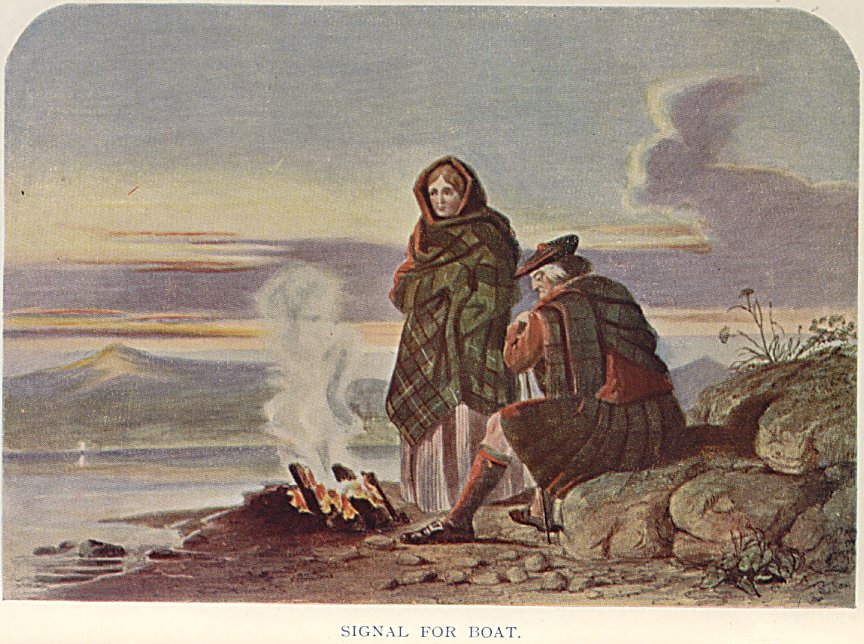
ONE of the great inconveniences of a Highland and
insular life, is the necessity in traversing the country for crossing
rivers, lochs, and arms of the sea. The state of the weather renders this
frequently impossible for some length of time; rivers become swollen,
lochs and seas are in tempestuous agitation during a great part of the
winter, the inhabitants of remote places consequently suffering at times
considerable privation from the stoppage of regular communication with the
mainland or more favoured localities. Should the weather, however, be
favourable for a passage, it is necessary to apprise the Fear a bhata, or
Boatman, on the opposite side, which may be a mile or more distant, that
his services are required by some weary traveller, anxious to reach his
destination. The hoisting a flag on a tall pole conspicuously fixed, might
well answer the purpose of a signal, but a more ready and natural
expedient is practised in the Highlands. Turf is found plentifully in
almost every part of the country, with which a fire is speedily got up,
the smoke giving the necessary notice.
In these days of universal improvement, the Highlanders
doubtless avail themselves of the use of chemical matches in the most
remote districts, but when this valuable article is not at hand, a light
is procured as in former times, from a neighbouring cottage, or a live
peat may be carried from some distance. It is otherwise obtained by the
sparks elicited from flint and steel, the back of a dirk, a sword, or the
flash of the powder from the lock of a pistol or gun. Those who possessed
a lens have used it during the warm days of summer to raise a fire by the
well known concentration of the sun’s rays.
There was much agreeable excitement in journeying
through the West Highlands in days of yore. It was then incumbent on the
tourist to engage a boat with able rowers to transport him from isle to
isle or across the numerous lochs or inlets of the ocean; horses and
guides were also to be procured, and in these ways a considerable amount
of money was left among the Highlanders, while the intercourse was in
other respects beneficial.
It is quite otherwise now that steam boats ply all
around. In these the travellers generally embark at Glasgow when bound to
the west and north, and they are carried to the far-famed Staffa, the
venerated lona, the Caledonian canal, and other places, where they are
allowed an hour or two to land and examine the natural and antiquarian
curiosities, which offer themselves to notice, and thus they pass through
the country, without perhaps leaving a shilling behind. The poor
Highlanders feel the loss of this source, whence a seasonable accession to
their scanty means was often obtained.
The boat fire is always made on the same spot, that it
may not be mistaken. It is generally kindled on a projecting point of
land, and when the smoke is seen ascending, the people on the opposite
side announce it to the ferryman, "Smuid suas!" the smoke is up, on which
the boat puts off to convey the awaiting passengers across their watery
way. The smoke, which it is desirable to render dense, is seen from a
great distance when the day is fine, but in wet and foggy weather the mist
which overhangs the water is embarrassing.
At night the brightness of the fire will render it the
obvious means of giving signal for a boat. "The warning flame" was the
primitive telegraph by which aid was requested and danger indicated, and
the same means are yet employed in military operations. The proper
distribution and management of "Bail fires" were regulated by Scottish
Parliament, and the proper time for the immortal Bruce’s descent upon
Carrick for the recovery of his kingdom, was indicated by the kindling of
a fire in a. certain place.
An affecting tale, in which we find the use of fire, as
the only mode of conveying information, is preserved in the islands of the
west.
St. Kilda, or Hirta, as it is called by the natives, is
the farthest inhabited islet in this range, and it has only one place
where a landing can be effected, while it is exposed to the unopposed fury
of the Atlantic Ocean. The people live chiefly on the sea fowl which
abound among the rocks, and with the feathers their little rent is paid.
To procure these birds the greatest perils are encountered, and loss of
life is often the result of the adventurous toils.
A boat had gone on one occasion to a precipitous rock
at some distance from St. Kilda, in search of the usual game, when
unfortunately the boat was dashed to pieces, while the crew got safe upon
the rugged isle. The storm increased, and here were the forlorn men
exposed to its severity with no means of escape, or any hope of relief
from their grieving friends, who could do nothing for their rescue or
ascertain their fate. In these afflicting circumstances the unfortunate
men lighted as many fires as there were survivors, and at night, when
these beacons were seen, and the number reckoned, night by night, the
people of St. Kilda knew, by this device, how many had been saved, and
until the weather moderated so that assistance could be sent to take them
off their sea-girt prison, they contrived to subsist on such fowl and fish
as could be procured.
The artist has sketched a man and woman, waiting the
arrival of the boat for which they have raised the smoke, the well-known
signal, which has been obeyed. In cold weather the fire is agreeable, if
the party has long
to wait, and there is usually a quantity of fuel
prepared for use, as necessary for the working of this Celtic Trajectus,
which is sometimes maintained at the expense of the landed proprietor or
surrounding gentlemen.