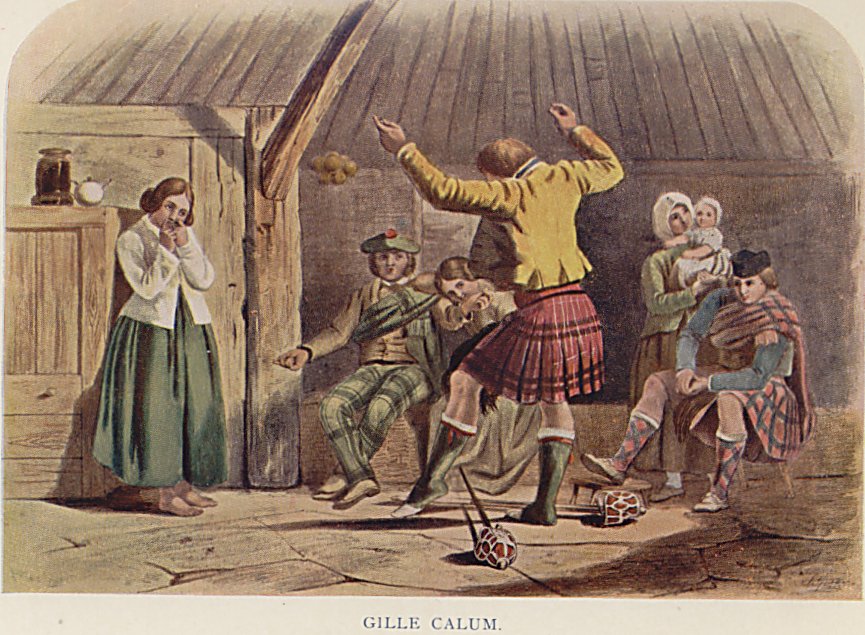
THIS dance so popular in the
Highlands is more properly the Sword Dance, a performance which requires
great agility and admits of considerable grace in its execution.
Dancing is one of those beautiful
exercises and agreeable amusements in which all nations indulge. The
savage, with whom it is either a matter of enjoyment, a defiance to the
foe, or incentive to fight, enters into the wonted evolutions with the
same spirit, and threads its maddening mazes, with as much punctilio, as
the accomplished performer of the grave minuet and the more exhilarating
waltz.
It is deemed by many of the more
austere to be unbecoming the composure and good sense of civilized
mankind, if not morally reprehensible, to engage in dancing; but we have
the example of no less a personage than Socrates, who in his advanced life
addicted himself to the practice, and to one who, having found him so
engaged, expressed surprise at the philosopher’s levity, he answered,
that, were his friend to know how much pleasure and advantage in point of
health were derived from the pastime, he also would learn the art.
Dancing was a part of religious
worship among ancient nations, and it is introduced in the ceremonials of
some modern people. We find King David dancing with joy and gladness
before the ark of the Lord. On the escape of the Israelites from Pharaoh,
Miriam, the sister of Aaron, went out, followed by all the women chaunting
with timbrels and with Dances, a solemn song of praise for their
deliverance, and the daughters of Shiloh danced in an yearly feast of the
Lord.
With the Greeks and Romans it was a
principal part of worship, and the Welsh were accustomed to form a dance
in the churchyard on the conclusion of service.
There is, perhaps, no people who
take more delight in dancing than the Gaël, both of Scotland and Ireland.
It is indicative of a strong musical genius and buoyancy of spirits, for
they will resort to it as a recreation after the hard labours of the day.
The figures and steps are admirably adapted to the national music; the
Jigs of the one, and the Reels and Strathspeys of the other being well
known characteristics of the two countries.
The effect of Scottish dancing is
very much heightened by the picturesque costume, as well as the manner of
using the arms by the men, and knacking the finger and thumb, with an
occasional shout of exhilaration in unison with the notes, which we think
peculiar to Scotland. The steps and passes are varied, and in many cases
elegant, generally requiring great agility to be well performed.
In variety, they are a contrast to
those of Ireland. George IV. on witnessing some of the reeling, at the
Ball given in the palace of Holyrood, 1822,
repeatedly expressed his applause by clapping
his hands; and our excellent Queen orders the native dances to be gone
through, not only in her visits to the Highlands, but at all Court Balls.
Military dances have been in
practice among most nations of antiquity, and are found with those who
still retain their primitive manners. The Indians exhibit with fervent
enthusiasm that striking scene in savage life, the wild war dance, and the
Greeks, so highly refined, joyed in the Pyrrhic, in which the actors
clashed their swords and bucklers in imitation of a combat.
The Gauls and their descendants, the
Caledonians, doubtless, had similar warlike excitements. The Highlanders
have the Dirk Dance now almost forgotten, and the Sword Dance, known all
over the country, as ‘Gille Calum,’ from the name of the tune by which the
movements of the performer are regulated, but it has no relation to the
performance itself, being simply the name of a man, about whom some
unimportant verses are repeated.
The air played to the dancer does
not appear to have been uniformly the same, different districts having had
particular compositions; in Perthshire, the tune was called ‘Mac an
Rosaich,’ being of that grave description called ‘Port.’ Its original
name, it would appear, was ‘Mac an’ orsair,’ which, with the mode of
dancing, General Stewart of Garth tells us, has disappeared; but he had
seen it executed by some old men.
As now performed, two naked swords
are laid across each other on the floor, and the person who dances, moves
nimbly around them, dextrously placing his feet by a peculiar step in the
intervals between the blades, at first by a single step, but as he
proceeds the movement becomes rapid and complicated, exciting a dread in
spectators lest he may wound his ancles. The object is to avoid the
blades, as the dance is broken should either be touched ever so slightly.
This is the Sword Dance as now
performed, which does little more than shew, like those of several other
nations, its martial origin. As danced by old men, according to
descriptions I have received, it was more in character, for in the course
of the dance they took up the swords and made certain flourishes as if
engaged in fighting or defying an enemy.
It was also appropriately called ‘
an Baiteal,’ or the Battle Dance, and was performed by thirteen persons at
Perth in 1633,
before King Charles. In Rolt’s life of the Earl of
Crauford, Colonel of the 42nd Highlanders in 1739, we are told, that "he
performed in a noble way the Highland dance habited in that dress, and
flourished a naked broad sword, similar to the Pyrrhic dance. He performed
before the King and full court, also before a grand assembly at Cormorra,
in Hungary, in the costume of that country."
‘Gille Calum’ has not certainly been
improved by the loss of this variation, which would give so much effect
and character to an interesting relic of the ancient Gaelic manners.
The figure in the illustration
dances to the music of the Jew’s-harp, a simple instrument which the
Highlanders play with great effect, and for excellence in which prizes
were formerly bestowed. An old man whistles as an accompaniment.