The night was very dark, but from the deepest of the
darkness, the shadow of the trees on the opposite bank, came the sounds of
the dragging of the nets and the handling of the boat, by men who spoke not
a word. Suddenly, the two young men broke the night air with their challenge
across the river, "Who the hell are you?"
They could get no answer, and then they blazed with their
guns, with the unfortunate result that three at least of the offenders were
peppered with shot. One, a very decent man called John Fraser, was shot by
thirty or forty pellets over the head and face, and he was injured in the
left eye so severely that the eye had to be removed, and there was a danger
to the other eye, and so of complete loss of sight. The circumstances were
these.
Two sons of an American millionaire had fired by night at
a party of Scottish gamekeepers, peppering them well and blinding one to the
loss of one eye and to the danger of another. On this kind of superficial
view, Scotland was ablaze with the wrath and Mr Phipps’ two sons, who were
implicated in the transaction, were arrested.
Behold then a telegram! It was from my clerk asking
whether I would accept a retainer for the two young millionaires. It may
give people some idea of the efficiency of Scottish criminal justice when I
mention that the offence was committed on July 5th of the year
1905, and the investigations were complete and the trial took place at the
High Court in Edinburgh in the following month, the trial taking only one
day and concluding on the evening of August 29th.
The case was as follows. The Phipps family who had
Beaufort Castle for about eight years, were tenants not only of the shooting
but also of the right of angling on the River Beauly. This fishing was one
of the finest in Scotland, and the right over one or two pools cost Mr
Phipps Senior, over £2,000 per annum.
One evening his two sons, strong and handsome specimens
of vigorous manhood, heard voices on the river and they suspected some
outrage was being committed — that, in fact, this valuable fishing pool,
known as "The Silver Pool" outside the very windows of the castle, was being
dragged with nets. They accordingly rallied forth armed as described, by way
of the gun room and to the river bank.
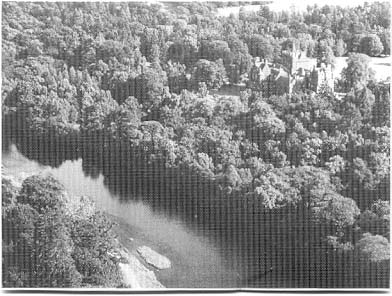
Beaufort Castle
Mr Phipps Senior asked me to come to Beaufort Castle—and
this I did so as to see for myself the place of the affray. I went to that
most beautiful residence on the banks of the River Beauly, and there I was
conducted from the hall, down the stairs to the gun room. I then was told
that it was from this gun room that the two young gentlemen, having heard
sounds of dragging salmon in the river, had emerged on the river bank, and
that each of them in passing through had taken his gun and a pocketful of
cartridges.
There was little else to see except the bank of the
river, on the opposite side of which a dark group of trees—which I might
easily conceive in the dim evening light would throw an extremely dark
shadow—attracted my attention. It turned out that it was in that very shadow
that the shooting took effect.
The next part of the story is peculiar. There turned out
to have been six men engaged in the operation of dragging the pool. Who were
these men?
It sounds incredible, but they were actually the servants
of Lord Lovat, the proprietor of the river and fishings and castle, and they
were engaged in dragging the pool in the river with nets, the angling on
which by rod yielded their master more than £2,000 of rent. But the wonder
does not stop there, for they were not poachers in the ordinary sense—that
is, for their own profit; they were all respectable men, and they were
deliberately dragging the pool so as to keep up the average of fish caught
in the river for the credit of the river and the estate, and the fish caught
in the net—forty in number in the last haul—were not sold for their own
profit, but they were taken and put into the estate account, number and
value complete.
As the situation developed before the Jury, the case took
a very different aspect as one might suppose, but still stranger things were
to happen…
As the trial proceeded, I shall never forget the entry of
Fraser, the injured man, into the Court. He was guided to the witness-stand
and gave his evidence perfectly quietly. It was my duty to cross-examine
him, and he in no way fenced. He was asked by me and afterwards by the Judge
why he did not answer the call across the river. He admitted he knew it was
young Mr Phipps that called, that Mr Phipps had for years been his friend,
and that he was young Mr Phipps’ own fishing attendant.
But it then came out, as was by this time suspected, that
so far as concealment from the Phipps family was concerned, the whole matter
was literally a deed of darkness in which these men were engaged; they had
not hinted to anybody about the netting expedition.
The head keeper with five other men under his orders, of
whom Fraser was one, had proceeded to the river. Fraser’s position was the
humble one of having to obey his head keeper’s orders. Upon the keeper being
pressed for some kind of reason for his conduct, he put forward the theory -
for which there is a good deal in fishing circles to be said - that the pool
was too crowded with salmon to be in a healthy condition and that dragging
would do it good. The difficulty about this was that if it was to do the
pool good for angling they might at least have informed Mr Phipps or some
member of his family.
As it was the six of them began their operations, forty
fish were caught, and three men went off with the forty fish to the nearest
ice-house, and three were left, one of whom was Fraser, another Robertson,
and a third whose name I forget.
When the young gentlemen emerged on the river side, they
went to the waters edge, called across, and getting no answer, fired.
This seems very dreadful, but the defence adopted the
line, which the Bench accepted, that the number of shots indicated no desire
to injure but merely to scare the men from the river, and Lord Ardwell on
the Bench charged the Jury that scaring in that sense was a good means of
getting poachers to abandon their enterprise and leave their nets, which
could then be impounded. All this was a difficult line of legal country; and
one had to pick their steps with care.
The next fact - a somewhat crucial one - now emerged. The
ordinary breadth of the river at the point of fishing was a hundred yards,
and to fire across that distance with an ordinary fowling piece would have
been a noisy and innocuous proceeding. The river, however, was very low, and
as it happened, at that particular point where the accused emerged from the
door of the castle on the river bank, its breadth that evening had narrowed
to a space of forty yards. In the dark the men had advanced on to the
water’s edge before they fired, and the case was that their firing was a
scaring operation, and that there was no real recklessness about it, as the
assumed breadth of the river would have made the whole proceeding harmless…
[Ed: According to two independent sources in
Beauly, the building next to the Lovat Estates Office, acquired by the
Phipps family, was subsequently donated to the town. Known as the Phipps
Institute, it serves as a community hall and library.]
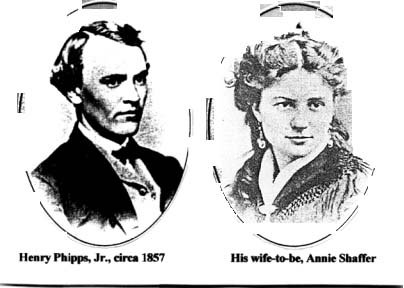
Henry Phipps & his future bride
Henry Phipps (1839-1930) was a capitalist and
philanthropist. Henry Phipps, Jr., the son of master shoemaker Henry Phipps
and his wife Hannah, from England, was born in Philadelphia, Pennsylvania on
27 Sep 1839 and grew up in Pittsburgh. In 1845 the Phipps family moved to
Allegheny City, PA where they became next-door neighbours of the Carnegie
family from Dunfermline, Fife, Scotland. Henry started as an office boy in
Pittsburgh and formed a lasting friendship with Andrew Carnegie (1835-1919),
then also an office boy.
Phipps became a partner of Carnegie in the development of
iron and steel manufacture and contributed to their association, the
financial genius to raise and control the capital necessary to their
progress.
On 6 Feb 1872, Henry Phipps married Anne Childs Shaffer,
the daughter of a Pittsburgh manufacturer, by whom he had three sons and two
daughters. Like Carnegie, Phipps became a well known philanthropist. He
amassed $100 million and gave $7 million to charity. He retired in 1900 with
more than forty million dollars and divided much of his estate among his
three sons in 1912. Jay, his eldest son, built Westbury House on Long Island
[American Heritage, November 1987, Rich Kids, by Barbara Klaw and
Halcyon Days, by Harry N. Abrams, chronicle the lives of the young
Phippses]. Westbury House and gardens are now open to the public.
Henry Phipps died 22 Sep 1930 at his estate "Bonnie
Blink" in the Lakefield section of Great Neck, Long Island, survived by his
widow, nee Anne C. Shaffer; two daughters, Mrs. Frederick Guest and Mrs.
Bradley Martin, and three sons, John S., Henry C., and Howard Phipps. He was
buried on Sept 24th at Westbury, L.I. (Protestant Episcopal
Church of the Advent).
Thanks to Marie
Fraser, Clan Fraser
Society of Canada for this article.



