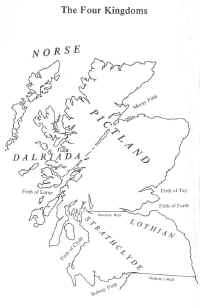
The raw materials from which Scotland was
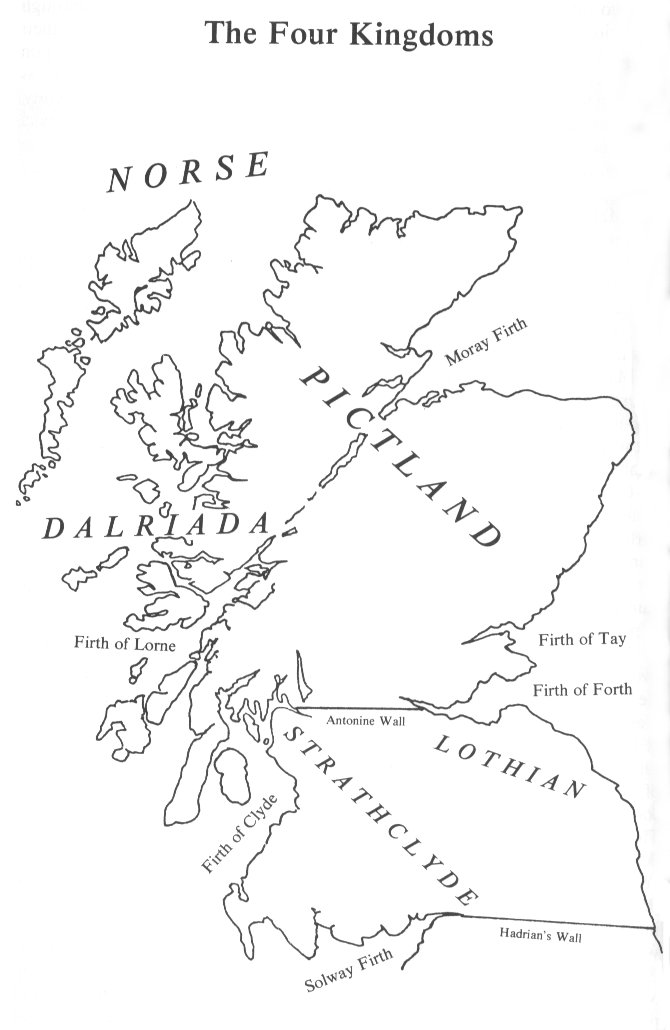
constructed were three Kingdoms - Pictland, Dalriada and 'Strathclyde' (as
the northern lands of the Britons came to be known), with the addition of
outlying parts of two larger kingdoms - Lothian (the part of English
Northumbria which lay between Tweed and Forth); and the Hebrides, the
Western Isles, which were part of the great sea borne empire of the
Norwegians.
Pictland was the largest of the Kingdoms
and, one would have thought, the most populous and powerful. But the Picts
had had the ill-fortune to be victims of attacks by all their neighbours
at one time or another.
Their resistance to the encroaching Scots,
and the defeat which the growth of Dalriada implied, must have contributed
to the weakening of Pictish power. As if the Scots were not problem
enough, the Picts were later the target for English incursions. They
proved strong and resolute enough to destroy the English threat for many
years to come by winning, in 685, the great battle of Nechtansmere at
Dunnichen near Forfar. The most deadly blows to the Picts however, came
from the greatest fighting force in Northern Europe - the Norsemen or the 'Vikings'.
Sometimes the Vikings came as raiders,
sometimes as settlers, and the grip which they established around the
northern extremities of Britain and its adjacent islands was so strong and
enduring that in place names and surnames the memory survives to this day.
The towns and villages of Caithness - Scrabster, Lybster, Ulbster - bear
names which testify to their Norse antecedents. Sutherland was 'Southern
land' to the men from the North; and throughout the Hebrides place names
ending in '-bost' or '-nish' or '-val' tell us that the Vikings lingered
here. Among the people of the Western Isles to this very day, Norse
surnames ending in '-son' are fully as common as Gaelic 'macs'.
All through these northern and western
seas, firths and lochs prowled the Norse galleys, bringing at one time
civil and good-humoured trade, at another permanent settlement and
frequently destruction and slaughter. 'From the fury of the Northmen O
dear Lord deliver us,' was one prayer long-used along the western shores.
The Norse were pagan during the early years of their marauding, and
churches and churchmen suffered cruelly at their hands - or at least
feared they might. This fear undoubtedly prompted the departure from Iona
of many of its people and the transfer of relics, treasures and religious
focus from Iona to, especially, Dunkeld, in Perthshire and even to Kells
in Ireland.
The Britons of Strathclyde and the Scots
alike had learned to flee from the raven banners, but the brunt of these
attacks was borne by the Picts. In 839 they suffered a particularly
disastrous defeat at the hands of the Norsemen, and the King of Scots,
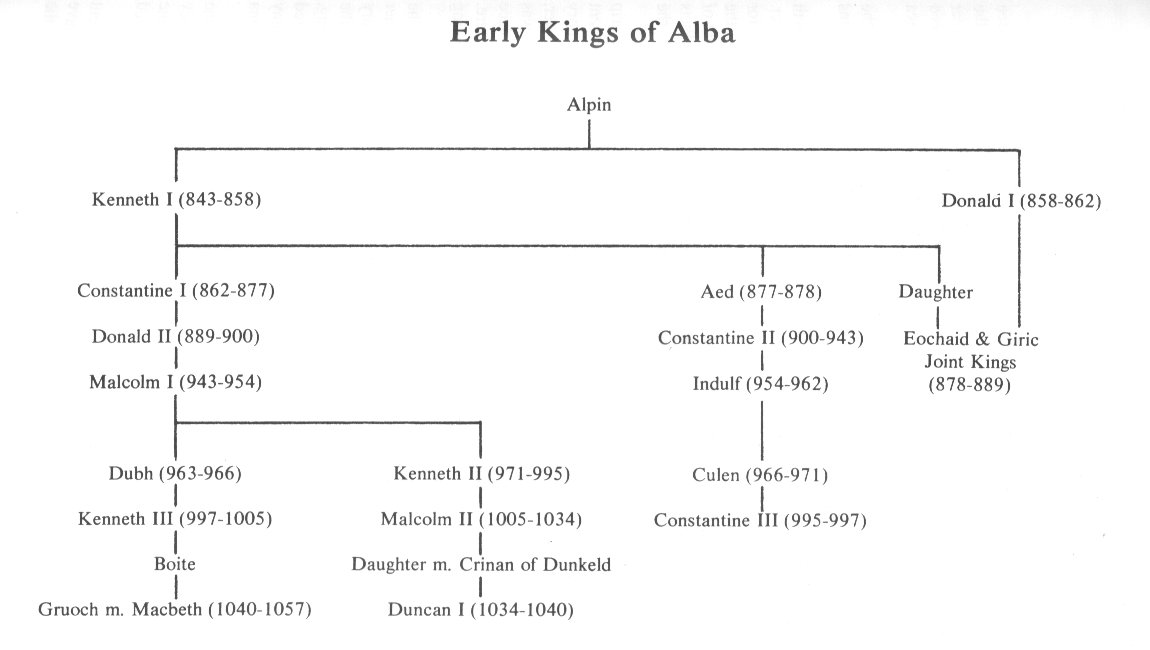
Kenneth MacAlpin, took the opportunity to attack the afflicted Picts and,
by 843, make himself their King.
It is possible - even probable - that
Kenneth was in the line of descent from Pictish kings, as inter-marriage
linking the two royal lines appears to have happened on numerous occasions
over the generations. It is probable that the role of Kenneth has been
emphasised rather more than it should, but the tradition which has come
down through centuries, that he was the first king of a united Pictland
and Dalriada is unlikely ever to be entirely rejected.
Another tradition, perhaps ill-founded but
none the less interesting, tells us that kingship among the Picts did not
pass from father to son, but from a deceased king to the son of a sister -
his nephew, or to the son of his mother - his brother. In other words,
though men ruled in Pictland, their eligibility to rule depended upon
their female parentage. Such a custom, though exceedingly uncommon, was
not unknown elsewhere; and it is not to be dismissed as absurd. On the
contrary, only by some such procedure could kingship be kept, beyond any
shadow of doubt, in a royal line. There is, after all, never any possible
doubt (other than in the event of deliberate deception) as to the identity
of a child's mother, whereas the identity of the other parent has to be
taken on trust.
Certainly the passing of the crown back and
forth seems more regular than would justify the alternative explanation of
feud and murder.
At all events, in 843 Kenneth emerges as
first beyond doubt king of a united Scottish/Pictish kingdom, Alba, which
has been described as 'the only kingdom of significance in the otherwise
fragmented Celtic world.'
Just as we must doubt that the union of
Picts and Scots was effected in such a tidy, swift fashion, so also the
traditional explanation as to how this new kingdom came to absorb lands to
the south, as far as the present Scottish border, is not quite the whole
story.
In the east, south of the Forth, lay
territory under the control in theory of the English Kings of Bernicia,
later part of the powerful kingdom of Northumbria. But these lands between
Tweed and Forth, were at the outer limits of Northumbrian power. That
power was in any case weakened from time to time by wars and divisions
among the English kingdoms and principalities. (Centuries later the Scots
amused themselves by jeering at the English on the grounds that Scotland
had been a united country at a time when England was divided among seven
kings.) As a result kings of Scots, from time to time, were able to
exercise power and authority in the area which was beginning to be known
by its own particular name - Lothian.
In 1018 England, which had achieved a
degree of internal unity but had then suffered the conquest of its
northern half by the Danes, found itself at a disadvantage when the
Scottish king Malcolm II, took his army across the Tweed and defeated the
army which the English from the Tyne and Tees valleys mustered against
him. This Battle of Carham proved more final than might have been
expected, and the eastern border between England and its northern
neighbour, remains today, along the River Tweed.
In the west, the kings of Alba came to
exercise increasing domination over the British kingdom of Strathclyde or
Cumbria. It seems to have been the custom for the kings of Alba to appoint
their chosen successors to be, in title, kings of Strathclyde, but in a
position of dependence upon the larger kingdom. Malcolm II appointed his
grandson, Duncan, King of Strathclyde, but Duncan, largely by chance, was
also the sole real contender for the crown of his grandfather. So, in
1034, Duncan, King of Strathclyde, inherited the throne of the larger
kingdom also, and the ancient British kingdom was incorporated into a new
united monarchy with its border placed at least as far south as the Solway.
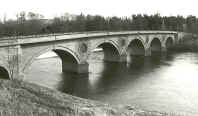
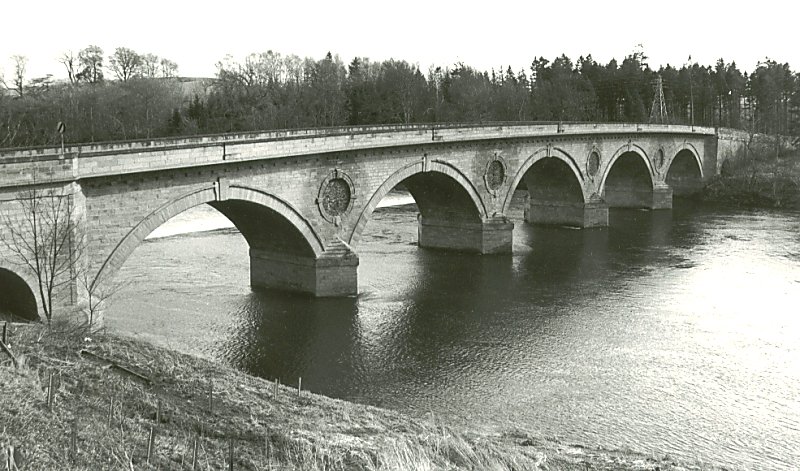
The Tweed Bridge at
Coldstream links Scotland and England. (Photo: Gordon Wright)
Thus by 1034 we can begin to speak of the
kingdom of Scotland, and picture it as having virtually the border which
exists today. The only lands which remained to be brought under the
Scottish crown were the islands and parts of the Scottish mainland where
the Norse still ruled.
A united country, such as might be expected
in modern times, was hardly to be looked for in the eleventh century.
Unity shows itself in easy and competent administration by rulers whose
orders are obeyed, and whose plans are implemented. But administration
could not be easy when instructions had to be carried by individuals from
one point to another, when the swiftest means of transport available was a
horse; when there was nothing equivalent to a police force making travel
reasonably safe, and when the ultimate power - armed force - was available
not just to the king, but to many of his subordinates as well. Also, it
was not so easy for the Scottish kings to establish and assert their
superiority over all others in the realm as it was, for instance, for the
kings of England after 1066. In that year, by right of conquest William I
was able to claim possession of the totality of English land, which he
could then re-allocate in return for service and good behaviour. The
Scottish kings never enjoyed this clean slate experience, but had, from
the earliest days, to maintain authority by their own abilities.
Then, in addition to these technical
obstacles to smooth government, there were recurring factional disputes.
From the earliest days of full Scottish unity - the beginning of Duncan's
reign in 1034 - this basic disunity was revealed, with the challenge to
Duncan's title and his defeat and death at the hands of Macbeth. It is now
widely understood that Macbeth acted not as some sort of bandit chief, but
as the representative of one long enduring faction among the various
branches of the Royal family.
Two such branches had been excluded from
hopes of royal office through the various brutalities of Kenneth II and
his son Malcolm II, who made it their business to remove any rivals from
their path. Macbeth may have taken it upon himself to act as champion of
one of those excluded lines; and his strength was based on the lands of
that particular family in Moray and the north-east generally. This fact
suggests that the feud went far back even into the days of Dalriada, when
one family or tribe of Scots was long in competition with another.
Whatever the origins of conflict were, Macbeth did oust Duncan, and
reigned for seventeen not unsuccessful years, before his own defeat and
death at the hands of Duncan's son, Malcolm III.
Yet, the essential idea of unity remained,
and no claimant or rebel was bent upon dismantling the Scottish kingdom as
it had come to exist. Scottish unity was, by modern standards, no doubt
less than perfect, but it was as genuine and as effective as the unity of
any other kingdom at the time, where administrative problems were no less
difficult and the emergence of claimants to the throne no less frequent.
Malcolm III is most commonly known not by
his numeral but by a nickname 'Canmore'. This name, from the Gaelic Ceann
mor, is literally translated as 'big-head'. The term may have been used
because of his physical appearance, but it has sometimes been suggested
that the term may have been used in a symbolic sense, and really means 'great
chief', or implies 'great wisdom'.
Certainly Malcolm is usually thought of as
one of Scotland's great monarchs, though, when we examine the actual
events of his reign, we must wonder why. Perhaps his reputation stands
high simply because he was the first king to rule a united Scotland with
limits more or less those of today. Perhaps it stems from the fact that
his reign was long (1057-1093); but perhaps his reputation has gained from
the fact that he was on the throne when events and changes of great
importance occurred.
In terms of actual achievement there is
really little to enthuse over. With his two powerful neighbours - Norway
and England - he began on good terms. He owed his victory in Scotland to
Earl Siward's English army, after all, and gratitude towards England might
have been expected. His ties with Norway, or, at least, the Norse warrior
leaders with power in and near Scotland, were established by his marriage
with Ingibiorg, the widow of the great Earl Thorfinn of Orkney. But, if
Malcolm's plans were of peace and co-operation, they very soon began to go
wrong.
The throne of England passed from the
ancient royal house of Wessex, on the death of Edward the Confessor,
firstly to a king by appointment rather than by descent, Earl Harold of
Wessex; and shortly thereafter to the conquering Duke William of Normandy.
This conquest sent rightful claimants to the English throne into exile -
an experience with which some of them had been already familiar when
Danish kings ruled early in the eleventh century. The main claimant was
Edgar, who sought refuge with his two sisters, Margaret and Christina, at
King Malcolm's court. Malcolm must have been by this time (1068) a
widower, and promptly determined that Margaret should now be his wife. The
English refugees were in no position to refuse, and the marriage was duly
celebrated, probably in Dunfermline, which Malcolm had made one of his
most frequently used residences.
 All
sorts of consequences followed from the marriage. It obviously placed
Malcolm among the enemies of the new king and regime in England, with,
finally, disastrous consequences. In the meantime, and for the rest of his
reign, the influence wielded by Queen Margaret and her following was
profound. And, even after Malcolm's death, Margaret's influence endured,
as one after another, three of her sons followed Malcolm, their father, as
kings of Scotland. All
sorts of consequences followed from the marriage. It obviously placed
Malcolm among the enemies of the new king and regime in England, with,
finally, disastrous consequences. In the meantime, and for the rest of his
reign, the influence wielded by Queen Margaret and her following was
profound. And, even after Malcolm's death, Margaret's influence endured,
as one after another, three of her sons followed Malcolm, their father, as
kings of Scotland.
Malcolm was killed, together with his
eldest son, in 1093 by an English ambush as he was returning from a
military raid into England, and Margaret died within days of hearing the
news. In Scotland the throne was taken by Malcolm's brother Donald, whose
power was then challenged by Duncan, son of Malcolm by his first marriage,
who had been at the English court as a hostage for several years, but who
was now employed by King William II of England as a potential puppet king.
Duncan's power in Scotland was brief. He was acknowledged as King Duncan
II in May 1094, but was murdered in November of the same year, enabling
power to pass to his uncle, Donald III, who enjoyed the support of the
eldest surviving son of Malcolm and Margaret, Edward. The younger children
of Margaret once more sought refuge in England, and it was the turn of the
eldest of those refugees, Edgar, to be the new client of the English king.
In 1097 an English army defeated Donald and Edward and placed Edgar on the
Scottish throne. Donald was blinded and imprisoned for life, while Edward,
perhaps as a virtual prisoner, ended his days as a monk far in the south
of England.
So Margaret's son Edgar reigned; and after
him his younger brother Alexander, and, after Alexander, the youngest
brother David. All three - especially perhaps, David - were very much
their mother's sons, and Queen Margaret's influence, through them, left
permanent marks upon Scotland.
Margaret is remembered particularly for her
concern for religion and the church. Twice, at least, events in Europe had
created a breach between the continent and the outlying islands of Britain
and Ireland. The English, on their first coming, were pagan, and the
Christian leaders in Ireland and in the various kingdoms of Scotland, were
cut off from direct access to Rome and the papacy.
Later, unbroken Roman supervision of the
church from central Europe to Ireland, was shattered once more by the
success of the pagan Danes who by the ninth century had conquered the
north and midlands of England. So, once more Ireland and Scotland had been
left to some extent to develop away from close and regular contact with
the controlling centres of the church in Europe. Naturally over the years,
little local peculiarities crept in, and ideas and practices unknown to
Rome evolved in Scotland.
Margaret was a cosmopolitan. By blood a
daughter of the English royal house, she was born while her parents were
in flight from the Danish kings (who once more, briefly, controlled
England in the early eleventh century) and had found refuge in Hungary,
recently Christianised by St. Stephen.
In the atmosphere of enthusiastic piety
inevitably following this experience, Margaret grew up; and her adult life
was dominated by her preoccupation with Christian work and order.
To her, the various differences which she
found among the clergy in Scotland were unacceptable, and she made it her
business to restore the church in Scotland to the full observance of Roman
authority. Her models and guides were men of
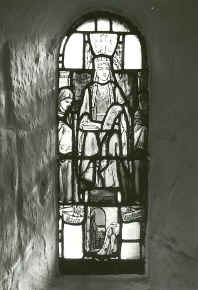
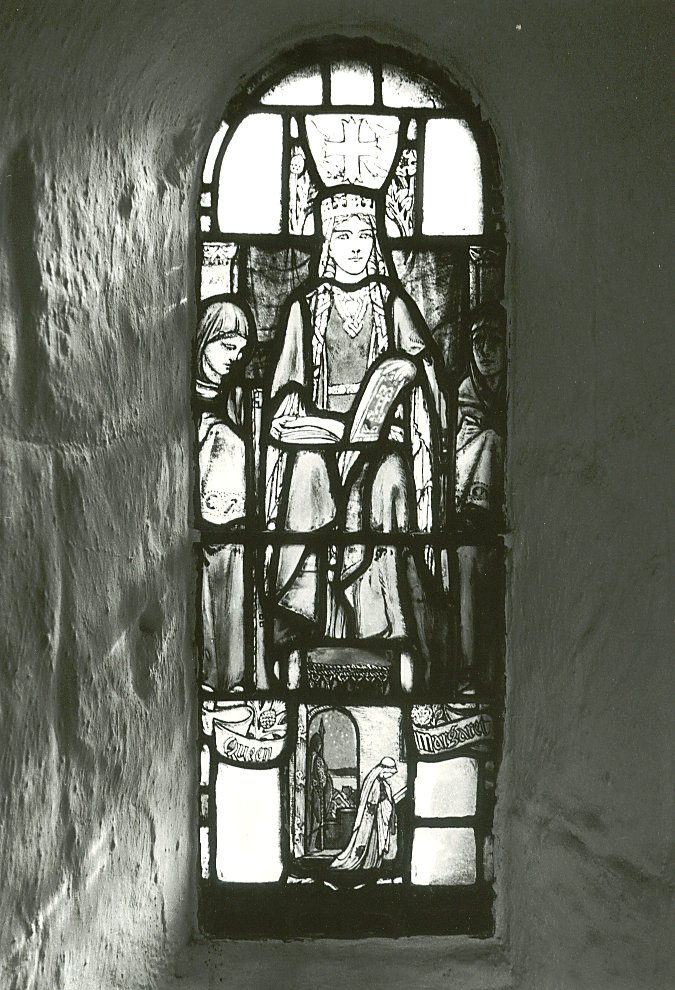
Stained glass window, St
Margaret's Chapel, Edinburgh Castle. (Photo: Gordon Wright)
austerity and discipline. The monks who
were summoned to establish a monastery at Dunfermline, were Benedictines;
and gradually she and the churchmen who enjoyed her support, cleansed the
Mass of various intrusions which had crept in; revived observance in
proper form of Church festivals, and restored the pattern of organisation
in dioceses, which had been apparently modified by monastic-style activity
during the years of comparative isolation.
In practical ways, as well as in matters of
doctrine and conduct, she assisted the church in its work. A chapel was
built on the castle rock in Edinburgh; a 'Queen's ferry' was provided
across the River Forth, to encourage the journey of pilgrims from south
and west to St. Andrews, and, giving honour where it was due, she secured
the restoration and revival of the sacred site of Iona.
She was, however, far from being unworldly.
She had a highly developed idea of royal dignity - 'queenly as well as
saintly' one writer has called her - and the court of King Malcolm was
more cultured, more luxurious and more formal than it had previously been.
A higher standard of living at court, and a closer association with the
continental forms of religion both tended to encourage commercial
contacts, and from the activities of merchants new standards of elegance
and culture were derived.
One aspect of these wider contacts,
however, had great significance. For whatever reason - family memories,
ease of access, personal acquaintance, all no doubt contribute - Margaret
tended to find her consultants in, or by way of, England. She was not the
first, nor by any means the only, Scottish public figure who acted on the
assumption that any influences reaching Scotland from the outside world
would normally and properly pass through England first.
But of course England now was not English
politically any more. Power and social influence were Norman, even though
the mass of the people remained English or, in the north, half-Danish. So,
when Margaret, her husband and her sons, entered into any sort of
co-operation with the court at Westminster they were dealing with Norman
kings, Norman officials, Norman courtiers and Norman churchmen.
There was so much to admire in the Normans.
They had won England thanks to superior military techniques. They had
brought to the country an efficiency of administration, and a competence
in organisation, which was new and admirable. With the power which
military victory gave them, they had imposed a pattern upon society which,
if not previously unknown, had not been fully accepted until the
post-conquest years.
This pattern, known to all later
generations as the feudal system, was based upon tenure and use of land
exercised by permission of the King. Society was contractual. Acceptance
of royal authority was rewarded by the grant of land, which was then held
as long as obedience was given in return.
There was nothing particularly intellectual
in Duke William's use of this method of binding his subjects to him. All
who had shared in the adventure of the Conquest expected to find
themselves rewarded by generous grants of property. Indeed in few cases
was there any other motive for their arrival in England at all. William
had to reward his followers, but in doing so he made them his agents, his
garrison as it were, policing the country through them and the military
strongholds which they made of their dwellings. The Normans had come to
rule and enjoy the fruits of power. The conquered would hew the wood and
draw the water.
A Scottish king too had already shown that
he appreciated what Normans had to offer a leader who could promise them
rewards. The first Norman knights to come to Scotland came at the
invitation of Macbeth. As it turned out they had backed the losing side on
that occasion, but the idea was not forgotten. |