Fortis in arduis (strong in
adversity) is a particularly appropriate motto for the Findlays of
Boturich, a family which has, at times, enjoyed great wealth but at others
suffered considerable losses, more than once as a consequence of historic
accidents of fate. Today, Robert Findlay, 8th of Boturich,
Dunbartonshire, the eldest Findlay male and the family historian,
humorously describes his own family as "stranded gentry" – a
delightfully evocative term.
With the help of the family Red Book or Leabhar dearg,
Robert Findlay has traced his family line back to one Findla (or Findlay)
Mhor, a giant of a man with great strength who, bearing the royal banner,
was killed at the battle of Pinkie in 1547. According to the 1849 edition
of Burke's Landed Gentry, Findla Mhor "was buried in the
churchyard of Inveresk, at a short distance from the field of battle. No
monument was erected to his memory, but the place was long known in that
parish by the name of the Long Highlandman's Grave"…
"In those days", notes Robert, "Scotland
was not a wealthy land and for most it was enough to subsist from the
fruits of soil or sea. This imposed severe limitations on enterprise;
foreign trade was almost non-existent. Any spare taxable wealth was
usually needed to pay, or fight, the English."
By the seventeenth century, the Findlays had become
prosperous merchants in Kilmarnock, a somewhat restricted activity
geographically at that time because the Scots were effectively barred from
trading with the English colonies. Hence the Act of Union in 1707 gave a
considerable fillip to the family fortunes. Robert Findlay explains that
"the union of the parliaments of Edinburgh and Westminster was
strongly debated and opposed at the time. But soon after this, the new
Edinburgh arose to be called the Athens of the North, while Glasgow's new
trade brought previously undreamed-of wealth flowing into the country as
adventurous Scots were suddenly able to compete on equal terms with
English traders under the powerful protection of the Royal Navy.
"The entrepreneurial younger sons of the Scottish
gentry, who were not constrained by the duty of looking after family
estates, sailed away to set up trading ventures with the colonies, making
their names as Virginia merchants and in the Caribbean, and then as East
India merchants and in other far-flung destinations including South
America and China. While, in those days, such ventures often meant long
and arduous sea journeys, fraught with dangers, the potential prizes were
irresistible."
Colonial adventures
The Findlays initially turned their sights westwards,
towards America.
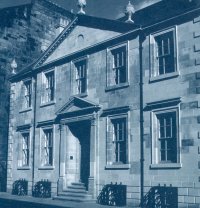 Sixteen-year-old
Robert Findlay sailed for six weeks across the Atlantic in 1764, to join
two uncles in Virginia. When he returned home, having amassed a
considerable fortune, he bought a town house at 42 Miller Street in
Glasgow, then one of the best houses in the merchant city, where his son,
also named Robert, was born. He also bought a country house called
Easterhill, a few miles up the Clyde, which from 1784 to 1895 was a
Findlay home. Today, sadly, it no longer exists. The house at 42 Miller
Street continued its existence as a townhouse and has recently been
restored to its original state as a typical tobacco merchant's house of
the time.
Sixteen-year-old
Robert Findlay sailed for six weeks across the Atlantic in 1764, to join
two uncles in Virginia. When he returned home, having amassed a
considerable fortune, he bought a town house at 42 Miller Street in
Glasgow, then one of the best houses in the merchant city, where his son,
also named Robert, was born. He also bought a country house called
Easterhill, a few miles up the Clyde, which from 1784 to 1895 was a
Findlay home. Today, sadly, it no longer exists. The house at 42 Miller
Street continued its existence as a townhouse and has recently been
restored to its original state as a typical tobacco merchant's house of
the time.
The revolt of the colonists and the American Declaration
of Independence led to ruin for many wealthy Glasgow citizens, but not
all... One of Robert Findlay's uncles cannily "did the rounds"
of the ruined merchants, buying their Glasgow tobacco stocks from them at
double the original cost. The merchants were happy at this, until the
market price soared well past that level – with supplies no longer
available. The fortunate speculator built himself a magnificent mansion
house, said to be the finest in the land at the time. This house still
stands today inside the front part of Glasgow's Royal Exchange.
The Findlay family then turned its sights eastwards,
becoming timber merchants in Burma, and establishing trading posts in
Manila in the Philippines. Little is known about the business in the
Philippines, although trading continued until shortly after the First
World War.
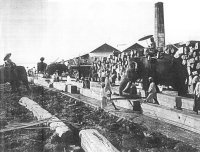 The
Burma operation, T D Findlay and Son Ltd, East India Merchants, was set up
in 1839, being founded by and named after the current Robert Findlay's
great-grandfather. "It was a private family company, the smallest of
the five British teak firms in Burma", explains Robert, "but
when it was nationalised in 1948, it was Britain's oldest existing trading
connection with Burma. The company felled trees in the Shan States and the
Pegu Yomas, after ringing them to dry out on stump for a few years. To
ensure future supplies, for every tree felled, five saplings were planted.
The
Burma operation, T D Findlay and Son Ltd, East India Merchants, was set up
in 1839, being founded by and named after the current Robert Findlay's
great-grandfather. "It was a private family company, the smallest of
the five British teak firms in Burma", explains Robert, "but
when it was nationalised in 1948, it was Britain's oldest existing trading
connection with Burma. The company felled trees in the Shan States and the
Pegu Yomas, after ringing them to dry out on stump for a few years. To
ensure future supplies, for every tree felled, five saplings were planted.
"A couple of hundred contractors' elephants then
dragged the logs to the nearest floating stream to await the rains which
would carry them to the main river. Here they were turned into rafts large
enough to carry a whole family downstream to a railhead or to the base in
Moulmein where the logs were sawn into saleable products, latterly
including fine tongue-and-groove parquet flooring.
"But T D Findlay's finest achievement was the
creation of the Irrawaddy Flotilla, a fleet of over 600 shallow draught
ships, built in Dumbarton by T D Findlay's co-founder Peter Denny, whose
statue still stands in that town. The ships were specifically designed to
navigate the Irrawaddy and they became the lifeblood of the nation's
prosperity, ensuring trade up and down the great rivers, and aiding
Burma's transformation into the rice-bowl of Asia."
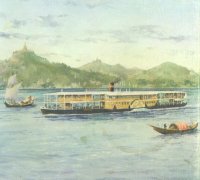 But
this exotic industry was to come to an abrupt end when the Japanese
invaded Burma in November 1941. The company scuttled its flotilla to
prevent it falling into the hands of the Japanese, "and this
action", notes Robert Findlay, "brought Burmese trade and
transport to a standstill. The flotilla had been the greatest-ever fleet
for river transport in the world. The teak business paid off its
employees, and dispensed with the elephants. In 1945, following the
liberation of Burma by the 14th Army, the family endeavoured to
build up the Burma business once again, only to see it nationalised by the
new, independent Burmese government in 1948" – a catastrophe for
the Findlay family which saw its capital decimated.
But
this exotic industry was to come to an abrupt end when the Japanese
invaded Burma in November 1941. The company scuttled its flotilla to
prevent it falling into the hands of the Japanese, "and this
action", notes Robert Findlay, "brought Burmese trade and
transport to a standstill. The flotilla had been the greatest-ever fleet
for river transport in the world. The teak business paid off its
employees, and dispensed with the elephants. In 1945, following the
liberation of Burma by the 14th Army, the family endeavoured to
build up the Burma business once again, only to see it nationalised by the
new, independent Burmese government in 1948" – a catastrophe for
the Findlay family which saw its capital decimated.
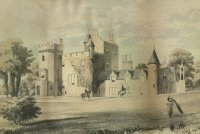
Life at Boturich
Going back just over a century, in 1839 the then Robert
Findlay purchased the Boturich estate in Dunbartonshire from the executors
of his maternal grandfather's estate. At his early death, the Boturich
estate passed to his father, who was also called Robert. The Easterhill
estate, just east of old Glasgow, on the banks of the Clyde, was at that
time inhabited by a junior branch of the family. The father of the current
Robert Findlay was a member of this junior branch and, in 1930, he
acquired Boturich and established his family home there, bringing family
pictures and furniture that were formerly in Easterhill. He also
substantially restored and extended Boturich.
The current Robert Findlay was born a decade or so
before these events, latterly growing up at Boturich with a brother and
three stepbrothers. His mother had died when he was five and his father
married again. He was a teenager when war broke out: "I was doing my
school certificate at Harrow when the war began," he explains,
"and we spent hours between exams digging trenches across the rugger
fields to stop gliders landing. Harrow also had its share of firebombs.
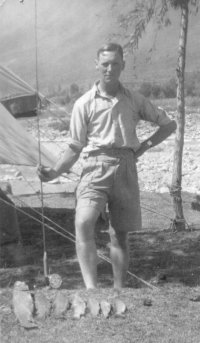 "I
spent the first winter after leaving school as an apprentice chartered
accountant in Glasgow and was called up in the spring of 1942 to the Black
Watch depot in Perth. After a stint with the Officer Cadet Training Unit
in Morecambe, I became a junior officer in the Indian Army and was shipped
out to the 8th Gurkha depot in Quetta (now West Pakistan) and
then on to the 4/8th Gurkha battalion which took me from Kohima
in the north down to the Sittang bend in the south of Burma. En route I
was wounded and evacuated, rejoining the battalion later.
"I
spent the first winter after leaving school as an apprentice chartered
accountant in Glasgow and was called up in the spring of 1942 to the Black
Watch depot in Perth. After a stint with the Officer Cadet Training Unit
in Morecambe, I became a junior officer in the Indian Army and was shipped
out to the 8th Gurkha depot in Quetta (now West Pakistan) and
then on to the 4/8th Gurkha battalion which took me from Kohima
in the north down to the Sittang bend in the south of Burma. En route I
was wounded and evacuated, rejoining the battalion later.
"I was away from the UK for four years, journeying
post-war to Bangkok, Malaya and Java. In early 1947, aged 23, I was
demobilised. Like most British officers, I was full of admiration for the
Gurkhas and it was with heavy heart that I left my men when I returned
home. Today I still feel a warm glow when I look back on my former life as
a Gurkha BO [British officer] – distance lends enchantment to the
memories.
"In Glasgow I completed my chartered accountancy
qualifications and, while doing so, became involved in several other
enterprises, including acting as shore manager for Gavin Maxwell's shark
fisheries, and helping to install Great Britain's first overhead ski tow,
at Glencoe.
 "All
along, I had intended to join my father in the family business, but only
did so to complete its winding-up after my father died in 1950.
Subsequently I worked in various industries, ranging from nuts and bolts
and railway engines to biscuits, before setting up my own shop-fitting
business on Clydeside.
"All
along, I had intended to join my father in the family business, but only
did so to complete its winding-up after my father died in 1950.
Subsequently I worked in various industries, ranging from nuts and bolts
and railway engines to biscuits, before setting up my own shop-fitting
business on Clydeside.
"During this time I felt constrained to stay within
reach of Boturich. In 1957 my stepmother gave up the life-rent of the
estate and, with a bachelor brother, I took it over. We had some splendid
parties there, benefiting from the tennis court and the boat on Loch
Lomond, which bounded the estate along its western shoreline, and
organising bonfires and shotgun weekends! Latterly there was water-skiing
to keep our parties busy. I also managed to dance on most of the main
ballroom floors of Scotland, from Skye to the Borders, and enjoyed a
week's stalking in Mull every autumn (having once captained the Harrow
VIII, I fancied myself as a shot). All this was fitted in between the
daily drive to 'the office', wherever that happened to be.
"Marriage came when I was 41 and Liisa joined me
from her home in Finland, where I had met her on a forestry visit. We
married in 1964 and the next ten years totally changed my life by adding
three more to Boturich's resident family: a boy followed by two girls, all
of whom are now grown up and, with their spouses, a great joy to us."
A new life at Knockour
"We all had fun living in the parts of Boturich we
needed. But, in 1984, Lisa and I were forced to sell up and leave 'the big
hoose' and its home fields. We had been fortunate to stay so long, but the
situation we faced was very different from that experienced by my father
when he moved there in 1930. We did not enjoy Burmese business support and
heavy marginal taxation was throttling the growth of business enterprises.
We were also faced with heavy death duties on the death of my father.
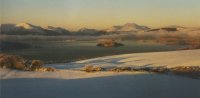
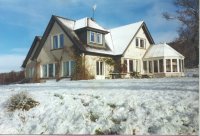 "Consequently,
we sold Boturich and its nearby fields and built ourselves a special
kithouse called a Scandia-hus where the kennels had stood and from
where we enjoy unrivalled views down to the loch and the hills behind. Our
house arrived on three long lorries despatched from the Swedish factory,
ready to erect. Complete it looks remarkably like an old style building
– in stone with lath and plaster internal walls. The differences are its
plus points: no draughts, thick insulation, triple glazing throughout, and
attractive architectural design.
"Consequently,
we sold Boturich and its nearby fields and built ourselves a special
kithouse called a Scandia-hus where the kennels had stood and from
where we enjoy unrivalled views down to the loch and the hills behind. Our
house arrived on three long lorries despatched from the Swedish factory,
ready to erect. Complete it looks remarkably like an old style building
– in stone with lath and plaster internal walls. The differences are its
plus points: no draughts, thick insulation, triple glazing throughout, and
attractive architectural design.
 "My
wife has made it our ideal home and is delighted by the change. I confess
mainly to a feeling of relief at extracting myself and my family from an
untenable position and leaving a house that I had grown to love for other,
better-endowed hands to care for.
"My
wife has made it our ideal home and is delighted by the change. I confess
mainly to a feeling of relief at extracting myself and my family from an
untenable position and leaving a house that I had grown to love for other,
better-endowed hands to care for.
"In 1960 I had become an underwriter at Lloyd's. We
were not long into our new abode in the 1980s when the Lloyd's disaster
struck, and for a time we faced bankruptcy as half a million in losses
drained any liquid reserves. Fortunately we then enjoyed three splendid
years before pulling out of Lloyd's at the end of 1996, in relief, sadder
and poorer but possibly wiser.
"We still maintained most of the former estate's
1000 acres, and especially Knockour Wood along the shore and Knockour Hill
which rises to some 650 feet in the centre. These gave the local name to
our new house. Now it is to Knockour estate, rather than to Boturich
estate, that I devote my time and interest. I am its 'caretaker' in many
ways, from the annual grazings to the planting and felling, the care of
roads, drains, fences and water supplies, and the accounting of costs
among the community of owners who bought the cottages and use the roads.
"I loved my young days planting up the woods here,
but I never thought I'd be reaping them too. Near sea level in the mild,
wet West of Scotland, they grow fast. Within the estate's Woodland Grant
Scheme, some field areas have been turned over to Nordman Christmas Trees;
elsewhere, the land is providing sites for masts to serve mobile telephony
– all this helps the land pay its way. We are soon to gain a mains water
supply, as we did electricity a few years ago, replacing the countryside's
current 'DIY' arrangements.
"Today I would describe the Boturich estate as an
owner-occupier neighbourhood of road-sharing, minor capitalists who enjoy
the countryside quiet and neighbourhood security – a practical and happy
solution to many needs, ours and theirs. I'm unexpectedly approaching my
eighties, but not yet allowed 'off-duty'. And reliving our family history
for Burke's Landed Gentry is helping to keep me out of
mischief."
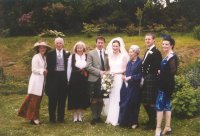
The Findlay family in June 2000 at the wedding at Knockour of Anne, youngest daughter of Robert and Liisa, to Niall Jenkins. From left to right: middle daughter Alex, Robert, Liisa in Finnish costume, Anne and Niall, Liisa's 93-year old mother, Mrs Ahtiala, from Helsinki, Rob Findlay and his then fiancée Aoife (they married in Tipperary in December 2000).
Our thanks to Burkes
Landed Gentry for this story



