|
By James Macdonald, Special
Reporter for the Scotsman, Aberdeen. [Premium—Thirty Sovereigns.]
General and Introductory.
The county of Fife has
pre-eminent claims to the dignified title of the "Kingdom," with which it
is frequently honoured. It is more largely surrounded by water than any
other county in the mainland of Scotland; and few counties in the United
Kingdom are more self-supporting—so extensive and so valuable are its
manufactures, so varied and so rich are the treasures of its rocks and the
production of its soil.
Fifeshire is attached to
the mainland of Scotland only by a narrow band on the western side, where
it joins the counties of Kinross, Clackmannan, and Perth. Its other three
sides are bathed in the waters of the ocean—the south by the Firth of
Forth, the north by the Firth of Tay, and the east by the German Ocean. It
lies between 56° and 56° 28' north latitude, the "East Neuk" being in 2°
35', and the most westerly point in 3° 43' west longitude. From east to
west it averages about 36 miles, and right down the centre from north to
south it measures about 14 miles. It has been ascertained by the Ordnance
Survey that the area of the county is 513 square miles, or 328,427 acres.
About four-fifths of the whole area is under regular cultivation, the
greater portion of the remainder being under wood. The county is divided
into 64 parishes, a number of which are by no means large. The population
in 1871 was 160,735, and the number of inhabited houses 27,056. There are
in all 10,410 owners of land in the county, 8638 having less than one
acre, or 1517 acres divided amongst them; while 1772 have possessions
exceeding one acre in extent, or in all 302,846 acres. In 1872-3, when the
return of owners of land in Scotland was taken up by the Government, the
gross annual value of the possessions of 1772 large landed proprietors was
L.741,379, 10s.; and those of the 8638 small land owners, L. 164,197, 17s.
The gross annual value of the whole county, exclusive of burghs and
railways, according to the Valuation Roll for 1874-5, is L.698,470, 13s.
l0d. The total valuation of burghs is L.208,002, 8s. 4d., and of railways,
L.49,957—grand total, L.956,430, 2s. 2d.
The Board of Trade returns
for the present year (1875) state the total number of acres under all
kinds of crops, bare fallow and grass, at 243,669 acres, of which 16,748
were under wheat, 30,037 barley or bere, 37,646 oats, 1304 rye, 2483
beans, and 109 peas, being a total under grain crops of 88,327 acres. The
average under green crop was 47,460 acres—28,514 under turnips, 17,746
potatoes, 34 mangold, 23 carrots, 88 cabbage, kohl rabbi, and rape, and
1055 vetches and other green crop. Of permanent pasture there is 50,261
acres, and of grasses under rotation, 56,430 acres, and of bare fallow, or
uncropped arable land there is 1189 acres.
Though almost every corner
of the county is the scene of great enterprise and no little activity, it
cannot be said that the general aspect of Fifeshire is strikingly
commercial. On the contrary, it has the appearance of being a quiet,
retired rural spot, where the aesthetic has never been wholly lost sight
of. Few counties in Scotland, if indeed any, can boast of a larger number
of baronial residences and gentlemen's seats than are to be found studding
and beautifying the undulating landscape of Fifeshire. The number of
landed proprietors is larger than in any other county of similar size in
Scotland, and the fact that these worthy gentlemen, with a few exceptions,
have all along been in the habit of residing on their desirable
possessions in Fife, explains the preservation of the county from the
modernising hand of trade and commerce. Not that they have hampered the
spread of industry and enterprise,—they have encouraged and aided the
development of every healthy industry in a manner that reflects upon them
unbounded credit,—but they have with equal care and rigour preserved the
amenities of their native county. Even in the greatest mining centres
where coal-pits are seen to the right and to the left, the scenery is very
fine, being beautified by numerous clumps of trees; while in the purely
agricultural districts, the carefully cultivated fields are tastefully
fringed by thriving belts of wood. The surface undulates considerably, yet
there are no high hills, the point of greatest eminence—West Lomond—being-only
1713 feet above the level of the sea. The Largo Law hill, situated in the
parish of Largo, on the south coast, rises to a height of 1020 feet, and
commands a magnificent view of the Firth of Forth and the city of
Edinburgh. The Lomonds lie at the north-west of the county, and impart to
the scenery around them an aspect which contrasts strikingly with the
landscape along the seaboard. Seated on the highest eminence of these
hills on a clear day, and provided with a powerful binocular field-glass,
one can command a most exquisite view. At our feet lies the historical
Kingdom of Fife spread out like a magnificent carpet, while away in the
distance the prospect is grand in the extreme. Southwards we see the low
winding ranges of the Pentlands and the Lammermuirs, and the richly
cultivated Lothians; to the west lies, dimly shrouded, the lofty Ben
Lomond; to the north, the rugged range of the Grampians; and, turning to
the east, the prospect softens down to the blue haze of the German Ocean.
The smaller objects of attraction in this wide range are far too many to
be enumerated, but, in a word, it may be said that the prospect is one of
the finest to be had anywhere in Scotland; and what country can boast of
grander prospect than the
"Land of brown heath and
shaggy wood"?
There are no very large
plantations, the wood being pleasantly strewed over the whole county in
thriving clumps, diversifying the scenery and lending a lustre to the
charm of the landscape. The county has no less than 85 miles of a coast
line, considerable portions of which are bold and rocky, and indented here
and there by miniature bays. Between Wemyss and the "East Neuk" a pretty
large stretch is low and sandy, and parts of it strewed with massive
pieces of rock; while on the east it is irregular and very rocky, and on
the north-east plain and sandy.
There are only two rivers
worthy the name—the Eden, which rises in the parish of Arngask, and after
a quiet winding course of about 24 miles, empties itself into St Andrew's
Bay; and the Leven, which has a course of only 12 miles, rising in Loch
Leven, in the parish of Portmoak, and falling into the Firth of Forth at
Leven. The next largest stream is the Orr—a slow muddy stream winding from
the Saline hills easterly to Dysart. There are several very small
streamlets throughout the county, the most of which are tributaries of the
Eden, the Leven, or the Orr. The Eden and the Leven at one time were
valuable salmon rivers, but now mill-dams and manufactories disturb the
fish and make the rivers almost worthless in this respect. The
trout-fishing, however, is excellent on nearly all the waters, as also in
several of the lochs. There is a number of lochs in the county, but the
majority of them are very small, the principal ones being Lindores —about
four miles in circumference; Lochgelly, about three miles in
circumference; and Kilconquhar, about two miles in circumference. Moors
are neither numerous nor large, and game very scarce, hares and partridges
being the predominating species. The majority of the landlords preserve
their shootings; but it is seldom that game grievances disturb the
political atmosphere of Fife. In the higher parts, adjoining Kinross,
there is a considerable quantity of peat-moss, and deposits of moss are
met with here and there throughout the county.
One important feature of
Fife is the very large number of towns and villages that are scattered
over the county. There are no fewer than fourteen royal burghs, and a
whole host of villages, chiefly along the coast. Cupar is the county town.
It is situated on the river Eden, has a population of 5105, and is a
cleanly kept busy little town of great antiquity. By far the largest town
is Dunfermline, situated at the south-west end of the county. During the
past two centuries it has risen from an unimportant rural village to one
of the principal manufacturing towns in Scotland. It has a population of
14,963, is yearly extending in magnitude, and may be called the commercial
capital of the county. St Andrews, once the ecclesiastical capital of
Scotland, is a city of very great interest to the antiquary, because of
the peculiarly eventful character of its ancient history. It was
constituted a royal burgh by David I. in 1140, and was once a most
populous town, but since the Reformation it has dwindled away
considerably, and now it can number only 6316 inhabitants. The University
of St Andrews was founded in 1411 by Bishop Wardlaw, and is thus the
oldest university in Scotland. The "Lang Toon" (Kirkcaldy), famous for its
manufactories and as the birthplace of Adam Smith, the talented author of
the "Wealth of Nations," has an industrious population of 12,422; while
Dysart, situated on the coast two miles northeast from Kirkcaldy, numbers
8919 persons. Burntisland, a rising-watering-place, stands on the coast
almost immediately opposite Edinburgh, and has a population of 3265. It is
surrounded by scenery of great grandeur, is held in high repute as a
watering-place, and during the summer months, when it is resorted to by
hundreds of the inhabitants of Edinburgh and other towns, is the scene of
no little life. The village of Lower Largo is famous as having been the
birthplace of Alexander Selkirk, the prototype of "Robinson Crusoe," while
Anstruther-Easter, a royal burgh with a population of 1,289, ranks amongst
its sons with pardonable pride the celebrated Dr Chalmers. The ancient
history of the county of Fife is of much more than ordinary interest on
account of its being so closely connected with the life and history of the
kings of Scotland. Anything merely historical is beyond the range of this
report, but a few sentences may be given. At one time the entire district,
comprising Fife, Clackmannan, Kinross, the eastern part of Strathearn, and
the country west of the Tay, as far as the river Braan, was inhabited by
the Horestii, a Celtic race, and was designated Ross, meaning a peninsula.
The peninsula was partly divided about 450 years ago, but it was not till
1685 that the county of Fife was reduced to its present size. At the time
of the Roman invasion the Celts were driven from their peninsular domain,
and after the Romans came the Picts, who united with the Scots about the
middle of the ninth century. In 881, and in several subsequent years, the
Danes invaded the county and troubled the inhabitants dreadfully. Down
till 1424 the Thanes of Macduff held sway over the greater portion of
ancient Fife, but on the execution of their last chief, Murdoc, their
estates were confiscated to the Crown, and Falkland Palace, the residence
of the Thanes, became the property and abode of the kings of Scotland.
Since then the social atmosphere of Fife has been comparatively clear and
tranquil, while enterprise and enlightenment have all along been the order
of the day. It is worthy of mention that Malcolm Can-more, David I.,
Malcolm the Maiden, Alexander III., Robert Bruce, his Queen Elizabeth and
nephew Randolph, Annabella, Queen of Robert III., and Robert Duke of
Albany were buried in the Abbey of Dunfermline, an antiquated ruin,
founded by Malcolm III. about 1070. In digging for the foundation of the
new parish church in 1818 the tomb of Robert Bruce was discovered, and his
skeleton found wrapt in lead.
The county sends one member
to Parliament, the present representative being Sir Robert Anstruther,
Bart. of Balcaskie; while Cupar, St Andrews, East and West Anstruther,
Pittenweem, Kilrenny, and Crail have one member—Mr Edward Ellice; and
Kirkcaldy, Dysart, Kinghorn, and Burntisland another—Sir George Campbell.
Dunfermline and Inverkeithing are conjoined with the Stirling District of
Burghs; and by the Reform Act of 1868 the Universities of St Andrews and
Edinburgh were combined into one constituency, their present
representative being Dr Lyon Playfair. The county is divided into two
districts, an eastern and western, for judicial purposes, and each
division is under the jurisdiction of a sheriff-substitute. For civil
purposes it is divided into four districts, viz., Cupar, St Andrews,
Kirkcaldy, and Dunfermline.
The railway system now
extends to nearly every district of the county, while the ferry-boats at
Burntisland and Tayport bring the county into close connection with the
principal centres of trade and commerce in Scotland. The expenditure on
railways within the county during the past ten or twelve years has been
very great, and if once the branch—now in process of construction—from
Dunfermline to Inverkeithing and Queensferry were opened, the system will
be almost complete. In the matter of roads also the county is well
accommodated.
A monthly cattle market is
held at Cupar, while similar fairs take place at stated times at other
parts of the county. During the winter and spring grain markets are held
weekly at all the principal agricultural centres. The proximity and easy
access, however, to the Edinburgh markets make farmers less dependent on
the local fairs for the sale of their stock and grain than they would
otherwise be.
Population.
The following table shows
the population of the county at various stages during the past
seventy-four years:—
1801, 93,743
1811, 101,272
1821, 114,556
1831, 128,839
1841, 140,140
1861, 154,770
1871, 160,735
The increase since 1801, it
will thus be seen, is 66,992; and it is worthy of notice that the increase
has been gradual and constant. The number of inhabited houses in 1851 was
24,610, now it is 27,056, and the number of separate families 38,038. The
present population is equal to about 313 to the square mile, or little
more than 2 to each acre; or to put it exactly, 53 to every 26 acres. The
average number of persons to each house is very close on 6, The
topographical nomenclature—the touchstone of the ethnographer—of the
county of Fife is sufficient to demonstrate the fact that the aboriginal
inhabitants were Celts. The number of farms and places designated by
Celtic names is very large, and it is peculiarly interesting to note the
striking similarity that exists between the local names of Fife and those
of several of the northern counties of Scotland, a fact that speaks of a
similarity or kinship between the original inhabitants of Fife and those
of the north. The Horestii—the name given to the tribe of Celts that
originally inhabited Fife, or rather the peninsula of Ross—were not
characterised by industry or enterprise, and like their kinsmen in the
north must have had often to be satisfied with a scanty meal; for in those
days Fife is described as having been nothing else than an immense forest
full of swamps and morasses and inhabited by wild beasts. They had no
towns in their possession, but occupied hill forts, the remains of many of
which are still to be seen at several spots throughout the county. The
Horestii were almost wholly annihilated by the Romans, who in turn were
succeeded by the Picts, that ancient Celtic race, regarding whose origin
and early history so much has been written and spoken. Fifeshire formed
part of the southern boundary line of the Pictish territory, the English
having then possessed the Lothians and the independent Britons the kingdom
of Cumbria, while the Scots, another Celtic race that inhabited
ancient Scotland, or in other words the "Emerald Isle," occupied the
western coast from the Firth of Clyde to Ross-shire. Towards the middle of
the ninth century the two Celtic races—the Picts and the Scots—united, and
lived peaceably until disturbed by the ambitious Danes, who invaded Fife
in 881. From that time down till 1424, when the extensive lands of the
Thanes of Macduff (who possessed the greater portion of Fife) were, on the
execution of Murdoc the last chief of the Thanes, confiscated to the
Crown, the county frequently sustained considerable damage at the hands of
invaders. In the days of James V., who resided at Falkland Palace, the
social condition of Fife, like the most of Scotland, was not of the
brightest or the happiest description. But the reign of that unfortunate
monarch may be noted as one of the turning points, a new point of
departure, in the social history of Fife, for ever after the county has
been found in the van of progress. The advance in the social and
intellectual scale during the present century has been most marvellous;
and Mr Westwood, in his "Parochial Directory for 1862," says that "perhaps
nothing gives that progress so much prominence as the magnitude attained
by the newspaper press connected with the county. Previous to 1822 there
was no newspaper published in Fife, and the practice was to advertise
county and other public meetings in an Edinburgh newspaper, and a few
hundreds would probably cover the sum total of every newspaper that found
an entrance into the county. At present (1862) Fife can boast of ten
weekly newspapers and advertising sheets, besides three with a fortnightly
issue, having a total circulation of 25,000; nor is this all, for the
circulation of Edinburgh and other newspapers not connected with the
county is at present ten times more than it was when no native broadsheet
existed. All this, without taking into account the immense circulation of
periodicals and books of every shape and size, which forty years ago had
no existence, exhibits an intellectual progress penetrating to all classes
of our society, and exerts an educational influence unequalled in any
country or in any age of the world." Even since 1862 there has been
considerable improvement in the social condition of the county. The
educational machinery, always abreast of the times, has been improved and
extended a good deal of late, and is now second to that in no other county
in Scotland; while the position and influence of the newspaper press has
been greatly strengthened. The mining and manufacturing interests being so
extensive, the number of commercial men in the county is necessarily
large, and these as a class are sharp, shrewd, intelligent, and well to
do; while the farmers, generally speaking, are independent, industrious,
enterprising, comfortably-conditioned men, several of them wealthy. The
working population have superior advantages in the way of house
accommodation, and are well-behaved, economical, industrious, and
trustworthy. Miners, an exclusive class of men, not always credited with
peaceful social habits, form an important class in the county. Barring a
little roaring now and again, however, about strikes and trades unions,
Fifeshire has little to complain of in this respect. There is less stir
and bustle now, however, in the mining centres than some two or three
years ago, when the revolutionary movements in the mining world were at
their height. On a summer's Saturday afternoon some two years ago it was
almost an absolute impossibility for ordinary persons to obtain a cab or a
carriage of any description in Dunfermline for an hour's drive, the
miners, rampant with their ten shillings a day, having them all engaged
for a drive "into the country."
The dialect of the county
is varied. The ordinary people speak mixed Scotch, while in the higher
circles English only is heard. Throughout the county generally several
antiquated social habits still obtain. The farmers, for instance, in
speaking of the produce of their farms, calculate by the Scotch acre
instead of by the imperial acre as in most other counties, while the
ancient system of regulating rent by the fiars is still adhered to in many
cases. Sporting is indulged in only to a limited extent. There is one pack
of foxhounds and one pack of harriers, and no fewer than forty-one curling
clubs in the county; but the favourite outdoor sport seems to be the
"royal game of golf." The links at several of the towns and villages along
the coast are specially adapted for golf, and during the summer they are
all taken full advantage of. The county can also boast of a very
creditable body of mounted volunteers, as well as a strong regiment of
rifle volunteers.
Climate.
The climate of the county
is modified by proximity to the sea. It is not so variable, not so cold in
winter nor so hot in summer as in larger continental areas of country. The
climate is mild, and the air humid and healthy, while the rainfall is not
by any means heavy. In the darker ages, when the extensive valleys lay in
spongy swamps, foul mists continually shrouded the county, keeping it
constantly in a damp, disagreeable, unhealthy state. These mists are
peculiarly trying to delicate constitutions, while they foster and
encourage disease of various kinds, and man and beast often suffered very
considerably from their prevalence. As the ignorant feudalisms and rude
barbarities of ancient Fife have been swept away by the current of modern
culture and the spread of civilisation, these dingy mists have disappeared
before the enterprising agriculturist. Thorough drainage and improved
cultivation have completely revolutionised the county of Fife—have changed
it from an unhealthy swampy waste, a nursery for wild beasts, into a rich
agricultural county. Occasionally several of the valleys are still visited
by floating mists and "hoar" frosts, and in the month of July grain and
potatoes are heavily damaged thereby, while in winter turnips in low
ground often fall victims to these hoar frosts. But the loss sustained in
this way is trifling compared with what was experienced some fifty or
sixty years ago. Westerly winds prevail, but sometimes in spring and
autumn biting east winds sweep along the east coast, especially in spring,
doing slight damage to the young crops. The numerous belts and clumps of
wood, however, that stud the fields break and soften the current of the
wind, and lessen immensely the damaging effect on the crops. The climate
varies a little in some parts of the county, being a little more rigorous
in the higher lying parts than in the valleys and on the coast. Severe
passing storms of wind and rain sometimes sweep along the coast from the
German Ocean, but it is seldom that snow lies to any great depth or for
any length of time on the lands near the sea. The higher lands and hills
in the interior are often clothed in a snowy mantle in November, and
coated to the depth of several inches now and again during the winter. On
the whole, the winters are comparatively open, and agricultural operations
are rarely suspended in consequence of the weather. Rough weather seldom
prevails in spring, while the harvests, or rather autumns, are invariably
favourable. Vegetation commences early and continues far through the
season, The flora of the county is peculiarly rich, and interesting to the
botanist. The Thalami-floral orders, the Crowfoot (Ranunculaceœ) family
especially, are extremely well represented, at least one species of the
genus Tha-lictrum being found in Fife and in no other county in Scotland.
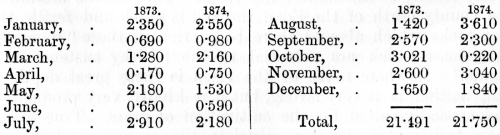
The rainfall during the year generally averages about 21½ inches, or
486,265 gallons to the acre. The following table shows the rainfall during
each of the twelve months of 1873 and 1874 at the Fife and Kinross
District Lunatic Asylum, near Cupar:—
Geology—Soils.
That well-defined valuable
group, the Carboniferous system, lying in the geological table of the
earth's crust, between the Old and New Red Sandstone, is the formation
that abounds in Fifeshire as in extensive portions of the Lothians and the
south-west of Scotland. The system, however, is not by any means intact in
the county. In almost all the Dunfermline and a considerable portion of
the Kirkcaldy district it abounds pretty exclusively. Here the coal
formation is extensive and very rich, and affords a valuable contribution
to the coal supply of our country, while it makes the west of Fife one of
the busiest centres in the "Land o' Cakes." Ironstone is abundant in
several parts of the county, and is extensively quarried at Oakley and
other works in the Dunfermline district. Lead was at one time quarried out
of the Lomond hills.
With the exception of a
narrow band running from Dunfermline to Dunino, near St Andrews, the
eastern and northern portions of the county are almost entirely destitute
of coal. On the high lands in the parishes of Cameron, Ceres, Kettle, and
Falkland, and along a ridge in the direction of Dunfermline, the
carboniferous limestone exists in great quantities, and is worked
extensively. The soil on the section of the county north of the valley of
the Eden lies on those felspathic igneous traps that are so often
connected with the Old Red Sandstone. This formation, however, does not
exist to any great extent, being confined chiefly to the valley of the
Eden, where the upper or yellow group abounds. Freestone of considerable
value is quarried at various points. Dura Den—a romantic ravine in the
neighbourhood of Cupar—is peculiarly rich in those fish fossils so
characteristic of the Old Red, and has engaged the pen of many of our most
talented geologists who have paid it a visit hammer in hand, eager to
possess some of its fossilised treasures. With all this variety of rocks
and formations throughout the county, the soil of the various districts
necessarily differs considerably, the character of the soil being
generally dependent upon the chemical condition of the rocks that underlie
it. In a few hollows on the north-west alluvial accumulations form the
soil, but with these exceptions the soil of the different districts
corresponds pretty closely to the underlying rocks. Thus in the section of
the county north of the Eden the soil is quick and fertile, the trap rocks
which abound there being rich in those "inorganic substances which are
essential to the healthy sustenance of plants." Nowhere north of the Eden
is there great depth of soil, neither is it very strong, but it is kindly,
very productive, and specially suited for the cultivation of grass. True
to the characteristics of the trap districts, the scenery and surface
north of the Eden presents great diversity—numerous irregular mounds and
many waving valleys. The soil that overlies the Carboniferous system is
generally composed of cold retentive clays and decomposed bituminous
shales, and is seldom fertile or easily cultivated. This rule still holds
good in several parts of Fife; but the advanced system of farming—the
extensive draining and the heavy manuring—of the past fifteen or twenty
years, have immensely improved the natural properties of the soil, have
changed much of it into fertile land. The Howe of Fife or Stratheden,
comprising both sides of the Eden up as far as Cupar, has rich fertile
soil, parts of it being exceedingly productive. South of the Eden the land
rises gradually until it reaches, in the parish of Cameron, an elevation
of upwards of 600 feet. On this high land the soil is cold and stiff and
of a clayey character, with a mixture of lime. Around Ladybank the soil is
very light and shingly, and presents signs of having been swept off its
richest earthy coating by a current of water. The land on the rising
ground in the parishes of Collessie, Monimail, Cults, and Kettle is
considerably heavier and more valuable than in the valley of Ladybank. In
the neighbourhood of the Lomonds the soil is light, but sharp and valuable
for grass, while similar remarks apply to the high land of Auchtermuchty,
Leslie, and Kinglassie. In the parishes of Death, Auchterderran, and
Ballingry, the land is principally cold and stiff; but several very
excellent highly-cultivated farms are to be found in these parishes. A
good deal of the land on the north side of Dunfermline is composed of clay
of a strong retentive nature, while on the south the soil is chiefly thin
loam, with a strong clayey subsoil. In the parishes of Saline, Torryburn,
and Carnock the soil is mainly a mixture of clay and loam, and is
generally very fertile. All along the coast the soil, though variable in
composition, is rich and productive. The "Laich of Dunfermline" has a
strong clayey soil, somewhat stiff to cultivate, but on the whole very
fertile. The soil on the coast from Inverkeithing to Leven varies from
light dry to strong clayey loam, rendered extremely fertile and friable by
superior cultivation. About Largo the soil is deep rich loam, and produces
magnificent crops of all kinds, while in Elie it is light but very
fertile. Along the east coast the soil is deep and strong and very
productive, consisting chiefly of clay and rich loam. Speaking generally,
very little hindrance is afforded to tillage by rolling stones or
upheavals of rock, but here and there all over the district, sloping down
from the heights in the parish of Cameron to the Firth of Forth, beds of
water-worn boulders are met with. These boulders, lying in beds or rows
from north-west to south-east, belong to the metamorphic rocks, and were
brought thither doubtlessly by floating icebergs during the glacial
period. In the neighbourhood of St Andrews the soil is by no means heavy,
while the section lying north-east of Leuchars village is sandy and very
light, especially on the east coast, where a large tract of land known as
Tent's Moor is wholly covered with sand, and almost useless for
agricultural purposes. In Forgan and part of the parish of
Ferry-Port-on-Craig, the soil, though light and variable, is kindly and
fertile. On the farm of Scotscraig there are a few fields of very superior
land.
The Progress of the past
Twenty-Five Years.
The total acreage reclaimed
in Fifeshire since 1850 is very small, almost every suitable tract of land
having been brought under the plough long before that time. The spirit of
improvement dawned early on the county of Fife, and hence all the
important reclamations date much further back than the range of this
report. In dividing and squaring up fields during the past twenty-five
years, many small patches and out-of-the-way corners that previously
produced only rough pasture have been made into cultivated land, while
around the base of hills on the borders of Kinross a few fields have been
reclaimed partly from moss and partly from strong pasture land. Draining
of course was the first operation in all those improvements, the stronger
land being trenched to a considerable depth. But though the acreage is not
greatly increased, the progress of the past twenty-five years has
nevertheless been very great. Those who recollect the state of agriculture
previous to 1850 can trace in the farms of the present day many wonderful
improvements. In fact, though a few of the older farmers still retain many
of the ancient customs,—customs that will in all probability die with
themselves,—it may almost be said that an entire change in the system of
farming has taken place in Fife during the past quarter of a century. The
science and practice of agriculture have of late years been receiving
considerable attention from a large section of the Fifeshire farmers, and
in the increased productiveness of the soil the result is showing itself
more and more strikingly every year. The expenditure for improvements
since 1850—and it has been very large—must be noted mainly against
draining, building, and fencing. Having been naturally very wet and
swampy, and next to useless in its original state, the greater portion of
the land was thoroughly drained early in the present century. Naturally,
however, these drains, never perhaps of the first order, required mending
after having done good service for perhaps a nineteen years' lease; and
during the last twenty-five or thirty years, almost the whole of the
county has been redrained.
A great deal has been done
since 1850 in the way of improving the buildings in the county. The
farmer's dwelling-houses have been immensely improved, while a very large
number of as fine farm-steadings as are to be seen anywhere in Scotland
have been erected. A very considerable amount of money has also been spent
in the erection of labourers' cottages. Almost every farm of even moderate
size in the county is now provided with servants' cottages of the most
approved construction, and we are inclined to think that in the matter of
house accommodation for the labouring classes, Fifeshire stands second to
no other county in the kingdom. An immense stretch of fencing has also
been erected since 1850; but still much, very much, remains to be done in
this respect. Ring fencing is pretty complete, but there is a great want
of interior or dividing fences. Every successive year, however, adds
greatly to supply this much-felt deficiency, and before many years have
past, it will in all probability be fully supplied. The true character or
real value of these, and all similar improvements, must of course be found
reflected in the rent-roll; and thus the following table of the total
valuation of the county (exclusive of railways and burghs) at various
periods since 1674 will be noted with interest:—
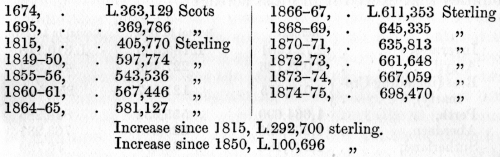
An increase during the past
twenty-five years of L. 100,696, or an average of close on L.4036 a-year,
is very creditable indeed, though it may not quite compare with the rise
in the rental during the same period in some other counties, especially in
the northern regions of Scotland. It must be kept in mind that, as already
stated, and as borne out by the table of figures just given, the principal
reclamations and improvements which go to increase the valuation of a
county were executed in Fife previous to 1850, while in these other
counties it is chiefly since then, or shortly before that date, that those
operations were carried out. The considerably greater increase during the
past half century in the value of grazing land, compared to arable land,
has also tended to retard Fifeshire in the general advance of rental.
Some half a century ago the
county of Fife occupied a slightly higher position than it does now in the
comparative valuation list of counties of Scotland. Its valuation for its
acreage, or say its valuation per acre, compared with that per acre in the
other thirty-two counties in Scotland, was slightly higher then than now.
Not that Fifeshire has been receding or sluggish in the race, on the
contrary it has been gradually and steadily moving onwards, but other
counties (taking up the good work begun by the farmers of Fife and
southern agriculturists generally, and carrying it on, too, with all that
spirit and zeal so characteristic of our Scottish farmers) have been
gaining ground upon it. Fife stands seventeenth among the Scottish
counties with respect to gross acreage, six—Inverness, Argyll, Ross,
Perth, Aberdeen, and Sutherland— being close on four times its size; while
other four—Dumfries, Ayr, Lanark, and Kirkcudbright—are nearly twice as
large. In 18.15 Fife occupied the proud position of fourth highest in
Scotland with regard to valuation, the three higher counties being Lanark,
Perth, and Ayr, while Forfar came fifth, and Aberdeen sixth. Now it stands
fifth, Aberdeen having not only made up to its spirited little rival in
the south (for little it may be called when compared with Aberdeen, a
county four times its size), but passed it by about L.17,158—a
comparatively small sum, however, taking into account the difference in
the size of the two counties. The following table shows the position Fife
occupied in 1815 and occupies now, in comparison with the sixteen counties
that exceed it in gross acreage:—
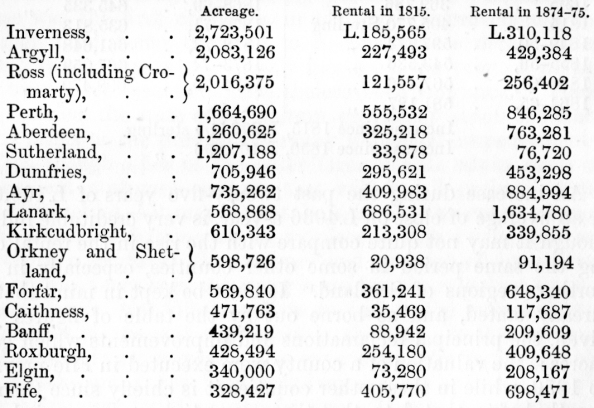
It will be seen from this
tabulated statement that Fifeshire's comparative position was a little
more prominently to the front in the early days of the present century
than now. It cannot be expected that a large annual increase of rental can
go on for ever at the same ratio. A certain point once reached, then the
increase must be limited; and we are of opinion that at 1815 the county of
Fife had attained a higher elevation in the steep hill of advancement than
most other counties between the Firth of Forth and John O'Groats. Hence
the recent apparent gaining of ground by these other counties. They have
done more than Fife, simply because they had more to do. The honour of
having the highest annual valuation per acre in Scotland belongs to
Lanark, but Fifeshire follows very closely. The total valuation of
Fifeshire for 1874-75, exclusive of railways and royal burghs, is equal to
no less than L.2, 2s. 6d. per acre, a fact that places the county in a
position of which it may well be proud. Of course Fifeshire has great
advantages by the valuable treasures of its rocks, but, after making all
due allowance for the rental of minerals and manufactories, the county
stands very high indeed in a purely agricultural point of view.
It is somewhat difficult to
ascertain exactly what the rise of the rent of arable land has been during
the past twenty-five years, but we think we are not far wrong in putting
it down at 25 per cent. From 1850 to 1860 there was a large increase of
rent on all farms, the rise in some cases amounting to as much as 50 per
cent. This large and very sudden increase was attributable chiefly to the
high price of grain and potatoes during the Crimean war. Almost every
year, from 1853 to 1867, potatoes at some time during the season reached
the high price of L. 5 per ton, and hence quite a potato mania arose in
the county. Potato land was rushed after, and fabulous rents paid for it;
and it is not too much to say that the step thus taken by a large number
of the Fifeshire farmers was the most unprofitable step that has been
attempted in the county during the last fifty years. Of this subject,
however, more anon. Since 1860 the value of clay land has considerably
decreased, owing to the low prices of grain for the crops of 1862, 1863,
and 1864, and since the latter year to the increased cost of labour and
other working expenses. One county agriculturist, whose opinion is
entitled to much consideration, assures us that "there is no increase in
the value of the rent of clay land as compared with the rents of 1850, but
that the rent of good green crop land has increased 20 per cent.;" and we
have met with several others who coincide in this opinion regarding the
clay land. We could point, however, to several clay farms that have been
slightly raised since 1850, but, speaking generally, the rise has not been
large. In fact, much of the clay land was so highly rented previous to
1850 that very little more could be added without "rack" renting the
tenants. During those few years that the Crimean war lasted the
competition for farms was so excessive that not a few were induced to
offer rents which they afterwards found themselves unable to pay, and thus
deductions had to be made in several cases, some before one half of the
lease was run. Had those fabulous prices that were paid for grain and
potatoes betweenl853 and 1867 continued, even the very highest rented farm
in the county would have proved a a most profitable speculation; but this
could not have been expected, nor, in fact, was it to be desired. During
the past ten years the increase in the rental in the Kirkcaldy district
has been no less than L. 42,516, while in the St Andrews district the
advance has been L.36,002. Manufactures and minerals have swelled the
increase in the Kirkcaldy district considerably; but in the St Andrews
district the rise is due almost entirely to an advance in the rental of
farms.- The Dunfermline district, the great mining centre of the county,
shows an increase of L.20,544, or about L.1500 more than the Cupar
district.
Modern Farming.
The system of farming that
obtains in Fife at the present day is, on the whole, of a most improved
description, and is quite abreast of the times; but before proceeding to
discuss the various farming customs, it may not be out of place to
introduce a few loose notes on a tour which the writer made throughout the
county. The starting point was Tayport, and the route—a waving one—along
the outskirts, ending where it began. It was in the "head hurry" of the
harvest, and all were busy in the fields. Cutting, a little more than half
finished, was proceeding with great rapidity in every direction, the
birring of the reaper being the prevailing sound. We visited several farms
along our course, and saw much to interest and instruct, much to admire
and little to find fault with. Close to Tayport, and situated on a slope
looking south-west, is the fine farm of Scotscraig Mains. It is the
property of Mrs Maitland Dougall of Scotscraig, is leased by Mr Peter
Christie, extends to 502 acres, and is rented at L.1210, being a rise of
about L.233 since 1864. Mr Christie, a gentleman of very extensive
experience in the valuation and cultivation of land, works the mains on
the seven-shift system of rotation, viz., 1st, oats; 2d, beans or
potatoes, or more frequently part of both; 3d, wheat; 4th, turnips; 5th,
barley; 6th, hay; and 7th, pasture. He breeds neither cattle nor sheep,
but buys in large numbers of both for the grass, and feeds them off in
winter with turnips and artificial food, of which latter commodity he uses
an immense quantity. The soil on the most of this farm is strong loam,
suitable for almost any kind of crop.
Leaving Scotscraig, and
proceeding along the north coast in the direction of Newburgh, we pass
through the parishes of Forgan, Kilmany, Balmerino, Creich, Dunbog, and
Abdie, at the northwest corner of which Newburgh is situated. In Forgan,
as all along this course, the soil is light but fertile. The principal
farms in this parish are Newton and Kirktonbarns, the former of which
extends to about 774 acres, and is leased by Mr George Ballingall, the
rent being L.1139. Mr Carswell, the proprietor of the estate of Rathillet
in Kilmany, holds the home-farm in his own hands. It extends to 643 acres,
and is valued at L.1132. The fine valuable farm of Wester Kilmany is held
by Mr Watt, and is rented at very close on L.3 per acre, or an increase of
a little over 12s. during the past ten years. The parishes of Balmerino
and Creich can boast of several extensive and very fine highly-cultivated
farms, the larger ones being Fincraig and Pitmossie, extending to 450
acres; Peasemills, measuring 348 acres; Carphin and Lutherie, 645 acres;
and Creich, 354 acres. The soil in the tract of land over which these
farms extend is very variable, as will be inferred from the fact that the
rents vary from L.l, 10s. to close on L.3 per acre. The little parish of
Dunbog, through which we next pass, contains a few large farms, but none
of them exceed L.2, 5s. per acre. The farm of Dunbar, leased by Mr John
Ballingall, extends to about 735 acres, the rent being L.910. Besides this
farm, Mr Ballingall holds several others, and pays in all between L.2400
and L.2500 of annual rent. He, like the majority of farmers in his
neighbourhood, works his farms chiefly in seven shifts, but occasionally
he takes three years' grass. He breeds and rears a large number of sheep,
while he generally owns about forty cows. He feeds very extensively, and
consumes upwards of L.1800 worth of cake every year. The soil in the
parish of Abdie varies very much, some parts of it being excellent, and
some light and very inferior. Perhaps the best farm in the parish or
neighbourhood is Park-hill, a valuable holding situated close to the royal
burgh of Newburgh. It extends to about 480 acres, and is rented at L.1420,
or an advance of about 16s. per acre since 1864, the tenant being Mr A. W.
Russell. Part of this farm lies on a low level, close on the banks of the
Tay. The fields next the river were reclaimed less than fifty years ago,
the present farmer remembering to have seen boats floating about where he
now reaps abundant crops. The soil is chiefly alluvial clay, part of it
being strong and deep. The rotation pursued on this level is eight
shifts—1st, oats; 2d, potatoes or beans; 3d, wheat; 4th, potatoes or
beans; 5th, wheat; 6th, turnips; 7th, barley; and 8th, grass. Turnips and
beans grow well, while wheat and oats grow fairly, and barley very well. A
considerable portion of the farm lies on a steep slope overlooking the Tay.
The soil here is light loam and black earth, and the rotation five shifts—
1st, oats; 2d, turnips; 3d, barley; 4th and 5th, grass. Mr Russell rears
about twenty-five calves from cross-cows and shorthorn bulls. He generally
feeds about fifty head of cattle every winter, buying in stirks or
two-year olds to supplement his own lot. An abundant supply of turnips is
liberally backed up by cake, and in the month of December Mr Russell often
sells at L.30 a-head. He is careful to buy in the best stock that can be
had, but still it is very apparent that the animals of his own • rearing
come out best in the feeding. Mr Russell has an excellent farm-steading
supplied with covered courts, and the two-year olds are kept in the house
all summer and fed on cut clover, the cows and stirks being grazed
outside.
Taking the train at
Newburgh we next land at Collessie, Passing on our way a number of large,
carefully-cultivated farms. The parishes of Strathmiglo, Abernethy,
Auchtermuchty, and Falkland, which lie on the west of the line, are very
irregular on the surface and variable in soil, the predominating kind
being light, friable, fertile loam. These parishes contain several very
large farms, rented at from L. 1 to L. 1, 15s. per acre. Close to the
Collessie Railway Station lies the compact valuable estate of Melville,
belonging to Lady Elizabeth Melville Cartwright. Mr Cartwright (Lady
Elizabeth's husband) is an enthusiastic, experienced agriculturist, and
the estate is a model of regularity and system. Considerable improvement
has been effected on the estate in various ways during the past
twenty-five years. A large breadth of very fine wood was cut down, part of
the land thus cleared being replanted and part reclaimed. One farm of 250
acres has been lined off and fenced. Of this, 100 acres were trenched at a
cost of about L.6 an acre, and having been put into regular rotation, the
farm was let to Mr Birrel for nineteen years at a rent of 15s. per acre
for the trenched land, and 3s. per acre for the unreclaimed land, which is
intended to be brought under cultivation immediately. Before the tenant
entered a new dwelling-house and farm-steading were built. The land is so
dry and porous that very little draining was required. Besides these
improvements Mr Cartwright has just erected about 12,000 yards of very
superior wire fencing. The posts and strainers are all unusually heavy and
strong, while the wire is of the best galvanised plaited description. The
wires are six in number, and are placed so as to keep in sheep. Mr
Cartwright has also erected a number of very superior labourers' cottages
throughout his estate, while at his home farm, which is under the able
superintendence of his factor Mr Andrews, he has most successfully
established a herd of polled cattle. Of the herd, however, more anon.
Adjoining his magnificent gardens Mr Cartwright has a neat little nursery,
into which he plants his young trees for a short time before planting them
permanently. The plants are brought in at the usual stage for
transplanting, but are put into the nursery for a short period to
strengthen the rootlets, a system that is found to be most advantageous to
the growth of the trees.
One of the principal farms
on the Melville estate is Nisbetfield, a very carefully cultivated
holding, lying in close proximity to Melville House, the ancient baronial
residence of the Leven family. The tenant is Mr Archibald, and the rent
about L.1, 7s. per acre, The soil generally is light loam, with a few
spots of clay. In our route from Melville towards Cupar we pass a number
of very excellent farms, large and well cultivated. In the parishes of
Dairsie and Kemback there are a few as fine farms as can be seen anywhere
in the county. About the centre of the latter parish, and close to Dura
Den— that classical spot so famous among geologists—lies the valuable
little estate of Blebo, the property of Mr Bethune, an agriculturist of
great enthusiasm, untiring energy, and considerable experience. Mr Bethune
works the home farm himself, and pursues a most advanced system of
farming. The soil is partly strong heavy clay, and partly deep able black
loam. He cultivates at a great depth, chiefly by steam, and manures well,
raising magnificent crops of all kinds, especially barley. He believes in
Mr Lawes' system of continuous barley growing, and intends giving it a
trial. The climate here is exceedingly mild and genial, and with such
fertile soil and good seed almost every grain of seed that is sown
germinates and produces a rich return. In 1873 he sowed one field with
only one and a-half bushels of barley, and had a very heavy crop yielding
seven quarters per acre, while last spring he sowed another with two
bushels, the crop of which happened to be in process of being cut when we
visited Blebo. It was extremely heavy, all laid, as thick on the ground as
it could well stand, and had the appearance of yielding from seven and
a-half to eight quarters per acre. Very fine crops of turnips and beans
are also grown here, while last year Mr Bethune had a small field of
carrots which yielded about six tons per acre, the price obtained for the
ton being L.6. Another small field was put under carrots last spring, but
they have not done quite so well, though they will yet afford a fair
return. The finely sheltered situation and the picturesque wooded policies
of Blebo fit it specially well for the rearing of stock, and Mr Bethune
has been well known for a number of years as a breeder of shorthorns,
while he breeds a few sheep and also rears or buys and feeds a large lot
of excellent cross cattle. The herd of shorthorns merits more than a mere
passing notice ; but this will be done when speaking of stock generally.
The scenery around Blebo is
magnificent, the view from the handsome mansion-house being one of the
finest to be had in the county. The Mains of Blebo, which adjoins the home
farm, is leased and very carefully cultivated by Mr Rintoul. The farm-steading
is large, commodious, and very convenient, and has admirably
well-constructed close courts. At the farm of Todhall occupied by Mr Bell,
and situated about four miles east from Cupar, one of the finest farm-steadings,
not only in Fife but even in Scotland, is to be seen. It was erected some
ten years ago by the proprietor, Mr Cheape, and when it is mentioned that
the cost was about L. 8000, some idea will be had of its character. At the
farm of Rumgally, belonging to Mr Welch, and also in this neighbourhood,
there is another very superior steading with roofed courts, though it is
not quite such an extensive one as that at Todhall. Leaving Cupar and
retracing our steps a short distance by train, we find ourselves next in
the parish at Kettle.
The farms at Ramornie and
Balmalcolm, extending to 435 acres and rented at L.1084, form the
principal holding in this neighbourhood, and are leased by one of the
leading agriculturist of the county, Mr William Dingwall. The six-shift
system, so general in the best grain-producing districts of the county, is
the rotation pursued by Mr Dingwall, but we understand that he
contemplates changing into seven shifts, taking two years' grass instead
of one as at present. The soil on these farms is partly heavy retentive
clay, partly light loam, and partly sand, and some parts moss. The heavy
clay and moss were troublesome to cultivate, and difficult to " make," so
as to allow the braird to come away properly, and some fourteen years ago
Mr Dingwall drove quicksand on to these parts, mixing the clay and moss
and the sand together. A whole field was gone over in this way, about 1000
loads being spread on every acre, and now the land, formerly yielding
indifferently, produces excellent crops of all kinds. The experiment was a
pretty expensive one, but Mr Dingwall expects to be fully repaid for his
outlay in a few years. He intends breeding a number of cattle as soon as
he can turn his farms into seven shifts, but for many years he has raised
only a few.
His cows are Galloways, or
first crosses between Galloways and shorthorns, and his stock bulls are
carefully selected from the best shorthorn herds of the day, Mr
Cruickshank, Sittyton, being frequently patronised. The calves are suckled
and fed off as two-year olds, when an average price of L.28 is generally
obtained. Mr Dingwall feeds liberally with turnips and cake, of which
latter commodity he consumes a very large quantity—about L.500 worth every
year. He takes parks in the grazing districts of the county, chiefly in
the neighbourhood of the Lomonds, and buys in stirks or two-year olds to
graze on them, but does not find the system a very remunerative one. He
thinks that the more profitable system would be to graze on his own farm.
He, like a large number of Fifeshire farmers, buys in half-bred hogs, and
feeds them on grass, turnips, and cake. He seldom sows beans, but plants a
considerable breadth of potatoes every year, and averages a return for the
market of four, five, to six tons per acre, the refuse being given to the
cattle. Oats range from five to seven quarters, barley from four to six,
and wheat from three to five per acre. The farm-steadings are good, the
cattle courts being covered, and very conveniently constructed. Mr
Dingwall keeps seven pairs of horses, and allots about sixty-two acres to
each pair. The farms of Ramornie and Balmalcolm were at one time very
liable to flooding by the overflowing of a small winding stream; but a
good deal of money has recently been spent in widening and deepening and
embanking the course of the water by neighbouring proprietors and Mr
Dingwall himself, and now no damage is suffered in this way. Proceeding a
little further on, and passing a number of large farms, we next visit the
home farm of Balbirnie, which the proprietor, Mr John Balfour of Balbirnie,
holds in his own hands. It extends to 378 acres, and is valued at about
L.1, 15s. per acre. The soil is strong and a little stiff, while the
climate is colder than in many parts of the county. Very few cattle are
bred here, or indeed on the whole estate, the majority of the farmers
preferring to buy in feeders to rearing them at home. A few shorthorns are
bred at Balbirnie, while at Balfarg a superior Clydesdale stallion and a
stud of mares are kept, Mr Balfour's tenants getting the service of the
stallion if desired. This, as might have been expected, has manifestly
improved the class of horses in the district, and Mr Balfour deserves much
credit for his liberality. The improvements on Mr Balfour's estate during
the past twenty-five years have consisted chiefly of draining and fencing,
and in providing more accommodation for the consumption of turnips and
straw than was required in the past century and in the first twenty-five
years of the present, when only about five or six acres of turnips were
grown on the largest farms in the county.
Taking the road once more,
and proceeding in the direction of Dunfermline, that busy commercial town,
famous as the burial-place of King Robert Bruce, we pass through the
parishes of Kinglassie, Auchterderran, Ballingry, and Beath. The mining
interest is very extensive in the district embracing these parishes; and
as mines and agriculture seldom flourish equally together, it could not be
expected that this would be the most valuable farming district of the
county. Nevertheless there are a number of large and very carefully
cultivated farms in these parishes. The soil is not of a very superior
character, while the climate is only moderately good; and thus the rents
are lower than in better favoured districts. A few of the farms are as
high as L.2 per acre, but, on the other hand, a large number are not much
beyond L.1. The principal farms in Kinglassie are Kininmouth, leased by Mr
Blyth, and extending to 452 acres, and rented at L.650; East and West
Pitteuchar, tenanted by Mr Gibb (who also holds Lochtybridge, a small farm
of about 100 acres), and extending to 434 acres, the rent being L.874, or
an advance of L.44 during the past ten years; and Fostertown, extending to
300 acres, and rented at L.442. The tenant of this latter farm, Mr Robert
Hutchison, and his father, have by improvements at their own expense,
raised its rent in little more than a hundred years from L.70 to the sum
above stated. Mr Hutchison is a very careful, liberal farmer, and expends
nearly double his rent in cake and manure every year. The farm of Dothan,
in Auchterderran, measures 424 acres, and is rented at L..612; while the
farm of Lumphinans in Ballingry extends to 803 acres, and is let at L.693.
Hilton, in the parish of Beath, is rented at L.375, a few pounds less than
in 1864, the extent being 460 acres.
Mr Henry Heggie leases a
valuable holding of 300 acres at the south corner of Beath, known by the
modern title of Mains of Beath. The soil is naturally good, and under five
years' liberal treatment from Mr Heggie, has improved immensely. The farm
is worked by four pairs of superior Clydesdale horses, the system of
rotation being the six shifts. Mr Heggie cultivates carefully, and manures
very heavily, and produces excellent crops of all kinds. His Swedish
turnips this year are very superior. They are regular and very large, and
look like affording a yield of from twenty-eight to thirty tons per acre,
a yield which Mr Heggie has produced more than once. In addition to a
large supply of farm-yard manure, they got six cwt. of artificial manure
per acre, viz., 1 cwt. of nitrate of soda, 3 cwt. dissolved bones, and 2
cwt. bone meal. Mr Heggie keeps eight or ten very superior cross cows, and
with these and a good shorthorn bull produces stock that invariably
carries the places of honour at the Dunfermline Cattle Show. He was-first
last two summers with two-year old cattle at this show, and had also some
prizes for sheep of his own breeding. He buys in calves to feed, and sells
them off when from sixteen to eighteen months old, at from L.21 to L.22.
For two-year olds-bred by himself he has frequently received as much as
L.36; while his hoggs generally bring about 50s. at the markets in early
summer. The houses on the farm are good, but fences-are very deficient. He
has drained a great deal at his own expense during the past five years,
and has now got it into excellent order. A few miles further west, and we
reach the thriving town of Dunfermline. In the parish which bears the name
of this town there is a large number of very fine farms, though the
Dunfermline district is equally as famous in the mining and manufacturing
as in the agricultural world. In the immediate neighbourhood of the town
there are several large holdings.
Little more than a mile
north of the town lies the farm of Ballyeoman, occupied by Mr Henry
Thompson. It extends to 212 acres, and is rented at L.329. The soil is
composed of clay, of a strong adhesive character, and the system of
rotation is the six shifts. Grain averages from five to six quarters, and
weighs—barley, 55 lbs. per bushel; oats, 42 lbs.; wheat, 63 lbs.; and
beans, 64 lbs. Mr Thompson cultivates well, ploughing stubble to the depth
of about nine inches, and lea seven inches, and manures equally well. Tor
turnips, he gives twenty tons farm-yard manure, three cwt. Peruvian guano,
and two cwt. dissolved bones per acre; and for potatoes about twenty-five
tons of farm-yard manure, without any artificial stuffs. He keeps a few
cross cows, and rears calves from these and shorthorn bulls. He buys in a
large number, however, sometimes Irish, and sometimes home-bred cattle.
The homebred cattle, as with other farmers, invariably thrive best. Mr
Thompson sells off his fat animals in the months of April, May, and June,
and receives from L.26 to L.30 a-head. Sometimes from three to four score
of sheep are wintered on the farm, and a good stock of excellent
Clydesdale horses is kept. The houses and fencing are good. Since Mr
Thompson entered the farm, a few years ago, he has effected extensive
improvements at his own expense. He has made 2000 yards of road, erected a
turnip shed, and two covered cattle courts; has cleared out 1000 yards of
old hedging, in order to enlarge and square up fields; has planted some
new hedges, built 1600 yards of stone and lime dykes, and drained about
thirty acres of land. The drains were cut about three feet deep and
sixteen feet apart.
Mr Thomas Crawford holds
several farms in the neighbourhood of Dunfermline. He resides at
Pitbauchlie, and is an experienced, careful farmer. The soil on his farms
is mostly thinnish loam, with a clayey subsoil. On part of his holdings he
pursues the six-shift system, but on a large portion he has no regular
rotation. Wheat generally yields about four quarters per acre, barley
five, oats six, beans four and a-half, turnips twenty tons, and potatoes
eight tons. He manures heavily, giving twenty-five tons of farm-yard
manure and four cwt. of guano, or dissolved bones, per acre for potatoes,
and fifteen tons farm-yard manure, with three cwt. dissolved bones and two
cwt. of guano, for turnips. He breeds no cattle, but buys in a great many,
partly to graze and partly to winter. About the autumn he usually buys in
a number of half-bred ewes, and takes a crop of lambs off them, feeding
both the ewes and the lambs, and sending them to the markets. He also buys
in a few half and three-parts bred lambs towards the fall of the year, and
feeds the latter on turnips, while the half-breds are kept for grazing the
following summer. His farms are well-stocked with strong young Clydesdale
horses. The fences and houses are bad, but the drains are in good order,
having all been renewed by Mr Crawford at his own expense. He farms very
differently from almost all his neighbours, inasmuch as he grows very
little hay, and keeps a large portion of his land in pasture for three,
four, and five years. In the parishes of Carnock, Saline, and Torryburn
the soil, though not heavy, is friable and fertile, and the farms are
generally in a high state of cultivation. The system followed is very much
in accordance with that already noticed on such farms as Ballyeoman and
Mains of Beath.
Turning southwards from
Dunfermline, and proceeding towards Inverkeithing, we pass through a
highly fertile valley, known as the "Laich of Dunfermline." It bends down
to a very low elevation, part of it being only about seventeen feet above
the level of the sea. In this valley Cromwell is said to have fought one
of his many battles, and in the process of cutting drains, several horse
shoes were dug up from a depth of three or four feet, and it is affirmed
that these shoes belonged to the horses ridden by followers or enemies of
this immortal warrior. The farm of Backmarch, lying in this valley, and
extending to about 230 acres, is tenanted by Mr Mitchell. It is worked in
six shifts, and its soil is chiefly strong adhesive clay, some parts being
strong black loam. Mr Mitchell grows excellent crops of beans and good
crops of potatoes, while oats and barley grow fairly. Turnips were usually
very subject to damage by " finger and toe," but last season he tried an
experiment which has proved an entire remedy. When the field on which the
turnips were sown last spring was in grass, he spread a slight doze of
slack lime over it, and the turnips show no signs of disease, which he
attributes entirely to the action of the lime.
Within the memory of some
of the oldest inhabitants, a large stretch of the Laich was lying in a
swampy, spongy, unhealthy state; but now it is comparatively dry, and is
one of the best cultivated parts of the county. Mr Mitchell has redrained
a good deal of the farm during the past few years ; but still a few
patches are in want of better drainage. In some of the more retentive
parts of "the farm, there are only about fifteen feet between the drains,
and still the soil is not thoroughly dry. No pick is required in cutting
the drains, and a three-feet drain can be dug at 2s. per chain. Almost all
the old drains were laid with stones, but tiles are universally used now.
The rents of a few farms in this neighbourhood have been tripled since
1800, and doubled since 1830. Proceeding by Inverkeithing along the coast
to the picturesque little village of Aberdour, we pass a number of
extensive and very highly cultivated farms. On the large and valuable
estate of the Earl of Moray, in the parishes of Dalgety, Aberdour, Beath,
and Auchtertool, numerous and very expensive improvements in the way of
fencing, draining, and building have been effected during the past
twenty-five years. A few acres of new land have been added to two or three
farms in the parish of Beath; but the total acreage reclaimed since 1850
is not by any means large.
The road from Aberdour to
Burntisland winds along the coast through most charming wooded scenery,
forming one of the most delightful walks to be had, even in the
picturesque county of Fife, and during the summer and autumn months is the
favourite saunter of many hundreds of holiday seekers, who crowd the
rising little town of Burntisland. The soil on a good deal of the land
around Aberdour, and running down to the Firth of Forth, is not by any
means heavy, but it is friable and very fertile. The farms of Dallachy and
Balram form the principal holding in the parish of Aberdour. They extend
to about 600 acres, and are rented at L.1253, the tenant being Mr Thomas
Cunningham. The greater portion of the farm of Dallachy consists of strong
fertile soil, while on Bal-ram the land is chiefly thin loam. The heavy
land is worked in seven shifts, with two years' grass, while the light
land is worked in five shifts, one green crop, two grain crops, and two
years grass. Dallachy produces excellent crops, barley sometimes yielding
as much as eight quarters per acre, the average being about seven. Barley
generally weighs from 53 lb to 56 lb per bushel, wheat about 64 lb, and
oats from 42 lb to 44 lb. It is very seldom that much grain is lost here
by bad harvests, but in 1872 Mr Cunningham sustained a loss of more than a
year's rent by wet weather. Turnips grow well, and have never been finer
than this season. The farm-steading is good, while the dwelling-house is
excellent. Mr Cunningham recently commenced to rear calves from Galloway
cows and shorthorn bulls, and as yet the experiment has been satisfactory.
Moving a little further on
we come to the highly cultivated farm of Newbigging. It extends to 280
acres, and is leased by Mr Prentice, who holds besides it the farm of
Balbairdie, extending to 350 acres, and situate in the parish of Kinghorn;
of Bankhead, also measuring 350 acres, and situate in the same parish; and
Balgreggie, extending to 130 acres, and situate in Auchterderran.
Newbigging is all arable, and grows very fine crops. This year there are
25 acres under wheat, 82 under barley, 26 under oats, 25 under potatoes,
20 under turnips, and 25 under hay. The remainder is so hilly that it is
left lying in grass, and cultivated only when the pasture gives way. Most
of this farm is on limestone rock, part of it being heavy clay and part
fine friable turnip and barley land. Newbigging is situated close to the
Grange distillery, from which Mr Prentice obtains large quantities of
draff, which enables him to keep about 100 cattle and 300 sheep every
winter. This gives him such a command of manure that he can grow almost
any sort of crop without strictly abiding by any fixed system of rotation.
Balbairdie is mostly heavy land, and here Mr Prentice has a breeding stock
of half-bred ewes, and keeps the outside land in grass as long as
possible. Four pairs of horses are employed in cultivating this farm, the
system of rotation being—1st, oats or barley; 2d, turnips; 3d, barley or
wheat; and 4th and 5th, hay and pasture. Bankhead is all fine haugh land,
lying on trap rock. With the exception of a hilly field, which is kept a
year or two longer in pasture than the rest, the whole of this farm is
worked in seven shifts—1st, oats; 2d, potatoes; 3d, wheat; 4th, turnips;
5th, barley; 6th, hay; and 7th, pasture. Barley and oats yield from 5 to 8
quarters per acre, while wheat gives about 5 quarters. The return of
potatoes ranges from 7 to 8 tons per acre. The lea is ploughed 8 inches
deep, and broken up as soon as possible in March, and sown by a drill
machine with 2½ bushels per acre on the best land and with 3½ on the
inferior land. Mr Prentice generally manures his turnips with a mixture of
artificial manure entirely, but when farm-dung can be had he gives about
12 tons to the acre. Most of the potato land is manured on the stubble
with 20 tons farm-yard manure, ploughed to as great a depth as possible,
and seasoned with from 3 cwt. to 4 cwt. of guano and dissolved bones at
the time of planting. The stubble land is generally ploughed 10 inches
deep, and when the land is steep it is ploughed downhill, the depth of the
furrow being about 12 inches. Balbairdie has all been limed and drained
within the past twenty years at the expense of Mr Prentice, who has also
expended a large sum on buildings.
The farm of Balgreggie lies
10 miles inland, and is all under grass. A large number of the cattle
required for feeding in winter are grazed here, which saves Mr Prentice
from the necessity of buying in all his winter's stock at one time. The
farm of Grange, adjoining Newbigging, and close to the town of Burntisland,
is leased by Mr Walls, and is worked in six shifts. Mr Walls usually keeps
about 24 cows, and rears their calves, buying in stirks to supplement the
winter's stock at from L.14 to L.15 a head. When fat these animals are
generally sold at from L.20 to L.28. The soil is good, and good grain and
green crops are raised. About 200 hoggs are usually wintered on the farm,
and fed or sold off lean as the state of the markets may determine.
Leaving Burntisland and proceeding eastwards, through an extremely fertile
border of land facing the Firth of Forth, we rest a little at Kirkcaldy,
around which there are several very fine farms. In the parish of Kinghorn,
which we have just passed, lies one of the best managed little properties
in the county, that belonging to Mr William Drysdale of Kilrie. Mr
Drysdale is a spirited agriculturist, and feeds a lot of very fine cattle,
not a few of which do him much credit in the Christmas and other fat
shows. The system of farming pursued in the Kirkcaldy district is almost
identical with that already described on seaside farms, and therefore we
need not waste time or space in detailing it. In the parishes of Wemyss,
Scoonie, and Largo the farms are very variable in size. The soil is also
variable, and rents range from L.1, 5s. to L.2, 10s. per acre.
One of the finest farms in
Largo is Buckthorns, occupied by Mr Beveridge. The soil is principally
rich loam and fertile clay, and heavy crops both of grain and roots are
grown. On a field on this farm we saw when passing as fine a crop of oats
as we have ever seen anywhere. Inland, a few miles from Largo, principally
in the parishes of Ceres, Cults, and Kettle, lie the valuable estates of
the Earl of Glasgow. These estates are under the able and efficient
supervision of Mr M'Leod, banker, Kirkcaldy (brother to the late
celebrated Dr Norman M'Leod), who acts as factor in Fifeshire for the
noble Earl. Since 1850 the rental of these estates for farms alone has
increased by about L.1700, while the revenue to the landlord from
limeworks has advanced from L.318 to L.900 during the same period. The
limestone is of the white variety, and when burned produces lime of very
superior quality. The demand for it is yearly increasing, large quantities
being exported out of the county. , Extensive improvements have been
effected of late in the way of draining and building, and though the rise
in the rental is pretty high, yet it does not afford a fair return for the
landlord's outlay. There is much need for more fencing on these as on all
other estates in the county, but the buildings generally are good; and
arrangements have been (or are being) made for the erection of several new
steadings and cottages. On some parts the soil is strong clay and on
others light loam. The five-shift rotation obtains for most part, only a
very small breadth of potatoes being grown.
Continuing our eastern
course, and as we approach the famous "East Neuk," we enter, perhaps, the
finest agricultural district of the county. The land all over the East
Neuk, though a little strong and retentive in some parts, is sure and very
productive, and is rented at high figures, some of it as much as L.4 and
L.5 per acre. One small patch, in fact, brings in to its fortunate
proprietor the enormous and almost unequalled rent of about L.8 per acre.
The estates of Balcarres, belonging to Sir Coutts Lindsay, Bart; of
Balcaskie, the property of Sir B. Anstruther, Bart., M.P.; Kilconquhar,
belonging to Sir John Bethune, Bart.; of Charleton, the property of Mr J.
A. Thomson; Gilston, belonging to the heirs of the late Mr Baxter; and
Gibliston, belonging to Mrs Gillespie Smyth, and situated chiefly in the
parishes of Kilconquhar, Elie, Abercrombie, and Carnbee, are under the
experienced hand of Mr Flockhart, banker, Colinsburgh. The improvements on
these estates during the past twenty-five years have consisted chiefly of
draining and building, and the sum expended in this way on the various
estates during that period has been about L.42,000. The soil varies from
thin clay to rich alluvial land, and is rented at from 17s. 6d. to L.4 per
acre. The increase of rent since 1850 has been on an average about 20 per
cent., a few farms having risen as much as 50 per cent., while others have
not advanced any. The houses are generally in good order and suitable for
the farms, but with a few exceptions fencing has been neglected. The farms
are generally well supplied with cottages, and "bothies" are now few and
far between, the majority of the servants being married. The general
system of cropping is the six-course shift, viz., 1st, oats; 2d, potatoes,
beans, or turnips (or fallow); 3d, wheat; 4th, turnips; 5th, barley; and
6th, hay. Very few cattle or sheep are bred on these estates, but a very
large number of both are bought in and fed, the sheep eating the turnips
off the light land.
Approaching nearer to the
Neuk we come upon a number of large very fine farms, almost all of which
are worked similarly to those on the estates just referred to. A belt of
land along the coast is rented at from L.3 to L.5 per acre, while about
two miles inland it falls to about L.2 or L.2, 10s., and other four miles
inland to from L1l, 10s. to L.2. Few cattle are bred in the East Neuk,
though a large number are bought in and fed. Along the coast wheat
generally yields 4½ to 6½ quarters per acre, and three or four miles
inland, from 3 to 5 quarters; barley on the coast, from 5 to 8, and three
miles inland, 3½ to 5½; and oats on the coast, from' 6 to 9. and three
miles inland, from 4½ to 7 quarters. Wheat on the coast usually weighs
from 61 lb to 63 lb; barley from 54 lb to 57 lb; and oats from 42 lb to 43
lb; the difference inland being about 2 lb in each case. The farm of
Balcomie, close to Fife Ness, is occupied by Mr George Downie. It extends
to about 297 acres, and is rented at L.1045, 10s., being an increase of
about 40 per cent. since 1864. The soil on this farm close to the shore is
easy green crop land, specially well adapted for potatoes, while about two
fields' breadth inland it is able heavy land, well adapted for wheat. The
farm is worked on six shifts. Wheat averages a return of about 5 quarters
per acre, barley 8 quarters, and oats 7 quarters. For Swedish turnips Mr
Downie usually gives about 20 tons farm-yard manure, and 5 cwt. guano per
acre; and for yellows a heavy doze of seaweed or 15 tons of farm-yard
manure, with 2 or 3 cwt. of guano. The potato land is dunged before being
ploughed out of stubble, with about 25 tons farm-yard manure per acre, or
where seaweed can be had in sufficient quantity it is applied instead of
the dung. Mr Downie and his son hold two farms in the west of Fife, both
of which are under grass and stocked with blackfaced sheep. Very few
cattle are reared; at Balcomie, but a large number are bought in and fed.
Between the East Neuk and St Andrews the soil varies a little, but is on
the whole very good, and is particularly well cultivated.
Mr Duncan of Kinkell is
perhaps the largest farmer in the county. He has been a farmer for a great
many years, and has been singularly successful, being now the possessor of
the valuable little estate of Kinkell, in the parish of St Andrews, and
the tenant of some three or four farms from other landlords in this part
of the county. The annual value of the land he farms is considerably
upwards of L.5000. His brother, Mr Duncan, the tenant of the farm of Pusk,
in the parish of Leuchars, is also well known as an enthusiastic
experienced farmer. He feeds a very large number of cattle every year,
using an immense quantity of cake and other feeding stuffs. He farms very
liberally, and grows excellent grain and green crops. Mr Reid, Cruvie, is
another very prominent farmer. His holding is situate in the parish of
Logie, extends to 526 acres, is rented at L.1031; and he displays much
care and experience in its cultivation and general management. Mr Reid has
a promising little herd of shorthorns, but it will be noticed afterwards.
Leaving the village of Leuchars and proceeding towards Tayport we pass
over "Tents Moor," an extensive level tract of land covered up with sand,
and almost useless for all agricultural purposes. Tayport is reached, and
we are now at the end of our tour, a tour which, though accomplished
hurriedly, has been both interesting and instructive. And we would fain
hope that our hasty notes, imperfect though they be, will not be
altogether devoid of interest to others.
Farming customs generally
must now be noticed. The duration of leases is almost universally 19
years. There are a few longer, a few shorter, and a few life leases; but
fortunately this latter period of tenure is now seldom, very seldom
granted. Martinmas is the usual term of entry. The first half-year's rent
is payable at the term of Whitsunday after reaping the first crop, and the
second half at Lammas thereafter, eighteen and twenty-one months after
entry. There are a few exceptions to this rule, but only a few; and on the
whole the system must be regarded as quite satisfactory to the tenant.
In the matter of land
apportionment Fifeshire is almost all that could be desired. The following
table shows the number of holdings in the county of various sizes from
under 5 to above 100 acres:—

Compared with the other
counties in Scotland, Fifeshire stands eighth on the list of farms above
100 acres, twenty-fourth of farms between 20 and 100 acres, and sixteenth
of holdings below 20 acres. The percentage of holdings below 20 acres is
45, above 20 and not exceeding 100 acres 19, above 100 acres 36. It will
thus be seen that the holdings above 100 acres are in the majority, but
the scale of increase in size from 5 to 100 acres is very gradual, while
the number of small crofts is neither too large nor too small, the county
being as near as might be in the centre of the other thirty-two Scotch
counties in this respect. Of the 808 farms above 100 acres there are only
39 above 500 acres, the large majority being between 250 and 350 acres. As
in most other Scotch counties a good many farmers hold two or three, and
perhaps four pretty large farms. It is very seldom, however, that two
farms, though leased by one man, are run together, but are judiciously
kept as separate holdings.
The system of rotation
varies a good deal; but in by far the majority of cases, especially in the
best arable districts, the six-shift course obtains, viz.:—
1. Oats.
2. Potatoes or Beans, or both.
3. Wheat.
4. Turnips.
5. Barley, and
6. Hay or Pasture.
This quick continuous
succession of grain crops is necessarily very trying to the land, and also
heavy on the labour and manure bills; and on these and various other
grounds we would decidedly prefer the seven-shift course—i.e., two years'
grass instead of one. It is said (and probably with some degree of truth)
that the soil of Fifeshire does not suit grass, and (which is more
doubtful) that it is much too highly rented to admit of its being kept two
years under pasture, or one year hay and another pasture. But were the
land thoroughly limed and sown out in good condition or not so much
exhausted during the rotation, we are pretty certain (in fact we have had
substantial proof of it) that grass would grow at least moderately, except
perhaps on a few of the very strongest clay farms. And as to the financial
part of the question, we are still more confident that the substitution of
the seven shifts for the six would be a most advantageous change. Besides
putting the land into a better and richer condition, we are satisfied that
this system of rotation would yield a larger return to the tenant at the
end of say two courses, or fourteen years. In fact, not a few hold that at
end of even one rotation it would show larger profits. Its advantages over
the six-shift course are many and various. As already hinted, less manure
and less labour, two of the most important items of the farmer's
expenditure, would be required, while it would enable farmers to keep a
larger number of cattle and sheep during summer. As matters presently
stand, only a few, a very few, cattle and sheep can be grazed in the
county. In fact, one might travel for miles through some districts during
the summer months and not see a single animal of the cattle and sheep
species, excepting perhaps a few cows which are kept at each farm to
supply milk, and a few "pet" ewes and lambs which run about the houses. A
large portion of the field sown out with grass seeds is left under hay,
and hence it is only in the higher lying and inland parts where several
farmers take two years' grass that any grazing can be had. It is argued by
many farmers, that while their land continues to be rented at its present
figure they cannot afford to employ it, or any part of it, in the rearing
of stock; in short, that the only way in which they can make a profitable
overturn of their money is to raise the greatest possible quantity of
grain and potatoes. Though the majority argue thus, a good many take a
different view of the matter.
One of the leading
agriculturists of the county with whom we happened to be discussing the
question said, " It appears to me that it would be profitable to breed
more cattle. There are a great many cattle fed, but I am of opinion that
it would be more profitable to the farmer to breed a larger and feed a
small number of cattle." That it would be advisable to lessen the number
of cattle fed we are scarcely prepared to say; but it seems perfectly
clear that it would be profitable to breed more, and at any rate graze a
great many more than at present, and that not only of cattle but also
sheep. When cattle can be reared to realise from L.28 to L.30 a-head when
twenty-four months old, it is not very easy to understand how
cattle-breeding would not be a profitable undertaking to the Fifeshire
farmers. The figures stated are not by any means beyond the general run of
prices for good two-year olds; and when an animal can produce L.28 for
twenty-four months' keep, it must be admitted that that animal affords a
very handsome return for the outlay upon it. Of course the expense of
maintaining its mother must be deducted, but even then the return is a
large one. We take it for granted that the value of the cow's milk, beyond
the nursing of her own calf, would meet the interest of the money lying on
her, and perhaps part, if not all, of the loss by "tear and wear." We do
not deny that by buying in cattle instead of rearing them himself a farmer
can make more money by the transaction "pure and simple," at least so long
as he can purchase good stirks in the months of August and September at
from L.16 to L.18 a-head and sell them off in March or April at from L.26
to L.28. But the various advantages arising to a farm by the keeping of a
herd of cows are worthy of consideration, and taking everything into
account, we are decidedly of opinion that it would be highly remunerative
for the Fifeshire farmers to breed at least one-half of their stock
themselves. Undoubtedly close and careful attention require to be paid to
a breeding stock, but they are worthy this trouble.
We do not think that it is
at all desirable that a farmer should be entirely dependent upon the
autumn or indeed any markets for a "fill" to his feeding-stalls; and at
the present day Fifeshire may be said to be entirely dependent on the
outer world for the stock it requires during winter—a very large stock it
is. It seems somewhat strange that the "Kingdom of Fife," so independent
and self-supporting in so many respects, should be entirely at the mercies
of the outside world for cattle and sheep to consume its turnips and
straw. Yet "true it is; and pity 'tis, 'tis true." A very large majority
of the cattle introduced are Irish, and hence the county is continually
kept in a state of disease, often from both pleuro-pneumonia and "foot and
mouth." During the past few years several farmers who kept no cows before,
except what were required for milk, have commenced to rear a number of
calves, while we hear of a good many more who are contemplating the same
course; and we feel pretty certain that before another quarter of a
century is past the breeding stocks of Fifeshire will not be counted by
scores but by hundreds, and that the Irishman's sway of the markets of
that county will become a thing of the past.
Every year since 1853, when
the Crimean war raised the price of potatoes to from L.4 to L.5 per ton, a
very large breadth of land has been put under this esculent; and
considering that the crop, taking an average of a rotation, is now the
opposite of a remunerative one, it seems a little surprising that so many
should have stuck to it so long. Had the price remained even at L.4 per
ton the crop would still have been a profitable one; but now that the
price has been reduced by nearly one half, and that labour, of which
potatoes require so much, has been nearly doubled since 1853, the balance
sheet for the potato held presents a very different appearance. Now every
acre of potatoes costs the farmer about L.12, and on an average of say six
years very little more is realised in the market. With few exceptions
farmers themselves admit that the potato crop does not pay; some say it is
the worst paying crop in the rotation; while one county agriculturist of
very extensive experience declares that, in his opinion, the potato mania
which arose in 1853 "has been a curse to the country." The crop, however,
has many things-to be advanced in its favour. It is peculiarly a
speculative crop, and certainly affords a very large return in some
seasons. It also prepares the land specially well for wheat, and perhaps
on this account, more than any other, it is still retained in the rotation
by a great many farmers. Rather than run the risk of losing-money by
planting potatoes, a good many farmers have of late been leaving part of
their second shift under "fallow." This enables them to cultivate and
clean the land thoroughly, giving labour to the servants during the slack
season, and resting the land so as to ensure an extra crop of wheat the
following year, a consideration which is often more important than the
small profit that might be realised from a potato crop. Potatoes
necessarily extract much of the richest substance of the soil, and it is
generally the case that after a good crop of potatoes comes a bad,, or a
moderate crop of wheat, and after a bad crop of potatoes a good crop of
wheat. Other farmers divide their second shift between potatoes and beans,
putting potatoes in the one half the one rotation and in the other half
the next; while a few add turnips, and work in a similar way with the
trio.
The time and mode of
cultivation in Fifeshire correspond very closely to the time and mode of
cultivation in most other counties in the south of Scotland. The whole of
the land intended for cropping, with the exception of the portion under
turnips, is ploughed in the autumn or winter, the depth of the lea furrow
varying from 5 to 8 inches, and that of the stubble from 8 to 12 inches.
The turnip land or clean ground is ploughed as early as practicable in the
spring, while the fields intended for turnips and potatoes are in some
cases scarified or cross ploughed or grubbed during the winter, thus
giving the frost full play upon the soil. Weeds are generally plentiful,
but, as a rule, great care is taken to clean the land well. Rolling stones
or surface boulders were never very abundant, and what did exist have long
ago been driven to the edges of the fields or utilised in drains and
fences. As will be inferred from the stiff nature of much of the land, and
the depth to which it is ploughed, the Fifeshire soil is heavy on horses;
strong Clydesdales are generally kept, and, on an average, only about 60
acres are allotted to each pair—a small breadth compared with several of
the other counties of Scotland. On the lighter soils a pair of horses
sometimes work as much as 80 acres; but taking the county as a whole, the
average is not much above what we have stated. The farmers of Fifeshire
cultivate their soil with no niggard hand. They manure liberally and
cultivate carefully; and, in fact, spare neither pains nor expense to
bring the utmost out of their holdings. Artificial manures are used very
extensively, and have been so for a considerable number of years. while an
immense quantity of the very best of farm-yard manure is made every year
and all spread on the land.
Fifeshire stands almost
unrivalled with respect to the implements employed in the cultivation of
its soil. All the most improved farm implements of the day are in use in
Fifeshire, while manual labour is economised to the utmost possible
degree. Double furrow ploughs are worked on several farms, but are not
generally approved of. The single and drill ploughs, however, have all the
modern improvements. Iron harrows are used almost exclusively, while the
sowing and reaping of the grain crops are accomplished by machinery on
nearly every farm above 50 acres, and many even below that. Steam is the
prevailing power in thrashing the grain, there being also a good many
water and horse-mills in the county. A number of portable thrashing-mills
traverse the county, and are extensively employed. In a large majority of
cases the thrashing-mills are fitted up with apparatuses for thoroughly
preparing the grain for the bags, while a great many also convey it to the
granary.
Steam Cultivation.
We know of very few
counties in Scotland better suited for cultivation by steam than Fifeshire.
Leaving out a few of the higher lying parts, and the parts most cut up by
collieries and other mineral operations, almost the whole of the remainder
of the county might be cultivated by steam. The surface, though a little
undulating, is seldom steep, and the fields are generally pretty large and
conveniently shaped. No stones (at least if there are any, they are few
and far between) would interrupt the course of the tackle, while the
advantages which the soil of the county would derive from steam
cultivation would be very important indeed. It is admitted on all hands
that steam cultivation, wherever properly managed, has had an extremely
beneficial effect on the soil; and it is on such soil as that of Fifeshire
that its influence would be felt the most. The soil of Fifeshire, as a
rule, requires deep cultivation, and much of it being very stiff and
adhesive, horses are severely tried in working it. Though it has not yet
been used very extensively, steam-power has been employed less or more on
a number of farms in the county for several years. The Scottish Steam
Cultivation Company has always two, and often three tackles working in the
county, while two or three private tackles are also employed. Mr Rintoul
of Lawhill works one tackle on his own estate, and the Hon. George
Waldegrave Leslie of Leslie purchased an 8-horse power steam tackle that
was exhibited at the Highland and Agricultural Society's Show at Glasgow
last summer ; while we understand that Mr T. L. M. Cartwright of Melville
has arranged to get a similar one. The Scottish Steam Cultivation Company
is fortunate in having for its Fifeshire representative Mr Bethune of
Blebo, a gentleman who has long advocated the desirability of the adoption
of steam cultivation, and who himself adopts it so far as is practicable.
He is one of the directors of the company, and takes a very lively
interest in everything pertaining to its welfare and to the advancement of
the great cause it seeks to promote. The company's tackles employed in
Fifeshire are under the able management of Mr Gilchrist, Carvenom,
Anstruther— a careful systematic farmer, with extensive experience in
steam cultivation.
Buildings, Roads, Fences,
and Drains.
Buildings.—As already
hinted, Fifeshire stands pre-eminent in the matter of houses of all kinds.
The dwelling-houses of the farmers, with a few exceptions, are of the
first order. They are generally large and conveniently constructed, while
with respect to architectural appearance, many of them are very handsome.
As already stated, the number of proprietors' houses is very large, and of
these by far the majority are very handsome structures, surrounded by most
magnificent gardens. It is not to the landlords' residences alone,
however, that the fine gardens are confined. They are to be found all over
the country, almost every inhabited house, even the majority of the
smallest cottages of the labourers being encircled by their fruitful
gardens. The climate of the county is extremely favourable for the growth
of fruit, and the crop of fruit of all descriptions which some of these
neat little gardens produce in a year is perfectly marvellous. House
accommodation for agricultural labourers and working people generally is
now almost all that could be desired, the improvement that has been
effected in this matter during the past thirty or forty years having been
very great indeed. With a very few exceptions, the whole of the farms in
the county are supplied with servants' cottages, and the deficiency that
still exists is speedily becoming less. The houses of the labouring
classes in the many towns and villages which are dotted over the county
are also of a superior character, and are gradually being improved where
improvement is necessary. The general character of the farm-steadings in
the county is very good indeed. They are mostly all large and commodious,
a great many of them having been erected since 1850. On almost all the
large farms, and on many of the smaller holdings, the cattle courts are
covered, or at least partially so. The advantages of a commodious
convenient farm-steading are now fully recognised on every estate, and it
is a special aim both of landlord and tenant to provide this great
desideratum. The value of covered courts has also been fully established,
and no farm-steadings are erected now-a-days without them. We do not think
that it is beneficial to have the courts wholly covered, and in by far the
majority of cases in Fifeshire only about one-half of the court is under
roof. The many and various advantages of these covered courts are already
so well known to all interested in any way in agricultural matters, that
it would be needless to enumerate them here, suffice it to say, that
without doubt they form the most valuable of all the modern improvements
in the construction of farm-buildings. So far back as 1850, covered cattle
courts were to be found in Fifeshire; one, the first in the county if we
mistake not, having been erected at Blebo home farm about twenty-six years
ago.
Roads.—The county is
particularly well supplied with roads. At an early period of the county's
history the principal public thoroughfares were very good, and of late
they have been considerably improved, while the mileage has been greatly
increased. Accommodation roads, generally speaking, are excellent; while
almost every corner of the county is particularly well supplied. There are
seven road trusts in the county, and the total annual income usually
amounts to close on L.11,000, while the expenditure is generally very
nearly as large; the roads being kept in excellent repair. Tolls still
exist in the county.
Fences.—Fifeshire being so
exclusively a grain-growing and so little a grass-producing county, it
could not be expected that fencing would form one of the leading features
of its agricultural development. Not only, however, does it not form a
leading feature, it is one of the most neglected branches in farming; in
fact, we think that there is no matter whatever connected with the
agriculture of Fife which calls so loudly for improvement as fencing. A
few farms are undoubtedly well fenced—two or three completely
enclosed—but, speaking of the county generally, there is a great and a
much-felt want of fences. King fences, or fences which separate farms, are
pretty complete in most parts, but on a very large majority of the farms
of the county interior fences are almost entirely wanting, or at least are
very partially provided. In the grazing districts of the county fences are
pretty plentiful, but in the parts where the six-shift system of rotation
obtains— and these parts represent by far the greater portion of the
county —they are very scarce indeed. So few cattle and sheep being grazed
in these last-mentioned parts, the want of fences of course presses much
more lightly than it would otherwise do; but still it is felt and
complained of too, and we doubt not but fencing will occupy a prominent
place among the Fifeshire agricultural improvements of the immediate
future. Thorough fencing is an inestimable boon to the farmer, and in fact
is almost indispensable on a grazing farm. Of the fences which presently
exist in Fife, wire predominates, but there are also a good many dykes and
a considerable stretch of hedging. Whether for substantiality or shelter,
hedging forms the best fence of all, and is being adopted much more
largely now than formerly. A large number of farmers fence their grass
fields with portable wire fences.
Drains.—The drainage of the
county is in a most efficient state. The greater portion was very fairly
drained many years ago; and during the past thirty or forty years the
whole of the county has been thoroughly redrained; a good deal of it twice
over. In many parts the subsoil is exceedingly retentive, and could not be
thoroughly dried till perfectly "riddled" with drains. On several farms
the drains are not more than from twelve to fourteen feet apart, and still
all their "drawing" powers are taxed to the uttermost. In the early days
of draining, stones were used exclusively, and are so still when they can
be had conveniently. It is very seldom, however, that they can be
obtained, and in a large majority of cases tiles are substituted. The
average depth of drains is about four feet, and the cost from 3s. to 4s.
6d. per chain. On some farms the soil is so extremely soft and free of
stones that no pick is required in cutting the drains, and of course in
these cases the cost is a little less. The beneficial effect which
superior drainage has had on the soil of Fifeshire has been inestimable.
Drainage, in fact, has changed much of it from being perfectly useless to
valuable arable land. A large amount of Government money has been expended
on draining in the county.
Grain Crops.
Fifeshire is an extensive
grain-producing county. In fact, as already stated, the great aim of its
farmers is to produce the best possible corn crops. Their whole efforts
are directed towards that end; their system of cultivation and general
management are arranged to suit it; and hence, the return from grain must
necessarily be regarded as the principal item of revenue. The fertility
and richness of the soil and mildness of climate fit the county specially
for the producing of grain of all kinds; and the advantages provided by
nature are fully taken advantage of. In speaking of farming customs
generally we referred to the prominence given to grain in the system of
rotation which obtains in most parts of the county, and therefore it would
be needless to enlarge on the subject here. On an average year the grain
crop throughout the county is invariably an excellent one, very heavy,
rich, and of the best quality, the yield and weight being at least equal
to that in almost any other county in Scotland. In colour the grain is
generally magnificent, while with respect to form and soundness it is all
that could be desired. It is very seldom indeed that much damage is caused
to the grain during harvest, though in such years as rainy 72 a good deal
of loss is inevitable. The springs, generally speaking, are open and dry,
and farming operations proceed without many stoppages.
A large proportion of the
land intended for cropping is ploughed in autumn or winter, and hence the
pressure of work in spring is not so great as in most other counties. Such
a very large breadth, however, is put under grain, that seed time must of
necessity be a period of great anxiety to the farmers of the county.
Fortunately, the weather seldom interferes very seriously, and the seed is
generally deposited in a dry, well-prepared bed, a desideratum of the very
first importance. Sowing machines are used exclusively on all the large
and many of the small farms—on several holdings in fact not exceeding 50
acres. The land suits the machines well, and they are found to be a most
valuable invention. Both drill and broadcast machines are in use in the
county, but the former seem to predominate. No labour is spared in
preparing the land thoroughly for the seed; while it is equally as well
done to after it has received it. Harvest operations generally commence
about the end of the third week of August, and seldom extend over much
more than a month. In the later districts the grain of course does not
ripen so quickly as in the better favoured parts, and here cutting is
seldom begun till about the end of August. Machinery is employed still
more exclusively in the reaping than in the sowing. In fact, the crop may
be said to be entirely reaped by machines; and, considering the superior
character of the work done by the reapers compared with that executed by
the now old-fashioned scythe, no surprise need be entertained that it
should be so. On many of the larger farms two and sometimes three reapers
are. kept going at once, and in this way many large fields are often
turned into stooks in a marvellously short time. A good many self-delivery
machines are employed, but the manual deliveries are by far the most
numerous. Strange to say, the scythe was never generally adopted in the
county of Fife, almost the whole of the grain having been reaped by the
antiquated "hook" till some ten years ago, when reaping machines were
introduced. Some farmers let the cutting of their crop to "thravers,"
while others engaged shearers and superintended the work themselves. The
crop was generally very carefully reaped in this way, but the system was a
painfully slow one, and it was abolished not a day too soon. The scythe
was employed on several farms for a few years, and is used yet on a few
small holdings. Scythes are used in preparing the fields for the reapers,
and in cutting out-of-the-way corners. The gathering in of the grain is a
work of the greatest importance, and all available hands are employed in
it. The stacks are generally large and carefully built and dressed up,
many of the stackyards being finished and "done up" in a most tasteful
manner. A good deal of the grain is thrashed out early in the season, and
is thus in readiness for the market when prices are most inviting. The top
quotations are invariably obtained for the Fifeshire grain, the fiars
prices being generally from 1s. to 2s. per quarter above those in the
northern counties of Scotland.
Wheat.—This fine variety of
grain is very extensively grown in Fifeshire. The acreage under wheat was
in—

The acreage annually put
under wheat in Scotland has been gradually decreasing during the past
twenty years, and in this falling off Fifeshire has had its full share. It
will be seen that since 1856 the breadth put under wheat in Fifeshire has
become less by more than one-half—a most marvellous decrease in such a
short period. The reasons for this change have been various, the most
effective perhaps being the recent low prices for wheat and the
comparatively high prices for other varieties of grain. A slight waving up
or down, however, of the breadth put under wheat in Scotland, need not be
viewed with very great apprehension, seeing that the whole wheat produce
of the kingdom is but as a drop in the bucket compared to the consumption
of wheat in Europe; it is equal to little more than one day's consumpt!
Though the decrease has been large, Fifeshire yet stands at the top of the
list in Scotland as a wheat-producing county. It exceeds the next highest
counties by upwards of 4000 acres, these counties being Forfar and Perth,
Haddington coming fourth, with 10,470 acres. A few years ago a
considerable quantity of wheat was sown in spring, but now it is almost
wholly put into the ground as soon as practicable after the harvest. In
autumn and early winter from 2 to 4 bushels of seed are given to the Scots
acre, and in spring sometimes as much as five bushels. The yield along the
coast ranges from 4 to 6½ quarters per imperial acre, and inland from 3½
to 5½ quarters. The weight varies from 60 lbs. to 63 lbs. per bushel,
while the quality is invariably good. Wheat is the third crop in the
rotation, and is grown either after potatoes or beans, principally the
former. The soil and climate of Fife suit wheat admirably, and as fine
samples of white wheat are grown in the county as could be produced
anywhere else in the kingdom. The roots of wheat are of a piercing
character, and the plant requires the very best of nourishment, and
coming, as it invariably does, after potatoes—another greedy crop—the land
is generally in a low manurial state by the time it is cleared for the
fourth or turnip crop. The favourite variety is white wheat, the red
variety being now grown a little less extensively than some years ago.
Barley.—Taking the average
of a number of years, barley is perhaps of all varieties of grain the most
remunerative to the farmer. It is not by any means an expensive crop, and
usually produces a large return, while in the market it invariably finds a
ready sale. No wonder then that its cultivation has of late been gradually
on the increase. The acreage under barley in Fifeshire was in—

The counties of Fife and
Forfar stand on a level with respect to the annual breadth under barley.
There is generally less than 100 acres of difference between the two, Fife
being highest the one year, and perhaps Forfar the next. These two stand a
long way a-head of all the other Scotch counties, Berwick and Perth, the
two next highest being upwards of 6000 acres behind. Large, however, as
has been the increase in the cultivation of barley in Fifeshire, it is
scarcely equal to one-half the decrease in the acreage of wheat. Barley,
the fifth crop in the rotation, is grown on the field after turnips, and
of course has the benefit of the manure unexhausted by the roots. A fine
friable medium loam, such as exists in many parts of Fifeshire, is best
adapted for the growth of barley; and, though to produce a good crop land
must be in a high manurial state, it is not nearly so trying on the soil
as wheat. Its roots are very unlike those of wheat. Instead of piercing
they spread laterally, and absorb nourishment from the surface. A good
many farmers eat off part of their turnips by sheep, and find that the
system is specially advantageous to the cultivation of barley. The sharp
stimulating manure left on the land by the sheep is easily within the
range of the barley roots, and is found to have a most beneficial effect
on the crop. On the richer soils along the coast, the yield varies from 5
to 8 quarters, and in the inland parts from 4 to 5½ quarters per acre. The
weight per bushel ranges from 54 lbs. to 57 lbs. The quality and colour of
the grain are invariably very fine. Chevalier is by far the most popular
variety, and is grown on almost every farm. From 2 to 3½ bushels of seed
are given to the acre.
Oats.—The acreage under
oats in Fifeshire was in—

It will thus be seen that
oats, like wheat, is gradually lessening a little in importance in the
programme of the Fifeshire farmer. Since 1873 there has been a yearly
decrease of about 100 acres in the acreage sown with this hardy variety.
Fifeshire stands eighth in Scotland as an oat-producing county, and is
closely followed by several others. Aberdeenshire has about five times its
breadth under oats, and Perth nearly twice; while Banff, Forfar, and Ayr
exceed it by upwards of 12,000 acres. But, though behind several others in
point of acreage, Fifeshire will compare with almost any other county in
Scotland with respect to the yield or value of the crop. All over the
county the oat-crop is generally a very fine one, heavy, equal, and very
rich. An excellent return is usually afforded, and the quality of the
grain is the very finest to be had anywhere. In fact, the best grain crops
we have ever seen growing were along the sea-board of Fifeshire. A few
fields on the east coast this year were, to say the least, magnificent.
When cut, the stooks were most marvellously thick and tall; the "heads" of
the grain being very unusually rich; while the straw was of the very best
quality. Oats may be called the first crop in the rotation, and are always
grown after lea. The lea land, or as much of it as possible, is ploughed
during winter, and being exposed to the ameliorating influences of the
frost and wintry atmosphere, yields more easily to the harrows than if
left untouched till spring. It is of very great importance for the
cultivation of oats, as indeed for all kinds of grain, that a good tilth
be obtained, and, generally speaking, no trouble is spared in Fifeshire in
harrowing the land thoroughly. When grain of any description is grown for
a number of successive years on the same farm, it deteriorates very
considerably in quality and productiveness, but the Fifeshire farmers are
careful to change their seed frequently, and thereby they escape damage in
this way. Large quantities of seed are taken from England and the Lothians,
and some from the north of Scotland. Oats from the latter region do very
well indeed. On the richer soils the yield per acre ranges from 6 to 9
quarters, and on the moderate land from 4½ to 7 quarters. The weight per
bushel varies from 41 lbs. to 44 lbs, and would probably average about 42
lbs. Potato oats are grown very extensively, and suit the rich land
admirably. On the higher and poorer soils, Sandy, Early Angus, English
Birley are generally preferred; while a very fine variety called the
Hopetoun oats is also sown on many farms. The quantity of seed given to
the acre varies from 4 to 6 bushels; the difference of opinion as to the
advantages of thick and thin sowing being very great. A considerable
quantity of seed is saved by the use of sowing machines.
Bye, Beans, and
Peas.-—Since 1856 the acreage under rye has increased from 678 to 1304
acres. It usually affords a very fair return and is used chiefly for
feeding. Beans grow exceedingly well on the heavy land, and it seems a
little surprising that they are not cultivated more extensively than they
are. In 1856 the breadth under beans was 3602 acres, and this year it was
2483 acres. Part of the second field in the rotation is usually put under
beans, and we are pretty certain that they afford equally as good a return
as potatoes. They are sown both in drills and broadcast; and are sometimes
mixed with peas and tares. In 1856 there were 456 acres under peas, but
this year there were only 109 acres, and this breadth was made up chiefly
of numerous small patches.
Since 1856 the total
acreage under corn crops has decreased by no less than 15,693 acres, the
figures being—

Hay and Grass,—It has
already been stated that very little hay or grass is grown. The acreage
was in—

It will thus be seen that
the breadth under hay and sown grass, as well as under wheat and oats, has
decreased considerably during the past twenty years. With respect to
acreage of grasses under rotation, Fifeshire stands tenth in Scotland, and
is very much exceeded by every other county with an equal breadth of
arable land. The introduction of the six-shift rotation con-fines the
grass acreage within narrow bounds, and so long as it continues to obtain,
of course the cultivation of grass cannot be much extended. In seventeen
counties in Scotland the area annually under hay or sown grass is equal
to, or exceeds the total acreage under corn crops, while in Fifeshire the
area under hay and grass falls short of that under corn crops by 31,897
acres. This shows most strikingly the marvellously small amount of grass
that is grown in the county of Fife. On almost every farm worked on six
shifts, more than one-half of the field sown with grass seeds is retained
as hay, and is thus available as pasture only after the hay is stacked.
And even then much of it is not used as pasture, a second crop being taken
in many cases for food to animals in the house. Of the 56,430 acres sown
with grass seeds, upwards of 24,500 acres are kept as hay, thus leaving
less than 32,000 acres as pasture grass.
Very fine crops of hay are
grown; and considering the exhausted state which most of the land must be
in before it reaches the sixth shift, it is most surprising that they
should be so very superior. No better testimony of the natural richness of
the Fifeshire soil could be adduced, than the excellent crops of hay it
produces at the end of such a trying system of rotation as that which
obtains in the greater portion of the county. And not only does it afford
an excellent crop of hay, but an aftermath or "second crop," which we have
not seen equalled for weight and quality in any part of Scotland. When
pastured, the grass stands out admirably well, and is of the finest
quality. Where two years' grass is taken, the covering of the second year
is on the whole very good, in some cases very excellent. It is held by a
good many of the Fifeshire farmers that the heavier and stronger soils of
the county are not adapted for grass, and won't grow it satisfactorily for
two successive years. We do not doubt there is some ground for this
argument in a few cases; but we are clearly of opinion that careful
preparation would obviate much of the difficulty. We think that if the
land were sown out in good heart and well limed,—much of the soil of the
county would be none the worse for a good dose of lime,—grass would grow
at least moderately well for two successive years. Perhaps of all the
different kinds of farm crops, none tests the manurial condition of the
soil better than a two or three years' succession of grass. Unless the
land is in good heart, and well cleaned and cultivated when sown out, it
cannot be expected that a rich covering of grass would continue for a
succession of years; and it must be admitted that much of the Fifeshire
land is sown out in only a moderately rich manurial state. We have already
given it as our opinion that it would be highly profitable to the
Fifeshire farmers to adopt the seven-shift system of rotation in place of
the present six shifts, and we have every confidence that before many
years have past a good many will have introduced the change. In fact, a
number have already done it, and so satisfied is one large farmer (whose
farm is rented at about L.3 an acre) with the advantages of the system,
and the grass-producing properties of his land, that he contemplates
changing into eight shifts, taking three years' grass instead of two.
The land is sown out with
the barley crop, the grass seeds being sown by some farmers along with the
grain, and by others a few days afterwards. In some cases the land is
rolled before the seeds are sown, and when the seeds have been committed
to the soil, the land is harrowed with chain harrows and rolled again.
This system, though not pursued by many, is a most satisfactory one. It
would be very difficult to give any indication of what is the most
universally used mixture of grass and clover seeds. Different soils need
different mixtures, and the views of farmers on the subject are very
varied in this, as in every other county in the kingdom. It is seldom that
less than 16 lbs. or more than 20 lbs. of ryegrass, with about 8 lbs. of
clover seeds—red and white—are sown to the acre. When intended for hay a
small proportion of cow grass is added. The few grass parks which are
annually let in the inland and higher lying parts of the county usually
realise from L.1 to L.4 per acre.
Root Crops.
Turnips.—The turnip crop is
a very valuable one. It is very carefully cultivated, and grows
exceedingly well. The number of acres under turnips was in—

It will thus be seen that
the breadth put under turnips has neither decreased nor increased to any
appreciable extent during the past twenty years. A quarter of a century
ago only a very few swedes were grown, but now more than one-half of the
whole turnip break is sown with this valuable variety. Farmers find that
they are much preferable to any other kind of turnips for feeding
purposes, and though they require heavier manuring, yet they are more
profitable than yellows. This latter variety, however, affords a heavy
yield, and suit young stock well; while they are found to be well adapted
for beginning feeders. In most of the northern counties in Scotland, where
grain is not so largely cultivated as in Fifeshire, the turnip crop is
often the most profitable crop of the rotation, and though it does not
rank so comparatively high in value in this county, yet it is a very
important crop. The turnip break is the fourth in the rotation. As soon as
the land is cleared of wheat and the harvest can be finished, the stubble
fields are ploughed, and ploughed most thoroughly they are, the furrow
varying in depth from nine to ten, and sometimes twelve inches. When the
land is steep it is ploughed downhill only, and turned over to the depth
of about a foot. Scarifying has been tried on a few farms, but was not
approved of, and has never been very largely pursued. The turnip land is
sometimes grubbed or cross ploughed during winter, but this is done only
when it is very rank with weeds.
The Fifeshire soil is not
very apt to become overrun by weeds, yet a few have to be extirpated every
rotation. The majority of the farmers gather the weeds and drive them off
the land, while others "shake" them well and turn them into the bottom of
the drills. The turnip land being exposed to the frost of the winter is
usually well pulverised, and is very easily cultivated. It is very
important for turnips, as well as for grain, that a fine tilth be
obtained, and the farmers of Fife bestow an immense deal of labour in
securing this. Coming as the turnip crop does after wheat and potatoes, it
necessarily finds the land in a very exhausted condition, and hence a
liberal supply of manure must be applied. The Fifeshire farmers, however,
manure with no niggard hand. They deal it out most liberally, and are
invariably most amply repaid for their outlay. For swedes about 20 tons of
farm-yard manure, with from 5 to 8 cwt. of guano or bones—dissolved or in
dust—are usually given to the acre; while for yellows, the dose consists
of from 15 to 18 tons of farm-yard manure, and from 2 to 4 cwt. of guano
or bones per acre. When sea-weed can be obtained it is applied instead of
farm-yard manure, and it is found to suit admirably. On a few farms more
of both artificial and farm-yard manure is allowed to the acre, and the
extra outlay is generally fully repaid by an extra heavy yield. Swedes are
mostly all sown before the end of May, but a large portion of the yellows
are sown in June. The greater part of the land is often ready for the seed
early in May, but it is found to be very unprofitable to sow too soon. The
yield of turnips in the county is very high, often as much as 35 tons of
yellows and 30 tons of swedes being grown on each acre. The average per
acre is very much below these figures—seldom much above 18 tons; but
still, the county usually stands about thirteenth in Scotland with regard
to the yield of turnips per acre. The quality of the Fifeshire turnips is
also excellent, and they are regarded as being very well adapted for
feeding. The turnips are stored on the land or driven home |to the farm-steadings
during winter, and are thus saved from the frosts of winter. Storing
operations, however, are seldom commenced till about the middle of
November, as the roots generally continue to grow till that time. Turnips
do not make much progress in Fife early in the season, and were a stranger
to visit the county in the months of July or August, he would be most
unfavourably impressed with the appearance of the turnip crop. An immense
improvement, however, takes place after the end of August. The bulbs
expand most marvellously, and many fields that seem sickly and stinted at
the close of summer turn out to be rich and very heavy. A large quantity
of the seed used is grown in the county.
Potatoes.—Fifeshire has
long been famous as a potato-producing county. It has always cultivated
them extensively, and of late years has been giving a little more
prominence to them than ever. The acreage under potatoes was in—

The increase since 1856, it
will be seen, is not very large, but then the county stood third highest
in Scotland with regard to the proportionate acreage under potatoes
compared with other crops. As already stated, the high prices which were
being paid for this esculent during the Crimean war increased its
cultivation in Fife, as in several other Scotch counties, and since then
it has never been abandoned, though these high rates have long-ago ceased
to exist. The soil and climate of Fife suit the cultivation of potatoes
admirably, and yet the county stands only about twentieth in Scotland with
respect to the produce of potatoes per acre. We have already expressed our
opinion against the extensive cultivation of potatoes, and stated our
reasons for doing so, which it would be needless to repeat. Suffice it to
say that the crop, taking an average of a rotation, is not a paying one,
and therefore it ought to be abandoned. It has got a firm hold in the
county of Fife however, and will not likely be given up for some time to
come. Potatoes are the second crop in the rotation, coming after oats. The
potato land, at least in the heavier soils, is invariably manured on the
stubble with from 18 to 22 tons of farm-yard manure per acre, and ploughed
as deeply as possible in autumn or early winter, getting from 3 to 5 cwt.
per acre of guano and dissolved bones at the time of planting. The
advantages of autumn manuring are found to be very important, and when a
good doze of artificial manure is applied along with the seed the plants
come away beautifully. It is very seldom that disease does much damage ;
and in general the crop is a pretty even one. The yield per acre ranges
from 5 to 8 tons, and in a very fine year, and when the land is well done
to, sometimes 9 tons are obtained. The dressing operation, however,
reduces the return available for the market, all the small potatoes being
turned aside as food for cattle and for sale to the starch works. Regents
and blues Prevail, but several other varieties are grown to a small
extent. Part of the potato crop is planted before and part after the
sowing of the grain seed, and is lifted immediately on the conclusion of
the harvesting operations. The lifting process is a tedious and precarious
one, and necessitates a considerable outlay, so many labourers being
required.
Other Green Crops.—Between
twenty and thirty acres of mangold is grown every year, while carrots
occupy a similar breadth. Both these varieties of roots grow well, and
would pay more extensive cultivation. Mr Bethune of Blebo had a return of
close on L.40 per acre for a small field of carrots in 1874. The crop is
somewhat risky. It sometimes grows exceedingly well one year and fails
almost entirely the next. This, however, may be partly owing to the
limited acquaintance which most farmers have of the best modes of
cultivating it. About 100 acres are generally put under cabbage, kohl-rabi,
and rape, and upwards of 1000 acres under vetches. Vetches grow
luxuriantly, and are very valuable as a commencement to cattle intended
for feeding.
The county of Fife stands
second in Scotland with respect to the percentage of its acreage under
green crops. The total number of acres under root crops and fallow was in—

Live Stock.
Cattle.—As already stated,
a most marvellously small number of cattle are reared in the county of
Fife, though a good many are prepared for the butcher. The number of
cattle in the county was in—

These figures show very
little variance during the past twenty years. The number returned this
year (1875) is slightly less than in 1856, but last year the figures given
exceed those of any previous year since the first issue of the Board of
Trade Returns from which our statistics are selected. Were the Board of
Trade Returns taken up in summer instead of in spring, the number of
cattle in Fife would be found to be less at least by two-thirds; and, on
the other hand, if they were taken up in January or February, the return
would be considerably larger than it usually is. A very large number of
cattle are kept in the county during winter, and of these a good many are
disposed of in the months of January, February, and March, and thus not
included in the returns. But in the summer months the stock of cattle is
very small indeed, consisting mainly of cows and young cattle. The total
number of cows and heifers in milk or in calf in this year's returns is
8494 (or about 1000 less than in 1856), and the number under two years of
age 16,768, the remainder, 14,278, being above two years.
Fifeshire stands thirteenth
in Scotland with respect to the total number of cattle of all kinds, and
seventeenth with regard to the number of cows in Scotland— Aberdeen and
Ayr have upwards of five times as many cows as Fife ; Lanark has four
times as many ; Argyle and Perth nearly three times; and Dumfries,
Inverness, Ross, and Wigtown fully twice as many. This shows what has been
already stated, that Fifeshire's strength—and unusual strength it is—lies
elsewhere than in its live stock. There are in fact only a very few
breeding stocks in the county, the 8494 cows being made up chiefly by
small lots which must necessarily be kept at every farm to supply the
residents with milk. Some of the larger farmers keep fifteen or perhaps
twenty cows, but by far the majority retain only as many as will afford a
sufficient supply of milk. The calves of these few cows are generally
reared and fed off as two-year olds; but so strong is the dislike which
several Fifeshire farmers have to the rearing of young stock that they
dispose of their few calves as soon as ever they are in a fit state to be
removed. This undoubtedly saves a good deal of trouble, but the system we
confess seems a slightly strange one. With so very few cows, and with such
a large breadth of turnips to be consumed, it becomes incumbent upon the
Fifeshire farmers to appeal to the markets for a large stock of wintering
cattle. The number of cattle bought into the county of Fife every year is
enormously large, larger in fact than in any other county in Scotland. The
number of calves reared in the county cannot be laid down at more than
8000; and when it is mentioned that upwards of 22,000 acres of turnips are
consumed by cattle every year, some idea will be had of the number of
cattle that must necessarily be introduced. The greater number of these
animals is bought in when yearlings, a small proportion being introduced
when about two years old. By far the majority are Irish bred cattle; and
we cannot help remarking that this is one of the few phases in the
agriculture of Fifeshire with which we do not entirely coincide.
A large number of very good
animals are brought over to us from the Emerald Isle, animals that very
often yield their feeders handsome profits, but, on the other hand, a very
considerable percentage is of an inferior character. We have seen a few
Irish cattle that were carefully treated from their youth upwards (which
many of them are not) bring a good deal more money when fully ripe than
the average price for home-toed cattle of the same age; and lately we
handled a very fine lot of three-year old Irish oxen, which have been
moderately fed for nearly two years, and for which their owner—a large
farmer in Boss-shire—refused the handsome figure of L.38 a-head in the
month of March last. But these are only exceptions. In Fifeshire, as in
every other county in Scotland, home-bred cattle are as a rule found to
give the best account of the good things bestowed on them, and to afford
the largest return for their winter's keep. And we do not doubt but
home-bred cattle would be bought by all the Fifeshire farmers were it easy
or possible to obtain them. But when such a large number is required this
is scarcely possible, and hence resort must be had to the large droves of
Irish cattle that are brought into the Fifeshire markets, especially in
the months of August, September, and October. The markets of these months
are invariably very largely made up of Irish cattle; often, in fact,
entirely. One very much to be deplored result of such a large import of
Irish cattle is, that the county is constantly kept in a mess of
foot-and-mouth disease, and often also with pleuro-pneumonia. The loss
that is frequently sustained by these maladies is very heavy, and in many
cases absorbs nearly the profit that can be had after the animals are
wintered. August and September are the principal months for buying in the
winter's stock, and at that time from L.16 to L.18 a-head is the price
usually paid for yearlings. The animals are very liberally fed during
winter with turnips (yellows generally at the onset and swedes latterly)
and cake, and are sold in prime condition in the spring at from L.26 to
L.32 a-head. The oldest and best thriving lots are generally sold in the
months of January and February, a few even in December, many of the
younger and stiffer beasts remaining in the feeding-stalls till the June
markets. A number of farmers introduce as many as possible of the winter
stock from the neighbouring counties,—Perthshire especially,—and these
animals invariably afford the largest return for their keep, excepting
perhaps the few reared by the farmers themselves.
The few cows that are kept
in the county are of various breeds, the majority being crosses of a
somewhat obscure origin. The bulls used are almost all shorthorns, and are
generally of very fair merit, a few of them being very good. With the view
of improving their breed of cattle, a few of those farmers who keep a
small breeding stock have recently been experimenting with crosses between
Galloway cows and shorthorn bulls. Mr Cunningham, Dallachy, bought a few
Galloway heifers some time ago, and has been rearing excellent calves
between them and a superior shorthorn bull; while Mr Dingwall, Ramornie,
has been breeding from pure Galloway cows and first crosses from Galloways
and shorthorn bulls for a few years. This system is not by any means a bad
one, and the efforts of these and other gentlemen to improve the native
breed of cattle deserve the highest commendation. A much more profitable
system, however would be to rear from polled Angus cows and shorthorn
bulls. The beef markets of every successive year convince us more and more
strongly that the most profitable "commercial" cattle beast that can be
produced is a cross between a polled Angus cow and a shorthorn bull. The
size of frame and early maturing qualities of the shorthorn bull, when
judiciously blended with the hardy constitution and rich quality of beef
of the Angus cow, form an animal which for general commercial purposes
could scarcely be surpassed. The cows between Galloways and shorthorns
have also much to recommend them, but they generally partake a little too
largely of the somewhat coarse and buffalo characteristics of the ancient
Galloway. Angus cows are conspicuous by their absence in the south of
Scotland, but they are abundant in the northern counties. To introduce
Angus cows would entail a considerably heavier outlay than the buying of
Galloways; but we are convinced that the difference in the price is not
nearly equal to the advantages that would be derived from breeding from
Angus instead of Galloway cows. In the north-eastern counties of Scotland,
where the Angus breed has had its headquarters for so long a period, the
system of cattle-breeding which we have recommended is pursued very
largely, and is found to be most profitable and satisfactory.
An ancient account of the
agriculture of Fifeshire says that the county "has long been distinguished
for the excellence of its herd of cattle. The prevailing colour is black,
though in the true county breed great variety of colour prevails; they are
hardy, fleet, travel well, are tame, good feeders, and fatten quickly."
The date or authorship of this report we have failed to discover; but,
nevertheless, it was the case that in "the good old days" of the past
century Fifeshire enjoyed a well-deserved fame for its black cattle. All
these have long ago disappeared, however, and now the few cattle that are
kept are of a very different stamp. Fifeshire has never had great
pretences in the way of rearing fine bred cattle. A few have all along
been bred in the county, but the system never obtained great popularity
among the farmers. The name of the county, however, is very closely
connected with the history of shorthorns on this side the Tweed, on
account of its having at one time boasted of one of the best shorthorn
herds in the kingdom—the late Keavil herd, bred by Mr G. E. Barclay. This
famous stock, managed for several years so carefully and well by Mr
Easton, took a very prominent position in its day. It was dispersed in
September 1869, and its members and their descendants are spread all over
the country, commanding notice and admiration wherever they appear. The
Seraphinas of Keavil have long been well known as a very tine race of
shorthorns. At the dispersion sale the fine old cow "Seraphina 13th," by
the noted bull "John O'Gaunt," fetched 110 guineas. This famous animal was
brought to Keavil when a three-year-old at a cost of 240 guineas, and that
the investment was a profitable one is amply testified by the fact, that
at the sale in 1869, two of her daughters —"Seraphina Carissinia," a very
fine two-year old heifer, and "Booth's Seraphina," a splendid
yearling—brought 120 and 150 guineas respectively; while her son, " Heir
of Englishman," fetched 100 guineas. This fine bull—the winner of the
second prize in the young class at the Highland and Agricultural Society's
Show at Glasgow in 1867, the first at the same show in Aberdeen in 1868,
and the fourth at the Royal English Show in 1869—was purchased by Mr Marr,
Uppermill, Tarves, Aberdeenshire, and has left a most valuable stamp on
the well-known herd at Uppermill. The cow and her two daughters were taken
to England by Lord Sudley, and have long ago repaid his lordship for his
outlay.
Lord Sudley's beautiful
heifer "Seraphina Bella 2d," which got first royal honours as a calf at
Hull in 1873, and for which 500 guineas were then refused, was bred from
them, as also was a very fine young bull which Mr Marr, Uppermill,
purchased last spring from his lordship at 200 guineas; and several
highly-priced heifers which have recently been shipped to America.
"Booth's Seraphina" had the first prize as a yearling heifer at the
Highland and Agricultural Society's Show at Edinburgh in 1869, while Mr
Barclay was first and third for yearling bulls at the same show at
Aberdeen in 1868, the first prize one falling into the hands of Mr Godsman,
Mains of Federate, New Deer, and the third one going to Gordon Castle. The
highest priced animal at the dispersion sale in 1869 was "Fan Fan," a
highly bred cow which was taken out by Mr White of Clinterty,
Aberdeenshire, at 165 guineas, and which has left excellent stock at
Clinterty. At the present day there are only five or six farmers in the
county who attempt the rearing of pure shorthorns; and with the exception
of Mr Bethune of Blebo, none enter into the movement very largely. Mr
Bethune bred shorthorns for a number of years previous to 1865, when the
rinderpest made such a deadly march through the country. In that year Mr
Bethune buried twenty-six pure shorthorns, all the work of that deadly
enemy. Only one or two shorthorn cows escaped; but with this small
remainder he commenced breeding anew, buying in a stock bull at a sale
held by Mr Mitchell, Alloa, on the 25th August 1870. This animal was
"Master Blyth" 29,314, out of "Lady of the Lake," by Mr Booth's "Prince
Arthur." At the same sale Mr Bethune bought a fine red cow, "Bessy Bell,"
after "Lord Eagle," and out of "Blue Bell," by "Knight Errant," 18,154.
Fortunately this fine cow's first calf at Blebo was a heifer one, the sire
being "Baron Booth." At the Costerton sale 18th May 1869, Mr Bethune
bought "Ramping Girl," a very fine cow that has been the winner of many
show-yard honours. "Ramping Girl" was got by "Enoch Arden," 23,890, and
out of "Brown Girl," by the famous "Duke of Tyne." "Master Blyth" is still
in the herd, and though six years of age, is still a useful stock bull.
These two cows bought in had two or three very good heifer calves sired by
"Waterman" and "Master Blyth." A representative of one of the cows that
survived the rinderpest is still at Blebo, a rich roan cow of very fine
quality. That cow was "Dewdrop," out of "Lady Havelock," a fine cow bought
from Mr Unthank, Netherscales, and after an almost pure Booth bull named "Autumnus,"
27,902. The latest, and perhaps the most important addition of all, was
the purchase of "Flog-gathrope" at the dispersion, on the 1st September
last, of the fine herd belonging to the representatives of the late Mr
William Torr, Aylesby, Lincolnshire. "Floggathrope" is four years of age,
is fine in the bone, shapely, and of very excellent style and quality, and
was very cheap at 225 guineas. Her condition at the time of the sale was a
little doubtful, else she would have given a great deal more money. She
was brought home safely to her comfortable quarters in Fifeshire the very
day we happened to visit Blebo. She looked none the worse for her long
journey, and will doubtlessly prove a valuable addition to the already
good herd, of which she is now a member. It is not very large nor of great
showyard pretences, but it is healthy and prolific, and of very
considerable merit, and is kept most carefully by Mr Bethune. Mr Reid,
Cruivie—a highly-experienced, careful farmer—has also a small herd. He has
kept a few shorthorn cows for about ten years, and has all along bred from
bulls with a large share of Booth blood. His herd now numbers about twenty
animals, and is of very fair merit. A few moderately good shorthorn bulls
are reared at the Home Farm of Balbirnie, and sold at fair prices among
the tenants on Mr Balfour's estate. About twenty pure cows are kept, the
last stock bull introduced having been bought four years ago from the Duke
of Buccleuch at the handsome figure of 100 guineas. Mr Tod, Bracklay, has
also a few good shorthorns.
While the shorthorn ranks
are not by any means strong, those of polled Angus cattle are still
weaker. In fact, there is only one herd of the latter in the county, that
belongs to Mr Leslie Melville Cartwright of Melville. This thriving herd,
so well and carefully managed by Mr Andrews, factor on the Melville
estate, was started in 1871, Mr Cartwright having in that year bought
"Lavender," bred by the Earl of Southesk; "Bracelet," bred by Mr M'Combie,
M.P., of Tillyfour; "Mina," bred by Colonel Fraser, Castle Fraser; "Topsy,"
bred by Mr James Leslie, Thorn; "Old Farnell," bred by Mr Leslie; "Young
Lavender," bred by Mr Leslie; "Young Bracelet," bred by Mr Leslie; and
"Colonel of Castle Fraser," all from the dispersion sale of Mr Leslie,
Thorn. "Colonel of Castle Fraser " was out of "Mina," and was thus
descended from the excellent polled herd so carefully superintended at
Castle Fraser by Mr Hampton. He was a bull of very great merit indeed, and
was first at the Highland and Agricultural Shows both at Kelso and
Stirling, besides having won many local show-yard honours. "Mina" was also
well known as an extensive prize-taker. She was first as one of a pair of
heifers at the Royal Northern Society's Show at Aberdeen in 1864; first as
one of a pair of cows at the same show in 1865; first at the same show in
the single cow class in 1867, carrying also the challenge cup as the best
polled animal in the yard, and first at the Highland Society's Show at
Glasgow in 1867, besides winning numerous local honours. Mr Cartwright has
still one of her daughters, a neat shapely cow of four years. In 1873
"Ruth," bred by Mr Scott, East Tulloch, Stonehaven, and after the Earl of
Southesk's "Theodore," 393; and "Victoria 6th," bred by Mr Bowie, Mains of
Kelly, Arbroath, and after " Jim Crow 4th " were introduced. At the
dispersion of the famous herd of the late Mr George Brown, Westertown,
Fochabers, in September 1874, Mr Cartwright bought "Maggie," bred at
Westertown, and after "Success;" "Mary," also bred at Westertown, and got
by "Captain;" and "Dandy," bred at Tillyfour, and after "Rob Boy." At
present the herd numbers twenty-three very good animals, and is in
excellent breeding condition. The best cows are "Mina 2d," "Bracelet 2d,"
"Victoria 6th," and "Young Topsy," the latter being a very fine two-year
old heifer. There are a few very good yearling heifers, the gem of the lot
being "Lily," out of "Victoria 6th," and after "Gainsborough," the gold
medal bull at Glasgow last July. There are also a few very fine bull
calves, the best one being out of "Mary," and after "Duke of Perth," the
fine bull bred by the late Mr Brown, and now in the possession of the
Marquis of Huntly. that was first in the aged bull class at the Highland
and Agricultural Society's Show this year. The herd is not by any means
over-fed, but is kept in a sound, healthy, thriving condition.
Sheep Farming.
Sheep farming is pursued
only to a limited extent, and considering that the county is so well
adapted in every way for the fleecy tribe, it is a little surprising that
it is not much more extensively followed. The genial climate, and dry,
rich soil of the county fit it specially for the rearing and feeding of
sheep; and at any rate, feeding might be extensively adopted with highly
beneficial results. The total number of sheep in the county was, in

It will thus be seen that
there has been a slight increase during the past twenty years, though the
number returned this year is less than in 1874 by nearly 11,000. A very
small proportion— only about one-fifth—of the flock kept is for breeding
purposes. The number of lambs annually raised in the county seldom exceeds
14,000 or 15,000, and thus a great many sheep must be bought in. The
prevailing custom is to buy in half or three-parts bred hoggs, chiefly
from the St Boswells and Melrose districts and Perthshire, about the end
of autumn, and feed them on turnips and cake or turnips and grain during
the winter, selling them off in spring. The prices paid for these hoggs
vary so much that it would be difficult to state an average figure. Often
as much as 50s. a-head, and sometimes more, is obtained in the spring
market. The majority of the farmers feed off; but a few obey the dictates
of the markets, and sell lean, or retain and fatten, according to
whichever system is likely to suit the demand best. With a good many
farmers the plan of feeding is to drive the turnips on to the lea fields,
and there cut them and give them to the hoggs in troughs or on the land. A
great breadth, however, of turnips is eaten off the root; and, except in
an unusually wet season, this can be done most satisfactorily. The turnips
to be eaten off by sheep are invariably "stripped," generally one-half and
sometimes two-thirds being pulled for the cattle; and thus a greater
breadth of land gets the benefit of the sheep's manure. When any portion
of the turnip break happens to be manured with artificial manure only,
farmers are careful to eat off the turnips on this portion by sheep, so
that the want of the more substantial farm-yard manure may be compensated
for by the droppings of the sheep. The advantages accruing to land by the
feeding of sheep upon it, especially when they are fed on swedes, are well
known to be very important; and when the fattening of sheep is usually so
remunerative a speculation, we think it would be highly profitable for the
farmers of Fife to keep a much larger number of sheep than they do. Of
course, while so little land is left under grass, the number must
necessarily be limited; but were two years' grass taken instead of one,
four or five times the present number might be kept with great advantage.
The want of fences is also much against the successful rearing and feeding
of sheep; but this, we doubt not, is a drawback that ere long will be
entirely swept away. By far the majority of the sheep kept in the county
are hoggs—crosses between Cheviot ewes and Leicester tups—perhaps as
profitable a class of sheep as is to be found anywhere in the British
islands. In the west and higher lying portions of the county a few
black-faced flocks are reared. This hardy breed seldom affords quite so
large a return as the half-breds, yet they are on the whole a sure and
profitable investment. The general character of the sheep kept in the
county is very good indeed. It may be mentioned, that as the Board of
Trade, returns are taken in the end of June, when the minimum number of
sheep are in the county, they are scarcely a fair index of the stock kept.
Horses.
The number of horses in the
county was, in

These figures show an
apparent decrease in the number of horses in the county now as compared
with twenty years ago. There has been no real decrease, however, the
difference in figures being explained by the fact that previous to 1869
every horse beast in the county was included in the Board of Trade
Returns, and that since then horses belonging to occupiers of land only
have been admitted. Of the 9000 or 10,000 horses in the county, about 7500
are usually employed in agricultural work solely; the remainder being
either young or unbroken or mares kept for breeding purposes. Generally
speaking, the horses used in agriculture are very superior animals,
strongly built and very hardy. The greater number have a strong touch of
the Clydesdale in them, while a good many are pure Clydesdales or almost
so. They are well fed as a rule, and worked equally as well, yet they seem
always in excellent trim for their work, and are seldom seen very lean in
condition. The farm horses in the county have been very much improved of
late by the care that landlords and farmers exercise in the selection of
stallions. Several associations have been in existence for a few years
expressly for the purpose of securing good entire horses to travel in the
county. They are what may be called farmers' associations, but are
assisted by a number of the landlords. Liberal premiums and a fixed rate
of fees are guaranteed, so much more being paid for each foal left; and on
these handsome terms the associations are able to secure the services of
the best horses to be had in the country. The effect is already showing
itself most manifestly among the young stock of horses, and the longer the
system is continued the greater the improvement will become. A great many
excellent ponies are kept in the county, while there is also a superior
class of carriage and hunting horses. A few of the latter are of the very
first order.
Swine.
The breeding and feeding of
pigs receive much more attention now than formerly, but still they have
scarcely the place they deserve on the farm. The number of pigs in
Fifeshire was, in

Though the number kept in
the county has not increased during the past twenty years, the system of
feeding and general treatment of the pigs has improved immensely. They are
now well housed and carefully fed, while a good deal of pains are bestowed
on breeding. The ancient breed of swine was very inferior, but of late a
great improvement has been effected, chiefly by the introduction of
Berkshire boars, and crossing these with the native sows. A few pure
Berkshire are reared in the county, Mr Leslie Melville Cartwright having a
very superior little lot at his home farm of Melville. For upwards of
twenty years Mr Cartwright has bred the improved Middlesex pigs on his
Northamptonshire estate, and for several years in succession carried the
leading honours at the principal English fat stock shows. A few of this
famous breed have been brought to Melville, but the present stock consists
almost wholly of Berkshires.
The science of poultry
farming is not much studied in the county. On every farm, however, a few
of the feathered tribe are kept, while in some cases they are reared
extensively. A few excellent collie dogs are to be found in the county.
Labour.
In no matter whatever
connected with agriculture does Fifeshire show its sister counties a
better example than with regard to the treatment it bestows on the
labouring classes—an example which we make bold to say it would be well
for the British farmers were every county in the kingdom to copy. The
labour question is undoubtedly one of the very first importance, and is
justly engaging the attention of our ablest and most experienced
politicians. The formidable character assumed by the unfortunate
misunderstanding that arose in England little more than a year ago,
between a number of farmers and their employees, ought to serve as a
warning of the danger that is involved in an unequitable adjustment of the
relations between agricultural labourers and their masters. The superior
attractions which are held out to working people by our friends across the
Atlantic have, during the past few years, been draining away the very bone
and sinew of the Scotch farm labourers, leaving us with "old men, women,
and boys" to cultivate our farms. That such should have been the case, we
are not in the least surprised; nor would we be astonished though the tide
of emigration should continue to flow uninterruptedly for some time to
come, unless strenuous efforts are made to check it. True, these
attractions which are offered to emigrants are too often false and cruelly
misleading; but still, to men who are discontented with their present
position, or who consider themselves hampered or carelessly treated at
home, they sound well; and who can blame a man for honestly seeking to
push his fortune in whatever region of the globe a competence seems to him
to be easiest within his reach?
We are not very careful to
inquire who is really to blame for the unhealthy state of matters at home
; we think that not only one class, but three—landlords, farmers, and
servants—are in fault. Our object is to endeavour to point out a remedy.
Though efforts were commenced immediately, a considerable time would
necessarily elapse before the present unsatisfactory state of matters
could be entirely removed. Improvement would have to be effected in many
and various ways; but we think that the key to the whole question is the
erection of cottages, and the encouragement of married servants. A
thorough acquaintance with the counties of Aberdeen, Banff, Moray, Nairn,
and Inverness, where cottages are few and far between, and where at least
80 per cent. of the farm servants are single, and live in kitchens or "bothies;"
and with Ross and Caithness, and Fife, and one or two other counties in
the south of Scotland, where cottage accommodation is almost complete, and
where upwards of 60 per cent. of the agricultural labourers are married
and live in these cottages, enables us to judge of the advantages and
disadvantages of the two systems. And we would advise all those landed
proprietors who are really anxious to improve the condition of the farm
labourers on their estates, and who have the means to do so, to adopt the
latter system, if they have not already done it.
Let them visit the county
of Fife, and carefully examine the state of matters there, and we feel
satisfied that they would return convinced of the efficiency of the remedy
we have recommended. As previously mentioned in this report, a very large
majority of the Fifeshire farms are accommodated with servants' cottages,
and those still wanting them are speedily being supplied. About
four-fifths of the servants are married, and live comfortably and
contentedly with their wives and families in these cottages. Every man has
his nice little garden, or division of garden, and perhaps a pig, which he
feeds for the winter's pot. His home is his whole possession, and his
daily aim is to make it happy and comfortable. The humble, but tidy,
little cottage is as dear to him as the noblest mansion in the kingdom is
to its favoured possessor. He is closely associated with the farm and
everything around it, and to change his quarters, would be to entail a
sacrifice of feeling and comfort which he rarely is able to overcome.
Hence, many of the agricultural labourers of Fifeshire of the present day
have been employed on the same farms for ten, fifteen, and even twenty
years and are as warmly interested in the welfare of the farmer as he is
himself. The servants' families when grown up are often employed under
their father, or engaged on neighbouring farms; and are thus seldom beyond
the healthy influences of the parental circle. Generally speaking, farm
labourers are very liberally paid in the county; the increase during the
past twenty-five years being equal at least to 100 per cent., or equal to
an increased rental of about 7s. 6d. per acre. Ploughmen receive from L.24
to L.30 a-year, with about 16 gills of milk per day, and 2 pecks of meal
per week, and sometimes 4 or 5 bolls of potatoes. In a good many cases the
men servants are allowed about three-fourths of an acre as potato ground,
the farmer furnishing the land, dung, and horse-labour. Women get from
L.10 to L.15 a-year with rations. Harvest hands, when employed by the day,
usually get about 2s. 6d. a-day with provisions, or in some cases with
dinner only. "Bandsters" generally get from L.4 to L.4, 10s. per month,
when not employed by the day. About 1850 wages were as near as might be
one-half the rates given above, and at the beginning of the present
century little more than one-fourth. In 1792 ploughmen got from L.6 to L.7
a-year, and women from L.2 to L.3 ; while day labourers were quite as
poorly paid, many of them receiving only from 10d. to 1s. for their long
hard day's work. Even in these days, however, the farm labourers of Fife
are said to have lived comfortably, and to have fed and educated their
children well.
Commercial Interests.
The commercial interests of
the county of Fife are numerous and very valuable; and our report would be
incomplete without a few remarks regarding them. The space at our
disposal, however, would not admit of anything like a full notice of all
the various interests, and therefore we shall content ourselves with a few
statistics and facts respecting their recent progress, and present extent
and value. We shall begin with...
Minerals and Quarries.—The
coal mines of the county are numerous and very valuable. They afford
employment for a great many people, and yield a very large revenue. It has
been computed that the quantity of available coal within the bounds Of the
county is equal to about 1,098,402,895 tons, which places it fourth in
Scotland with regard to the stock of this valuable commodity, the counties
exceeding Fifeshire being Edinburgh, Lanark, and Ayr. The number of tons
shipped coastwise from Kirkcaldy in 1858 was 35,773, and the number
exported abroad 35,005, the declared value of the latter being L.15,754.
In 1859, 39,026 tons were shipped coastwise from Kirkcaldy, and 60,695
tons exported abroad, the declared value of the latter being L.23,534. In
1869, 56,272 tons were shipped coastwise, and 203,466 tons exported
abroad, the value being L.68,307. The number of tons shipped coastwise in
1870, was 60,081; and exported abroad, 204,890, the declared value being
L.72,593. In 1873, the number of tons shipped coastwise was 76,180 ; and
exported abroad 180,815, the declared value being L.147,946. Ironstone
also abounds very extensively in the Dunfermline and Kirkcaldy districts,
and is extensively worked. The quality is excellent, and the percentage
very high. There are several very large iron works in the county, and at
Inverkeithing and Kinghorn sailing vessels and steamers are built of
home-made iron. The quarries are numerous and large. The freestone is of
very fine quality, and is extensively exported, several magnificent
buildings in Edinburgh and other Scotch towns being constructed of
Fifeshire freestone. As already stated, a large quantity of lime is burned
every year, part of it being used at home, and part exported to other
counties.
Whinstone is quarried for
building purposes in considerable quantities, while there are a number of
brick and tile works in the county, the clays of Fife being specially
adapted for purposes of this kind. There are no obtainable data upon which
to calculate the exact increase in the annual value of the coal mines in
the county during the past twenty-five years, but the increase in the
yearly exports from Kirkcaldy affords a very fair criterion. The total
value (or rental) of minerals and quarries in 1864 was L.35,025, and since
then a few collieries have increased by about 100 per cent., a great many
from 20 to 50 per cent., and some about 10 per cent. Ironworks have
advanced from 10 to 50 per cent., and quarries from 5 to 50 per cent.
There are in all upwards of seventy coal pits in the county, and over 3500
men and boys are employed in the work. In the Dumfermline district the
pits are very close to each other, and have been worked for such a length
of time that a great deal of the land here is wholly undermined. The
quality of the Fifeshire coal is good. Inkstands, picture frames,
brooches, and various other articles of ornament, are carved out of the
cannel coal found at Wemyss. The Mines Inspection Act divides Scotland
into two districts—an eastern and a western— and Fifeshire is included in
the former, which in the year 1866 numbered 254 collieries, the number of
miners employed being 21,200, and the amount of coal raised 6,100,000
tons. The western district numbered 1218 collieries, employed 20,046
miners, and yielded 5,934,638 tons of coal. The miners of Fifeshire are
considered superior in respectability and intelligence to the greater
number of their brethren in the west of Scotland. They are well paid and
live very comfortably and quietly. The average wage of miners in Scotland
(and Fifeshire may be taken at the same rate) in 1851, was reckoned at 2s.
6d. a-day; in 1854, 5s.; in 1858, 3s.; in 1863, 5s. 6d.; in 1864, 4s. 9d.;
and' in 1868, 4s. 6d. Some two or three years ago, miners in many cases
were earning as much as 10s. a-day, but now the rates have lowered to
little more than the standard in 1868.
Manufactures.—Fifeshire is
one of the most important manufacturing counties in Scotland. Justice
could be done to this extensive branch of industry only by devoting a
special report to itself: and therefore our few remarks here must
necessarily be very imperfect. The yearly valuation of the mills,
manufactories, and other public works, in 1865, was L.18,124. Linen is the
staple production, for the manufacture of which the county is justly famed
all over the country. Mr Warden, author of a comprehensive treatise on
"The Linen Trade, Ancient and Modern," calculated that in 1867 there were
51 flax, jute and hemp works in Fifeshire—74,658 spindles, 5038 power
looms, and 11,579 persons employed in the trade. Linen has been produced
in the county for upwards of 200 years, but it was after the advent of the
present century that it began to develop properly. Of late it has
increased immensely. In 1743 the number of yards of linen stamped in
Kirkcaldy was 300,000, about 1780 it was 1,000,000, and in 1818 no less
than 2,000,000. At present there are upwards of 1000 hand looms in
operation in the county; the number of power looms is about 2700, and the
quantity of cloth annually made by hand and power is considerably over
30,000,000 square yards. Mr Bremner, in his "Industries of Scotland,"
published in 1869, says, that "Dunfermline is the chief seat of the
manufacture of table linen in Britain— indeed it may be said, in the
world. . . . There is more linen cloth manufactured in Dunfermline than
was made in all Scotland in any year preceeding 1822, and the value of the
goods produced cannot be much under L.2,000,000 a-year." The county is
specially noted for its manufacture of table cloth, and Fifeshire firms
have frequently had the honour of supplying royal orders. Floor-cloth is
manufactured very extensively at Kirkcaldy, where two very large
floor-cloth works—the only factories of the kind in Scotland—are busily
employed. In one of these works about 200 persons are employed. There is
also a large fishing net manufactory in Kirkcaldy.
Fishing.—Fifeshire partakes
pretty largely in the "harvest of the sea." Along the east coast
especially, there are several fishing villages. Anstruther, however, may
be called the headquarters of the fishing persuasion. In 1825 there were
only 58 boats at Anstruther, but a few years ago a fine new harbour was
constructed, at a cost of between L.60,000 and L.70,000, and now the fleet
is a large one. In the Anstruther district, which includes all the fishing
stations in the county, the number of boats in 1873 was 787; the number of
fishermen and boys, 2911; the number of fish-curers, 42; the number of
coopers, 86; the value of boats, L.27,675; the value of nets, L.53,445;
and the value of lines, L.14,485. The total estimated value was thus
L.95,605, or about L.20,000 below Buckie, the highest valued district in
Scotland. |



