|
By Duncan Clerk, Writer,
Oban
[Premium - Thirty Sovereigns]
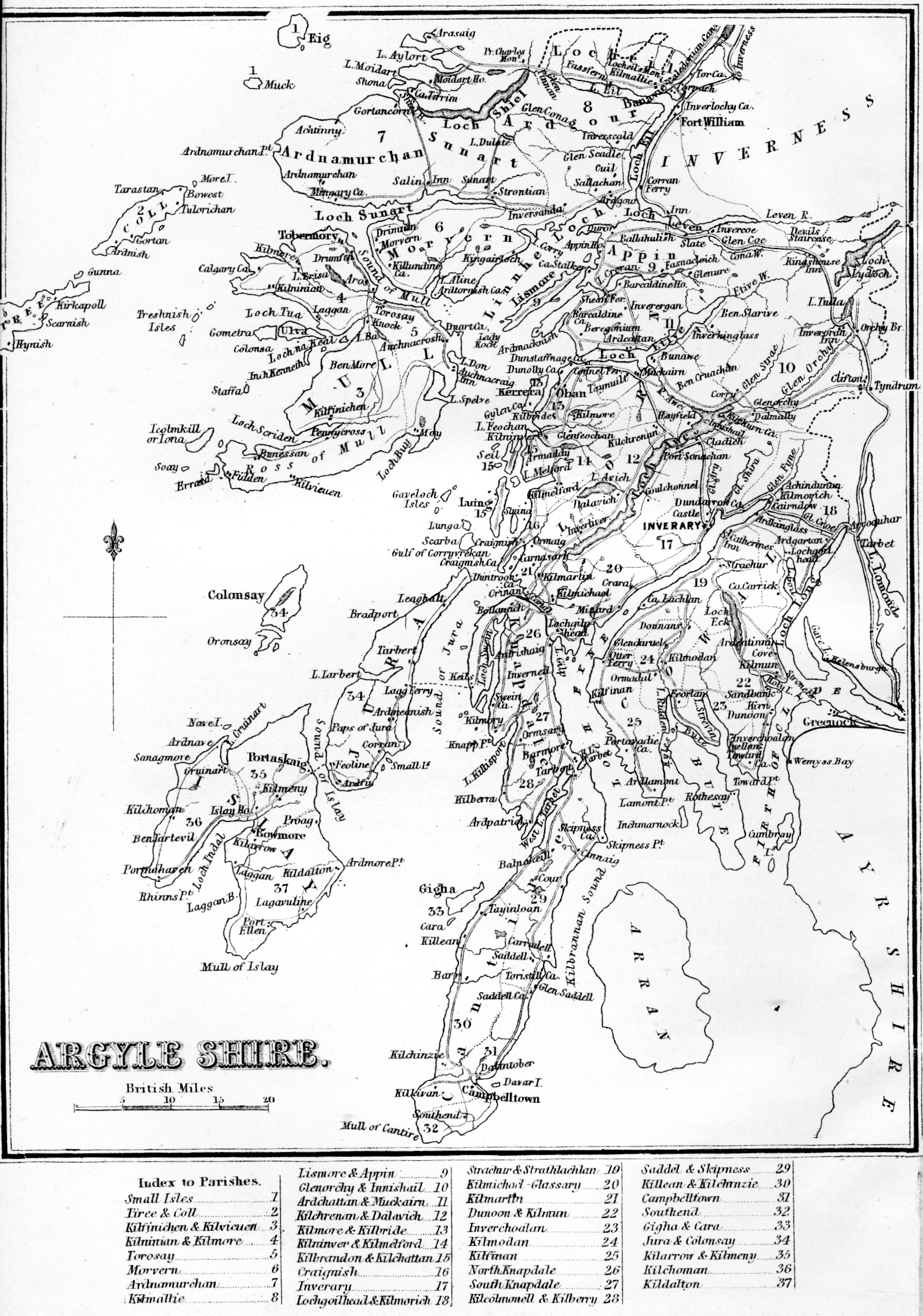
The county of Argyll formed
one of the seven provinces into which Scotland was divided in ancient
times. It was known under the various names of "Oirir Alban," "Oirir
Ghaidheal," "Ergadia," "Aire Ghaidheal," and extended at one time as far
north as Loch Broom. These boundaries were continued ecclesiastically up
to nearly the middle of the seventeenth century. when the Synod of Glenelg,
previously forming part of that of Argyll, was disjoined and raised into a
separate court. The present boundaries, both of county and synod, are as
follows, viz., on the north, Inverness-shire; on the south and west, the
Atlantic Ocean; and on the east, Perthshire, Dumbartonshire and the Firth
of Clyde. Its latitude is 55° 15' to 56° 55' north and longitude 4° 32' to
6° 6' west. The extreme length is 115 miles; breadth, 68 miles, measuring
from the Perthshire boundary to the back of Mull. Its area is 2735 square
miles of mainland, with 1063 of insular surface; in all, 3798, or about
one-tenth of the area of all Scotland. It presents a combination of
grandeur and picturesque beauty rarely surpassed in any region of the
earth.
This county is remarkable
not only for extent of surface and variety of scenery, but it holds a
proud place alike in the civil and ecclesiastical history of Scotland. It
is the cradle of the sovereign race, which, from the ninth to the
seventeenth century, reigned over Scotland, first at Scone, then in
Edinburgh, and subsequently, in the person of James VI., added the
sovereignty both of England and Ireland, and is so nobly represented by
Queen Victoria.
Kenneth M'Alpin, the first
king of united Scotland, was unquestionably of the Dalriadic stock. The
succeeding sovereigns, merging in the Stuart dynasty, all reigned in
virtue of their connection, nearer or more remote, with him; and it is
needless to add that the house of Brunswick reigns through its connection
with the Stuarts.
In regard to ecclesiastical
matters Iona was the luminary, not of the Caledonian regions only, but
shed the light of the Gospel over all the north-east coast of Scotland and
the north of England, and rightly' commands more reverence than any other
spot in the county.
Our scope does not lead us
to deal with the ancient 'history of the country, but it may be briefly
mentioned that in a.d. 503, a small band of Scots from Ulster in Ireland
settled in Argyllshire, and there established a kingdom known as Dalriada,
which embraced the whole northern part of the county, as well as some of
the islands still belonging to it. This Dalriada, after maintaining a
lengthened conflict with the northern Picts or Caledonians, seems to have
been overthrown by these in the eighth century. The history of the
succeeding hundred years is extremely obscure; but when the light again
dawns, it shows us, as already referred to, Kenneth M'Alpin,—a Scot by
paternal descent, but to all appearance a northern Pict by maternal
connection,—who, without opposition, reigns over the northern Picts, as
well as over the Dalriadii, and eventually unites the greater part of
modern Scotland under his sway.
In the twelfth century
Somerled, known in his early days as Somhairle Mac Gille Bride na h-uamha,
Somerled, son of Gille Bride of the Cave, was afterwards well known as
Lord of Argyll. The designation above mentioned shows that his father,
though . called Lord of Argyll, had been so stripped of his possessions as
to be obliged to take refuge in a cave; and this was caused by the
repeated invasions of the Norsemen or Scandinavians. Somerled began his
career with a small following of the clan Innes in Morven, and soon
subjected to himself both the southern and northern Hebrides. Thereafter
he boldly stood out against innovations attempted to be introduced into
Scotland by Malcolm IV, and .refused to acknowledge that king as his
sovereign. The descendants of Somerled were known for a longtime as Lords
of the Isles. They claimed sovereign rights, and entered into treaties
with England as independent princes. All the families of Macdonald claim
descent from Somerled, and while the chiefship has often been the subject
of dispute among them, it is certain that Macdougall of Lorn is the lineal
descendant of Dugald, a son of Somerled.
In the fourteenth century
Macdougall, having opposed Robert the Bruce, was stripped of the chief
portion of his lands, which the king gave, as a matter of course, to his
own supporters. The greater part was given to the Stuarts, and a
considerable portion to the Campbells, the chief of that clan at the time
having married the king's sister—an example happily improved upon in our
own day by his descendant, the Marquis of Lorn.
The county of Argyll
suffered, like every other place in the kingdom, from the constant
fighting carried on by neighbouring tribes, until the power of the State
was fully established throughout the country. Many bloody battles were
fought between Macdonalds and Campbells, and between Campbells and
Macleans, chiefly about the possession of Mull and Islay. During the
Montrose wars the county was first ravaged by one of the Macdonalds of
Antrim, still well remembered in song and tradition as Alasdair MacColla—a
very able partisan leader, and a distinguished swordsman, who came to
support the cause of Charles I. Thereafter it was utterly swept by the
Marquis of Montrose, who, in this pillage, and in the subsequent battle of
Inverlochy (1645), did greater scathe to the Campbells than any other
enemy ever did.
Alasdair MacColla
eventually escaped to Ireland, but a numerous band of his followers, who
defended the Castle of Dunaverty, in Kintyre, and who at length,
surrendering as prisoners of war to General David Leslie, were ruthlessly
put to death—a proceeding which reflects deep dishonour on an otherwise
brave man and an able general. The saddest event, however, connected with
the history of Argyll at any period, is the massacre of Glencoe (1692)—a
deed of savage and treacherous butchery, to be traced chiefly to the
Master of Stair; but which sheds infamy on all connected with it, from
King William and the Earl of Breadalbane, to the meanest soldier engaged
in the transaction.
The physical outline or
contour of this county is very diversified, and combines as grand and
picturesque scenery as any to be found in Scotland. A great part of the
county consists of islands, round which the billows of the great Atlantic
Ocean continually beat; and another large portion of it consists of
extensive peninsulas, frequently subdivided into tongues or promontories
by arms of the sea, which in some places penetrate into its inmost
boundary. Thus, to the east, we have the peninsula of Cowal, formed by
Loch Long and Loch Fyne, the southern point of which is subdivided into
three minor horns by Loch Riddan and Loch Striven. We have the peninsula
of Kintyre, 20 miles long, nearly cut off from the mainland by East and
West Loch Tarbet. The district of Knapdale, joined to Kintyre by the
narrow isthmus of this name, only 1½ miles broad, and often proposed to be
cut through to form a canal, is at its north end; and it, too, is almost
separated from the mainland by Loch Gilp and Loch Crinan. and on the
western side it is deeply cut into by Loch Swein. Lorn, which is connected
with Knapdale at Crinan and Carnban, is indented by many creeks and arms
of the sea, such as Loch Craignish, Loch Melfort, Loch Feochan, and Loch
Etive. The windings of Loch Etive are often compared to the Kyles of Bute,
but the scenery around the former is much bolder and of greater variety.
East of Bonawe, the loch takes a northerly direction, and amid mountains
of great height and curious outline, runs inland to the close
neighbourhood of Perthshire. The whole length of the loch is 22 miles. To
the north-west of it we have Benderlock, bounded by Loch Etive and Loch
Creran, forming a high ridge between them, with a level margin near the
sea-shore. Again, we have Appin between Loch Creran and Linnhe Loch
running north-east, and Loch Leven branching off to the mouth of Glencoe.
North of Loch Leven we have Inverness-shire, or Nether Lochaber. After
crossing the Linnhe Loch, there is the large peninsula of Ardgour, Kin-gairloch,
and Morven on the one side, and Sunart and Ardna-murchan on the other,
split up by Loch Sunart, which branches off from the Sound of Mull, and
runs in an easterly direction about 25 miles. The north side of this
peninsula and of the county is bounded in part by the ocean, thereafter by
Loch. Shiel, a fresh water lake fully 20 miles long, ending at Glenfinnan,
celebrated as the place where Prince Charles unfolded bis standard in the
autumn of the year '45. Loch Eil, a salt water loch, branching off from
the Linnhe Loch at Corpach, bounds the peninsula, and ought also to bound
the county; but there is a space about three miles beyond Loch Eil which
belongs to Argyllshire. There are forty of these sea-lochs or arms of the
sea described in the "Sportsman's Guide" for the month of July last as
good fishing places.
The fresh water lakes are
also exceedingly numerous, varying in length from upwards of 20 miles to
small ponds. There are 86 of these enumerated in the publication above
mentioned, with a minute account of the fishing afforded by each of them.
Loch Awe is not only the first of the Argyllshire lakes, but undoubtedly
the second of the lakes of Scotland, and deserves special notice. It runs
nearly from south-west to north-east from the Ford in Nether Lorn, to the
foot of Ben Cruachan and Dalmally. The north-east end is studded with many
beautiful islands, and on its banks, or rather on one of these islets at
its upper end, are the ruins of Castle Caolchurn, built some three hundred
years ago by the Breadalbane of the day, known in Gaelic as Cailein dubh
na Roimhe, in English as the Black Knight of Borne. Inch Connal is at the
south-west end, and upon it are the remains of a castle named, like the
island, after Connal, one of the Ossianic heroes; and in the immediate
neighbourhood are places named after Errath and Daura, also mentioned in
the Ossianic poems. Loch Avich lies close to Loch Awe, and Loch na Sreinge
farther west, is celebrated as the place where a distinguished ancestor of
Argyll was killed in battle. He is known as Cailein mor na Sreinge,."Great
Colin of the Sreang," and is buried in the churchyard of Kilchrenan.
Mountains.—With so many
valleys full of water, there must be very elevated ranges of land, and the
county is as remarkable for its mountain ranges as for its lochs.
Looking to the Grampians as
culminating in Ben Nevis, we can follow their gradual descent towards the
western sea in the various branches which they send off through
Argyllshire, all nearly parallel, and radiating from the Black Mount. We
have first the Cowal Mountains, inclining southward; (2) the Inveraray,
Knapdale, and Kintyre range; (3) the Glen Etive, Ben Cruachan, and Lorn
range, which may be traced on to the island of Islay; (4) the large
mountain tracts in Appin, Morven, Ardnamurchan, and Mull.
Cruachan is the highest of
all these, and is in form the most picturesque mountain in Scotland. The
Glen Etive range, with the two striking peaks so appropriately named "Buachaillean,"
"the Shepherds of Etive," rank second to Cruachan in height. The higher of
the two Shepherds towers to a height of 3341 feet. Some of the peaks in
Appin, Ardgour, and Ardnamurchan approach the height of 3000 feet. Ben
Cruachan is 3611 feet by Ordnance Survey.
Rivers.—The number of
lochs, and the proximity of the sea to the base of the mountains,
necessarily exclude rivers of any lengthened course. The Orchy, rising in
the Black Mount, and flowing into the north-east end of Loch Awe, is one
of the principal feeders of that lake. The Awe, by which the lake of the
same name discharges its waters into Loch Etive, has a short and rapid
course of less than four miles, and is among the principal salmon rivers
of the Highlands. The Etive and the Kinglass fall into Loch Etive. The
Creran and the Coe are in Appin. These, along with the Nant, Lonan,
Feochan, and Iuchair in Lorn, the Add, flowing into Loch Crinan, and the
Shira and Aray, flowing into the north end of Loch Fyne in Cowal, are
among the most important on the mainland. The Lochy and the Shiel, both
large and very valuable salmon rivers, separating Argyll from
Inverness-shire, cannot be claimed exclusively for either county.
Islands.—The islands are
many in number, important in size and productiveness, and several of them
interesting both on natural and historical grounds. Mull, the Maleus of
Roman geographers, is the largest of these, being 28 miles in length. Ben
More, its highest mountain, is 3168 feet in height. Mull, like its parent
county, is deeply indented with various arms of the sea, such as Loch nan
Ceall, Loch Screden, Loch Buy, and Loch Speilve.
Islay comes next in size,
and ranks first in point of fertility. It is 23 miles in length, by 20
miles in extreme breadth. The population in 1871 was 8139. It is nearly
cut into two by Loch-in-daal in the south, and Loch Gruinart in the north.
Jura comes third in order,
and is celebrated for the height and shape of its mountains, with their
granite heads known as the Paps of Jura. Close to Jura is Scarba, which
consists of one mountain, as rugged in character as those of its sister
island. Between these two islands is the celebrated whirlpool of
Corrie-Bhreacain, the Maelstrom of Celtic mariners, and the subject of
many tales and myths in past times. To the west is the island of Colonsay,
celebrated as the birthplace of the late Lord Colonsay, a lawyer in the
fullest sense of the term, who adorned the highest legal offices in
Scotland; and had the honour of being the first Scotchman who was
transferred from the Supreme Scottish Court to a seat in the House of
British Peers. His brother, Sir John M'Neill has earned deservedly great
fame in the diplomatic service of his country.
Adjoining Colonsay lies the
small isle of Oronsay, which ought to be better known for its beautiful
ecclesiastical ruins, admirably illustrated in Pennant's "Tour." To the
north of, and lying close to, the Boss of Mull is Iona, which will always
be celebrated as the place where the truly great and noble Columba landed
in the year ,563, and afterwards founded his monastery, where many
distinguished missionaries were trained, and where kings, not of Scotland
only, but of other realms, sought their final resting-place.
Staffa, the gem of the
Hebrides, and within sight of Iona, has been so often visited, and so
frequently sketched, that it is not necessary to describe it here. Her
Majesty, Queen Victoria, was there in 1847, and says of it:—"At three we
anchored close before Staffa, and immediately got into the barge, and
rowed round towards the cave. As we rounded the point the wonderful
basaltic formation came in sight; the appearance it presents is most
extraordinary, and when we turned the corner to go into the renowned
Fingal's Cave, the effect was splendid,—like a great entrance into a
vaulted hall: it looked almost awful as we entered, and the barge heaved
up and down on the swell of the sea. It is very high, but not longer than
227 feet, and narrower than I expected, being only 4 feet wide. The rocks
under water were all colours, pink, blue, and green, which has a most
beautiful and varied effect. It was the first time the British standard,
with a Queen of Great Britain, her husband and children, ever entered
Fingal's Cave, and the men gave three cheers, which sounded very
impressive there." The island is small in size, and there is no dwelling
upon it, but a few sheep and young cattle are sent there to graze.
Tiree, known as "Tir iosal an eorna," "the low land of barley," is 13
miles in length by 6 in breadth. In its neighbourhood is rocky Coll, 14
miles long and 3 broad. Lying close to Mull is Ulva, the ancient
possession of the Macquarries, having a church and a school of its own.
Inch Kenneth, remembered on account of Dr Johnson's elegant tribute to the
refined hospitality he met with there from Sir A. Maclean and his
accomplished daughters ; also Gometra, the Treshnish Isles; Calne innis
forming such a breakwater in the mouth of the bay of Tobermory as
constitutes it one of the safest harbours in the world. Farther north is
the small island of Muck, and beyond it that of Eigg, remarkable for its
geological formation, very clearly exhibited in the various strata of its
Scur, or highest peak, where among other varieties are to be seen
different specimens of the Pinus eggensis, an extinct pine, thoroughly
silicified.
Turning to the south we
have first Lismore, 10 miles long by 1½ broad, formed entirely of
limestone, and consequently affording rich pasture everywhere, as its
name, "the great garden," implies. Kerrera, in the immediate neighbourhood
of Oban, is celebrated for its horse-shoe harbour. Gylen Castle, at the
south-west end of this island, is much visited by tourists. Farther south
still is Easdale, well known for its slate quarries; Seil, Luing, Shuna,
Lunga, the Holy Isles, and some smaller ones. On the west coast of Kintyre
we have Gigha. To the northward, again, and in the Linnhe Loch we have
Stalker Island, with its old castle, and in its immediate vicinity there
is the green isle of Shuna. At the mouth of Loch Creran we have the island
of Eriska. Besides these there are other smaller islets too numerous to
specify. The coast-line of the county, following the windings of the bays
and sea-lochs, is said to extend to 600 miles.
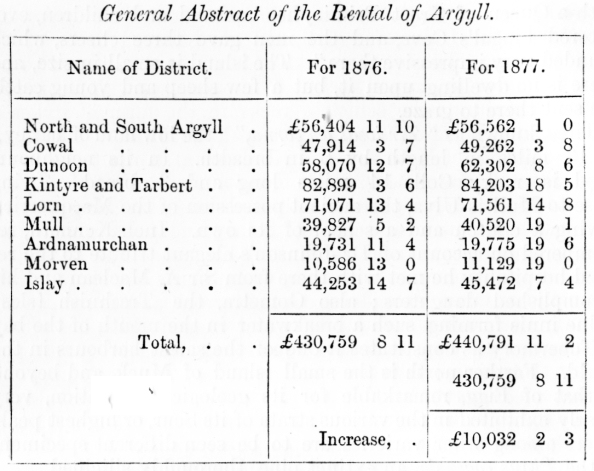
Rental.—The following is a
brief abstract of the rental of the different districts of the county,
which, for the year 1877 as compared with 1876, shows a small increase,
not only for the whole county, but also for each district:—
Population.—The population
of the county in 1831 was 100,973; in 1851, 89,298; and in 1871, 75,679.
These figures will be reverted to in the concluding remarks. There are
thirty-eight parishes in the county, of which sixteen are united parishes
or double charges.
Geology.—Before proceeding
to soil and climate, it will be proper to make a few remarks about the
geology of the county.
In the geological map of
Scotland, arranged by the late Sir Roderick I. Murchison and Mr Geikie,
and in the new map issued by Mr Geikie, the great proportion of the rocks
of Argyllshire belongs to the Lower Silurian period. The most ancient
sedimentary fossiliferous deposits known are the strata of gneiss, first
studied on the river St Lawrence, and hence named the Lawrentian system.
The equivalent of this system constitutes in Scotland the island of Lewis,
from the Butt to Barra-head, and also occurs in the islands of Coll, Tiree,
and Iona. The Lawrentian system is not represented in England or in
Ireland. The Silurian rocks prevail throughout the central Highlands, and
are described in the map referred to as the Grey Wacke slates and
limestones of the south of Scotland, metamorphosed in the Highlands into
clay, chlorite, mica slate, and gneissose rocks, based on quartzose
flagstones, quartz rocks, and associated limestones. The clay slate is
quarried for economical purposes at Easdale, Ballachulish, and near
Carnban on the Crinan Canal. The secondary geological series of the
formations is represented by the Oolitic deposits of Mull and Morven,
which are fossiliferous. Deposits of coal of the Oolitic age occur in
Mull. At Artunhead, in Mull, the Tertiary leaf beds occur, which were
discovered by the Duke of Argyll, and are believed to be of the Mesozoic
age. The basaltic rocks of Staffa are considered to belong to the same
geological period. Whinstone, which is frequently found to penetrate the
schistose rocks in the form of dykes or veins, is developed on an
extensive scale in Mull, at Oban, and in the parishes of Muckairn and
Kilchrenan. Granite occurs at Loch Etive, Bonawe, Ben Cruachan, and at the
Boss of Mull. The Old Bed Sandstone appears on a limited scale near
Campbeltown, and between Dunoon and Toward Point; and the Carboniferous
system is represented near the Mull of Kintyre. The Bed Sandstone and
conglomerate formation, which skirts the shore of the mainland at Oban,
extends across to Kerrera, and is seen in the Linnhe Loch, often forming
lofty and rugged cliffs, has a basis of decomposed trap, enclosing round
fragments of quartz, porphyry, whinstone, feldstone, and granite. The
geological age of the conglomerate has not been ascertained. It is
probably as old as the Silurian rocks which it accompanies. Dunstaffanage
and Dunollie Castles are built upon this rock, and it is also the basis of
the ancient vitrified fort of Dunmacsniochan, or Berigon-ium, in the
parish of Ardchattan.
Soil and Climate.—The soil
in Argyllshire is of many and various kinds, as must be evident to anyone
who looks at the variety of rocks mentioned in the foregoing geological
summary, and reflects on the number of its high mountains, its glens, and
its sea-lochs. Light gravelly soil and sandy loam are the most prevalent.
Beat mosses are also frequently to be met with, and occasionally a few
meadows composed of rich alluvial soil occur. Owing to the configuration
of the land the rivers have not long courses to run, and consequently the
meadows are but small in extent, while we have no deep clay lands such as
are to be found in the southern portions of the kingdom. It is needless to
observe that the nature of the rock generally determines the nature of the
soil. At the same time there are important exceptions to this rule, and
various modifying circumstances must be taken into account before we can
pronounce absolutely on the subject. Thus, in Glen Etive, as in many other
localities, decomposed granite makes very poor soil, while in Sunart, in
the northern part of the county, the same material gives very good
pasture, and, when well cultivated, remunerative crops. The same may be
said of trap. In some parts of the county it is covered by heather, and in
Morven it yields many rich grasses. In Glen Etive and Glenkinlass there
are wide mountainous tracts, almost barren, yet elsewhere we find healthy,
though coarse, pasture over similar rocks. Decomposed limestone everywhere
makes rich and productive soil, which is specially seen in the island of
Lismore; and clay slate, as in the islands of Seil and Luing, is scarcely
inferior. The lands in these islands, whether pasture or arable, are very
valuable. Mosses, when the peat is even to a small extent mixed with sand
or clay, form an improvable subject, but where nothing but vegetable
matter is to be found, and the roots scarcely decayed, it is much better
adapted for fuel than for any agriculture purpose. Wherever rivers run
moderately, they leave an alluvial deposit, forming rich level land, as,
for example, the Lonan, which in its short course of a few miles has
formed several valuable meadows, both in the glen to which it gives its
name, and especially at the head of Loch Nell, into which it discharges
itself. The quantity of natural hay yielded by these meadows is very
great, and the size of the cattle pastured on them attest its nutritive
qualities. Mention may be made of gravel mounds, or escars, as they are
now frequently called, which are to be met with throughout the county in
very great numbers. They sometimes differ entirely from the nature of the
soil which surrounds them, evidently showing that they are due to the
effect of drift during the glacial period; but while their surface is
green, they are not generally productive. A great proportion of the arable
land of Argyllshire is to be found on the raised level or terrace to be
seen between the present sea margin, and an ancient one about 30 feet
higher, which is to be seen around the whole of Scotland, along the south
coast of England, and the north of France. This old beach or terrace is
generally composed of layers of gravel and clayey sand, with frequent beds
of marine shells, which, as well as the waterworn stones, speak
unmistakeably of its origin, and while such a soil cannot be called rich,
it makes a fair return to the farmer. Before the potato disease the yield
of that valuable esculent was often very large, and exceedingly good crops
of barley were also grown on it. A belt of this raised sea-beach, greatly
varying in breadth, according to the general conformation of the land, is
to be seen from Kintyre, the south-west of the county, to its extreme
northern point in Appin, and elsewhere along the shores of all its
numerous sea-lochs.
Climate.—The climate of
Argyllshire is remarkably mild, considering the latitude of the county,
but is very moist. The great extent of its sea-coast accounts for both
these qualities. The prevailing winds are from the south and south-west.
These partake of the comparatively high temperature of the Atlantic Ocean,
and, at the same time surcharged with its vapour, cover its high mountains
with clouds, which frequently discharge their watery contents over the
neighbourhood, and always keep the atmosphere in a humid state. Snow
seldom lies more than two or three days near the sea, even on the shores
of Loch Eil and the Linnhe Loch, which are in the immediate vicinity of
Ben Nevis—the highest mountain in Scotland; but it covers the tops of the
mountains for four or five months, and Ben Cruachan is seldom clear of it
before the end of July. Frost is not of long continuance in ordinary
seasons, and while there are curling clubs in the county, the members
complain that they do not get so much practice as their brethren in the
south.
The winters are milder in
Argyllshire than in many places further south, and plants are found to
stand the winter in the open air that require protection in the south of
Scotland, and even in England. The portions of it bordering on the Firth
of Clyde have long been favourite winter retreats for those suffering from
pulmonary complaints; and some medical men maintain that the natives of
the western islands are almost entirely free from such complaints, which
form such a fatal scourge in other portions of the kingdom.
According to the Scottish
Meteorological Tables, the weather for a series of years was found to be
as undernoted, the observations having been taken at Oban:—Barometer at 3
degrees, and at sea-level, 29.851; mean temperature, 47.3; rainfall,
65.29. At Dunollie the rainfall in the year ending 30th September last was
67.21.
Further returns will be
seen in the Appendix.
Sheep Hill-Farms.
In treating of sheep, it
would be convenient to take sheep farms by themselves, but it must be kept
in mind that the best sheep ranges have often straths or low ground where
black cattle are reared, and that both kinds of stock answer well
together. There are portions of the county, however, more mountainous than
others, and the farms in these may properly enough be called hill-farms,
sheep being the leading stock. This is the case with that part of the
county bordering on Perthshire, forming part of the range called "Drimalbain"
in former times.
Starting, then, at Tyndrum,
which is now a railway station, the large tenement of Auch will be seen to
the right, and it deserves a prominent place for its sheep stock. Under
the management of Mr Stewart, the stock attained a high character, and
commanded the best prices at Falkirk and other markets. The pasturing was
good, and the ranges extensive, including the far-famed Bendoran; but
without judicious management neither sheep nor cattle would thrive as they
were found to do at Auch.
This tenement was possessed
in succession by Mr Charles Stewart, Mr Ogilvy, Mr Menzies, and now by Mr
Robert Grieve,, who keeps a mixed stock of ewes and wethers, and manages
so well that the high character of the stock is fully maintained. The rent
paid by him is £1100. This and all the adjoining tenements belong to Lord
Breadalbane, and are in the parish of Glenorchy, or united parish of
Glenorchy and Innishael.
The neighbouring tenement
of Auchalder, sometime possessed by the late Mr Donald Sinclair, produced
sheep not much inferior to those of Auch; and the friendly rivalship
between him and Mr Stewart helped to forward the improvement of both
stocks. The present tenant is Mr Donald Stewart, at a rent of £820. He
also keeps up the high character of his stock.
For the extent of bounds,
the tenement of Succoth, in the same parish and on the same estate,
deserves to be mentioned. It occupies the greater portion of Glenorchy,
through which the railway to Dalmally passes. This tenement was long
managed by Messrs M'Kay (father and son), who had a very good stock of
sheep, and also summered a few scores of heifers, taking care to have the
best that could be found at the local markets. Messrs J. & D. C. Willison
are now the tenants, paying a rent of £1060. The stock is a mixed stock of
ewes and wethers, and is well managed. Along with Succoth, the Messrs
Willison have a large tenement of rich good land in the island of Luing,
which affords excellent wintering ground for the hoggs.
Adjoining Succoth is
Corryghoil, possessed by John Campbell at a rent of £272. He keeps a
first-class stock of ewes, and is an excellent manager.
Snow lies heavily on these
high lands, and the sheep suffer when there is a long continuation of it.
The remedies are to send
the weaker portion of the stock to winter on lower grounds, and to attend
carefully to the herding of those kept at home. The rate now charged for
wintering hoggs is very high, ranging from four shillings to seven and
even eight shillings. This may be called additional rent, but it is better
to submit to such high rates than lose a great proportion of the young and
weaker part of the stock.
There was a memorable
occasion in which the sheep farmers in the district now referred to
suffered severely, and the tenant of Corryghoil was ruined by it. This was
the heavy snowstorm in November 1827, by which there was a great loss in
sheep, and even human lives were lost. Whenever snow lies on the ground,
though not so heavy as to smother the sheep, it reduces them in condition,
so that many of them die before the new grass springs up for their
support.
Passing down the glen
towards Dalmally, and leaving Succoth behind, the tenement of Brackley
will be seen. It is possessed by Mr James Crerar, who keeps a mixed
blackfaced stock. The rent paid by him is £270. On the right hand side of
the glen is Craig, of which Mr Peter Robertson is the tenant. He pays £212
of rent, and keeps a mixed blackfaced stock and a few cattle.
Going round by Stronmilchan,
and arriving at the Bridge of Strae, the large tenement of Duiletter will
be seen. It was long possessed by Captain Alexander Campbell, who kept a
fairish stock of sheep, and a very good fold of black cattle. Some meadow
land along the river Strae affords the means of wintering black cattle,
and there was also some arable land.
Duiletter is now possessed
by his son, Duncan Turner Campbell, and those of the family who remained;
but they have also the large farm of Achalian, on the road to Cladich,
which belongs to J. Cunliffe Kay, Esq., and the rent is £550. The stock
kept is of the same description as formerly kept at Duiletter, except that
wether lambs are transferred from one farm to another, so that there is
ewe stock on part of their possession and wether stock on another. The
fold of Highland cattle is still kept up.
Having left the Breadalbane
lands on going to Achalian, it may be as well to finish a group of
hill-farms, of which Ben Laoidh and Ben Buie are conspicuous portions.
Near to Achalian, but on
the Breadalbane estate, is Blarachaorin, possessed by J. B. Lawes. Esq. He
pays £200 of rent, and keeps a mixed stock of sheep and West Highland
cattle, which are very good. There is some good arable and meadow land at
Blarachaorin. After passing Cladich, and ascending towards the top of
Glenera, is the tenement of Accurach, which belongs to the Duke of Argyll.
The rent is £250, and Mr John M'Arthur is the tenant. He keeps a mixed
stock of sheep, and summers a score or two of heifers. He has now taken a
large tenement near Kingussie, and seldom resides at Accurach. Ben Buie or
Ellrigmore, also on the Argyll estate, has long been known as a very
important sheep tenement. The present tenant is Mr William M'Niven, who
pays a rent of £707. The stock almost entirely consists of blackfaced
sheep, ewes, and wethers. Drimlea, occupied by Mr H. M'Intyre, marches
with Ben Buie; and the same kind of stock of sheep is kept. There are kept
upon it at present about half a score of milk cows, and a score of Hying
stock. Lower down the glen is the tenement of Maam, which is in Glenshirra,
whilst the two last mentioned are rather at the head of it. Maam is
possessed by Mr Charles Turner and sisters, at a rent of £351. The sheep
are of the same kind as those above named, and there is about a score of
breeding West Highland cattle and their followers. Kilblaan is the next
farm down the glen, and is occupied by Mr James M'Pherson at a rent of
£290. The sheep are chiefly a ewe stock, and are very good, perhaps among
the best in the county. He also keeps some milch cows and flying stock.
The lower part of the glen
is level and of excellent soil, and is generally let in parks, in which
cattle are fattened for the market. Leaving Glenshirra, and passing
Stroneshirra (which is covered with plantation), Glenfyne and the head of
Loch Fyne are soon reached.
There are a few large
tenements there which must be classed as hill-farms. The first to be
mentioned is Dundarave and Clachan, the latter at the very head of the
loch, possessed by Messrs D. Black, sen. and jun.
The rent of Clachan is
£850, and of Dundarave, Cuil, &c, £300. Messrs Black keep a mixed stock of
blackfaced sheep, which are very well managed.
The large tenement of
Achadunan, at the head of the loch and on the Cowal side, has long been
famed for its stock of cattle and sheep. It is at present possessed by Mr
Duncan M'Arthur at a rent of £950. He keeps a mixed stock of blackfaced
sheep.
Marching with Achadunan is
the large tenement of Pole, possessed by B. H. & B. Crawford at a rent of
£800.
The sheep, which are
blackfaced, are good. The old coach road from Lochgoilhead to Loch Fyne
passes through the farm, and there used often to be seen a herd of good
West Highland cattle in the strath of the glen. Following the coach road,
and ascending towards Loch Fyne, the tenement of Ardnoe is entered upon,
and the houses are seen on the right hand side of the road. Ardnoe is now
possessed by Mr Alexander Rintoul at a rent of £900. He keeps a good mixed
stock of blackfaced sheep, Highland cattle, and Ayrshire cows. The four
possessions last named are on the Ardkinglass estate, and in the parish of
Kilmorich, which is joined with Lochgoilhead.
Leaving the head of Loch
Fyne it is necessary to return to Dalmally, which, with its railway
station, is now a central point among the mountains. Arrived then at
Dalmally, and looking towards Ben Cruachan, the large tenement of Castles
will be seen. Mr John Grieve has long been in possession of Castles,
Drisaig, &c, which have very extensive bounds. The tenement includes the
wood of Leitter, fringing Loch Awe and the base of Ben Cruachan for six
miles, and having its north-west boundary at the pass of Brander. The rent
is £750, and the stock is blackfaced sheep, ewes, and wethers. A
considerable number of cattle can be summered on this farm. Mr Grieve is
an excellent manager of sheep and cattle, and has often been called upon
to act as a valuator of sheep stock on a change of tenants. A portion of
Ben Cruachan is within the bounds just mentioned, at the whole front of
the mountain belongs to Inverawe.
Inverawe and Grundachy used
to be joined together, and the late Mr Charles Johnstone possessed them
along with other lands on the lower side of the river. His heirs have
Grundachy at £180 of rent, and keep good blackfaced sheep. The pasture is
better at Grundachy than on any other part of Ben Cruachan.
Inverawe is now possessed
by Mr James Jardine, a Dumfries farmer, and he has a mixture of whitefaced
sheep among the blackfaced stock. Marching with Inverawe, and occupying
the back part of Ben Cruachan, is the tenement of Glenoe and Dua,
possessed by Messrs D. & J. Campbell, who are excellent managers of sheep.
The stock is mixed of blackfaced sheep, and is very good.
Glenoe will summer about a
score of cattle, but very few can be wintered. The rent is £350, and both
it and the other tenements in Glen Etive, to be immediately mentioned, are
on the Breadalbane estates.
Next to Glenoe is
Inverliver, possessed by Messrs J. M. & N. Campbell, sons of the late Mr
John Campbell, who was an excellent judge of sheep, and a man much trusted
and respected in the county. The rent of Inverliver is £350, and the stock
kept is of the same description as that of Glenoe, with the exception that
Inverliver admits of black cattle being kept. There is more of level
ground along the shore than at Glenoe, and some crop can be raised,
sufficient for wintering them. Messrs Campbell have a small fold of tidy
cows and their followers, and they are of the best description.
The next tenement on that
side of Loch Etive is Acharn, Ardmaddy, &c, possessed by Messrs B. & J.
Crerar and Mr William Campbell, and the rent is the same as that of
Inverliver.
Acharn is back from Loch
Etive and into Glenkinlass. There is some meadow land along the river
Kinglass, so that a few black cattle can be kept. After leaving Ardmaddy,
the deer forest, forming part of the Black Mount range, commences.
Dalaness, at the head of the glen, has been for a long time under deer.
These lands are so rugged and wild that they are much more fitted for deer
than for sheep, and still there used to be good sheep kept on portions of
them, such as at Glenketlan. It was long possessed by Mr Peter Campbell,
father of the present tenants of Glenoe, and uncle of those at Inverliver.
On crossing the river Etive,
the mansion-house erected by Mr Greaves will be seen. He lately purchased
the lands of Invercharnan, Drumachois, &c., which formerly belonged to Mr
Campbell of Monzie. Mr Greaves has all the lands in his own hands, and is
making many improvements in planting, erecting fences, &c.
Leaving Drumachois, the
Wood of Barrs will be seen stretching for some miles along the north side
of Loch Etive. From the shelter afforded by the brushwood, and the sunny
exposure, the Wood of Barrs was found an excellent place for wintering
hoggs. When Mr Sinclair was tenant of Glenoe he had it for this purpose,
and for summering young cattle. Both places belong to Lord Breadalbane.
Barrs is the only portion
of the west side of the loch that belongs to the Breadalbane estate. This
place is now joined to the tenement of Glenure, on the other side of the
hill, and will be mentioned on coming to Glenure. To the west of it
Ardchattan estate, belonging to Mrs Popham, begins. Daill and Cadderly are
the first two farms, but they also have lately been joined to other
tenements to be immediately mentioned. Passing down to Island Ferry, and
leaving the granite quarries behind, Blarcreen, beautifully, situated at
the base of Bendurinis and at one of the curves of Loch Etive, will be
seen. The tenement now consists of Blarcreen, Inveresragain, Craig,
Kineraig, and Cadderly, all possessed by Mr Angus Buchanan at a rent of
£800. The sheep stock is blackfaced, and moderately good in quality. A
fold of cows and their followers is kept, and there is a considerable
extent of arable land at Blarcreen and Inveresragain. The soil is thin,
but good crops are generally raised, and there is more than sufficient for
the use of the farm. Potatoes, for instance, thrive very well there, and a
considerable quantity can be spared for the market. Benbhreac, which is
joined to Achinreir, marches with Inveresragain. Achinreir was long
possessed by Mr Donald Sinclair, and latterly by his two sons. Mr Sinclair
was an excellent manager of sheep and cattle, and was often asked to act
as judge at cattle shows, and as valuator of sheep stocks. The sons
quitted possession at Whitsunday last, and Mr Angus Buchanan, junior, is
now the tenant. The cattle, which were pure West Highland, and very good,
were sold by public roup at Whitsunday, and realised good prices. The
young cattle also sold well. The rent is £465, but varies with prices at
Falkirk market.
On reaching Loch Creran at
Barcaldine, and leaving the beautiful mansion and parks behind, and
turning to the right, Dalachulish is the first considerable sheep farm. It
is possessed by Mr Hugh M'Coll at a rent of £325, and he now has joined to
it Daill in Glen Etive, of which the rent is £65. It is an excellent sheep
range from the one loch to the other, and Mr M'Coll does full justice to
the stock. There is some arable land at Dalachulish, and a small fold of
Highland cattle is kept. Both Achinreir and Dalachulish are on the
Barcaldine property, now belonging to Mrs Mary Cameron. After leaving the
end of the loch, and entering Glen Creran, the farm of Tarphocan is seen
on the right hand side of the river. The hill is not favourable for
producing sheep of a large size, but under the careful management of
Messrs J. & D. M'Kenzie the stock was put into a fair condition, and is
still kept so by the surviving brother and his sons. D. M'Kenzie made a
point of being in the hill once a day, and such care will always reward
itself. The rent of the tenement is £300.
Further on in the same
direction Glenure will be reached, and the tenement is well suited for
sheep and cattle. The Wood of Barrs in Glen Etive is now joined to it, to
the great advantage of the sheep stock, and the tenants, Messrs John &
James M'Kay, will turn this to good account. They have also Glenstockdale
in Appin, and the home farm and parks of Kinlochlaich. They have sheep on
the hill, and a flying stock of stots and heifers, of the best they can
get to purchase, on the low grounds. Bound the head of Loch Creran, and on
the Appin side, there is the tenement of Salachail, possessed by Messrs J.
& A. M'Nicol. The rent is £315, and they keep whitefaced sheep, ewes, and
wethers, and a few cows. After passing Origan Ferry, and turning to the
right, there is the farm of Invernahoyle, possessed by Mr D. M'Vean at a
rent of £390. He keeps a ewe stock, blackfaced. He also keeps some tidy
cows, with their followers. The Strath of Appin, which is excellent land,
and well cultivated, may be passed over at present, and Glenstockdale may
be passed through as having already been mentioned in connection with
Glenure and Messrs M'Kay.
Salachan and Belloch are at
the east end of Glenstockdale, and are possessed by Mr John M'Intyre. The
rent is £265. Beyond Salachan and at the back of Appin are the farms of
Lugnaha, Acharra, Keil, and others. The farm of Lugnaha (proprietor, G.
Gardiner, Esq.) is presently possessed by Mr John G. Anderson, who pays a
rent of £220. He keeps a stock of Ayrshire cows and blackfaced sheep. Next
comes Keil, belonging to Mrs M'Alpine Leny of Duror. It is occupied by Mr
John M'Intyre, who pays a rent of £150. His stock consists of Highland
cattle and blackfaced sheep. The farm of Acharra (proprietor, A. D.
Anderson, Esq., of Ardsheal) is possessed by Mr Lachlan Campbell, who pays
a rent of £142. The stock consists of Highland cattle and blackfaced
sheep.
Achindarroch (proprietor,
G. Gardiner, Esq., of Ardsheal) is possessed by Mr James Scott at a rent
of £433. He keeps Highland cattle and blackfaced sheep. Ardsheal home farm
is occupied by the. proprietor, A. D. Anderson, Esq., who keeps a fold of
Highland cattle, very good and rapidly improving. The estimated rent is
£230.
Ballachulish home farm,
belonging to LadyBeresford,is occupied by Mr James Scott, who pays for it
a rent of £227, 10s. His stock consists of Ayrshire cows and blackfaced
sheep, strong and good. further on, and at the mouth of Glencoe, is the
tenement of Achnacoan, Invervagain, &c., possessed by Messrs. S. & W. E.
Farish at a rent of £398. A grand sheep tenement of the same class as
those around it.
Mr Duncan Buchanan,
Caolasnacoan, now rents a number of farms - Caolasnacoan, £160; Invercoe
home farm, £135; Auchtrichtan, &c, £290. Blackfaced sheep are the stock to
which Mr Buchanan has devoted his attention for a long time, and he has
been very successful in his management of them.
The mountains and crags
about Glencoe are not very fit for the grazing of any domestic animal, and
there are some hill tops in Glen Etive, such as Benstara and Bentrilichan,
that have been denuded of soil so as to be useless for sheep. Except
these, however, there is very little ground that can be called useless in
the somewhat extensive tract of land that has been glanced at. It is
proposed to take next the division of the county north of the Linnhe Loch,
formerly mentioned as a division of the county.
In the tourist season it is
easy to pass from the one place to the other, as the "Swift" steamer
leaves Ballachulish and calls at Cor-ran, making the passage in less than
half an hour. After arriving at Corran, the following tenements will soon
be reached:— Stoncreggan, Trinslaig, &c, of which Mr Duncan Boyd is the
tenant, at a rent of £331. The stock consists of blackfaced sheep and
milch cows. Part of Inverscaddle is occupied by the proprietor, the Earl
of Morton. The estimated rent is £667, and the stock kept is blackfaced
sheep and milch cows. Aryhoulan and Corryveachang are possessed by Dr
Simpson, at a rent of £737. The stock consists of Cheviot sheep and milch
cows. There are no crops raised on this or any of the succeeding farms,
except for the use of the house and to feed the few cows kept.
Kiel and Camusasaig,
occupied by Mr William Cameron; rent, £210; stock, blackfaced sheep, cows
(Highland). Sallachan and East Gerrach—D. M'Vean's executors are the
tenants, at a rent of £356. The sheep stock consists partly of blackfaced
and partly of Cheviots. There are some cows kept.
Inversanda and Torran—tenant,
A. M'Vean's widow; rent, £259; stock, blackfaced sheep and Highland cows,
with their followers. These four farms are on the portion of the Ardgour
estate, retained by A. M'Lean, Esq., of Ardgour, when a part of the
property was sold to the Earl of Morton.
On the Kingairloch estate,
belonging to Charles Forbes, Esq., the following farms may be mentioned:—Glensanda,
Glengal-maddle, Lochuisg, &c, possessed by Mr John M'Intyre, who was for a
long time tenant of lands in Lismore. The stock kept by him consists of
blackfaced sheep and cattle of all kinds. The rent of the whole is £1130.
Kilmalieu, occupied by A.
H. Bill and Mrs Bill at a rent of £200. The stock consists of blackfaced
sheep.
North Corry is held by the proprietor at the estimated rent of £200,
including the mansion-house. Stock, blackfaced sheep.
Mr Smith, Acharanich, keeps
his lands in his own hands, and has a deer forest and a sheep stock of
whitefaced. There are also some Highland cattle.
The estimated rent of the
estate is £2090. Mrs Paterson of Lochaline keeps the estate in her own
hands, and has a stock of blackfaced sheep. The sheep, on the whole, are
strong and The lands now under sheep were occupied by small tenants and
crofters until Mrs Paterson's time, but they were all turned away to make
room for the sheep. On the Drimnin estate (J. C Gordon's) are Drimnin
Mains, possessed by Dundas Helme, rent £280, and Drimbuie, by D. M'Master,
rent £220, with a stock of whitefaced sheep on each tenement.
The Glencrepisdale estate,
belonging to Rev. W. & H. Newton, is occupied as follows:—Glencrepisdale,
by Messrs Robertson, at a rent of £850. The stock consists of blackfaced
sheep. Laudle, with a stock of blackfaced, and Liddesdale, with whitefaced
sheep, are in the proprietor's hands.
Killundine also is in the
hands of the proprietor, who has a stock of whitefaced sheep and a fold of
cattle.
There were splendid
Highland cattle on Killundine when Mr M'Lean possessed it, and Colonel
Cheape has them quite as good. The lands in this portion of Morven are
very good, and well adapted for sheep and cattle.
On the Sunart estate,
across Loch Sunart, there are some large sheep tenements, but it maybe
enough to mention the following:— Drimuantorran, possessed by W.
Kilpatrick and J. Mulligan, jun. rent, £571; carries a stock of Cheviot
sheep. Reisipoll, &c., by H. & C. Cameron; rent £235 ; stock, blackfaced
sheep and Highland cattle. Carnach, by D. Cameron; rent, £215; stock,
blackfaced sheep and Highland cattle. Achanellan and Clash, same tenant
and same rent as last; stock, sheep, but no cattle. liauachan,&c., by
Charles M'Arthur; rent, £200; stock, Cheviot sheep. Glenhurich, Pollock,
&c, by J. Milligan, sen. and jun., rent, £1050; stock, Cheviot sheep.
There are many sheep stocks
throughout the county as good as any that have yet been mentioned, but
they will be taken up on going over the different districts. The subject
may be concluded for the present by a few general remarks.
When a change of tenant
occurs in a sheep tenement, the entry is always at Whitsunday (old style).
The custom in the county is to take the sheep stock at valuation, and that
is specified in the lease, when there is a written lease. The customary
manner is to fix upon two valuators and a thirdsman.
When the day appointed for
the delivery arrives, they carefully examine the sheep and discuss the
value or price, and also settle the number of shotts out of each class.
The valuator for the seller generally asks a very high price, while the
one for the buyer passes the line as far on the other side. The settlement
necessarily falls to the thirdsman or oversman. He often takes time to
consider: but after fully making up his mind, he gives his decision in
writing, and furnishes a copy to each of the parties, from which an
account is made out. The classification generally is—
Class I. Milch ewes and
aged tups.
Class II. Three-year-old wethers.
Class III. Two-year-old wethers and eild ewes.
Class IV. Hoggs.
The shotts of Class I. used
to be added to the next class, and so on with the others. Of late it has
become customary to make a price separate for the shotts, such as
one-third less than their class, and this is a more convenient mode than
carrying them down to another class. In a large sheep tenement the process
of delivery takes a complete day, even in the month of May. Not only have
the sheep to be put through the fank, but each animal is handled and
marked, and the ewes all turned over to make sure that they are in milk.
But however carefully the delivery is gone about, there will be some
stragglers, and these are to be looked out for during the summer, and
marked as they come in. Cladding of one in the score is always allowed at
sheep deliveries, so that when the prices are fixed it is so much per 21
or clad-score. A specimen of an account is given in the Appendix D, which
will show how the shotting and cladding are managed in practice.
In the ordinary management
of sheep stock in high lying lands, the first gathering takes place in the
end of May or beginning of June, when the lambs are marked and cut. The
next gathering is about the 20th of June (or after a month of summer has
elasped), when the eild sheep are clipped. The milk ewes are clipped about
the middle of July. The lambs are separated from the sheep or speaned
about the 12th of August, and after being kept a week separate they are
allowed to go to the hill again, after receiving a brand mark, where that
is used, and the keel mark of the farm. According to the account shown,
the stock consists of all the classes reared on the farm, including
wethers and ewes. In small tenements the wethers are not kept, the wether
lambs being sold in autumn, when separated from the sheep. There is always
demand for these, and particularly by those having large mixed stock who
wish to sell the weaker of their ewe lambs, and buy in an equal number of
wether lambs. These small ewe lambs are in demand for small tenements
where few sheep are kept. They generally thrive well in such places, and
this kind of interchange helps to increase the number of sheep reared in
Argyllshire, and to account for the large number returned for the county.
Farmers in low-lying places
often buy in slack ewes, or crogs in autumn, and take lambs off them,
crossing the blackfaced ewes with Leicester tups, and this has been found
to answer well. The lambs are ready for the market in June and July, and
the ewes can be sold about Martinmas in pretty fair condition. In the
Glasgow market they meet with a ready demand, and the price generally is
equal to what is paid for them the previous year; a fleece and a lamb
having in the interval been secured from each ewe.
The value of sheep has
increased greatly during the last twenty years. Prices were low at that
time, but in 1850 and 1851 the alarm raised by the introduction of foreign
sheep and cattle was passing away, and the price of sheep improved. The
price of wool fluctuated, but on the whole the tendency was upwards. In
1860 prices took a great start quite unexpectedly, and the result was that
the rent of such lands as were out of lease was raised greatly, and lands
that were formerly under black cattle were put under sheep. This did not
answer well, and the former system was in most cases reverted to. A scale
of the prices of sheep and wool at the Inverness wool market for the last
twenty-five years is given in the Appendix B, and it applies to
Argyllshire as well as to every other part of the Highlands.
The Oban sheep and wool
market is held immediately after that of Inverness, and the dealers from
the south who have been at the one attend the other. A large amount of
business is transacted in sheep, wool, and smearing materials, and between
this and the Tyndrum and Inveraray markets held the same week, everything
that is to be sold is disposed of. These markets, strictly speaking, fix
the prices in Argyllshire, but they have preserved no regular lists as
Inverness has done. Neither wool nor sheep are exhibited at any of these
markets, and all the transactions are done on trust between buyer and
seller.
The three-year-old wethers
sold at these markets are to be uplifted by Michaelmas or end of October.
When dealers take the wethers to the Glasgow fat market they are generally
taken away during August and September.
There has been a
considerable change in the mode of smearing within the last twenty-five
years. As far back as that date the whole of the stock began to be smeared
instead of the weaker portion, as was formerly the case. Tar and butter
were the materials used, and latterly bone grease, and other substitutes
for butter were pretty common. Within the last ten or twelve years the
sheep farmers of Argyllshire have gradually adopted the plan of dipping
instead of smearing, and as they seem to be proceeding cautiously, the
matter may be safely left in their hands as to the comparative merits of
the two processes.
One thing likely to turn
the scale in favour of dipping, even per force, is that there is much
difficulty in getting sufficient hands for smearing. The diseases of sheep
have been treated of from time to time in different papers or essays, for
which premiums were given, and need not be entered upon here.
Improvements in fencing and
sheltering, sheep-draining, &c, are also treated of in able papers
published lately, and it is not necessary to mention here that Argyllshire
has still need of these improvements. Very little has been done in
sheep-draining. and nothing at all in fencing and sheltering. The proposal
of fences for mountain ranges, such as those generally occupied by
blackfaced sheep, may seem extravagant; still there are many places where
marches are so difficult to keep, that fences are absolutely necessary for
the useful occupancy of the land, and, cheaply raised, would soon repay
themselves.
The hand feeding of sheep,
so much practised in the south, deserves to be considered for the north
and west. The severe injury to sheep by continuous snow-storms might be
avoided in a great measure by artificial feeding. Turnips can be raised in
Argyllshire almost to any extent, the soil and climate being well adapted
for them, and this ought to be kept in view.
Black Cattle
Black cattle have long been
the staple produce of the county, and Argyllshire cattle, and West
Highland cattle are terms used indiscriminately to indicate the West
Highland breed. Some preliminary remarks may be offered here, although it
will be more convenient to deal with existing stocks when going over the
districts in detail.
The number of cattle in the county in 1875 was 62,397, including Ayrshire
cattle.
This is a decrease on the
numbers of the previous years, which was owing to the excessively wet
season of 1874, when cattle had to be disposed of for want of provender.
The number of sheep was also reduced that season, through deaths and want
of lambs. Without going far back, a time will be found when special
attention was paid to cattle in Argyllshire. This was toward the end of
last century, when the tide of improvement in agricultural matters had set
in over the country generally.
Landed proprietors in the
county turned their attention to the rearing of cattle, and among the
foremost of them was the Duke of Argyll, John, the grandfather of the
present Duke. He was a keen agriculturist and improver of cattle. He had
in his own possession all the parks at Inveraray, with the woods and the
greater part of Glenshira; and these were all put under cattle. He did not
grudge expense in procuring the best animals that could be got, or in
giving them good treatment. He secured the assistance of David Campbell,
Esq., of Combie, a proprietor in his immediate neighbourhood; and he was
considered the most; skilful manager of cattle in the county at the time.
The Duke consulted him in everything connected with the stock, and the
result was that between them the stock improved rapidly, so that before
the end of last century it was of the first quality, and could not easily
be surpassed at the present day.
This excellent fold was
continued until his Grace's death, which happened in 1806, and after that
it was sold by public roup, and dispersed over the county. High prices
were realised at the sale, £50 being given for some of the cows.
It should be mentioned, to
this nobleman's credit, that he was very liberal in giving some of his
cattle not to his tenants only, but to neighbouring proprietors, thus
effectually advancing the riches of the county.
Mr Campbell of Combie was
appointed factor to the Countess of Sutherland, who was also getting up a
stock of Highland cattle. Mr Campbell still paid visits to Inveraray, and
coutinued some superintendence of the stock there. He was the means of
getting an exchange of bulls and heifers from Argyllshire to Dunrobin, and
that exchange turned out remarkably well, both stocks having been much
improved by it.
There was an excellent
stock of sheep and cattle kept at Sonachan, Lochaweside, which is
mentioned in the old statistical account of the parish written in 1793.
The owner was Donald Campbell, Esq., of Sonachan, and the stock was
afterwards kept on by his two sons, Robert Campbell, Esq., of Sonachan,
and Duncan Campbell, Esq., of Rockhill.
Mr Campbell's stock was
highly valued, and such a price as £100 was given for one of his bulls.
The stock at Rockhill was kept up by Mr D. Campbell until his death, now
thirty years ago, and it maintained its character to the last. Alexander
M'Dougall, Esq., of Dunollie, commenced to rear a fold about the end of
last century. It was kept up by his two sons, Patrick M'Dougall, Esq., of
M'Dougall, and Captain Duncan M'Dougall of Ardintrive, and both stocks
were among the best in the country. The fold at Dunollie consisted of
forty tidy cows, and forty calves were always reared each season. The
space under them was Dunollie and Dunolliebeg, and Gylen Park, in Kerrera,
for heifers. The calves were kept separate from the cows, except twice a
day, morning and evening, at the fold. The calves got all the milk of the
cows as a rule. The stirks were wintered in the house, and fed on meadow
hay. In the month of May they were sent to Gylen Park, and the first year,
when they were six quarters old, they were taken back to Dunollie, and
wintered among the woods. The queys were, in the month of May, sent back
to Gylen, and allowed to shift for themselves till they were three years
old, when the best of them were taken to Dunollie to supply the place of
old cows which were sold off. The heifers at Gylen got no hand-feeding,
and still they were well wintered.
The fold at Ardintrive was
managed in the same manner as that at Dunollie, except that the heifers
were sent to Glen Etive, instead of Kerrera; and they were found to thrive
well in that wild glen, where they had plenty of space and freedom, red
deer being their next neighbours.
The Dunollie cattle had a
peculiar mark, viz., a dewlap hanging from the neck, being cut from the
chin to the chest; and the Ardintrive cattle had the same mark, but
reversed, the slip being cut in the opposite direction, and both of them
were known at markets by these marks.
The stock at Ardintrive was
disposed of by public sale, and people gathered from all parts of the
country, some even from England, and large prices were given for the best
of the stock.
Walter Campbell, Esq., of
Shawfield, had a splendid stock in Islay. His connection with the Argyll
family gave him facilities in getting up the stock, and he maintained it
well. Another good stock in Islay belonged to Dugald Campbell of
Ballinabey. The Colonsay stock was got up a little later than these, and
was chiefly drawn from the Dunollie stock. The proprietors of these were
uncle and nephew, and the nephew at Colonsay brought on his stock so
rapidly that the uncle at Dunollie grumbled a little that the youth whom
he had taught and encouraged in the rearing of cattle was likely to
eclipse himself.
Mr Campbell, New Inverawe,
commenced rearing a stock about 30 years ago, which he brought on very
rapidly. The nucleus of it was a pair of heifers of a light dun colour,
out of the Clanamackrie stock, which he bought at a high price, and from
which he reared calves off the best bulls that he could procure, and the
stock improved rapidly. The Clanamackrie fold was put together about the
beginning of the century by Mr John M'Intyre, who dealt in cattle, and
reared a stock with good success. He rented Glenoe as well as Clanamackrie,
and the cows and calves were summered in Glenoe, but wintered at
Clanamackrie, where there was arable land, as well as meadow hay.
Duntanachan is also in the
same glen (Glenlonen), and has had a stock of very superior cattle for a
long time. The stock was good when the tenant, Mr Clerk, went to the glen
from Kilmaronag, now upwards of 60 years ago, and the stock has been kept
up ever since by father and son.
The cattle do not receive
any feeding beyond meadow hay and the pasture that the farm affords, and
still they thrive so well that they have often competed at cattle shows
successfully.
The farm of Clachadow, also
in the same glen, was possessed by Mr Duncan M'Lachlan for some time, and
his stock was about equal to that on the two farms beside him before he
left the glen. He was very enterprising in securing good bulls; and being
an excellent judge of cattle, he managed to have a good stock wherever he
went. A black bull, got from D. M'Donald, Monochyle, and taken to
Clachadow, turned out remarkably -well; and being very well horned, his
progeny could be traced for several generations.
The late Marquis of
Breadalbane had a herd at Ardmaddy, Argyllshire, which was commenced about
the year 1839. It was chiefly made up from the stock in Perthshire, which
was first commenced at Achamore about the year 1834, and followed up at
Taymouth, where it was brought to a high state of excellence. The stock at
Ardmaddy was nearly equal to it, but that at Taymouth received fully more
justice, the best of the bulls being always shifted to Taymouth, The cows
at Ardmaddy did not receive much extra feeding in the house, and all the
cattle there received meadow hay as their chief provender, and little or
no crop was raised.
The calves received all the
milk of the cows, and were kept separate from them. Bulls were frequently
changed, and seldom kept more than two seasons; and the cows were disposed
of when eight years of age. The pasture and good management were found
sufficient for keeping the stock in the superior state attained by it
without any forcing being attempted. A lot of stots were kept till four
years old, and then sold at Dumbarton, where they always commanded the
highest prices going. After the Marquis' death, the fold at Ardmaddy, as
well as that at Taymouth, was sold, and the cattle dispersed in all
directions.
The Poltalloch herd of West
Highland cattle was known as far back as the early part of the present
century, and it may now be said to be second to none in Scotland. For many
years the bulls have been from time to time selected from the best stocks
in the country; and when the celebrated Breadalbane stock was broken up,
many of the best animals went to Poltalloch. The surplus stock is sold by
public auction annually, in the month of September, and the sale is
attended by purchasers from England, Ireland, and Scotland. There is also
a stock of very superior blackfaced sheep at Poltalloch, no expense being
spared in the selection of the tups, the best of which are bought at the
Lothian ram sales in Edinburgh.
Feeding and Treatment.
Those who have been
successful in rearing good cattle do not aim in general at high feeding.
Young cattle, when kept in moderate condition, are found to be healthy and
hardy, and to thrive well. In summer it is comparatively easy to keep
stock in the condition required by allowing them plenty of good pasture,
regulating the number kept, so as not to let any place be overstocked—good
herding being always attended to. The calves, as a rule, get all the milk
of the cows, and are kept separate, except twice a day, at the fold.
On some farms the calves
are allowed to go with the cows night and day, and the practice is
becoming pretty general of allowing them to so together after the month of
June. The calves are taken from the cows entirely about the end of
October, and should be housed as soon as may be, before they fall off in
condition.
They are then called stirks,
and wintering the stirks well is an important part of cattle farming. In
glens and high lands, where there is but little arable land, the stirks
get the finest of the meadow hay and a small mixture of unthrashed corn
among the hay, which keeps them in a thriving condition. It is not
desirable to give them a large quantity of turnips or potatoes, even when
these can be spared.
Probably cheap grain
purchased for young cattle, as was suggested for sheep, can be used to
advantage. Casting a small quantity of roots in is very good.
In the month of April (the
particular time depending on the •weather) the stirks are turned out to
their summer pasture, and the division of the farm allotted to young
cattle. That is always separate from the division occupied by the milk
cows.
During the summer the young
cattle shift for themselves, without much herding. The second winter they
are left out, and the amount of hand feeding depends much upon the
locality. Where there is good shelter and moderately good pasture, it is
enough to give them meadow hay once a day, beginning about Christmas. When
there is snow on the ground, they should be fed twice a day. In lands
where there is arable land, ryegrass, hay, and corn will supply the place
of meadow hay; and where straw is used for the outlying cattle, some
unthrashed corn should, to a limited extent, be given along with it, and
turnips may in such cases be freely used. Cattle, in all circumstances,
should have careful attention, not only when fed in the house, but also at
pasture, so as to make sure of their getting the full use of their pasture
in quiet, without being disturbed more than necessary; and also that they
are sent to sheltered places in stormy weather.
Details of that kind are
matters of practice that cannot all be given on paper.
On some islands young
cattle often thrive well, summer and winter, without any feeding, with
only the shelter of rocks or caves chosen by themselves. Even in such
places they ought to be visited often, to see that there is nothing wrong,
and to prevent their getting wild.
Crops and Culture.
Crops will be noticed in
going over the different districts, but a short summary may be given here
by way of preface. According to the Board of Trade Returns, the acreage
under crops of corn, potatoes, and turnips for the last ten years was as
follows:-
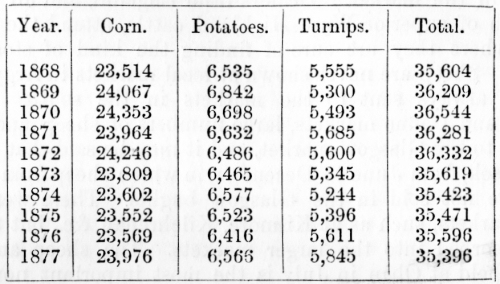
Other crops, such as
cabbages, carrots, and vetches, occupy only an area of 439 acres. There is
very little barley or bere grown, and next to nothing of wheat, so that
almost the whole space is under oats. For green crop, potatoes and turnips
are the only kinds worth mentioning.
The rotation of cropping
has been the five course shift, viz., first, oats after lea; second,
potatoes and turnips; third, oats with grass seeds; fourth, hay; and
fifth, pasture. Instead of one year of pasture, it is now turning common
to leave the ground in that state for two or three years, which changes
the course into a six or seven years' shift. The five years' shift, which
was generally insisted upon by proprietors and factors, served a good
purpose in causing more attention to be paid to culture and cropping than
was formerly the case. Different kinds of manure are now better known; and
when these are judiciously applied, rotation of cropping is of less
consequence. It is evidently an advantage-in such a county as Argyll to
have the ground more than one year in pasture.
Markets and Cattle Shows.
The leading cattle markets
in the country are held at Kilmichael, Oban, and Lochgilphead twice a
year. The Kilmichael market used to be the most important, but Oban market
is now about equal to it, and Lochgilphead maintains its ground without
much change. There are several small markets through the county, such as
at Shian, Duror, Mull, Strontian, Salen. Corran, Islay, &c. A large
proportion of the cattle sent from Argyllshire is disposed of at markets
in the south. At Dumbarton the droves of heavy oxen and heifers from
Argyllshire have always been conspicuous, and always much admired.
In the end of the year, old
cows from Argyllshire are disposed of in large numbers; and at Falkirk
Tryst of September and October droves of heifers from this county make up
a large proportion of the stock shown, and often formed the most
attractive feature in the market. Dealers from England, and all who are in
search of superior West Highland cattle, attend the Falkirk Tryst, where
they are sure of finding the kind of stock they require. Sheep are never
shown at local markets in Argyllshire, but are always sent to the markets
in the south. Besides Falkirk and Doune markets, large numbers of sheep
and lambs are sent to the Glasgow market, and it may be said that there is
not a week, from June to December, in which sheep from Argyllshire are not
sold in the Glasgow bughts. There were some other markets, such as at
Kilmore, Kilchrenan, &c., but they are now absorbed into the larger
markets. The sheep and wool market held at Oban in July is the most
important now, there being an immense deal of business transacted at it.
Inveraray wool market is of long standing, and is still continued much as
it used to be. Tyndrum market, although beyond the bounds of the county,
used to be the leading wool market for Argyllshire, but Oban market has
nearly absorbed it now. It is the custom at Inverness, and also at Tyndrum,
to spend much time in mere negotiation, so that at the latter it was rare
to hear a price named by a purchaser till after dinner. At Oban market the
practice is quite different, business being commenced early in the day,
and mostly finished before dinner-time at four o'clock. There is a saving
of time in this practice, which will surely be followed in other places.
The Horse Markets.—The Mull
market and Ford market are of old standing, but the attendance at them is
not on the increase.
Kilmartin market, held
twice a year, and Oban market, corresponding with it in time, are now the
most important in the county.
A good many horses are
shown at Lochgilphead and Tarbert, and there are transactions in buying
and selling horses in many places that need not be detailed.
Hiring Markets.—Dalmally
market, held once a year, at which shepherds were hired, is of very old
standing. It was called "Feill Eandrish," "Feill Commain," being one of
the few specimens of the old custom of dedicating fairs to saints, which
was very common at one time. Shian market, held twice a year, is still
continued, but is in a good measure absorbed into the Oban hiring market,
also held twice a year. Oban is a favourite place for holding markets,
owing, no doubt, to its central position and easy mode of access by
steamers and coaches, and also to its ample accommodation for man and
beast. The shops, which are increased now, are also an attraction.
Agricultural Societies have
their shows each year, and there are several of them in the county. The
one that has been longest in existence is the Lorn Agricultural Society,
commenced in 1839. The list of premiums given at its cattle shows is
large, and embraces sheep, black cattle, and horses, and a few premiums
for Ayrshire cattle are now given. The premiums for Highland cattle are
given for bulls, heifers (two and three year old), and cows and calves.
There are ploughing matches held every spring-in two districts, and the
medal of the Highland and Agricultural Society is obtained for them
alternately, the sum of £3 being paid in premiums from the funds of the
Lorn Society.
Mr Campbell of Loch Nell is
president of the Society, and a good supporter always. Colonel M'Dougall,
Dunolly, and Mr M'Donald of Dunach are the vice-presidents, and they give
their countenance by subscribing to the funds and by attending meetings.
The Farmers' Association of
Kilmartin and Poltalloch has been established for many years, and is well
supported. Mr Malcolm of Poltalloch contributes liberally to its funds,
and handsome prizes are given, which encourages agriculture in that
district.
There is an important
association at Campbeltown, at which premiums are given for the produce of
that district; and there is also one at Dunoon, which is extensive in its
scope, and doing much good.
There also has been one in
Mull for the last few years, with excellent prospects before it, and, no
doubt, destined to be very useful. The Islay, Jura, and Colonsay
Agricultural Society has been very successful in encouraging the rearing
of good Highland cattle. There is also a small society in Lismore, chiefly
devoted to crops and culture. Besides these local societies, the district
grants of the Highland and Agricultural Society are given liberally in
Argyllshire to every society that applies for them, and a neat silver
medal at the disposal of each association which complies with the simple
and useful rules of the Society.
In awarding prizes to West
Highland cattle, it has often been thought desirable to fix on some points
according to which an animal should be judged. The Lorn Agricultural
Society have tried the following:—No. I., carriage, 25 points; No. II.,
back and ribs, 20 points; No. III., head and horns, 15 points; No. IV.,
hind quarters, 15 points; No. V., hair, 10 points; No. VI., neck, 5
points; No. VII, legs, 5 points; No. VIII, size, 5 points; so that a good
animal must have 100 points to be classed and compared in some such way as
the above.
It was found, on going over
the separate districts, that horses were to be found on every possession
of any size, but in small numbers in any one place, and that the same
might be said of Ayrshire cows, therefore a few general remarks on both of
these, and also on pigs, may be offered here.
Horses.
There is nothing special to
be said about the horses of Argyllshire, they being crossed by so many
other kinds, particularly the Clydesdale, as to have lost all distinctive
character. A few ponies may still be picked up in Mull and Tyree, from 12
to 14 hands high, singularly active and hardy.
It is said that when the
"Florida" (one of the ships of the Spanish Armada) was sunk in the Bay of
Tobermory in 1588, a number of Spanish horses, having Moorish or Arab
blood in them, swam to shore, and that the progeny is still to be seen
there. Some countenance was given to the story by the appearance of Home
of the ponies, which are of slender limbs, small head, sharp ear, and
wonderful pluck and endurance. They are last disappearing, however, weight
being now held all important in a horse.
There was another race of
horses well worth preserving, which is allowed to run out.
The Lorn Furnace Company
had a large number of the common Highland mares, to which they gave tall,
large-boned Lancashire hunter stallions. The produce was roadsters of
uncommon action, strength, and endurance.
The high price of horses
for the last few years ought to cause farmers in Argyllshire to attend to
their rearing. Some of the agricultural societies (Inveraray and Lorn)
have given premiums to induce the owners of superior Clydesdale horses to
travel the county, and it is to be hoped this will have a good effect. The
number of horses in the county, according to the Board of Trade's Return,
is as follows, viz.:—In 1869 there were 6775; in 1870, 6342; in 1873,
6598; in 1874, 6722; and in 1875, 6867; in 1876, 7142; and in 1877, 7192.
Ayrshire Cattle.
Considerable numbers of
these are reared in Islay, Kintyre, and the southern parts of the county,
and also in the neighbourhood of the towns and villages, where milk is in
demand. Some of the local societies have, within the last few years,
offered premiums for Ayrshire cattle, which shows that they are held in
some estimation. The kind of cattle and their treatment are so much the
same in Argyllshire as in other places that it is not necessary to dwell
on the subject.
Pigs.
The number of pigs in the
county, as per Government returns, was in 1876, 4934; in 1877, 5116; in
1870 there were 5080; and in 1871, 6266.
When the potato crop began
to fail, it was supposed that the rearing of pigs would be discontinued
entirely; but the potato crop has been standing pretty well for some years
back, and so the rearing of pigs is to some extent continued, but varying
according to the state of crops and seasons.
There is always demand for
them in the Glasgow market, and steamers convey them to the Broomielaw. In
the county of Inverness the number of pigs is fewer than in Argyllshire,
whereas in Perthshire the number is greater than in both these counties
put together. The greater quantity of crop raised in Perthshire, and the
nearness to the markets of the south, may account for this.
Cowal.
It is now proposed to go
over the different divisions of the county, beginning with Cowal. The
length of it, in a straight line, from the head of Loch Fyne to Ardlamont,
is 33 miles, with an average breadth of about 12 miles. A careful look at
a map of the county will give a better idea of the shape and size of the
district than could be given by any description. There are six parishes in
Cowal, three of them united, and three of them single. The united parishes
are large in extent, whilst the single ones, viz., Inverchaolain, Kilmodan,
and Kilfillan, are small.
Cowal, being nearly
surrounded by the sea, may be inspected from various points. The old route
by Lochgoilhead to In-verary has been the means of making that part of the
district well known to tourists and others. For a long time there have
been daily steamers from the Clyde to the head of Loch Goil, and a stage
coach from Lochgoilhead to St Cathrines on Loch Fyne, and a little steamer
across to Inverary. The entrance to Loch Goil is picturesque and grand,
and always admired by strangers; but the agriculturist will not see much
to satisfy him. On the Argyllshire side of Loch Long, and on both sides of
Loch Goil, the ground is very rocky and rough, to the verge of the sea,
and is not of much use for grazing, even for sheep. On the left hand of
the loch will be seen the old Castle of Carrick, a royal castle, of which
the Dukes of Argyll have been keepers, and from which one of their titles
is derived. At the end of the. loch the ground is level and the soil
pretty good. On the left hand side Drimsyne will be seen, with its elegant
mansion and policies. On the opposite side of the loch there is a group of
villas, with gardens neatly laid out. The ground was at one time very
rough, with large boulder stones, and required levelling and clearing
before buildings were commenced; but the place looks neat and well
finished now.
The old village, or clachan,
of Lochgoilhead, with its church, smithy, and groups of houses, is a
little back from the end of the loch, and the land surrounding it has for
a long time been under cultivation. After driving a couple of miles up the
glen, the large farm of Pole will be entered upon, and a flat of meadow
land along the river will be seen, and very often good Highland cattle
grazing upon it. The land is still very much in a state of nature; but a
crop of good meadow hay, with spring-grazing in the wet ground, is perhaps
as profitable a crop as could be raised in that particular locality. There
are good slated houses on the farm, and the fences are very good. There is
a considerable portion of the land under copsewood, chiefly oak, and there
is excellent shelter for outlying cattle.
After leaving Pole, the
glen branches into two, and the left hand branch, followed by the coach,
becomes very narrow, and, towards the top is more of a mountain pass than
a glen. The grazing on both sides of the glen is suitable enough for
sheep, which may be seen there, and thriving well.
After reaching the top or
watershed, and descending towards Loch Fyne, the farm of Ardnow comes into
view, a large tenement,, with good average soil. Prom Ardnow to St
Cathrines the road runs along the shore, and the soil, although light,
produces fair crops of oats and excellent potatoes.
Besides the farm of Ardnow,
there are other large and excellent tenements on the Ardkinglass estate,
through which the road above mentioned passes; but those have been classed
as hill farms, and are mentioned elsewhere. In thinking of the route by
Lochgoilhead, oldish people will fondly remember Captain Grahame and the
St Catherine, and old Duncan Campbell and his coach.
Another route across Cowal
is from Kilmun to Strachur, by the valley of the Eachaig and Loch Eck.
This line is not so much frequented as that by Lochgoilhead, though it was
often proposed to run a stage coach and steamer that route, and for a
short time tried. The entrance at Kilmun is by the Holy Loch, which is now
covered on both sides with buildings of various kinds and villa ground.
At the head of the loch
there is a grand stretch of land, which was evidently under the sea at one
time; but it has been drained and enclosed, and contains now large parks,
under crop or in pasture. These are on the Hafton estate, and will be
mentioned afterwards. On the side of the loch and of the river, Benmore
estate commences, and extends from the shore far back into the hills.
After leaving the end of the loch and entering the valley of the Eachaig,
the mansion-house of Benmore will be seen, with its beautiful
surroundings. Taking the locality into account, with the steep hills on
either side, glens, and comes among the hills plantations, clear stream or
river in the middle of the valley the scene is altogether magnificent.
The proprietor, James
Duncan, Esq., of Benmore, keeps the home farm in his own hands, and is
evidently making it a model farm. Steam-engines for field purposes, with
their trucks and accompaniments, will be seen at work, and office-houses,
horses, and farming implements are as complete as possible.
Driving along the road, the
first field of the home farm will be seen laid out as nursery ground for
forest trees, and is as well kept and managed as any nurseryman's grounds
near the large cities. The trees here reared are intended for planting the
hillsides, a process that is going on vigorously.
The plantation near the
mansion-house serves to indicate the kind of trees best adapted to the
soil and most likely to thrive. In this plantation may be seen beautiful
larches, 60 and 70 feet high, and perfectly straight. Other kinds of trees
also thrive well. All the plantations are in a flourishing condition.
The route by Loch Eck is
very well described in the last statistical account prepared by the late
Dr Mackay. He says of the valley of the Eachaig that it commences at the
inland extremity of the Holy Loch, where it is nearly two miles in
breadth. It stretches till it reaches Loch Eck, a distance of about four
miles, and narrows as it approaches that lake. It runs along Loch Eck for
seven miles or upwards, and thence strikes into Loch Fyne, at Strachur
Park. Its course, from the inland extremity of the Holy Loch, being pretty
uniformly in a north-western direction. Thus viewed, the valley of the
Eachaig, with its continuation along Loch Eck and Strachur, forms a
leading and very interesting feature in the topography of the district of
Cowal. Its summit level, shown by Loch Eck, is not more than eighteen feet
above the level of the sea, so that the valley must have been an arm of
the sea at one time, making the portions of Cowal to the south of it an
island. At the entrance to Loch Eck the scenery is very grand. The loch is
seven miles long, and well wooded on both sides, with fair grazing for
cattle, and excellent shelter.
Leaving Loch Eck, Strachur
plains are soon reached, where there is a large space of good level
ground. Strachur Strath, about 100 acres in extent, consists of good
alluvial soil, particularly along the banks of the river Cur. Any kind of
crop might be raised in such soil. There is good meadow ground for hay,
but the river often overflows its banks in summer and autumn, doing much
harm to the crops of hay and corn. Like many other rivers fed by mountain
streams, it is very difficult to provide any remedy against the
overflowing of its banks, or the changing of its course occasionally.
Extensive improvements were executed at Strachur by the late General
Campbell near the end of last century, and Strachur Park was for a long
time a model. In the old statistical account of the parish there are
complaints of the scarcity of labourers and the high wages asked by them,
and one of the reasons assigned for this was the number of hands employed
by General Campbell at Strachur Park.
At the time General
Campbell was carrying on his improvements, M'Lachlan of M'Lachlan built a
new mansion-house, and otherwise improved his policies. He also encouraged
improvements by his tenants. The effect of this was, that the portion of
the shore of Loch Fyne from Strachur to Stralachlan had a cultivated and
pleasing appearance at a comparatively early date. Further down the loch
is Otter Ferry, from which there is another line of road across Cowal to
the head of the Holy Loch.
In former times large
numbers of sheep and cattle were ferried across Loch Fyne at Otter Ferry,
and driven along the road referred to through Glenlean, some to the ferry
at Dunoon, and some to that at Ardentinny, according to their destination
for different markets.
This road passes through a
Hilly district which is by no means barren; on the contrary, excellent
sheep grazing is to be seen on all sides; black cattle also will thrive on
these uplands if attended to. On the left hand side, and in the parish of
Kilmodan, Glendaruel is passed, and on the right is the head of Loch
Riddan. Further on, and after entering Glenlean, the head of Loch Striven
will be seen, but the land there is more picturesque than suitable for the
agriculturist.
In descending from the
glen, and coming in sight of Kilmun, the powder mills will be passed, and
to the right of these, Garrachorran House, prettily situated at the base
of the corrie from which the name is derived, will be observed. The
proprietor, John Macdonald, resides there, and pays much attention to his
stock of blackfaced sheep, for which the lands are well adapted. Below the
powder mills the road crosses the little Eachaig, where the traveller
finds himself in the charming valley of that name. With small deviations
from the routes already pointed out, many places of interest may be
reached. For instance, on the voyage to Lochgoilhead, opposite Roseneath,
the beautiful mansion and policy grounds of Glenfinart present themselves.
This place never fails to attract the attention of the traveller, and much
of its beauty may be seen without leaving the steamer. It is worth
landing, however, and this can convenient!}' be done at the old ferry of
Ardentinny. It will then be seen that the level ground along the shore,
which is planted and ornamented, is the mouth of a glen extending three
miles inland Glenfinart was at one time covered with natural wood and is
now ornamented with plantations. The ground has been cultivated and
improved in a manner showing taste and judgment. The present proprietor,
General Sir John Douglas, keeps the lands, woods, and policies in
excellent order, and the place is altogether very attractive.
The next route, viz., that
from Kilmun to Strachur, has many-attractions to induce the traveller to
deviate from the line of road. On entering the valley of the Eachaig,
Benmore House and its beautiful policies, situated in a very romantic
spot, will attract the attention. After passing the parks above mentioned,
a very elegant entrance gate and a beautiful avenue beyond it, with
flourishing specimens of the Wellingtonia gigantea on either side of the
drive, will be observed. These trees are in a very thriving state, and
will soon form a magnificent avenue. The mansion-house and offices are
handsome and commodious, but the range of greenhouses and the extent of
ground covered with glass is wonderful. Any attempt at describing the
plants and flowers, stove plants, greenhouse plants, bedding out plants,
border flowers, and annuals of every kind and description, would be out of
place in a report like this. Among the many classes of plants attended to
at Benmore, ferns are not forgotten. This is as it ought to be, for ferns
have not hitherto received the attention which they deserve, and there is
no place where they will thrive better than in Argyllshire. Leaving
Benmore, and about two miles up the glen, a deviation to the left will
lead into Glenmassen. This glen is well worthy of a visit, both on account
of its romantic appearance and its importance to the agriculturist. With
fair soil and excellent shelter it is very well adapted for rearing sheep
and cattle. When thickly wooded on both sides, as this glen appears to
have been, Glenmassen must have formed a singularly romantic and secure
Highland fastness. Glenmassen and Glendaruel are both mentioned in a very
ancient poem, ascribed to Darthula as her lament on leaving Scotland. A
small deviation from the road through Glenlean will lead into Glendaruel,
which is well worthy of a visit. Its beautiful strath and sloping
hillsides are very attractive, and the glen has long been famed for its
sheep and cattle. The parish church will be seen in the middle of the
valley at the clachan of Glendaruel.
A large extent of the coast
will be passed by those going by steamer from the Clyde to Ardrishaig
through the Kyles of Bute.
Before entering the Kyles,
Toward Castle, half seen, half hid, among trees, with the extensive
plantations around it, never fails to interest the traveller. Much was
done by Kirkman Findlay, who is said to have planted 5,000,000 of trees.
His successors also attended to improvements, and everything is kept in
good order on this beautiful estate.
The scenery in that winding
strait is much admired, but the land on the Cowal side is not very good.
The level, well-cultivated ground on the Bute side contrasts well with the
rugged and wild scenery on the opposite side, and the scene is exceedingly
picturesque. The rugged and rocky portion of the picture furnished by
Argyllshire is more calculated to please the tourist than the
agriculturist, but still there are well-cultivated spots, such as that at
Tigh-na-bruiach and Caol-an-trive, where pretty villas with neatly laid
out grounds are to be seen. Between the Kyles of Bute and the entrance to
Loch Fyne the land is pretty level, but thin and poor, and without any
shelter. Southhall, with its elegant mansion and tastefully laid out
grounds and plantations, always attracts the notice of those going by this
route. It is evident that the pleasing appearance of Southhall is due to
cultivation, for the soil is thin and poor. Any fields that are left in
grass for any length of time get covered with whins, and probably heather
would appear in a few years more.
Many steamers pass through
the Kyles of Bute, but the passenger steamers to Inveraray, of which there
is a new one this year, offer the traveller the best means of seeing one
side of Cowal to advantage. Of that route it may be enough here to quote
what Her Majesty has said in her book on the approach to Inveraray:—
"I only came on deck again
when we were within an hour of Inveraray, where the lake widens; and the
hills on either side are very green and undulating, but not very high. The
approach to Inveraray is splendid; the loch is very wide ; straight before
you a fine range of mountains, splendidly lit up—green, pink, and lilac;
and above it, surrounded by pine woods, stands the Castle of Inveraray,
square, with turrets at the corners."
Having taken this general
view of the district, it is time now to look more closely at the different
farms or possessions.
On the Ardkinglass estate
the three large tenements of Pole, Ardnoe, and Achadunan have already been
mentioned as sheep farms, but the following deserve to be noticed:—Corryn
and Beach, rent £115, occupied by J. and A. Buchanan; Laglina-gartan,by J.
Brodie and F. M'Callum, rent £115; Lochgoilhead, by W. and R. Armstrong,
rent £250; Troskie, by proprietor, rent £130; Ardchyline, by John
Henderson's heirs, rent £300.
On the Glenfinart estate
(proprietor, Sir J. Douglas) are— Lettermay and Cuilnamuck, occupied by L.
M'Farlane, £437; Coilessan, by L. Macfarlane, rent £450; Ardnahcin, by
James M'Gibbon, sen's., heirs, rent £213; Carrick, by James M'Gibbon, jun.,
rent £150; Craig-coal farm, by John MacPherson, rent £175; Coylette, by B.
and A. Waddell, rent £150; Stronachulin, by John Turner, rent £268.
On the estate of Benmore,
belonging to James Duncan, Esq., are Balliemore and Balliebeg, occupied by
the proprietor; estimated rent, £260.
On the Strachur estate
(proprietor, J. Campbell, Esq.) are— Dreip, occupied by John Clark, rent
£220; Succoth, by J. and R. Saffley, rent £435; Inverrieodan, by John
Nichol, rent £271; Island, by John Cowan, rent £200; Ballymeanach, by John
Clark, rent £229, 8s. 6d.; Strachurmore, by John Anderson, rent £400.
On the Balliemore estate
(proprietor, Campbell Macpherson Campbell, Esq.) is Camquhart, occupied by
A. M'Intyre; rent, £235.
On the Dunans estate
(proprietor, B. C. Fletcher, Esq.) are Stronardran and Dunans, occupied by
J. and A. Black; rent, £580.
On the Glendaruel estate,
belonging to B. H. Campbell, Esq., are—Achdacheranmore, occupied by Don.
Gillies, rent £100; Duieletter, by Dun. Gillies, rent £132; Garvie, by A.
Clark of Garachra, rent £380; Kilbridemore, by A. M'Nicol, rent £260;
Kilbridebeg, &c, by A. Gordon, rent £330; Moymore, by Donald Buchanan,
rent £250; Strondenan, by A. M'Nicol, rent £190.
The sheep in Cowal, both
black and whitefaced, are very good, and there are some excellent folds of
Highland cattle. Ayrshire are of pure breed, and well attended to.
A visit to one of the local
shows will make this obvious to any one qualified to judge. Only large
farms are taken in the above list, but there are many small possessions on
which the stock is not materially different. It would be easy to classify
the stock in its different kinds, but not being the whole stock of the
district, this has not been attempted.
On looking back at this
list of farms, it will be obvious that the rearing or grazing of sheep and
cattle is the main occupation of tenants in the district. On some
possessions cattle are kept for dairy purposes, and the land is cultivated
for crops. There is a group of such farms near the head of the Holy Loch,
which may be mentioned separately. They are occupied as follows, viz.:—Ardensleat,
by William Speare, rent £346: Ardnadam, by John Mercer, rent £352;
Dalinlongart, by James Turnbull, rent £511; Dunlosjin, by John C. Turner,
rent £200; Tugear-hallos, Achamore, &c, by D. and A. Mercer, rent £546.
The cattle kept are of the
pure Ayrshire breed, and are generally very well attended to. The arable
land is well managed, and on it, although the soil is rather poor, very
fair crops are raised. The parks at the end of the loch look exceedingly
well, but it was with much labour and expense they have been brought to
the state in which they are now seen.
The ground had all to be
drained, levelled, and fenced. The drains were found difficult to make,
owing to a deposit of oxide of iron, which converted the gravelly subsoil
into a kind of concrete, very troublesome to manage; and from the same
cause the pipes got choked and closed. However, the outfall is good; and
by close attention in flushing the drains and otherwise, the ground is
kept in good condition. Along the road from Sandbank to Dunoon, the fields
are well enclosed and well cultivated; but on looking beyond the enclosure
farthest from the road, the ground will be seen covered with heather and
coarse grass, showing that these fields were reclaimed from waste land. Mr
Hunter of Hafton, on whose estate these farms, and also the parks above
mentioned, are situated, has done much to improve his property, and his
predecessor did fully more. All the level ground on the Hafton estate, and
also on that of Benmore, is very well cultivated.
The rotation of cropping
followed in this locality is a seven-years' course, viz.:—First, oats
after lea; second, green crop; third, oats with grass seeds; fourth, hay;
fifth, sixth, and seventh, pasture.
There has been much done of
late years in improving farm buildings, but there is still much to do.
Workmen's houses are still deficient in accommodation, but not worse in
Cowal than in other parts of the county.
It is necessary to take
leave of Cowal for the present, but we do so with regret, considering the
many interesting subjects left untouched, such as the ancient history and
traditions of the district, very remarkable caves, old castles, and
Druidical remains. Some of these will be found described in the old
statistical accounts for Lochgoilhead by Dr Macdougall, and that for
Strachur by Mr Stewart; and also in the new statistical account for Dunoon,
prepared by the late Dr Mackay. In this last will be found the very
interesting story of Macgregor and Lamont. The account there given
corresponds substantially with the tradition of the country, although some
of the details are different. A very good account of the botany of the
locality, furnished by the late Sir J. W. Hooker, is given in Dr Mackay's
report.
Knapdale, Kintyre.
The ground about east Loch
Tarbert is rocky, and rather poor, but inland there is good pasture for
sheep and cattle. The mansion-house of Stonefield will be seen on
following the coast towards Ardrishaig. The policies are neatly laid out,
and the lands and plantations are well managed. The present proprietor,
Colin G. Campbell, Esq., generally resides there. His father, John
Campbell, Esq., greatly improved the place, particularly in planting
trees. The plantations are in a thriving condition, and add much to the
appearance of the place, besides affording timber and shelter.
Some of the larger farms on
the estate deserve to be mentioned.
Kilchamaig was long
possessed by Dugald Sinclair, who was also factor for Stonefield. This
farm was greatly improved by him, the soil having been thoroughly drained
and cleared of whins and brushwood. In parts of the peat bogs drains were
cut to the depth of from 7 to 9 feet, so as to reach the subsoil. Large
tile pipes were laid; and in filling up the drains, short pieces of wood
were laid across to keep the pipes safe. The drains, which were carefully
filled in, answered their purpose well, and lasted a long time. This farm
is now possessed by Mr Archibald Turner, jun., along with some other
lands. He keeps a mixed stock of very good blackfaced sheep, and an
excellent herd of Highland cattle. The rent is £861.
Achnacarnan, occupied by
Allan Pollok, Esq. The rent is £563. Stock, Highland cattle and blackfaced
sheep, all good.
Grear high and low grounds,
occupied by William Stewart's heirs; rent, £314. Stock, blackfaced sheep,
very good, along with some cattle.
Arivore, occupied by John
Mundell; rent, £151. Stock, Ayrshire cattle.
Escart, Bardaravine, &c,
occupied by Neil Sinclair; rent, £249. Stock, blackfaced sheep, good, and
some cattle.
Mealdalloch, Aultbea., &c,
occupied by Alexander Macfarlane Esq.; rent, £148. Stock, good blackfaced
sheep, and some cattle.
Ashens occupied by Donald
Macdougall; rent, £955. Stock very good, blackfaced sheep and cattle.
Glenrollach, occupied by Dr
Hugh Campbell; rent, £279. Stock, sheep, and cattle, good.
Gartavaigh and Glencusdale,
occupied by Hugh M'Laine; rent, £547. Good deep land, carrying a mixed
stock of superior ewes and wethers, and an excellent fold of Highland
cattle; arable and meadow land extensive.
Laggan, occupied by A.
Macfarlane, Greenock; rent, £130, Stock, very good blackfaced sheep.
Near to Stonefield is the
small estate of Ronachan, belonging to Allan Pollok, Esq., of which the
estimated rent is £850. This neat property was purchased by Mr Pollok
about thirty years ago, it being then let in small holdings, and not very
well cultivated.
As soon as practicable Mr
Pollok took the lands into his own hands, taking all the tenants' stock at
valuation. He then commenced the improvement of the property on a large
scale, reclaiming land that was formerly of very little use, and laying it
out in fields of from 20 to 50 acres. Draining, fencing, and building, all
shared his attention, and Ronachan was soon made a most desirable little
property. He also set about rearing a stock of black cattle and sheep of
the best kind. He purchased cattle from Jura, and wherever he could find
them, of the best quality, and by judicious treatment he soon brought his
stock to a high state of excellence, and often carried prizes at the
Highland Society's Shows.
The stock is still kept up
in the same high condition, although not often exhibited of late. Mr
Pollok has taken a fancy for fallow deer, of which he keeps a considerable
number in parks, enclosed by excellent fences, without which they would
prove very troublesome.
On the estate of Inverneil,
belonging to James A. Campbell, Esq., the following farms may be
mentioned:—
Ardbeg, occupied by P. Dun
and Donald Gillies; rent, £102. Stock, Highland cattle, very good milk
cows and followers, well managed.
Achabrad, occupied by A.
Wilson's heirs; rent, £130. Stock, sheep and good Highland cattle.
Barrahormed, occupied by
Donald M'Gougan's heirs; rent, £137.
Barnashalg, occupied by
Dun. Campbell; rent, £164.
In the three preceding
farms the stocks consist of Highland cattle.
On the Poltalloch estate,
belonging to John Malcolm, Esq,, the following farms may be mentioned:—
Gallichoille, occupied by
A. M'Ewen; rent, £133. Stock chiefly sheep and flying stock, or young
cattle bought for grazing.
Arichonan, occupied by A.
Jackson; rent, £229. Stock, cattle and sheep, cross and blackfaced, good.
Auchnamarbh, occupied by M.
and P. M'Nicol; rent, £154. Stock, cattle, sheep and flying stock.
Ashfield, occupied by Mr
Miller; rent, £220. Stock, sheep, whitefaced, but returning to blackfaced.
Burnagad, occupied by Col.
M'Dougall; rent, £322, 10s. 6d. Stock, sheep and Highland cattle.
N. and S. Lechnambarn,
occupied by A. M'Donald's heirs; rent, £129. Stock, good Highland cattle
and sheep.
Castle Sween, occupied by
Neil M'Neil; rent, £206. Stock, Highland cattle and sheep.
Craig-a-vaddie, occupied by
John Fisher; rent £160. Dunans, occupied by A. M'Gilp's heirs; rent, £255.
Dunoronsay, occupied by
Don. Graham; rent, £130. Dailtot, occupied by Neil Baxter; rent, £200.
Gariob, occupied by Don.
Johnstone; rent, £107. In the five preceding farms the stock consists of
Highland cattle and sheep.
Kilmahunaig, occupied by
Peter Clark's heirs; rent, £248, Stock, chiefly sheep.
Downie, occupied by
Archibald Turner; rent, £178. Stock, very good Highland cattle and sheep.
Keilbeg and Barranlochan,
occupied by Archibald Fletcher; rent, £256. Stock, good Highland cattle
and sheep.
Carsaig and Arishafadmore,
occupied by J. and D. Buchanan; rent, £199. Stock, good Highland cattle
and sheep.
Brackly Farm and Brenfield
Hill, occupied by A. Campbell, Esq., of Auchindarroch, proprietor;
estimated rent of the former, £200; of the latter, £110. On both farms are
kept good blackfaced sheep.
On the Carradale estate,
belonging to Colonel Buchanan, the following farms deserve to be noticed:—
N and S. Auchansavil,
Brackley, &c, occupied by James Miller, jun.; rent, £202. Stock,
blackfaced sheep and cattle.
Ducheran More and Beg,
occupied by Duncan M'Quikan; rent, £200. Stock, good blackfaced sheep and
Highland cattle.
Rhounadale and Corradale
Mains, occupied by A. J. and F. Thom; rent, £830. Stock, good blackfaced
sheep and cattle.
Barmollach, &c, occupied by
proprietor; estimated rent, £260. Stock, good blackfaced sheep.
Lephincorrach, occupied by
Wm. Cowan; rent, £285. Stock, good blackfaced sheep.
Cour and Benvreck
(proprietor, Keith M'Alister, Esq., of Glen-bar) is occupied by A.
Stewart; rent, £275. Stock, blackfaced sheep and cattle.
On the estate of Kintarbert,
belonging to Miss M'Neil Campbell, the following farms may be mentioned :—
High Ugadale, occupied by
John Galbraith; rent, £200.
Ifferdale, occupied by John
Galbraith; rent, £530.
Lephinmore, &c, occupied by
Wm. Lang; rent, £300.
N. and S. Crossaig,
occupied by M. and P. M'Kellar; rent, £482.
The stock of the four
preceding farms consists of blackfaced sheep and cattle.
On the island of Gigha, of
which James W. Scarlett, Esq., is the proprietor, the following farms
deserve to be noticed:—
Kinerach and Tarbert,
occupied by Allan Pollok at a rent of £383, are stocked with cattle and
sheep. There are 120 acres of arable land on the two.
N. and S. Ardailly,
occupied by A. and P. Galbraith at a rent of £105, are stocked with cattle
and sheep. There are 50 acres of arable land on these farms. Ardlammy, by
Wm. M'Callum; rent, £348. Stock, cattle and sheep; arable laud, 100 acres.
Achmore by D. and M.
M'Sporran; rent, £261, 10s. Stock, cattle and sheep. Drimachro, by Neil
M'Gougan; rent, £130. Stock, cattle.
Leim, by A. and T. M'Millan;
rent, £234. Stock, cattle.
There is a remarkable
spouting cave at this place, from which the farm derives its name.
Drimyeon More, by Angus
M'Vean; rent, £110. Stock, cattle and sheep. Drimyeon Beg, by J. and W.
Galbraith; rent, £131. Stock, cattle and sheep.
On the Skipness estate,
belonging to E. C. Graham, Esq., there are the following farms:—
Monybachach, occupied by
proprietor; rent, £100. Stock, blackfaced sheep. Ariour, occupied by A.
and D. M'Quikan; rent, £331. Stock, very good blackfaced sheep. Eskart,
Cregaig and Strone, occupied by H. and H. M'Kellar; rent, £429. Stock,
blackfaced sheep and cattle. Creggan, occupied by S. Thomson's, jun.,
heirs; rent, £131. Stock, blackfaced sheep and cattle.
Achmeanach, &,c, occupied
by the heirs of Peter Moir; rent, £143. Stock, blackfaced sheep and
cattle.
Cuilantrach, occupied by W.
M'Nair; rent, £136. Stock, blackfaced sheep and cattle. North Coelfine,
occupied by D. and D. Stalker; rent, £130. Stock, blackfaced sheep and
cattle. Home farm, proprietor; sheep and cattle; well managed.
Kintyre.
In Kintyre proper, and
particularly near Campbeltown, there is more level ground than among the
hills and dales of Knapdale, and Tarbert. There is the large plain called
Laggan of Kintyre, four miles in length, and three in breadth, and lying
between the town of Campbeltown and the bay of Machrihanish. It is only 46
feet above the level of the sea, and from the appearance of the soil it is
not unlikely that it may have been under the sea at a former period. This
flat or plain is now highly cultivated, the system followed being much the
same as in Ayrshire, with which it has fully as much connection as with
the other portions of Argyllshire. There was a very inferior breed of
cattle in Kintyre at one time, being a cross with Irish cattle, but pure
Ayrshire's have now been introduced, and dairy farming is followed
successfully. The mode of management here is so nearly the same as in
Ayrshire and other parts of the low country, that it is needless to go
into any details.
The lands near Campbeltown,
belong in property to the Duke of Argyll, and the following farms or
possessions may be mentioned:—
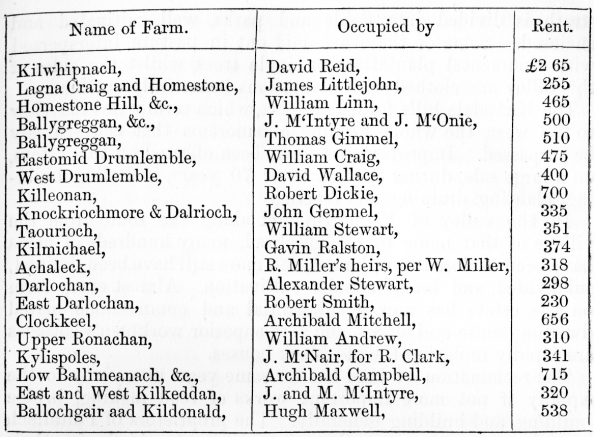
There are seven parishes in
the peninsula of Kintyre, viz.:— (1) North Knapdale, (2) South Knapdale,
(3) Kilcalmonell and Kilberry, (4) Saddell and Skipness, (5) Killean and
Kilkenzie, (6) Campbeltown, and (7) South End.
North and South Argyll.
After leaving Kintyre we
may take a district that is really a part of the mainland.
Argyll proper borders with
the peninsula of Kintyre and Knapdale at the Crinan Canal, and has among
its boundaries Loch Fyne, Loch Awe, and a small part of the Atlantic, from
Loch Melfort to Loch Crinan. Her Majesty the Queen passed a night at
Crinan, in the course of her tour round the West Coast in 1847. She was
there on a beautiful calm evening in autumn, and admired the scenery very
much. The late Neil Malcolm, Esq., of Poltalloch, was in attendance on her
Majesty, and he could with pardonable pride show his own princely mansion
near Crinan, on which he is said to have laid out £100,000.
It is situated on the slope
of a hill among noble plantations, and can be seen to great advantage
across the moss of Crinan.
The view from the hill
above Poltalloch is always admired, not so much for its extent, as for the
rare combination of hill and dale, land, water, and islands of every size
and form. A more beautiful view, if possible, is to be got from the
eminence on which the village of Kilmartin stands. The valley of Kilmartin
lies below, and spreads out into the big moss of Crinan. The strath is
divided into fields and parks, well cultivated and enclosed. Some of these
are laid out in pasture, interspersed with ornamental plantations or
single trees, whilst the sides of the valley are clothed with plantations
beautifully outlined.
The Knapdale hills form a rampart, which
terminates the view to the west, the whole forming a panorama that can
scarcely be surpassed. Improvements have been effected on this estate, on
a large sale, during the last 60 or 70 years, including building,
planting, draining, and fencing.
In the valley of Kilmartin, and along the
route from the village of that name to Lochgilphead, many hundreds of
acres have been enclosed and planted, and more still have been drained,
subdivided, and brought under cultivation. Almost every farm on the estate
has now a substantial and commodious slated dwelling-house and offices,
and very superior workmen's cottages are rapidly replacing the old black
houses. The
reclamation of land has for some years given way to the equally if not
more important works of road making, bridge building, and building
generally. The proprietors of Poltalloch have been carrying out these
improvements chiefly for their tenants, but the public also share in some
of them, such as forming roads and building bridges.
There is a saw-mill near the home farm, which
is driven by water power, and constantly employed in cutting up timber for
estate purposes, such as house building, fence making, &c. Round timber is
given gratis to the tenants for the repair of all thatched buildings.
There is a splendid herd of cattle, and excellent sheep at Poltalloch, but
these have been already mentioned.
The mode of cropping followed in the Kilmartin
district is the six course shift, namely, 1st, oats ; 2d, green crop ; 3d
oats; 4th, rye-grass, hay; 5th and 6th, pasture.
Kilmartin.—The soil in the strath of Kilmartin
is pretty good, and is a mixture of many kinds. In high states of the tide
the sea comes in as far as Kilmartin, submerging the bottom of the valley.
There is reason to believe that the outlet from Loch Awe was at one time,
from the west end of the loch, through the valley of Kilmartin. The late
Mr M'Calman explained this in the last statistical account of the parish,
and his description of the valley is well worthy of a perusal.
Banks of water-worn gravel are to be seen at
the sides of the valley, and particularly at Kilmartin, where there is a
steep bank, with a level platform above it. These banks are now covered
with green-sward, and afford very good pasture, or crop if well manured.
Some of the farms in the district may now be
mentioned:— On the
Poltalloch estate, Ardafonr and Beanan are on the sea-shore, and have long
been occupied by Mr George Campbell, who pays £378 of rent, and keeps cows
(West Highland), which are very good; also flying stock.
Torrans, occupied by T. O. Richmond; rent,
£476. Achamish,
occupied by T. and R. Hunter; rent, £523.
Upper Largie, &c, occupied by P. Sinclair;
rent, £462. Stock, cows and their followers of the very best, and sheep ;
land under rotation, 100 acres.
Eilanrigh, Greenaig, &c, occupied by James
Campbell, Ormaig; rent, £120. Stock, cattle, young and old, and sheep, all
very good; not much arable land.
Nether Largie, &c. occupied by Alex. M'Donald;
rent, £339. Stock, Highland cows and followers, first class, and sheep;
land under rotation, about 60 acres.
Gleanan, occupied by J. and A. Menzies; rent,
£160. On the same
estate, but at Lochaweside, are Durane, occupied by C. H. Bell, J. Stott,
and T. Robson; rent, £442. Stock, whitefaced sheep.
Blarghour, occupied by Dan. Fisher; rent,
£252. Stock, blackfaced sheep, cows, and their followers.
Ballimeanach, occupied by John and Heirs of
James Mac-Diarmid; rent, £451. Stock, blackfaced sheep, cows, and their
followers. Ardconnell,
occupied by John Macfarlane; rent, £358. Stock, sheep.
On the Barbreck estate the following farms may
be mentioned —proprietor, Admiral C. F. Campbell:—
Barbreckmore, &c, occupied by John Longwill;
rent, £349. Keeps dairy stock and fattens cattle; arable land well
managed. Barrichbeyan,
occupied by D. Macfarlane's heirs; rent, £106. Black cattle and crops.
Lergychonics, occupied by James M'Kechnie, jun.;
rent, £295. Stock, cattle, flying stock.
Part of Turnault, occupied by John Craig;
rent, £235. Stock, good blackfaced sheep and Ayrshire cows.
On the Craignish estate, F. C. T. Gascoigne,
Esq., proprietor, are the following farms:—
Gartcharran, &c, occupied by Walter M'Farlane;
rent, £300. Crop and wintering hoggs.
Airds, and islands, occupied by Alex. Gray;
rent, £147. On the
Ederline estate, proprietor Henry Bruce, Esq., are the following farms:—
Corran and Fincharn, occupied by Robert Lawrie;
rent, £574. Stock, blackfaced sheep, very good, and cattle.
On the Minard estate, proprietor Thomas Lloyd,
Esq., the following may be mentioned:—
Kilmichael Beg, occupied by A. Craig; rent,
£200. Stock, good ewe stock, sells wether lambs.
Fans, Craigans, &c, occupied by Robert Cay;
rent, £380. Stock, good ewe stock and cattle.
Ederline Beg Park, &c, occupied by proprietor;
estimated rent, £191. Flying stock.
Auchinellan, belonging to J. Reid's heirs, is
occupied by Mr Alex. Stevenson, who pays a yearly rent of £180. Stock,
sheep and cows very good.
Sir J. P. Orde is proprietor of the following
farms, which are in his own hands:—
Kilmory lands, &c, estimated rent, £224
Duncholgine, &c., £218
Old Achnaba, &c., £220
The stock is white Highland cattle, a herd
formed from a remnant of the Athole herd, Southdown, and blackfaced sheep.
Sir John Orde has also for the last thirty
years or more kept herds of two varieties of Indian cattle, which, with
housing by night in winter, and occasionally by day in severe weather,
have thriven well, the beef being juicy and fine in grain, and the hump an
especial delicacy.
These animals have shown a great disposition to fatten, and some crosses
with the Highland and Ayrshire, have been brought to good weights. Sir
John has also a dairy stock of Alderney and Guernsey cattle.
Loch Fyne Side.
Following Loch Fyne towards Inverary there is
good land to be seen, some under crop and some under pasture. On the Cum-lodden
estate there is the large tenement of Goatfield and Gallanach, possessed
by Mr John Horsburgh; rent, £350. He keeps a large number of sheep, all
ewes, and a dairy stock; the milk—the sale of which always pays well—is in
demand for the quarriers at the granite quarries.
Mr Horsburgh tried shorthorn bulls for
crosses, but now keeps Ayrshire bulls.
On the Duke of Argyll's estate are the farms
of Brenchoilly and Braleckan, possessed by Dr Campbell and C. Brown; rent
of the one £365, and of the other £150. The sheep, a mixed stock, is very
good. The cattle kept are a few cows and flying stock, chiefly stots.
Killean is possessed by Mr James M'Kay; rent,
£269. The stock kept is of the same description as the last mentioned, and
is well managed.
Clonary, rented by Mr Mel M'Kechnie, Dunoon; rent, £124. Stock all sheep.
The lands about Inverary are in a high state
of cultivation and the soil is moderately good. The policies and grounds
near the castle, and the splendid avenues and plantations are too well
known to require any description here.
Glenary is chiefly under wood, and part of it
preserved for game, but there is some cultivated land at Stronmagachan and
Tullich of fairish quality. The top of the glen is an excellent moor for
grouse. Ardbrecknish,
or Rockhill, marches with this park of the ducal estate, and the place was
long known for its excellent fold of Highland cattle. It now belongs to Mr
Thorpe and his tenants. The Messrs M'Callum keep a sheep stock, along with
a few cows. The rent is £150.
Lorn—Lochaweside.
On crossing Loch Awe from this place, the
traveller will find himself in the district of Lorn. A compact portion of
this district is the space between Loch Awe and Loch Etive with the river
Awe for its north-eastern boundary. At the south-east corner of the
sub-district is New Inverawe, formerly called Tirvine. Here will be seen
an elegant mansion-house, grounds well laid out, good fences, and thriving
plantations. About forty years ago this very attractive spot was known as
the farm of Tirvine, with thatched houses, fields undrained, and much
waste ground. The proprietor having been asked to give an account of the
improvements that have since been made, kindly sent the following letter,
which we here insert in the belief that the narrative will be interesting
in his own words:—
"New Inverawe, August 13, 1877.
"For eight months of the year the west and
south-west winds prevail here, and the warm mist or vapour caused by
evaporation in warm regions sweeping across the Atlantic condenses on our
mountains, and gives a great amount of rain. This is not unfavourable so
far as pasture for hill stock is concerned, on the thin soil of our hills,
which would suffer greatly from drought, as we see not unfrequently in the
spring months, say April and May, when easterly winds prevail. But the
large amount of rain renders cropping of arable land very precarious. The
saving of hay for winter keep is also very uncertain and expensive. For
example, this same season, no natural grass could be cut until August, and
at this date (13th) none has been secured. I remember once haying a meadow
uncut in October, and carrying it in good condition after the frost set in
in November. Of course the greater part of the land in this neighbourhood
is hill pasture or peat-moss improved or otherwise. From twenty to thirty
years ago I improved a good deal of moss land, as well as dried soil, and
had good crops. I drained chiefly with pipe tiles and stones.
"My enclosures were stone walls, about three or four feet high, with a
couple of wires on the top, which proved very satisfactory, I used a six
shift rotation, but I have not ploughed any land for the last dozen years.
"Planting answers very well. There are few
trees which do not thrive, and I have a great variety. In the grounds
about my house I have some very, good specimens well grown and healthy.
The Wellingtonia gigantea is the only exception I know of. It has never
thriven with me. In the reclaimed moss there are some very large trunks of
oaks that must have thriven well at some distant age. The black Highland
cattle stand the climate best, but the milking qualities of the Ayrshire
has caused their introduction in much larger quantities than formerly. I
used the former for hill grazing, and the latter for the low ground. The
same may be said of the sheep. The Cheviots are used in some favourable
localities, but I believe the blackfaced to be more profitable in the long
run ; and some who have tried the Cheviots are going back to the
blackfaced breed. They still largely predominate in numbers.
"In the last thirty years I have seen a great
change for the better all over the country, in the dwellings of all
classes, lairds, tenants, and labourers, also in the farm steadings.
"Almost all buildings are slated now. The
thatched houses are the exception, so far certainly as new erections are
concerned. The wages of labourers is very high. Where I gave 1s. 6d. or.
2s. a-day formerly, I now have to give the double. So much of the land has
changed hands in my memory, and so many wealthy southerners have come
amongst us, that the tie which existed between the landowners and the
people has greatly changed. They feel the advantage of the money that is
expended amongst them, but they feel also that they work simply for money,
with a small grudge at the employers.
"Again, for the sake of sport, so many of the
cottages are pulled down, and their occupants removed, that the contrast
to the old well-known families is painfully before them at all times. This
will pass, and is passing, but some of the old cottars who remain still
tell of the nineteenth or twentieth generation of these people who have
the same crofts, but they are becoming rarer every year.
"As a matter of sentiment one cannot but
regret this, but for the general benefit of the country it is perhaps
better. The old order must give place to the new."
New Inverawe is bounded on the west by the
estate of Innistrynich, beautifully situated on the banks of Loch Awe. The
ground rises from the edge of the water in a beautiful slope, has a
southern exposure, and is well sheltered by plantations. The soil is
rather thin, but good crops and excellent cattle have often been seen on
these lands. The late
proprietor, Mr M'Alister, was very fond of good Highland cattle, and kept
the home farm in his own hands. His tenant at Larachban had also an
excellent fold of Highlanders.
The present tenant of Hayfield, Mr Rannie, has
other possessions in the south, and the stock is often changed to suit the
different tenements.
Achnacarron.—The tenant is Mr William Menzies, and the rent £275; stock,
blackfaced sheep and cattle.
Ballimore and Balliebeg are possessed by Mr
M'Arthur, to be immediately referred to.
Barbreck, to the west of Innistrynich, belongs
to John M'Arthur, Esq., banker, Inveraray. The soil is very good,
limestone being its basis, and Mr M'Arthur turns it to the best account.
He pays great attention to West Highland cattle, of which he is an
excellent judge. His fold of cows at Barbreck and the portion of the
Innistrynich estate above mentioned cannot easily be surpassed. Mr
M'Arthur buys the best bulls that can be found, and he has reared some
very good ones. He has not been long in possession of these lands, and his
stock may be expected to improve still further under his guidance.
The Breadalbane lands begin at Port Sonachan,
and stretch for many miles along this side of Loch Awe. There is good
rough land, a large proportion of which is clothed with natural
plantations, chiefly oak. The two leading tenements are Fearnoch, to which
Achnamaddy is now joined, and Inverinen and Drimdarroch. The first of
these is possessed by A. A. and J. Glendinning at a rent of £430. They
keep blackfaced sheep, which are very good, and a flying stock of young
cattle. The other tenement of Inverinen, &c, is possessed by D. M'Niven,
at a rent of £417. The stock is of the same description as that kept at
Fearnoch. After
leaving the Breadalbane lands there are several small properties at the
west end of Loch Awe.
Barnalean belongs to Munro's heirs, and is
possessed by Mr Duncan Dow at a rent of £150. He keeps blackfaced sheep
and a few cows. The
small estate of Kilmun belongs to John M'Dougall, and is occupied by three
tenants at the respective rents of £50, £55, and £60. The stocks consist
of blackfaced sheep and Highland cattle.
The estate of Drishaig belonged to the late
Rev. D. M'Calman but has lately been purchased by Mr Paul, Greenock. The
stock is blackfaced sheep, moderately good.
Barmaddy belongs to the Rev. D. M'Intyre, and
is possessed by Mr Murray Jenkins at a rent of £115. Barmaddy does not
touch Loch Awe, hut marches with Glenmore. The march between Lorn and
Argyll proper passes through the lands of Glenmore, but the principal
portion, including the home farm and mansion-house at the head of Loch
Melfort, is in the district of Lorn. The level portion of Glenmore is well
cultivated and enclosed, and the soil is good. The former proprietor, Mr
Campbell, had an excellent herd of Highland cattle. McNiel's trustees are
now the proprietors, and the lands are let to Messrs Allan, at a rent of
£700. They keep blackfaced sheep and some cows, all very good.
Melfort estate marches with Glenmore, and
resembles it much in regard to soil and shelter. It now belongs to Keith
M'Lellan, Esq., who keeps the most of the lands in his own hands. The
estimated rent is £550. Mr M'Lellan is getting up a fold of West Highland
cattle. They are of the best kind, and are sure to succeed on such lands
and in his hands. He has also tried shorthorn cattle, and his stirks are
very promising, but until a winter or two are past it is needless to say
much about them.
Leaving Melfort, and following the coast, another portion of the
Breadalbane lands is reached. Degnish and Ardmaddy now form one tenement,
possessed by Messrs Peter and Allan Hall, at a rent of £700. In the late
Marquis of Breadalbane's time the home farm of Ardmaddy was kept in his
own possession, along with the castle. A division of his famous herd of
Highlanders was reared at Ardmaddy. The tenement is managed differently by
the Messrs Hall, who keep a large number of sheep of different breeds. The
stock of cattle is also mixed, some of them being the West Highland breed
and some shorthorns. The arable land is very well managed.
Leaving Ardmaddy, and following the Sound of
Seil, the tenement of Achnansaul and Clachan is reached. Mr Duncan M'Innes
is the tenant; at a rent of £280. The soil, which rests on slate-rock, is
of excellent quality, and strongly resembles that of Luing and Seil. This
is an arable farm, with some Highland cattle of fairish quality.
The next farm to this is Duachy, possessed by
D. M'Callum, rent £300, and the soil, stock, and crop are of the same kind
as on the tenement last mentioned.
Crossing the hollow at Belnahua, the farm of
Barnacarry is entered upon, and there are hills attached to it which make
it a considerable tenement. Messrs J. and J. M'Farlane have been for many
years the tenants. They pay a rent of £420, and keep sheep and Highland
cows with their followers, and some flying stock. The cattle are good
strong animals, and the sheep stock is very fair.
For this and many succeeding tenements,
Highland cattle and blackfaced sheep are kept, and may be understood
without specifying them as such.
Kilninver, across the river Euchar, is the
next farm, a compact tenement, with a good proportion of arable land and
hill pasture Mr Dugald M'Niven is the tenant of it and of Aultocarmaig, at
a rent of £235. He has a sheep stock and cows of the best kind. He has
been very careful in selecting good bulls, and manages his stock well.
The small farm of Barandromain is possessed by
Mr John M'Kenzie, along with his own little estate of Knipoch. He used to
keep very good cattle, but has sold off his cows, and keeps a flying stock
at present. The
Breadalbane lands do not go farther in this direction, but they extend
southward along the river Euchar and in among the mountains till they meet
the Lochaweside property. On the right hand side of the road and across
the river is the farm of Raray, possessed by Mr John M'Dermid, rent £390.
He keeps sheep and a flying stock of cattle. He has removed his cows to
Balinoe, to be afterwards mentioned. Between the two places he will likely
have a first-class stock. Further up the glen is the hill farm of Inie,
possessed by Mr Duncan M'Cowan, rent £140. Stock, sheep, and a small
number of cows, which are very good. There is also the hill farm of
Fineglen, possessed by D. Campbell; rent, £350. The sheep stock is first
class. Before going
so high up this glen, a deviation to the left will lead into Glen Euchar,
where the river of that name emerges from Loch Scamadale. In this last
glen are the farms of Sheilaehan, Lagganbeg, and Lagganmore, Scamadale,
and at the head of the glen is the farm of Bragloenbeg, of which Mr John
M'Intyre is proprietor and occupant. Bragloenmore, the property of Miss
Campbell of Bragloen, is near it, and is possessed by D. Campbell's heirs;
rent, £195. There is some good meadow land at the head of the loch, but in
the rest of the glen the soil is rather poor. The west end of this glen
belongs to the Duke of Argyll.
From Bragloenbeg a short mountain path leads
into the hill farm of Musdale, which belongs to D. Campbell, Esq., of Loch
Nell. The tenants are J. and P. Stewart, at a rent of £190. Properties in
this locality are strangely mixed together. Midmuir belongs to Mr
Macdougall of Gallanach, and a sheiling in the middle of it is part of the
Glenfeochan estate, and also Sonachan on another side of Midmuir;
Aultocarmaig belongs to Lord Breadalbane: Mr Sinclair of Glenoe, formerly
mentioned, possessed the tenement of Musdale and Midmuir, and was paying
rent to four proprietors, namely, Loch Nell, Glenfeochan, Gallanach, and
Dunolly. These patches among the hills were probably sheilings belonging
to low-lying farms, and have been kept on account of the game or
shootings. Midmuir is now joined to Duntanachan, and other portions of the
old tenement are variously occupied.
The shepherd's house at Midmuir is in a very
lonely spot, but in former times the old Midmuir road which passes the
house was much frequented. Though never much of a road, it was used by all
who had occasion to go from Mid Lorn to Port Sonachan and Inverary. The
road by Taynuilt is now used instead of the old line of road. Leaving
Midmuir, and turning to the west, this old road leads into Glenfeochan. At
the head of the glen is the farm of Kilbride, to which Sonachan is now
joined, the rent being £285. It is possessed by Mr Dugald Campbell. These
farms are on the Glenfeochan estate, as is also Craigintaggart, possessed
by John Leitch. Stronchormaig comes next, where the mansion-house of
Glenfeochan is beautifully situated. The policies and plantations around
it are kept with taste by Mr Murray Allan. The home farm and hill of
Stronchormaig are let to Mr John M'Dermid, formerly mentioned as the
tenant of Raray. The arable land at Stronchormaig and Balinoe is very
good, and is a portion of a large space of level ground at the head of
Loch Feochan. The
little Feochan runs through Glenfeochan, and joins the larger river of the
same name at Balinoe, and both fall into the head of Loch Feochan.
Opposite Stronchormaig and across the little
Feochan, is Kilmore, with its old church and old public-house, the former
being superseded by a new building in another locality, and the latter
being now only used as a farm-house. Kilmore was a place of importance at
one time, inasmuch as the principal markets of the district were held
there. There was a horse market in summer, to which people gathered from
many quarters to buy and sell horses, lambs, and other stock. There were
also markets at the beginning and the end of the summer season for cattle,
for hiring servants, and other business. The manse of Kilmore is a short
distance from the old church, and the glebe is on a point or angle formed
by the two rivers Feochan (the larger and the less) and the road from
Cleugh to Kilmore. The soil on this glebe looks well and bears good crops,
but when it was laid out. now fifty years ago, the ground was a barren
moss. The incumbent, Mr M'Intyre, employed a John M'Calman, who had been
in the low country, and was acquainted with draining so far as practised
in those days. He set about draining and trenching the glebe, and
succeeded very well; but the process was so uncommon at the time, that he
went by the name of "John M'Calman of the drains." The present incumbent,
Mr M'Ker-cher, has the glebe in good heart, and it does not appear that
new draining has been much required since J. M'Calman's time. Kilmore is
the property of Mr Campbell of Loch Nell, to whom also belongs the farm of
Dalnacabaig farther up the glen.
The river Feochan runs out of Loch Nell and
flows into Loch Feochan, after a short course and an easy current. On
crossing the old bridge at Cleugh, the portion of the Glenfeochan estate
last acquired by Mr Murray Allan is entered upon, Cleugh being the first
farm. This also was of old a public place or clachan like Kilmore, and
there is still a public-house, and a market twice a-year. Oban market
superseded those held at Kilmore, Kilchrenan, and other places, but the
one at Cleugh is kept up in connection with Kilmichael and Lochgilphead
markets. Messrs D. Paterson and D. Livingstone are the tenants of Cleugh.
Moleigh farm, immediately above Cleugh, is possessed by Mr M'Donald of
Dunach, whose property will be mentioned afterwards.
Moleigh marches with Kilchonich, part of the
Loch Nell estate, on which we here enter again. There is a grand stretch
of it from the west end of Loch Nell to the river Awe, a distance of fully
twelve miles. This space is bounded on the north by Loch Etive, and on the
south by the high ridge of the Benglass hills; the distance between them
being about five miles on an average. Around Loch Nell are the farms of
Kilchonich, Balli-gown, Strontolier, Torinturk, and Cabrachan. There is
excellent ground at the east end of the loch, being chiefly alluvial soil
washed down by the river Lonen. A share of this ground is •attached to
each of the farms of Balligown, Strontolier, and Torinturk, and
consequently they have all meadow land of the best kind. At Torinturk
there is still a remnant of the old system of joint-occupancy. Strontolier
was in the same condition until General Campbell caused four divisions to
be made of it, giving each tenant his separate possession; and this was
found to answer better than the former mode of holding. There are only two
tenants now—two of the divisions having been joined together this year,
and each tenant has a moderate quantity of land. The place is remarkably
well cultivated, and the crop and cattle are of the best sort.
The road that passes through Strontolier leads
into Glenlonen. The whole of that glen and the land beyond it belong to
the Loch Nell estate, being on the space already mentioned. The first farm
in Glenlonen is Clenamackrie, possessed by Mr Dunean M.'Callum, for which
he pays £140. He also rents the small farms of Auchnacosin and Lailt at
the Black Lakes, on the same estate. Mr M'Callum is careful in the
selection of the cattle he buys, and manages always to have them good. The
next farm in the glen is Clachadow, possessed by Mr Finlay M'Lauchlan and
his two sons; the rent is £180. There is some arable land on this farm,
but meadow hay is the chief crop for wintering the cattle. The next farm
is Duntanachan, possessed by Mr Dugald Clerk, who has also the hill farm
of Midmuir and Sheiling, both formerly mentioned; the rent of the whole is
£241. There is little or no arable land at Duntanachan, but there is a
considerable extent of meadow ground along the banks of the river 'Lonen'
which flows through the glen. This stock has held a high place in the
district for a long time, often carrying prizes at cattle shows, as
mentioned in the introduction. At the head of the glen is the tenement of
Bargoilean and Laggan, possessed by Mrs M'Naughton at a rent of £400.
There is here a good proportion of meadow land, arable ground, and pasture
of the best kind, whilst there is good shelter for sheep and cattle. It is
a good wintering place, and it is not necessary to send any sheep out to
winter. Mrs M'Naughton and her son, who is still a youth, are managing
everything very well.
Bargoilean marches to a large extent, with the
lands formerly held by the Lorn Furnace Company, according to the system
to be explained afterwards in connection with the Lorn Furnace. On the
north it is bounded by Fearnoch or Coillelean, a large extent of woodland,
and on the south-east by the wood of Branakeil. Between these are the two
farms of Balindeor and Ardeny, where many of the Lorn Furnace workmen had
their dwellings and small crofts. The other farms occupied in the same way
are Keil or Kirkton, Airds, and Ichrachan, on the last of which the
furnace and buildings connected with it were erected. The system is
passing away rapidly, and houses are allowed to fall down. For instance,
on Ardeny there are only two families now instead of ten or twelve as
formerly. The place is in a transition state at present, and if there
should be a railway station at Bunawe, there may be further changes. There
being a large space of level ground at Bunawe, which is not very common in
the county, it is thought proper to take note of it.
The soil and the crop for this season were
found to be as follows:—
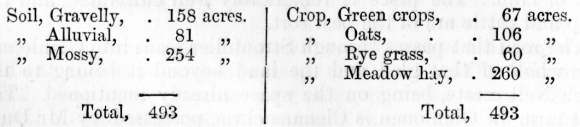
The woodlands formerly held by the Company are
now let for wintering hoggs to large sheep farmers, who make some use of
them in summer for grazing young cattle.
The tenants this year are, for Fearnoch, A. E.
and J. Jaffley, rent £280; and for Branakeil, William Menzies, rent £170.
After leaving Bunawe, and following the south
side of Loch Etive, the road passes through the woods of Fearnoch and
Airds point, and emerges from them at Stonefield. The small farm of that
name is not part of the Loch Nell estate, although it is in the centre of
it Beyond Stonefield, at a bend of Loch Etive, is the farm of Culnadallach,
possessed by Mr Duncan Sinclair. He pays for it and the wood of Barvisen a
rent of £265. He keeps a small fold of Highland cows, which are very good,
and improving every year.
This farm, and Kilmeronaig adjoining it, are
considered arable farms, but good cattle have often been reared on them.
Kilmeronaig is now let to Mr Virtue, the tenant of the shootings on Loch
Nell estate.
Achaleven is the next farm, and is occupied by four tenants, paying about
£20 each of rent. The river Lusragen, which falls into Loch Etive at
Achaleven, is the boundary of Loch Nell estate in this direction, and also
the boundary between the parishes of Ardchattan and Muckairn, and Kilmore
and Kilbride.
Dunstaffnage estate extends from this stream westward to the march of
Dunollybeg, a distance of four miles, with a breadth of a mile and a half
from the sea towards the hills. At the northeast corner of the estate
there is Connel Ferry and public-house, with some lands attached. The
first farm of any size is Saul-more, which is let to Messrs J. and J.
Miller at a rent of £208.
There is here a large plain or flat, composed
of peat moss and alluvial soil. The hills above Saulmore not being high,
there was no mountain stream to carry the soil into the sea. There was
some extent of moss land, but it has been nearly all brought into
cultivation. Messrs
Miller manage the arable land well, and keep a stock of Ayrshire cattle
for dairy purposes. A new farm-steading was erected at Saulmore within the
last few years. The mansion-house of Dunstaffnage is on a portion of this
farm, and the proprietor, Sir Donald Campbell, generally resides there.
The farm of Achavaich, to which the
Dunstaffnage portion of Ardchonnell is now joined, is above Saulmore, back
from the sea, and is possessed by Mr Ronald M'Dougall at a rent of £170.
The arable land on the lower part of the farm
is good, but the upper part is thin and poor. The stock kept consists of
blackfaced sheep and a few cattle. The next farm to Saulmore along the
sea-shore is Dunbeg, the arable land on which is pretty good.
The tenant, Mr Neil Brown, keeps a small stock
of Highland cattle, which are better than might have been expected in such
a place, and which are highly creditable to the tenant.
Dunstaffnage farm is possessed by Daniel and
Walter Bain, father and son, the rent being £90. The arable land is good,
and the tenants attend to it well. They have a dairy stock of pure
Ayrshire cattle, and a small stock of sheep. The road towards Oban passes
through the farm of Pennyfuir, occupied by Mr Charles M'Lean, at a rent of
£180. He keeps a very nice stock of Highland cattle and some flying stock.
A good farmhouse and steading have lately been erected.
The little farm of Ganavin, on the sea-shore,
is joined to Pennyfuir, and contains some good arable land. The hill
pasture of Pennyfuir is excellent, and has often been used for cattle
alone, but Mr M'Lean keeps a small stock of blackfaced sheep, which he
manages well.
Dunstaffnage estate ends here, and Dunolly estate begins— the first farm
being Dunolly Beg. This is an excellent farm as regards soil and shelter,
and very good Highland cattle used to be reared upon it. The farm is now
in the hands of J. and E. Struthers, at a rent of £200.
They keep a dairy stock of Ayrshire cows, and
dispose of the milk and fresh butter in Oban. Mr John Struthers was the
sole tenant till within the last few years, and he was constantly making
some improvements in the way of draining and clearing the ground of whins
and brushwood. Long before Mr Struthers' time, draining and building
improvements were carried on at Dunolly Beg. The late Sir John M'Dougall,
the proprietor, secured a share of drainage money the very first year of
the grant, and applied £200 of it to this farm. Some portions of the
ground were nearly useless, such as the whin park at the back of the farm.
The place was thoroughly drained, and when brought under the plough, it
was found to yield excellent crops and permanent grass afterwards. It has
since then been sometimes under crop and often in pasture, and is among
the best parts of the farm. Some of the drains have had to be renewed, but
not to any great extent. Besides the dairy, which evidently answers well,
there are some sheep kept on the hill part of the farm, and some cattle
are fattened for the market.
The home farm of Dunolly is kept in the hands
of the proprietor, Colonel M'Dougall. The arable land is very well
cultivated, and the stock, which consists of Ayrshire cows, for the use of
the house, and some sheep, are always of the best kinds. Colonel M'Dougall
generally resides at Dunolly, and his mother, Lady M'Dougall, and some of
the family, are always there. On the south side of Oban is Glencrutten,
where the property of Mr Houldsworth begins.
Glencrutten is the best part of the estate,
which stretches over Barran Hill until it meets Loch Nell lands at the
back of Balli-gown. Large portions of this moor, and of the upper part of
Glencrutten, were enclosed and planted by the late proprietor, Mr M'Kay.
This interferes with the pasture at present, but will greatly benefit the
estate in every respect when the plantations are further advanced. They
are getting on rapidly where there is shelter, and more slowly in exposed
places. Glencrutten
farm is possessed by Mr John Craig at a rent (including one of the
Glencrutten crofts) of £129. Mr Craig keeps a dairy stock, and sends the
milk to Oban. The arable land is good, and he turns it to the best
account. There are several crofts at the top of Glencrutten which are
variously occupied. Mr Peter M'Arthur has Polavinister, for which he pays
£55. The south side of Glencrutten is on the Dunolly estate, and is
occupied by Mr Duncan Campbell, Dalintart, and Mr Angus Campbell, Soroba;
and the parks below by Mr Peter Cumstie, Oban. Mr D. Campbell has been
most industrious in draining parts of Dalintart that required it, and has'
excellent crops on ground that was formerly useless. Mr Campbell, Soroba,
also attends to his arable land with skill and industry, and has always
good crops. He sends milk to Oban in the summer season, but does not
depend upon it so much as Messrs Craig and Struthers.
There is a corner of the district of Lorn to
the west of Oban, lying between the Sound of Kerrera and Loch Feochan,
which, taking the road from Oban to the head of Loch Feochan as a base,
may be regarded as a kind of triangle. The length of any of the sides of
the triangle is not more than four miles, and yet it is divided among six
proprietors. Mr M'Fie has the portion nearest to Oban, including
Glenshellach, and the property extends along the Sound of Kerrera for
fully two miles. There it is met by Gallanach property. The mansion-house
is situated in a sheltered romantic spot near the entrance to the sound.
The property extends round to Loch Feochan, ending with the farm of
Ardoran, at which it is almost within a stone-cast of Dunach property.
Here a stripe of land touching Loch Feochan, and belonging to Mr Murray
Allan, comes in between the two estates. This point belongs to the farm of
Kilbride, and that farm and Colagin, which marches with it, belong to
Glenfeochan. Dunach estate, consisting of the farm of that name, now
belongs to N. M. M'Donald, Esq. The mansion-house is very elegant, and
beautifully situated on a platform on the side of a hill facing Loch
Feochan, and is surrounded by fine plantations. The whole place has a most
picturesque appearance. The late proprietor, Mr Forsyth, bestowed much
labour and expense in improving Dunach. He drained all lands requiring
drainage, and turned up rough ground under heather, bringing it into
tillage. These grounds have been laid out in permanent pasture, and remain
green to the present time. They have been grazed by sheep, and that helps
to keep down the heather. Mr M'Donald keeps the lands in his own
possession, and rents Moleigh, which marches with it. He has commenced to
rear a stock of black cattle, and is very likely to have a superior herd
in a few years. The estate of Lerags is in a hollow at the back of Ardoran,
and touches Loch Feochan. It belongs to the heirs of the late Dr Campbell,
and is all let in small farms. The only other estate in this division is
the small estate of Soroba, belonging to A. W. M'Dougall, Esq., of
Battlefields and Oban. It marches with Moleigh on the south, and descends
into Glen-shellach on the north, marching there with Mr M'Fie and with
Dunolly. There is a
neat mansion-house at Soroba, which looks very well, half seen among trees
on a hillside facing Oban and Dunolly woods. In this corner of land there
are two hollows or valleys running east and west, namely, Glenshellach,
which is a continuation of Glencrutten, and Lagnakil, through which the
road to Kilbride and Ardintallin runs. In both of these valleys the soil
is good, and the land is well cultivated. For the most part there are
small farms on which black cattle are reared and hoggs wintered. For this
last purpose the ground is well adapted, and the winter grazings are
always in demand. The only farms of any large size are Upper Glenshellach,
possessed by Mr John M'Innes at a rent of £210, and Ardoran, by Mr Hugh
Craig, rent £231. Kerrera runs alongside of the division last mentioned.
It must have been connected with the mainland at some remote period. Whin
dykes run across Kerrera, and a continuation of each of them is seen on
the opposite side of the sound. This is remarkably the case at Gallanach
and at Port Kerrera. Another stratification of rocks seems to point out a
connection between Kerrera and the slate island of Nether Lorn. There is
slate rock in Kerrera, and the stratification is the same as in these
islands, whilst in both cases whin dykes run across at right angles. What
is most to the purpose here, the soil in Kerrera bears a strong
resemblance to that of the island of Luing, and in both places the soil is
rich and good.
Kerrera is about four miles in length, and belongs to Dunolly, all except
the farm of Ardentrive, which forms the north-east end of the island.
Ardentrive and Balliemore, which marches with it, are farms of moderate
size, and have been held as separate possessions for a long time back,
whilst there were joint tenants in the rest of the island. There used to
be four tenants at Burnabuck, three at Slatterich, two at Balliemore
Crofts, two at Ardachoire, and three at Gylen. The late Sir John M'Dougall
gradually reduced the number of tenants, and gave each a separate
possession, and this was done as changes occurred. Long before his death
each tenant had his own possession on easy terms, and the rent was
punctually paid and the land well cultivated. Arable land of a good kind
is met with everywhere in the island, and the pasture is excellent.
Balliemore, which is the best farm on the
estate, is possessed by Mr Archd. M'Callum at a rent of £195. He also
holds Gylen Park at a rent of £70. He keeps a flying stock of cattle, and
blackfaced sheep on Balliemore. The place would summer 80 head of stots or
heifers, and four or five cows for milk; but Mr M'Callum prefers to have
fewer cattle and a larger number of sheep. The tenants on the rest of the
estate rear black cattle and raise crops—the rents being, for Slatterich
(three divisions united), £143; for Barnabuck, £80; Ardmore, £72; Gylen
(one division), £64, (another division) £62; Ardachoire, £70; Balliemore
Croft, £55 ; and Ferry Croft, £14.
The farm of Ardentrive is rented by Mr John
Robertson (who has other lands in Skye). The rent is £220, and the stock
kept consists of sheep and flying stock, and animals fattened for the
butcher. The arable land in Ardentrive is of the best quality, and used to
yield excellent crops. A very large quantity of potatoes were raised in
Kerrera before the time of the potato disease, and they were often bought
up for the Liverpool market. There is a less quantity of potatoes and more
turnips now raised.
The islands of Luing and Seil belong to the district of Lorn, and should
be mentioned here. The soil in both places lies on slate or claystone, and
is dark in colour, and heavy and good. The following farms in Seil may be
referred to as about the best, viz.:—Dunmore and Carnbaan, possessed by Dr
Hugh Gillis, rent £270; Ballachuan, Mr Joseph M'Innes, rent £220 ;
Kilbride, D. and A. Johnstone, rent £80. These lands are in a high state
of culture, and may be compared favourably with any equal extent of land
on the west coast. Along with the best treatment otherwise, artificial
manures, such as guano and bone dust, are extensively used. Sea-ware comes
ashore in large quantities at Dunmore and Ballachuan, and much of it is
used with good effect. The soil in Luing is of the same description as
that in Seil, except that there is greater variety, moss and sandy loam
being met with in parts of the island, such as at Ardlarach and Ardluing.
The lands are chiefly under sheep at present, and in possession of Messrs
John and George Willison, who have been already mentioned as the tenants
of a large hill farm in Glenorchy. They have rented Kilchattan, Ardlarach,
and other lands in Luing, for which they pay £1050 per annum. It may be
explained here that the late Marquis of Breadalbane commenced a model farm
for fattening stock and raising crops, and erected office-houses at
Kilchattan at great expense; but he died suddenly, and the experiment was
not followed out. The only other large farm in Luing is Bardrishach,
rented by J. and W. Glendinning at £242; and the next to these are
Leccamore, Ardanamir, and small possessions variously occupied. Torsa is
worth mentioning. It is close to Luing on the inside, and is excellent
arable land. The
whole of the island of Luing belongs to Lord Breadalbane, and also the
island of Seil, except the little property of Ardincaple at the east end
of it. Allan M'Dougall, Esq., is the proprietor, and the tenant of the
home farm is Angus M'Cal-man, who pays a rent of £145. Camuslaich is the
next farm to it, and the tenant is A. M'Lachlan, who pays £115 of rent,
and like the other tenants on the estate, keeps Highland cattle. The lands
are low-lying and well adapted for crop, and the system of culture is very
fair. Seil is connected with the mainland by a one-arched bridge at
Clachan, seventy-eight feet in span, and twenty-six feet above high
water-mark. This bridge, thrown across the narrow sound of Clachan, was
erected at least half a century ago, and is said to have been among the
first instances in this country of joining an island to the mainland. Seil
measures four miles by two, and Luing six miles by two. There are a number
of small islands near, but Shuna, which is 2½ miles in length by 1½ in
breadth, deserves to be mentioned. It was left by a Mr Yates to the city
of Glasgow for benevolent purposes. Being clothed with natural wood, and
the soil pretty good, it has generally been used for Highland cattle. The
present tenant is Mr James Gibson, Glasgow, who pays £335 of rent.
Benderloch.
Lorn has islands within its bounds, as we have
just seen, and it has also peninsulas, viz., Benderloch and Appin. The
upper parts of both districts consist of sheep farms, which have been
already referred to.
Benderloch is a mountain range between two lochs or arms of the sea, but
there is a margin or border of level ground around the most of it. This is
probably an old sea-beach, but it is now for the most part under the
plough. It contains two large tracts of moss—the one near Connell, and the
other at old Barcaldine Castle, but these will be mentioned further on.
The soil in Benderloch is generally light, but
there is variety of peat, light loam, and clay to a small extent. The
crops raised are oats, potatoes, and turnips ; and the rotation is the
five-shift course, but is in some cases being superseded by the six-shift
course—two years in pasture, instead of one year. The average return for
oats is from five to five and a half bolls on the boll sown. Potatoes
yield from ten to twelve returns, The soil is well adapted for potatoes,
and a considerable quantity is sold every year. Vessels go into Loch
Creran and Loch Etive for their cargoes, so that there is no expense in
sending them to market. There used to be several folds of excellent
Highland cattle in Benderloch, but there are very few at present. The
largest and best of them, viz., the stock at Auchanreir, was sold off at
Whitsunday last, on the removal of the tenants to other lands. There was
keen competition for the different lots, the average price for cow and
calf being £22. The new tenant has this year contented himself with flying
stock, but it is to be hoped he will commence a rearing stock by-and-by.
His father, Mr Buchanan, Blarcreen, has a fold of good Highland cattle.
There is excellent arable land at Blarcreen and Inveres-ragain, so that
there is plenty of wintering for cattle. Following the banks of Loch Etive
to the west, some good strong Highland cattle will be seen at Ardchattan,
on the lands kept by Mrs Popham in her own hands. At Ardachy, Mr M'Callum
keeps a limited number of cows, which are of the very best description. Mr
M'Callum is frequently asked to act as judge at cattle shows.
The division between Ardchattan and Loch Nell
properties is at the march with Achnamba, which is the next farm. Mr
M'Innes, the tenant, has a small fold of excellent Highland cattle, with
which he carries prizes at cattle shows every year. Mr M'Niven, who rents
Balure, Loch Nell, has made a beginning with a Highland stock, which
promises very well. There is plenty of arable land at Balure, and there
are woods and shelter. The late Mr George Clerk had a fold of first-rate
Highland cows there; and if Mr M'Niven perseveres, he will soon have them
equally good. Mr Archibald Campbell, Shenvally, has a small fold of good
Highland cattle.
There are several dairy farms in Benderloch. Mr Kinnes, Ledaig, keeps
Ayrshire cows, which are of the very best kind, and makes butter and
cheese. Mr Bannatyne,
Achnacreebeg, keeps the same kind of stock. Mr Colthart, Loch Nell home
farm, has Ayrshire cows.
Mr Colthart, Balure, Barcaldine, also keeps
dairy stock, and makes excellent cheese. Barcaldine home farm is possessed
by Mr Hosack, the factor for Loch Nell, Barcaldine properties, and others.
He keeps a flying stock of Highlanders, and makes a point of having them
good. There is a
large space of level ground at Barcaldine, surrounded by woods and
plantations; and the crop and cattle there are generally of the best. The
late proprietor, Mr Cameron, had a fold of Highland cattle which were
remarkably strong, although not of the finest. The trees about Barcaldine
are very large, and some of them will be mentioned elsewhere. The lawn or
parks around the mansion-house and the garden are extensive and well kept,
and the place is altogether most attractive. Improvements were going on at
Barcaldine in building farm-houses and fences, but the death of the late
proprietor has brought matters to a standstill for the present.
On Ardchattan estate the houses and fences are
very good. The plantations are well attended to; and the Priory, where Mrs
Popham resides, is a picture of neatness and elegance. There is less room
for draining on this estate than on any other that can be named.
Appin.
Appin is divided from
Benderloch by Loch Creran and Glen Creran, but both meet at the head of
the glen among the Glencoe mountains. The highest parts of Appin have been
mentioned already in connection with sheep farms, and the lower part, or
strath, of Appin may now be disposed of. Properly speaking, the strath is
the hollow or valley between Port-na-Crois and Loch Creran, but the name
is applied to the space between that hollow and the point of Ardveich.
This strath was under the sea at one time, as it is only a few feet above
the level of it, and then the point of land to the west of it would have
been an island. The soil in the strath just mentioned is of excellent
quality, formed of deposits left by the sea, but moss has grown over it in
a few places. There is level ground on a platform a little higher between
Port Appin and Ardtur, the soil of which is lighter, a large portion of it
being moss. Good crops can be produced when the lands are well manured. Mr
Smith, Ardtur, can show as good crops as are to be seen in the country;
and on the home farm of Airds excellent crops are often seen. A summary of
the tenants and their possessions on this part of Appin may be given as
follows:—At Elerick, Mr Cameron, rent £85; stock—sheep (ewes), cows, and
followers. Fasnacloich, Robert Hall, rent £110; stock—sheep, cows, and
arable land. Glasdrum, George Boyd, rent £50; stock—cows and hogg
wintering. Glasdrum, Robert Clark, rent;£70; stock—sheep, cows, and
followers. Crigan, Hugh M'Coll, rent £125; stock—sheep and cows. Inver-folla,
&c, C. Blacklock, rent £68; stock—cows and hogg wintering. Ardnaclach,
William Allison, rent £100; stock—cows (dairystock), and arable land.
Shian, John M'Innes, rent £36, 4s.;- stock— Ayrshire cows and young
cattle. Glaceriska, John Cameron, rent £100; stock—Ayrshire cows and young
cattle. Airds home farm, Colin Campbell, rent £144; stock—cows and
followers. Ardtur, J. H. Smith, rent £112; stock—Ayrshire cows and arable
land. Ledgrianach, Alexander M'Leod, rent £63; stock—cows and followers.
Auchnacon, Malcolm Boyd, rent £240; stock— sheep (ewes), milch cows, and
followers. Shuna, A. Cameron, rent £190; stock—sheep and flying stock,
Lurignish, Archibald M'Kenzie, rent £120; stock—sheep and cows.
Lismore. Close to Appin lies the island of
Lismore, which is 10 miles long, and averages 1½ in breadth. The
proprietors are the Duke of Argyll; Captain Campbell, Baleveolan; Rev. J.
A. Fell; and D. Campbell, Esq., of Loch Nell. The west end of the island
is let to F. and J. Paterson, at a rent of £1403, 8s. 10d. The stock
consists of whitefaced sheep; also young Highland cattle, both stots and
stirks. Clochlea is possessed by Dugald M'Intyre, at a rent of £166. He
keeps whitefaced sheep and a flying stock of Highland cattle, besides
milch cows. Part of Achuaran is presently possessed by two tenants, viz.,
D. and A. M'Gregor, who pay a rent of £108—the remainder by D. and A.
Carmichael, rent £145. Balaveolan is occupied by D. Buchanan at a rent of
£51. Achandoun is occupied by three tenants, viz., A. M'Intyre, who pays a
rent of £82, and keeps a stock of cows; John Campbell, rent £47, 11s., and
keeps cows with followers; H. Carmichael, rent £49, 6s., and keeps a stock
similar to the last mentioned. The soil in Lismore is rich and good, and
yields heavy crops. Limestone rock crops up everywhere, and the soil over
it, however thin, is productive.
Ardnamurchan.
The Morven range of hills, including
Kingarloch and Ardgour, having been treated of as a sheep district, we may
now pass on to Ardnamurchan—the only remaining peninsula. A good view of
both Morven and Ardnamurchan is obtained in going through the Sound of
Mull. After leaving
Tobermory, and passing the mouth of Loch Sunart, Ben Hiantan presents
itself, rising boldly from the seashore to a moderate height, and green to
the very top. Mingary Castle, around which much history gathers, is at the
north base of the mountain. Mingary farm has been known as a suitable
place for rearing black cattle, a large number of which is kept by the
present tenant, Mr M'Lachlan. Ben Hiantan is now stocked with Cheviot
sheep, which thrive remarkably well. Ardslignish, at the foot of Ben
Hiantan, was of old celebrated for fine cattle, and now rears very heavy
Cheviot sheep—the pasture being uncommonly rich. Corrievullin, so
celebrated by Alexander M'Donald in the well-known song, "Ault-an t'Suicar,"
lies north of Mingary. On the other side of Ardnamurchan, Achatenny,—keeps
good sheep, and produces fair crops. The three Swordales now joined in
one, of which the soil lies on limestone, rears Cheviots of the best
quality, whilst further north Gorteneorn combines qualities, fitting it
for sheep, cattle, or arable. Ben Resipol in Sunart is a conspicuous
object to the north-east, and although rugged at the top, very good
grazing for sheep is found around its sides. Proceeding to the head of
Loch Sunart there are glens and hollows yielding excellent pasture both
for sheep and cattle. The large tenement of Drimnantorran may be
mentioned, and specially Glennahuirach. It is a valley in Sunart of some
note, containing a lake of considerable size, a good farmhouse, and
remarkably good sheep pasture. The back of Sunart is bounded by Loch Sheil,
and is much more admired for its picturesque appearance than for any
pasture it can afford.
There is one exception in the recess
containing the excellent farms of Polloch and Scammadale. The rest of the
land at that side of Loch Sheil is bounded by dreary moss, and along the
coast at the west end of the loch to the point of Ardnamurchan the land is
very poor, except in the few places above mentioned. The tendency during
the last twenty-five years has been to reduce the number of small
holdings, and several farms that were of that class are now under sheep,
so that the extent of land under cultivation, and the stock of black
cattle have largely decreased. Several families emigrated some years ago,
and there is still a yearly outgoing of young men and young women for
service in the south ; consequently the population is on the
decrease-About thirty crofts were laid out near the point of Ardnamurchan,
to which as many families were removed from the much better farms of the
three Swordales. A
good many of the crofters derive their principal support from the
prosecution of cod fishing in spring, and herring fishing in summer ; and
several of them have now got good well-fitted smacks of their own.
There is a large tract of moss at Kintra, of
which 50 acres have been reclaimed, and is now occupied chiefly by the
crofters who reclaimed it.
Along the edges of this moss near Kintra the
subsoil is sand, with a thin layer of moss, and this has been improved by
sheep-draining. The sheep stocks have increased in number, and improved in
quality, the farms being generally well managed. Cheviots and blackfaced
sheep are nearly equal in numbers. Highland cattle have greatly decreased,
there being only one large fold in the district.
Rents have increased for the last twenty-five
years from £6500 to, £10,000, and the rent of the salmon fishings has
immensely increased. There are extensive natural woodlands, principally
along Loch Sunart, there being a stretch of eight miles from Strontian to
Salen, all on Sir Thomas Riddell's property. The Ardnamurchan property,
which was part of the late Sir James Riddell's estate, was bought in 1856
by Mr Dalgleish, W.S., Edinburgh, who cleared out the natural wood along
Loch Sunart, between Salen and Glenboradale, and planted a portion yearly
with larch, &c, and there is now a thriving plantation six miles in
length. The property has been greatly improved by the erection of a
mansion-house at Glenboradale, a superior class of farm-houses, and a good
road from the north side of the district to Kilchoan, so that the
principal parts of this estate are now opened up. Sir Thomas Riddle's
estate has also been much improved by good farm buildings, and wire
fencing on the sheep farms. There are yearly cuttings of oak and oak
coppice on the estate, but more limited of late on account of the low
price of the bark, and the increase of the cost of 'manufacturing it.
The islands of Canna, Muck, and Rum, forming
the parish of Small Isles, are attached to Ardnamurchan for assessment
purposes. These islands have their histories and traditions, but for an
agricultural report not much need be said of them. Canna is the property
of Donald M'Neill, Esq., and his ancestors possessed the island for many
generations, known as the M'Neills of Canna. The estimated rent is £604,
and Mr M'Neill keeps most of the lands in his own hands, and rears good
Highland cattle. There are twelve cottars on the estate, each paying £7 of
rent. The isle of
Muck is the property of Thomas Swinburne, Esq., and is let to Mr David
Hardie at a rent of £350. The isle of Rum is now the property of Captain
E. Campbell of Rum and Tenga, and this year he has the lands in his own
possession. The stock of the island has been blackfaced sheep for a long
time back, and it seems to be very well adapted for a sheep range. This
island has changed owners and occupants repeatedly of late years, but it
is to be hoped that Captain Campbell will remain the proprietor for a long
time, with or without a tenant under him.
Islay.
Islay may be taken next, and some of the best
soil in the whole county is to be found in it. In the last statistical
account (1844 some of the lands were mentioned unfavourably in respect of
management. Runrig land and joint-tenancy were persevered in to that time,
but matters are in a more favourable state now.
This island lies about north-west from the
peninsula of Kintyre. Its sea-board is generally rocky, and in some places
bold and rugged. Immediately above the shore there is generally green
pasture or arable land; the larger portion of the interior of the island
is tolerably flat, cultivated more or less, though there are still large
tracts of land which might profitably be brought under the plough. In the
north-east there are high hills, some of their summits being bare, and
there are large loose boulders ; others are green, and afford good sheep
pasture. The climate is, salubrious, being neither so cold in winter, nor
so hot in summer as the mainland, yet it might be improved by the planting
of trees. Except about Islay House and Port Askaig, planting has hitherto
been much neglected.
In sheltered spots trees thrive very well, and the want of them about the
farm steadings gives a bare appearance to the place. Many of the natives
reach a good old age, and some of them when above eighty years of age
enjoy good health. The island has been long famed for its fine breed of
west Highland cattle, and also for its whisky.
Of late years the lands have passed into new
hands, the new proprietors being Morrison of Islay, Ramsay of Kildalton,
Finlay of Glenlossit, M'Laren of Sunderland, and Campbell of Ballinaby.
The last small property is strictly entailed on heirs male.
The larger portion of the old native race of
tenantry has also passed away, and their holdings are now mostly occupied
by tenants from Ayrshire and the lowland districts, who turn their
attention principally to dairy farming, and find that Ayrshire stocks
thrive exceedingly well. They also rear a considerable number of cross
lambs, which are sent fat to Glasgow early in the season. The hill
districts, which were formerly only partially stocked, are now covered
with thriving flocks of blackfaced and Cheviot sheep, which help to supply
the Glasgow market. West Highland cattle are still reared to a large
extent, and the number is likely to increase under the stimulus of the
high price of beef, which Islay supplies in perfection. Mr Campbell,
Cladville, has perhaps the finest stock of Highlanders; Mr Stewart,
Octafad, and Mr Wilson, Lerrin, being the most enterprising reclaimers of
waste land. The area
of arable land, though considerably increased, has not been so rapidly
extended as might have been anticipated. However, the cultivation of the
land has been very much improved, so that the production of food for
cattle and sheep is very much larger per acre than it was thirty years
ago. Many fields carry heavier crops of turnips, potatoes, and corn than
are usual even in the Lowlands. The improved culture, and the general rise
in the value of farm produce, stimulated by the large expenditure by the
landlords on houses, fences, &c, has caused the rental of the island to be
nearly doubled within the last thirty years. So much room for improvements
still remains, however, that with a judicious outlay of capital, it might
be doubled again in' the same number of years.
The principal exports from Islay are horses,
cattle, sheep, pigs, and poultry, cheese, butter, eggs, and some years a
large quantity of potatoes. Whisky is largely produced, and the
distilleries afford a valuable help in the supply of manure, while they
also assist in maintaining prices of stock in the local markets, many
cattle being fattened off in connection with them. The distilleries will
be mentioned under a separate head. The following farms and possessions
may be mentioned:—On Mr Ramsay's - estate of Kildalton are—Proaig,
possessed by Andrew M'William; pent, £164; stock—blackfaced sheep.
Ardtalla and Claggan, John M'Intyre; rent, £280; same kind of stock, with
20 acres under crop. Trudernish and Craigfionn, heirs of A. Campbell;
rent, £140; stock—Highland cattle and blackfaced sheep. Kintour, &c, Dun.
M'Kay; rent, £351; stock—Highland cattle and Cheviot sheep. Ardelister and
Ardbeg, Colin Hay; rent, £300; stock of the former, Highland cattle and
Cheviot sheep, and of the latter, Ayrshire, Shorthorns, and Cheviot sheep.
Columkill, William Morrison; rent, £335;
stock—Ayrshire cattle, shorthorns, and Cheviot sheep. Laphruaig and Texa,
Dugald Johnstone; rent, £214; stock same as last. Ballivicar, Dun.
M'Kerrel; rent, £189, 9s.; stock—Ayrshire cattle and blackfaced sheep.
Laorin, &c, Robert Wilson; rent, £489, 7s.; stock—Ayrshire cattle,
shorthorns, and blackfaced sheep. Ballich-atrican and Park, Hugh
Stevenson; rent, £412; stock of the former, blackfaced sheep, and of the
latter, blackfaced sheep and cattle. Kennabus, Farquhar M'Rae; rent, £272;
stock—Ayrshire cattle and blackfaced sheep. Giol and Glenastle, John
Phillips; rent, £360; stock—Highland cattle and blackfaced sheep. Corrabus
and Torrabus, William Gemmel; rent, £622 ; stock—Ayrshire cattle and
blackfaced sheep. Kintra, &c, Archibald M'Nab; rent, £393; stock same as
last. Machry, Peter Carmichael; rent, £225; stock—Highland cattle and
blackfaced sheep. Duich, John M'Nab; rent, £155; stock same as last.
Laggan, Hugh Stevenson; rent, £269; stock—Ayrshire cattle and Cheviot
sheep. Corrary, &c, A. Stewart's heirs rent, £193; stock—Ayrshire cattle
and blackfaced sheep.
On Mr Morrison's estate of Islay are—Tallant,
&c, J. Johnstone's heirs; rent, £289; stock—Ayrshire cattle and mixed
sheep. Nereby, &c, Samuel Mitchell; rent, £361; stock same as last. Dal
and Upper Duich, Alexander M'Conocher; rent, £593; stock—Ayrshire cattle
and blackfaced sheep. Knockdon and Corrabus, William Dunlop; rent, £250;
stock same as last, Octamore, A. M'Taggart's heirs; rent, £245;
stock—Highland cattle and Cheviot sheep. Port Charlotte, J. B. Sheriff;
rent, £206; stock—Highland cattle crossed with shorthorns, and Cheviot
sheep. Olistadh, &c, J. B. Sheriff; rent, £284; stock same as last.
Octafad, William Stewart; rent, £303; stock— Ayrshire and shorthorns and
Cheviot sheep. Lossit-Rhinns, D. & J. Rickett; rent, £320; stock—Ayrshire
cattle and shorthorns and blackfaced sheep.
On the Sunderland estate, belonging to the heirs of Alexander M'Laren,
Esq., are—Coul, Daniel Simpson; rent, £400; stock—Ayrshire cattle and
Cheviot sheep. Claudeville, William Campbell; rent, £350; stock—Highland
cattle and Cheviot sheep. Sunderland and Foreland, Donald M'Donald; rent,
£550; stock—Ayrshire cattle and shorthorns and Cheviot sheep.
Jura.
Jura is separated from Islay by the Sound of
Islay, and from the mainland by the Sound of Jura, The chief proprietor is
Richard D. Campbell, Esq., of Jura, whose rental is close upon £4000. The
other proprietor is Walter M'Farlane, Esq., of Ardlussa.
The land of Jura is for the most part rugged
and wild, and a considerable part of it is under deer—estimated number
2000. The rent of the deer forest is £1127, 10s.—the tenant being Henry
Evans, Esq., Derby. The proprietor keeps a portion of the lands in his own
possession, the estimated rent of which is £700. He has always good strong
Highland cattle, in which he seems to take great interest. The rough land
in Jura suits well for flying stock. Mr Campbell used to buy the best
stots at Kilmichael market, keep them till they were three and sometimes
four years old, and then sell them at high prices. Mr Campbell of
Achindarroch rents the farm of Kennachtrach, for which he pays £200. Mr
Archibald Fletcher and Sons have always an excellent stock of sheep and
cattle. There is a large number of small tenants on the estate, paying
rents of £20, and some £25, and a few higher than that. Mr M'Farlane,
Ardlussa, has a very good stock of sheep. He is making considerable
improvements on the estate since he bought it, in forming roads, making
fences, and the like. The small island of Scarba is divided from Jura by a
narrow channel, the one end of which is in the Gulf of Corryvreckan. The
proprietor of the island and Garvilloch, which lies close to it, is F. C.
T. Gascoigne, Esq., of Craignish. The rent of both is £350. Scarba is in
the proprietor's own hands, and under deer, but Garvilloch is let to Mr
James M'Eachnie for £160.
Colonsay.
Colonsay has been for a long time the property
of the M'Neills of Colonsay. The eminent Lord Colonsay was the proprietor
for many years, and after him Sir John M'Neill, but the present owner is
Colonel John C. M'Neill, a member of the same much respected family.
The cattle reared in Colonsay held a high
place long ago, and one after another of the proprietors continued the
stock without any falling off. The lands on which they kept the cattle and
other stock are now let to Mr Peter Strayan, who pays a rent of £1300 for
his whole possession. The farm of Balinahard is let to Mr Alexander Weir
for £300, Bonaveh and Glassart to Mr Donald M'Neill, the rent being £320.
The soil in Colonsay is good, and well suited for cattle or crops. There
are seven small tenants with smaller rents than the few mentioned here.
Agriculture is in a very satisfactory state in Colonsay and Oronsay. The
rental of the whole is £2950, 6s.
Mull
Mull is the largest of the
islands belonging to Argyllshire, and has several small islands adjoining
it. One portion of it is a peninsula, the arm of the sea, called Loch-nan-gaul,
running so far in towards the bay of Aros as to leave only a neck of land
to form a connection.
There are three parishes in the island, viz.,
Kalfinechen and Kilvickeon, or Ross of Mull; Kilninian and Kilmore, or the
Tobermory district; and Torosay, or the southern portion in which Duart is
situated. The boundaries of these parishes correspond in some measure with
the natural divisions of the island, and they may be followed here,
beginning with Torosay. The principal proprietors in Torosay are—A. C.
Guthrie, Esq., of Duart; Colonel Gardyne of Glenforsa; and M. G. M'Laine,
Esq., of Loch Buy. A small portion of the Duke of Argyll's Mull estate is
within the bounds of this parish. The length of the parish from south-east
to north-west is 20 miles, and its breadth is 12 miles, so that it
contains about 160 square miles of land.
There are mountains and glens in this division
of the island, which give it a picturesque appearance. Ben-teallaidh is
entirely in the parish, and a portion of Ben More forms part of the
boundary on the west. Besides these there is Benmaigh, which rises above
Loch Buy. The glens are Glenforsa, Glenmore, and Glencanail. Ben-teallaidh
in Glenforsa has been long famed for its sheep stock, and the hills around
it are also well suited for sheep. Long ago Ben-teallaidh was in
possession of Mr Donald Sinclair, who had a splendid stock of blackfaced
sheep there, when good sheep were not common in the Highlands. At a later
date Mr Campbell Paterson became the tenant of Ben-teallaidh and the whole
of Glenforsa and Glenmore. He was a banker in Oban, and factor for Mr
M'Quarrie, the proprietor of these lands. About the year 1848 he took the
farm of Knock, belonging to the Duke of Argyll, and went to reside there.
His sheep stock amounted to 20,000 in number, one half of them being of
the Cheviot breed, and the other half blackfaced. After some years' trial,
he commenced crossing with Cheviot tups, and his successor, Mr Oliver,
followed the same course during his possession. Both of them had wether
stock on Ben-teallaidh, for which it seems to be well suited. This large
tenement is now in four different divisions, Colonel Gardyne, the
proprietor, having one of them in his own possession, Mr Lachlan M'Innes
another, Mr Charles Stewart a third, and the executors of the late Mr
Archibald M'Phail the fourth. The respective rents paid by these three
tenants are £340, £480, and £350. When Archibald M'Phail got possession of
his division, which is the north-west portion of Glenforsa, the sheep were
of the Cheviot breed, but he lost no time in converting one-half into
blackfaced; the other half is still Cheviot. It was found that the Cheviot
sheep require more care in wintering, richer and better grass in summer,
and also better smearing. The hills and glens in Torosay will always
produce good sheep under good management. Ben More is a good sheep range;
and although above 3000 feet high, there is pasture to the very top. The
slopes and hillsides around Loch Baa furnish excellent grazing, and the
same may be said of Glencanail, and of almost all the glens and mountains
in Mull. The
following tenements may be specified, viz.:—Glens and Bevin, W. Elliot;
rent, £700; stock, cheviot sheep. Knock, Mr Graham; rent, £650; stock,
cheviot sheep and Highland cattle. These two tenements are on the Duke of
Argyll's estate. The little property of Burgh is in the hands of the
proprietor, N. M'Intyre, Esq. The stock upon it is blackfaced sheep and
some flying stock of young cattle.
On the Duart estate is the tenement of
Strachaoil, Torrans, &c, possessed by Mr James Merry; rent, £350; stock,
blackfaced sheep and Highland cows and followers. It is worthy of note
that Mr Merry kept a stock of Ayrshire cows for many years, which he
managed remarkably well, but of late he has seen cause to turn to
blackfaced sheep and black cattle. Guala-chaoilish, Auchnacraig, and Grass
Point are in the hands of J. and A. M'Phail; rent, £500; stock, blackfaced
sheep, flying stock of Highland cattle, and some Ayrshire cows. Oakbank
and Upper Achnacrois are possessed by Mr Hugh M'Phail; rent, £248; stock,
blackfaced sheep and Highland cows. The four tenements in Glenforsa
belonging to Colonel Gar-dyne have already been referred to. On the Loch
Buy estate are the following tenements, viz.:—Rossal, possessed by Cath.
Shaw; rent, £120; stock, blackfaced sheep and Highland cattle. Cameron and
Benbuy, tenant, Mr Donald M'Phail; rent, £176 ; stock, blackfaced sheep
and flying stock. Laggan, &c, tenants, D. M'Phail and the heirs of A
M'Phail; rent, £267; stock, blackfaced sheep and Highland cows and
followers. Glenbyre, heirs of D. and J. M'Intyre; rent, £165; stock
blackfaced sheep. Kinlochspelve, same tenants as last; rent, £266; stock,
blackfaced sheep and Highland cattle. The following three tenements are on
Mr Guthrie of Duart's estate:—Garmony and Lederkle, possessed by F.
Campbell, Esq.; rent, £400; stock, blackfaced sheep and Highland cattle.
Corrynahenachan, &c, tenants, L. and 1ST. M'Innes; rent, £258; the same
kind of sheep as the last, with flying stock. Scalasdale, occupied by J.
M'Phail; rent, £320; stock, blackfaced sheep and Highland cows and
followers. Scalasdale was long possessed by the late Mr John M'Phail, who
was well known and much respected.
Kilfinichen and Kilvickeon.
This large parish forms the south-western part
of the island of Mull. It is bounded on the east and north-east by a ridge
of mountains, which separates it from the parish of Torosay, and is
surrounded by the sea on all the other sides. It also is nearly divided
into two by Loch Scridan, an arm of the sea that runs 12 miles from west
to east into the parish.
The island of Iona or Icolmkill, and the
smaller islands of Innis Kenneth and Eorsa, both at the entrance of Loch-nan-gaul,
belong to the parish. Exclusive of its islands, the extent may be set down
at 170 to 180 square miles, being 24 miles long in one direction and 13
miles broad. The district of Ardmeanach is on the north side of Loch
Scridan; and Ross and Brolas on the south side. Ross forms a point or
promontory stretching out into the Atlantic much farther than any of the
other divisions. The Duke of Argyll is the proprietor of the larger part
of the parish, his rental in it being £5447, whilst the rental of the
whole is £8466. The small property of Pennyghael belongs to Donald
Robertson, Esq., rent £540, and Kilpatrick estate to F. W. Clark of Ulva,
rent £592, 10s. Taking the parish in general, the land presents but a
barren appearance, but on a more minute inspection much fertile land and
good pasture will be found. There is variety of hill pasture and low
grounds, consisting of heath, green pasture, and arable ground. The part
of the district which faces the south, and is called Carsaig and Inimore,
where there is a very bold headland and interesting rocks towards the sea,
consists of good land and excellent pasture inland. The Ross of Mull looks
very wild from a sea view, presenting bare granite rocks, without any soil
at all. Beyond the reach of the sea, however, there is tolerably good soil
and pasture. About the strongest and best cattle in Mull used to be reared
at Ardfenaig, when possessed by the late Mr Campbell, the Duke's factor.
The lands are now in the hands of Hector A. Campbell, Esq., who is most
likely to have good stock. He has only to follow the example of his late
father and of his uncle in that respect.
The island of I, or Iona, is separated from
Ross by a narrow channel called the Sound of I. This well-known island
belongs to the Duke of Argyll, and is let to small tenants. There are
about twenty-five of these, and the average rent is about £20. There are a
few exceptions, however, there being one tenant who pays £131, 16s. 3d.,
another £49, 5s., and there are several who pay about £10. There is a
larger number of black cattle kept on the different possessions than on
farms of the same rent on the mainland, but it may be questioned whether
it would not be better policy to keep a smaller number and have them of
better quality. Its distance from markets is a drawback to this island,
but small steamers call pretty regularly now at this and the other outer
islands. The arable land is pretty good, although a considerable portion
of it is light and sandy. Oats, barley, and potatoes are the crops raised,
but the cultivation of the soil has not yet been attended to so well as in
many other parts of the country. Iona is the most interesting island of
the west on account of its ancient history, and much has been written
about it, but in a report like this there is not much to be said in favour
of its present condition.
Leaving Iona, and returning to Ross, the
following tenements on the same estate may be specified, viz.:—Ardachy,
Suie, &c, A. and J. M'Nevin; rent, £245; stock—sheep and Highland cattle.
Ardalanish, Alex. M'Intyre; rent, £240; stock—blackfaced sheep and
Highland cattle. Ardfenaig, Hector A. Campbell; rent, £500; stock—blackfaced
sheep and Highland cattle. Fidden, &c, J. M'Nevin; rent, £277, 17s.;
stock—blackfaced sheep and flying stock. Knockalogan, Nicol M'Intyre;
rent, £300; stock—blackfaced sheep and Highland cattle. Scoor, &c, A. and
P. M'Keand; rent, £502, 4s. 8d.; stock—Cheviot sheep and flying stock.
Gribune and Ballymeanach, D. and A. M'Intyre; rent, £228; stock—blackfaced
and Cheviot sheep and Highland cattle. Ardvergnish, R. M'Leod; rent, £394,
12s. 8d.; stock—blackfaced sheep and Highland cattle. Feorline, &c,
possessed by W. and W. M. Malcolm; rent, £360; stock—blackfaced sheep and
Ayrshire cattle—A. M'Lean, Esq., of Carsaig, is the proprietor. Torrans,
possessed by Duncan M'Quarrie and Angus M'Kenzie; rent, £250; stock—blackfaced
sheep and Highland cattle. Pennyghael and Pennycross, possessed by A.
M'Kerracher's representatives; rent, £220; stock— blackfaced sheep and
Highland cattle. These two tenements are on Pennyghael estate, belonging
to D. Robertson, Esq. The Kilpatrick estate, belonging to F. W. Clark,
Esq., of Ulva, is possessed by Donald M'Nab; rent, £465; stock—blackfaced
sheep and Highland cows and their followers. Kilfinichen, Donald A.
M'Diarmid; rent, £209; stock—excellent Highland cattle.
Kilninian and Kilmore.
This large parish forms the
north-east portion of the island, and is surrounded by the sea, except at
the isthmus between the head of Loch-nan-gaul and Aros. There are many
islands belonging to the parish, such as Ulva, Gometra, and Little Colonsa,
which are at the entrance to Loch-nan-gaul. The far-famed Staffa and the
Treshnish islands belong to the parish. Exclusive of these various islands
the united parish may be 150 or 160 square miles in extent. The leading
proprietors are—Alex. Allan, Esq., of Aros, whose rent is £2396; John
M'Kenzie, Esq., of Morinish, rent £1241, 10s.; Wm. Lang, Esq., of Some,
rent £1037; and the Marquis of Northampton for Torloisk, the rent of which
is £1409, 10s. Ulva belongs to F. W. Clark, Esq., who has an estate in
Ross, already mentioned. The appearance of the land is hilly, but there
are no mountains worth mentioning The soil is rather poor in most parts of
the parish, but still there are places where rich productive land is to be
found, such as in Ulva and at Torloisk. The soil in Ulva is fertile and
good, and has been highly cultivated, and the place is altogether well
kept. The policy grounds at Torloisk are very attractive, and the garden
and greenhouses there would be admired in any part of the kingdom.
The village of Tobermory, with its beautiful,
well-sheltered bay, is in this parish, and the mansion-house of Aros,
called Drimfin, is in the near neighbourhood. This mansion and the
plantations around it add much to the appearance of the place, and the
scene is altogether uncommon and attractive.
On the Aros estate the following farms and
tenants deserve to be mentioned:—Mr Peter Underwood, Ardnacrois, pays £550
of rent, and keeps blackfaced sheep and Ayrshire cows. Mr J. Thomson, Aros,
pays £300, and keeps blackfaced sheep and Ayrshire cows. J. and E.
Marshall pay £220, and keep the same kind of stock as last. D. M'Pherson,
Lettermore and Calve, pays £400, and keeps blackfaced sheep and Highland
cows. Glenaros is in the hands of the proprietor, D. Fletcher, Esq., who
keeps blackfaced sheep and Highland cows. Mr Lang has the lands of Sorne
in his own hands, and keeps blackfaced sheep, and horses and brood mares
sometimes to the number of 80. Mr Forsyth of Quinish keeps the farm of
Penmollach in his own possession, on which he has blackfaced sheep and
some Ayrshire cattle. Gometra island is in the possession of the
proprietors, P. and J. M'Lean, with a stock of Cheviot sheep and a few
Ayrshire cows. On the Killichronan estate, belonging to Thomas. P. Parr,
Esq., are the farms of Keallan, &c, possessed by M. Murcheson; rent, £285;
stock—Cheviot sheep and Highland cows. Achronich, H. Campbell; rent,£120;
stock— Cheviot sheep and Highland cattle. Oskamull and Corkamull, M.
M'Phail; rent, £150; stock—Cheviot sheep and Highland cows and followers.
Killiemore, same tenant; rent, £120; stock— blackfaced sheep and young
cattle. Killichronan, J. Miller; rent, £200; stock—Cheviot sheep and
Highland cattle. On Mishnish estate are the farms of Erray, Ardmore, and
Monybeg, all possessed by Mr J. M'Lachlan, Mingary, at a rent of £440 ;
stock—blackfaced sheep and Highland cattle. Treshnish and Crackaig belong
to Donald M'Lellan, Esq., of Treshnish, who keeps blackfaced sheep and
Highland cattle. On Morinish estate, belonging to J. M. M'Kenzie, Esq.,
are the tenements of Calgary, &c, [possessed by David Thorburn; rent,
£619, 15s.; stock— Cheviot sheep and Ayrshire cattle. Drimnacrois, &c,
possessed by Duncan Whyte; rent, £296; stock—blackfaced sheep and Highland
cattle. The estate of Tenga, belonging to Captain F. Campbell of Rum and
Tenga, is possessed by J. M'Donald at a rent of £120; stock—blackfaced
sheep and Highland cattle. On the Torloisk estate, belonging to the
Marquis of Northampton, are the following tenements, viz.:—Kilbrennan,
possessed by M. and D. M'Phail; rent, £107; stock—blackfaced sheep and
Highland cattle. Kingharrir and Kilmory, P. and J. M'Lean; rent, £160;
stock—blackfaced sheep and Highland cattle. Laga-mull, A. M'Donald; rent,
£150; stock—blackfaced sheep and Highland cattle.
The whole stock kept on Mull, with its
islands, exclusive of Tyree and Coll, according to the return made to the
Board of Trade on 4th June last, was as follows:—
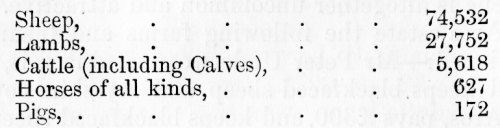
Tyree.
Further out into the Atlantic than the islands
above mentioned are the two islands of Tyree and Coll. His Grace the Duke
of Argyll is sole proprietor of Tyree, from which he draws £5000. The
tenants and occupants are very numerous, and their possessions are small,
except a few who pay large rents. The latter are—Heirs of Hugh Blair,
Balephetrish, rent £256, 10s.; Lach-lan M'Quarrie, Heynish, £296, 5s.; Wm.
Sproat and Cameron, for Hellipoll and Parks, £360; Hugh M'Diarmid, Hough,
£225; Lachlan M'Quarrie, for Reef, £320; Allan M'Fadyen, for Scar-inish
and Golthill, £166. Ayrshire cattle are kept on some of these farms in
various numbers, from thirty to eighty head. Highland cattle are kept on
the rest of the farms, and on the great majority of the smaller
possessions. Generally speaking, close attention is paid to the
improvement of stock. Sheep, consisting of Cheviots, blackfaced, and
crosses, are also kept on the larger farms. The number given to the Board
of Trade this season (4th June) was 4797 sheep and 2351 lambs. The soil on
the island is light, sandy loam, but it is easily worked, and is kept in
good heart by the immense quantity of drift sea-ware constantly driven
ashore. The cereals raised consist of oats, here, and rye, and root crops
of potatoes and turnips. There are good agricultural implements used, and
the land culture is on the whole in a satisfactory state. The whole stock
kept on Tyree was as follows, according to the return made to the Board of
Trade on 4th June last:—
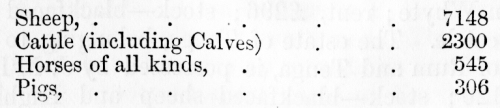
Coll.
Coll stretches a little further north than
Tyree, and the two islands have the appearance of having been at one time
joined. The space between them is but small, and the rock and soil are of
the same description. The principal proprietor of Coll is, John L.
Stewart, Esq., whose rent is £3256, 10s. The small estates of Caoles and
Cornaig belong, the one to Hector A.. Campbell, Esq., and the other to his
late father's trustees.
The principal tenants on the islands
are—Donald M'Lean, Crof, Arileod, and Interest, £145; John Paterson,
Arnabost and part Cliad, £158; William Weir, Gallanach and part Arnabost,
£500; Charles Cowan, Crossipol, £160; J. and M. Gilchrist, Totronald,
£170; Messrs Oliver, Greshipol, £289: John Galbraith, Cliad and Mipost,
£208; John M'Corquodale, Bulard, £100; Breckacher, the proprietor, £560;
Caoles, Peter and John M'Lean, £350. Several of these tenants are from the
low country, and are noted for their skill and enterprise. Reaping,
mowing, and thrashing machines are common, and the lands are managed in
accordance with the most improved method of culture.
The manufacture of butter and cheese is
carried on extensively and successfully. There are some dairies in which
upwards of eighty Ayrshire cows are kept. The pasturage of the island is
said to be rich in milk-producing qualities. Considerable numbers of pure
Highland cattle are bred on several of the farms. Sheep of the same kinds
as those mentioned for Tyree are kept, and the numbers returned for each
island this year was very nearly the same. That for Coll was 5033 sheep
and 1685 lambs. Pigs are also kept on all the dairy farms. The crops of
cereals axe of the same kind as in Tyree, and both these and the green
crops are remarkably well managed. The whole stock kept on Coll was as
follows, according to the returns made to the Board of Trade on 4th June
last:—
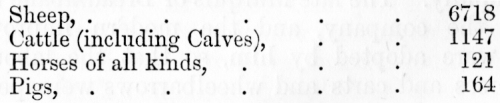
General.
In going over the different districts an
immense number of tenants whose rents are of small amount had to be passed
over. This was done with regret, because many of them are as good farmers,
and as useful members of society as those who pay higher rents; but it was
necessary to avoid making the report unreasonably long. The following
table, in which rents are classified, will give some idea of the size of
farms. Acreage, although it could be given with accuracy, would be of very
little use among moors and mountains:—
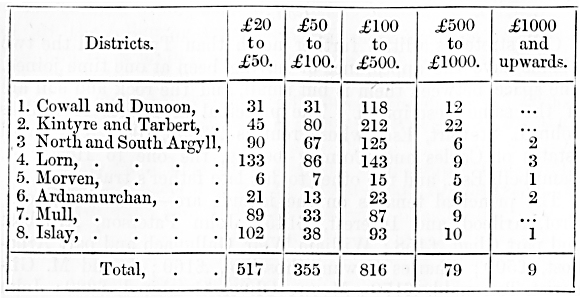
Leases.—It has been customary in Argyllshire
for a long time to grant leases to tenants. For large farms nineteen years
is the usual period, and for smaller farms, from seven to fifteen years.
The leases are often annexed to printed regulations used on different
estates. These regulations are generally too long and too stringent, and
it would be a very desirable thing to have the conditions of lease
shortened and simplified.
Slate Quarries.—There are several slate
quarries in the county, but the oldest are those at Easdale, on a portion
of the Breadalbane estate. These have been worked for more than 200 years,
having been commenced about the year 1631, and they are still carried on
vigorously. At the first there were but few men employed, there being no
great demand for slates. Afterwards the Easdale Slate Company took a long
lease of the quarries, and also of the marble quarries at Ardmaddy, and
commenced the work on a larger scale. The marble quarry was discontinued,
but the slate quarries were found to require all the hands that were
employed at both, the demand for slates having increased rapidly. The late
Marquis of Breadalbane became sole partner of the company, and the modern
improvements in machinery were adopted by him, so that the labour formerly
done by horses and carts and wheelbarrows were performed by steam engines
and railroads. The number of men employed in 1794 was 300, and the
quantity of slates made in the year about 5,000,000. In 1841 the number of
men was fewer, owing to the machinery used, but the number of slates
turned out was about the same. At present there are 280 men employed.
These quarries are not confined to the island of Easdale. Luing and Seil
abound in slates of the same quality, and quarries are being worked at
present at Cullipool, in the island of Luing. One quarry at Easdale is 220
feet below the level of the sea. The slate is of excellent quality, and
not inferior to any other found in the kingdom. The present proprietor of
the Breadalbane estates has let the quarries to a company, by whom the
work is carried on extensively, under all the modern improvements.
Ballachulish,—The slate quarries at
Ballachulish were commenced about the year 1760, and are at present worked
with great vigour, under the proprietorship of the trustees of the late
Sir George Beresford. The vein of slate, which is at an angle of 80°,
commences at the shore, and stretches south and eastwards along the side
of the mountain for a short distance, and then runs into the centre of it.
The face of the rock is laid open by workings fronting the north and west,
the inclination of the vein being towards the east. The workings of the
main or east quarries are conducted in four levels, above the common
highway, and three sinkings, making an aggregate working face of 436 feet
in depth—an increase of 230 feet since 1843. The west end workings are
conducted upon a similar method—one with three upper levels, and two
depths of sinkings. Recently there have been several new quarries opened,
which promise well. The material from the upper parts are conveyed from
the respective levels by inclined planes, regulated by powerful
brake-drums, the weight of the loaded waggons descending taking up the
empty waggons without difficulty. Material from the sinkings is taken up
to the surface in inclined planes by three stationary engines, which, by
auxiliary gearing, keep the sinkings free of water—no small matter in such
a rainy district, and with such great watersheds. The rock, after being
quarried, is conveyed partly by railway locomotive. In all the workings
there is from 10 to 11 miles of firm and permanent lines of iron rails
used, and 130 substantial iron waggons. For deep boring a powerful patent
rock drill is put to work to rend the hill into pretty large blocks, which
is afterwards easily disposed of by the regular manual process—that is,
one man, in a half-recumbent position, regulating the boring-drill, while
another wields a large hammer, doing great execution. At times this
process would appear alarming to the inexperienced spectator, inasmuch as
the operators are slung in giddy heights from ropes twisted round their
bodies, the pressure of which, combined with physical exertions required
in the manual toil, must prove no mean test of their strong and healthy
frames. The slate-making portions, or "blocks," are conveyed on "lines"
along the banks formed by the refuse, and laid down at little sheds, where
they are, by one man, split up to the required thickness, and, by another,
cut into shape, after which they are ready for export. There are three
safe and commodious shipping harbours, all formed by the banks of rubbish
Projecting into the sea in arms of two to each harbour, thus completely
sheltering vessels in any weather. The slates are of a deep blue colour,
and spangled with pyrites, called by the workmen "diamonds," and these
gold-coloured drops are so incorporated with the slate that they cannot be
separated from them. The slates are allowed to possess in a pre-eminent
degree all the qualities of permanence of colour and durability of
material essential to roof slates. There are five different descriptions
of slates made, viz., queens, duchesses, countesses, sizables, and
undersized. The annual production of manufactured slates is 28,000 to
30,000 tons, or, in numbers, 16 to 17 millions. 'There are over 600 men
employed in the works, earning from 20s. to 40s. per week, according to
their respective merits.
Minerals.—Though the precious metals, properly
so called, are as yet unknown in the county, yet its mineral resources are
by no means inconsiderable.
Limestone is more or less abundant in several
districts, but especially in the island of Lismore, which supplies almost
all the lime used in the West Highlands for building and agricultural
purposes. There are three limeworks, viz., Salen, Port Ramsay, and Sheep
Island, which turn out about 8000 barrels of shell lime each in the year,
which is equal to 48,000 barrels of slaked lime altogether.
Granite.—Granite of a superior quality is to
be found at the Ross of Mull, on the estate of his Grace the Duke of
Argyll. Like most of the building stone found in the county, it is very
difficult to work, but when dressed and polished it will compare
favourably with that of Peterhead, and is therefore extensively used for
monumental purposes. The Dhuheartach Lighthouse, recently completed, is
built of this granite. The granite quarries at Bonawe Ferry rank next in
importance. They afford employment to about 60 workmen all the year round,
chiefly Welshmen and Aberdonians. There is another quarry of a similar
nature at Furnace, on Lochfyneside, where 100 people are employed. The
most of the streets of Glasgow are, or are in the course of being,
causewayed with stone brought from these quarries. "Monster blasts" of
several tons of powder have been tried with success. At Ballachulish, and
in the northern districts of Sunart, as well as elsewhere, there are
mountains of the finest granite. A quarry has been opened at Ardsheal, and
the granite is of a dark grey colour, fine in the grain, and easily
dressed. Marble of
very fine quality has been recently discovered in the immediate vicinity
of the slate quarry of Ballachulish. The vein is of considerable
thickness, and the colour and texture give it considerable market value.
Marble also occurs in the Ross of Mull, but it has never been wrought to
any considerable extent.
On the estate of Ardsheal, in Appin, quartz,
known as magnesian, is found, and is exported to Staffordshire, being
found useful in the pottery manufacture.
Freestone.—Patches of freestone abound in
different parts of the county, but on account of its hardness, tradesmen
find it so difficult to work that builders are frequently obliged to
procure stone elsewhere. A very pretty kind of freestone of this hard
description, and of a bluish colour, is found at Ardintallen, on the
northern shore of Loch Feochan, in the neighbourhood of Oban. Of this
stone is built the Free Church at Oban, according to Mr Buskin, the
celebrated art critic, "the most perfect specimen of Gothic architecture
in the Highlands of Scotland." Several other buildings in and about Oban
are constructed of the same kind of stone. There is also a seam of a
similar stone, less expensive to quarry and in a more accessible
situation, at Barnacarry, at the mouth of Loch Feochan. Detached seams of
a softer freestone, but of a dull reddish colour, are to be met with
throughout the county. On account of its friable nature, this latter is
seldom used for any other purpose than that of erecting dry stone walls or
dykes. Coal.—The
district of Kintyre can boast of a seam of coal, limited in area, but of
great thickness, and very productive. In the island of Mull, and at
Achavaich, on the estate of Dunstaffnage, coal has also been discovered,
but in such small quantities and in situations so inaccessible as to
render the working of it of no pecuniary advantage. It is curious to note,
that although coal and iron are generally found in close proximity to one
another, the latter has hitherto remained undiscovered within the confines
of the county.
Lead.—Till within a few years, lead mining formed one of the staple
industries of the county. So far back as the year 1748 the White Smith
mine alone, which is one of the several mines in the Strontian district,
gave employment to no fewer than 500 men and boys. These mines were being
wrought more or less for a period of 150 years previous to the year 1855,
when they had to be discontinued for want of capital, and on account of
their distance from a proper shipping place. The metal "Strontium," named
after the district, was first discovered in these Strontian lead mines.
Recently a lead mine has been discovered in Islay, which, according to
report, promises to turn out well.
Canals.—The Crinan Canal is the only one
entirely within the county. The Caledonian Canal has a very important
portion in Argyllshire, viz., the south-west end or terminus at Corpach,
and the extensive system of locks at Banavie; but it has been so fully
described in the Report of Inverness-shire, that it is needless to enter
into detail here. The
Crinan Canal was undertaken and commenced under the auspices of John, Duke
of Argyll, who obtained reports, surveys, and estimates, the result of
which was the formation of a company, under an act passed in 1793, and the
work was commenced in that year. The course of the canal from the place
where it starts from the Loch Gilp branch of Loch Fyne extends for about
two and a half miles, about due north, and then inclines slightly to the
west through the vale of Dall, which forms the summit level; thence it
goes on to Crinan, where it joins the sea, the whole length being nine
miles. The locks are fifteen in number, eight being at the Loch Gilp end,
and seven at the end towards Crinan. The average depth of water in the
canal is only ten feet, but twelve feet could be obtained if required. The
canal is supplied with water from the reservoirs in the hill above,
varying in depth from eight to twenty-five feet. Very serious damage was
caused by the bursting of these reservoirs on the 2d of February 1859. The
embankment of one of the reservoirs gave way, and the contents of three
small lochs rushed down from a height of nearly 800 feet with terrible
impetus, so that the canal at Carnbaan and the locks at either end were
filled up and obliterated. It was a wild scene of devastation, until the
rubbish, including large blocks of stones, was cleared away. The original
object of the Crinan Canal was to benefit the coasting and fishing trade
of the West Highlands and the Clyde by avoiding the difficult and long
voyage round the Mull of Kintyre, but it was afterwards proposed to
accommodate large vessels for the Baltic and West Indies. The project,
however, had to be abandoned on account of the expense. The stock of the
Company was intended to consist of shares amounting to £120,000, and these
were actually subscribed to the extent of £108,000. But many difficulties
arose which were not anticipated, so that the expense was greatly
increased. A loan of £25,000 was obtained from the Barons of Exchequer in
1799. By that means, and another loan of £9810, the canal was opened in
1801. Other loans had to be obtained before the work was completed, so
that in 1814 the Company was burdened with a debt of £67,810. Afterwards,
by order of the Treasury, the financial affairs of the canal were placed
under the control of the Barons of Exchequer in Edinburgh, and it is now
under the management of the Commissioners of the Caledonian Canal.
The average annual revenue of the Crinan
Canal, from 1st January 1802 to 31st December 1816 inclusive, was £999,
11s. 4½d., and from 1st January 1818 to 31st December 1838 inclusive,
£1717, 17s. l½d. The receipts of the canal and harbour in the year ending
30th April 1870 amounted to £4032; in 1875, £4815, 1s. 10d.; 1876, to
£5057, 6s. 7d.; and at 30th April 1877 to £5389, 12s. 7d., showing an
increase of £332, 6s. over the previous year. The balance of revenue over
expenditure was £1096, 10s. 10d.
Means of Communication.
Steamboat Traffic.—The West Highlands have
derived much benefit from the modern improvement of steamboat
communication. The want of such means of transit was severely felt, and
the old statistical account is full of references to this grievance. Mr
MacLeod of Morven, in the concluding part of the report on his parish,
pointed out strongly the disadvantage under which that part of the country
laboured, and even suggested Government bounty to sailing packets that
would ply regularly between it and the south. However, he lived to see
steamboats introduced, and his youngest son, still living in the manse of
Morven, could tell a wonderful tale of what has been done through
steamboat traffic in his day. The first steamer built in this country, the
old "Comet," was launched at Port-Glasgow in 1811. She had her trial trip
from Glasgow to Greenock on the 18th January 1812, and in September of
that year her voyage was extended to Oban and Fort-William.
By means of the "Comet," and other steamers
which immediately followed, when the great experiment of Henry Bell was
seen to be a success, the traffic with the Highlands was kept up. The
number of boats of all kinds passing through the Crinan Canal from the
year 1822 to 1838 was 1346, in 1875 it was 2117, and in 1876 it was 2293.
The introduction of passage-boats on the
canal, introduced in 1838, has made great difference on the passenger
traffic. Large well appointed steamers now receive the passengers at
either end of the canal, and not only a speedy passage, but comfort and
elegance are provided. Until the time referred to, only small steamers
that could pass through the canal were used for coasting trade, but these
were kept up in a spirited manner. Messrs Thomson & M'Connell, the Messrs
Burns, and a few others, were the owners of these steamers, and conducted
the traffic with great energy.
The "Maid of Morven," the "Highlander," and
"Highland Chieftain," are still fondly remembered by those who knew them
in early life; and at a later date the "Bob Boy," Captain Duncan; "Helen
Macgregor," Captain Turner; "Toward Castle," Captain Macdonald; "The
Dolphin," Captain M'Killop, were regular and welcome visitors. The "Maid
of Morven" was a great favourite, and was better known by her Gaelic name,
"A Mhaighdion Mhorairneach."
About the year 1851 the steamboat traffic was
handed over by the two large firms above mentioned, to Messrs David
Hutcheson & Co., who have continued the trade with great success. That
enterprising firm have conducted the business well and successfully,
although they have had sometimes opposition to meet, and always an
exacting public to satisfy. Their fleet of steamers, small and great,
amounts to nineteen in number. They ply to many ports beyond the bounds of
Argyllshire, but that county gets a full share of their services. The
swift passenger boats can stand comparison with any in the world; but they
are so well known and appreciated that it is needless to say more about
them.
Coaches.—Coaches are kept upon several lines of road during the summer
season, and on the main line from Dalmally to Oban a coach is run during
the winter months; also a railway has now been introduced into the county,
and is open from Tyndrum to Dalmally. There were many coaches last season
to and from the station at Dalmally, and also from Oban to Loch Etive,
Loch Awe, and Pass of Melfort. The railway will not have much effect on
the trade of the county until the . line is completed to Oban or some
other seaport.
Herring Fishing.—Among the industries of the county, herring fishing is an
important occupation. Loch Fyne has long been celebrated for the quantity
and quality of this most valuable fish which it annually yields. Of late
years there are complaints of the herring having forsaken its old haunts,
but there are still large numbers caught in Loch Fyne and along the coast,
and in some of the lochs that intersect the county. According to the
report of the Fishery Board the herring fishery of 1875 yielded the
following returns, viz.:—Barrels cured, 942,980 ; barrels exported,
660,970½; barrels branded, 523,789½; brand fees, £8729, 16s. 6d. "The
fishing proved abundant; indeed it was more abundant than that of any
previous year, with the single exception of the fishing immediately
preceding, viz., that of 1874. In no year have so many barrels of herrings
been branded as in 1875, which makes this part of the returns, and the
year's collection of brand fees, the largest on record."
This refers to the whole of Scotland, but the
following remarks apply to Argyllshire, viz.:—"Soon after the Stornoway
fishing, the fishing for the season began to be prosecuted in earnest in
the districts of Campbeltown and Inveraray. In Campbeltown district it
proved an inferior fishing to that of 1873 and 1874, both of which,
however, were in this district extraordinary fishings, but it yielded
considerably above the average of the ten years preceding 1873. Here, as
in Stornoway district, unfavourable weather marred the prospects of the
fishermen, and kept down the returns of catch. In Inveraray district the
catch of the year exceeded 1874, the returns of this district for 1875
showing an increase in cure of 7662 barrels of herring over the returns of
1874, or a cure in 1875 more than double that of 1874. The herrings failed
to pass up to the higher parts of Loch Fyne, although about the end of
July there was great abundance of small-sized herrings between Otter and
Minard, and nowhere above Ardrishaig was there anything but a poor
irregular fishing, the upper parts of the loch being almost blank. But
about Tarbert, at the entrance to the loch, the case was different. Here
there was an excellent fishing, especially with seine nets, and the
herrings thus caught were of fine quality and large size, and, being
larger than those in the drift nets, brought a better price. In the month
of June eight seining fishermen from Tarbert earned in one week £325. In
July, another seining party enclosed nearly 300 crans of herring in their
net, and on the 13th and 27th of July the take at Tarbert was so abundant
that more herrings were landed in those two days than have been remembered
to have been landed there on any two days in any former years."
Salmon Fishing.—Salmon fishing by net is the
next in importance to herring fishing, and there are many important
stations on the coast of Argyllshire, and in its rivers. The rent for 1875
was £1903, and, according to the "Sportsman's Guide," for 1877 is £2088.
The deep-sea fishing of ling and cod is
abundant, and might be prosecuted to a much greater extent than it is.
Some capital is required for suitable boats and nets, and that is a bar in
the way of poor people. Other kinds of fish, such as haddocks, whiting,
gurnet, lythe, and mackerel may be caught in great numbers, and saithe or
coale fish almost to any extent. Lobsters are to be got on rocky coasts,
which abound along the margin of the county, and oysters in some of the
lochs and bays.
Towns and Villages.—Campbeltown,
near the south point of the peninsula of Kintyre, used to be the largest
of the towns in the county, although Dunoon is probably beyond it now in
population. The population at last census was 6628, and the rental for the
current year, £24,000. Its spacious bay or loch, in which so many vessels
take shelter, makes it something of a shipping town, and it is now a
centre for the herring fishing boats. There is a resident
sheriff-substitute in the town. The distilleries for the making of whisky
are the distinctive features of the place, there being still twenty
distilleries there. The quantity of whisky manufactured is mentioned
elsewhere. Dunoon.—Dunoon,
on the Firth of Clyde, is the next in size, the population in 1871, with
Kilmun, having been 7132. Villas, hamlets, and towns spring up near the
Clyde very rapidly, so that from the Holy Loch to Innellan is almost one
town. Tigh-na-bruach, though into the Kyles of Bute, has now a group of
elegant villas around it, and may soon be a populous place.
Lochgilphead.—Ardrishaig and Tarbert are
thriving villages, but depending much on the herring fishing. Ardrishaig
being the south terminus of the Crinan Canal, is crowded with tourists in
the summer season, but they do not pass much of their time there, except a
few who remain at the large hotel that was erected there some thirty years
ago for their accommodation. Lochgilphead is the headquarters of the
County Constabulary, and the Argyll and Bute Lunatic Asylum is situated
there. Inveraray.—Inveraray,
although it is the county town, is but small in size, and not increasing,
the population at last census being only 981. Herring fishing and herring
curing are the industries, and the castle (Duke of Argyll's residence),
with the splendid avenues, are the leading features. The scenery
altogether is very striking.
Oban.—Oban has sprung up quite lately. Near
the end of last century the Duke of Argyll wished to encourage building,
and with the assistance of Collector M'Vicar got plans prepared, and
offered very favourable terms for building. Long leases for ninety-nine
years were offered to any one who would undertake to erect a house
according to his plan for a nominal tack duty, 2s. 6d. a stance being the
common rate. Two brothers of the name of Stevenson, who had a contract for
building a bridge at Muckairn, on learning the terms, offered, availed
themselves of them to the utmost. They were enterprising persons, and
helped greatly to promote the industry of the place. Steamboat traffic,
however, was the great cause of increase of late years, Oban being the
centre of communication for all places on the west coast. The increase of
the rental was as follows:—
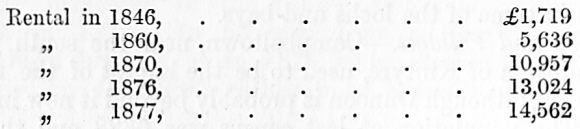
The population in 1871 was 2413. The hotel
accommodation is excellent, the lodging-houses are very commodious, and in
the summer months these are resorted to by thousands of tourists from
almost all parts of the world.
Tobermory is in Mull, opposite the mouth of
Loch Sunart. Its picturesque situation and its beautiful landlocked
harbour, lend an interest to that lonely little town. There is a resident
sheriff there, also lawyers, bankers, and merchants. The population in
1871 was 1259. The rest of the villages of the county are small and
unimportant.
Distilleries.—There are many distilleries in Argyllshire, but not so many
as in former years. There are still the following, viz.: —
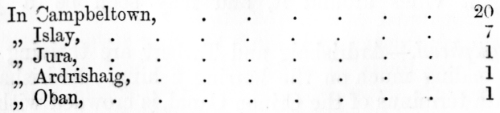
There were twenty-five in Campbeltown when the
last statistical account was issued. The following quantity of proof
spirits is produced annually by those now in operation, viz.:—1,934,856
gallons, duty, £967,428. (See "Collins' Geography," with corrections.)
Lorn Furnace, Bonawe.—In the year 1753 an
English company, who had iron works in Lancashire, took a long lease of
the lands about Bonawe, chiefly for the sake of the extensive woods, which
they converted into charcoal for smelting iron. The lease endured from the
date above mentioned until the year 1864, and during that period the work
of cutting wood, preparing charcoal, and making iron were carried on
vigorously, and the iron produced was among the finest anywhere made. The
iron ore "hematite" was imported from Lancashire, and regular
communication was kept up between Bonawe and the north of England. All the
tools for wood cutting, &c, were brought from England, and also implements
of various kinds, much superior to those used in the Highlands at that
time. The rent paid for the lands included in the long lease was £430; but
when it expired the rent was raised to £2300. The company kept a
considerable extent of land in their own hands, on which crops were
raised, cattle grazed, and young horses reared. The rest of the lands were
occupied by the work-people of the company, and the greatest inducement to
engage or remain in the work was the possession of the houses or crofts.
The work itself was not considered desirable, and the wages were not
great. When the wood to be cut each season was fixed upon, it was divided
into lots, and a small company of three or four had to give in offers for
the cutting of the wood and preparing of charcoal, and the payment was to
be so much for the dozen bags of charcoal. Matters were so managed that
the wages were low, but the people had their houses, and earned a scanty
living. When the long lease expired, a new one for twenty-one years was
entered into, and is still current. It is now, however, found difficult to
get people to work the wood to pay. A large proportion of the income of
the company was derived from the bark sold by them. The importation of
catechu for tanning purposes has depreciated the value of bark from about
£14 a ton to £6. In consequence, partly of this depreciation in the value
of the bark, and of the higher rate of wages for working it, and for
charring the black wood, which has now become scarce over the wide
districts from whence the company drew their supplies, it has been found
necessary to lessen smelting operations, which, however, are still carried
on on a small scale.
Woods and Plantations.—Argyllshire must have been densely covered with
wood at one time, judging from the remains to be seen in mosses and other
places. It was not, however, until the middle of last century that
planting trees on a large scale began to be attended to. It is said that
Archibald, Duke of Argyll, took the lead in planting as well as in many
other things, and a minute account of the plantations made under his
directions may be seen in the last statistical account of Inveraray.
Professor Walker of Edinburgh, also, in referring to this subject, says:—
"The next considerable planter in Scotland was Archibald, Duke of Argyll,
who, among his other great qualifications, was remarkable for his skill
and zeal in the raising and management of trees. His taste for plantation
was adopted by a number of his intimate friends." Among these friends were
the proprietors of Loch Nell, Barcaldine, Inverawe, and Dunolly, the
latter of whom was married to a Campbell of the Argyll family. There are
trees still to be seen in these places that have every appearance of
having been planted during the latter part of the last century. A list of
a few of them, showing their sizes, will be seen in the Appendix G.
Much attention has been given to plantation of
late years, and with good reason. There is, perhaps, no part of Scotland
where wood thrives better, and this applies specially to larch. On the
estates of Airds, Barcaldine, Poltalloch, Inverawe, and many others, larch
props can be cut at from twelve to fifteen years, and the timber is heavy
enough for sleepers at from thirty to thirty-five. There was a
considerable extent of larch of about fifty years' growth recently cut on
the estate of Ardchattan, the price for which was equal to a rent of about
20s. an acre for the land on which the trees grew, for the period from
planting to felling. All over the county young woods are springing up.
Much has been done on the estates of Poltalloch, Ardnamurchan,. Ardgour,
Oban, Glenfeochan, in the island of Mull, and in fact in all directions.
Some larch trees that have been recently cut down at Oban, in the
formation of a drive, although only eight years planted, have measured 20
feet in length and 4 inches diameter at the surface of the ground.
Altogether, the plantations found about Oban give great encouragement to
the planter.. In the wilds of Glen Etive, Mr Greaves has extensively
planted larch and Scots pine, which in time promise to restore to the
grandest glen in the west its pristine character of "woody Etive." The
acreage under wood in 1872 was 45,641. Aberdeen, Inverness, and Perth are
before Argyllshire in this respect, but it was the fourth on the list in
the year mentioned, and planting has proceeded rapidly from that time.
Natural woods are to be met with in most parts of the county, particularly
in glens, and the banks of its lochs and lakes. It is sufficient to
mention Glenmassen and Glenfinnart in Cowal, Gleneray and Glenshira near
Inveraray, and the banks of Loch Awe, from end to end of that noble lake;
banks of Loch Etive, and particularly Muckairn, where the woods have been
well attended to; Loch Creran, and the most of Appin; and, above all, Loch
Sunart and its splendid birch woods. Apart altogether from the value of
the timber, these woods are of the highest importance for shelter.
Ferns.—Farmers seldom think of ferns as worthy
of any great share of their attention. The coarser kinds of ferns cover
more of the hillside than the sheep farmer would wish, particularly the
common bracken (Pteris acquilina). Before passing sentence upon it,
however, it should be considered that even as respects grazing the fern
fronds furnish shelter and shade favourable to the growth of fine grass on
the hillside, which would otherwise be parched and bare. Even copsewood
has often been condemned for interfering with grazing, but if cut down the
grazing will be of much less value than it was among the woods before the
shelter of it was lost. The bracken sometimes encroaches upon good
pasture, but it can easily be pulled up by the roots, or cut down by a
scythe or sickle. The
common bracken has many economical uses, such as the thatching of houses.
A good covering of brackens will last twice as long as the best straw
thatch, and is much more ornamental. It is of great use for bedding cattle
and litter of every kind. The cottar who has no straw would fare ill
without brackens, and could scarcely raise his potato crop at all. As a
covering and protection for potatoes, in house or pit, there is nothing
equal to bracken. If cut down early in the season and well dryed, horses
and cows will eat it as winter provender.
Farmers also think that too much of the
hillside is sometimes covered by the mountain buckler (Lastrea montana),
but it is of more use than harm to pasture. The fronds, which are not very
large, decay early in the season, and at the end of autumn and beginning
of winter the grazing will be found very much better than if there had
been no ferns. If any space is to be cleared of this fern, no one need
attempt to pull it up, and nothing short of a sharp spade to cut off the
crown will be found sufficient. The roots go deep among stones and other
fissures of the rock, and probably one of the uses of such plants to
pasture is that they draw up moisture from a depth that the roots of grass
will not reach, and after the fronds have grown, affording shelter and
shade to smaller plants, they fall down and improve the thin soil by
leaving a top dressing. The finer kinds of ferns grow and flourish in
Argyllshire, because of the moist climate and the shady situations to be
found in its glens and ravines. It is in these ravines that they are found
in their greatest perfection, and they are not without use to the grazier.
Many of them are clipped down by sheep during the autumn, whilst other
pasture is abundant, showing that they are relished. The finer kinds, such
as the bladder fern (Cystopteris fragilis), have no escape at all, except
when growing in such steep places that sheep cannot reach them. Even
stronger ferns, such as the male fern {Filix mas), that last into early
winter, will be seen clipped down into stumps. On the whole, ferns furnish
feeding for sheep much beyond what is generally thought of by sheep
farmers. It is in the banks of ravines that ferns love to grow, and the
use of them in binding together the banks and keeping them firm is very
great. Many ravines,
such as Cruachan's Eas-more, or large ravine, will be found with its banks
covered with ferns waving in the breeze, and by means of these the banks
are kept firm and covered with vegetation to the edge of the water in its
rocky channel, whereas without the ferns there would be nothing but red
scaurs and falling banks.
If belts of planting for shelter are to be
attempted among the hills, ferns ought not to be forgotten. In such
localities it would be easy to plant some of the kinds most relished by
sheep, and they would soon spread of their own accord. Lastrea spinulosa,
of which there are three varieties, and Lastrea aemula, or hay-scented
fern, with a few of Filix mas and Filix foemina, might be chosen. The
kinds that multiply by side-shoots, such as Lastrea spinulosa, are the
most easily propagated, but all may be managed by chosing young plants,
and taking them up with a trowel. It may be assumed that ferns are of some
use when they grow so abundantly, and it is beyond all question that they
are highly ornamental. To appreciate them fully they must be seen in their
natural habitats, and no better place could be chosen than a deep ravine
in Argyllshire. There the larger kinds will be seen in great variety,
covering and adorning the banks; and the smaller kinds ornamenting the
face of the rocks, the smallest crevice being sufficient for their tiny
roots. Even large blocks of stone will sometimes be seen covered with
"film fern,' and fringed with green spleenworts (Asplenium viride) and
Cystopteris, and no object could be more attractive. Entering a ravine on
a winter day, when most plants are in decay, it is quite a surprise to
find these fresh and beautiful, and with the larger kinds which stand the
winter, they render the scene quite enchanting.
Flora of Argyllshire.—The flora of the county
may be described in general terms as belonging partly to the "Scottish
type" of Watson's "Cybele," and partly to the "Highland type" of the same
authority. Ben Cruachan, which is 3611 feet in height. produces alpine and
sub-alpine species of plants, but is surpassed in this respect, more even
than the difference of height would imply, by Ben Nevis, in the
neighbouring county of Inverness, and especially by Ben Lawers in
Perthshire. The mild
and equable temperature on the shores of the sea and the lochs during
winter is manifest from the number of what are commonly known as
greenhouse plants capable of growing in the open air during the season.
The memorable frost of Christmas 1860, which proved so destructive to the
woods and gardens of the south of Scotland, was in a great measure
deprived of its severity in the western and northern Highlands and Islands
by the proximity of the Gulf Stream. The shores yield plentifully the
sea-weeds from which, in the early part of the century, kelp was
manufactured to the extent of 20,000 tons per annum. The species
principally used in the manufacture of this substance are— Fucus
vesiculosus, nodosus, and serratus; Himanthalia and Lorea; Laminaria
digitata, bulbosa, and saccharina; Chorda filum; and all the large
Fucaceae. Kelp is still manufactured from these plants, and as it contains
potash, soda, lime, silica, sulphur, chlorine, iodine, and several other
of the inorganic constituents of plants which are required by them, it is
not only of increasing importance in chemical manufactures, but is
valuable as a manure. It may be applied to the land in nearly the same
circumstances as wood ash. Fresh sea-ware is extensively used on the east
and west coast for manuring. The value of sea-weeds when used in the dry
state, as contrasted with other sources of inorganic matter in manures, is
shown in the following results of analysis by the celebrated French
chemist, Gay Lussac. A ton weight of each of the following substances when
made into manure, provided nothing is washed out by the rains, will return
to the soil the following quantities of inorganic matters in pounds:—

The late Professor Johnston remarked, in his
"Lectures on Agricultural Chemistry," that "it is of importance to bear in
mind that the saline and other inorganic matters which are contained in
the sea-weed we lay upon our fields form a positive addition to the land;
for while ordinary green crops ploughed into the soil simply restore what
they took out of it, sea-weed brings back from the sea a portion of that
which the rivers are constantly carrying into it, and is thus valuable in
restoring what rains and crops are constantly removing from the land. Most
parts of the county testify to the soil and the climate being favourable
to the growth of trees, particularly of the coniferae; but, indeed, the
sheltered shores of the lochs frequently exhibit woods which, in point of
variety and bulk of timber, will bear a comparison with much of the finest
scenery in the Lowlands. It cannot escape notice, however, that greater
care is bestowed in some districts on the production of numbers of trees
than on the means of developing their bulk. In such cases there is room
for a judicious process of thinning, whereby young trees may obtain air
and food, without which they will not thrive.
Game.—Argyllshire is not a game county in the
ordinary meaning of that term, or as understood in the northern and
eastern districts of Scotland. The hills are too green for grouse, and the
arable land is so limited that there is not room for a large head of
common low ground game; but there is no district in which a finer variety
can be killed. In the extensive woods black game can find a congenial
home. The woodcock breeds freely, and may be flushed at any time of the
year, and one day's shooting frequently gives a bag consisting of grouse,
black game, bare, pheasant, plover, snipe, and partridge, with an
occasional roe. Red-deer are abundant in several forests, but especially
in the Black Mount and Dalness. Both these are extensive and well adapted
for this purpose; high-lying, and indented all over with long glens and
deep corries, is too stormy for sheep, and fit only for goats or deer.
Jura is celebrated for its deer.
The "Sportsman's Guide" mentions the county
favourably even for game, but when it comes to rod-fishing, or angling, it
says:— "Argyllshire is a sort of paradise for the angler. Its fresh water
lakes are numerous, and cover many thousands of square acres. Its salmon
rivers are as good as any in Scotland, and yield splendid sport, while
sea-trout fishing can be enjoyed in perfection, and river trouting is also
extremely good."
Tenants complain much of the injury done by rabbits, which are nearly as
bad on sheep pasture as among crops. Proprietors ought to do their utmost
to keep down these destructive creatures, or to give their tenants every
facility for destroying them.
Peat Mosses.—There are several large tracts of
peat moss in Argyllshire, and the following may be mentioned:—1st, Crinan
peat moss, which is computed to extend to 5000 acres. A considerable
portion has been reclaimed, as will be mentioned immediately. 2d,
Achnacree moss, which extends to about 2000 acres, and Culcharron moss, at
the old castle of Barcal-dine, which extends to 800 acres or thereby. 3d,
Corpach moss, Lochaber, which is fully a square mile in extent. 4th,
Kintra moss, in Ardnamurchan, about 3000 acres.
The Black Mount, on the borders of Perthshire,
is of greater extent than all the mosses named, but it is partly moss and
partly moor, and being a deer forest, it may be left out of the account at
present. No. 1, or
Crinan Moss, is on the Poltalloch estate, and the late Mr Malcolm drained
and reclaimed a large portion of it. It was found to vary in depth from 2
to 17 feet—average, about 5 feet. A considerable part of it consisted of
what is called " flow moss," and has sank when drained from 3 to 8 feet.
Large roots of trees, principally oak, alder, birch, and hazel, are often
found several feet below the surface.
Below the mass of vegetable matter there occurs a layer of fine gravel,
from 2 feet to 2½ feet in depth, beneath which is a bed of blue tenacious
clay mixed with sea shells. This moss is very little above the level of
the sea at high water, so that the outfall is not good, and a better fall
could not be obtained without very great expense. It is doubtful if any
further outlay upon it would remunerate either landlord or tenants under
present circumstances.
No. 2, or Achnacree moss, is on the Loch Nell estate, and has the
advantage of being sufficiently high above the level of the sea to afford
a good outfall. Nothing has been done on any extensive scale to reclaim or
improve it; but the margins of it have been encroached upon where the moss
was not deep; and these portions are now under cultivation, and yielding
moderately good crops.
The mosses at the north of Benderloch are
partly on Loch Nell estate, but principally on the Barcaldine estate. Like
the Achnacree moss, portions of them have been reclaimed by the tenants of
the adjoining farms, but a large extent remains in its natural state.
No. 3, or Corpach moss, is on the Loch Eil
estate, and very little of it has been reclaimed. Peats are made in great
quantities for the crofters at Corpach, and others near the place, and
where the peats have been regularly cut, the ground is reclaimed in some
measure, but not systematically.
No. 4, or Kintra moss, is on the Ardnamurchan
estate, and no attempt has yet been made to reclaim it, except as already
mentioned. The greater part is a perfect quagmire or quaking moss of great
depth, through which progress can be made only by leaping from one tuft of
heather or coarse grass to another. Achaneilan moss is not much better,
except that the depth of it is not great, being in many places only 2 or 3
feet deep, reposing upon a bed of sand. There is a sufficient outfall for
good drainage, and many hundred acres could be reclaimed at very moderate
expense. At Kintra,
at the one end of the moss of that name, shell sand is to be found in
abundance, and it has been found admirably adapted for the improvement of
moss, when the water is taken off by drainage. The following account of
what was done in that way in another part of the county seems very
applicable to Kintra and its moss:—"In cultivating moss, the water is
taken off by open and wedge drains, the surface is then delved and
levelled, shell sand is spread on it at the rate of eight tons to the
acre, and it is then manured for potatoes, or sown down with oats and
grass seeds. What previous to these operations produced only heather, or
very coarse herbage, has now become a close greensward" ("New Statistical
Account, Parish of Kilchoman," p. 654).
It is but proper to
remember that the one place is in Islay, whilst Kintra moss is in
Ardnamurchan, but even that district is becoming more accessible every
year. These large
mosses might furnish an ample supply of fuel to all the inhabitants of
Argyllshire, if they all lived in their near neighbourhood. They are not
of practical value in that respect to any who live at a distance, on
account of the expense of carriage. However, there are other mosses in
most parts of the county, and these deserve to be attended to, as being
the only fuel at the free command of the inhabitants. Argyllshire being
remote from coal fields, and many parts of it rather inaccessible from
want of roads, &c, coals cannot be a cheap fuel, and peats are the only
substitute, except a mixture of wood, which cannot be obtained in any
large quantities. It has been the impression of some proprietors that peat
mosses are inexhaustible, but that is far from being the case, as many who
have to depend upon peat fuel find to their loss. Peat mosses, when
treated with care, may be made available for a succession of crops of peat
The eminent chemist, Dr R. Angus Smith of
Manchester, has bestowed much attention upon peat, and points out the
importance of treating peat mosses so as not to become exhausted. The
first part of an able and elaborate pamphlet has appeared in the
Transactions of one of the learned societies of which he is a member, and
as the work is not much known, a few extracts may here be given. Dr Smith,
who was a pupil of Liebeg in his younger days, and does not forget
agricultural chemistry, although his official duties are somewhat
different, says, p. 294 of pamphlet:—"In some places you will be told by
gentlemen, by the ministers of the parish and some of the farmers, that
the peat is almost as dear as the coal. This, of course, depends partly,
sometimes entirely, on the carriage; but there are other cases where I
believe the population would starve without peat, or be reduced to the
state of the dwellers in Terra del Fuego, civilisation becoming
impossible. Many persons who have to pay high wages to have their peats
cut, take the readiest combustible, coals, as they are convenient, if a
little dearer; but by many, and by all the poor, the fuel can be dug
economically, the latter using their own hands in districts where the
people as a rule have a good deal of time at their disposal. This quality
of being within easy reach is never found with coal, and is not to be
forgotten. The idea of buying peats or coal, with many would be
preposterous. They have certain rights to a peat moss, and all I advocate
is the systematic protection of these mosses, these rights, and the
cultivation of the fuel, as carefully as they would cultivate the oats,
although the crop may be slower sometimes, and to be reaped only by the
succeeding generations; and my reason for doing so is that I find fuel
becoming dear in some parts of the Highlands, and a hitherto abundant
supply of nature is turning into a serious expense."
At page 289 he says:—"An advantage of the peat
is that it can be cultivated near one's home, and used when required. The
disadvantage is that it cannot afford much carriage. It may be found to be
the final and most convenient method in all the northern parts of this
country to have a field growing fuel at the side of others growing corn
and potatoes; and it certainly is in some places the most convenient
method at present. The habit, however, is going out more than is safe, and
the mode of cultivation never has been sufficiently systematic." And
again, at page 292, he says:—"In short, I advocate a systematic peat
agriculture in the north, carried on so as to have easy carriage to every
house far from railways, and deprived of access from any cause, and I have
reason to believe that even in this age many would be great gainers,
whilst the gain will increase as coal becomes dearer."
How far the course here recommended has been
followed hitherto will be seen from the rule copied here, which forms one
of the articles of lease on several estates in Argyllshire:—
"Digging Peats.—The proprietor reserves all
peat mosses, with power to drain, regulate, and divide them as he shall
see necessary, and in digging and winning peats in the mosses to which the
tenants may be allowed access a fair face or bank shall be carried on, and
the turf which is removed from the surface of the bank shall be regularly
placed with the sward uppermost, at the bottom thereof. And the ditches
leading from the several banks shall be scoured and kept clean by those
having the privilege to cut peat, so as there may at all times be a free
run to the water, as the same may be pointed out and ordered by the
proprietor, or by those having his authority; and the tenants shall be
bound to keep by the roads pointed out to them, and to maintain the same
in good order." If peat moss is thoroughly drained, and the outlet kept
clear, as directed in this article, there can be no second growth of peats.
Dr Smith's warning on the subject, along with the experience of those
whose peat mosses are running out, deserve serious consideration.
Besides the large mosses above mentioned,
there are very many small flats of wet boggy ground that may almost be
called waste land. Admiral Campbell describes a piece of ground at
Barbreck that was rendered useless by stagnant water, but which he drained
thoroughly at considerable expense ("Transactions of Highland and
Agricultural Society," vol. viii,).
There are hundreds of places in the county
where the same evil prevails to some extent, and in which the same remedy
is required, viz., a good outfall or clear run for the water. Very often
this could be effected by making an opening in a rock that is in the way,
or in a bank of till or gravel impervious to water. In either case, a good
leader, with sufficient outfall for the stagnant water, is required; and
that being once attained, the ground can afterwards be thoroughly drained,
or dealt with according to circumstances. Even sheep drains, along with a
good leader and outfall, will be an improvement, and anything of this kind
will amply repay a moderate outlay.
There are also hillsides and brae faces of
little value that might with great advantage be enclosed and planted. Such
places will yield a good crop of larch and other valuable timber, though
nearly useless for any other purpose.
General Remarks.—The population of Argyllshire
is not in proportion to its size, and has largely diminished for the last
forty years. In 1831 it was 100,975; 1851, 89,298; 1871, 75,679. The
increase of the population was also rapid, as will be seen from the
following figures:—In 1755, according to Dr Webster's report, it was
63,271; from 1790 to 1798, by Sir J. Sinclair's tables, 76,101; in 1831,
by census, 100,975. Professor Walker remarks:—"The principal causes which
of late years have so much advanced the population of the Hebrides are the
introduction of inoculation, the manufactory of kelp, and the cultivation
of potatoes. By the first the lives of multitudes are saved; by the second
the quantity of labour, and by the third the quantity of food, has been
greatly enlarged." The population went on increasing, and the cultivation
of potatoes was one great cause of the increase. When the potato crop
began to fail, the population decreased rapidly; but there were other
causes also at work. Communication with the south was opened up, and young
people flocked thither for better wages and more constant employment than
they could find at home; and many families emigrated to the Colonies,
particularly to Australia and New Zealand.
There was another cause at work which is still
going on, viz., the enlargement of small possessions, and particularly the
discontinuance of joint possession. Professor Walker says of this
tenure:—"In old times a large farm was usually occupied by a number of
conjunct tenants, who cultivated the farm in common, and divided the
produce. Nothing like improvement can be expected from farmers placed in
this situation. Each of them has a negative on the rest, which must
confine the whole, as it everywhere does, to the immemorial and awkward
practice upon the farm. No community can ever equal the carefulness and
industry of an individual in the management of his own affairs. It
appears, therefore, proper on every account that all such conjunct
possessions be disjoined, and that a separate farm or portion of land
should be allotted to each possessor." He adds in a foot note:—"A nobleman
of large property in the Highlands was clearly of this opinion, that all
such common farms ought to be divided, and that each possessor, according
to his rent, should have allotted to him a just share of the arable and
pasture. But he knew it from experience to be a difficult operation, and
that it could only be executed in a gradual way."
Other proprietors, as well as the nobleman
referred to, have been following out the process recommended by Professor
Walker, and keeping in view the number of tenants or families that could
properly be maintained and find employment upon their estates. The result
has been a very considerable reduction in the population, which seemed
necessary for the sake of the tenants as well as proprietors, There should
be a limit, however, and this reduction has already reached the point of
causing much difficulty in finding farm servants and labourers. This evil
was felt in the neighbouring county of Perth some years ago, and is so
well pointed out in the following passage that it may as well be quoted,
the circumstances being nearly the same in each of the counties:—"The
tendency, also, on the part of proprietors to endeavour to check the
increase of the poor-rates since the poor law of 1845 was passed, by not
rebuilding or repairing cottages, has also had its share in contributing
to the reduction of the rural population. In places where there are too
many people and too many horses, and the labour of both is misapplied and
wasted, they may well be reduced in number; but in those districts where
all the present population and more are wanted, it is a great mistake,
from a terror of poor-rates, to thin their numbers. To prevent the further
desertion of their native land by the labouring class of this country, it
is not too soon that the movement for the improvement of their dwellings,
both cottages and bothies, has been originated. The best means for
checking the reduction of the necessary rural population would be by a
more general employment of married ploughmen, who would rear families on
the farm, early accustomed to, and suited for, farm work." [Report in
Transactions, 1868.]
The children of shepherds and ploughmen make the best of servants, and
this seems to be the source that must be looked to in Argyllshire, as well
as in Perthshire and other counties.
Joint occupancy prevailed very generally in
Argyllshire, and along with it there was very often an overcrowding of
small tenants. On a moderately-sized farm, such as would now let for £150
a year, it was customary to have four tenants, four cottars, a herd, and a
tradesman, such as a weaver or shoemaker, making altogether ten families
on one farm. The sole occupation of the tenants and their families was a
struggle to raise crops on poor soil in a wet climate, and the rearing of
as many cattle as possible. The people lived some way on the produce, but
not in such a way as could be thought desirable in the present day. Many
proprietors, alive to the evil, have been gradually increasing the
holdings, and giving each tenant his own possession. The tenants have been
obliged to submit to the inevitable, and are gradually reduced in numbers,
and the young people have betaken themselves to other occupations, by
which they earn good wages. A reduction in the population was necessary
for a time, but there is now full demand for all the hands ready for
country work. Even the pasture land admits of improvement, and the
resources of the county are not half exhausted. The tide of the population
will probably turn very soon, and an increase may be expected for many
years to come.
Rental.—Although the population of the county has been on the decrease,
the rental has been on the increase. It amounted in 1866 to £350,951;
1871, £415,797; 1876, £430,759; 1877, £440,796. (See Appendix H.)
The increase in the price of sheep and cattle
will, in a great measure, account for the increase of rent. Land
improvement has also been going on steadily, although not on a very
extensive scale. The
rearing of sheep and cattle, rather than the raising of crops, being the
occupation of farmers, it could not be expected that so much should be
done in the improvement of land here as in counties depending on crops and
culture. However, drainage-money, at it was called, was applied for by
many proprietors when the grant was first made in 1846, and improvements
under the different Acts subsequently passed have been going on ever
since. Accordingly, lands have been drained, fences have been erected, and
houses built, greatly to the benefit of the country. Much, however,
remains to be done, and it is to be hoped that these improvements will
continue on an increased scale year by year. Railway traffic has barely
commenced, and is still in reserve, and it will, no doubt, give a great
impetus to many improvements in Argyllshire, as it has done in other
places. Appendix A
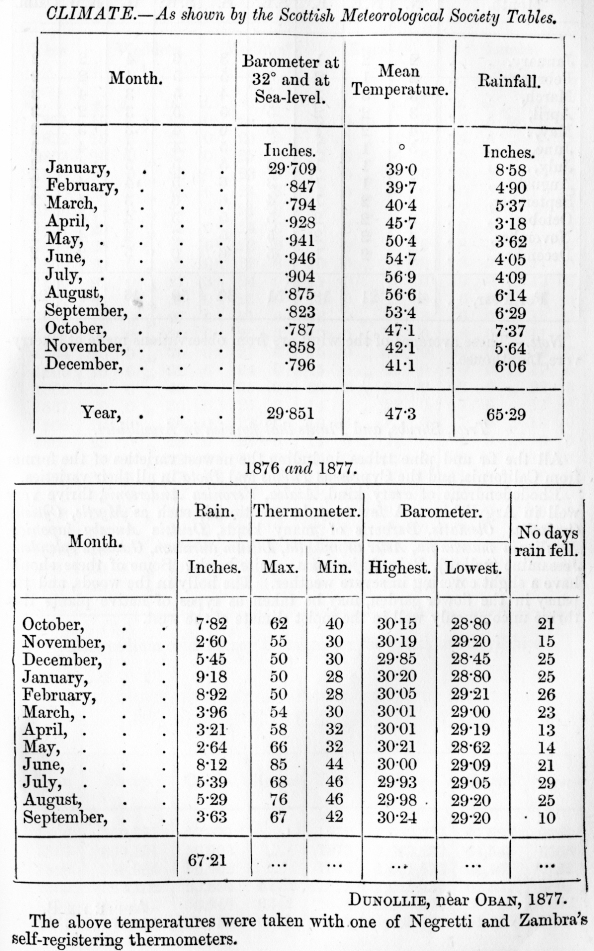
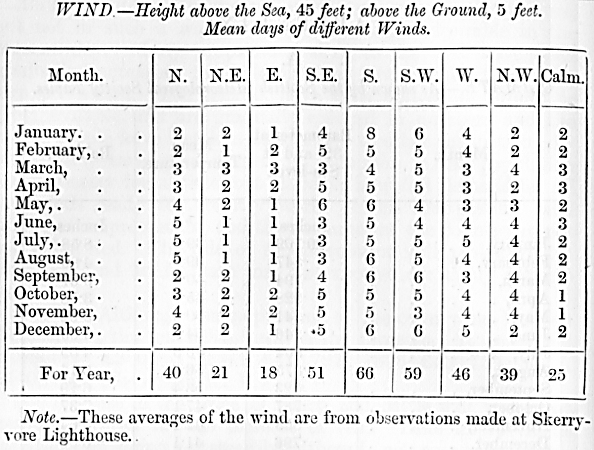
Trees, Shrubs, and Plants that flourish in
Argyllshire. All the
fir and pine tribes, including the newest varieties of the former from
California, and the Cypressus Thujas and Biota in all their varieties.
Rhododendrons of every kind, Azalea, Veronica
Andersonii, thrive very well in Argyllshire. A few may be mentioned, such
as Myrtle, Gytisus, Ceanothus Clematis, Berberis of many kinds, Deutzia
Aucuba japonica, Escallonia macrantha, Aster argophylla, Lilium auratum,
Gazania splendens, Jessamine (yellow), Primula japonica—quite hardy. Some
of these should have a slight covering in severe weather. The holly in the
woods, and the pansy in the flower garden, may be taken as types of native
plants that thrive uncommonly well in the moist climate of the west.
Appendix B.
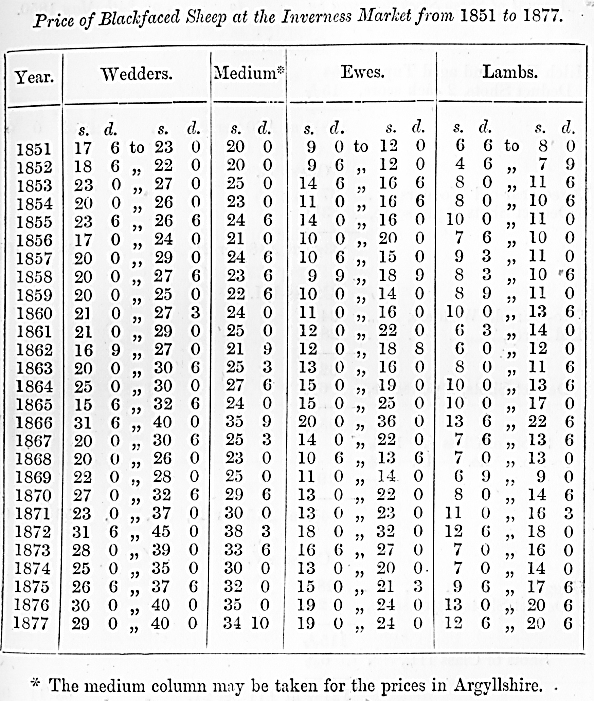
Appendix C.
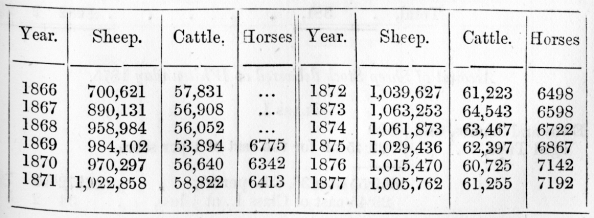
Appendix D.
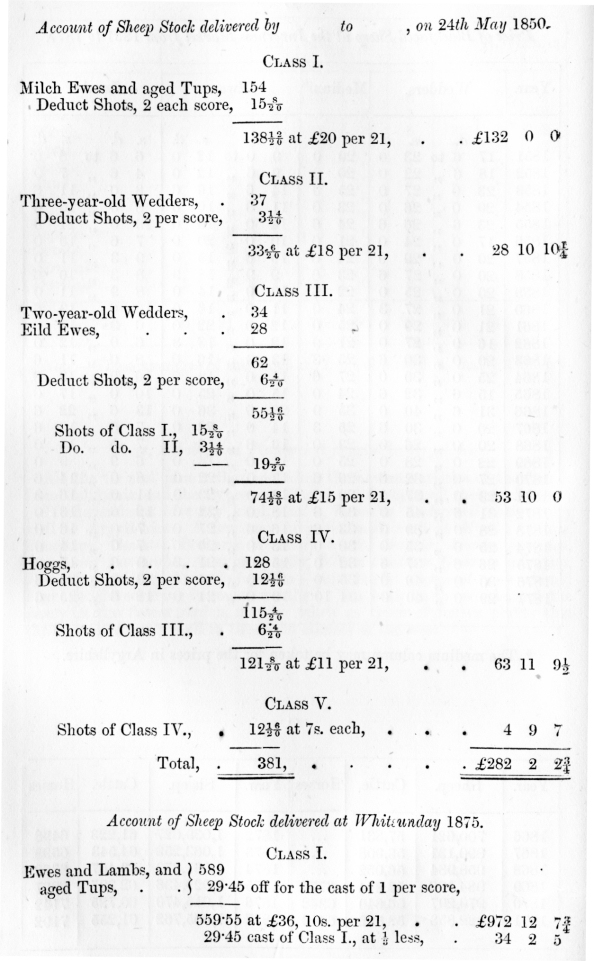
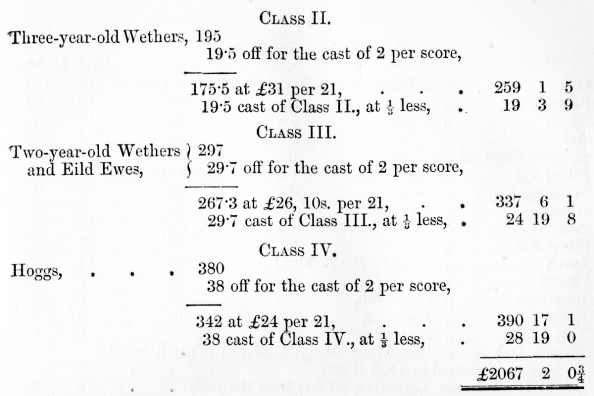
Appendix E.
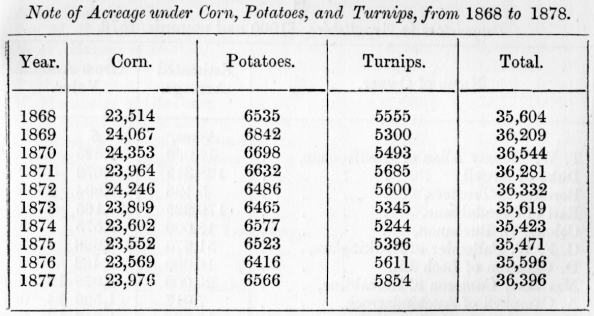
Appendix F.
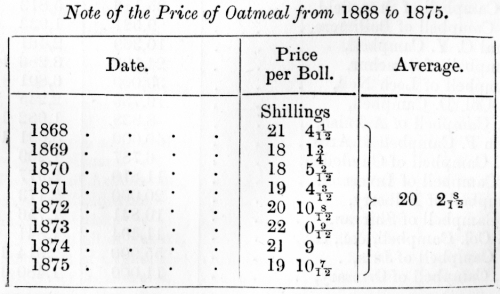
Appendix G.
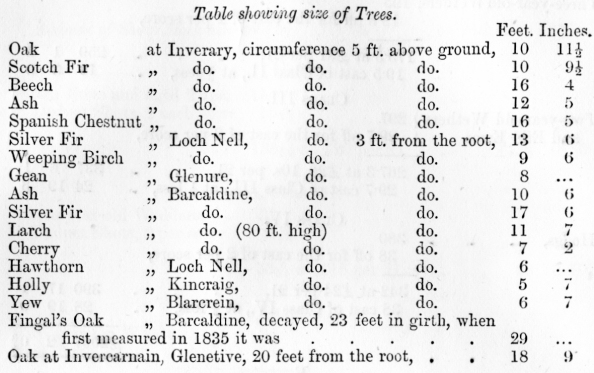
Appendix H.
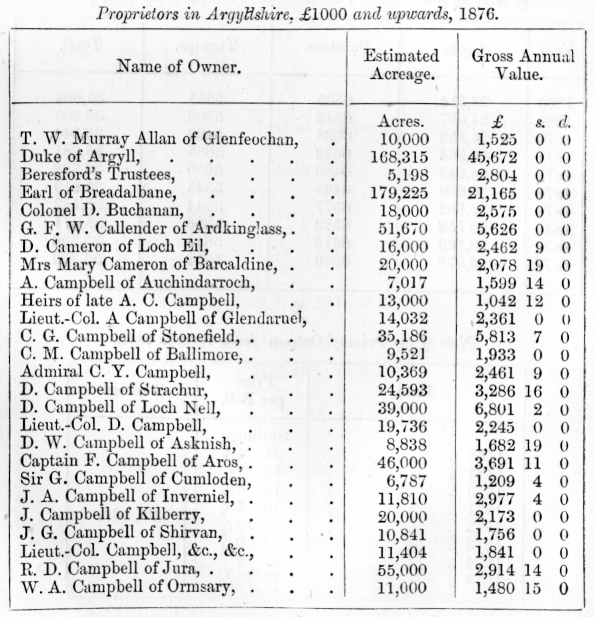
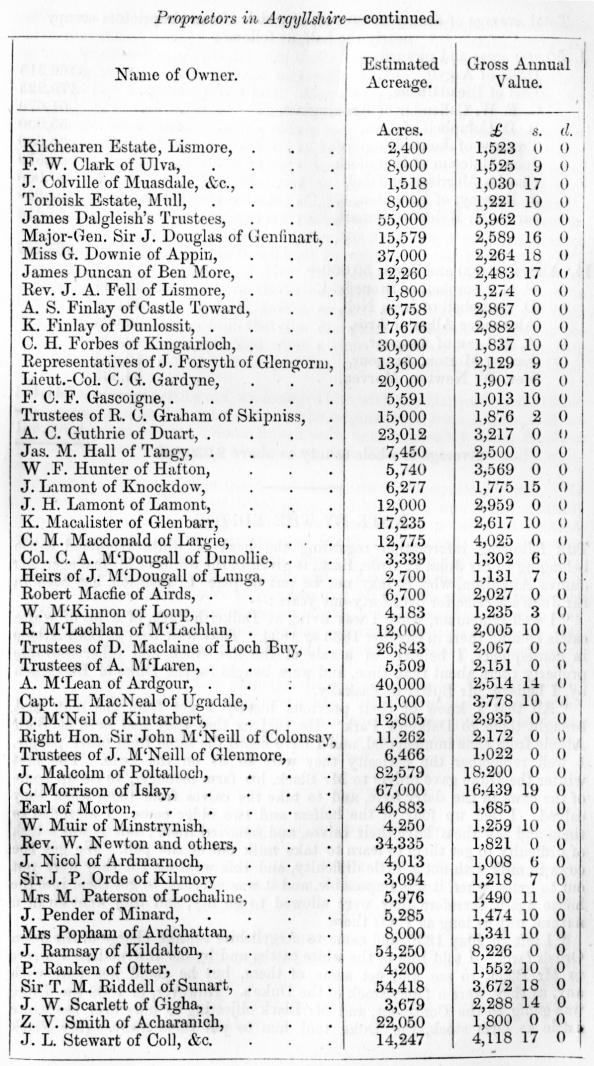
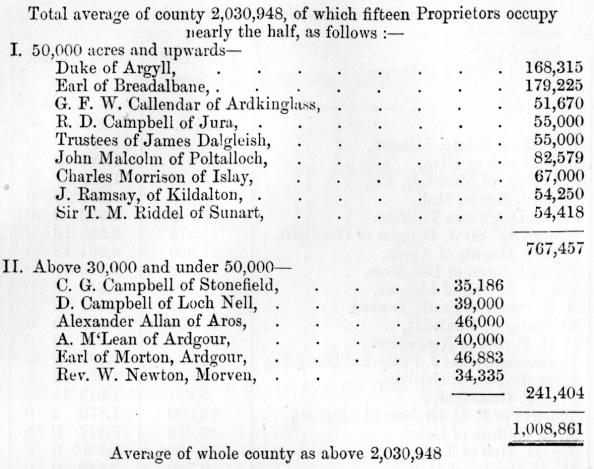
NOTE BY THE EDITOR.
The following information regarding the herd
of white Highland cattle belonging to Sir John P. Orde, Bart., is given in
the words of his manager, Mr James Aitchison, who, it may not be out of
place to mention, has been in Sir John's service for over forty-one
years:— "I well
remember, when I was living at Dalkeith Park, of a lot of white cattle
coming there in October 1833 or 1834. They were sold at Blair Athole in
consequence, I believe, of a sale of the live stock and other movable
property there about that time, and were bought for the Duke of Buccleuch
by, I believe, Mr Butter of Faskally.
"All that I know of their previous history I
got from the man that brought them to Dalkeith Park. He told us that they
had been at Blair Athole from time immemorial, and I have heard the same
from other people. I well remember the curiosity they were to us on the
farm. The first winter the Duke gave orders to Mr Black, his farm manager,
to tie up some of the cows in the dairy byre, and to take the calves from
them when they calved. I tied up four of the heifers and two older cows. I
attended to them and saw them have their calves, and removed them; but it
was a task of difficulty to get them to learn to take milk out of the
pail. We got the cows to milk with not a little difficulty, and this went
on till they were put out to grass, when it was impossible, and it was not
easy, to get them into the house again, therefore they were allowed to go
dry, and they went on in a natural way as long as I was there.
"I left in May 1836, and came to Argyllshire
to take charge of Sir John Orde's farm. I told him of the white cattle,
and by his instructions I wrote to Mr Black to see and get some of them,
but he could not part with any, as they were a fancy stock of the Duke's.
However, in 1839 the Duke was going to the Continent, and Mr Black
objecting to take over the white cattle as farm stock, the Duke told him
to put them away. (Mr Black said to me that it was foolish to breed
Highland cattle on such a place where shorthorns did so well.) The stock
were all fattened, but remembering my request he offered us a bull calf,
which Sir John was glad to take. We kept him till he was two years old,
and meanwhile I picked up any pure Highland cows that had a tendency to
white. Many were offered to us as white, but were only light dun coloured.
These cows were, however, put to the bull as well as the white ones. Their
produce was always dark slate coloured or grey, but invariably with white
face and belly, and part of the tail also white. Whenever, however, a
really white cow was put to the bull, she never failed to have a white
calf. We continued to breed these in and in till they became as white as
the original ones, all, however, having black noses and a few black hairs
on their ears, and their horns with the points black, otherwise striped
black and white. Some time after Sir John got a very well-formed white
bull with black points from about Barcaldine, in the north of Argyllshire,
through Mr Campbell of New Inverawe, and I never saw such an improvement
as he produced on the stock which had been too long bred in and in. Here I
must go back to the original sale of the cattle at Blair Atholl, to say
that I was told that the Marquis of Breadalbane bought the rest of the
white cattle, but that after a time they ceased to breed among themselves,
though doing so readily either way with the common Highland cattle.
"Sir John's bull getting old, we changed him
with the Marquis for one rather older, consequently, I conclude, one of
the original herd from Athole, and we had a few calves by him. Some
fifteen years ago, or possibly more, Sir John got an aged cow, white, with
black points, from Barcaldine. She had a white cow calf at foot.
"I kept a bull from both of these, and they
turned out remarkably well. We have not had any change of blood since, and
they are now quite a family type for more than twenty years. There has not
been a calf born spotted, or other than pure white, except the black
muzzle and black hairs on the ears as before mentioned. I am informed that
they make an excellent cross with the shorthorns in England, and I sent
some few years since six heifers to Her Majesty's farm at Windsor, but Mr
Tait the manager there told me that though the crosses with the shorthorn
bull answered admirably, they had to give them up, owing to its getting
wind that they were 'Scotch wild cattle,' and when ladies were walking in
the park they looked at them with their black eyes.
"It is a curious fact that although the white
bulls never got other than white calves from the cows of their own herd,
when a red or spotted cow of the Ayrshire or Channel Island breed is put
to them, the produce is almost invariably a black calf with a few white
hairs or points of hair, and perhaps a little pure white under the belly,
or on the tail." |