|
By Archibald M'Neilage, Junior, Glasgow.
[Premium—Twenty Sovereigns.]
The county of Bute, composed of seven islands dotted
over the Tilth of Clyde, offers peculiar attractions to men of science.
Containing as it does that
"epitome of the geology of the globe" —the
island of Arran—it is little wonder that it should long ere now have
claimed the attention of the votaries of geology and botany. The flora
and natural history of Arran have often been written of, and few
islands, otherwise so insignificant, have received so much attention.
Bute has formed the retreat of many whose names are as household words
in the world of art. Here Montague Stanley lived and died. Here Edmund
Kean fled for repose from the plaudits of the metropolis, and Glasgow's
merchant princes have many of them spent the evening of their days amid
the salubrious airs of Rothesay, Port-Bannatyne, and Ascog. Bute has
given a premier to Great Britain before now, and Arran is associated
with the traditions of the stirring times of the Reformation and the
Covenants. Indeed, it must be admitted that the county of Bute presents
greater attractions to the man of science, the archaeologist, and the
historian, than it does to the agriculturist. A region dear to artists
and tourists is not generally much accounted of by the practical farmer.
Winding ravines, frowning precipices, and rugged mountain slopes are all
very fine to look at, but are of little avail towards raising good
crops. Nevertheless, the agriculture of these islands is not without a
history, and such as we know it to be we will lay it before the reader.
The position occupied by Bute amongst the counties of
Scotland is unique. Everyone has heard the story of the Cumbrae minister
who prayed for the wellbeing of the "inhabitants of the Greater and
Lesser Cumbraes, and the adjacent islands of Great Britain and Ireland."
No part of the mainland is included in Buteshire, and the islands of
Bute, Arran, the Greater and Lesser Cumbraes, Inchmarnock, the Holy
Isle, and Pladda, form the county. The whole lies between 55° 32' and
55° 56' N". lat., and 4° 52' and 5 º
17' W. long. According to the agricultural returns for 1879, the total
area of the county is 143,997 acres, and the total acreage under crops,
bare fallow, and grass, at the same period, was 24,986 acres, being 72
acres less than in 1878.
Few parts of Scotland, considering its size, offer
such a variety of landscape scenery as this county. Viewed from the
north one sees in front the island of Bute lying long and flat along the
waters of the firth, while in rear of it there rises with overshadowing
vastness the rugged peaks of Goatfell in Arran. The remarks in this
paper made on Bute must be considered as applicable to Inchmarnock and
the Greater Cumbrae, and those made on Arran will apply to the Holy Isle
and Pladda. The Lesser Cumbrae contains 700 acres; it is owned by the
Earl of Eglinton, and, although included in the county of Bute for
parliamentary purposes, it forms part of the parish of West Kilbride in
Ayrshire. Its geological formation is Secondary trap, which seems to
rest on a substratum of brown sandstone. The cultivation is confined to
a few patches growing potatoes and the ordinary garden produce. A great
number of rabbits are reared on the island; but, in fact, the Lesser
Cumbrae with the other two small islands— Pladda and the Holy Isle—may
be said to derive all their importance from the fact of lighthouses
being erected on them.
As the modes of agriculture pursued in Bute and Arran
differ in many particulars, and the prices of the farm produce in each
are ruled by different markets, we think it better to treat of the two
islands in separate sections, and to detail the progress of farming in
each under distinct headings. In order, however, to give an idea of the
agricultural progress of the whole county during the past twenty-five
years, we here subjoin two tables of statistics compiled from reliable
resources. The first table shows the acreages of the various crops in
Bute and Arran in the year 1855, compared with the acreages of the same
crops as sown in 1879. The second table shows the numbers of live stock
kept in the islands in the former year, compared with the numbers kept
in the latter year. And we have no doubt that a slight study of these
tables will convince the reader that great progress in an agricultural
respect has been made by the county during that interval.
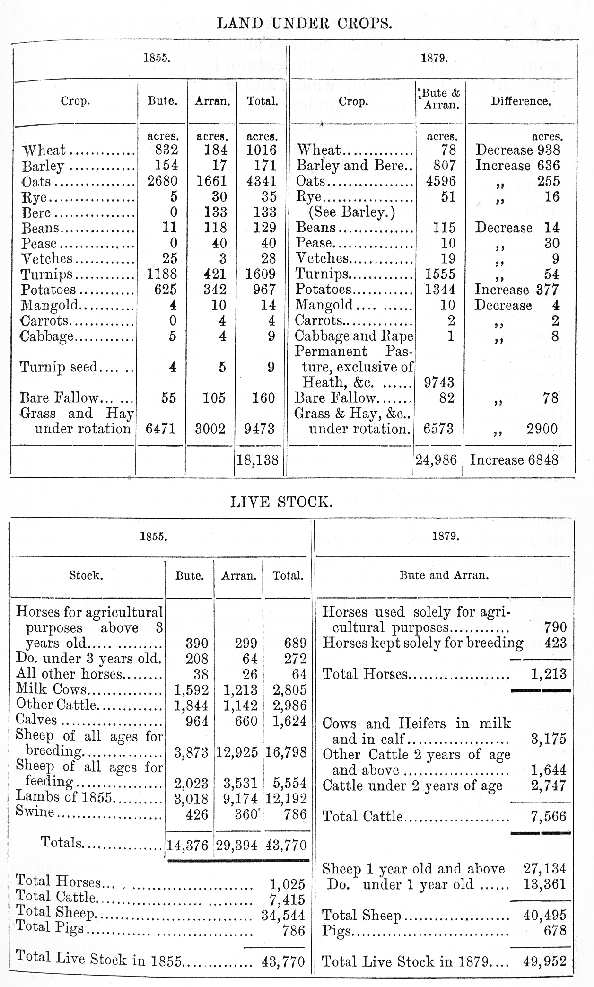
An analysis of the first of the foregoing tables will
show, 1st, a marked increase in the acreage under cultivation in 1879 as
compared with 1855; 2d, an extraordinary decrease in the breadth of land
growing wheat, and an equally extraordinary increase in the breadth
under barley; 3d, a decrease to the extent of 54 acres in the amount of
land under turnips, and an increase of 377 acres growing potatoes; and
4th, the acreage under sown grasses, sanfoin, and clover, shows a
decrease of 2 900 acres in 1879, but in the same column will be found an
item of 9743 acres under permanent pasture, not heath or mountain land,
against which there is no corresponding entry in the column for 1855.
The result of this analysis, therefore, is that there is found to be, in
1879, 6848 acres under cultivation more than there was in 1855 ; that
the growth of barley has in a great measure, though not altogether,
superseded the growth of wheat, that an increased number of acres are
now green cropped, and more potatoes are grown and less turnips than in
1855; and that there is a considerable increase in the acreage under
permanent pasture. As we proceed with our report evidence in support of
these statements will be furnished, and the causes which have produced
these changes will be referred to.
Coming now to the second table, we find that the
number of horses in the county has increased during the last twenty-four
or twenty-five years by 188 animals, the number of cattle by 151, the
number of sheep by 5951, while the number of pigs has decreased by 108.
The total increase in live stock over the period, therefore, is 6182
animals.
The only other statistical information, indicative of
the progress the county has made, agriculturally and otherwise, during
the period reported on, to which we will refer, is furnished by a
comparison of the rental of the county at intervals since 1855. In that
year, inclusive of the burgh of Rothesay, and the extensive
watering-place of Millport in Cumbrae, the entire valuation of the
county amounted to £53,567; in 1865, exclusive of Rothesay and
Millport, the valuation was £34,679; in 1870 it was £41,054; in 1875,
£43,725; and in 1880 it is £47,938. The rental of the island of Bute,
exclusive of the burgh, in 1880, is £25,109, 9s.; the valuation of
Arran, £20,136 10s.; and of Cumbrae, £15,690, 18s.
Bute.
The island of Bute, which gives the name to the
county, although not its most extensive division, is nevertheless the
richest in resources, and, taken as a whole, the most advanced in
agriculture. Its centre is in 55° 50' 1ST. lat. and 5° 4' W. long. It
lies 40 miles west from Glasgow, and 18 miles south-west of Greenock.
Its greatest length is about 14$ miles, its average breadth is about 3
miles, and its circumference about 35 miles. Including Inchmarnock,
which lies west of it about a mile and a half, its total area is
31,836.475 acres. Its highest summit is Kames Hill, which is 875 feet
above sea-level; and there are in it three lochs of some extent, viz.,
Loch Pad, 2¼ miles long by
¼ mile broad, Loch Ascog, and Quien Loch.
Naturally and geologically the island is divided into
four distinct sections. The Garrochhead, forming the extreme south, is
composed of steep rugged hills; trap rock protrudes itself on every
hand, and imparts to the scene, as viewed from the water, a very fierce
aspect. Proceeding north, the second division, lying between Rothesay
Bay and Kilchattan Bay on the one hand and Scalpsie Bay on the other, is
composed with slight exceptions of red sandstone. The third division,
extending from Scalpsie Bay to Ettrick Bay, consists of chlorite slate;
and the fourth division, from Ettrick Bay to the Kyles of Bute, is
composed almost entirely of micaceous schist. The mineral deposits of
the island are lime, coal, and slate, but all are of an inferior
quality.
The following description of the island, as one views
it from the steamer's deck when sailing round it, will give a general
idea of its fertility, and the measure of its agricultural enterprise.
Sailing from Rothesay northwards through the Kyles, before us lie
patches of cultivated soil beautifully laid out and lying well to the
sun, and alternating with these, little bits of moorland covered with
heather and whins. The land ascends gently almost from the water's edge,
and the further west one sails through the narrow strait between the
island and Argyllshire, the little cultivated plots on it become fewer
and fewer, till, at the point of the island facing Loch Bidden, it
presents one mass of almost barren rocks, on which grow a few patches of
scraggy wood. Indeed, the extreme north end of Bute may be said to be
almost uncultivated and unprofitable for cultivation.
Turning round the Buttock Point, the agriculturist
soon finds as he skirts the west side, that here farming is prosecuted
with energy, and that a somewhat cold and unkindly soil is made to yield
crops of fair average quality. In Ettrick Bay and Scalpsie Bay, and up
the straths which intersect the island from Ettrick Bay to Kames Bay,
and from Scalpsie Bay to Rothesay Bay, the soil is much more kindly, and
in the valleys patches of fertile loam relieve the monotony of sharp
sandy till which prevails throughout the island.
The south end, with the exception of the extreme
south, is well under cultivation, and Inchmarnock grows splendid barley
crops. Bounding the Garroch Head, Kilchattan Bay bursts upon the view,
with the beautifully wooded slopes of Mountstuart and Kingarth. In the
bay, and on the slopes and over the brows of the hills, the soil, which
is of a sharp gravelly nature, raises splendid potatoes
for the early markets. This eastern side of the island is much more
wooded than the western, and altogether presents a more pleasing
appearance.
The principal proprietor in Bute is The Most Noble
the Marquis of Bute, K.T. Mr Thomas Russell owns the estate of Ascog; a
portion of the island belongs to the burgh of Rothesay, and there are
also one or two other smaller proprietors. There are few parts of
Scotland in which the relationships of landlord and tenant are so
creditable and pleasant. Since the noble family of Stuart obtained
possession of the island in 1318, Bute has ever been a favourite
residence of the representatives of the house.
It was stated by the present bearer of the title,
when fourteen years of age, that his desire was that all his tenants
should sit easy, and in every instance when it has been necessary for
his desires to be consulted, the same spirit of anxious solicitude for
the good of his tenantry has shown itself. The widows of farmers who
have proved themselves unequal to the task of managing their husband's
businesses have been invariably pensioned, and it has been a rule of the
estate for many years that on expiry of leases no farms should be
advertised unless the tenant wishes to quit. All draining for the last
eighteen years has been executed at the landlord's expense, the tenant
paying 5 per cent. on his outlay. The steadings on the island are
commodious and in excellent repair, in which state they are maintained
by the landlord. Old tenants invariably have the first offer of farms to
let, and no farm is ever offered to the public unless the former tenant
is retiring from the business. On formally requesting it, permission is
given to all tenants to trap or snare rabbits on their holdings.
Besides treating their tenantry in this liberal
manner, the landowners in Bute have done much in the way of presenting
gifts to, and carrying out works of utility and interest in, the burgh
of Rothesay, to make that favourite watering-place even more popular
than it has been, and of course the greater the number of visitors to
Rothesay the brisker the demand for dairy produce. The Marquis has
renovated the old castle of Rothesay at great expense, and the
munificent gifts to the burgh of the late A. B. Stewart of Ascog Hall,
and of Thomas Russell of Ascog, should not be forgotten by those who
derive considerable benefit from the great influx of Glasgow visitors
during summer.
In addition to many other premiums a grant of £20 is
annually made to the funds of the Farmers' Society out of the exchequer
of the Bute estate office, and for several years, through the
instrumentality of the late Mr Henry Stuart, a silver cup was competed
for, which was eventually to become the property of the tenant on the
Bute estate who should twice be adjudicated to have the best managed
farm. This cup was awarded in 1867 to the late Mr Alexander Hunter, Mid
St Colmac; in 1868, to Mr James Duncan, Culivine; and in 1872 to Mr
Robert M'Allister, Mid Ascog, who, having again been awarded it in 1875,
now holds it in possession.
Burgh of Rothesay.
As the onward progress of industry in the island of
Bute is intimately connected with the wellbeing of the burgh of Rothesay,
a few particulars regarding the latter may not inaptly find a place
here.
Rothesay is situated on the east side of the island,
and has a population of well-nigh 8000 inhabitants. A considerable
amount of trade was until recently carried on in the town, and a
plentiful water-supply, suitable for use as a motive power, peculiarly
adapted it as a centre for carrying on the business of cotton-spinning.
One of the first cotton-spinning mills in Scotland was erected in 1780
on a site adjacent to the "lade" which runs from Loch Fad, nearly
opposite to the present Ladeside Mill. The incipient stages of this
industry were nothing very wonderful, but in course of time more
extensive works were erected, and the business was prosecuted for about
fifty years with tolerable success, until the dearth in cotton, caused
by the American civil war and several concurrent causes, brought about
the stoppage of the works, which have never been re-opened, and are
indeed now partially demolished.
The weaving trade was once represented in Rothesay by
three mills, but about eight years ago the Vennel Factory suspended
operations, and within the last two years the Broadcroft Factory has
followed its example, so that there is now only the Ladeside Mill
working. Various causes might be assigned for the cessation of this
industry, but the chief are perhaps the isolated position of the town
and the great improvements recently effected in the style of machinery,
against which less modern machinery is not able to compete.
The general adaptation of steam-power to shipping
dealt a severe blow to the timber shipbuilding trade, which was carried
on in Rothesay with great success for a long period of years. This
business latterly was represented by two firms engaged in separate
branches of the trade; the "Town Yard" dealing specially in those small
vessels of from 100 to 150 tons register, known as "Coasters," while the
"Ardbeg Yard" was chiefly employed in the building of fishing-smacks.
The failure of the west coast herring fishing during the past ten years
has, however, ruined this branch of the trade; and although the building
of the coaster class of vessels might have been persevered in, the
compulsory removal of the "Town Yard," some few years ago, to make room
for the esplanade, has extinguished that branch also.
But notwithstanding the collapse of these industries,
the prosperity of the town has not to any extent been impaired. Rothesay,
it is well known, is a favourite summer resort of the Glasgow folks;
large numbers of them flock to it yearly in quest of health and
recreation, and this has been a means of great advantage and prosperity
to the whole town and island. Many trades and interests have been
fostered and advanced by it, and amongst these, as may naturally be
supposed, the agricultural interest has come in for its due share of
advantage. As it is with this interest that we are chiefly concerned, we
will now proceed to remark more particularly upon it, making in the
first place some few observations on soil and climate.
Soil and Climate.
The characteristics of the soil in Bute vary greatly.
On the east side of the island it is of a sharp gravelly nature, and
rests on a substratum of red sandstone. Going north along the west side
of Port-Bannatyne or Kames Bay, the land lies very steep, and with the
exception of the fields along the shore, where the soil is deeper, and
the subsoil a gravelly clay or slate, the whole of the ground is thin,
and rests on a subsoil of red till. Passing through the valley from
Bannatyne Bay to Ettrick Bay, the soil is still gravelly, but is much
deeper, and large patches of loam are to be found. The deepest soil in
the island lies along the Bay of Ettrick, where there is a depth of
about 3 feet of earth, and a bed of gravel lying under. Fifty years ago
this was a huge marsh, and a bed of moss still runs along the greater
part of the farm of Mid St Colmac. In the valley of Glenmore, large
patches of deep moss and loam are scattered over the fields, and a
turnip crop has been grown in this year (1880), in this glen, which will
compare favourably with any in the island.
In the Commermenoch district, comprising the farms of
Larichorig, Baluachrach, Dunalunt, and Balichrach, the soil will be
found to be representative of all the different kinds of soil in the
island. The farm of Balichrach is admitted to be the most regular
crop-producing farm in the island, and on Ballycurrie, the soil is
light, free, and very easily wrought. In Kingarth, especially along the
valley from Scalpsie Bay to Kilchattan Bay, there is also great variety
of soil; on the higher grounds it is of a till and clay formation, and
therefore poor, but in the straths light sandy soil prevails, and an
occasional depth of good loam is met with.
Bute has been so long famed for its salubrious
climate that little need be said on the subject. Frost seldom continues
long, and is never very severe; and snow lies a very short time even in
the worst seasons. The salubrity of the island is so well known that
Rothesay has been called the "Montpelier of Scotland." There are two
very extensive hydropathic establishments, well-frequented—one at
Rothesay, and the other at Port-Bannatyne.
The following figures give the rainfall over a period
of years, as measured near Rothesay:—
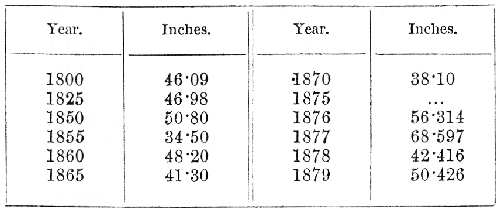
Comparing these figures with the returns made for
other parts of Scotland, we find that in 1855 the average rainfall in
Bute was 34.50; in Dumfriesshire, it was 35.63; in Midlothian, 21.43; in
Strathearn, Perthshire, 19.20 inches. In 1870, Bute rainfall averaged
38.10; in 1876, 56.314; in 1877, 68,597; and in 1878, 42.416 inches;
whereas the gauge at Dunrobin Castle, in Sutherlandshire, gives the
following measurements for the same years, viz:—1870, 26.75; 1876,
34.62; 1877, 41.65; 1878, 34.36 inches. The results of this comparison
prove that the moisture of Bute is about the same as that of
Dumfriesshire, and that it is very much greater than the moisture of
Sutherlandshire. To take a particular point in each of the two
first-named counties, the rainfall in the town of Moffat measured, in
1855, 35.60, and the rainfall in Rothesay measured in the same year,
34.50 inches. These figures speak for themselves, and give a very good
idea of the general nature of the climate of Bute.
Retrospective Glance at the state of Agriculture prior
to 1850.
From a valuable "History of Bute" written by Mr John
Blain (who for sixty years previous to 1820 was intimately connected
with the island), and recently published by Mr Harvey, Rothesay, very
full particulars of the agriculture of Bute at the beginning of this
century can be obtained. It appears that about 1748 the Earl of Bute
introduced farmers from the mainland, in the expectation that the
natives would be induced to adopt their system of farming. The
introduction of these strangers did not, however, have such a beneficial
effect as was expected, and the landlord soon tried other experiments to
improve the condition of his tenantry. Nineteen years leases were
granted, and all rents were converted into money payments. In the low
state of farming pursued at that time many more cattle were kept than
the holdings would maintain, and the horses were of such inferior
quality that six of them were employed to draw the wooden plough then
used. Black cattle were general throughout the island, and were an
ill-conditioned bad-milking breed. It was one of the conditions of these
new leases that the stocks should be reduced, and for this purpose a
public fair was appointed to be held at Rothesay for the sale of the
surplus stock, of which fair the following extract from the "Glasgow
Journal," of 16th April 1765, is an advertisement:-—
"At Rothesay, in Bute, upon 28th May next, there will
be held a market of black cattle, sheep, and horses; the market, to
continue till all are sold off. As most of the tenants in the island are
obliged by their tacks to dispose of a third of their stock against
Whitsunday next, it is expected there will be a great, number of cattle
there.
"For the convenience of merchants, boats will attend
at Rothesay, and likewise at Scoulag Burn-foot, for carrying off
the-cattle sold, either to Largs, or anywhere up the river, freight
free."
While the Earl was thus
trying to improve the condition of the stocks by causing fewer animals
to be kept, he also offered: "a variety of premiums, such as, for the
best bulls, for the best dairy produce, for the greatest quantity of
butter and cheese produced by a given number of cows, for
well-compounded compost dung-hills, and a certain sum per acre for waste
land brought under cultivation." A Suffolk stallion was kept for
the,-use of the farmers' mares, and no fees were charged for his
service, and many other important improvements were promoted, by this
patriotic nobleman.
In 1805 or thereby his successor, following in his
footsteps, and actuated by the same laudable motives, sent, at his own
expense, half-a-dozen farmers' sons, bred on the island, to. be educated
by a Mr Walker, on the farm of Rutherford, near Kelso, and instructed in
the most approved systems of agriculture then pursued in Roxburghshire.
On their way east these young men passed through the country from
Glasgow to Edinburgh and from Edinburgh to Kelso on foot, and were thus
enabled to obtain a good general view of the whole agriculture of the
counties along their route. The curriculum through which these students
passed lasted for two years, at the end of which time they returned to
Bute, and were furnished with farms on the estate of the marquis at
reasonable rents. Their improved mode of farming, and intelligent
application of scientific principles, so far as then known, to the
cultivation of the soil, excited the interest of their neighbours, and a
generous spirit of rivalry was engendered, which tended to bring about a
remarkable change for the better in the condition both of the farmers
and of the land. As this fact seems to have been overlooked in all
former agricultural accounts of the island, no apology is necessary for
here inserting the names of several of the gentlemen who were the
principal agents in effecting this change. They included Mr James
Jamieson, who became tenant of Ambrismore; Mr Charles Stewart,
afterwards of Ardroscadale; Mr John Duncan, the tenant of Meikle
Kilchattan; Mr George M'Phee, North Inchmarnock; and Mr A. M'Intyre,
Dunalunt.
The next most important event in the early part of
this century, and one which has exercised an immense influence in
improving the agriculture of Bute, was the institution of the Bute
Farmers' Society. The idea of such an association was first mooted at a
meeting of the inhabitants of the island, held in the early part of the
year 1806, over which Mr John Blain presided, and at which he delivered
an address on the state of agriculture, which is given in extenso
at pages 274-283 of the history referred to,—an address remarkable alike
for its breadth of view, its fearless denunciation of abuses, and its
judicious recommendation of reforms.
The first object contemplated by the promoters of
this institution was discussion on agricultural topics, but in 1807, at
their March meeting, we find them making arrangements for holding a
ploughing-match, and settling the amount of premium to be offered
respectively for the best stallion and the best bull for breeding
purposes. At the first ploughing-match ever held in the island, that in
March 1806, premiums were offered by the Marquis of Bute, and twenty-six
two-horse ploughs competed, each being provided with a driver in
addition to the ploughman proper, but at the match held under the
auspices of the Society a year later, drivers were dispensed with, and
thirty-four ploughs appeared on the ground.
These ploughing-matches were in course of time
discontinued, it being considered that the object they had in view had
been attained, but premiums continued to be offered for the best fields
of turnips, the most successful crops of artificial grasses,
improvements in the breed of cattle, the best kept hedges, and the best
regulated farms.
At what time this budding society, which was
technically known as the Bute Agricultural Society, ceased to exist, it
is difficult to determine; its last published minute is dated the 16th
March 1807, but that it had been defunct for some time prior to 1820 is
clear from the fact that in 1821, Mr Samuel Girdwood, then in
Kerrylamont, proposed to revive the ploughing-match, and was empowered
by the farmers to collect subscriptions, and to call a general meeting
of the tenantry so soon as he had collected a sum sufficient to pay
adequate premiums to competitors. This scheme proved successful, and the
next development of the renewed agricultural enterprise took shape on
the 3d day of February 1825, when a meeting was held in Rothesay of
persons friendly to the institution of a Farmer's Society. The result of
this meeting was that the Society which still exists was founded, having
for its object the promotion of agricultural improvement in all its
branches, to be attained by the granting of premiums, the formation of a
library, and the holding of meetings for discussions on agricultural
topics. This Society has done very much towards the furtherance of
agriculture. By the premiums offered for dairy cows of pure breeding and
good milking qualities it has fostered dairy-farming, till it is now
almost in as flourishing a condition as could be desired. By the
introduction of good Clydesdale stallions it has enhanced the value of
the draught horses, and by its premiums for the best fields of turnips,
&c, it has greatly increased the profitableness of green-cropping in the
island.
Modern Farming.
As Lord Bute may be said to have been the principal
agent in abolishing the last remnants of primitive farming, and Mr John
Blain may be said to have been the forerunner of scientific farming, so
the honour of being the inaugurator of the modern era in Bute farming
must be awarded to Mr Samuel Girdwood. This gentleman about forty years
ago held the offices of steward to Lord Bute and secretary of the
Farmers' Society, and was also tenant of the farm of Kerrylamont in
Kingarth. He was a man of more than average intelligence, of great force
of character, and possessed of unbounded enthusiasm in the furtherance
of a favourite pursuit. His tombstone in Rothesay churchyard tells us,
that he was for forty years connected with the estate of the Marquis of
Bute; "distinguished by fidelity in his trust, ability, skill, and
success in the discharge of his duties, and zeal for the public
interest." Under his fostering care the Society progressed wonderfully,
and by the introduction of furrow drains and the system of liming, the
reclamation of waste lands was vigorously prosecuted. Through his
instrumentality, a lime-kiln was established at Kilchattan Bay, and the
limestone found in the island was there burned and utilized, and a
premium was offered by Lord Bute for the best heap of composite manure,
i.e., of farmyard manure, mixed with such waste as the sweepings
of the farmyard, and the "scouring" of the roadside drains, &c. On the
farm of Kerrylamont he carried on various experiments, the results of
which, when successful, were communicated to the farmers. In order to
facilitate interchange of opinions by practical men on agricultural
questions, Mr Girdwood, in conjunction with Mr Alexander Anderson, the
first letterpress printer in Rothesay, issued, on the 26th November
1839, the first number of the "Bute Record of Rural Affairs," a
publication which continued to be issued regularly until January 1846,
and which in its republished form (1860) furnishes an excellent
reference work to the student of agricultural progress in Bute.
Having thus brought the review of the agriculture of
Bute prior to the period on which we are asked to report to a close, we
now proceed to give somewhat in detail particulars of farming operations
during the past twenty-five or thirty years.
The system of farming differs little if at all from
that commonly pursued in the west of Scotland. The rotation of crops at,
and some time previous to the commencement of the period reported on,
was what is known as a seven years' shift, i.e., the ground lay
three years in pasture, and four under crop, but for the last twenty
years or more a six years' shift was substituted; in all the new leases,
however, the seven years' shift has again been reverted to. The land
lies under pasture for three years ; it is then broken up by the plough,
and the fourth year an oat crop is sown; the fifth year it is green
cropped; the sixth year it is sown down with oats or barley and
rye-grass and clover seed; and the seventh year a crop of rye-grass and
clover is taken off. No two white crops are allowed to be taken off in
succession without the consent of the landlord.
Taking these crops in the order of their rotation we
are first called upon to give a few particulars of the
Oat Crop.
The established custom for the last fiftyyears has
been to import for seed purposes Midlothian "potato" and "sandy" oats
from the Edinburgh markets. On the higher lands, where the ground is
shallow, and of a heavy clayey nature, "sandy" oats are invariably sown,
and on the deeper and more fertile lands scarcely any but "potato" oats
are produced. "Hamilton" oats are found to grow admirably on the light
soils of Kilchattan Bay, and weigh about 42 lbs. per bushel. The land is
broken out of grass during January and February, and sowing is begun in
April, and thought to be completed in good time when the seed is all in
by the 20th of that month. In the north-east of Bute damage is often
done to the growing crop during the month of June by gales of east wind,
which shake the grain when in flower, and although the bulk of straw is
often very great, the result of thrashing is many times disappointing.
The crops are generally first harvested in North Bute,—not that the soil
there is capable of raising earlier crops than the soil in Kingarth, but
the farmers on the east side of the island give all their attention in
the early part of spring to the potato crop, whereas generally
throughout the rest of the island the farmers give equal attention to
white and green crops. The reaping-machine is now, and has been for many
years, in use on almost every farm in Bute, and very few acres are now
cut with the scythe or hook, and these only when the crop has been much
flattened by the storms. The first who introduced a successful
reaping-machine was Mr John M'Dougall, the tenant of Kerrytonlia who
purchased one of Jack's reapers about twenty or twenty-five years ago. A
very few acres may occasionally be let to Irish reapers
by the acre but this mode of harvesting
is now nearly obsolete. The hands necessary for the management of the
farm during the year are usually equal to the extra demands of harvest
time, but if additional workers are necessary they can easily be
procured in Rothesay.
The average produce of oats per acre in 1855 was 32
bushels, and the average of fiars prices for the seven years ending
1856. was 23s. 6|d.; the average produce per acre in 1880 will be about
the same as in 1855, and the average of fiars prices for seven years
ending 1876 was 24s. 6 11/12d. per imperial
quarter. Over a period of years the bushel of oats will weigh on an
average about 40 lbs. and when ground a 6 bushel bag of oats usually
yields 140 lbs. of meal. The habits of the people of Bute have greatly
changed during the past twelve or fifteen years, and whilst formerly a
large proportion of grain was ground into oatmeal, now only a very small
proportion of it is devoted to this use.
Green-Cropping—Potatoes and Turnips.
The early history of green-cropping in Bute is
interesting and instructive. As we have seen, the chief proprietor early
gave tangible proof of his interest in the improvement of agriculture,
and the Highland and Agricultural Society, as well as the local Farmers'
Society, later on, did something to encourage the growth of green-crops.
The National Society, in 1851 and 1852, and in several following years,
offered premiums for the best managed green crop in the island, and in
1868 a premium was offered by the agent for the best 2 acres of turnips
and potatoes grown with Goulding's manures. The Highland
Society's medals fell to the lot of the tenant of Mid Ascog in
1851, 1852, 1854, and 1855, and the premium offered by Goulding was also
awarded to him. Prizes of a like nature were awarded on different
occasions by other donors, and the competitions for them did much to
make the farmers bestow increased care on these important crops.
For many years Bute has been known as one of the
earliest places in the west of Scotland for the growth of potatoes.
These favourite roots grow well on the sharp gravelly soil of Kilchattan
Bay and Kingarth, and the farmers in that district vie with each other
in sending the earliest potatoes to the Glasgow market. In the spring
time potatoes used to become rather a scarce commodity in Bute, but the
advent of the "Champion" potato has somewhat obviated the danger of a
local famine of these vegetables. "Bed Bogs" is the principal variety
planted for sale in the early markets. The average price of early
potatoes is about £18 per acre; although in Kilchattan Bay from £20 to
£24 have been obtained in an exceptionally good season. The buyer digs
the crop, and the farmer drives to the place of shipment free of charge.
On some of the shore farms the stubble is during winter covered with
seaweed, but in general it is ploughed down or grubbed about Martinmas,
and again ploughed in February. Potatoes for early sale are planted as
soon as possible after the end of February. The width of potato drill is
from 25 to 26 inches, the latter figure being the standard. The crop is
in most cases sold to dealers from Glasgow, and the frequent
communication between Bute and the mainland—steamers sailing hourly
during summer, —admits of the crop being lifted and transported to
Glasgow in a very short time.
In the extreme northern portions of the island and in
the more exposed situations, potatoes are only grown in quantity
sufficient to supply the wants of the family. On one of the farms in
Kingarth, in 1880, a fair crop of barley has been raised on a field on
which a crop of early potatoes was grown. The potatoes were lifted about
the middle of June, and the barley was sown on the 26th and 30th of the
same month. This is rather an unusual proceeding (rape-seed being
generally sown on the potato ground), and its success will be watched
with interest.
Turnips.
The growing of these favourite feeding-roots forms a
large part of the agriculture of Bute. Turnips were first introduced
into Bute by Mr Knox, then tenant of Kerrylamont, in 1800.
The sorts now in most common use are purple
top Swedish and green top yellow, and
about one-half of the breadth under turnip crops is sown with the
former, and the other half with the latter variety. As a rule the whole
produce of the crop is consumed by the stocks on the farms, but a good
exportation trade is carried on by some of the farmers. The turnips are
shipped in bulk, and sold in Glasgow and Greenock.
The average width of turnip drill is 27 inches. In
the south end of Bute the turnip crop has—since the growing of early
potatoes assumed its present important position—been chiefly grown with
artificial manures, as the farmyard clung is all required for the
earlier crop. In North Bute and Commermenoch, where less attention is
given to the early potatoes, an effort is made to sow the crop on manure
formed of an equal proportion of byre and stable manure and artificial
stuffs. Generally it may be said that the farmers are now using more
ground bones than formerly, and within the last few years it has become
necessary to use a good deal more town manure, and on one farm in
Kingarth, in the winter of 1879, upwards of 400 tons have been spread.
For the storage of the turnip crop during winter
different plans are adopted. On the eastern side of the island the
produce of two drills is gathered into one furrow, and covered over by
the plough. On the western side the turnips are only taken out of the
ground as they are needed, the earth being put up to them at the
beginning of the winter. The system, so successfully carried out in
Dumfriesshire, of feeding sheep on the growing crop, has been tried in
Bute, but on account of the moistness of the climate it was found very
unprofitable, and the practice has been discontinued.
The average yield of turnips per acre in 1855 was 15
tons 11 cwts; the average yield of Swedish turnips in 1870, about 18
tons; and of yellow, 14 tons. For thinning turnips the services of
female workers can be secured at about 2s. per day, and of male workers
at about 2s. 6d. per day; in both cases without food.
Summing up the report on green-cropping, it must be
said that the most unprofitable branch of farming during the last ten
years has been the growing of early potatoes, and those farmers who have
bestowed more attention on the turnip crop are to-day better off than
the others, and their farms are in much better condition. Turnips leave
the soil in much better condition for the growth of the next crop, and
one can easily distinguish by the appearance of the white crop whether
it has been sown on potato or on turnip ground.
Barley.
Up to within a recent period wheat was extensively
grown in Bute. About the time of the Crimean War white wheat was grown,
and was the most successful and most profitable crop raised in the
island. Seasons were then very favourable, prices were high, and on one
of the most northerly farms the average of 48 bushels per acre was
realised on a field of 10 acres. Barley, however, has for the last
twenty years more or less been increasingly cultivated, and, as a
result, has now almost entirely supplanted wheat. The reason for this
change of crop has chiefly been this: the ready market which is found
for barley in the distilling districts
of Campbeltown and Islay, and the increasing foreign supplies of wheat,
which have rendered it more profitable to grow barley. The change of
crop has also proved beneficial in another way: it has tended to the
good of the soil, because barley keeps the ground much cleaner, and does
not take so much of the strength out of it as wheat.
The red land alone is sown with barley; indeed, it
may be said that, with the exception of the moorland farms, all the
sown-down land is cropped with it. The variety sown is in general that
known as common barley, although in the north end, and wherever the land
is strong and in good condition, the farmers prefer the "Chevalier"
sort, as it is the more profitable.
Experience has taught the farmers in Bute that
home-grown barley is ill-adapted for seed purposes, and consequently all
the seed is brought from Midlothian. The heads of the home-grown seed
become black, and the yield is not up to what might be expected. The
Midlothian grain usually weighs about 56 lbs. per bushel, and the
average weight per bushel of the barley crop is from 52 to 54 lbs.
Barley harvest in a fairly good season begins about the 15th of August,
and the crop in the south end is commonly hutted in the fields, and
thrashed off the huts by the large thrashing mills, two of which travel
the island in circuit. In the north end the crop is stacked in long
stacks placed four abreast, and containing about twenty cartloads
a-piece. The mill stands between the two inner stacks, and the tops
being taken off these, the sheaves from the outer stacks are forked on
to them, and from them on to the machine. The outer stacks being thus
disposed of, the sheaves of the inner are then passed through the mill.
The barley straw on being thrashed is stored in long square stacks, and
is used during winter in various ways. Some of it is cut into chaff,
steamed, and mixed with meal and turnips for feeding purposes; the rest
of it is used for "litter," and a little of it for thatch.
Rye-grass.
When land in Bute was newly reclaimed great
quantities of rye-grass seed were ripened and sold for exportation. At
that time the ripening of rye-grass seed was one of the features of Bute
farming. Sometimes the yield per acre has been known to be as high as 6
quarters. In 1853 the Highland and Agricultural Society's medal awarded
for the best sample of perennial rye-grass seed grown in Scotland, was
gained by Mr James Duncan, Rhubodach; and in 1854 the same medal was
gained by Mr John Stewart, Baluachrach, in Commermenoch district. The
average yield per acre will not now be more than 2 quarters; the great
majority of the farmers cut their hay green and winnow it, and the
ripening of it is only permitted on such farms as are best suited for
the process, when the crop is exceptionally clean. The weight per bushel
of this season's (1880) rye-grass seed averages from 23 lbs. to 28 lbs.,
and the price realised for it is from 1s. to 1s. 3d. less per boll of 4
bushels than the price of that sampled in Ayrshire.
Eye-grass seed is invariably mixed with clover, and
the second growth of clover in a season such as 1880 could hardly be
matched in any part of Scotland. On Mid Ascog and Colmac this season
(1880) there has been a crop of great bulk, which has been winnowed and
stored for fodder.
Cattle and Dairy-farming.
The native breed of cattle in Bute, which were
presumably of Highland origin, although many of them were polled, have
long-been superseded by the Ayrshires. Dairy-farming is one of the
principal departments of the rural economy of the island, and as the
demand for dairy produce increased, so it became the interest of the
farmers to meet it by improving their herds, and increasing the milking
qualities of their cows. We are able with tolerable certainty to
establish the date when the first Ayrshires were introduced. The
earliest occasion on which a prize was specially awarded at the annual
show for Ayrshire cows was in 1830, but the breed had been in the island
fully a quarter of a century before that date. Among the first, if not
the very first, to introduce Ayrshires, was Mr Thomas Stevenson, who in
1803 came from Neilston, in Renfrewshire; to the farm of Edinmore, and
brought with him a number of Ayrshire calves, which were brought over by
ferry from Largs to Scoulag, and were then travelled across the island
to the west side, near Colmac. Mr William Barr also came from Ayrshire
about the same time, and brought with him a small stock of the breed of
his native county. These gentlemen were followed soon after by Mr
Johnstone, the father of the present tenant of West St Colmac, who came
from West Kilbride, Ayrshire, in 1809, and by Mr Robert Hunter, Mid St
Colmac, also an Ayrshire man, both of whom brought herds of pure bred
Ayrshires with them. The cattle brought in by these strangers must have
soon commended themselves to the natives, because we find that the
Stewarts of Balichrach and Baluachrach, who are said to be a family
resident in Bute for about three hundred years, have long had excellent
herds of Ayrshire cows. The herd presently on the farm of Baluachrach or
Upper Ardroscadale, was founded by the late Mr Robert Stewart in May
1833, from purchases made in the island. A bull was bought from the late
Rev. Alexander M'Bride, minister of the parish, and afterwards of the
Free Church, North Bute, which greatly improved the breed, and sires
have been introduced from the mainland which have maintained its
superiority. Mr Stewart was awarded the first prize, twenty years ago,
for the best aged cow in milk, and also a silver medal as owner of the
best six cows shown.
In 1856 a selection of Ayrshire cows was made from
herds in Bute, and sent over to the Paris Exhibition as the joint
adventure of several farmers. The cows were all sold at a good profit,
and one selected from the herd of M.id Ascog, was awarded the bronze
medal as one of the best cows in milk in the exhibition.
The Mid
Ascog herd was founded aboutl850,withcowspurchased in the island,
and its superior milking qualities were maintained by the use of bulls
from the herd of Mr Murdoch, Carntyne, near Glasgow. Up to about 1870
only bulls from this herd were bought in, and during that period many of
the leading prizes at the local show were awarded to Mr M'Allister, the
tenant of Mid Ascog. From 1859 to 1880 scarcely a year has passed
without his gaining medals for his Ayshires, and the trophies won by him
can hardly be enumerated. After the Carntyne herd was dispersed bulls
were purchased from the Burnhouses breed, and by the exercise of great
care in mating sires and dams the excellency of the herd has been
maintained.
The herd of Mid St Colmac, owned by the late Mr
Alexander Hunter, and formed from stock brought from Ayrshire by him,
was one which for many years upheld the credit of Bute dairy cows in
show yards all over Scotland. After the death
of Mr Robert Hunter the farm was carried on and the stock greatly
improved by his son, and at his death a few years ago it was sold by
public auction, and the prices realised were the highest ever obtained
at a displenishing sale in Bute. The three-year-old queys drew very high
prices, and three of them sold respectively at £33, £28, and £25
a-piece.
Several of the highest priced animals were purchased
by the present tenant of the farm, and with the herd founded by his
father, Mr James Simpson, on Largivrechtan about thirty-four years ago,
they now form the magnificent herd of forty dairy cows on Mid St Colmac.
The Largivrechtan herd was founded from purchases made in Ayrshire, and
from cows purchased from Mr Lochhead, 'Toward, Argyllshire; the bulls
have almost invariably been purchased from the tenant of Boydston,
Ardrossan. One of these bulls was the sire of twenty prize animals, and
several high priced cows have at times been added to the herd, including
the famous cow "Joan," bred at Knockdon, and sold at the Auchendennan
sale of Ayrshires some few years ago.
The Bute herd, however, which has come most to the
front, in shows on the mainland in recent years is that of Meikle
Kilchattan. This herd was founded fourteen years ago from purchases made
in the island. Bulls have been used bred by Mr Scott, Plane Barm, Bute;
Mr Ivie Campbell, Dalgig, New Cumnock; Mr Fleming, Castleton, Carmunnock;
Mr Brown, Cartleburn, Kilwinning; and Mr Howie, Burnhouses. These were
all good breeding sires, but the Cartleburn bull effected the greatest
improvement in the breed.
As these dairies touched upon, are, with Balichrach,
the most extensive in the island, the details of the way in which their
quality has been maintained may serve as an indication of the general
method of breeding Ayrshires followed in Bute.
Queys are seldom or never bought in, but bulls almost invariably are.
The quey calves are all kept to keep up the herds, but the bull calves,
unless very promising, are sold as unfed veal to the butchers. As a rule
the aged cows are not kept after they are ten years of age unless they
have proved themselves to be extra valuable as breeders. Cows which
calve in autumn sell at about £15 per head; those calving in spring draw
from £12 to £14.
The produce of the Bute dairies is either sold as
sweet milk or manufactured into fresh butter, for both of which there is
an abundant demand in Rothesay, Port-Bannatyne, and Ascog. A good deal
of fresh butter is also sent out of the island. A boat crosses from
Kilchattan Bay to Millport with supplies of butter, and quantities are
also sent to Dunoon. When the dairy trade began at first to develop
itself in 1810, the milk was all sold skimmed; after a time a demand
arose for mixed "skim" and. "sweet" milk, and again butter milk was in
favour; but for many years sweet milk has been exclusively in demand.
Cheese was somewhat extensively manufactured in former times. The writer
of the " Statistical Account," in 1840, tells us that the "cheese then
made was equal to the best Dunlop," but this remark does not now hold
good. Bowing establishments are-very rare; the farmers generally sell
the produce of their dairies without the intervention of any middle
party, as by this means they receive about 2d. a pound more for their
butter than they would by selling it wholesale to merchants in Rothesay.
The first farmers who sold milk from carts in the streets of Rothesay,
were Mr John Currie, then in Ardbeg, and Mr Thomas Stevenson, Ardmalish.
Fresh butter sells out of Rothesay at about 1s. 5d. per lb. on an
average, and fresh country eggs, sent from Bute at about 1s. per dozen.
In Rothesay the consumer can purchase butter produced by the Bute
dairies at about 3d. a lb. less than he-would pay in Dunoon or
Helensburgh, as the supply in the island exceeds the demand.
The price of sweet milk, wholesale, is about 4d. per
imperial pint; of fresh butter, wholesale, about 1s. 2d. per lb.,
retail, 1s. 4d. to 1s. 6d.
As there is not a market for all the butter milk
churned in the island, for the last twenty years it has been usual for
many of the farmers to make the sour milk into a curd for dye, which is
sold to merchants in Glasgow. The milk after churning is put into a
large vat, and a slow fire being put under, it is allowed to remain
there for two days; at the end of that time,
being now formed into a curd, it is taken out and put into a suspended
bag, by which means the whey is allowed to drip out of it. It is
afterwards taken clown, and put under a cheese-press for a time, and is
then sent off to the Glasgow market. The price received for the curd is
from 18s. to 20s. per cwt. which is about equal to three farthings a
pint, or within a fraction of the price usually obtained for butter
milk. The sour milk whey is mixed with meal, and forms excellent food
for the pigs.
Sheep.
Sheep-farming is not very extensively followed in
Bute. All the farms carrying pure bred stocks are in the north end, and
the chief of them are Rhubodach, Kilmichael, Hilton, and Glenmore. The
stocks carried on these hills are mixed flocks of blackfaced ewes and
wethers. A little more than thirty years ago several of the farmers sold
off their blackfaced sheep and bought in Cheviots, but it was found that
the Border favourites were very unprofitable, and for the last twenty
years there have been few or none of them in the island. An experiment
was also tried on one of these farms with crossing blackfaced ewes with
Leicester tups, but on account of the difficulty experienced in keeping
up a blackfaced stock the experiment was abandoned. Thirty years ago the
sheep on the Bute hills were very small and ill-conditioned, but,
chiefly through the energy of Messrs Crawford and Duncan, the tenants of
Kilmichael and Rhubodach, by the selection of good tups from the
mainland, a great improvement has been effected in their quality. The
tups in use are for the most part bought in from the flocks of Craigton,
Milngavie, Foyer's, Knowehead; and Jardine's, Campsie.
The tups are generally let out with the ewes about
the 20th November, and the lambing season extends from the middle of
April to the middle of May. After going with their dams between three
and four months the lambs are weaned, and about the middle of August all
the tups and stock lambs are dipped with the usual compositions. The
lambs are kept from their dams for about eight days, at the end of which
time they are sent off to the hills again, and usually find their old
quarters. At weaning time the weakest of the lambs are sold off to
graziers, who winter them and sell them in the ensuing autumn as hoggs,
to make up the stocks on farms where cross-bred lambs are reared.
The "cast" ewes are drawn about the 1st of October,
and clipping begins about the same date. For dipping, a trough is in
use
into which two sheep can be put at once, and by this means the work is
got over very expeditiously. Smearing has now been almost universally
abandoned, because of the amount of extra time and labour it involves;
though occasionally black-faced ewes are smeared with a mixture of tar
and butter, in the proportion of 1 gallon of tar to 6 lbs. of butter—a
quantity sufficient to smear six sheep. The clip after smearing with
this composition generally yields about 6 lbs. of wool per fleece.
Clipping begins about the middle of June, and is continued till the end
of the month; the milk ewes are about a fortnight later of being clipped
than the others. Taking an average over ewes and wethers, the produce of
the clip will give about five fleeces to the stone of 24 lbs. Wethers in
some cases will occasionally give a clip of 8 lbs. of wool.
The average rent paid for purely sheep farms is about £18 per every 100
sheep carried. The prices realised for shot lambs range from 6s. to 8s.
per head; for draft ewes, from 16s. to 18s. each; and for wethers, about
31s. per head.
On several of the arable farms which have also a
piece of moorland included in them, another branch of sheep-farming is.
carried on. The tenants of these farms buy in at the beginning; of
winter a number of cross-bred or half-bred hoggs, which they winter on
grass, with the addition of a few turnips and a little corn, and sell
again in summer to the butchers. Some sell before clipping, others after
having taken off the fleece. These hoggs are bought in at prices ranging
from 20s. to 30s. a-head, and are sold after the six or seven months'
keep, at prices averaging from 40s. to 50s. each. These hoggs,
unclipped, now sell at about 1s. per lb., clipped hoggs, at about 8d. or
9d.
A few Cheviot ewes are kept on one or two farms, and
are-crossed with Leicester tups, for the supply of cross-bred lambs for
the butchers. The lambs are sold about the middle of June,, and draw
about 30s. a-piece. The ewes, when the lambs are taken off them, are fed
off, and, if fat, draw about 5s. a-head more than the price for which
they were purchased. Sometimes the difference between the buying and
selling prices of these ewes is even greater than 5s., and when the
value of their clip is taken into account, it is apparent that this
system of sheep-farming is by no means unprofitable, and many farmers
think it should be more generally adopted. It has now been pursued for
the last twenty or thirty years on two or three farms. One of the
tenants keeps Cheviot ewes in stock, shoots out the slack ewes, and buys
in hoggs to maintain the stock; the others sell off the ewes and; buy in
a new lot every season. Sheep are brought in now from Argyllshire in
October, to be wintered for six months at 6s. 6s.. a-head. Whether this
is profitable or not for the land it puts money into the farmers'
pockets for the time being.
Pigs.
In the table at the commencement of this paper we
have given the relative numbers of pigs in Bute in 1855 and in 1879, and
it only remains further to be added here, that these animals are only
kept to the extent of one or two on each farm, for the purpose of
consuming the waste about the kitchen, and that pork-feeding forms no
part of the rural economy of the island.
Horses.
During the last quarter of a century there has been
little change in the quality of the horses bred in Bute. For some time
prior to the period reported on, and during it, the farmers have been
fortunate in securing some of the best Clydesdale stallions ever known
in Scotland to travel their island. The Sproulston horse "Farmer"
(Stud-book, 290) was the first to effect a marked improvement in the
quality of the stock, and after him "Round Robin" (721), "General
Williams " (326), and "Young Clyde " (1360), greatly increased the value
of the young horses reared in the island. In more recent years
"Surprise" (845), "Young Lorne" (997), and others, have been secured by
the Farmers' Society to travel under their auspices. "Druid" (1120), the
well-known champion horse of 1879 and 1880, also was engaged by the Bute
farmers, when a three-year-old, in 1878. The best horses are undoubtedly
to be found on the west side, on the deep land of Ettrick Bay, but the
east side has also come to the front through the reputation of the
famous mare "Rose of Bute" (89). Horse-dealers visit the island
regularly, and buy up any of the stock which may not be required for
home purposes. Generally the mares are not of the largest size, and
there is an apparent lack of the finely flowing fringe of hair on the
legs, so much accounted of by Clydesdale fanciers. Clydesdale mares were
introduced into Bute by Mr James Simpson about forty years ago, but
whether these were the first pure bred importations we have not been
able to ascertain. It must be between thirty and forty years since
"Farmer" (290) travelled the island, and "Round Robin" (721) was there
in 1854 and 1855. About this latter date Mr Robert M'Allister, Mid Ascog,
held a leading place in the local show with his mares, and bought in one
from the stud of Mr Robert Findlay, Springhill, Baillieston, which bred
many excellent animals. At the time when Mr Simpson came from Ayrshire,
and "Farmer" (290) was traveling, the native breed must have been
somewhat inferior, and in all probability of Highland origin, because
the very first year Mr Smpson was
in Bute he gained the prize as the owner of the best
pair of mares at the ploughing match. It is questionable if very
heavy mares could be raised in Bute; the soil is not so
well adapted for grazing purposes, and the pasturage is very bare
compared with that of the fertile lands of Galloway and Kintyre, and,
therefore, so long as the needs of the island are best served by a horse
somewhat light of limb, the present breed may be considered the best for
all purposes. The farmers find a ready market for their surplus stock,
and mares from Bute have been sent all over Britain, and even to the
colonies. With the produce of such horses as "Druid" (1120) and "General
Neil" (1143) coming up, there should be little danger of the stock being
deteriorated.
Draining and Liming.
The first draining operations of any extent carried
on in Bute were commenced more than fifty years ago by Mr Kirkman Finlay,
who at that time was proprietor of the lands of St Colmac. The farm of
West St Colmac was the first that was drained in Bute on the Deanston
principle, and all the deep land on the level fields around Ettrick Bay
were reclaimed from a state of unprofitableness. A drain plough was
introduced by Mr Finlay, but it proved unworkable on account of the
number of boulders buried in the marshes. There is double the extent of
arable land in Colmac now that there was forty or fifty years ago, and
what was then considered good arable land has been very much improved by
lime and draining.
When Mr Samuel Girdwood began reclamation works on
the Bute estate he encountered much opposition from the indifference of
the farmers in seconding his efforts to improve the soil. He broke
ground on the farms of Cranslagvourarty and Largivrechtan, but the
tenants of those days were not able to see the force of all his
blasting, digging, and draining labours. In their hands the dry patches
on the hillsides were cultivated, but where-ever nature asserted her
supremacy by the presence of whins and marshes, no efforts were made to
battle against her. Whins, rocks, and brushwood were left to the freedom
of their own will, and stagnant bogs remained untouched. Mr Girdwood
succeeded in convincing the tenants that it was for their advantage to
clear the land, and the result in the case of one of them at least was,
that when he went out of the farm he went with something very like a
fortune.
About thirty years ago it was customary for the
proprietor to pay the tenant who broke new land a premium of £5 per
acre, but he gave him no lime. On the farm of Kerrycroy, in Kingarth,
upwards of 20 acres of waste land have been reclaimed during the past
twenty or twenty-five years, and all the steep land lying along the
hillside on the farm of Kilbride, in North Bute, has been
reclaimed within the same period. About ten years
previous to that time 40 or 50 acres were taken in on the farm of Mid
Ascog, and margins of moorland have throughout the island been
reclaimed. Previous to the last eighteen years, when the land was much
drained, farmers received half value in lime for the expense of draining
done by them, but since that time they only receive half value for lime
used in reclamation, and all drains are made by the landlord, the
tenants paying 5 per cent. interest on the outlay. Much of the soil that
has been drained is so thin, that in many cases the interest payable
increases the rent so much that farming is made unprofitable both to
landlord and tenant. There are tile works situated in the parish of
Kingarth, from which drain-tiles can easily be obtained, and a
lime-kiln, which many years ago was in operation, has again commenced
burning the limestone found in the island. The farmers in the south end
prefer Bute lime because it does not require shipping, but those in the
north end find they are as cheap to use Irish lime, as in either case
shipping has to be resorted to, and the quality of the Irish shells is
much superior.
Ploughing and Manure.
The common single furrow plough is that most in use
in Bute. The plough is in most cases drawn by two horses. Subsoil
ploughing is seldom practised, but in general throughout the island
there is no subsoil to plough. Stubble land is ploughed shortly before
and after Martinmas; pasture land is broken about the beginning of
January; and red land is turned over as near the time for barley sowing
as possible.
Iron harrows are mostly, if not altogether, in use in
the island, and chain harrows are also common. Grubbers and drill
harrows of the usual kinds are generally in requisition, and some
farmers grub the stubble land at Martinmas with the three-horse grubber
instead of ploughing it.
Artificial manures have been greatly in use in Bute
both for raising potatoes and turnips, but especially the former.
Peruvian guano, ground bones, and within recent years "Blood" manure
have been put into the soil, and the fact is, too many artificial stuffs
have been employed, and now many of the farmers are importing large
quantities of town manure from Greenock. Upwards of 800 tons of long and
short town dung were put on farms in Kingarth in the winter of 1879, and
this kind of manure is gradually supplanting the other. On land where
much artificial manure has been used lime has not the same effect as it
had when the land was reclaimed, and in many cases liming in recent
years has not been remunerative. Long dung can be purchased in Greenock
and laid on the fields in Bute for about 7s. per ton ; short dung or
ashes for about 3s. per ton. If purchased in Rothesay long dung can be
laid on the fields for 6s. a ton, and the police manure is given to the
farmers for taking it away.
Pasturage.
The pasturage of Bute enjoys no great reputation, and
purely pastoral farms are very scarce. Within recent years the tenant of
Rhubodach, Kilmichael, and Bannatyne Mains, has maintained the last
named farm as a grazing farm by top dressing with short dung and
farmyard manure, mixed with lime and ground bones. Ayrshires, Highland
bullocks, shorthorns, Galloways, and Canadian cattle are grazed on this
farm, and fattened for the markets. The only other grazing of any extent
is around the Mount Stuart policies, and it is let to farmers and others
for grazing young stock.
Wages.
As in the rest of Scotland so in Bute the cost of
working a farm has almost doubled, in respect of wages, within the last
twenty years, and were it not that, with machinery in use for almost
every purpose, fewer hands are required, it is difficult to conceive how
farming could be carried on, rents also having increased so much until
recently. Married ploughmen in Bute at present are receiving 18s. per
week with a free house. Female servants, good milkers and field workers,
boarded in the house, are paid from £8, 10s.
to £9, and lads receive from £8 to £12, with board, per half-year; About
twenty-five years ago the same class of women servants were receiving
about £3, 10s., and lads about £5 per
half-year with board and lodgings. Female field-workers employed
thinning turnips in 1880 were paid 2s. a-day without rations, and the
same workers in harvest time received 2s. a day with rations. Men
employed during harvest time received from 6d. to 1s. a-day more than
the women, with their rations, and full wages whether the weather was
wet or dry. The wages of these workers in 1880 were just about double
what they were in the years from 1855 to 1860.
GREATER CUMBRAE.
Having thus exhausted our information regarding the
agriculture of Bute, a few particulars of the island of Cumbrae may best
be inserted here before proceeding to write of the agriculture of Arran.
Cumbrae has everything in common with Bute, but little or nothing in
common with Arran. The island lies 4 miles east of Bute, and 2 miles
west of Largs, in Ayrshire. It is 3½ miles in
length from north-east to south-west; its breadth is 2 miles, and its
circumference from 10 to 11 miles. According to the measurement of the
last Ordnance Survey it contains 3120.597 acres.
The climate is agreeable, being less moist than the
mainland or Arran, and very salubrious. The geological formations are
whinstone, freestone, and limestone. The soil is varied; on the higher
parts of the island it is light, gravelly and thin, bedded on moss, and
covered with heath; in some of the valleys rich loam pervades, and
produces good crops. Along the east coast it is light and sandy, and in
the south of the island it abounds in marl.
The island is owned by the Marquis of Bute and the
Earl of Glasgow. All the old part of Millport is built on Lord Bute's
estate, which extends from Newton Bay across by Barbary Hill to Fintry
Bay, and includes all the land between this line and the west coast; the
rest of the island belongs to Lord Glasgow.
Along the north end of the island, on the farm of
Port Boy,, great improvements have been effected within recent years by
draining and liming. Good crops are raised on the new land, and wheat is
very extensively grown. Early potatoes are cultivated with somewhat
similar energy as in the east of Bute. Cumbrae potatoes, however, are
about a fortnight later of being ready than those in the earliest parts
of the sister island. On the top of the second terrace which rises on
the west side there is some very deep land, and good crops of turnips
are raised on it. Lime has not been very largely introduced into Cumbrae,
but great quantities of sea-weed are spread on the fields.
All the farms on the island carry stocks of dairy
cows numbering from 20 to 40. The milk is for the most part sold as
sweet milk in Millport, where there is a brisk demand for it during
summer. A few of the dairy-farmers churn, but not regularly, and one
sends his milk to Glasgow.
The stocks on the farms are in good condition; there
is only one sheep-farm in Cumbrae, and it carries a blackfaced stock of
average quality. The horses are much the same as in Bute, and Ayrshire
cows alone are kept for the dairies.
The burgh of Millport, situated at the south end of
the island, is one of the best frequented watering-places on the Clyde.
The influx of visitors during summer is very large, and communication
between Glasgow and Millport is kept up six times a day by the steamers
in connection with the Wemyss Bay Railway Company's trains.
The assessable rental of Millport in 1865, the year
following that in which it was created a
burgh, was £5,451; in 1870 it was £7,519; in 1872 it
was £8,710; in 1875 it was £10,581; in 1877 it was £11,401;
in 1880, it is £12,998. In fifteen years, it will
be seen from these figures, it has more than doubled its rental,
and there is every prospect of its progressing as rapidly in future.
Leaving now the beautiful islands of Bute and Cumbrae, it only remains
for us to add that, with the maintenance of the same cordial
relationship between landlords and tenants, which has so long obtained,
and the fostering of that spirit of enterprise which has actuated the
labours of the farmers during the past twenty-five years, still further
improvements may be made, and we have every confidence will be made, in
agriculture and all other industries.
Arran.
The island of Arran lies about 8 miles south-west of
Bute. It is about 20 miles long from north to south, and about 10 miles
broad. It is divided into two parishes—Kilbride forming the eastern
section of the island, and Kilmory the western. The northern part of it
is crowded with lofty granitic mountains of & conical form,
connected by sharp, serrated ridges, and intersected by deep gulleys and
ravines. The highest point in the island is Goatfell, which is 2,900
feet high. The southern part of the island, which is geologically
divided from the northern by a band of Old Red Sandstone, crossing the
island from behind the village of Brodick, is formed of undulating hilly
ground, sloping gently to the sea. The whole, with the exception of the
small estate of Kilmichael, belongs to His Grace the Duke of Hamilton
and Brandon, who, according to the "Parliamentary Return of Owners of
Land in Scotland," furnished to the House of Commons in 1873, holds
102,210 acres in the county of Bute, the gross annual value of which
then was £18,702. The Kilmichael estate consists, according to the same
authority, of 3,632 acres, the value of which was £622.
The climate upon the whole is mild and moderate. Snow
never lies very long; the heat in summer is not long very intense, and
neither is the cold in winter. Rain falls copiously, and the prevailing
winds are south and west. The soil varies greatly; one field may
sometimes be found which contains patches of stiff clay, soft moss, and
loam or gravel, or both mixed together. In many places along the shore,
especially in the north end of the island, it is little else than
granitic sand washed down from the mountains and driven back by the sea.
In the more fertile regions loam is in most cases mixed with gravel, and
interspersed with patches of moss. In Whiting Bay the soil is chiefly
sharp the shingle resting on a subsoil of red till. The best land is in
Southend and Shiskan on the west side of the island. The road to Lagg
leads over the hills from Lamlash, and the road to Shiskan leads over
the hills further north from Brodick.
The Holy Isle, lying in the entrance to Lamlash Bay,
grazes a few sheep and goats, and the small patch of arable land at the
north end of the island is now wrought on a regular rotation of crops.
Pladda, lying a short distance off the Kildonan shore on the south end,
is cultivated by the lighthouse keepers, and grows the usual garden and
field seeds.
General Review of the Agriculture of Arran.
To report on the state of agriculture in Arran during
the past thirty or forty years is a matter of considerable difficulty.
There has been progress made, and there has been stagnation. The larger
farmers have done much to improve their holdings, some of the smaller
farmers have done a little, but many of them
have done nothing. Little or no encouragement
to improve land is given by the superior; game is preserved to an
inordinate extent, and the smaller tenantry, especially in "Whiting Bay
and Lochranza districts, combine the occupations of fishermen and
farmers, and depend more on the letting of their houses to summer
visitors than on the produce of the soil. When Dr M'Naughton wrote his
"Statistical Account of the Parish of Kilbride," in 1840, he says: "In
dairy-farming and the art of cultivation the smaller farmers have yet
much to learn. They put little lime on their lands, neglect the cleaning
and protection of their thorn fences, evade the rotation of crops laid
down for them, when they can, and are not sufficiently alive to the
advantages of green crops and sown grasses. Hence their fodder is scarce
in winter, and their pasture defective in summer; their cattle a stinted
breed, unproductive either for the dairy or the butcher."
These remarks have still considerable force. The
smaller tenants do not attend sufficiently to the proper cultivation of
their farms; many of them have cars which they hire in summer to the
visitors, and occasionally they hang about the pierheads for hours in
hope of securing hires, when they might be busily engaged working their
plots of ground. Many of the farms are very small and would not support
a family. When Dr M'Naughton wrote, there were in Kilbride parish, which
forms the eastern half of the island, 208 farms of unequal size; 161 of
these were let at rents less than £20 per annum each, 30 were let at
rents exceeding £20 and under £40, the rents of 11 of them were more
than £40 and less than £100, and only 6 tenants paid over £100 of rent
each. Although in 1880 the number of these small farms is considerably
less than it was in 1840, yet from King's Cross to Dippin, along the
comparatively level land facing the southeast, there are still 52
tenants who will rank as farmers. Going round the south end of the
island from Dippin the farms become somewhat larger, and several of them
are of more than average size; but at Sliddery again, on the south-west
side, there is another batch of small farms similar to those at Whiting
Bay.
At Southend and Shiskan the farms are large, and the
soil in many places will compare equally with the best land on the
mainland. At Shiskan, on Balnacoole and surrounding holdings, mossy loam
is found in great quantities, but on Sheddog and the farms near the
shore the soil is mostly a fine friable clay, with a vein of gravel
running through it,—easily wrought and raising good crops. The fields at
Southend and Shiskan are level, and some of the farms present rather a
"scattered" appearance. Agriculture at Lochranza is still carried on on
very primitive principles, and the soil is bare and poor in the extreme.
The men portion of the community combine the occupations of farmer and
fisherman—two callings having little in common—and after the seed is
sown they leave the island to prosecute the latter, and the women are
entrusted with the management of the crops and stock. A wooden plough
was seen in Lochranza not very many years ago, and a woman has been seen
ploughing within the past few years. At Corrie, farming is conducted on
the same principles as at Lochranza and Whiting Lay.
The greater portion of the arable land is divided
into fields and farms, fenced off by thorn hedges. These grow well over
the island, and when properly managed form excellent fences, but in the
majority of cases no care is expended on them, and as a consequence they
grow high and thin, and are useless. The stocks of the small
farmers—horses, cows, sheep, and even pigs— have to be tethered to
prevent their straying. Many of the very small farmers have no horses;
others keep one each, and get the loan of each other's animal to assist
in ploughing. In Whiting Bay one or two of these farmers keep horses for
hiring purposes, and they plough the plots of their neighbours during
winter.
The cows on these small farms are a very mixed breed.
They are neither Ayrshires, West Highlanders, Arran cows, nor Irish cows
; they have the blood of all four in their veins. Irish bulls have been
in use at Lamlash and Whiting Bay, so have Ayrshires, and so have West
Highlanders. The natives were of course the Arran breed—lively,
intelligent-looking little creatures, with black skins, small heads,
bright eyes, and horns coming clean out of the head. They are still to
be found in the northern district of the island, and weigh, when as fat
as they can be made on the poor pasture, about 11,12, and sometimes as
high as 14 stones of 24 lbs. each.
The horses in the island generally have greatly
improved during the last thirty years, and this improvement has extended
to those in possession of the small farmers. Many of them are of the
hardy Highland breed—a type of horse well worth preserving, on account
of the ease with which he can be kept, and his admirable adaptability to
the requirements of a mountainous country; and the light-legged "gip"
horse is in common use where car-hiring is engaged in. The famed breed
of trotting-horses known as the "Douglas" breed has been represented in
Arran at different times; and, in fact, the old "Douglas horse" himself
was in the island for several years, and died at Balnacoole about thirty
years ago. Some of the present day Arran horses show breeding after
these sires, but, strange to say, almost all their produce were affected
with "bog spavin," and other diseases of the legs. On the larger farms a
greatly improved breed of horses is now kept, but these demand a section
to themselves.
The breed of sheep on the smaller farms has also been
improved since 1840; and indeed it is questionable whether the tenantry
in the Lochranza district have not increased the size of their sheep too
much for the bare pasture of that part of the island, because small,
hardy sheep will thrive best on bleak hills.
Dr M'Naughton blamed the smaller farmers for evading
the rotation of crops, and for neglecting liming and draining. Their
culpability in this direction still continues. On some of the farms it
would be difficult to say what rotation of crops is followed. One field
contains patches of pasture, oats, potatoes, turnips, and ryegrass, and
the same piece of land is broken almost every year. Wherever there is a
better piece than another it will be turned over with the plough ; but,
in truth, in Whiting Bay and Lochranza the great proportion of the soil
will not give a return in its present state for any labour expended on
it. At these places there is such a good demand for milk and butter
during summer, that the plough is merely put into the land to keep up
the semblance of cultivation, and to raise a few potatoes and fodder,
and, as it causes much less labour and is more profitable than
cultivating, cows are kept, and the fields allowed to lie in pasture.
However willing the smaller tenants might be to
improve their farms, little or no inducement is offered for carrying on
any effectual operations in the direction of draining and liming, seeing
that the holdings are of such limited extent, and they themselves are
merely tenants at will. In cases where there are fairly substantial
houses attached to the holdings, the rents paid by these tenants average
as high as £1 per acre; but in other cases, where the houses are none of
the best and there is a stretch of moorland included in the holding, the
rents will be as low as 5s. per acre, and in some cases less.
Previous to 1856 the hill around Whiting Bay was set
apart as a common for the use of the tenantry, and each was allowed to
put a certain number of sheep on it. Sometimes, however when the sheep
were counted, it was found that those farmers who had capital had more
stock on it than they were entitled to have, whilst the others had their
quantity, or less. It was thus seen that injustice was being done, and
in 1856, the late Duke of Hamilton erected a substantial wall between
the low ground and the high ground, about 7 or 8 miles in length, and
put on a stock of improved blackfaced sheep, and it is now let as a
sheep-farm. There are still several of these commons in the north end of
the island.
Other improvements suggested by the statistical
writers in 1840, were, a road from Lochranza to Sannox, a bridge over
Ashdale burn, and a good pier at Brodick, all of which
were completed several years ago, but bridges over the rivers of North
and. South Sannox, and good piers at Lamlash, Blackwater, and Lochranza
are still awanting. There is a pier at Lamlash, but it is only
accessible at high water, and the Campbeltown and Glasgow steamers touch
at Lochranza, where a ferry-boat meets them every day in summer, and
four times a week in winter, but there is no direct communication of any
sort between the west side of the island and the mainland. All the
produce from that quarter has to be carted over the hills to Brodick,
where there is a splendid new pier, from which there is direct
communication daily with Glasgow and the west coast during summer, and
by the way of Ardrossan four times a week during winter, in addition to
a goods steamer, which sails between Glasgow and Arran once a-week all
the year round.
The roads throughout the island, although bearing
little evidence of thought being expended on their first formation, are
kept in. excellent repair at the joint expense of landlord and tenants.
The smaller tenants are all bound to work six days of nine hours each,
annually, and the larger tenants have to pay a certain amount in
proportion to their rent, towards the upkeep of the roads. No part of
Arran is now without a good road; but some of these roads are very
steep, especially those that cross the island from side to side.
Literally, almost, the traveller ascends the
hills on all-fours, and tumbles down the other side head-foremost. The
makers of the roads seemingly followed the line of the sheep-walks, and
hence the peculiarly steep nature of many of them.
An old inhabitant may still be met with who remembers
when there were few or no roads, and no wheeled carts in Arran;. when
the ponies were a small diminutive breed—six or seven of them being
necessary to draw the wooden plough then in use; and the produce of the
soil was carried in "creels" slung on the ponies' backs. The old
inhabitant of Arran can remember many things, amongst others,
the time when a man might be seen holding the plough-handles, a
woman led the ponies, and a boy or girl drove them. He can also remember
when there were no steamers between Glasgow and Arran, and no Glasgow
visitors to make a living off!
Reclamation of Waste Lands.
Having in the previous pages bestowed some little
attention on a general review of agriculture in Arran, with special
reference to the condition of the smaller tenants, it is now our duty to
enter more fully into detail regarding the various improvements which
have been effected within recent years on the larger farms.
Unquestionably great advances have been made in the
cultivation of the soil during the past thirty or forty years. This is
chiefly to be attributed to the introduction of farmers from the
mainland, who have been attracted to the island by the cheapness of the
rents, and the wide scope it affords for carrying out improvements. The
native farmers eyed these intruders at first with jealousy, and even yet
the Highlander affects to despise the Lowlander, though at the same time
he attempts to imitate his modes of farming. The late Duke of Hamilton
was once conversing with one of his tenants in the Shiskan district. His
Grace remarked on the decadence of the Gaelic language in Arran, and
inquired the tenant's opinion as to its cause. The sturdy Highlander
made answer that it was all owing to the fact, that when a farm was
vacant it was generally let to a stranger in preference to a native.
Considering the way in which the natives in
general appear to have farmed prior to 1840,
it is little wonder that a landlord, anxious to improve his estate,
should have preferred tenants possessed of the needful capital, and
willing to exert themselves to increase the productiveness of the soil,
instead of those whose only ambition was to live and die where they and
their fathers were born.
Dr M'Naughton tells us that in 1840 improvements were
being-pushed rapidly forward, and it was about that time that Mr James
Allan, now of Clauchlands, and late of Baluacoole, the late Mr John
Spiers, Benecarrigan, and others, commenced to drain and lime waste
lands on a somewhat extensive scale.
When Mr Allan, senior, entered Balnacoole in 1839, it
was impossible for a horse to be driven over every part of the farm, on
account of the numbers of exhausted peat-bogs lying full of stagnant
water. These "bogs" were first filled up with turf, and the surface made
somewhat level, after which the fields were drained and limed. On
account of the depth of the moss it was found impossible in many places
to put down tile-drains, and moss-drains formed with cut turf were laid
at first 4 feet deep, and three main drains were laid from 7 to 9 feet
deep. These moss-drains ran clear a long time, but the mossy surface has
now been wrought off, and the horses' feet when ploughing sink into the
drains, consequently tile-drains have been relaid on the sandy subsoil.
After being first drained, and until the moss had become firm, these
patches were not ploughed, but "delved" with the spade, The land on
Balnacoole lies very flat, and drains are difficult to keep clear, and
in most cases have to be renewed every five or six years. Tile-drains
were laid at first from 3 to 4 feet deep, but they required to be often
lifted because of their frequently choking with iron ore water washed
off the hills. To prevent this as much as possible, a plan was adopted
of letting in a run of clear water from the ditches along the higher
ends of the fields during summer, and this helped to carry away the foul
matter accumulated in the tiles during the heavy rains of winter. Still
the cost of lifting and relaying choked drains forms no inconsiderable
portion of the expense of farming in Arran.
At the time of draining, all the land on Balnacoole
was limed with Irish shells, from forty to forty-five barrels the
imperial acre being put on. The cost of liming new land between 1840 and
1850 was about £4 per acre, including the spreading on the fields. Lime
is still used on the same land, but in less quantities, not more than
thirty-two or thirty-three barrels per imperial acre being now laid on.
When first brought under cultivation this land raised
promising looking crops; there was great bulk of straw, but not the
weight of grain one would have expected. Now, however, the ground is
firmer, and the yield of both grain and straw is much better. Generally,
it may be said that on account of the humidity of the climate the soil
of Arran produces greater bulk of straw than weight of grain.
Improvements similar in nature to those described,
were effected on the farm of Balmichael, bordering on Balnacoole;
and many years previous, the farm of Sheddog, nearer the shore than
Balnacoole, when in the hands of the proprieter, was greatly improved,
and is now and has long been considered the best, as well as the
best-cultivated holding in the island.
On the farm of Benecarrigan all the arable land east
of the steading, above and below the Lamlash road, was broken out of
moorland by the late Mr Spiers about twenty or twenty-five years ago.
Tile-drains were laid through the fields at a distance of 21 feet apart,
and from 3 to 3½ feet deep. The fields being
steep there is a sufficient fall, and the leaders did not require to be
laid any deeper than the branch drains. The mossy top-soil has now in
many cases been wrought off, and when ploughing the drains are not above
6 inches from the hoofs of the horses. On the older arable portion of
this farm, many of the drains, when first put in, were laid in the
furrows between the gathered rigs, and not deeper than 18 inches, and
consequently, where the soil of these rigs has been levelled down
through ploughing, the drains are found very near the surface.
The farm of Clauchlands, situated at the eastern
entrance to Lamlash Bay, and extending westwards past the Brodick road,
and north by the hill-tops forming the watershed between Brodick and
Lamlash districts, is another portion of Arran on which much waste land
has been reclaimed and pasture now exists where once heather and stones
held undisputed sway. When the farm was taken by Mr Allan, senior, of
Balnacoole, in 1865, the arable land consisted of about 126 acres; now
it forms 260 acres. More land has been reclaimed from a wild state than
arable land consisted of in 1865. One of the greatest difficulties the
energetic tenant had to contend against, was the number of boulders
found about 6 or 9 inches under the surface, which impeded the path of
the plough when first going through the land. These boulders are very
common, and the soil interspersed with them is peculiar to Arran. Going
over the moor roads one sees, in places where a deep cutting has been
made to form the road, about 9 inches of good red earth or moss, resting
on a basis of large stones and gravel. In Clauchlands much of the soil
is light and friable, and rests on a freestone formation, with the
exception that to the east of the steading and near the point the
formation is whinstone boulders. The farm has been all drained, wherever
it required it, at a uniform depth of 3 feet, although in some places,
where a tough subsoil of red till was encountered, it was found almost
impossible to go down any depth, and in other places the rock had to be
quarried to admit of the drains being put in at all. The whole farm was
limed once, and some parts of it have received a second coat; the
quantity applied being the same as at Balnacoole. The first ploughing at
Clauchlands was done with the single furrow plough drawn by a pair of
horses.—One fur being-turned over coming down the hill, and the plough
being slid up the hill without a fur. After being ploughed the first
time the land was allowed to lie uncropped for two years, until the
roots in the turf rotted away. From that time it has been wrought on a
regular rotation. The reclamation took five years to complete, and the
cost per acre was from £10 to £15. Some of the reclaimed land has now
lain nine years uncropped, having only been turned over the first time,
and it is almost back into its wild state again. In the autumn of 1869
an arrangement was entered into by the proprietor (the Duke of Hamilton)
and the tenant of Glenree farm, according to which over 100 acres of
unenclosed rough land on Glenree were to be improved by enclosing,
draining, liming, and cultivation—the Duke
contributing £700 towards defraying the cost
of the work. The greater portion of the land to be improved had been
under cultivation previous to 1830, when the land was held by six
tenants on the rig-about system. In those days the rigs were always
top-gathered, a wide space being left between the ridges into which the
stones were thrown, and when reclamation works began, it was all
overgrown with heather, bent-grass, or fog. The land was laid off into
four fields of about 30 acres each, and the work of draining and fencing
was at once begun, one field being taken each year. Where the surface
was pretty level the drains were put down every 18 feet apart, and from
3 to 3½ feet deep; but where the old furrows
were deep, the drains were laid in the furrows 2½
feet deep. Pipe tiles, 2 and 2½ inches
diameter, were laid in the branch drains, 4 inch tiles being used in the
main drains, which were cut 3 inches deeper than the others. A small
proportion of the drains was filled with broken stones; these being
plentiful, it was the easiest way to get rid of them. As draining
proceeded, the land was ploughed as deep as a two-horse plough could
turn a fur over coming down the hill. Two or three men followed each
plough and turned out the stones on to the surface, when they were
carted away, and employed in building dykes to enclose the fields. So
numerous were the stones that few additional needed to be quarried to
complete the dykes.
Ploughing and carting off stones was carried on
during winter, and about the end of March the land was sown with "sandy
" oats.
All the fields got nearly the same treatment, except
that which we will call No, 1, which was not so rough and stony as the
others. Two crops of oats were taken off, and the ground was then sown
down with grass. Lime was applied at the rate of fifty barrels or 5 tons
per imperial acre, after the second crop of oats was sown and harrowed
in. Two crops of oats were taken off the other three fields, and the
third year as much of the land as could be got ready was green-cropped,
and the remainder summer-fallowed. Farmyard and bone manures were used
in putting down the crop, and during early summer lime was applied at
the rate of fifty barrels per acre, and wrought in. The following year
the fields were ploughed in ridges 18 feet wide, sown down with oats,
grass, and clover seeds, and have been in pasture ever since. The
following mixture of grass-seeds was sown per acre:—2 bushels perennial
rye-grass; 8 lbs. fescues and meadow grasses; 2 lbs. crested dogstail; 6
lbs. "Timothy"; 4 lbs. white, 2 lbs. alsike, and 2 lbs. perennial red
clover; and ½ lb. rib grass. As a rule, the
first crop of oats was very poor; the second was good all over. Green
crops, on the average, were good, and the sown-out oat crop was
excellent.
The following is a summary of the total expenditure
incurred in reclaiming this piece of land :—
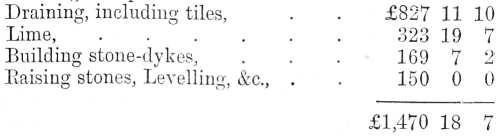
To the above sum there ought to be added the value of
the work of three pairs of horses and four men, but as no exact account
was kept of their time, or the yields of the crops, figures as to the
profit or loss on the operations cannot be given. However, the tenant is
of opinion that the crops over all would pay the cost of keeping the
horses, and men's wages, or nearly so. For every sheep carried by this
moorland before it was reclaimed, it will now in its pastoral state
carry 2½ sheep.
The most recent works of reclamation in Arran have
been executed by the tenant of the Douglas Hotel, Brodick, who farms
Corriegills, Strathwillan, Barnhill, and Springbank. About 500,000 tiles
have been used in draining, and about a dozen good sized fields have
been added to the farms. Sixty or seventy acres have been trenched with
the spade. The same difficulty has to be contended against in Brodick as
in Balnacoole, that is, the great quantity of iron ore water in the
subsoil, which chokes the drains, and necessitates their being
frequently lifted. Draining costs from 3s. 6d. to 4s. per chain of 24
yards; trenching cannot be done for less than £6 per acre. Labourers
well up in draining and trenching cannot be secured in Arran, and squads
have to be brought from the mainland, which entails additional expense.
The drains are laid from 15 to 16 feet apart, and are made to run so
that if possible they may follow the course of the mountain streams. The
newly drained land has mostly been limed, and top-dressed with bone and
stable manure, of which there is an abundant supply from the heavy stud
of cab horses kept for hiring purposes in connection with the hotel. The
new land is cropped in rotation with oats, green-crop, and sown-down
oats and ryegrass seed, except where it has been trenched, because the
trenched land is better to lie for two years before being cropped.
In addition to these somewhat more extensive
operations of reclaiming land to which we have now been adverting, other
farms have been increased by patches of moorland being brought under
cultivation, and the method pursued has in every case been identical
with either of those to which reference has been made. Notwithstanding
the vigour with which for many years they prosecuted the breaking of new
land, the farmers now, it has to be said, have somewhat relaxed their
energies, and much that was once reclaimed is again lying wild. Various
causes have operated to bring about this result, and amongst these may
be mentioned the comparative success of pastoral farming during recent
years, which has made it more profitable to feed sheep than to cultivate
the soil; the difficulty of securing field-workers during press of work
thinning turnips and in harvest-time, the cottars having most of them
disappeared, and the other residents being careless of rural labour; and
the great difficulty experienced, especially in the Southend, in getting
manure brought into the island—the farmyard manure being insufficient to
green-crop the whole arable land, even with the addition of sea-weed,
which is extensively collected and spread on the shore farms. A
last and by no means unimportant
hindrance to the carrying on of farming on aggressive principles is the
amount of damage done to farm produce, especially in the hill districts,
by the deer, rabbits, &c, preserved in the island with most anxious
care. It would be no benefit—it would be a distinct disadvantage—to the
Arran tenant to reclaim waste land now, considering the low price of
agricultural produce, the destruction perpetrated by game, and his
distance from the markets.. On one farm, it has been calculated that the
produce forty years ago was one-third an acre more than it is now,
labour is so much more expensive; and when the land requires liming a
second time, instead of giving it a substantial coat of say fifty
barrels per acre„ many of the farmers seem to think that they may spare
the lime, and yet expect the same productiveness as after the first
liming.
Arran Farmers' Society.
Next to the energy displayed by the Arran farmers in
the reclamation of waste lands, and the liming and draining of their
holdings, nothing has so much contributed to the advancement of
agriculture as the Arran Farmers' Society. As far as can now be
ascertained this Society was instituted in 1830, and its objects were
the improvement of the breed of cattle, horses, and sheep in the island,
by giving prizes, and encouraging the importation of well-bred sires of
the different breeds; the advancement of agriculture by the offering of
prizes for the best managed green crops, and the holding of an annual
ploughing match, at which prizes were offered for the best ploughing,
and the newest and most improved ploughs, &c.
The membership in 1860 consisted of 95 persons; at
present it numbers 150 individuals. This increase is partly accounted
for by the fact, that four or five years ago a separate class was opened
at the show, in which prizes are given for Ayrshire cattle and horses,
the competition being limited to tenants paying rents of £60 and under.
This has induced many of the smaller farmers to join the Society, and,
by stimulating a friendly rivalry, will no doubt in the end tend to the
improvement of their stocks.
Rotation of Crops.
Although in 1816 there was established, and still
exists, a stated rule of rotation in crops, Arran farmers, small and
great,. do very much as seems right in their own eyes. An attempt is
made to keep up a six-years' shift, that is, two years under pasture;
third year, oats; fourth year, green crop; fifth year,
sown-down oats; sixth year, rye-grass and clover; but
many of the smaller farmers have little compunction in taking two white
crops in succession off one patch, and in leaving bare and
ill-conditioned spots untouched by the plough for years. According to
the conditions of one of the most recent leases granted by the Duke of
Hamilton, the tenant is bound not to take "two white crops in succession
without having a green hoed crop between, manured with at least 25 cubic
yards of stable manure or other approved manure to each imperial acre,
unless by permission from the proprietor or factor." And, after land is
laid down to grass, "the tenant shall not break up the same sooner than
four years thereafter if a crop of hay be taken, or sooner than three
years if no hay be taken." This constitutes a seven years' rotation, [This
is exceptional, the usual rotation being six course.—Editor.]
but the larger farmers do not as a rule follow it, but allow the land to
lie in grass for from four to ten years, and in some cases for a longer
period.
The crops previously named, with the addition of
beans, which are largely grown in the south end of the island, form the
principal farm produce of Arran, and for the sake of order, it will be
well to take them in their rotation, and treat of each separately
Corn Crops—Oats, Barley, and Beans.
Oats are very generally sown throughout the length
and breadth of Arran. The greater part of the
land under white crops is sown with "sandy" oats, but in Shiskan a few
acres are under the variety known as "Tam Findlay"; and on Glenree and
the new land in Brodick, Swiss oats have been used. These last are about
two weeks earlier than the common oats, but they give less bulk of straw
and less weight of grain, and do not grind so well as the home seed,
Fierce gales sweep the island from side to side during autumn, and
"sandy" oats are found to be least shaken by the blast. The best corn
growing districts are Shiskan and the Southend. Crops are raised in
these places which fairly astonish the stranger by their abundance, and
the well-built and neatly-thatched stacks which fill the yards compare
very favourably with the miserable-looking thatched houses which form
many of the steadings. Indeed, a more pleasing drive could not be taken
by any one interested in agriculture, than that round by Shiskan and the
Southend of Arran. The soil generally is deep heavy loam, and in some
places sharp shingle resting on a subsoil of clay; the fields lie, many
of them, very level, and farming is prosecuted with much vigour. Of
course some farmers work better than others—there are drones in every
hive—but, taken all in all, the medium-sized farms around the Southend
of Arran only need good steadings to make them as desirable holdings as
any on the mainland. In the yards ten, twelve, fourteen, and sixteen
good solid-looking round stacks are seen, most of them built with a
greater circumference, and not so high as those on the mainland,—a
formation rendered necessary in order that they may the better withstand
the force of the fierce Atlantic gales which rage during winter.
The lea and red land is all sown with oats;
occasionally on good heavy soil barley may be substituted, but oats are
the more profitable crops. About fifteen years ago the smaller tenants
sowed great quantities of barley, but since the increased demand for
milk and butter arose, through the influx of Glasgow visitors, barley
has entirely been superseded by oats, as the straw of the latter makes
much better fodder for the cows than the straw of the former. As this
annual migration of Glasgow folks to Arran has in no small measure
contributed to the increased comfort of the Arran residents, and has
circulated much more money through the island than formerly was the
case, it may be interesting here to note, that the arrival of these
visitors has been chiefly promoted by the opening of the short route to
Glasgow via Ardrossan. A steamer, in connection with the
Ardrossan and Glasgow, now the Glasgow and South-Western, Railway, was
placed on the Arran and Ardrossan station about twenty years ago by a
limited liability company, which however came to grief, and the Duke of
Hamilton then stepped in, and at his own expense placed the "Lady Mary"
on the route, and afterwards the "Heather Bell" ; and now for a number
of years the steamboat accommodation has been maintained by private
enterprise. By this route the journey from Glasgow to Brodick can be
accomplished in two and a half hours.
The lea ground is broken by the plough about the
beginning of January, and the red land is turned over about the middle
of March. Sowing is commenced about the 1st of April, or a week earlier
in a good spring. Generally the Arran farmers do not incline to sow
early. They have an idea that more fodder is procured by sowing about
the 10th or 12th of April, than by sowing at the beginning of the month.
Harvest in an ordinary season begins during the last
week of August, except in the extreme north, where it is later. The
average yield of oats per imperial acre in 1855 was 25 bushels; over the
whole island now the average yield will be about 30 bushels. Some of the
larger farms will yield on an average from 32 to 36 bushels; and, in
1880, 40 bushels per acre will he realised on
heavy land. The weight per bushel of oats raised on good land will
average from about 40 to 42 lbs.; on the smaller farms the average will
not be more than 39 lbs. "Hutting" is now very common throughout the
island, although thirty years ago such a thing was altogether unknown.
Some of the farmers from the mainland were the first to introduce the
practice, and the natives were not slow to follow their example.
In the Southend what little barley is sown is
"Chevalier"; on the smaller farms common barley is used. Seed is brought
from the Edinburgh market, and the crop weighs about 53 lbs. per bushel.
Bere used to be widely grown in Arran. When Dr
M'Naugh-ton wrote his "Statistical Account" in 1840, he tells us that
sown-down land was as often cropped with bere as with oats, but this is
not the case now. Since thrashing mills became common, people are too
lazy to thrash with flails, and bere can only be satisfactorily thrashed
with these latter instruments.
Beans are grown, as we have said, in Lagg, and round
the south end. They are either sown broadcast or in drills—as often the
one way as the other. The crop is cut down by the reaping-hook.
The corn stacks on some of the larger farms are well
made, and rest on iron stools ; on the smaller
farms the stacks are thick and short, and flat on the heads.
Notwithstanding the apparent want of fall which they possess, these
stacks keep very dry, and it is a rare thing for one of them to become "
heated."
The great proportion of the grain is ground into
meal, but one of the larger farmers, at least, disposes of much of it as
seed corn to the smaller farmers. The price received for seed corn
averages about 23s. per 6 bushels. In order to keep up the quality of
the seed, a quantity of Midlothian oats are sown annually on most of the
larger farms, which provides a change of seed for the rest of the
island. After being ground, oats, which weigh 40 lbs. per bushel,
usually give 140 lbs. of meal in return for a 6 bushel bag of corn. The
price of oatmeal in 1879 was 20s. per boll of 140 lbs.; in 1880, it is
15s. Mills are erected for the convenience of the tenantry by the
landlord at Lamlash and Sheddog, and all the oats are ground at these
places. The tenants are bound to send their oats to be ground in the
mill of the district (except seed and horse corn), and they pay the
miller at the rate of a peck of meal for every sixteen pecks made, or
1s. per boll of 140 lbs. The prices of meal are fixed by the rates
current in Ayr market; the millers being bound not to charge more than
1s. per 140 lbs. above Ayr prices when selling Arran oatmeal; and on the
other hand they are bound not to pay the farmers who may have oatmeal to
sell, more than 1s. per 140 lbs. under Ayr prices.
As in Bute, so in Arran, the habits of the people
have changed much during recent years. About fifteen years ago, all the
material sold by the grocer in one of the landward parts of the island
was brought over from Brodick in a cart drawn by one horse, whereas now,
for the same part of the island, several boat loads of stuffs, weighing
about 100 tons in all, are brought in during spring and summer. These
stuffs consist of flour, Indian corn,, oatmeal, sugar, tea, &c, and as
the population in this particular district has in no way increased
during the past decade, a great deal less farm produce must inevitably
be consumed by the residenters. Consequently a greater quantity of the
oat crop is now sold as grain than at any former period.
Potatoes. These roots are not very extensively
grown in Arran, except on the deep land on the west side of the island.
The early varieties are not so much planted as formerly. The sorts now
common in the island are "Walker's Early," "Red Bogs," "Regents," "Dalmahoys,"
"Skerry Blues," but chiefly the "Champions," except in the north end,
where the "Skerries" still hold their own against all comers. The first
to introduce the " Champion " potato was Mr James Allan, junior,
Balnacoole, Shiskan, who in 1877 planted two bags of this seed on his
farm, and now the most of the potato-growing portions of the island are
covered by them. On good land, in 1879, the yield per acre averaged
about 5 or 6 tons; the average yield per acre in 1855 was only 4 tons 7
cwts. The crop of 1880 is the best, both in quantity and quality, which
has been grown in Arran since 1847,. some plots of "Champions" yielding
from 12 to 15 tons per acre.. The crop is lifted by the tenants
immediately after harvest is finished, and is pitted. In the spring the
potatoes are sold to dealers from Glasgow and Greenock. The price
realised for them in 1879 was about £6 per ton, but in 1880 not more
than £3 per ton is expected. The pits are of various lengths, and the
potatoes in them are covered with heathery turf, over which about 6
inches of earth is placed.
After the failure of the potato crop about
twenty-five years ago, the landlord provided the tenants with flax-seed,
and an experiment was tried for two years of growing flax instead of
potatoes. A mill was erected by the landlord, at Lagg, where the flax
was bought by him and dressed for the market. The experiment proved very
unprofitable, and was abandoned after two years' trial.
Turnips. The history of turnip-growing in Arran
is very much similar to that in Bute. Wherever there is a plot of ground
suitable, this favourite feeding-root is raised. Swedish and yellow,
purpletop and greentop, are the varieties sown. On the larger farms
about two-thirds of the entire acreage under turnips is sown with
Swedish, and the remaining third with yellow. The smaller farmers use
the same kinds of seed as their neighbours, although they grow more
yellow than Swedish. In a fairly good year, on the deep land of Southend
and Shiskan, the yield of Swedish will be about 20 tons per acre, and of
yellow about 16 tons. So far as climate is concerned, there is nothing
to hinder the turnip crop to remain in the ground until it is required;
and this is what is done on the south-west end of the island, where the
attacks of frost are very mild, as is evidenced by the fact that the
ground after frost can be ploughed far earlier than on the mainland. In
the eastern side of the island, about Lamlash, the yellow turnips are
much more easily kept than the other, whether on account of the nature
of the soil we cannot say. The whole crop around Lamlash and Brodick
districts has to be pulled in the beginning of winter and stored, to
prevent the roots being devoured by game, deer being very plentiful in
this part of Arran. During the summer months of 1880 one farmer has had
to pay a man 21s. a-week for herding the deer off the crop during the
night. During the last two years a part of the fields on Clauchlands
near the steading has been wired off, and a deep pit dug in it,
into which the turnips are thrown, and covered over the top with
straw. This is found to be a very safe method of storing them. The only
objection to it is, that the turnips are apt to grow a little in the
spring. Another method followed by some of the farmers is to store the
roots in small pits in the fields, containing about a cart-load each,
and covered over with a few inches of earth. This plan is found to work
admirably. Were it not for the destruction perpetrated by game, storing
of turnips would form quite an unnecessary part of the work of the Arran
farmer, as the roots might be allowed to lie in the ground all winter.
Rye-Grass and Clover.
The sown-down land in the island of Arran, in
addition to oats or barley, is laid under a crop of rye-grass seed mixed
with clover. The soil on the west and south sides of the island raises
good hay crops even in a dry season, but, on the east side, it is so
thin in many places that the crop is only fit to be eaten by the sheep
and cattle when growing. All the smaller farmers allow the rye-grass to
ripen, and the seed is sold in Glasgow and Ayr markets. The larger
farmers seed as much as is necessary to sow their own land, and some of
it they sell to the tenants on the smaller holdings.
"Where the soil is heavy clay, and has not been
carefully green-cropped, or where the soil is mossy, the seed ripened is
not very clean; hair-grass grows amongst it, which, on account of the
meagre appliances at their command, the farmers are not able altogether
to get clear of. The usual weight of Arran rye-grass seed is about 23 or
24 lbs. per bushel; the price realised this season (1880) is 11s. 6d.
per boll of 96 lbs. The average price per boll is about 10s. Clover seed
is sown in the proportion of 5 or 6 lbs. to the imperial acre. In a good
season clover grows well on the deep soils of the Southend, but in
Lamlash and Brodick districts a good crop is the exception, not the
rule.
A good market for winnowed hay is found in Brodick
and Lamlash, where the inhabitants keep more cows than their holdings
can well carry, and consequently have to buy in fodder for winter
feeding. In 1879, hay carted to the purchaser's door was selling at £4,
10s. per ton. One of the farmers in Shiskan supplies the proprietor with
the fodder necessary for the maintenance of the stud and deer kept at
Brodick Castle, and at the various lodges throughout the island, and
this always ensures a ready market for the greater portion of the
surplus farm produce. The average weight of winnowed hay produced per
Scotch acre of 5 imperial roods, is about 32 or 33 cwts.
For storage of hay the round stack is most in use;
the large square stack so well known in some parts of the mainland is
rarely met with, but on one or two of the larger farms sheds have
recently been put up, which hold as much hay as the ordinary square
stack. These sheds can be erected for about 20s. per foot of length;
they are open all round, and are covered in by a roof of galvanised iron
or felt, supported by wooden posts 12 or 14 feet high. The hay is built
up under the roof in a square, the size of the shed, and thus the time
and material used in thatching are saved.
Another very common sort of fodder is what is known
as "sprits"—long grasses which grow on the moorlands, especially where
the soil is somewhat deep and damp, and which are cut and winnowed in
the sun like meadow hay, and stacked either in the moors or in the
stackyards. The cattle relish this kind of fodder immensely, and in a
place like Arran, where fodder is scarce, such hay forms an excellent
substitute for rye-grass or straw. Liberty is given by all the farmers
to the cottars and very small farmers to cut these "sprits" on the
moors, and large quantities are annually winnowed. Pasture in Arran is
good during summer, but in winter it becomes foggy.
Sheep-Farming.
As would naturally be expected from the mountainous
character of the island, sheep-farming forms no inconsiderable part of
the rural economy of Arran. It is interesting to drive up the wild glens
which intersect the island, and to compare the varieties of pasturage to
be found on what, at a distant view, seem sterile hills, only remarkable
because of their rugged grandeur. The pasture on all the hills is not
uniform, and much has been done to improve it in one part which has been
left undone in another. Indeed, sheep-farming in Arran is very much like
arable-farming; there are drones in this hive as well as in the other.
One man has drained his hills and paid great attention to the breeding
of his tups and ewes ; another is content to leave things as he found
them. There is not the slightest doubt, however, taking the island all
over, that the sheep on the hills have been greatly improved within the
last twenty-five years. Many energetic young farmers have entered the
field, and they have introduced tups from the very best stocks in the
mainland, which have effected a marked improvement on the quality of the
stocks on the larger farms. The "shot" lambs from these farms are, many
of them, sold to the tenants on the smaller farms, and in this way all
the stocks in the island have gradually improved. It would be as
difficult as it is invidious to single out any one farmer more than
another as being the principal agent in effecting the meritorious change
in the quality of the sheep, but if success in a showyard be any
criterion of the quality of flocks, then the owners of the flocks of
Balnacoole, Glen Scorrodale, and Glenree, must be awarded the place of
honour.
The stocks throughout the island are now, with one
exception, blackfaced. As in Bute, Cheviots have been experimented with,
but all who had them have now disposed of them except the tenant of
Glenree. The larger sheep-farms in the glens carry stocks varying in
numbers from 400 to 1800 head each. Generally the flocks are composed of
ewes and wethers, but the former are more in number than the latter. The
worst of the wether lambs are sold every year, and the best, on mixed
stock farms, are kept till they are three years old. The old ewes are
sold to farmers on the mainland to be crossed with Leicester tups for
the production of cross-bred lambs for the butchers. The tups on the
hill farms are bought for the most part in Edinburgh and Ayr, at the
autumn ram sales. Tups which have effected the greatest change on the
flocks have been bred at Dornel, Knowehead, Overshiels, Westown, and
Polquheys. With the exception of those in the north end of the island
the sheep are strong healthy animals, large of size, and carrying good
fleeces; those in the extreme north are smaller than the others, but
they also have greatly improved during recent years. The rams are let
out about the 20th of November, and the lambing season extends from the
middle of April till near the end of May. The lambs are weaned about the
20th of August, and are then generally dipped ; but sometimes they are
not dipped until a short time before they are sent to the low lands to
graze for the winter, and on a very few farms they are dipped when
weaned, and again in March or April. Smearing is now but little
practised, dipping with patent compositions having taken its place.
Clipping commences about the middle of June, and is
continued till about the first week in July, when the milk ewes have
their fleeces taken off. The average weight of clip in 1880 is five
fleeces to the stone of 24 lbs., last year (1879) it was 5½
fleeces; but smearing and dipping have so often been employed
alternately, that it is impossible to give a correct average over a
period of years. Of course sheep after smearing give a much heavier clip
than they give after dipping, but it is proved to be cheaper to dip,
because the cost in time and labour smearing, and the lower price of
laid wool, more than counterbalances the sum realised for the larger
return of wool. The price of white wool at the clipping season in 1879
was 11s., this season (1880) it was 14s. per stone of 24 lbs.
In 1879, the price realised for three-year-old
wethers was about 34s. a-head, in 1880, it was 31s. a-head.
Average-sized ewes draw from £18 to £20 for the score of twenty-one. In
former years it was customary to winter hoggs on the mainland, but for
the past seventeen years they have invariably been wintered in the south
end of the island, and in Shiskan. The period of wintering is from the
middle of October till the end of March, and the price charged per head
for the season is from 5s. to 6s. The reasons for wintering on the low
lands which hold good as regards Bute, apply with equal force in the
case of Arran. It is a remarkable fact that both in the north of Bute
and the north of Arran, where the formation is granite or slate rock and
the subsoil clay, from 10 to 15 per cent. of the hoggs die of braxy
before they are taken off the hills; whereas on the south end of
these islands, where the subsoil is over sandstone and whinstone rock,
such a thing as death by this disease is comparatively unknown.
The purely sheep-farms up the glens of Shiskan and
Scorrodale (which run respectively from Brodick to Shiskan, and from
Lam-lash to Lagg), have each a small patch of fine arable land around
the steadings. Many of the farm steadings are very commodious and
comfortable, new houses having been built within the last twenty-five
years on most of the farms, generally at the tenant's expense. These
plots are wrought on a regular rotation of crops. The best sheep-farm,
though not by any means the largest in the island, is universally
admitted to be Glen Scorrodale, between Glenkill and Glenree, on the
road from Lamlash to Lagg, on which great improvements have been made by
draining the moorland with sheep-drains, and in selecting choice rams,
thereby greatly promoting the quality and condition of the hill stocks.
Married shepherds are usually employed on
sheep-farms, and their wages at present average about 15s. 6d. per week,
with free house, an allowance of fuel, grazing for one or two cows, and
land to plant potatoes. The flocks on the mixed arable and sheep-farms
have come most to the front in shows on the mainland. The stocks on
these farms were first improved by tups purchased from Mr John Lorne
Stewart of Coll, the late chamberlain on the Argyll estates in Kintyre,
by Mr James Allan, senior, then in Balnacoole; and for many years past
the tups in use on Balnacoole, Clauchlands, Glenree, Glenkill, and one
or two other farms, have been purchased at the autumn ram sales in
Edinburgh and Ayr. Balnacoole flock is famed for its ewes and gimmers,
and numerous prizes have fallen to its lot at Glasgow and Ayr shows.
The cast lambs from these farms are sold to dealers
from Glasgow, Ayr, and Galloway, in the end of summer, and are scattered
over the country for grazing purposes. On the arable farms near Lagg in
the south end, and some other/parts of the island, blackfaced ewes [are
crossed with Leicester tups, and begin to lamb about the end of March.
These ewes are fed during winter, sometimes on turnips, and sometimes
with Indian corn. The turnips are carted to them in the fields, as
feeding on the netting principle is never practised in Arran. The
crossbred lambs are taken from their dams during summer as they are
required by the butchers, and draw from about 18s. to 24s. each; the
ewes are sold off, if fat enough, about the end of September, and
realise similar prices with the lambs. A new stock is put on in October,
and border Leicester tups are bought at the Edinburgh and Hawick sales,
in the end of September, for crossing with them. The clip of these ewes
formerly, when grease was much in use, weighed about 6 lbs. to the
fleece; now, when dipping compositions are used, it will not weigh more
than 4 lbs. to the fleece. Some of the farmers keep the cross-bred lambs
till they are one and a half year old, and the clip of these hoggs
averages about 6 lbs. to the fleece, unwashed.
The only other kind of sheep farming to which we need
now refer is the experiment with the Cheviots. This favourite Border
breed was first introduced into Arran, by the late Mr Peter Tod, about
1829, and has since then been kept at different times on the farms of
Glen Sannox, Glenkill, Auchenhew, and up to the present time (1880) on
Glenree. On all of these farms, with the exception of Glenree, they were
found not to do well, and have been replaced by the blackfaced. Two
hirsels of about 500 breeding ewes each are still kept on Glenree. The
climate of Arran is rather moist for Cheviots; and although in a good
season they do uncommonly well, yet over a series of years blackfaced
would be found to be more profitable. The two objections to the Cheviot
ewe are, that in a hard spring she is a bad milker, and she is not so
productive as her black-faced rival. A hirsel of 25 score of Cheviot
ewes was kept from 1860 to 1874 on laud now carrying a blackfaced flock,
and on an average there was every year 20 per cent. of the Cheviot ewes
barren, whereas with the blackfaced there is not more than five per
cent. without lambs. In the severe spring of 1879, the Cheviot ewes only
gave 60 lambs per 100 ewes, whereas the blackfaced ewes gave 90. On the
other hand, it has to be said in favour of the Cheviots that their wool
is worth 50 per cent. more in value than that of the blackfaced,
although they give a clip of equal weight per sheep. Cheviot draft ewes
are, worth about 5s. or 6s. a-head more than the blackfaced, and they
live equally well. Of late years blackfaced lambs have been selling
fully better than the others through so many Cheviot stocks-being turned
into blackfaced, and a fifth more blackfaced than Cheviots can be
carried on the same land.
Cattle.
When the "Statistical Account of Arran" was written
forty years ago, there were in the island three distinct breeds of
cattle. These were the native breed, the Arran cow; the improved breed,
the West Highlander; and the imported breed, the Ayrshire. At that time
the Ayrshire was fast coming to the front. The admirable milking
qualities of the breed, and their well-known adaptability for large
arable farms where a dairy was kept, together with the greater profit to
be derived from their sale when fattened than from the native stock,
clearly pointed them out as the coming breed. Although, therefore, the
West Highlander has been almost completely supplanted by the Ayrshire,
it is open to question whether, in the case of the small upland farms,
this has been altogether a wise proceeding. Where good dairy cows, as on
the large arable farms, are required, Ayrshires certainly pay best, but
on some of the higher farms, with poor pasturage, where the breeding of
a few cattle for the grazier is of more consequence than dairy produce,
the West Highlander would most likely prove more remunerative. Pure bred
Ayrshires are not to be found in Arran except on large arable farms.
When the breed was first introduced we have not been able to determine,
but that a few Ayrshire cows were to be found in the island forty years
ago seems certain. The farm of Sheddog has long been noted for its
Ayrshire herd, and the former tenant, Mr Neilson, being a native of
Renfrewshire, was greatly interested in his dairy stock. His successor,
the present tenant, a native of Ayrshire, took over Mr Neilson's stock,
and largely increased it. The bulls employed have been imported from
herds in the neighbourhood of Dairy and Kilmarnock, and the stock is now
one of the finest in the island. Mr Allan, now of Clauchlands, also an
Ayrshire man, introduced good cows and bulls from the mainland, and the
late Mr Spiers of Benecarrigan possessed an excellent stock, which has
been maintained and improved by his son. On the Douglas hotel farms also
there are now splendid stocks of Ayrshire cows, and the breeding of good
milk cows generally is being prosecuted throughout the island. On the
smaller farms the breed is not yet pure; the cows still show
cross-breeding, but were a little care and attention paid to the
selection of sires, the Ayrshire breed would soon be the only one found
in the lower districts of Arran.
There are three bowing establishments in the
island—one at Glenkill, Lamlash, and two near Lagg. The average price
paid by the bovver per cow is £10 per annum. With the exception of the
occupier of the Lamlash dairy, all the other dairymen make cheese, and
the smaller farmers invariably make butter, for which there is an
extensive demand all over the island in summer.
The price generally realised for cheese, which is
sold to merchants in Glasgow, Hamilton, Ardrossan, Kilmarnock, and Ayr,
is from 12s. to 13s. per stone of 24 lbs.; butter realises from 1s. 2d.
to 1s. 4d. per lb.
The stocks on all the farms are maintained by the
quey calves reared on each, and the bull calves are almost all sold as
slink veal to the butchers.
The pure West Highland breed of cattle has now become
very scarce in Arran. About twenty-five years ago, and prior to that
time, on many of the hill farms from 20 to 30 head were grazed during
summer, and Monyquill was then noted for its herd. The quality of the
cattle has been allowed to degenerate, and Mr Crawford, Drimadoon, and
Mr Craig, Dougarie, have it all their own way at the island shows in the
matter of prizes.
The native Arran breed are still to be met with in
the north end, and the farmer in Sannox regularly purchases the best of
the yearlings bred by the north end farmers, which he feeds until they
are three years old, when they turn out excellent beef producers. The
remainder of the "stirks" are sold annually, at whatever prices they
will bring. They are seldom in good condition, the pasturage being very
bare. A first cross with an Arran cow and an Ayrshire hull has
invariably produced an animal possessing good milking qualities.
The only new breed introduced into Arran of recent
years is the Galloway, a number of which are kept by Mr William Tod, of
Glenree, who, in 1875, purchased ten well-bred heifers and a hull in the
Galloway breeding districts, and now has a herd of between 30 and 40
head. Ten or twelve calves are produced annually; the bull-calves are
castrated when a few days old, and the calves are allowed to suckle
their dams for seven or eight months. They are not allowed to run loose
with their dams but are kept in a shed by themselves and are led morning
and evening to the byre to their dams. When three years old the cattle
are sold, and draw from £16 to £18 each off the grass. Galloways in
Arran seem to thrive as well as the West Highlanders ; they are as
easily reared, and when they come to maturity are more valuable.
Horses.
The native horses in Arran were a small stinted
breed; seven of them used to be yoked to the wooden plough, and they
were ill-kept and ill-trained. When Dr M'Naughton wrote in 1840,
attempts were being made to improve the breed. This has been continued
ever since with the most gratifying results. The late Duke of Hamilton
gave an annual premium of £25 for a number of years prior to his death,
for the services of an entire draught horse, which was the means of
considerably improving the breed previous to 1860. From 1860 to 1873
there was no premium Clydesdale entire horse in the island, and horse
breeding was at a very low ebb. About that time horses began to be very
valuable, and some of the members of the Farmers' Society, foremost
amongst whom was Mr Hector M'Allister, junior, Glaister, seeing the
benefits and profit likely to be derived from breeding good animals, got
the Society to move in the matter, and to award premiums whereby owners
of Clydesdale stallions were induced to send their horses to the island:
the amount of service fee being, at the same time, fixed at a rate
within the reach of all. The following is a list of the entire horses,
with their stud-book numbers (so far as their pedigrees have been
registered), which have secured the Society's premiums since 1873:—in
that year "Sir William Wallace" (803); 1874, "Scottish Chief" (763);
1875, "The Chief" (857); 1876, "Lofty" (462); 1877, "Earl of Arran"
(263) and "Campbletown Bob" (118) also travelled; 1878, "Marquis"
(1215); 1879, "Duke of Connaught" (Dickie's); 1880, "Prince Frederick"
(1504).
Young stock have also been purchased in Kintyre for
many years back, and their produce has done a good deal to improve the
native breed. Horse-breeding is general throughout Arran, and the annual
fairs at Brodick in June, and at Lamlash in October, offer favourable
opportunities for disposing of the foals and surplus stock. The horses
generally have improved in quality about 50 per cent. during the past
twenty-five or thirty years; these annual fairs are largely attended by
dealers from the mainland, and sales are often very brisk. On the
smaller farms the mare is kept working all the time she is nursing her
foal, but there must be very little for her to do during the summer
months. Foals in October sell for about £16 each; in 1865 £7, 10s. was a
common enough price. About six years ago prices ranging from £20 to £28
each were in a few instances
realised, and in 1880 at Lamlash Fair the highest
figure reported for a single foal was £14. Taking a survey of the island
we find that the best and most Clydesdale-looking horses are met with in
Shiskan, Lagg, and the south end; but taken as a whole the Arran horses
at present may be said to be crosses between a Clydesdale stallion and
Highland mares. This type of horse best meets the requirements of the
island. Many of the farms are steep, and the roads in general hilly; the
light-limbed creature goes quickly over these risings, and is easily fed
during winter. No horse suits the farmer so well for certain kinds of
work as the old-fashioned, wise, little creature to be found in Arran
and other parts of the Highlands, and the breed is worth preserving,
both on account of the docility of the animals, their suitableness for
light draught purposes, their ready obedience to words, and their neat
style of action.
Peats.
Especially in the moorland districts the casting of
peats forms, in the early summer, the principal work of the Arran farmer
and cottar. Generally the peats are cut in May, and the casting of them
is finished by the beginning of June. On being cut they are borne, on
barrows made for the purpose, to a position where they will be best
exposed to the sun's heat, and spread singly on the bare ground. After
lying flat for some time till they are nearly dry, they are "footed,"
i.e., set up on one end, several together, something after the
manner of a stook of corn sheaves, and in good seasons do not require
any further handling till they are taken home. With fine weather they
should all be stacked a month after they have been cast, and for
bringing them home creels made for the purpose are employed, which hold
about a half more than the ordinary farm carts. In 1879 few or no peats
were got home on account of the wet weather, and coals had to be
extensively imported. Peats in a favourable season weigh heavier than in
a wet season, as the rain washes all the substance out of them, and,
when burned, they neither give out a proper heat nor last any length of
time. Short black moss is chiefly cut for peats in Arran. A few peats
with fibrous material through them may occasionally be seen, but they
are not favourites.
Wages and Cost of Farming.
Wages have increased in Arran during the last
twenty-five years in much the same ratio as in Bute. Dairymaids are
receiving now (in 1880) from £8 to £12, 10s. per half-year with board,
but those engaged at the latter figure must have full charge.
Ploughmen's wages are from £12 to £15 per half-year with board ; and
workers in harvest time,—women, who can with difficulty be procured,
receive from 2s. 6d. to 3s. a-day without food, and men from 3s. 6d.to
4s. a-day, also without food. The wages of
these same workers in the turnip-thinning and potato-planting season are
from 1s. 3d. to 1s. 6d. a-day. Men are not generally employed at this
work, and the wives and families of the cottars are those chiefly
engaged in it. Squads of Irishmen are sometimes engaged in Ardrossan and
Ayr to come over to
Arran and assist in press
of work. Although the cottar system is rapidly dying out in the
island, on every farm of any size there are still one, two, three, and,
in some few cases, more cottars' houses, and the inmates find employment
on the farms and in herring fishing. Many of them keep a pig, and each
has a drill or two of potatoes, which are planted by the farmer, the
cottar supplying the manure, which is principally sea-weed. There are no
feeing markets in the island, but the children of the cottars are often
engaged privately by the farmers at the rates of wages per half-year
which may rule in Ayr market at the time.
Shepherds in most cases are paid salaries of about
£40 per annum, with a free house, an allowance for coals or a supply of
peats carted, grazing for one or two cows, and a few potatoes planted.
Married ploughmen receive 16s. a-week, a free house, an allowance of 1d.
worth of milk per day or grazing for a cow, and 2 tons of coals per
annum.
The wages of female servants boarded in the house
have been doubled within the past twenty-five years, and those of male
servants are now about one-half more than they were at the commencement
of that period.
Conclusion
There are in Arran five villages of a greater or less
size, viz.— Lamlash, Brodick, Whiting Bay, Lochranza, and Corrie.
Brodick is the most modern-looking of the five, but Lamlash is
considered the most important. A branch of one of the Scotch hanks is
open here daily all the year round, and the village is also the station
of a coastguard. A branch bank is opened twice a-week at Brodick, and
three times a-week during summer. There are no industries in the island
other than farming, and the majority of the inhabitants derive no
inconsiderable part of their revenue from the rents they receive for
their houses from summer visitors. They are a quiet inoffensive race of
people, and many of them live to very old ages. Churches and schools are
plentiful throughout the island, and altogether the people have few
complaints to make. |



