|
By James Macdonald, Editor of "The Irish Farmers'
Gazette."
[Premium— Thirty Sovereigns. ]
Introductory.
The counties of Forfar and Kincardine are bound in by
the counties of Perth and Aberdeen and by the Firth of Tay and German
Ocean. The former, by far the larger of the two, is separated from
Fifeshire on the south by the Firth of Tay; washed on the south-east by
the German Ocean; bounded on the north-east by the North Esk; and on the
north and northwest by the parishes of Aboyne, Birse, Glenmuick, and
Crathie in Aberdeenshire, and by the Grampian Watershed; while
Perthshire lies on the west. The most southern point, near Dundee, is in
56° 27', and the most northern, near Mount Keen, in 56° 59' N. lat.; the
most easterly point, near Montrose, being in 2° 27', and the most
westerly, at Blacklunans, in 3° 24' W. long. The distance from north to
south is about 38 miles, and from east to west 27 miles. The coast-line
is about 45 miles long. Forfarshire stands eleventh among Scottish
counties as to extent. There are different estimates of the exact
acreage. In the Ordnance Survey it is stated at 569,850. Of these, 6486
are taken up by foreshores and 3178 by water. The return of owners of
lands and heritages, compiled in 1872-73, gives the "acreage of
property" at 553,850 acres.
Kincardineshire is bounded on the south and west by
the North Esk and Forfarshire, and on the north by the Dee and
Aberdeenshire, and washed on the east for about 35 miles by the German
Ocean. It is triangular in form, extending 32 miles from south-west to
north-east, and 24 miles where broadest from south to north. Ranking
twenty-first among Scotch counties, its area is stated in the Ordnance
Survey to be 248,195 acres. The foreshores extend to 1385 and the
surface covered by water to 1463 acres. In the return of owners of lands
and heritages, the area is stated at 244,585 acres.
According to the return of owners of lands and
heritages there are in Forfarshire in all 4898 owners of land, whose,
property is stated at 553,852 acres, and estimated at £795,581, 7s. of
gross annual value. Of these, 971 possess one acre and upwards each, and
their total acreage is given at 552,708 acres, or an average of about
569 acres each. The 3927 owners of land under one acre in extent have
only 1144 acres amongst them, being less than one-third of an acre each.
In Kincardine, there are 1384 owners of land having amongst them
244,585 acres, and a gross annual rental of £253,392, 12s. The average
sizes of the properties is under 179 acres. There are 195 owners of one
acre and upwards, the total extent of their estates being 244,396 acres,
and their gross annual value £236,021, 17s. These 195 landed proprietors
have an average of over 1253 acres each. Among the 1189 owners of lands
under one acre in extent, there are only 180 acres, or less than
one-sixth of an acre to each.The assessor's roll for
Forfarshire for 1880-81 states the valuation of the county at £649,372,
17s. In 1879-80, the valuation for Kincardine was £259,102, inclusive of
£28,464 for railways, &c.
Forfarshire is divided into 55 parishes, but of these
six are only partly within it. Edzell extends into Kincardineshire,
while pretty large portions of Alyth and Coupar-Angus, and smaller
portions of Liff, Kettins, and Airlie, lie in the county of Perth. In
Kincardineshire, including Edzell, there are 21 parishes. Each county
sends a representative to Parliament, while Dundee has two members, and
Montrose with Arbroath, Forfar, Brechin and Bervie, one. Sheriff Courts
are held at Dundee and Forfar. The sheriffdom of Kincardineshire is
joined with that of Aberdeen, weekly courts being held in Stonehaven.
In Forfarshire there are five royal burghs—Dundee,
Arbroath, Montrose, Brechin and Forfar. Dundee, "The Hill or Fort
of the Tay" was a place of considerable importance as early as the
twelfth century. Situated on the left bank of the estuary of the Tay,
about 10 miles from where that river falls into the sea, it has a
population of about 119,000, including 10,812 in Lochee, which lies
within the boundary of the town. It thus in population ranks third in
Scotland, and next to Glasgow in trade and manufactures. It is the chief
seat in Scotland of the manufacture of coarse linen fabrics and of jute.
The more modern parts of the town are well laid off, and it can boast of
some fine public buildings, the Steeple, Town House, Albert Institute,
the Free Library, &c. It is well provided with public parks. The chief
one, the Baxter Park, laid off by Sir Joseph Paxton, and costing in all
£50,000, was presented to the town by Sir David Baxter and his two
unmarried sisters. The town is historically interesting in many ways.
James VI. visited it in 1617; Charles II.
in 1651; and Her Majesty the Queen and Prince
Consort landed and re-embarked at it in 1844, on their journey to and
from Blair-Athole. To commemorate this last event, the Royal Victoria
Arch was raised. Dundee has often been the scene of burning and pillage,
and down to the middle of the sixteenth century it had walls and gates.
Among the eminent men
connected with the town are Sir William
Wallace, who, as well as his companion in arms Scrymgeour, is said to
have attended school there, and who defended its walls in 1303 against
Edward I.,—and Hector Bœthius,
the first Principal of King's College, Aberdeen.
Arbroath or Aberbrothock is a very old seaport town
and royal burgh. It is situated at the mouth of the Brothock, and has a
population of 20,169. It possesses a good harbour, and a large trade is
carried on in farm produce, and in pavement obtained from 8 or 10 miles
inland. There are also extensive tanneries, roperies, breweries, and a
shipbuilding yard. The chief object of interest is the Abbey of
Arbroath, once one of the richest in Scotland. It was founded by William
the Lion, and dedicated to the memory of Thomas a Becket. In 1320 Robert
Bruce and his nobles here met, and despatched a nuncio declaring the
independence of Scotland. It shared the fate of most of the other
abbeys, having been destroyed by the Re-formers in 1560. The last of its
abbots was Cardinal Beaton. Twelve miles south-east of Arbroath lies the
Bell Rock lighthouse, the tradition concerning which is preserved in
Southey's well-known ballad.
Montrose, with a population of over 14,000, is a very
ancient royal burgh and seaport, with one of the best natural harbours
on the east coast. Standing on a level peninsula, it has on one side the
sea, on the other the river and basin. Here was established, in 1534,
the first school for the study of Greek in Scotland. Among the first of
its pupils was the learned Andrew Melville; while David Lindsay, Bishop
of Brechin and Edinburgh, who raised the ire of Jenny Geddes, was one of
its teachers. In 1848 the Queen and Prince Consort visited Montrose on
their way from Balmoral to London. A fine suspension bridge, erected in
1829, connects the island of Rossie with the main body of the town. In
the neighbourhood there is a beautifully situated lunatic asylum capable
of accommodating 450 patients.
On the South Esk, 8 miles north-west of Montrose,
lies Brechin, a town of nearly 8000 inhabitants, and a royal burgh of
very ancient date. Like most other Forfarshire towns its staple
manufacture is linen, but paper mills, tobacco factories, distilling,
brewing, and freestone quarrying, give work to a good many of the
inhabitants. The cattle and horse markets of Trinity Muir are held here.
Close to the city, on the opposite side of a ravine, stands Brechin
Castle, a seat of the Earl of Dalhousie. St Ninian's Cathedral, built in
the thirteenth, fourteenth and fifteenth centuries, is now used as a
parish church. A round tower, rising to a height of about 100 feet,
stands near the church. The only other one of these ancient and
mysterious towers in Scotland is at Abernethy. Among the
more famous of the natives of Brechin are Gillies the Grecian historian,
and Thomas Guthrie, D.D.
Forfar, the county town, has been a royal burgh since
the time of David I. It is situated in the fertile valley of Strath-more,
not far from the centre of the county, and has a population of 11,031.
Duncan Canmore had a castle here, in which he held his first parliament,
but no part of it can now be seen. It is said to have been destroyed by
King Robert Bruce in 1307. Linen and jute are the staple manufactures.
The County Buildings, and the Reid Hall, presented to the town by Mr
Peter Reid of "Forfar Rock" fame, are elegant and substantial edifices.
Of smaller towns and villages there is a large
number. The more important of these are Broughty Ferry, Coupar-Angus,
and Kirriemuir. Broughty Ferry, or Burgh Tay Ferry, lies on the coast, 4
miles east of Dundee, and includes West Ferry in the parish of Dundee.
It is a favourite bathing resort, and has a population of 5817. About a
hundred years ago Broughty Ferry consisted of only a few fishermen's
huts. Its castle, built in the fifteenth century, was held by the
English from 1547 to 1550, and was retaken along with the fort on the
hill by the Scottish allied army. Coupar-Angus, a tidy thriving town,
stands in the valley of Strathmore, partly in Forfarshire and partly in
Perthshire. Its inhabitants, according to the census of 1871, number
2149, and of these 303 reside in the Forfarshire portion. It has linen
factories, a tannery, farina works, and saw-mills, and important markets
for the sale of farm stock and produce are held at it. The ruins of an
abbey, built in 1164 by Malcolm IV., remain in
the neighbourhood on the site of a Roman camp. Kirriemuir and Southmuir,
with a population of 4000, stand on a slope above the Gairie burn, about
16 miles north of Dundee. They form a burgh of barony, and their linen
works employ a large number of people. There is a public school in the
town, built in 1835 with £8000 bequeathed for the purpose by John
Webster, writer and banker.
Stonehaven is the county town of Kincardine. A burgh
of barony and a seaport, with a population of over 3396, it stands on a
rocky bay at the mouth of the Carron, and at the extreme northern end of
the great valley known as Strathmore. Its principal industries are
tanneries, and wool, flour, and meal mills, while herring and white
fishing give employment to a large number of its population. Only small
vessels can enter the harbour. About 1½
mile along the coast to the south-west of Stonehaven stands the famous
Dunnottar Castle. The ruins of this castle occupy about four acres on
the summit of a rock that rises almost perpendicularly out of the sea,
and is almost separated from the mainland by a narrow and deep chasm. In
earlier days, considered impregnable, it was stormed in 1297 by Wallace,
who is said to have driven the English garrison over the cliffs. It was
a place of considerable importance clown to the seventeenth century,
when it was used for several months as a prison for 167 Covenanters,
male and female. The Earls of Marischall, the founders of Marischall
College, Aberdeen, resided here. In 1650 Charles II.
visited Dunnottar, bringing the Scottish regalia with him for
safety. It is stated that Mrs Grainger of Kinneff secretly removed the
regalia to the parish church of Kinneff, and thus prevented their
falling into the hands of the English, when, in 1652, the garrison of
Dunnottar, under Ogilvy of Barras, surrendered to Cromwell's forces. The
ruins are in a wonderfully good state of preservation.
Bervie is the only royal burgh in the county.
Situated about 10 miles south-west of Stonehaven, at the mouth of the
Bervie Water, it has a population of 1013. The first linen yarn mill in
Scotland was erected here in 1790. Flax spinning and weaving are its
staple manufactures. Hallgreen Castle, an important stronghold of the
sixteenth century, stands on an eminence within the burgh. In the year
1800 some vessels were chased to the shore by a French sloop-of-war,
which, however, is said to have "taken fright and sailed away on seeing
the muster of the volunteers"! Gourdon, a thriving fishing village with
a population of 714, is the port of Bervie.
Laurencekirk, the chief town of the Howe, with a
population of 1521, lies 10 miles north of Montrose. It may be said to
owe its very existence to a gentleman of the eighteenth century —Francis
Garden, a Judge of the Court of Session, under the title of Lord
Gardenstone, who raised it from a clay-built hamlet with 54 inhabitants
to a substantially built burgh of barony. He erected a town hall, an
inn, an Episcopal chapel, a library and museum ; while he also set up a
spinning mill with a bleachfield on the Luther, a tributary of the North
Esk, and introduced linen manufactures. Johnshaven, with a population of
1077, is an irregularly built fishing village about 9 miles north-east
of Montrose. Its harbour is small, capable of admitting only boats and
small coasting vessels. One of the most charmingly situated villages in
the north of Scotland is Banchory, on the north bank of the river Dee,
about 18 miles west of Aberdeen. In 1871 it had a population of 865; but
being a favourite summer resort, it has increased considerably since
then. In the parish of Nigg, and directly opposite Aberdeen, is the
important fishing village of Torry. It has a population of 686, chiefly
engaged in fishing. About 5 miles along the coast lies the village of
cove, with a population of 450. It is a coastguard station, and has a
small natural harbour. The other more important villages are St Cyrus,
Auchinblae, and Fettercairn, the older part of the last being a burgh of
barony. The Queen and Prince Consort spent a night in Fettercairn, in
September 1861,. and an elegant Gothic arch near the hotel where they
slept commemorates the royal visit.
The configuration of Forfarshire presents great
variety. It combines the wildest of mountain scenery with the softest
and most charming of valley landscape. The county forms four natural
divisions, the Maritime, Sidlaw, Strathmore, and Grampian sections. The
first extends along the coast from Invergowrie to the North Esk, and
stretches from 3 to 8 miles-backwards. Between Broughty Ferry and
Montrose there is a considerable extent of links, unfit for cultivation,
and of little value for pasture, but admirably adapted to the royal game
of golf and other sports. It contains several tracts of remarkably rich
land ; is in some parts beautifully wooded and undulating; in others
rather flat and tame; while, as it rises towards the Sidlaws, the soil
is here and there stiff and cold, or thin and poor, with little shelter.
The Sidlaws, a range of trappean hills, almost in line with the Ochils,
run through the county from south-west to north-east, terminating a
little south of Montrose. The range is very clearly defined, and rises
to a height of 1399 feet at Auchterhouse Hill, near the middle of the
chain. The other higher peaks are the Gallow Hill, in Glamis, 1242; the
Gask 1141, and Kinpurnie 1134 feet. At the pass between Dundee and
Newtyle, the ridge sinks to about 1000 feet. The Sidlaw division is true
to the general characteristics of trap districts. The higher peaks are
partially covered with heather and other coarse herbage, and the slopes
green and very uneven-Cultivation has been pushed to a great altitude on
both sides, the arable land being continued through the pass between
Newtyle and Dundee. The third natural division, Strathmore, or the Great
Valley, is, from a purely agricultural point of view the most important
of the four. In reality, Strathmore consists of a belt of Old Red
Sandstone that extends from the west end of the Ochils, where it is
about 16 miles in width, to Stonehaven,, where the width is less than 1
mile. This beautiful plain is about 90 miles in length, and it has been
truly said that nowhere else in Scotland is there so extensive a reach
of perfectly level fertile soil. The Forfarshire portion of this fine
strath is hemmed in by the Sidlaw and Grampian ranges, and displays
scenery of great beauty. The valley is well wooded ; its farms well laid
off and skillfully cultivated, and the soft lowland aspect of its
landscape forms a striking contrast to the rugged sterile contour of the
heights on the north-west. The Grampian division is by far the most
extensive, but the greater part is so mountainous as to be of little
value in an agricultural sense. This chain of hills is a continuation of
the Grampian range, and includes, in Forfarshire, about 100 peaks over
1000 feet in altitude. The slopes running down to Strathmore are known
as the Braes of Angus, the ancient name of the county of Forfar. These
slopes are extensive, very irregular in surface, on the whole moderately
fertile, in some parts especially so, and are cultivated high up the
hill side. The mountain range is intersected by several large glens, the
chief ones being Glenesk, Glenisla, Glen Clova, and Glen Prosen. The
scenery in these hilly regions is exceedingly beautiful, particularly in
Clova, where the hills are steep and picturesque, and where a large
number of rare plants are to be found. The higher peaks are Glasmhaol,
which reaches an altitude of 3500 feet, and on which the counties of
Forfar, Perth, and Aberdeen meet; Cairnglasha, a little to the north,
3490 feet; Cairnbannoch, and Broadcairn, in Clova, each 3300; Tolmount,
also in Clova, 3100; Mount Keen, north of Lochlee, 3077. There are 55
peaks between 2000 and 3000 feet, and 12 over 3000.
The Grampian range and the valley of Strathmore both
run into Kincardineshire. The former, indeed, make up about one-third of
the entire county. The highest peak here is Mount Battock, on which
Forfar, Aberdeen, and Kincardine meet, the altitude being 2555 feet.
From this point the range gradually descends, until it terminates at
Doonie's Hill, on the coast of Nigg, and 214 feet above sea level. In
the Glen of Dye, and along the course of the Feugh, there is a good deal
of cultivated land; while the slopes running down to the Dee are not
only fertile but beautifully wooded and picturesque. The southern and
south-eastern division of the county comprises the Howe of the Mearns
(the name given to the part of the valley of Strathmore extending into
Kincardineshire), the Hill of Garvock, and the coast from the mouth of
the North Esk to about Muchalls. The Garvock Hill, like the Sidlaws in
Forfarshire, separates the coast from the central plain, which, though
rather less fertile, and not so well wooded as the corresponding portion
of the Great Valley in Forfarshire, is nevertheless a moderately rich
and very well cultivated stretch of land. Around Fettercairn the scenery
partakes a good deal of the soft beauty that characterises the most
charming parts of the valley farther south. The land sloping towards the
sea is, generally speaking, bare and uneven. The coast is extremely
steep and rocky, and dangerous to shipping.
There are a good many lochs in Forfarshire, but they
are small. The largest is Lochlee, fed by the streams of Lee and Unich.
It is only about 1¼ mile in length, and barely
half a mile in breadth. It lies in the extreme north of the county. A
little to the south-west (in Clova) are the small lochs of Wharral and
Brandy, while still further south lies Lintrathen Loch, enlarged by the
Melgarn being diverted into it for the purpose of forming a larger
reservoir for the Dundee Water Works. It now extends to about 1¼
square mile. The loch of Forfar, which was partially drained for its
marl, and for the improvement of the surrounding land, lies on the west
of the town, and extends to about 1 mile by ¼
mile. The Fithie, Rescobie, and Balgavies Lochs are in this
neighbourhood, while in Lundi there are four lochlets, the largest being
Longloch, ½ mile by ¼
mile. Several small lochs, including those of Kinnordy and Logie in
Kirriemuir, and Restenet in Forfar, were drained for their skell marl,
which was used for agricultural purposes. In Kincardineshire, the lochs
are both few and small. The loch of Drum once covered about 300 acres,
but has been reduced to less than one-third. The loch of Leys, at one
time more than 2 miles in circuit, has been drained. Loirston Loch, 27
acres in extent, lies in the parish of Nigg; and at Fasque there is a
beautiful artificial loch, covering about 20 acres.
The chief rivers in Forfarshire are the Isla, the
South Esk, and the North Esk. The Isla, rising in the extreme
north-west, drains the western districts of the county, and passing into
Perthshire near Ruthven, and, after a course of 42 miles, empties itself
into the Tay at Cargill. The South Esk has its source in Clova, and
flows south-east for the first half of its course, which is about 50
miles in length, and due east the latter. It drains the main portion of
the centre of the county, and falls into the sea at Montrose, its mouth
forming a large and beautiful basin. Its chief tributaries are the
Prosen, the Carity, the Noran, and the Lemno. The Prosen has a course of
about 16 miles, and after receiving the burns of Glenlogie, Glenoig, and
Lednathy, joins the South Esk below Cortachy Castle. The North Esk or
East Water has a course of about 40 miles. It drains the north-eastern
division of the county, forms for a long distance the boundary line
between Forfar and Kincardine, and falls into the sea about 3½
miles north of Montrose. On the right, it receives the waters of the
Effock, the Keeny, and the Mooran, from which, at a cost of £15,000, a
daily supply of 500,000 gallons of water was diverted for the town of
Brechin. The Tarf, the Turret, the Meallie, and Auch-mull and other
streams join the North Esk from the left. The water of Lunan, issuing
from Lunan Well, Restenet, and Balgavies, flows in a north-easterly
direction for about 17 miles, and empties itself into the beautiful bay
of Lunan. The Dighty has a course almost as long, and drains a portion
of the eastern slope of the Sidlaws, and falls into the Firth of Tay at
Milton. The North and South Esk are excellent salmon streams, while in
the smaller waters there is a good supply of trout. In most of the
lochs, too, lovers of the piscatorial art find capital sport. The
northern and western slopes of Kincardineshire are drained respectively
by the Dee and the North Esk and their tributaries, the interior being
drained by the waters of Bervie, Carron, Cowie, Finella, and other
smaller streams. The Bervie rises in the parish of Fordoun, and after a
course of about 14 miles, falls into the sea a little north of
Inverbervie. The Finella, with a course of 7 miles, rises at Garvock,
and falls into the sea near Johnshaven. The Carron and the Cowie, each
about 9 or 10 miles long, rise respectively in Glenbervie and Wodder
Hill, and fall into the German Ocean at Stonehaven. The Luther, rising
at the head of the Glen of Drumtochty, is the chief tributary of the
North Esk in Kincardineshire; that of the Dee being the Feugh. The
latter stream, with a course of 15 miles, rises near Mount Battock, and
falls into the Dee at Banchory. The scenery at the junction of the Feugh
and the Dee is very beautiful, the Falls of Feugh being greatly admired.
The Water of Dye rises at the top of Glendye, and after a course of 10
miles, joins the Feugh a little above the village of Strachan. The
Sheeoch water rises on the east of Kerloch, and after a run of about 8
miles, joins the Dee near the Church of Durris.
The counties have long enjoyed the advantages of
active communication with the outer world. They can boast of several
moderately-sized harbours, and for more than thirty years have had a
pretty good railway system. The main line of the Caledonian Railway,
which enters Forfarshire at Coupar-Angus, and passes through about the
richest parts of both counties, was opened to Aberdeen in 1850. Since
then, the local system in Forfarshire has been extending gradually, and
is now exceptionally complete. Coupar-Angus and Blairgowrie are united
by a branch line of 4¾ miles; Meigle and Alyth
by a line of 2 miles ; Forfar and Kirriemuir by a line of 6 miles;
Bridge of Dun and Brechin by a line of 4 miles; Dubton and Montrose by a
line of 3 miles; Guthrie Junction and Dundee by a line of 24¼
miles; Forfar and Dundee by a line of 21¼
miles; and Meigle and Dundee by a line of 18 miles. Coupar-Angus, Meigle,
Forfar, Bridge of Dun, Dubton, and Guthrie Junction are all stations on
the main line, and thus, it will at once be seen that the leading
districts of the county have been brought into wonderfully close
connection with the highways of commerce, an advantage not easily
overestimated. It is interesting to note that the railway between Meigle
and Dundee is one of the oldest in Scotland. Opened in 1831, its
original route was by the Balbeuchly and Hatton inclines, worked by
stationary engines. It was afterwards altered to easier gradients,
making the route longer by 6 miles. From Meigle it runs over the
Sidlaw range
by the Pass of Auchterhouse, and winds its way to Dundee via
Baldragan, Lochee, Camperdown, and Liff. The branch from Guthrie
Junction to Dundee passes through Friockheim, Arbroath, East Haven,
Carnoustie, Barry, Moni-fieth, Broughty Ferry, and Dundee. In connection
with the North British Railway, steamboats ply between Broughty Ferry
and Tayport, and Dundee and Newport. To supersede this somewhat
unsatisfactory connecting link, the Company constructed the ill-fated
Tay bridge. The length is 2 1/8
miles, and the number of spans eighty-nine, the centre one being 200
feet wide, and 115 feet high. The cost exceeded £400,000.
The bridge, which was constructed of iron, worked well for some time,
and was acknowledged by all who saw it in its completeness to be the
most wonderful achievement of modern engineering. But, during a terrific
hurricane on the memorable night of the 28th December 1879, it gave way
under a passenger train, causing the loss of between thirty-five and
forty lives. Kincardineshire is not so well supplied with local lines. A
branch of 13¼
miles connects Montrose and Bervie, while the Deeside Railway runs
through the parishes of Drumoak and Banchory-Ternan.
From an agricultural point of view, Forfar and Kincardine occupy a
prominent position among Scottish counties. In the lower districts of
Forfarshire, with their genial climate and rich soil, the cultivation of
potatoes and wheat is carried to a perfection not excelled in any other
part of the country. In Kincardineshire and the higher parts of
Forfarshire, less favoured by nature, quite as much skill and care are
exercised in the raising of oats and turnips, while in both counties the
rearing and feeding of stock are pursued with great success.
In both counties there is a considerable extent under
wood, the total value of which is great. In Forfar, there were 26,604
acres under wood in 1854; the increase since then being 1492. The area
in Kincardine increased from 16,652 acres in 1854 to 27,843 acres in the
present year, being an increase of no less than 11,191 acres. The extent
of land in Forfarshire this year, under both grass and fruit trees, was
52 acres; used by market-gardeners for the growth of vegetables and
other garden produce, 282 acres; and used by nurserymen, 106 acres. In
Kincardine there is no ground under grass and fruit trees, but
market-gardeners occupy 20 and nurserymen 12 acres. Both counties are
valuable from a sporting point of view, containing as they do many
excellent grouse moors and several very good deer forests.
Population.
The following table shows the population of the two
counties at various times since the beginning of the present century:—
|
|
|
Forfar. |
Kincardine. |
|
1801, |
|
99,053 |
26,349 |
|
1851, |
|
191,264 |
34,598 |
|
1861, |
|
204,425 |
34,466 |
|
1871, |
|
237,528 |
34,651 |
|
Increase in Forfar since 1801, 138,475. |
|
Increase in
Kincardine since 1801, 8,302. |
It will thus be seen that the population of Forfar
has been more than doubled during the present century. This remarkable
increase is due almost wholly to the development of the commercial
industries of the county, particularly to the growth of the linen
factories. The population in the rural districts has decreased since
1801, while that of Dundee is more than four times as large as it was
fifty or sixty years ago. The total increase in Kincardineshire is much
less, being under one third; but here, also, there has been a diminution
in the rural parts and a large increase in the towns and villages. In
regard to population Forfarshire stands fourth, and Kincardineshire
twenty-fifth in Scotland. The former has one person for every 2
2/5 acres; and the latter, one for every 7 acres.
The rate in Scotland as a whole is about 3½
acres to each person. Of the population in Forfarshire in 1871, 106,223
were males and 131,355 females; Kincardineshire had 16,790 males and
17,861 females. In 1871, the inhabited houses in Forfarshire numbered
25,663, or one for every 9 of population; and in Kincardineshire 6661,
or nearly equal to one for every 5 persons. The town of Dundee itself
claims fully one-half the whole population of Forfar; while about
three-fourths reside in the six larger towns, viz.:—Dundee,
Arbroath, Montrose, Forfar, Brechin, and Bronghty-Ferry. About one-fifth
of the population of Kincardine reside in Stonehaven, Laurencekirk,
Johnshaven, and Bervie, these being the only places in the county whose
inhabitants number or exceed 1000. The history and antiquities of these
counties are very interesting, but these matters he outside the subject
proper of this report.
Climate.
Throughout these counties there is great variety in
the climate. Within Forfarshire itself it differs very greatly. Along
the coast it is mild and dry, the rainfall being under 30 inches, and
the mean annual temperature high. The summer heat and the cold in the
winter are less intense than in the interior, while low down by the
seaboard snow seldom lies longer than two or three days. On the Sidlaw
Hills and the slopes leading up to them the climate of course is colder.
The rainfall is greater, and snow often lies to a considerable depth for
a pretty long period. In the valley of Strathmore the climate is genial
and moderately dry, being well adapted to the cultivation of wheat.
Along the Braes of Angus, owing to their close proximity to the Grampian
range, the climate is even more rigorous than on the Sidlaws. The winter
cold is more severe and the rainfall greater, while these parts are also
more subject to heavy falls of snow.
Throughout the mountainous region the summer weather is generally
warm—sometimes very hot, and for the most part moderately dry. In
winter, however, it is stormy in the extreme,—so much so, indeed, that
during the dead of the winter sheep-farmers have to withdraw their
flocks from the higher glens. The climate of the hilly districts of
Kincardine resembles very closely that of the corresponding parts of
Forfar; but with regard to the climate of its arable parts, the northern
county has not been so highly favoured as the southern. The coast of
Kincardine is colder than that of Forfar. The coastline is very rocky
and steep, while the land rises rapidly as it recedes. The Garvock Hill
rises to a height of 915 feet, and yet its highest peak is little more
than 3½ miles inland. At Bervie and several
other points the land reaches a height of about 400 feet within a mile
from the sea; while, generally speaking, the elevation one mile inland
averages from 180 to 220 feet. The Howe of the Mearns enjoys a more mild
and more equable climate than any other part of the county, and yet even
there it is not equal to the Howe of Strathmore in Forfarshire. This is
due partly to the fact that the Howe of the Mearns lies nearer to the
Grampians, that it is farther north, and that it is not so well wooded
as the valley farther south. The greater portion of the parishes of
Fordoun, Glenbervie, and Fetteresso are rather bare, the climate on the
higher and more inland parts of the latter two being cold and late. Snow
seldom lies long on the coast or in the Howe of Mearns, but on the
Garvock Hill and the higher districts of the interior it often falls in
considerable quantities, drifts fiercely, and lies for pretty long
periods. The higher parts of Nigg, Banchory-Devenick, Mary-culter, and
Durris are similar in regard to climate to the heights of Glenbervie and
Fetteresso. The section of Kincardineshire lying on the north side of
the Dee, part of the parish of Drumoak and the parish of Banchory-Ternan,
is favoured with perhaps the warmest climate of any part of the county.
Sheltered from the north by the Hill of Fare, it has a southern
exposure, and is well wooded, with a free porous soil. The slopes on the
south
side of the Dee are generally steeper and colder,
being exposed, excepting in the lower verges, to the full blast of the
north winds. The soil in general being of a sandy nature, the land on
Deeside frequently suffers considerably from drought in summer, a
drawback from which, with this exception, these two counties are
comparatively free. The prevailing winds are from the south-west. These
winds sometimes sweep along the valley of Strathmore with great
violence, there being no eminence sufficient to check them. Coming from
a warmer climate, however, they are not as a rule unfavourable to
vegetation. Westerly winds, which are not unfrequent, spend upon the
Grampians the moisture they absorb in crossing the Atlantic, and thus
they are invariably pretty dry before they reach the east coast. The
easterly winds are the most damaging, alike to vegetable and animal
life. They occasionally sweep the seaboard, especially of Kincardine,
with great violence, doing no little damage to crops, and also pressing
somewhat hardly on the health of man and beast. A chilly easterly haze,
which sometimes sets in in the summer evenings, is also a slight
drawback; while in the lower and damper parts of the valley of
Strathmore some damage is occasionally sustained from hoar-frost
or mildew. Notwithstanding these slightly untoward influences, the
climate of Forfar and Kincardine is on the whole healthy. Spring sowing
of grain generally commences in the earlier parts in the third week of
March, and harvesting between the beginning of the third
week of August and the 5th of September. In the later districts
little is sown till the last week of March or first week of April, and
reaping seldom commences before the 1st of September, often not before
the second week of September, and sometimes, such as in 1879, even later
than that. The mean annual heat of the two counties is stated at
46°—that of summer at 58°; and that of winter, in Forfar at 36°, and in
Kincardine at 37°. In Forfarshire rain or snow, it is stated, falls on
an average on 195 days, the mean depth in inches being—at Kettins, 33;
Monikie, 34; Arbroath, 27; Dundee, 29. In Kincardine rain or snow falls
on an average 190 days, the mean depth in inches being reckoned at 32½,
At Drum it is 34; Nether Banchory, 30; Fettercairn, 32; and The Burn,
33.
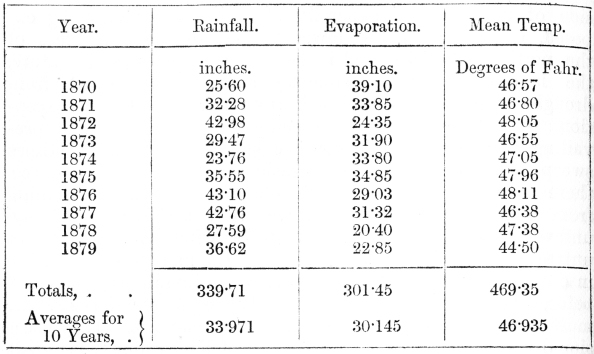
Through the kindness of Mr James Proctor, Barry
Village, Forfarshire, we are able to give the following interesting
table as to the rainfall, evaporation, and temperature at Barry, from
1870 to 1879, both inclusive.
Barry Village is within about one mile of the sea,
and about 35 feet above sea-level.
Geology—Soil.
The main features of the geological formation of
these counties may be indicated in a few sentences. The Grampian range
is composed mainly of primary rocks. The tops are formed almost wholly
of granite, but, descending the southern and eastern slopes, we find the
primary rocks associated with small quantities of those belonging to the
transition formation, layers of gneiss, mica schist, and quartz being
interspersed with small deposits of limestone and clay-slate. A slate
vein runs along the hill sides, from a little north of Stonehaven to
Easdale, Argyle, and is nearly all the way accompanied by a dyke of
trap, or whinstone, which gives value to the soil and beauty and variety
to the scenery. The slate comes to the surface at several points, and in
some parts, notably in Fearn and Lethnot, it has been quarried. The
valley of Strathmore is one long bed of Old Red Sandstone. The Sidlaws,
in Forfarshire, and the Garvock Hill, and the other lower hills further
north in Kincardineshire, are composed mainly of trappean rocks,
with several important deposits of greyish blue sandstone slate, which
is of excellent quality for pavement, and which at Carmyllie and
elsewhere is quarried extensively for local use and also for
exportation. At various points throughout both counties there are
deposits of limestone. In Forfarshire it exists in Clova; Glenesk; in
some of the Sidlaw valleys; at Hedder-wick, near Montrose; and at Bodden
in Craig. In Kincardineshire, it is found at Clattering Brig; at
Drumtochty and Glen-farquhar in Fordoun; at Whistleberry, Kinneff; at
Mathers, St Cyrus; at Kirtonhiil, Marykirk; and at Tilwhilly and
elsewhere on Deeside. At several of these places the limestone has been
extensively worked for many years. At Bodden it was worked as early as
1696. In both counties there are some deposits of conglomerate, or
pudding stone, that on the hill on the farm of West Drums, near Brechin,
being considered one of the most perfect in the country. At Dunthill,
Marykirk, there is a bed of New Red Sandstone, but there is not enough
to give any hopes of there being coal underneath it. At Cowie and
elsewhere in Kincardine, and at several points in Forfar, pipeclay is
found. At Montrose, Arbroath, Durris, Fetteresso, and at other places,
there are chalybeate or iron ore springs with medicinal properties.
Fossil remains of plants and fishes occur in the sandstone; but, as
might have been expected, all borings for coal have been unsuccessful,
for that valuable substance does not exist under Old Red Sandstone.
Throughout the sandstone districts there is a good deal of iron, to
which the Red Sandstone owes its colour. About 1710 an iron mine was
worked for a short time in Edzell.
With such distinct geological formations, it is only
natural to expect that these counties should present considerable
variety of soil. The rule that the surface soil corresponds to the rocks
beneath holds exceptionally true in Forfar and Kincardine. The extent of
alluvial soil—or, in other words, of soil deposited where it now lies by
water—is very small indeed, and hence it follows that the great portion
of the soil consists of decomposed particles of the underlying rocks,
enriched by the decay of vegetable matter, and by a long-sustained
system of liberal manuring. It is therefore possible, from the foregoing
hurried sketch of the geology of the counties, to form a general idea of
the character of the soil in the various districts. In the south-eastern
districts of Forfar, those lying between the Sidlaw range and the sea,
the soil is, generally speaking, of a light friable nature, well suited
for potatoes and turnips. Nearly midway between Dundee and Arbroath
there are small portions well adapted to the cultivation of beans; while
in the Invergowrie district there is a good deal of very fine grain
land, some parts of which, however, are slightly subject to drought.
Close by the sea at Monifieth there is a portion of as rich dark brown
loam as one could wish to see; while in Panbride, Arbroath, and
elsewhere along the coast there is a pretty
large extent of similar soil. On some parts of the southern slopes of
the Sidlaws, and along as far as the parishes of Monikie and Carmyllie,
the sub-soil is hard and retentive; but, as a rule, along the coast it
is free and easy, with a small admixture of gravel. On the more inland
parts of Carmyllie and in that neighbourhood there is a good deal of
thin moorish soil; while along the higher
arable parts, on both sides of the Sidlaw range, the soil varies from a
very thin "hungry" loam to pretty fertile loam of moderate depth. As we
descend the north-western slopes we find the soil increasing in depth
and quality until, on the banks lying partly on the trap rocks and
partly on the Red Sandstone, it becomes very sound heavy reddish loam,
well adapted to the cultivation of wheat and potatoes, and rented at
from 35s. to 50s. per acre. With the exception of a small stretch of
mossy land near the west end of the valley, the soil of Strathmore is,
on the whole, true to the character of the formation to which it
belongs. On unbroken belts of Old Bed Sandstone, the soil is generally a
reddish loam of medium texture, very fertile and not difficult to work,
with a sub-soil of sand, gravel, or friable clay. This is as near as
might be the general character of the soil along the valley of
Strathmore; but while the composition does not differ greatly, there are
many degrees of depth and value. It is evident that large portions of
the lower-lying parts of Strathmore have been scoured by water, for in
several of these parts the soil is very thin and gravelly; in a few
spots, indeed, so much so that it is scarcely worthy of being
cultivated. On the Mains of Glamis and some other farms in the bottom of
the valley, the soil is both deep and sound, but, as a rule, the heavier
and richer soil lies on the banks and lower parts of the slopes. In the
Guthrie and Farnell districts there is great variety of soil. Indeed,
there are few farms on which there is not both very rich and very poor
land. The most of the land here lies on a clayey subsoil, some of it
rather stiff, and resting on the sandstone. Towards Montrose, the soil
becomes easier and lighter, but on many farms it is heavy and fertile,
being mixed with decomposed trap rocks. In the Howe of Kinnaird there is
some very stiff clay, which, in these untoward times, is proving a
rather stubborn subject to work. Part of the Howe lies so low that it
has been found almost impossible to drain it sufficiently well to admit
of its undoubtedly high productive powers being taken full advantage of.
It is understood that the redraining of part of the Howe is being
contemplated, and much improvement would certainly result were that
carried out. On the rising ground in this neighbourhood the soil is
generally a fertile friable loam on a clayey, sandy, or gravelly
subsoil. Along the Braes of Angus, which include a large range of
country, the soil varies from a thin poor loam, resting on a close red
"pan" coming very near to the surface, to good, deep, sound, black loam
lying on limestone, trap, sandstone, primary rocks, or a mixture of two
or more of these. A friable black loam of medium depth and fertility
predominates, the most general subsoil being gravel mixed with clay. Dr
Page's graphic description of the configuration of districts adjoining
beds of the Old Red Sandstone, applies so truly to the Braes of Angus
that we produce it here. He says:—"The hills of Old Red districts,
partly composed of traps and partly of soft sandstones and hard
conglomerates, present great diversity of scenery, here rising in
rounded heights, there sinking in easy undulations, now swelling in
sunny slopes, and, anon, retiring in winding glens or rounded
valley-basins of great beauty and fertility." A more correct description
of this part of Forfarshire it would be impossible to give.
Along the Kincardineshire coast, from the mouth of
the North Esk to Stonehaven, the soil varies from deep rich loam to thin
poor black earth or stiff cold clay. A medium loam predominates. In the
parishes of Benholm and St Cyrus, there is a good deal of moderately
heavy fertile loam, which produces excellent crops. In Bervie, there is
also some very good loam, but on almost every farm there is considerable
variety, part being free black loam, resting on an open subsoil, part
red or brown stiff clay, and part thin and moorish. Similar remarks
apply to Kinneff and Dunnottar. On the Garvock Hill the soil is cold,
stiff, and sour, heavy to cultivate, and even when well cultivated only
moderately fertile. The greater part of the Howe of the Mearns is
similar to the main portion of the valley of Strathmore in Forfarshire,
the soil being, as a rule, a reddish loam, resting on sand, gravel, or
clay. Gravel predominates on the north-western slopes, and clay on the
southeastern. Generally speaking, the soil of the Howe is not quite
equal to the Forfarshire part of the Great Valley, but still near
Fettercairn, in some parts of Fordoun, and elsewhere, there is some very
rich land. Around the village of Fettercairn the soil is deep, strong,
rich loam; but in other parts of this parish, and in Edzell,
Laurencekirk, and Fordoun, not a little of the land consists of moderate
black loam or stiffish clay. Taken as a whole, Fordoun is an excellent
agricultural parish, there being in it a large breadth of really good
substantial clayey loam. The soil on the best farms in Fordoun and
Laurencekirk is a heavy loam, with an admixture of clay. In some seasons
it is not very easily reduced to a satisfactory tilth, but when well
worked and liberally manured, it yields abundantly, and is rented at
from 35s. to 45s. per acre. Along the slopes on the hill sides the soil
is thin friable loam. In the parish of Glenbervie there is some good
clay loam, but there is also a good deal of thin reddish land that
produces only moderate crops. There are some deposits of moss in this
parish. In the parish of Fetteresso, near Stonehaven, the soil is mostly
sharp friable loam, but in the more inland and higher parts it is an
inferior clayey or moorish loam. Throughout the northern half of
Kincardine, the soil consists mainly of decomposed granite, with an
admixture of moss and other vegetable substances. In the parishes of
Banchory-Devenick, Nigg, and Maryculter, the surface is remarkably
stoney, large blocks of granite being very numerous on all uncultivated
patches. It would seem that the greater part of the coast-side district
between Stonehaven and Aberdeen had at one time been covered with moss.
There is a good deal still in the uncultivated parts, though the
inhabitants have been carting it away for fuel perhaps for centuries.
The soil, too, in the arable parts is impregnated with it, and in this
respect the land here differs slightly from that in the Deeside
districts of the county, where there is less moss. There the soil is
chiefly light, friable, fertile, sandy loam, with subsoil of clay and
gravel, or gravel alone. Under liberal farming for a long-period, it has
become considerably richer than it was originally, and in a year when
moisture is plentiful it yields excellent crops of barley, oats,
turnips, and potatoes. In the parish of Durris, back from the river
side, there is a good deal of stiff loam lying on a damp clayey subsoil.
Exceptionally close drainage has been required here to make the land
useful, and although it has, on the whole, been well handled in this
respect, it is still of a somewhat damp cold nature. The arable land in
Strachan lies along the courses of the Feugh and its tributary the Dye;
and in these parts the soil is mostly of a medium loam, friable and
fertile in a favourable season, and lying on clayey gravel or on the
primary rocks. Away far up on the Feugh side there are some wonderfully
rich pieces of land, admirably suited for the raising of barley, oats,
and turnips.
The Progress of the past Twenty-five Years.
Before tracing the progress of the past twenty-five
years (the period over which this report is required to extend), it
would have been interesting to have given an account of the ancient
systems of farming, and of the social condition of the two counties a
century ago. Such an account, however, would take up more space than
could well be devoted to a subject not properly within the range of the
report. A few sentences must therefore suffice. As might be expected,
from its better climate and more southern situation, the lower part of
Forfarshire was earlier brought under a system of improved husbandry
than Kincardineshire, and thus the contrast between the farming in
Forfarshire now and eighty years ago is less striking than between the
agriculture of Kincardineshire at the present day and at the
commencement of the century. From the Rev. Mr Rodger's Report on
Forfarshire, drawn up in 1794, it appears that wheat was then cultivated
in every parish in the lower parts of the county; that Angus oats, still
famous, had then a wide reputation; that sown grasses were used on
almost every farm; that turnips were freely grown; and that potatoes
were cultivated with great success, the yield in some instances being as
high as from 50 to 60 bolls of 16 stones per acre. The number of cattle
was estimated at 36,499; a small breed, ranging in weight from 16 to 20
stones avoirdupois, occupying the higher grounds, and a larger breed,
weighing from 40 to 70 stones, the lower parts. Sheep numbered 53,970,
and were mostly of the blackfaced, a few being of the ancient dun or
whitefaced kind, and others of mixed breeding. On some of the better
managed farms, and around proprietors' residences, there was a good deal
of enclosed land mostly under pasture. Farm implements were still
primitive, but improvements were fast being introduced. The clumsy old
Scotch plough, modernised by metal boards, was still in use, but
improved ploughs, chiefly of Small's make, were speedily superseding it.
It was not uncommon to see four horses attached to a plough, and oxen
were employed on many farms. Ploughmen's wages, without board, averaged
about 1s. 3d. per day. There was then a large extent of wood in the
county, and early in the present century the area was greatly increased
by Lord Airlie, Sir Jamas Carnegie, the Strathmore family, and others.
The Rev. Mr Headrick states the number and rental of the farms in 1813
as follows, viz.:—Under £20 of annual rental. 1574; between £20 and £50,
565; between £50 and £100, 682; between £100 and £300, 315; and above
£300, 86; making in all 3222 farms.
Agricultural improvement in Kincardineshire would
seem to date from about 1760. About that time some important steps of
advancement were made by a few enterprising proprietors and farmers, but
it was not before the advent of the present century that the spirit of
improvement spread throughout the main body of the tenantry. The area of
cultivated land about the commencement of the century is stated at
74,377 acres, and that under actual tillage at 45,736, it being
estimated that other 28,000 acres were capable of being cultivated. In
the better parts of the county, in the Howe of the Mearns, and in the
parishes of St Cyrus and Benholm, wheat had been grown as far back as
tradition and record stretched; while by 1807, barley, oats, peas,
beans, potatoes and turnips, and sown grasses were cultivated with
success all over the county. The practice of leaving land in fallow is
said to have been introduced into the county by Mr Barclay of Urie in
1761. It spread gradually over the county, and in 1807 the fallow break
was estimated at 2619 acres. A pretty regular and well-understood system
of rotation was pursued about the commencement of the century. In the
wheat districts the older rotation was—1st, fallow and turnips; 2d, part
wheat and part barley, usually two-thirds of the former; 3d, beans; 4th,
barley; 5th, clover; 6th, pasture ; and 7th, oats. Following this came a
six-course rotation, of fallow, wheat, beans and turnips in equal
proportions, barley, clover, and oats, in order. On thin outlying soils
the rotation was fallow, barley, pasture for two years, and then oats.
Mr Barclay for some time pursued with success a rotation of four crops,
viz.—1st, wheat, manured after clover; 2d, turnips; 3d, barley; and 4th,
clover. In the more hilly parts of the interior the following somewhat
peculiar rotation was followed, viz.,—1st, oats; 2d, oats, or oats and
bere; 3d, turnips, potatoes, and peas; 4th, part oats and part bere;
5th, green crop as before; 6th, part oats and part bere; 7th, clover and
rye grass cut for hay; 8th and 9th, pasture. It is stated that potatoes
were first planted in Kincardineshire in 1727 by an old soldier who had
brought some tubers with him. from Ireland to the village of Marykirk,
where he resided for only one year. He raised a good crop, and it is
recorded that, while the villagers were ready enough to steal the
strange plant, "none of them had the ingenuity to cultivate it after he
was gone." They looked in vain to the stems for the seed. Potatoes were
again introduced into the Mearns in 1760; while in 1754 turnips were
introduced by Mr E. Scott of Dunninald, and grown by him on the farm of
Milton of Mathers, St Cyrus. In 1764, Mr William Lyall, farmer in
Wattieston, Fordoun, raised about an acre of turnips, and it is stated
that the crop was considered so rare that it was sold in small
quantities, at one penny per stone, for kitchen vegetables. This crop
was cultivated on only a very few farms till 1775, but by the beginning
of the present century it was grown all over the county. Sown grasses
were not in general use till about 1770; but it is stated that as early
as 1730, Sir William Nicolson of Glenbervie, "a spirited cultivator at
an early period," raised hay from sown seeds, "not, however, from the
seeds of any of the species of clover now in use, but from such seeds as
were found among the natural meadow hay." The number of cattle in 1807
was 24,825, and it is stated that a four-year-old Mearns ox weighed
about 45 stones. The best cattle are described as black or brown, or
brindled, with spreading horns. There were also some very good polled
cattle, similar to, and no doubt of the same breed as, the Buchan "Humlies,"
the progenitors along with the Angus "Doddies" of the improved polled
Aberdeen and Angus breed. The sheep stock numbered 24,957, and consisted
mainly of blackfaced sheep and the ancient dun faces. Along the coast
there were a few Bakewell Leicesters, and also some South Downs. At the
commencement of the century the farm implements were somewhat primitive.
The ancient Scotch plough was fast giving way to Small's improved
ploughs, which cost about £4 each, and which by 1807 was almost the only
sort of plough used in the county. Harrows, with five wooden bills and
five iron teeth in each, were coming into use, as also were single
carts. During the first ten years of the century about a score of
threshing mills were erected in the county at a cost of from £140 to
£180 each. Among the noted early improvers, Mr Barclay is mentioned as
having been the most prominent. Between 1760 and 1790 he reclaimed over
900 acres, and planted 1000 acres, raising the rental of his estate of
Urie from £200 to £1800 in less than fifty years. Early in the century
great improvement was effected in houses, roads, and fences.
Coming to speak of more recent times, we are happy to
be able to state that the spirit of improvement aroused in the last
century has never been allowed to lie dormant. True, during the last
twenty-five years, a smaller extent of land has been reclaimed than
during either the last twenty-five years of the eighteenth century or
the first twenty-five of the present, but that has not been due to any
flagging in the spirit of improvement, but simply to the fact that only
a limited area of suitable land remained for the proprietors and tenants
of the past twenty-five years to bring under cultivation. There has been
less done lately, simply because there has been less to do. No reliable
data exist upon which to estimate the extent of land reclaimed in the
two counties during the first half of the present century. The Rev. Mr
Headrick estimated the arable land in Forfarshire in 1813 at 340,643
acres, but it is clear that that far exceeded the actual extent, for the
area at present under all kinds of crops, bere, fallow, and grass, falls
short of it by nearly 90,000 acres. The statistics relating to
Kincardineshire seem to be rather more accurate. The area under
cultivation in 1807 was estimated at 74,377 acres, and from this it
would appear that during the first half of the present century about
27,000 acres had been added to the arable extent.
Confining ourselves to the last twenty-five years, we
find that in both counties there has been a very substantial increase in
the extent of arable land. The agricultural returns, taken up at the
outset by the Highland Society and ultimately by the Board of Trade, did
not at the commencement include holdings rented at less than £10 a year.
It is therefore impossible to ascertain the exact extent of the
increase. The following table, however, affords a pretty correct
indication:—
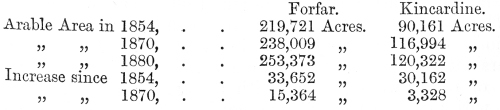
The percentage of the arable area of Forfar under
cultivation in 1870 was 41.8 ; now it is 44.5. In Kincardine, the
percentage in 1870 was 47.1; it is now 48.5.
This increase, equal to 1246 acres a year in Forfar
and 1117 acres in Kincardine, must be regarded as highly creditable,,
especially when it is considered that, as previously stated,
agricultural improvement in these counties had been carried to a great
length long before the period to which the above table refers, so far,
indeed, as to leave comparatively little to be done. In Forfar, the main
portion of the new land lies in the Braes of Angus along the foot of the
Grampians, but there is also a fair proportion on the Sidlaw range.
Throughout all the higher lying parts of Kincardine there has been less
or more reclamation since 1854. On the slopes of the Garvock Hill there
has been a good deal, and also on the hard heights and mossy hollows of
Glenbervie and Fetteresso. Along the foot of the Grampians, in Edzell,
Fettercairn, Laurencekirk, and Fordoun, there has been a narrow fringe
reclaimed within thirty or forty years; a small portion within twenty
years; while in each of the parishes in the northern division of the
county there has been a certain extent reclaimed. Strachan and Durris
claim the larger portion.
The reclamation of land, however, has not constituted
the whole of the agricultural improvement in these counties during the
last twenty-five years. Indeed, it is doubtful if it has not in outlay
been far exceeded by the improvements in farm buildings,, draining,
fencing, road making, and other accessories which tend to develop the
resources of the soil. In both counties there has-been a great deal done
in the improvement of farm buildings, and these are now on the whole
fully abreast of the times. In several parts of Forfar, and also in some
parts in Kincardine, re-draining might be carried out with advantage;
but still, since 1854, a great improvement has been effected in the
condition of" the land in this respect. In the wheat and potato
districts there is yet a large stretch of open land, but in the parts
where the pasturing of live stock holds a prominent place in the economy
of the farm, a great extent of fencing, mostly wire and stone dykes, has
been erected within the last twenty-five or thirty years. In service or
farm roads, too, as well as in the county roads, there has been
considerable improvement; while not a little has been done in the way of
straightening watercourses, squaring fields, draining small pieces of
lake or swamp, clearing the land of stones, and in other small but
useful works.
The progress in the cattle department sustained a
most serious check by rinderpest in 1865-66. It was several years after
that dreadful scourge before the rearing and feeding of cattle were
pursued with the same energy as formerly, but within the past ten years
a good deal of the lost ground has been made up. The number of cattle in
Forfar has decreased since 1854 by 1699 head, and in Kincardine by 202
head. In the character of the stock kept, however, there has been a
considerable improvement since 1854. There is no doubt a greater number
of cattle fed than prior to 1854, and it is equally certain that the
average weight of beef per head is greater now than twenty-five years
ago. Sheep farming has increased greatly in Forfar since 1854, there
being a very small decrease in Kincardine. Here also there has been a
slight increase in the comparative production of meat, if not likewise
of wool.
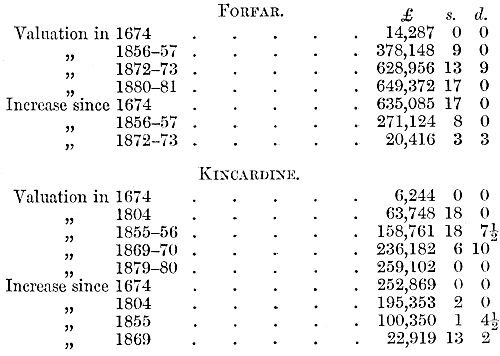
The valuation roll is perhaps the truest mirror of
the development of a county, and in it these counties appear in a most
favourable light. The following tables show the valuation of the two
counties at various periods since 1674:—
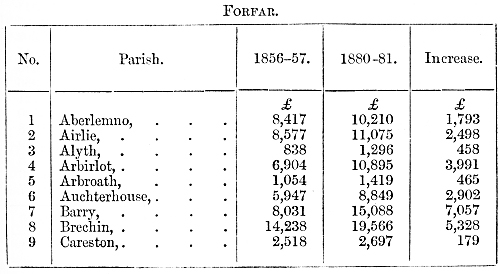
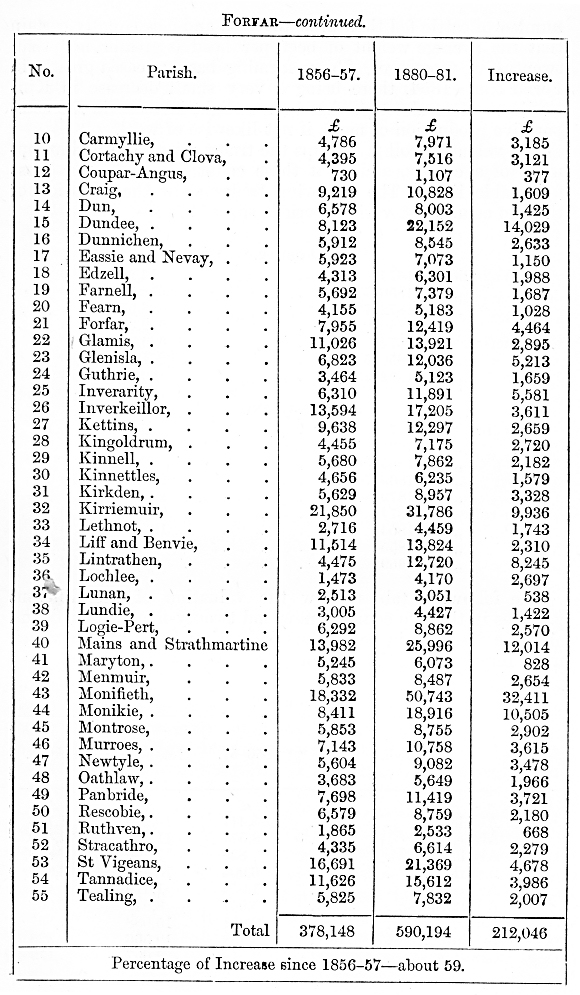
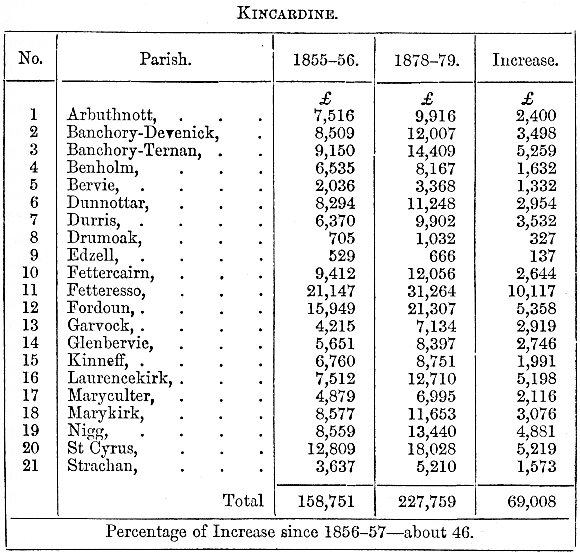
The following tables show the valuation of the
different parishes in the two counties now and twenty-five years ago,
and also the increase in each, thus indicating the parts in which most
improvements have been effected within that period.
Details of Improvements and of Different Systems of
Farming.
Before proceeding to indicate in order the general
farming customs, we shall give, in as condensed a form as possible, some
notes which we collected regarding improvements and systems of
management on different estates and farms throughout both counties. And
in giving these, we have to acknowledge our indebtedness to many
proprietors, factors, and tenants, for much valuable information.
Perhaps the best plan would be to make an imaginary tour through the
various districts, bring the reader along, and transcribe our notes as
we proceed.
Forfar.
Starting, then, where Forfar joins Perth, a few miles
west of Dundee, we find ourselves in the parish of Liff and Benvie,
which has an area of about 8049 acres, and a rental of £13,824, being an
increase of £2310 since 1856-57. The rental in 1683 was £4618 Scots
money. Around Invergowrie there is some very fine land rented at from £4
to £5 an acre, this great value being due to the proximity of the land
to Dundee. One of the largest farmers in this district is Mr William
Smith of Benholm, who manages his land with much liberality and success.
He, along with most of his neighbours, drives a large quantity of city
manure from Dundee, and in addition uses a good deal of artificial
stimulants. A six-shift rotation is the one most generally pursued, that
is—oats, potatoes, wheat, turnips, barley, and one year's grass; all the
produce, except what is required to maintain the working staff of the
farm, being sold. The cow-feeders of Dundee take all the turnips, hay,
and grass they can obtain in their neighbourhood. For some time back
they have been paying such high prices for both, more especially
turnips, that they have been losing heavily by the transaction, and they
are now beginning to deal in these commodities with more moderation.
Even yet, however, farmers have no difficulty in obtaining from £16 to
£22 per acre for a good crop of turnips, according to the situation of
the farm. Coming nearer to Dundee we find still higher-rented land, the
best land all around it being rented at from £5 to £6 per acre. The
rotation pursued here is also mostly the six courses, with one year's
grass and two green crops; but some work without any fixed rotation,
cropping to suit the markets and the condition of their land. On the
farms close to Dundee few more stock are kept than are required for
working the land and supplying the residents with milk, it being found
far more profitable to dispose of the turnips and grass to the
cowfeeders in the town than to consume these on the farm. This, of
course, necessitates very liberal manuring, but from the cowfeeders in
Dundee an abundant supply of dung is always to be had. The suburban
farmers use city manure very freely. The soil around Dundee is mostly an
easy rich loam, in many cases worked into a very high state of
fertility. In some parts there is stiff clay, and on some of the higher
parts thin loam; but, on the whole, it is more than ordinarily fertile,
and is fully taken advantage of. The produce per acre on the suburban
farms varies greatly. Generally speaking, it is above the average of the
county. One of the best managed farms in the neighbourhood of Dundee is
Mid Craigie, occupied by Mr Thomas Drummond. Situated almost in the
suburbs of Dundee, it is well laid off, has been highly farmed for a
very long period, and is in very rich condition. The soil is heavy loam,
well suited for wheat, potatoes, and turnips. An eight-shift rotation is
pursued—grass, oats, potatoes, wheat, turnips, oats, potatoes, and wheat
with grass seeds. There is thus each year one-fourth of the farm in
wheat, one-fourth in oats, one-fourth in potatoes, one-eighth in
turnips, and one-eighth in grass. Few stock are kept, all the surplus
turnips, hay, grass, and straw going to Dundee. The rent per acre is
about £6, payable partly in grain; and the increase since 1850 about
12s. 6d. per acre. The valuation of the landward part of the parish of
Dundee increased from £8261 in 1858-59 to £12,079 in 1876-77. Proceeding
northwards from Dundee we enter the parish of Mains and Strathmartine,
which had a rental of £13,982 in 1856, now increased to no less than
£25,996. The valuation in 1683 was £3113 Scots money. The chief estates
in this parish are—Baldovan, owned by Sir John Ogilvy, Bart.; Balmuir,
belonging to Mr James Webster; and Douglas, the property of the Countess
of Home. On each of these there are several large well-managed farms.
The principal holding on the latter is the Barns of Claverhouse, which
has just passed to the third generation of the Bell family, a family
that has for over half-a-century occupied a leading position among
Forfarshire farmers. Mr George Bell removed lately to the adjoining farm
of Mains of Fintray, leaving in the Barns his only son William, who
continues to manage it with all the energy and skill which his father
and grandfather so successfully applied to it. Mr George Bell and his
father effected great improvement on the farm by draining, road-making,
fencing, building, and in other respects, the former having expended no
less than £2000 on these improvements during his tenancy. Part of a new
steading was erected in 1854, while the remaining portion was renewed in
1874-75, making it one of the most commodious and convenient in the
district. The greater part of the farm lies low, by the side of the
Dighty Water, and there the soil is a clayey loam of a stiffish
tendency. On the rising ground on the north the soil is thin sharp loam.
On the Mains of Fintray the soil is stiffer, but under the careful and
liberal treatment it receives it yields well. It is rented at about £4,
10s. per acre, gives an average of about 4 quarters of wheat per acre,
weighing 62 lbs., and about 5½ quarters of
barley and oats, the former weighing 54 lbs. and the latter 40 to 44
lbs. per bushel. On the north-east of Mains and Strathmartine lies the
parish of Murroes, which contains some very fine and also some very poor
land. Overlooking the valley of the Dighty Water, and commanding a
magnificent view of the German Ocean, the coast of Fife, the Firth of
Tay, and the suburbs of Dundee, stands the old Castle of Powrie. This
hoary ruin adjoins the beautifully situated dwelling-house and steading
of the farm of Powrie, occupied by Mr Thomas Smith, whose choice herd of
polled cattle and equally well-bred flock of English Leicester sheep,
give his farm an interest and importance rivalled by only a few in the
county. Of the herd and flock more anon. The steading on Powrie was
erected in 1806, when the late Mr Smith, father of the present tenant
and a man in many ways in advance of his times, entered the farm. It is
in the form of a square, commodious and substantial. Part of this farm
also lies down on the Dighty valley, and there the soil is pretty strong
loam. The greater part, however, is on high ground, and, though sharp
and sure, is rather wanting in body. Not far away, in the same parish,
is the farm of East and West Murroes, leased by
Mr David Smith at a rent of £873, 12s. Situated on the Gagie
estate, this farm is maintained in very high condition, and produces
good crops of potatoes, wheat, barley, oats, and turnips.. In drains,
stone dykes, and other improvements, Mr Smith has expended over £1600 on
the farm, and every year uses a large quantity of city dung and
artificial manure. He follows a seven-course rotation, which is by far
the most general course in all the wheat and potato districts excepting
in the neighbourhood of Dundee, viz.:—oats, potatoes, wheat, turnips,
barley, and two years' grass. Mr Smith also holds the fine farm of
Grange of Monifieth, which lies nearer the sea, and consists of very
rich friable loam. Here he produces beautiful crops of wheat and
turnips, and also, as at the Murroes, grazes and feeds a large; number
of cattle. Mr Smith's father, the late tenant of Leshade in Murroes, was
one of the most enterprising farmers in this part of the county. He
transformed the farm of Leshade from swamp and moss into one of the best
laid out, and most efficiently fenced holdings in the county. The system
of drainage which he carried out on the farm is most extensive and
unique, and has worked admirably. A great stretch of substantial dykes
were also erected at a heavy outlay.
Passing into the parish of Tealing we find ourselves
on a higher elevation and in a colder climate. This parish, leading up
to the Sidlaws, extends to 7231 acres, and gives a rental of £7832, or
£2007 more than in 1856. The rental in 1683' was £1886 Scots. In the
lower lying portion of the parish there is a good deal of strong rich
land, that yields well when skilfully managed and when the seasons suit.
It is a clayey loam with a subsoil of clay and gravel, in some parts
rather retentive. In part of the hollows there is also very poor soil,
thin, hard, and unproductive, with very stiff subsoil. There are several
instances in this parish where the land on the one-side of the road is
worth 25s. or 30s. an acre, and not worth more than 15s. or 20s. on the
other. On the higher lying parts; there is also a good deal of variety
of soil, but in general it is a moderately fertile loam, resting on a
clayey or gravelly subsoil which in some parts is not so open as could
be wished. Mr Alexander Bell, Kirkton of Tealing, better known as the
late tenant of Balnuth,has been one of the leading farmers in
Forfarshire for many years. For a long time he has been extensively
employed in the valuation of land and farm crops, and has thus acquired
a most extensive and accurate acquaintance with the agriculture of the
county. Entering Balnuth when a young man, he at once commenced
improvements, and in the course of his first lease spent a large sum in
reclamation, draining, fencing, building, and other works, bringing the
farm into high order and convenient form. A good deal of the land is
stiff strong clayey loam, not very well suited to potatoes, but of
wheat, barley, oats, and turnips he raised excellent crops. A few years
ago he transferred Balnuth to his nephew, Mr William Bell, and now
resides on the adjoining farm of Kirkton, which he also maintains in
high condition. At Kirkton the elevation is over 500 feet, and from a
little beyond that the ground rises fast, so that we soon pass beyond
the wheat land, and come into the elevation where oats and turnips
predominate. In these higher parts the ordinary five or six-shift
rotation is pursued, that is turnips, with a small patch of potatoes,
barley or oats or part of both, grass for two or three years, and lastly
oats. Immediately to the west of Tealing lie the parishes of Auchter-house
and Lundie, in which, as in the higher parts of Tealing, a good deal of
land has been reclaimed from moorland within the past thirty years. The
soil is for the most part light, sharp loam; and being as a rule well
farmed, produces good crops of oats, barley, and turnips. The five and
six-shift rotations are also pursued here, and the latter gains ground
every year, owing perhaps partly to the greatly increased cost of
labour, and partly to the fact that turnips are less subject to "finger
and toe" on land worked in six shifts. In these three parishes last
referred to, rent ranges from 20s. to 50s. per acre, the main portion
being under 28s. A few tenants pay as little as 15s. per acre for the
very poorest and coldest of the land. The Earl of Airlie owns the larger
portion of the parish of Auchterhouse, one of his lordship's largest
farms in this district being East Mains of Bonnyton held by Mr Alexander
M'Kay at a rent of £680. In Lundie the Earl of Camperdown is the
principal proprietor. On his lands in this parish extensive improvements
have been effected since 1850 in the way of reclaiming, draining,
fencing, and building, part being done by the proprietor and part by the
tenants.
Retracing our steps and proceeding eastwards we pass
through the parish of Monikie, in which the Earl of Dalhousie owns a
large extent of valuable well-farmed land, and in which a very large sum
has been expended on various agricultural improvements during the past
twenty-five years. Monikie extends to 9027 acres, and yields a rental of
£18,916, or more than £2 per acre. The increase since 1856 amounts to no
less than £10,505. The rental in 1683 was £4608 Scots. On the east of
Monikie lie the highly cultivated coast-side parishes of Barry, Panbride,
and Arbirlot, extending to 6155, 5506, and 6889 acres respectively, and
yielding respective rentals of £15,088, £11,419, and £10,895, Barry has
increased £7057 since 1856, or more than £1 per acre. A very large part
of this increase, however, is due to the rapid growth of the village of
Carnoustie, which has sprung up almost entirely within the last fourteen
years. The increase in the other two parishes amounts to over 10s. per
acre, the greater part of which is certainly due to the development of
the land. The principal property in this neighbourhood is that of
Panmure, owned by the Earl of Dalhousie, who is by far the largest
proprietor in the county. He owns several estates, situated chiefly in
this neighbourhood, around Brechin, and away up through the Grampian
range. According to the Return of Owners of Lands and Heritages in
1872-73, the total area of his property measures 136,602 acres, the
gross annual value being £55,601, 16s. The Panmure estate is one of the
most important. It extends into the parishes of Monifieth, Barry,
Monikie, Arbirlot, Carmyllie, St Vigeans, Inverkeillor, and Kinnell, all
lying along the east coast. Panmure House, a large palatial mansion, is
situated in the upper part of the parish of Panbride, about four miles
north-west from Carnoustie. The grounds are both extensive and
beautiful, while the gardens, which have a very fine situation, are kept
in excellent condition. The policies extend in all to 550 acres. The
Home Farm or Mains of Panmure, under the charge of Mr George Cowe,
Balhousie, consists of about 200 acres of arable land, worked on the
seven-course rotation, with two years grass. A large flock of half-bred
ewes and a smaller flock of Border Leicesters are kept on the farm,
while a good many cattle are also grazed and fed. A few cows are kept
for the supply of milk. Each autumn a lot of two-year-old cattle of the
best class that can be obtained are bought in and fed on turnips, straw,
and cake. They are generally sold off in spring, and for six weeks
before leaving, the allowance of cake is very liberal. The soil on the
Panmure estate varies from the richest to the poorest of loam, part
lying on a red sandstone subsoil, part on a hard irony pan, part on a
moderately open mixture of clay and gravel, and part on porous sand. The
poorest land lies in Carmyllie, and the richest a mile or two or more
from the sea side. On the greater part of the estate it is very good. On
the better soil the seven-shift rotation with wheat, potatoes, and two
years grass prevails. A few also work on the six courses. In the higher
lying districts and poorer soils the ordinary five or six-shift rotation
is pursued, no wheat and few potatoes being grown. Latterly, a good many
who formerly worked on the five-shift rotation have turned to the six.
The Panmure estate is very judiciously apportioned. It contains a good
many large farms, rented at from £500 to close on a £1000; a great many
medium sized farms rented from £100 to £300; and a very large number of
crofts or pendicles and small farms rented at from £4 to £60. In the
parish of Carmyllie alone there are over fifty pendicles. Twenty of
these are rented below £10 each, the lowest being £4 and the average
about £6 or £7. Nine pay between £20 and £40, and the others, on an
average, from £14 to £15. Generally speaking these small tenants occupy
the poorest land, that on the Carmyllie pendicles being thin "hungry"
loam lying close to a hard irony or rocky subsoil. The greater part of
it has been reclaimed, mostly within the last thirty years, by the
crofters themselves, who have no doubt made the district more productive
than larger tenants would have done. They cultivate their land well and
raise wonderful crops. They grow oats and turnips for the most part,
raising just as many potatoes as are required by the family. The smaller
tenants keep one cow each, and the larger ones two or more, the young
stock being sold when six, twelve, or eighteen months old. The class of
stock raised on. these pendicles is far superior to what it was some
fifteen or twenty years ago, and now they meet a ready sale among the
neighbouring larger farmers at good prices. The more industrious of
these crofters seem contented and comfortable. They maintain their
little places in the best of order, educate their families well, and in
not a few cases store up as much money as in course of time enables them
to step into larger and better holdings. One great advantage in having
these small tenancies on an estate is that they provide an excellent
supply of labour, an advantage which those having the management of the
Panmure property have evidently not failed to recognise. Pendicles have
been well named nurseries for farm servants. The rent per acre on the
Panmure estate varies greatly, according to the soil and situation. The
better land on the coast side is rented at from £2 to £3 per acre, while
in the poorer inland parts the rent falls to £1, and in some cases even
to 10s. There is also great variety in the yield of the different crops.
Wheat gives from 4 to 6½ qrs., weighing from
60 to 64 lbs. per bushel; barley from 5 to 6 qrs., weighing from 54 to
56 lbs.; oats from 4½ to 8 or even 9 qrs.,
weighing from 40 to 45 lbs.; potatoes from 5 to 12 tons; and turnips
from 14 to 25 tons. Since 1850 the increase in the rental of the Panmure
property has been great. At that time several of the best farms were
held at little more than nominal rents by life-renters; all of whom,
with one exception, had died prior to 1870. When brought into the market
these farms were readily let at greatly increased rents, one bringing
more that four times the sum paid by the life-renter. Other influences,
however, have helped the increase. Aided by the proprietor, the small
tenants in the higher parts have, within the last thirty years,
reclaimed over 500 acres from moor and moss. A large sum of money has
also been expended on drainage and building throughout the property
since about 1860, and, under wise direction, this expenditure has
resulted in substantial improvement. A good deal has likewise been done
in road making near Panmure House, while since about 1870 close on 700
acres of wood have been planted. Of these 200 acres were planted about
ten years ago; and form an addition to the Mansion House policies, the
greater part of which has recently been thoroughly drained. These 200
acres were fenced with a high stone wall.
Balhousie, tenanted by Mr George Cowe, is one of the
best managed farms on the Panmure estate. A large part of it has been
drained by himself; while it is cultivated and manured to the very
highest degree, producing abundant crops of all kinds. A choice small
flock of Border Leicesters is kept on the farm, while a number of
two-year-old cross cattle are bought in in autumn and fed during winter.
One of the largest and one of the best farms along the east coast of the
county is Pitskelly, leased by Mr F. Dickson at a rent of £1100. The
soil is mostly strong sound loam, not so stiff as some land on other
farms in the neighbourhood. Panlathie Mill, in the parish of Arbirlot,
is also very carefully and skilfully managed by its enterprising tenant;
Mr James Duncan. The soil, mostly black friable loam, is worked in the
six shift rotation. Wheat yields from 4 to 5 qrs., and weighs from 59 to
64 lbs.; barley 5 to 6 qrs., weighing from 49 to 55 lbs.; oats 6 to 7
qrs., weighing from 40 to 47 lbs.; potatoes 6 to 7 tons; turnips 14 to
18 tons; and hay from 1½ to 2½
tons per acre. Potatoes receive nearly all the manure that can be
made in covered courts, the litter grown on the farm being supplemented
by flax dust; and in addition to this 2 or 3 cwt. of artificial manure
is allowed to the acre. Turnips are generally manured with artificial
stuffs. Mr Duncan has long devoted special attention to the raising of
potatoes, in which he has been eminently successful. Latterly, he has
been conducting experiments in the producing of new varieties which
cannot fail to be of service to the country. Wheat is sown as soon as
the potatoes are got out of the ground, generally in November, and
sometimes in December. Harvesting of grain extends from the end of
August to the middle of October. Turnips are not as a rule stored in
large quantities, only as many being kept in store as would supply the
stock for a month or six weeks. A number of store cattle, generally
Irish stock, are bought in every year, and fed off at various times, on
turnips, straw, hay, cake, and meal. A few are fed in the courts in
summer on cut grass, cake, &c. With some assistance from the proprietor,
for which he pays from 5 to 6½ per cent.
interest, Mr Duncan has redrained nearly all his farm, and erected a new
dwelling-house, and the greater part of the farm steading. The farm of
Inverpeffer, occupied by Mr James Swan, and rented at £645, 10s., lies
in a detached portion of the parish of St Vigeans, adjoining Panbride,
and is also on the Panmure estate. This farm extends to about 420 acres,
300 of which are arable, the remainder being rough pasture on sea-braes.
The soil varies a good deal. About 100 acres are good fertile clayey
loam, a like extent easier black loam, somewhat liable to damage by
drought in dry seasons ; and the other 100 acres drifting sand and
moorish soil. For fifteen years Mr Swan worked the best land in the
seven course rotation, and the poorest in six shifts, three years in
grass with only one green crop. The thinner land was for a time tried
with two green crops after three years grass, and also after two years
in grass; and now the whole farm is worked in seven shifts. In one
division of the farm, potatoes are grown after two years old grass, and
are followed by wheat, oats, turnips, and barley or oats in succession.
This course has been adopted with the view of keeping the land free from
weeds, and of preventing the oat crop from lodging, which it invariably
did, after two years feeding with cake on the pastures. Wheat yields
from 4 to 7 qrs. per acre, weighing from 56 to 63 lbs. per bushel;
barley from 4 to 9 qrs., weighing from 47 to 57 lbs.; oats from 6 to 12
qrs., weighing from 40 to 44 lbs.; potatoes from 2 to 10 tons; and
turnips from 10 to 30 tons. In a very exceptional season, as many as 40
tons of turnips per acre have been grown on this farm. Mr Swan keeps an
excellent stock of cross cows, and from these and well bred shorthorn
bulls rears a class of beef cattle not surpassed by any and equalled by
few in the county. He also has a few pure bred shorthorn cows. He feeds
his crosses from birth onwards, taking care to maintain them in a
healthy condition, and constantly adding both to their size and cover of
flesh. The cattle are sold to the butcher when two or two and a half
years old, and on an average for ten years have realised from £24 to £36
a head. Cotton cake is the chief auxiliary during the greater part of
the feeding period, linseed or beans or both being given for a month or
six weeks before the cattle are sold. About 180 or 200 blackfaced ewes,
obtained from the same glen for fifteen years, are purchased in October,
and from these and the best of Clark and Stark tups, a very fine stock
of half-bred lambs are raised. The lambs are fed on undecorticated
cotton cake till from eleven to thirteen months old, and then disposed
of. The average price for ten years has been 58s. a head. Mr Swan has
effected great improvement on his farm since his entry in 1860. In
buildings, draining, fencing, and road making he has expended in all
£3500. For improvements in 1868 he obtained
£600 at 7 per cent. interest, and £400 in 1877—78 at 5 per cent. The
farm is now well appointed in almost every respect. Each field is
supplied with water, while there is a sufficiency of cottage
accommodation for the servants.
Along the coast here there are many other farms well worthy of
special notice, it would be but repetition, however, to detail the
system pursued on many more.
Proceeding northwards along the coast towards the
thriving town of Arbroath, we pass a number of large well-managed farms,
on which the seven-shift rotation is for the most part pursued. One of
the best managed and most widely known farms in the neighbourhood of
Arbroath is Mains of Kelly, tenanted by Mr Alexander Bowie, the eminent
breeder of polled cattle. Mr Bowie is a distinguished general farmer as
well as a cattle breeder. He. has conducted many experiments on the
growing of grain from thick and thin sowing, and under other
circumstances. He uses remarkably little seed (about 2 bushels per
imperial acre), and grows beautiful crops of all kinds of grain.
Continuing our northern route, we pass through the
parishes of St Vigeans, Inverkeillor, Lunan, Maryton, and Craig, and
halt at Montrose. These parishes extend respectively to 13,143, 10,516,
1981, and 3686 acres; and in each there has been a substantial increase
in the rental since 1856, though not so much as in some other parishes
in the county. The increase in St Vigeans, Inverkeillor, and Craig is
equal to about 6s. per acre of the total extent, and in the other two
about 1s. less. A leading farmer in Craig states that the soil in his
district is mostly black loam on trap, or "scurdy" rock. The cropping is
pursued in six and seven shifts. Wheat yields about 4½
or 5 qrs., weighing 62 lbs. per bushel; barley 5½
qrs., weighing 54 lbs.; oats 6 to 6½ qrs.,
weighing 42 lbs.; potatoes about
6 tons; and turnips from 15 to 24 tons per acre.
Potatoes are usually manured with court-made dung, while turnips get
dung and from 3 to 5 cwt. of artificial manure per acre. Spring sowing
commences about the 18th of March, turnip sowing about the 10th of May,
and harvesting about the 1st of September. There is very little
difference in the system of farming pursued now and twenty-five years
ago. In the system of cropping, the only difference is that no fallow
wheat is now grown. Twenty-five years ago most of the farmers in this
district bred their own cattle. Now they depend chiefly on Irish stock,
which they buy in young, from a year to eighteen months old, at from £7
to £17 a head, and which they feed on turnips and cake or meal. The
majority go to the London and Glasgow markets when two or three years
old. The greater portion of the land has been redrained since 1850,
mainly by money advanced on interest by the proprietors. Farm houses
are, as a rule, good, and the supply of water sufficient, but fencing is
scarce. Rent ranges on an average from 50s. to 60s. per acre. On the
large farms of Gilchorn and Cauldcots, on the Anniston
estate, in the parish of Inverkeillor, and occupied
respectively by Mr James Bell and Mr John B. Bell, and on the extensive
holdings of East Newton and Rosehill, on the Northesk estate, in the
adjoining parish of St Vigeans, and held respectively by Mr E. J.
Donaldson and George Miln, steam cultivation has been pursued jointly
for several years with success.
Reversing our course, we proceed westwards along the
valley of Strathmore, first passing through the parishes of Farnell and
Kinnell. These parishes have hardly forty farms between them, and yet
the former has a rental of £7379, and the latter of £7862. Since 1856,
the one has increased by £1687, and the other £2182. The whole of
Farnell belongs to the Earl of Southesk, whose estate is one of the most
compact and desirable in the county, extending, as it does, to 22,525
acres, and bringing an annual rental of £21,811. Of the fourteen farms
in Farnell, four exceed £700 in rental, while two exceed £1000— East and
West Carcary, leased by Mr Robert Lyall at £1078, and Fithie, rented by
Mr David Mitchell at £1008. Lord Southesk is also the largest proprietor
in Kinnell, in which the Earl of Dalhousie, as already mentioned, also
owns a large extent of good land. The soil in this district is mostly a
clayey loam, in parts rather stiff and in others of a moorish texture.
The subsoil is chiefly clay, mixed with gravel, and resting on the Old
Red Sandstone. On the higher parts whinstone shoots up here and there to
within a few inches of the surface. On the richer land the seven-course
rotation is pursued, but on the thinner soils, and where it is not
convenient to grow potatoes, the five-shift rotation prevails. By not a
few farmers the six-shift is now preferred. Only a small extent of land
has been reclaimed in this district since 1850, but draining and
building have been carried on largely; while since wire-fencing was
introduced a good deal has been done in enclosing land. In the latter
respect, however, there is still much to do. The draining has been done
chiefly by government money, for which the tenants are usually charged a
percentage sufficient to cover the interest on the loan and repay the
principal. In some cases proprietors have given money for draining for
interest only. There have been few changes of much importance in the
system of farming in this district during the last twenty-five years.
For some time the practice of letting turnips to be consumed on the land
by sheep has been prevalent. It is the opinion of experienced farmers
that more profit is derived from the crop in this way than if cattle
were brought in and fed upon it. The average rent of the land in this
district affords no real criterion of the agricultural value of the
different classes of soil, for on almost every farm there is a portion
of poor land worth little per acre. The average rental per acre is thus
reduced far below the value of the really good land. Bolshan, occupied
by Mr Goodlet, is one of the largest and one of the best managed farms
in the county. Situated in the parish of Kinnell, on a slope facing
south-west, it extends to 690 acres, of which 670 are under cultivation,
the remainder consisting mostly of wood pasture. Mr Goodlet took the
farm by public competition, paying a large increase on the former rent,
while on the renewal of the lease in 1866 he paid a further advance,
making the total increase on the rent since 1847 70 per cent. The soil
consists of a clayey loam of a moorish texture on the west, where it
adjoins the moorside, and runs into stiffish clay on the south-east. The
whole farm lies on a clay bottom, overlying the sandstone formation,
with protruding pieces of whinstone on the heights. On 280 acres the
seven-course rotation is pursued, and on 330 acres the five-shift, with
one green crop and two grasses, while the remaining 60 acres are allowed
to lie in pasture, being broken up at intervals and sown down again.
Wheat yields on an average 4 qrs., weighing 58 to 62 lbs.; barley 5
qrs.; oats close on 6 qrs.; turnips from 18 to 25 tons; potatoes from 4
to 9 tons; and hay from 200 to 300 stones per acre. Only as much hay is
grown as is sufficient to supply the farm horses and sheep, the rest of
the young grass being pastured mostly by sheep. The root crops get from
twelve to fifteen cart loads of farm-yard manure, and 4 or 5 cwt. of
guano and other light manures per acre. Guano has been used latterly on
account of Mr Goodlet's having found that his cold-bottomed land was not
much benefited by the superphosphates and other artificial compounds
which he had tried. For a number of years he has obtained large
quantities of Aberdeen city manure for mixing with his farm-yard manure,
and from this he has found more benefit than from any quantity of light
manures he has ever used. The grass lands in particular, which were
formerly poor, have improved very much under this treatment. From 120 to
130 cattle are kept during winter. The majority are bought in, but a few
are bred on the farm from cross cows and a well-bred shorthorn bull. The
two and three-year-old cattle, which make up three-fourths or more of
the lot, are fed on turnips, cakes, and crushed grain, and sold as they
become "ripe." The three-year-olds weigh on an average, when sold, from
48 to 54 stones (Dutch), and the two-year-olds from 40 to 44 stones.
About 50 young cattle and cows are grazed during summer. In addition to
the cattle stock, a large and very good flock of Border Leicester sheep
are kept. To these we shall refer again. Since his entry Mr Goodlet has
effected great improvement on the farm, not only in the land, but also
in the houses and other respects. When he obtained possession the land
was run out and full of weeds, and for a number of years he had to farm
the whole in the five-shift rotation. He afterwards for a time pursued
the seven-shift system alone, but finding potatoes a risky crop, he
adopted the present system in order to reduce the area under potatoes
and increase the extent under grass. Since his entry in 1847 he has
tile-drained upwards of 200 acres to a depth of from 2½
to 4 feet. The landlord built a range of covered cattle-courts,
repaired and made alterations on the farm-steading, and erected two new
cottages to replace old ones. He also put an addition to the
dwelling-house, and built other two cottages, for the outlay on which Mr
Goodlet paid interest at the rate of 3 per cent., performing all the
carriages over and above. Eight married ploughmen reside in cottages,
and five unmarried men in a "bothy," in which there is a separate
bed-closet for each, and a sitting room, and scullery or pantry for
general use. The "bothy" is cleaned out daily, and the beds made by a
woman paid for the purpose. The farm is conveniently laid out in finely
shaped fields, well fenced with dykes and hedges, with rows of trees
here and there, and is altogether one of the most beautifully situated
holdings in the county.
Continuing westwards we pass through the parishes of
Guthrie, Kirkden, and Rescobie, and rest in Forfar. These parishes
extend respectively to 3824, 5018, 6724, and
8379 acres; and since 1856 the rental of the first two and the last one
has increased by about 10s. per acre of the total extent, and that of
Rescobie by about 6s. per acre. In each there are several large
well-cultivated farms, and a pretty large extent of good soil. The
largest holding is the combined farms of East and West Carsebank, held,
along with another adjoining farm, by Mr Patrick Fair-weather, and
rented at £1285. Situated in the parish of Res-eobie, this fine farm
extends to 650 acres arable and 22 acres under pasture. The soil is dark
brown loam, with good " body." During the first twelve years of the
lease he had liberty to farm in any rotation wished, provided always
that he worked the land in accordance with the rules of good husbandry.
During the remainder of the lease he was bound to have the land in the
seven-shift rotation. Wheat gave on an average 4 qrs. or a little more
per acre, weighing 61 lbs. per bushel; barley 5½
qrs., weighing 54 lbs.; oats 6 qrs. or a little more, weighing 42
lbs.; Regent and other early varieties of potatoes 6 tons, Champions and
other late kinds 8 tons; turnips from 20 to 25 tons; and hay about 2
tons per acre. One half of the turnip break gets twelve loads of dung
and a mixture of artificial manure, generally guano, superphosphate, and
dissolved bones, to the value of 40s. per acre. The other half receives
a mixture of artificial manure to the value of from £3, 5s. to £3, 10s.
per acre. Potatoes get twenty loads of dung per acre, and a small
quantity of artificial manure above the dung to start the plants, the
value of the doze of light manure being about 25s. or 30s. per acre. Of
late years potatoes have sometimes been grown after lea, and in that
case no dung is given, a mixture of light manure being left to do the
work itself. This mixture usually consists of woollen manure, dissolved
bones, superphosphates, guano, and potash, and when given to the value
of about £4 per acre invariably produces an excellent crop, generally
less damaged by disease than when dung is applied in the ordinary way.
Autumn wheat is sown as soon as the potatoes are lifted, commencing
about the end of October, and continuing till the first of January when
the weather is suitable. Harvest usually commences about the end of
August or first of September. A mixed stock of cattle and sheep are kept
in this district, a large number being fed off every year. Most of the
cattle are bought in at the auction marts at Dundee, Perth, or Forfar.
Very few are bred in the district. A good many farmers within the last
few years have returned to the old-fashioned mode of cropping, which
leaves a greater area under grass, and also lessens the manure bills.
There being much variety of land in this district, it is difficult to
arrive at a correct estimate of the average rental. It cannot be far
wrong, however, to put it at 30s. per acre. Mr Fair-weather took his
holding ten years ago at a rent of 50s. per acre. It has now been let to
a new tenant at 37s. 6d. per acre, the proprietor undertaking to rebuild
all the fence-dykes and erect new steadings free of interest, the tenant
performing all the carriages. One of the best holdings in the Guthrie
district is that of the combined farms of Newton of Guthrie and
Drumhead, held by Mr John Ramsay at a rent of £615. They extend to 378
acres, all arable. The soil is free black loam, with clayey subsoil on
three-fourths and gravel on the remainder. The better land is worked in
the seven-shift rotation, and the poorer fields in the "easy sixes,"
that is, three years grass, two grain crops, and one green crop. Barley
in this district yields from 4½ to 5 qrs. per
acre, weighing 54 lbs. per bushel; oats about 6 qrs., weighing 42 lbs.;
potatoes from 5 to 7 tons; turnips 20 to-30 tons; and hay about 200
stones of 22 lbs. As a rule potatoes get all
or nearly all the farm-yard manure, turnips getting town manure and
artificial mixtures, usually guano, superphosphates, and bone meal, to
the value of about £3, 10s. per acre. Harvest generally commences in
this district about the 20th of August. Mr Ramsay keeps a stock of 70 or
80 cattle. He rears about 20 calves every year, and buys in the
remainder at the principal county markets. They are kept mostly on
turnips and straw. When potatoes are cheap a few are given to the
cattle, while to finish off from 4 to 6 lbs. of linseed cake are allowed
per day. Mr Ramsay has not for a long time made any alteration in the
system of cropping. As is the case in the district generally, the cattle
he feeds are larger and finer than twenty-five years ago, while they are
also fed off more quickly. He now buys in two-year-olds instead of
yearlings as formerly. Since he entered,, twenty-eight years ago, he has
effected considerable improvement both in the drainage and manurial
condition of the land. The rent of land in this district ranges on the
average from 25s. to 40s. per acre.
On the west of Forfar lie the Earl of Strathmore's
Glamis estates, which form one of the choicest blocks of landed property
in the country. Compactly and beautifully situated in the very heart of
Strathmore, this property comprises 16,850 acres of arable land, 4000 of
natural pasture, and 2000 under wood, making in all 22,850 acres. The
gross rental amounts to £25,000, and the average rental of the arable
land 27s. per acre. The increase during the past twenty-five years is
about 10 per cent. Since about 1860 very extensive improvements have
been carried out on this property, involving an outlay of over £43,000
exclusive of from £150 to £180 expended every year on planting for some
time back. Between 1862 and 1870 about 200 acres of woodland, mostly
near Glamis station, have been reclaimed at a cost of about £15 per
acre. The land was drained and trenched by spade, and for two years
cropped with potatoes, stimulated by artificial manure, costing about £3
per acre. Both crops did well, and each sold for £15 per acre, thus in
two years doubling the cost of reclaiming the land, less the outlay in
raising the crops. One crop of grain followed, the land being sown down
with grasses, fenced and planted with Scotch fir, larch, oak,, spruce,
and other varieties. The soil on the lower lying portion of the
reclaimed land is thin, sandy loam, but on the slopes it is a good black
loam, lying on Red Sandstone. The greater part of the 200 acres was
reclaimed by the proprietor himself; about 40 or 50 acres being let free
of rent for four years to a contractor who trenched the land, and
drained part of it, the proprietor supplying tiles. During the four
years he was allowed to crop the land in any way he pleased. Almost
every year since 1860 some building, fencing, and draining has been
going on on the property. As leases have expired the land has been
drained and fenced where necessary, and new houses built, or the old
ones repaired, according to their condition. In the course of the next
three years the whole of the estate will have been gone over in this
way; and, judging from the portion finished, it will by that time be in
a condition equalled by few, and, perhaps, surpassed by none in the
county. Covered courts are erected on every farm, and the steadings in
all other respects made commodious, substantial, and convenient. The
dwelling-houses of the tenants are also made large and handsome, while
the supply of servants' cottages is being completed. In the building of
new houses alone about £20,000 has been expended since 1860, while
between £1200 and £1500 additional has been spent annually on repairs.
The outlay on draining in that period has been about £11,000, on fencing
£5000, and road-making £2000. It was formerly the custom to charge
interest at the rate of 5 per cent. against the tenants for outlay on
buildings, but in recent years all buildings have been erected by the
proprietor under the conditions upon which the farms are let. The farms
on the Glamis property, as a rule, range from 200 to 400 acres in
extent, a few being larger and some smaller. There are also sixty-four
crofts or pendicles, running from 8 to 15 acres, held from year to year,
and rented at about 30s. per acre. The farms are let on lease of
nineteen years. An improvement worthy of special notice is the
straightening of the course of the Kerbit, which was carried out by Lord
Strathmore in 1876-77. The course of this water formerly ran through the
farms of Scrogalfield, Mains of Glamis, and West and Mid Ingleston, in a
winding and very inconvenient manner. To obviate this a new course was
cut through a sandy mound into the Dean, about 300 yards above the old
junction of the two waters. The new run is about a mile in length and 40
yards wide, the greatest depth being about 40 feet. The work, which was
carried out under the direction of Mr Ralston, factor on the estates,
was attended with considerable difficulty, owing to the want of fall and
the sandy nature of the ground. It has, however, proved thoroughly
successful. It gives a better fall for the drainage of about 200 acres
of valuable land, and thus improves the climate of the district. The
cost was about £2000. The old run has been filled up, converted into
arable land, and added to the adjoining farms, the tenants of which pay
interest on the cost of filling up at the rate of 5 per cent. In this
way about 10 acres of excellent land have been added to the farm of Mr
Arnot, Mains of Glamis, and all the extra rent he pays is about £10 of
interest.
Glamis Castle, an ancient and noble mansion, stands
not far from the centre of the property in "its world-famed magnificent
surroundings." The home farm adjoins and includes part of the policies.
It is worked in six shifts, three years grass, oats, turnips, and
barley. Lord Strathmore takes great interest in the rearing of the best
class of farm stock, alike of horses, cattle, and sheep, and in this
respect his home farm has few equals in the country. The stock consists
of a stud of Clydesdale horses, a herd of polled cattle, and a flock of
Shropshire sheep, each composed of the best available materials, and
managed with great skill and success. In this department Mr Ralston is
ably assisted by Mr John Stewart, farm overseer. Of the live stock more
anon. The largest farm on the Glamis estate is Mains of Glamis, which
lies on the north and east of the castle, and which is leased by Mr
William Arnot at a rent of £1134. Mr Arnot is a skillful, enterprising,
and successful farmer; and, perhaps, he holds more arable land than any
other tenant in the county. He pays about £3000 of annual rent. At the
Mains, which extends to about 600 acres, he keeps an excellent stock of
cattle, including a number of good shorthorn cows, and every year he
feeds off a large number. The beautifully-situated farm of Hatton of
Eassie, on the west of the Home Farm, is occupied by Mr William Whyte,
who is one of the most extensive arable and sheep farmers in the county,
and is also well known as a successful breeder and an accurate judge of
farm stock, more particularly of polled cattle. The Hatton is the
highest rented farm on the Glamis property, the rate being about 50s.
per acre. The soil, however, is very good sound loam, and the farm
altogether a very desirable one. Mr Whyte is perhaps most widely known
as the tenant of the farm of Spott, north from Kirriemuir, in connection
with which he has a large sheep-run. On the opposite side of the line of
the Caledonian Railway is situated the fine farm of Cookston, also on
the Glamis property, and occupied by Mr George Ballingall. The extent is
560 acres, and the rental £894. In connection with this farm Mr
Ballingall holds a sheep-run extending to 1800 acres. The soil on
Cookston is mostly a sandy loam, with some moss in one part. After two
or three years grass alternate grain and green crops follow, the latter
consisting of potatoes and turnips, and the former mostly of barley and
oats. The potatoes grown after grass get a liberal supply of artificial
manures. In wet seasons the grain crops are liable to lodge, and, in
consequence, the yield is sometimes deficient and the grain light. In
good dry seasons, however, about 6 qrs. of oats and barley may be
obtained per acre, the average being about 5 qrs. Hay yields about 220
stones per acre, turnips about 16 tons, and potatoes 8 to 9 tons. In
late wet years the yields are far below these. Barley and oats are sown
from the 20th of March onwards, and turnips between the 15th of May and
20th of June. Harvest commenced this year on the 20th of August, and
last year (1879) on the 17th of September ; the work being completed
this year on the 4th September, and last year on the 10th of October. Mr
Ballingall is one of the most successful cattle feeders in the county.
He buys in a good many cross yearlings and two-year-olds, mostly Irish,
and feeds them off during both winter and summer, He also keeps a large
stock of sheep, and feeds these on grass, hay, cake, and turnips. Both
cattle and sheep get cake or other extra food during summer as well as
winter. Additions were made to the farm steading not long ago, but still
it is not quite satisfactory and is not conveniently situated. The
tenant has erected a large extent of fencing, mostly wooden erections,
which are being supplanted by wire fences as they decay, The steading
and fields are supplied with water by force pump and running streams.
The rent of land in this neighbourhood ranges from 30s. to 40s. per
acre.
Among other very fine farms in the parish of Eassie
and Nevay may be mentioned that of Castleton. occupied by Mr John Adam.
Situated on Mr Baird's estate of Drum Kilbo, it extends to 450 acres,
all arable, and is rented at £825. The soil is a soft sandy loam, and
the seven-shift rotation is pursued. On an average, grain in this
district will yield about 5½ qrs. per acre;
wheat weighing 60 lbs. per bushel, barley 54 lbs., and oats 42 lbs.
Potatoes yield about 6½ tons, turnips 22 tons,
and hay about 200 stones of 22 lbs. Green crops get about twelve cart
loads of dung and about 5 cwt. of dissolved bones and bone meal per
acre. A good many cross bred cattle, mostly Irish stock, are brought in
and fed in the district. A large number of cross bred and blackfaced
sheep, mostly bred in the county, are also bought in and fed. More
cattle and sheep are fed now than formerly, but in the system of
cropping there has been little or no change for twenty-five years. Mr
Adam also holds the farm of Balnakeilly in the parish of Lintrathen,
from the Earl of Airlie. It extends to 250 acres arable and 350 of
pasture, the rental being £190. The soil consists of black light loam on
trap rock, and is worked in five shifts, with two years' grass and one
green crop.
In the parish of Inverarity there are some very good
farms, one of the best managed being that of Seggieden on the estate of
Fotheringham, and tenanted by Mr Thomas M'Laren. It extends to about 235
acres, all arable, and is rented at £500. The soil in this district is
mostly a heavy clayey loam, black and free in some parts, and rather
stiff in others. A good deal of the land lies on a damp stiff subsoil,
and would be much improved by draining and liming. The seven-shift
rotation is the most general. Grain crops yield from 5 to 6 qrs. per
acre in fairly good years ; wheat weighing about 61 lbs. per bushel,
barley 53 lbs., and oats 42 lbs. Potatoes average about 4 tons, turnips
about 16 tons, and hay 2 tons. Potatoes get a good supply of farm-yard
dung, and turnips farm-yard and city dung, supplemented by from 4 to 6
cwt. of artificial manure. The rent of land in this district varies from
£1 to £3, the average being about £2 per acre.
The principal property in the parish of Newtyle is
Belmont, owned by the Earl of Wharncliffe. Extending to 8700 acres, this
fine property extends into the county of Perth, but the main portion
lies in Forfar. The rental amounts to £13,500, or an average of
considerably over 30s. per acre. The arable area extends to 5500, and
the woods to 600 acres; the remaining 1600 consisting of natural
pasture. Since 1850 about 800 acres have been reclaimed, mostly by
trenching, while in the same period about 300 acres have been planted.
On other permanent improvements no less than £59,500 has been expended
since 1850—£34,200 on buildings, £17,000 on drainage, £7000 on fencing,
and £1500 on roads and miscellaneous works. No fixed regulations exist
as to improvements, the works being generally carried out by the
proprietor at the beginning of leases. The houses are now as a rule in
excellent condition, excepting on some of the crofts and in the hamlets.
The soil consists partly of clayey loam, partly of friable black loam of
excellent quality, partly light free land, and partly moss on a sandy
subsoil. The natural pasture is mixed—green grasses and heather, with a
good sprinkling of whins—and is all sound and healthy for stock. The
leases are of nineteen years duration, and for very many years no tenant
who was able and willing to remain has left the estate. The greater
portion of the land is worked on the seven or eight-shift rotation, with
two green crops and either two or three years grass. Farms range in size
from 60 to 960 acres ; and besides these, there are about twenty crofts
on the property, the extent of which vary from 4 to 20 acres, and the
rental from £9 to £50. These crofts are held from year to year, but
changes seldom take place. Indeed, there are crofters on this property
whose ancestors had been on the same land for several generations.
During this year (1880) one tenant died who had paid no fewer than
seventy yearly rents. The pasture land carries Cheviot, blackfaced, and
crossbred sheep, while on the arable farms a large stock of cattle are
fed, very large quantities of cake being used. On a few farms the
breeding of cattle is being pursued pretty extensively, and this system
is on the increase. The general system of farming has improved greatly
since 1850, large sums of money being expended on lime and manures. In
the same parish lies the desirable little estate of Couston, which
belongs to Mr Andrew Whitton, factor on the Belmont property. Mr Whitton
has expended large sums of money on various permanent improvements, and
now his tidy little estate, which he farms himself, is in the best of
trim.
The beautifully-situated parish of Kettins, part of
which runs into Perthshire, contains several very fine large farms. The
principal estate here is that of Hallyburton or Pitcur, which, in
February of this year (1880), Mr Menzies, of the Caledonian Distillery,
Edinburgh, purchased from the Marquis of Huntly for the sum of £235,000.
One of the best managed holdings, not only on this fine estate, but in
Scotland, is South Corston and Mid Gask, leased by Mr David Buttar at a
rental of £700. The late Mr Thomas Buttar, then in Baldinny—still held
along with Corston— took Corston for his son, the present tenant, in
1851 at a rent of £400. The farm was then in bad condition, and during
the earlier part of the lease the whole was redrained, and about 20
acres reclaimed by trenching from patches of whin bush. A large stretch
of fencing was also erected, the proprietor, then the late Lord
Hallyburton, supplying wood. In 1870 the lease was renewed, arrangements
being made for the erection of a new farm steading, threshing mill, and
servants' cottages. These buildings were forthwith erected, and cost in
all about £2800. The steading is one of the most commodious and
convenient in the county—the cattle courts being wholly covered, and
very large and well ventilated. The threshing mill is driven by a
turbine-wheel, which proves a great convenience in pulping turnips. The
dwelling-house is large and handsome, and is surrounded by beautiful
gardens and grounds formed by
Mr Buttar. The main portion of the
house is about a hundred years old, an important addition having been
made in 1879 by the proprietor under arrangements entered into in 1878,
when the leases of the two farms, Corston and Baldinny, were extended
and renewed for nineteen years. The addition to the house cost between
£700 and £800 exclusive of the carriages, which were performed by the
tenant. The house was at the same time supplied with water by means of
hydraulic power. On the farm of Baldinny, which adjoins Corston on the
north-east, extensive improvements-have been executed, both by the
landlord and tenant, within the past twenty-five years. Considerable
difficulty was long experienced in getting the lower lying fields
thoroughly drained, and to obviate this, Lord Hallyburton in 1878
constructed a large culvert at a cost of about £200. By this means a
much better outlet has been obtained, and now the drains work admirably.
The proprietor also gave £200 in 1878 to extend and improve the farm
steading of Baldinny, besides wood for fencing, the wire being supplied
and the fence erected by the tenant. Baldinny was twice drained by the
late Mr Thomas Buttar and the present tenant,—first, with stones on
wooden soles, and then with tiles. The fields have all been rearranged,
old ditches filled up, old hedges uprooted, and many other improvements
effected. In all, the present tenant and his father have spent over
£4500 on improvements on the two farms. All this is in addition to the
large sums spent upon them by the proprietor. They are now in the best
of condition, and make a compact desirable holding of 560 arable acres,
rented at £1050. The soil consists of varying loam resting on rotten
sandstone rock. On some parts the loam is thin but sharp, in others,
particularly on the haughs of Baldinny, somewhat clayey. On some fields
the subsoil is of a sandy nature, while here and there on the higher
knolls, the whinstone rock, so well displayed on the adjacent hills,
shoots up very close to the surface. As a whole, the soil on Baldinny is
heavier than on Corston, but the latter is rather more sound and sharp,
and better suited for crass and potatoes. Heavier grain is generally
grown on the sharp sound land of Corston than on the deeper softer land
of Baldinny. Potatoes are also more liable to disease on the soft land.
The rotation stipulated for in the lease is that of seven shifts, two
years grass, and two green crops; but, latterly, Mr Buttar has been
allowing the land to lie in grass for three years. The grass stands up
very well. Mr Buttar feeds a great many cattle and sheep, but these will
be referred to afterwards.
Directing our course towards the Grampians, we enter
the Braes of Angus. "We here find a colder climate, greater variety of
surface and thinner soil, but withal a beautiful country, occupied by an
intelligent and enterprising class of farmers, whose system of
management bears no unfavourable comparison to that which has won for
the lower and better favoured parts of Forfarshire, the credit of being
one of the most advanced agricultural districts in Scotland. The
principal property in this region is that owned by the Earl of Airlie,
who is well-known as an active supporter of every movement that has for
its object the development of the agriculture of the country. The Airlie
estates extend over a considerable part of Forfarshire, and also stretch
into the county of Perth. The total area measures perhaps about 70,000
acres, the rental for the crop of 1879 being £26,500—£19,500 in
Forfarshire and £7000 in Perthshire. The increase in the rental during
the last twenty-five years amounts to about £10,000. The arable area is
estimated at about 1800 acres, rented on an average at say 24s. 6d. per
acre, making a total of £22,050, and the hill pasture at 4500 acres
rented at 2s. per acre, or in all £4500. The plantations extend to about
7000 acres. Since 1850 a large extent of land has been reclaimed from
moor, and is now bearing profitable crops. Within the same period over
500 acres have been planted at a cost of about £3, 10s. per acre. The
proprietor has also expended a large sum of money in building, draining,
and fencing. These improvements are effected under agreements entered
into at the commencement of leases, all new buildings, considered
necessary, being as a rule erected by the proprietor, the tenant
performing the carriages. Throughout these estates the tenants have also
done a good deal to improve the condition of their farms, in the way of
reclaiming small patches, draining portions, and erecting fences. The
soil varies greatly, but the most general is a medium friable loam, rich
in some parts and thin on others. The five and six course rotations
prevail, the latter being more general now than some time ago. A good
many cattle are reared up on the higher lying parts from polled bulls
and cross cows, but on the lower farms few cattle are bred. A large
number of one and two year old cattle, mostly from Ireland, are bought
in every year and fed off when two and a half or three years old. There
are a number of very good sheep farms on the estates, the stock
consisting mostly of blackfaced wethers. The arable farms vary in size
from 30 to 400 acres, and the pastoral holdings from 150 to 3000 acres.
There are few crofts on the property. The farmhouses, as a rule, are
sufficient and in good order. At the home farm at Cortachy, Lord Airlie
keeps a select herd of polled Aberdeen and Angus cattle, some very good
Clydesdale horses, and has just introduced a small flock of well-bred
Shropshire sheep. These will afterwards be noticed.
The Airlie estates may be taken as a good sample of
the general character of the Braes of Angus, not only as to soil,
surface, and system of farming, but also as to stock kept, the nature
and extent of the improvements since 1850, and the increase in the
rental. In the parish of Kirriemuir, which, including the village, has a
rental of close on £32,000, there are a number of large well-managed
farms, mostly on the estates of Clova, Glamis, and Kinnordy. On the farm
of Sandyford, on the Glamis property, the enterprising tenant, Mr Thomas
Lawson, has for a few years been conducting experiments on the growing
of turnips with different kinds of manure which cannot fail to be useful
and interesting to farmers. All along the foot of the Grampians the
arable land has been gradually moving higher up. Within the last thirty
or forty years almost every holding adjoining the hills has been
enlarged by the reclamation of lesser or greater patches of moorland,
carried out mostly by the tenants, but partly by the proprietors. The
land thus reclaimed is of fair quality in some parts, and yields
profitably; but, generally speaking, it is of secondary quality, and has
been only moderately remunerative. An extensive farmer in the parish of
Tannadice states that there the farms range as a rule from 100 to 300
acres in extent, and that the soil is partly black loam of good quality,
and partly thin and of a moorish texture. The five-shift rotation is the
most general; but a good many are now adopting a seven-shift course,
three years grass, followed by two grain crops, turnips, and oats or
barley, with grass seeds. Under this rotation turnips are found to be
less liable to damage by "finger and toe." The average yield of grain,
barley, and oats is stated at about 5 qrs. per acre, barley weighing 53
or 54 lbs per bushel, and oats about 41 lbs. Potatoes, which are not
largely grown, yield about 6 tons, turnips 20 tons, and hay 120 stones
per acre. Potatoes and turnips get all the farm yard manure, and a
mixture of about 5 cwt. of guano and dissolved
bones per acre. The sowing of grain is commenced
about the middle of March, and turnip sowing about the middle of May.
Harvest generally begins about the last week of August. Only a few
cattle are bred, a large number being bought in and fed every year. The
farms in this district have been much improved since 1850 by draining,
fencing, and building, mostly done by money advanced by the proprietors
on interest at the rate of 5 per cent. On the Tannadice estate, Mr Neish
has expended a very large sum on buildings and other improvements within
the last seven or eight years. He has spent as much as £2000 on the farm
of Easter Balgillo, which is leased by Mr William Davidson at a rent of
£525, and almost as much on some others. The fields on Mr Davidson's
farm are all fenced with stone dykes and wire, and also well watered.
The rent of land in this district averages about 35s., some farms being
as high as £2 per acre.
Almost the whole of the parish of Careston, extending
to 2113 acres, belongs to Mr John Adamson, Blairgowrie. The rental of
the parish amounts to £2697, and all excepting the valued rental of the
parish manse and glebe, and the public school-house, goes to Mr Adamson.
The increase since 1856-57 is about £180. About 100 acres had been
planted on the Careston estate some twenty-five or thirty years ago, but
with that exception few improvements had been effected when Mr Adamson
entered into possession about 1872. On the home farm an excellent farm
steading had previously been erected at a cost of over £800 by Mr
Stevenson, now of Blairshinnoch, Banffshire, and during the past six or
seven years the present proprietor has done a great deal in the way of
building, draining, and fencing. Additions, consisting mostly of covered
courts, extra byre accommodation, and in some cases of a re-arrangement
of the whole buildings, have been made to the steadings on the Home
Farm, Hillhead, Peathill, Cowford, Knowehead, Balfour, and Blackhill.
The cost of these additions ranged from £100 to £400. A great portion of
the estate has been drained at a cost of from £6 to £7, 10s. per acre.
Many of the old drained fields were re-drained by forming drains with
two-inch pipes across the old drains, at a distance of from 15 to 25 or
30 yards apart. This plan has been found not only cheap but also quite
as effectual as if a new drain had been cut between every two of the old
drains; the new drains were not cut right across the old ones, but at an
angle, while they were cut a few inches deeper than the old drains. As a
rule, these improvements, carried out by the proprietor, have been
charged to the tenants in the form of a certain percentage of interest.
In some cases, however, they have been done free of interest. The
tenants themselves have also improved their holdings a good deal. Dr
Guthrie, who rents the farms of Nether Careston and Gateside at £879,
11s. 10d., has made improvements on the farm buildings, and has also
drained some portions at his own cost. Mr Doig, Balfour, reclaimed large
portions of rough pasture land on the farm of Knowehead, and also
drained the new land and part of the old. Both these gentlemen are
skilful and enterprising farmers, and by good management have very much
improved the land they hold. The soil on the Careston estate, which also
extends into the parishes of Menmuir, Fearn, and Lethnot and Novar, is
very various. On the lower portions it consists of a deep rich alluvial
soil, patches of it being light and sandy or gravelly. Along the centre
of the property the soil is chiefly a deep loam of good quality, capable
of growing excellent crops of all kinds of grain, turnips, and potatoes.
On the upper portion the soil is thinner, but generally sharp and well
suited to the production of turnips, oats, and barley. In moderately
damp seasons it also grows grasses well. The richer land is farmed in
the seven-shift rotation, and the poorer on the five or the "easy" six.
The farms as a rule range from 200 to 300 acres in extent. There are
about ten crofts, varying from 4 to 25 acres in extent, held under
nineteen years' lease, the rent per acre being higher than the same land
would bring in larger holdings. Very few cattle are bred in the
district, a large number of Irish yearlings and two-year-olds being
bought in and fed every year. Some very good crosses between Highland
cows and shorthorn bulls are bred in the estate. The farm of Nathro is
devoted wholly to sheep, and carries a good stock of blackfaced ewes
which are crossed with Leicester tups. On a few other farms in the
district, a number of blackfaced and crossbred sheep are reared and fed.
We are now in the neighbourhood of the ancient and
royal burgh of Brechin, which with its noble castle, unique round tower,
and beautiful cathedral, used as a parish church, has much to interest
and delight visitors. In this district there are many large and
remarkably well-managed farms. The farm of West Drums, on the south of
Brechin, has been held by the same family for four generations, the
present tenant being Mr William Smith, a gentleman of intelligence and
experience in agricultural matters. The holding now includes three
different farms. Situated on the Aldbar estate it extends to 450 acres,
all arable; and in addition Mr Smith sometimes takes fields of pasture.
The soil rests on the Old Bed Sandstone, which comes very close to the
surface, and of which there is an excellent quarry on the
farm. On the better parts the soil is a good friable loam, and on
others sharp but somewhat light. It is, on the whole, well adapted to
barley and turnip husbandry; and of both these, as well as of oats,
excellent crops are raised. The farm is all enclosed with stone dykes,
and, with the exception of about 100 acres on the western boundary, it
is well watered from springs. The fields on these 100 acres are supplied
by pumping. On the better land a seven-course rotation is pursued, three
years in grass, all pastured, two white crops (sometimes varied by
potatoes being taken on a suitable field instead of the second grain
crop), turnips, and barley, with grass seeds. The thinner land is worked
in the ordinary five-shift rotation. No hay is made in this part. On
another portion, where the land is pretty heavy, the six-shift rotation
is followed. One year's grass, cut for hay, is succeeded by oats, beans,
or potatoes, or tares, or some of each, wheat or barley, turnips, and
barley, with grass seeds. Wheat yields about 30 bushels, barley 36
bushels, oats 46 bushels, turnips 18 tons, potatoes 6 tons, and hay 1¾
ton per acre. In specially good years these yields are considerably
exceeded, but these figures represent the averages over a period of
about seven years. Mr Smith manures liberally, and thus his farm is in
high condition. Swedes and potatoes get about 18 loads, and yellow
turnips about 12 loads of farmyard manure per acre, with about 4 cwt. of
light manures, usually a mixture of dissolved bones and guano, with a
little superphosphate and nitrate added when necessary. Latterly, he has
been allowing about 4 cwt. of kanit extra per acre for potatoes, and by
that he has succeeded in lessening the damage by disease. Mr Smith rears
from 14 to 20 calves from cross cows and shorthorn or polled bulls. He
also buys in and feeds a pretty large number of two-year-old crosses,
mostly in the spring months, at the local markets, and from neighbouring
farmers. These he puts on moderate fare at the outset, treating them
more liberally as the season advances, and giving them when the grass
begins to fail a supply of ground food, made up of beans, tares, and
peas. This is given either in the house or on the grass fields,
according to the weather. During winter they are carefully kept and well
fed, being sent away as they become fat. The farm is fairly well
supplied with houses. Both the dwelling-house and steading were erected
in 1846. The former is large and very handsome; the latter is also
pretty good, but would be improved by additions to the covered courts.
The farms of Broomknowe and Blackiemill, also on the
Aldbar estate, the one in the parish of Aberlemno and the other in
Brechin, are held by Mr Alexander Paxton at a rent of £500. They extend
to 222 acres of arable land and 38 acres of permanent pasture. The soil
is mostly light black loam on gravelly subsoil, somewhat liable to
drought. Broomknowe is worked in the "easy" seven shifts, and
Blackiemill on the five shifts. Oats average about 30 bushels per acre,
weighing 43 lbs.; barley, 26 bushels, weighing 55 lbs.; and potatoes,
about 7 tons. Turnips let at from £7 to £11 per acre. Hay yields about
180 stones per acre. Mr Paxton has for some years given his turnips
about 20 cart loads of dung per acre, with 1 cwt. of guano and 2 cwts.
of bone meal. The manure made on the farm is usually supplemented by
about 500 loads of dung from Brechin. Within the last twenty-five years
the proprietor has spent £1100 on farm buildings; while the tenant has
himself expended £300 on houses and £200 upon draining. Only part of the
land is fenced.
As already indicated, a large part of the extensive
and valuable property owned by the Earl of Dalhousie lies in this part
of the county. One of the best managed farms on the Panmure estate, in
the parish of Brechin, is Barrelwell, held by Mr David Hume at a rental
of £727. Situated within two miles of Brechin, this fine farm extends to
400 acres, and lies on the northern slope of the valley of Strathmore.
The soil consists for the most part of black loam, the better portion
resting on a substratum of limestone, and the less productive on a hard
irony pan, which in some parts comes so near the surface as to barely
afford a full furrow. The farm, which was held under one of the last of
those famous "live and let live" life-leases on the Panmure property,
came into the possession of Mr Hume about seven years ago. Since that
time great changes have been effected, which have added largely to the
value of the farm. A handsome and commodious steading was erected six
years ago at a cost of between £2000 and £3000, of which £1600 was laid
out by the late Earl of Dalhousie, and the remainder by the tenant. A
great stretch of fencing has also been erected, while a considerable
portion of the land has been re-drained, the proprietor supplying money
for these improvements on interest at the rate of 5 per cent. The
eight-shift rotation is pursued—three years grass, pastured all the
time, and two green crops. While producing good crops of oats, often
weighing 44 lbs. per bushel, and fair crops of wheat and barley, the
farm is evidently best suited for turnips and potatoes, for of these it
generally gives excellent results. Turnips average from 20 to 25 tons,
and potatoes from 6 to 9 tons per acre. The dressing used for turnips,
all applied in the drills, consists of 20 loads of dung, and from 5 to 6
cwt. of artificial manure, mostly phosphatic. Potatoes are similarly
treated, except that a portion of the break is generally dunged in the
autumn. The results are very much the same after autumn and spring
manuring. Mr Hume, however,
devotes his attention more to stock than to crops. Through the
use of a very large quantity of artificial food, for which he invariably
pays over £600 a year, he is able to feed a good many more cattle than
the farm would naturally carry, and thus the soil is being enriched by
very liberal doses of rich farmyard manure. The stock are generally
bought in when two years old, home-bred cattle being preferred, the
number required being made up of the best available class of Irish
cattle. Every animal of the cattle tribe on the farm gets cake all the
year round, and in the course of the twelve months about 200 head of
cattle are turned off to the butcher in the best condition. Mr Hume
usually takes the grass and turnips on one or two adjacent farms as
starting ground for the newly bought-in lots. During the last few years
he has been buying in a few well-bred shorthorn cows at various sales
over the country; and along with his extensive system of feeding he is
gradually introducing the breeding of shorthorns. Already he has been
very successful, alike in the breeding and feeding, having carried off
several prizes both in the fat stock and breeding shows. About a hundred
half-bred ewes, bought at the southern sales, are also kept, and from
these and Leicester or Shropshire tups an excellent class of lambs is
raised. The ewes and lambs are fed together on the fields, and sold as
they become " ripe," the lambs being always away in June, and the ewes
by the end of July. The most of the fat stock is sold to Montrose
butchers, who kill largely for the London market. A flock of blackfaced
wethers is likewise fed, either on Barrelwell or on some adjoining farm,
every winter. As many horses are bred on the farm as maintains the
required working " staff," with a pair to sell occasionally. They are of
a very good kind, and have brought high prices.
Part of Lord Southesk's fine property lies in the
parish of Brechin, where his lordship has some excellent farms,
particularly those of Longhaugh, Windyedge, and Kincraig. The former
two, along with a small farm adjoining each, are held respectively by Mr
Robert Lyall Mustard and Mr William Mustard. These four farms, now
leased by his sons, were entered by the late Mr Mustard, an
enterprising, skilful farmer. The combined farms of Leuchland and
Northtown of Leuchland extend to 430 acres, all arable, and are rented
at £712. The soil consists mostly of medium loam of fair quality, some
small portions being stiff and others very light. As a rule, the
seven-shift rotation is pursued on Leuchland, but latterly one field has
been allowed to lie three years in grass, the green crop being
considerably improved by the alteration. On Northtown the five-shift
system is followed. Taking the twelve years from 1858 to 1870, the
average yield of undressed wheat on Leuchland would be 34 bushels,
weighing 61 to 62 lbs.; barley, 40f bushels, weighing 52 to 54 lbs.; and
oats, 49 bushels, weighing 41 to 42 lbs. On Northtown the yield of
barley would be about 39½ bushels, and
oats 43½ bushels. The returns the last
few years have been much under these. Potatoes vary greatly in the
yield. Regents may be noted at from 4 to 6 tons, and champions at from 6
to 8 tons per acre. Yellow turnips average from 16 to 18 tons, and
Swedes from 18 to 20 tons per acre. Hay in a good season yields about
200 stones of 22 lbs. each per acre, 240 stones being considered a very
good crop. For potatoes, from 17 to 20 tons of farmyard manure, and from
6 to 7 cwt. of artificial manure, consisting of 2/5 ths of bone meal,
2/5 ths of superphosphates, and 1/5
th of muriate of potash, are allowed per acre. Swedes get the
same quantity of dung and light manures, the
mixture of the latter being changed to 2/3 rds
bone manures and 1/3 rd guano. Yellow turnips
usually get about 12 tons of farmyard dung, with 6 cwt. of bone manures.
No superphosphates are used for turnips. A few cows, usually six or
seven, are kept; and from eight to ten calves, sometimes as many as
twelve or fourteen, are raised. A large and good stock of feeding cattle
is kept. The majority are bought in when fifteen or eighteen months old,
and sent to the beef markets twelve or fifteen months afterwards. At
times a lot of cattle two and a half years old are put in, and fed off
in from four to eight months. The greater number are Irish bred animals,
and when the two and a half year old cattle bought in come direct from
Ireland, they generally require double the length of time to prepare for
the butcher they would take when they have for some months previously
been kept on this side of the channel. No sheep are kept, and only as
many horses are bred as supply the farm. Mr Mustard has drained a good
deal since the commencement of his present lease in 1868, and has also
expended a pretty large sum in altering and covering cattle courts and
in erecting wooden sheds. About twenty years ago the proprietor erected
two new cottages, on the cost of which the tenant paid an easy rate of
interest. A few years thereafter about 37 acres of moorland were
reclaimed, the proprietor advancing on interest the cost of the tiles
and the cutting of the drains, and the tenant doing all the other work.
This land has since been attached to another farm for which it is more
conveniently situated, at a rent of 30s. an acre. The fields are as a
rule well watered, but deficient in fencing. The steading is old, and
not very convenient.
Between the parish of Brechin and the Grampians,
mostly in the parishes of Menmuir and Stracathro, there is a large
extent of land, not a little of which has been reclaimed within the last
forty or fifty years. Since 1856 the rental of Menmuir has risen from
£5833 to £8487 this year; and that of Stracathro from £4335 in 1856, to
£6614 this year. These are very substantial increases, and are due in a
large degree to the transformation of moorland into productive fields.
The soil varies greatly. It is generally a light loam, of moderate depth
and fertility in some parts, and very thin and poor in others. It lies
partly on red-sandstone, limestone, trap rock, slate, and primary rocks;
and is rented at from 15s. to 30s. per acre. The new land reclaimed
since 1850 consists for the most part of small patches taken in here and
there by tenants, but in a few cases the extent exceeds a hundred acres.
Perhaps the most extensive scheme of reclamation carried out in recent
years is that so successfully accomplished on the estates of Lundie and
Parkland, by the proprietor, Mr George Shepherd. Situated partly in
Menmuir and partly in Stracathro, this property was purchased in 1860
from the Earl of Kintore by Mr Shepherd for the sum of £11,000. The
total extent is 1145 acres. At the time of the purchase 342 acres were
under cultivation or partially reclaimed. Since then Mr Shepherd has
reclaimed about 400 acres. The work was commenced in 1863 when the
leases on the property expired, and carried out gradually. Nearly the
whole extent was reclaimed by ploughing, in some parts with two horses,
a furrow being taken down hill only, but generally with four horses,
making a furrow both ways. In a few spots spade trenching had to be
resorted to. Before being ploughed the land had to be cleared of whins
and broom, and many surface boulders removed; while two or three men
followed the plough, digging up the larger stones and throwing them on
the ploughed land. The larger stones were carted to lines fixed for
stone wall fences, in which they have been turned to good account; and
the smaller ones to convenient situations, to be utilised in the forming
of drains and roads. The ground was next harrowed until a surface fit
for receiving oats was obtained; and as soon as it was in season it was
sown with oats at the rate of from 6 to 7 bushels per acre, along with 5
or 6 cwt. of artificial manures. Three crops of oats were generally
taken in succession, the number of crops being regulated by the rate at
which the sod decomposed. Turnips followed the oats, but before these
were sown, the land received from 2 to 3 tons of lime per acre. When it
could be obtained dung was given, and when it could not artificial
manures alone were used, the mixture usually consisting of bone and
mineral phosphates with a small proportion of ammoniacal manures either
in the form of guano or nitrate of soda. With this treatment good crops
of turnips were always obtained. A grain crop with grass seeds
followed—barley where dung had been applied, and oats where the
artificial manures were used alone. The new land was thoroughly drained,
generally after the second or third oat crop, the most satisfactory
system being 3 feet drains, at 24 feet apart. Stones were used for a
number of years, but as the price of labour advanced, tile drains were
found to be less expensive and equally efficient. These operations,
together with fencing, road making, and the erection of buildings,
entailed an outlay of about £30 per acre. The cost was made up
thus:—ploughing, clearing the land of stones, draining, ditching,
fencing, liming, and dunging, £20; roads and buildings, £10. There still
remains about 100 acres suitable for reclamation. The soil is mostly a
friable loam with a subsoil of good red clay, intersected by bars of
"pan" which decompose after drainage. Where these bars do not decompose,
they are raised by the subsoil plough and lifted off the field along
with the stones. Part of the estate, lying into the valley of Lethnot,
rests on gravel, and is retained in grass on account of its suitability
for sheep. The new land is cropped in the six-shift rotation—three years
grass, one green crop, and two grain crops, partly oats and partly
barley. Oats yield about 4 to 5½ qrs. per
acre, and barley 4 qrs. The climate is wonderfully good, the land being
comparatively free from hoar frosts which do damage in the valleys. The
crops generally ripen as soon as any in the district, unless in the
parts near the sea, The elevation of the arable land ranges from 300 to
700 feet, the greater part being about 400 feet. The new land yields
very satisfactorily when treated (as a large proportion has now been) in
the manner indicated. The old land has required similar treatment as to
draining, stone clearing, manuring, and in other respects, and as a rule
yields equally as well as the new land. In addition to the reclamation
of these 400 acres, about 4000 yards of roads have been made, at a cost
of 2s. per yard. A dwelling-house, cottar houses, and farm steading have
also been erected. When the estate was bought there were no houses upon
it. It was held as a sheep-run. by adjoining farmers. The threshing-mill
is driven by water, obtained from a bog about half a mile distant. About
60 acres have been planted, while hedgerows with trees at intervals
divide some of the fields. The soil is admirably adapted to the growth
of wood. Larch and Scotch fir are thriving beautifully on the highest
portion, about 800 feet above sea level. A good quarry has been opened
on the estate. Here a very fine quality of red sandstone is easily
obtained. It is light in colour, easily wrought, very durable, and is
almost entirely free of the hard pebbles that abound in much of the
sandstone in the neighbouring districts. The stock kept consists of
cattle and sheep. Irish cattle are bought in lean, and fattened on the
holding. Blackfaced ewes are bought in the higher reaches of the North
Esk and Westwater, and from these and Leicester tups a good class of
lambs is reared, which when sold in the autumn bring from 25s. to 29s. a
head.
Most of the land in this neighbourhood suitable for
reclamation has already been brought under the plough. Almost all the
recent reclamations have been carried out by tenants, and have as a rule
turned out well. Much of the old land would be greatly improved by more
thorough drainage and by deeper cultivation. On the farms of Longhaugh
and Kilgarie, on the estate of Balna-moon, and in the parish of Menmuir,
Mr David Fairweather, the enterprising tenant, has, within the last
twenty years, reclaimed over 300 acres by ploughing and trenching, at a
cost of from £12 to £15 per acre. The land before being reclaimed
consisted of bog or moor. The soil is now mostly light loam, resting
partly on a hard pan and partly on clay. In consideration of these
reclamations, Mr Fairweather obtained the farm at a small rent, on a
lease of twenty-five years' duration. On the cost of draining and
building, which was advanced by the proprietor, the tenant pays interest
at the rate of 5 per cent. The land is worked on the seven-shift
rotation, with three years grass. The yield has been fair and the grain
up to the standard weight. Grass has done well since the land was limed.
The new land paid well as long as the turf lasted. A stock of young
cattle is kept, being obtained and disposed of at local markets.
Retracing our steps, we again pass Brechin and take a
run through the Howe of Kinnaird, and the parishes of Logiepert and
Montrose, leaving the county at its extreme north-eastern corner. The
Howe of Kinnaird is one of the most beautiful parts in the county. It is
well wooded and well farmed, and is adorned by Kinnaird Castle and
grounds, one of the most charming country seats in the kingdom. The soil
is mostly alluvial, in some parts, stiff tenacious clay, and in these
untoward times and bad seasons it has proved a somewhat stubborn subject
to deal with. A large portion lies so low that it is liable to be
flooded. A good many hundred acres indeed lie below high-water mark at
spring tides. The thorough draining of the Howe has therefore been an
exceedingly difficult matter. There is no doubt that, if thoroughly
drained and well limed, the land would be about the richest in the
county; and in these respects it will in all probability before long be
greatly improved. In the parish of Logiepert, which is bound in on the
north by the North Esk, there are several large skilfully managed farms.
Brae of Pert, on the estate of Stracathro, and rented by Mr Andrew
Couper at £1200, is about the largest. It extends to 670 acres, all
arable. The soil in this district varies from light gravelly loam to
strong hard clay, a pretty large extent being good sharp medium loam on
a moderately open subsoil. The better land is worked in the seven-shift
rotation, with two green crops, and the thinner soil in five or six
shifts. In a good season wheat yields about 4 qrs. per acre, weighing 60
to 64 lbs. per bushel; barley, 5 qrs., weighing 53 to 56 lbs.; and oats,
6 qrs., weighing 42 to 44 lbs. Turnips usually get about 12 loads of
farmyard manure, and about 6 cwt. of bones and other light manures per
acre. Potatoes get 14 loads of dung and 3 cwt. of potash and bones.
Harvest commences between the middle of August or 1st of September. A
large stock of Irish and home-bred cattle, the former forming the large
majority, are fed in this district. A good many sheep are also fattened
or wintered. For both cattle and sheep, cake and bruised grain are
extensively used, much more so now than formerly. On the farm of Brae of
Pert and others a great deal has been done within recent years, both by
the proprietor and tenant, in the way of draining, building, and
fencing. Kent varies from 25s. to 40s. per acre. The farm of West
Ballochy, also on the Stracathro estate, is held along with West Mains
of Keithock by Mr Charles Martin. West Ballochy extends to 260 acres,
and is rented at £476. The soil is black loam with clayey subsoil on
two-thirds of the farm, and gravel and sand on the remainder. The
seven-course rotation is pursued. Wheat yields about 3¾
qrs., barley 3½ qrs., oats 5 qrs., potatoes 6½
tons, turnips 14 tons, and hay 150 stones of 22 lbs. each. Potatoes get
from 15 to 20 loads of farmyard manure per acre; and turnips about the
same, with the addition of 3 or 4 cwt. of guano and dissolved bones. Mr
Martin rears about twenty calves, and also keeps about forty
one-year-old and thirty two-year-old cattle, besides ten cows. When
potatoes are cheap they are given along with or instead of turnips, cake
and bean meal being also largely used in the feeding of cattle. Mr
Martin has reclaimed a portion of land from natural pasture, while the
proprietor has drained almost the whole of the holding, and built a
dwelling-house and farm steading, the tenant paying interest on the
outlay at the rate of 5 per cent., and performing all carriages free.
The land has been fenced, partly by the proprietor and partly by the
tenant.
Kincardine. We commence with Kincardine, as we did
with Forfar, at its extreme south-eastern corner—at the mouth of the
North Esk. And, as in Forfar, we find the first farm, that of Stone O'
Morphie, held by Mr William Smith, a gentleman of extensive and accurate
knowledge of farming, and a noted breeder and judge of polled Aberdeen
and Angus cattle. This fine farm is situated on the estate of Morphie,
in the parish of St Cyrus, lies close to the North Esk, and is rented at
£913, 8s. The soil is variable; very rich loam on some parts, thin sharp
loam on others. The better fields are rented as high as about £3 per
acre. In good seasons beautiful crops of wheat, barley, oats', potatoes,
and turnips are grown, the land being maintained in very high condition.
A large number of cattle, bought in as yearlings or two-year-olds,
mostly at the latter age, are fed on the farm, partly on the grass
fields and partly in the courts. Both inside and on the fields a large
quantity of feeding stuffs is used. Mr Smith's lease is almost
exhausted. During it he has expended about £300 on the repairing of the
farm steading, and about £200 in the purchasing of moveable fences,
while the proprietor has erected servants'
cottages. The adjoining farm of Morphie, rented by Mr James Adamson at
£1000, is also managed with skill and success. It contains a good deal
of rich loam and some rather thin soil, mostly sharp and sound however.
The parish of St Cyrus is about the best favoured in
the county in regard to soil and climate combined. It extends to
8718 acres, and brings a rental of £18.028, or more than an average of
£2 per acre. The increase since 1855 amounts to no less than £5219, or
close on 12s. per acre. The soil is mostly good sound loam, pretty
strong in some parts and light in others, but as a rule very fertile.
The subsoil is partly decomposed red sandstone, partly of a clayey
nature and partly gravelly. The better class of land is worked mostly on
the six-shift rotation with two green crops. Some work in four shifts
with one green crop, partly potatoes. A considerable extent is put under
beans and potatoes on the richer lands. The principal estate is
Lauriston, owned by Mr D. S. Porteous. As on the other properties, a
good deal has been done here within the last twenty-five years, in the
way of draining, fencing, and building. On the smaller parish of Benholm
which adjoins on the north, there is also a considerable proportion of
excellent soil—good deep fertile loam, well suited to all the ordinary
crops. It is farmed in a way similar to the better lands in St Cyrus,
and yields fully as well. Here also, however, there is some light loam,
chiefly on the higher parts, and likewise some portions of close hard
land that can scarcely be made even fairly fertile. This parish extends
to 5216 acres. The rental is £8167, the increase since 1855 being £1532.
The largest property in this parish belongs to Mr Hercules Scott of
Brotherton, one of the most enterprising and liberal-minded landlords in
the county. He takes a lively interest in everything that tends to
promote the interests not only of his own tenantry but also of the
county generally. In the shape of draining, fencing, reclaiming,
building, and other works, he has carried out extensive improvements on
his well-managed and highly cultivated property. The lands of Benholm,
formerly owned by the Baroness De Virte, were purchased in July 1879 by
Mr William Smith, Stone O' Morphie, for the sum of £25,600. The property
extends to 740 acres, yields a rental of about £1000, and is altogether
one of the most desirable little estates in the county. In 1877 the
property was carefully gone over by Mr George James Walker, Hillside
House, Portlethen, a gentleman experienced in the valuation of land, and
by him it was estimated as worth £31,100,—a sum which in all
probability would readily have been obtained some five or six years ago.
The soil is mostly strong fertile loam, only a very small portion being
light. Benholm Castle, which is being extended and renovated by Mr
Smith, is beautifully situated in the midst of extensive and well laid
out policies. The home farm, extending to 167 acres and rented at £373,
was taken over by Mr Smith at the expiry of the lease at Martinmas 1879,
and is to be farmed by himself.
We next enter the parish of Bervie, which extends to
2447 acres, and yields a rental of £3368. The increase since 1855 is
£1332. Here also there is some good loam, but the soil generally is
lighter than in Benholm and St Cyrus. The largest property here is that
of Hallgreen, in which there are a few good large farms, rented at from
£160 to £635. The much larger parish of Arbuthnott lies on the north,
stretching from near the sea side far inland. Extending to 9623 acres,
it yields a rental of £9916, the increase since 1855 being £2400, or
about 5s. per acre of the total extent. Lord Arbuthnott is the chief
proprietor in this parish. His fine estate, situated in a well-favoured
part of the county and extending into several parishes, is stated in the
Parliamentary Return of Owners of Lands and Heritages, 1872, to comprise
13,560 acres, and to yield a rental of £13,036, or very close on £1 per
acre all over. The improvements effected on this desirable property
within the past twenty-five years have been very extensive and costly.
The arable area has been slightly increased in several parts; but the
principal works have been the erection of new farm houses, and the
draining or redraining of land. In the erection of houses in particular,
a very great deal has been done, a large number of very handsome and
commodious farm steadings having been erected all over the property. In
every case the tenant performs the carriages free, and generally also
pays a certain percentage on the outlay by the proprietor, the works
being invariably executed under a private arrangement between the
proprietor and each individual tenant. A large extent of land has been
drained since 1850, while some fencing has also been erected. In this
latter respect, however, there is still a great deal to be done. There
are a large number of extensive and well managed farms on this property.
An intelligent and extensive farmer on the Arbuthnott section of the
property states, that the soil varies a good deal, but is mostly a
medium loam or pretty strong clay, parts being thin and moorish. The
ordinary five-shift rotation is the most general, but a few are now
taking to a seven course—two crops of oats in succession, one of turnips
with a small portion of potatoes, one of barley, and three years of
grass. Some farmers are also working on six shifts, with only one crop
of grain between grass and turnips. Under both these latter systems
turnips are found to be less liable to damage by "finger and toe" than
under the five shifts. There is great variety in the yield of grain.
Last season (1879), on some farms oats and barley did not exceed 1½
qr. per acre. In an average season, however, the yield would be about 5
qrs. per acre, barley weighing about 54 lbs., and oats 42 lbs. per
bushel. Potatoes yield about 6 tons, turnips about 15 tons, and hay
about 1¼ ton per acre. In many cases these
figures would be greatly exceeded, but as an average they are not far
wrong. On some of the best managed farms, turnips receive about 25 tons
per acre of farmyard and Aberdeen city dung mixed; and potatoes about 20
tons of farmyard manure, very little artificial manure being used. On
other farms, also skilfully and successfully managed, a lesser quantity
of dung is given, the dose being supplemented by from 4 to 6 cwt. of
artificial manure per acre, mostly bones in different forms, guano, and
superphosphates. Sowing of grain is commenced between the middle of
March and first week of April; and of turnips about the 15th of May.
Harvest, as a rule, begins between the 1st and 10th of September. On
every farm a few cows are kept, but only a very small number of the
cattle fed upon it are bred on the estate, or even in the county. A
large number of Irish and other cattle are bought in every year, and fed
off when two or three years old. A large quantity of cake, potatoes,
grain, and maize is used in feeding, along with turnips, straw, and hay.
A good many sheep are wintered on the property. The farm of Gyratsmyre
is held, along with another farm, by Mr John Taylor. The extent of the
two is 368 acres arable, and 120 acres of hill pasture. The soil varies.
Some fields are of black loam, some clayey, and others moorish. Most of
the land is worked in five shifts. The average yield of barley would be
about 4½ qrs. per acre, weighing 53 lbs. per
bushel; oats 5 qrs., weighing 40 lbs.; potatoes, 6 tons; turnips, 16
tons; and hay about 1½ ton per acre. A
breeding stock of cattle—mostly crosses with a few shorthorns—is kept on
the holding. The crosses are fed oft when two years old, and the
shorthorn bulls sold either when newly weaned or when one year old. The
feeding stock get linseed cake for several weeks before being sent to
the butcher. At one time a lot of breeding ewes were kept on this farm,
but cattle now form the whole stock. Cattle are now fed off a year
younger than they were some years ago. Most of the farm has been fenced
by the tenant, the proprietor having done a good deal in the way of
building and draining. Rent in this district runs from 20s. to 30s. per
acre. One of the largest holdings in the county is that of Pitcarry and
Clashendrum, on the estate of Pitcarry, in the parish of Arbuthnott, and
leased by Mr J. Blythe Myles. It extends to 540 acres arable and 70 in
rough pasture. Five pairs of horses are kept at Pitcarry and one at
Clashendrum, the one farm adjoining the other. About 54 acres consist of
stiff red clay, 40 acres free to moorish land, 100 acres friable black
loam, and the remainder good strong land, well adapted for grain. The
stiff land is worked in the six-shift rotation, three grain crops, and
two green crops, and one year in grass. The ordinary five-shift rotation
is pursued on the other portion. In a pretty good year barley yields
about 5 qrs. per acre, weighing about 54 lbs. per bushel; oats from 5 to
8 qrs., weighing from 40 to 42 lbs.; potatoes from 5 to 8 tons; turnips,
14 to 20 tons; and hay from 100 to 150 stones per acre. Turnips get 12
loads of farmyard manure per acre, with two cwt. of bones, and 2 cwt. of
superphosphate; while potatoes get about the same quantity of farmyard
manure, with 2 cwt. of a potato manure and 1 cwt. of sulphate of potash.
A good deal of beans are grown on the farm, and these are sown early in
March. Potatoes are planted between the middle of March and the second
or third week in May. Mr Myles prefers to plant them early. During
summer, about 100 head of cattle are kept, the stock in winter being
increased to 130 or 140. Few are bred on the farm, the large majority
being purchased in the south. Cake and grain are liberally used in the
winter feeding. The farm steading has lately been improved by the
proprietor, the tenant performing the carriages. The tenant has also
carted on to the farm a good deal of lime and manure, since he entered,
two years ago. The fields are all well watered, but badly fenced, almost
all the fences being of wood. There is a pretty fair supply of servants'
cottages on the farm.
Turning southwards, we enter the somewhat cold hilly
parish of Garvock. On the slopes of the Garvock hill, which, almost in a
direct line between the villages of Laurencekirk and St Cyrus, rises to
a height of 915 feet, the soil is mostly either thin or medium loam,
resting on a hard subsoil, or stiff clayey loam lying on a cold sour
bottom. Extending to 7982 acres, this parish has a rental of £7134, the
increase since 1855 amounting to no less than £2919, or about 7s. 6d.
per acre of the total extent. Considering that a large portion of this
parish consists of uncultivated hilly ground, this increase must be
regarded as very large. As already indicated, a large extent of land has
been reclaimed on the slopes of the Garvock hill during the last
twenty-five years, and this in a great measure accounts for the long
stride in the rent-roll in that period. A very large sum of money has
also been spent since 1855 in improving the old lauds and farms by
draining, building, and fencing; and this, of course, had likewise done
much to increase the annual value of the parish.
On the west of the southern end of Garvock, lies the
fine agricultural parish of Marykirk, comparatively level and low-lying,
the greater portion being under 200 feet above sea level. Marykirk
extends to 9912 acres. The rental is £11,653, or about 23s. 6d. per
acre. The increase since 1855 is equal to nearly 6s. per acre of the
whole area. The principal estates in this parish are Inglismaldie,
Kirktonhill, Thornton, Luthermuir, Balmakewan, and Balmain. A large
portion of the land consists of good sound fertile loam, lying on
decomposed red sandstone, and well adapted to all the ordinary crops. On
the richer land the six and seven shift rotation is pursued; and on the
thin soil the five-shift rotation, with one green crop. The beautiful
and extensive parish of Fettercairn lies on the west. Extending to
13,803 acres, it yields a rental of £12,056, the increase since 1855
being £2644. The principal estates in this parish are Fasque,
Fettercairn, The Burn, and Balmain. On Colonel M'Inroy's desirable
little property of The Burn, a good deal of improvement has been
effected during the past twenty-five years; while on Sir A. E. Ramsay's
estates of Balmain, a very large sum of money has been laid out during
that period on reclaiming, planting, draining, building, and fencing. On
Balmain about 30 acres of old woodland were trenched and drained and
made arable by the proprietor, while about 100 acres were planted. Most
of the farm steadings have either been renewed or added to and improved
by the proprietor since 1855, the tenants generally paying interest on
the outlay. All these improvements, however, are made the matter of
private arrangement between the landlord and tenant. The farms on the
Balmain estates range from 30 to 300 acres in extent, there being in
addition about twenty crofts, ranging from 5 to 15 acres. All the farms
and most of the crofts are held on leases of nineteen years' duration.
Several crofters hold their land from year to year, but even among these
very few changes take place. The soil is mostly sharp medium black loam,
deep in some parts and thin in others. The subsoil is partly adhesive
clay and partly a mixture of gravel and clay. On the richer, blacker
land, a seven course of cropping is pursued,—three years grass, oats,
potatoes along with smaller portions of beans, vetches, and cabbages, or
a small division of oats a second time, then a full shift of turnips,
followed by barley with grass seeds. On the thinner land the ordinary
five-shift rotation is followed. On good land oats average about 6 qrs.
per acre, weighing about 42 lbs. per bushel; barley, 4½
to 5 qrs., weighing 54 lbs.; potatoes, 5 to 6 tons; and turnips, 20
tons. Potatoes get 16 to 20 loads of farmyard manure per acre with 2
cwt. of dissolved bones; and turnips about the same quantity of dung,
with 3 or 4 cwt. of dissolved bones and other light manures. Only a
small number of the cattle fed in the district are bred in it. Mr Smith,
Balmain, keeps a few shorthorn cows, and also breeds a few cross; but
the general custom is to buy in Irish cattle at one and a half year old,
and feed them off within a year or fifteen months. Excluding the higher
and poorer lands, the average rent in this district is about 30s. per
acre. Around the village of Fettercairn there is some very fine heavy
loam, rented at about £2 per acre, or even more. The Fettercairn
property contains some very rich land, mostly of the nature of clayey
loam, with a good open subsoil.
The Fasque estates, now by far the most extensive in
the county, have been acquired at different times since about 1825 or
1830. About that period the late Sir (then Mr) John Gladstone purchased
the adjacent properties of Fasque and Balfour, and some time afterwards
that of Phesdo in the same neighbourhood. Then followed Balnakettle and
Little and Meikle Strath Balbegno, and last, but not least, the immense
property of Glen-dye. The last, by far the largest, was purchased about
twenty-five years ago by Sir Thomas Gladstone, the present owner, from
the Earl of Southesk, the price having been fixed by the late Mr Walker,
Portlethen. It adjoins the other estates excepting Phesdo, which is
detached but not far distant, and thus the Fasque property now extends
from the village of Fettercairn to within less than 10 miles from
Banchory on Deeside, a distance of over 16 miles. The total area is not
far short of 49,000 acres. By far the greater portion lies on the
Grampian range, and consists of black heath-clad hills intersected by
numerous valleys or small straths in which there is a good deal of green
pasture. On the Glendye property there are several small farms on the
lower parts towards Banchory, while on the other estates there is a
large extent of excellent arable land, mostly good rich loam, strong and
deep in some parts and thin in others, but all over sound and fertile.
The property contains a great deal of valuable wood, not a little of
which has been planted by Sir Thomas and his father. At the time Fasque
was purchased by Sir John its wood was valued at £10,000, and since then
its plantations have been increased by several hundred acres. The
plantations on Phesdo extend to about 103 acres, and those of Balfour to
215 acres; while on the Glendye property, Sir Thomas has planted about
2500 acres. Around the mansion-house of Fasque there are many trees of
great dimensions and rare grandeur. The mansion-house, a large
palatial-looking edifice, was built by the Ramsays of Balmain in 1808-9,
and is said to have cost about £30,000. The policies are extensive and
beautiful. A picturesque finely situated lake, extending to about 20
acres and formed by the late Sir John, adds greatly to their beauty. The
home farm, extending to 670 acres, including the farm of Bogendello, is
held by the proprietor. About 150 acres around the mansion-house lie
under permanent pasture. The other portion is worked in the ordinary
five or six shift rotation, and as a rule excellent crops of barley,
oats, and turnips are raised. The soil on the lower parts consists of
good black loam, what is known as excellent barley and turnip land, and
on the higher parts the soil is lighter, but also fertile. Almost the
whole has been redrained lately and also well fenced. Barley yields from
4 to 5 qrs. per acre, weighing from 50 to 54 lbs., and oats from 5 to 7
qrs., weighing from 40 to 43 lbs. Turnips grow exceptionally well,
yielding as much sometimes as 30 tons per acre. A very commodious and
substantial farm steading, with all the modern comforts and
conveniences, was erected on the home farm in 1872. It was built from a
design by Mr Murray, the local factor on the property, and is altogether
one of the best steadings in the county. The cattle courts are covered,
and are extensive. A saw mill, carpenter's and blacksmith's shops adjoin
the steading, the saws and other machines being driven from the
water-wheel, which also drives the threshing mill. These conveniences
enable Sir Thomas to accomplish by his own employees a good deal of the
estate work. An excellent herd of polled cattle is kept at the home
farm, as also some very good sheep. The herd will be referred to
afterwards.
Proceeding eastwards from Fasque we enter the parish
of Laurencekirk, in which there is a large extent of good land, clayey
loam in some parts, deep strong loam in others, and thin loam on the
higher portions. Extending to 5617 acres, this parish has a rental of
£12,710, the increase since 1855 being £5198, or not far short of £1 per
acre. A good deal of this very large increase is no doubt due to the
growth of the village of Laurencekirk; but it is equally certain that
there has also been a very large increase in the agricultural rent of
the parish. The principal estates in this parish are those of Haulkerton,
belonging to the Earl of Kintore, and Johnston, owned by Mr and Mrs
Pearson. On the former there are several large and very good farms, on
which a most advanced system of farming is pursued. That of Bents of
Haulkerton, occupied by Mr William Alexander, is specially worthy of
mention. On this estate a good deal has been done in the way of building
and draining since 1855. The Johnston estate extends to about 1010
acres—800 arable, 40 under natural pasture, and 170 under wood. The
gross rental amounts to about £1800. Near the village of Laurencekirk
the rent is as high as £3 per acre, while on the higher parts it is
below 20s. Since 1850, some draining and building and other improvements
have been effected on the estate. The soil is mostly of a clayey nature;
the five-shift rotation being generally pursued. The home farm extends
to 200 acres arable and about 80 of wood pasture. A good many small
crofts are held by villagers on leases of ten years' duration, and at
rents as a rule higher than those paid for larger holdings.
Fordoun, the most important agricultural parish in
the county, lies on the north of Laurencekirk. It extends to 26,937
acres, and yields a rental of £21,307. The increase since 1855 amounts
to no less than £5358, or close on 4s. per acre of the total area. The
soil varies greatly. A large portion is strong clayey loam, a
considerable extent good medium loam, and a pretty large area light
loam. The subsoil is a mixture of clay and gravel in some parts, and
hard gravel in others. Lord Arbuthnott owns some excellent land in this
parish; his larger farms being Cairnton, leased by Mr Falconer, and East
and West Cairnbeg, held respectively by Mr Brown and Mr Johnston.
Cairnton extends to 525 acres, all arable; and was obtained by Mr
Falconer at Martinmas 1878. The soil on the lower fields is good friable
black loam, a little stiff in some parts, while towards the hill it
becomes light. The land is not well suited for wheat, and therefore it
is grown only to a limited extent. The better land is worked on a
seven-shift rotation,— two years grass, oats, potatoes, wheat, turnips,
and barley with grass seeds. A portion of a new steading, consisting of
stables, cart sheds, and cattle courts, wholly covered, has just been
erected by the proprietor, the tenant performing the carriages; while in
draining, about £700 have been spent by the proprietor since Mr Falconer
entered. On that sum the tenant pays interest at the rate of 4 per cent.
Barley yields about 5 qrs. per acre, and weighs 54 lbs. per bushel;
wheat, 3½ to 4 qrs., weighing from 63 to 64
lbs.; and oats, from 5 to 6 qrs., weighing from 40 to 43 lbs. In an
ordinary year harvest usually commences between the middle or the end of
August, in the earlier parts of the parish. Mr Falconer feeds a large
number of cattle, bought in mostly when eighteen months or two and a
half years old, and fed off during winter. Latterly, he has been giving
the Canadian cattle a trial. He buys them at Glasgow in the autumn,
paying from £13 to £18 a head for them. They are mostly strong lean
cattle, three or four years old, and larger than could be purchased from
Ireland at the same money. They usually weigh from 6 to 8 cwt. when
"ripe," and as yet they have paid well. Mr Falconer also holds the farm
of Candy on the Drumlithie estate. On that farm about 70 or 80 acres of
mossy land were reclaimed about seventeen years ago. At that time the
rent was only about £200; now, it is exactly double. In Fordoun rent
runs from £1 to £2, while towards Laurencekirk some of the best land is
rented at close on £3 per acre. Among the other large farms in Fordoun
may be mentioned that of Pitarrow, on Mr Crombie's estate of Pitarrow,
and occupied and very carefully managed by Mr Hugh Bisset. This farm
extends to 400 acres, and is rented at £602. The soil is mostly a heavy
loam, mixed with clay, part of it being in some seasons rather difficult
to "make" properly. The five-shift rotation is stipulated in the lease,
and it is the system most generally followed in the district. There are
many exceptions to it, however, and proprietors do not hesitate to give
some freedom to a good farmer. Barley and oats yield about 5 qrs. per
acre, the former
weighing 54 and the latter 43 lbs. per bushel. Hay
yields 200 stones and potatoes about 6 tons per acre. For turnips Mr
Bisset gives about 15 tons of farmyard manure per acre with about 3 cwt.
of bones and guano. About one half the cattle stock is bred on the farm,
the other half being bought in in summer or autumn. The feeding cattle
usually go to the butcher when from two and a half to three years old.
Last year (1879) Mr Bisset fattened a lot of Canadian bullocks that paid
remarkably well. Very extensive improvements have been effected on this
farm during the past twelve years. The proprietor erected, at a cost of
£3500, a very large and commodious steading, one of the best indeed in
the county. The tenant performed all carriages free, but pays no
interest on the proprietor's outlay. He has, however, expended a large
sum on draining and liming a large portion of the farm. The farm is well
watered, but not so Well fenced. What fences there are consist of wire
erected by the tenant. Nine pairs of horses are employed in working the
farm, which is maintained in high condition.
Passing northwards into the parish of Glenbervie we
find in it great variety of soil and surface. The land is very uneven,
but excepting around Glenbervie House, which has a snug and beautiful
situation, it is not well wooded. The largest estates in this parish are
those of Glenbervie, owned by Mr J. Badenach Nicolson, and Drumlithie,
belonging to Mr John Miller, Edinburgh. On the latter a large sum has
been expended on reclamation, draining, and building within the last
twenty years; while on the former, a great deal has been done in the way
of draining, building, and general estate improvements. The Glenbervie
estate extends to 8481 acres, and yields a rental from land of £3683,
being an increase of about £500 during the last twenty-five years. A
survey, taken about thirty years ago, shows the arable area at that time
to have been 2985 acres, the natural pasture 3850 acres, and the woods
116 acres. Since that time, however, a pretty large extent has been
added to the arable area, while between 200 and 300 acres have been
planted. Within the last twenty-five years more than £10,000 has been
expended by the proprietor on general agricultural improvements on the
estate; and, in addition, the tenants have, by draining small pieces,
reclaiming little corners, and other works, done a good deal to
ameliorate the condition of the property, which is now far superior to
what it was thirty years ago. The late Mrs Nicolson, mother of the
present proprietor, took advantage at an early period of the Drainage
Loan Act, having, prior to 1855, obtained under that Act about £4500,
which was spent in forming about 90 miles of subsoil drains on the
Glenbervie estate. That sum has now been wholly cleared off by interest
paid by the tenants. If the drains were put in at the commencement of a
lease the tenant paid the full amount of interest, which was 6½
per cent., but if the work were done during the currency of a lease only
5 per cent. was charged against the tenant. All the recent improvements
have been carried out under private arrangements between the proprietor
and each individual tenant. Mr Nicolson also owns the smaller estate of
Auchterhouse, in the parish of Garvock. Here also a large sum has been
expended on permanent improvements. Since 1855 the rental has increased
from £500 to £740. As leases expire on both estates arrangements are
made for the improvement of the houses and for other desirable works;
and particularly in regard to building there is still a good deal
remaining to be done. The soil varies from good strong, fertile, clayey
loam to thin loam lying near the rock or on a hard pan. On the better
parts the subsoil is gravel and clay. The five-course rotation has long
been the rule on the estate, but Mr Nicolson, who is a popular and
painstaking landlord, has been encouraging his tenantry to grow a
greater extent of grass, and devote still more attention to the rearing
and feeding of stock. On suitable land, and under good management, he
allows two successive grain crops to be grown when the tenant desires to
have that advantage. The portion of Glenbervie that extends on to the
Grampian Hills, about 2400 acres, is held as a sheep farm by Mr Lindsay,
bank agent, Montrose. Mr Nicolson enclosed the whole of this farm by a
substantial fence; and his experience has been that, with the little
"hunting" thus required by dogs, the grouse and sheep thrive together
most admirably. Under the lease it has been arranged that the heath on
one-ninth of the farm shall be burned every year, the tenant giving
assistance in the burning. The stock kept are of the blackfaced breed.
Between Glenbervie and the sea lie the parishes of Kinneff, Catterline,
and Dunnottar. The combined parish first named extends to 7249 acres,
and has a rental of £8751, or more than an average of 24s. per acre all
over. The increase since 1855 amounts to close on £2000, or over 5s. 6d.
per acre of the total extent. Dunnottar extends to 7884 acres, and has a
rental of £11,248, or not far short of 30s. per acre. The increase
during the last 25 years is equal to more than 7s. per acre. The soil
varies greatly in these two parishes. In some parts there is stiff clay,
in others deep rich loam, on the heights thin poor loam, and on what may
be called the main body of the parishes a medium loam, rather light, but
sharp, sound, and fertile. The land is worked mostly on the five and six
shift rotations, with one green crop. It is, as a rule, well cleaned and
liberally manured, and yields comparatively heavy crops. On the Kinneff
and Catterline properties in Kinneff, on the estate and lands of
Dunnottar, and on the Barras estate in both parishes, there are several
large farms of good land, which being managed in a skilful and liberal
manner are made to produce excellent crops. One of the largest and best
managed farms in this district is Fernyflatt, on the Kinneff estate,
which contains some very good loam, and produces excellent crops. The
farms of Harvieston and Beedlieston, also in the parish of Kinneff, and
occupied respectively by Mr George Greig and Mr Walker Campbell, are
likewise large and are worked in a no less skilful manner. Mr Greig has
given great attention to cultivation by steam, and on his own and other
farms employs steam extensively and with much success. The improvements
on the different estates in these parishes within the last twenty-five
years have been extensive and varied, very similar indeed both in nature
and comparative cost to those executed in that period on the Glenbervie
estate. These remarks apply equally well to the various estates in the
parish of Fetteresso which lie on the north of Dunnottar. Extending to
27,528 acres Fetteresso has a rental of £31,264, the increase during the
last twenty-five years being equal to over 7s. per acre of the total
extent. As in Dunnottar, however, a pretty large part of the rental of
Fetteresso is derived from the town of Stonehaven, which lies partly in
the one parish and partly in the other. The principal estates in
Fetteresso are Cowie, Fetter-esso, Gillybrands and Newtonhill, Muchalls,
Netherley, Urie and Rickarton. On all these estates pretty large sums
have been expended since 1855 on various improvements, chiefly draining
and building; while on all there has been less or more reclamation,
mostly done in small pieces by the tenants. Since the beginning of the
present century the arable area of this parish has been very largely
increased, but the main portion of the reclamation took place prior to
1850. On the lower parts of the parish and along the coast towards
Muchalls there is a good deal of medium fertile loam, that yields well
under liberal management. On the more inland and higher parts, however,
the soil is either mossy, or thin moorish loam, or cold clayey loam; the
subsoil being moderately open in some parts, but in a large portion
close and hard. Much as has been done in draining there still remains a
good deal to be done. On the estate of Netherley there is a large tract
of deep moss, from which in former times immense quantities of peat were
cut and driven to Aberdeen, mostly by crofters and cottars on the
property. The estate of Netherley was purchased close on twenty years
ago for Mr W. N. Forbes from Mr Horatio Ross, the famed sportsman, for
£53,000. Not very long before that time it was purchased for Mr Ross by
the late Mr Walker, Portlethen, for £33,000. When in Mr Ross's
possession the property was under the skilful management of Mr Walker,
and was in many respects considerably improved. About twenty years ago
the Commonty of Cowie in Fetteresso, extending to about 2000 acres was
divided among the proprietors interested, the superior, the proprietor
of Dunnottar, getting about one-half. When divided most of the land was
let in small lots to tenants on improving leases at a rent of 5s. per
acre the first ten years, and afterwards about 10s. These tenants
reclaimed the land partly by ploughing and partly by trenching; have
drained it well and made it into moderately fertile land. The soil
consists mostly of moorish loam and moss.
In the parishes of Banchory-Devenick, Nigg, and
Maryculter, which form the north-eastern corner of the county, there is
great variety of soil and an irregular stony surface. Along the coast
there is a narrow fringe of good sharp loam, thin as a rule, and nowhere
heavy, but generally sure and fertile. Within 7 or 8 miles of Aberdeen
almost all the farms and a good many crofts are devoted to producing
milk, butter, and eggs for Aberdeen; and in this way larger rents are
paid than could possibly be taken out of the land by ordinary farming.
In the Portlethen district, for instance, a rent of 30s. or £2 per acre
is paid for land that in the centre of the county would not be worth
more than £1 or £1, 5s. per acre. These parishes extend respectively to
7819, 4606, and. 7923 acres. In Banchory-Devenick the increase in the
rental since 1855 is not far short of 10s. per acre of the total extent.
Nigg has increased by more than £1 per acre, but of that a large portion
is due to feuing and building in the neighbourhood of Aberdeen. The
increase in Maryculter exceeds 5s. per acre. In all these parishes there
is a very large proportion of uncultivated land, so that these figures
do not represent anything like the actual increase per acre of the
arable land. Since 1850 there has been a large extent of land reclaimed,
and a great amount of money expended on other improvements, such as
draining, building, and fencing. One of the most extensive and
systematic improvers in the county was the late Mr Dyce Nicol of
Badentoy and Ballogie, M.P. Commencing in 1850 he spent a large sum
every year for ten years, in reclaiming draining, fencing, building, and
road making; and thereafter till his death in 1872 he set aside
one-fifth of the rental of the estate for permanent improvements. Since
then his son, under the advice of his
experienced factor, Mr George James Walker, Hillside House, Portlethen,
has been maintaining the property in excellent condition, spending small
sums on improvements now and again. The other larger properties in these
parishes are Ardoe, on which Mr Ogston has expended a large sum on
building, draining, and other improvements, and to which he has recently
added the estate of Heathcot; Banchory, a very desirable property that
has been greatly improved within the past twenty-five years, and now
owned by Mr John Stewart; Coul and Loirston; Altries; and Kingcausie. On
the desirable little estate of Hillside, Portlethen, owned by Mr R. S,
Kynoch Shand, there is some very good sharp loam, let in small holdings
to industrious tenants, who devote the land to dairy farming and thus
pay high rents. On the adjoining small property of Portlethen there is
also some very fair land. The largest farm, the Mains of Portlethen, is
leased by Mr E. B. Walker at a rent of £456, 6s. For the long period of
forty-eight years this farm, and, for the greater part of that time,
several other adjoining farms, were held by the late Mr E. Walker, one
of the most enterprising and experienced agriculturists of his day. In
addition to carrying on several arable farms, which he improved very
greatly by reclamation, draining, building, and fencing, he managed with
distinguished success during the greater part of his career as a farmer
a large and well-bred herd of polled cattle, while he also, at the
earnest solicitation of his many friends both among proprietors and
tenants, devoted no little time to estate management and to the
valuation of estates and farms. In the valuation of estates the benefit
of his long experience and accurate knowledge was often solicited, and
in many instances the fixing of the price between the buyer and seller
of landed property was left entirely to himself. On the Kingcausie
estate extensive improvements were carried out by the late Mr John
Irvine Boswell; while the present proprietor has also improved the
condition of the property. The largest estate in Maryculter is that of
Altries, belonging to Mr Kinloch of Park. Towards the river Dee the soil
is sandy loam, of moderate depth in some parts but generally light,
while back from the river moss and clay predominate. The rent of the
arable land averages about 20s. per acre. The extent under wood is about
364 acres, of which 60 acres were planted between 1865 and 1870 at a
cost of £1, 2s. per acre. Between 1864 and 1878 about 90 acres of new
land were reclaimed by trenching, draining, &c.,
at a cost of £11 per acre; while, since 1865, £2200 has been
expended on farm buildings; £460 on the erection of 13,000 yards of
stone dykes, 8½d. per yard; £825 in making
66,000 yards of furrow drains, £1, 5s. per 100 yards; £180 on 9000 yards
of leader drains, £2 per 100 yards; and £110 in forming 2200 yards of
roads, 1s. per yard. The total outlay on estate improvements during the
past fifteen years has thus amounted to about £4900. Improvements have
always been made under private arrangement between the proprietor and
each individual tenant. Farms on this estate range from 30 to 400 acres
in extent, there being sixteen crofts held under lease and rented at an
average of about 25s. per acre. The five, six and seven shift rotations,
with one green crop, are pursued, the first being the most general. By
far the largest farm on the Altries estate is Ashentilly, held by Mr
James Duguid. Well laid off and efficiently fenced, with stone dykes,
this farm has latterly been stocked mainly by sheep and dairy cows, for
both of which it seems well suited. Though his farm is fully 10 miles
from Aberdeen, Mr Duguid carries on dairy farming extensively and with
success. The dairy produce is driven to Aberdeen every morning.
Proceeding westwards along Deeside we enter the
parish of Durris, which extends to 15,435 acres, and has a rental of
£9902. The increase since 1855 amounts to £3532, or close on 5s. per
acre of the total area. Almost the whole of this parish belongs to Mr
James Young, who about eight years ago purchased the extensive estate of
Durris from the trustees of the late Mr A. W. Mactier, for the sum of
£300,000. The estate extends to 16,659 acres, and yields a rental of
£10,104. Mr Mactier expended a very large sum of money in reclamations,
draining, fencing, and building, thus adding very largely to the value
of the estate. A good deal of the land reclaimed by Mr Mactier was of a
rough nature, and in some cases the cost was as much as £50 per acre.
The soil consists mostly of loam of various texture, rich in some parts
and thin and moorish in others; but the subsoil is for the most part
cold damp clay, which has required close and thorough draining. The
greater part of the estate, indeed, has been twice drained within the
past thirty or thirty-five years ; a good deal of it twice within the
last twenty years, being done mostly by the proprietor, but partly also
by the tenants. Since Mr Young obtained possession, he has expended a
large sum on improvements of various kinds, particularly on planting,
which he has carried out perhaps to a larger extent recently than any
other proprietor in either of the two counties to which this report
refers. The arable land is rented at about an average of 30s. per acre,
the highest being £2 and the lowest £1. The rent of one farm let
recently fell about 8s. per acre. On the whole, few estates are in a
better condition as to houses, fences, draining, &c.; but, as is the
case generally in these bad times, the tenants complain of rents being
somewhat high. Near the side of the river Dee the soil varies from a
light to a medium loam, all being fertile, sharp, and early. On the
higher parts back from the river the soil is a trifle stiff, and the
climate rather cold and late. One of the best farms on the estate is
that of Nether Balfour, which is leased by Mr E. Salmond at a rental of
£608, and managed with commendable skill and enterprise. The seven-shift
rotation is pursued on this farm, wheat and potatoes being grown with
success. Another admirably managed farm is that of Quithelhead, which is
rented at £253 by Mr James Cowie Thorn, whose system fairly illustrates
that pursued in the district generally. Quithelhead extends to
173 acres, all arable, and to this a croft of 5 acres is added..
The soil is mostly a yellowish loam, with clayey subsoil. Two-thirds of
the farm was drained at 18 feet, and the remainder 36 feet apart. The
five-course rotation is generally pursued, but many are now turning into
the six-shift, which both lessens the labour and manure bills and
diminishes the risk of damage to turnips by "finger and toe." Mr Thorn
would also prefer the six shifts, with three years grass, but his farm
is laid off and fenced with stone dykes in five shifts, so that in six
shifts the farm would be very inconvenient to work. Other farmers on the
estate, and also on other properties in the two counties, have a similar
difficulty to face in the altering of their system of cropping. Barley
succeeds turnips on most farms, and yields from 4 to 5½
qrs. per acre, weighing 53 to 55 lbs. per bushel; oats yield from 4 to 7
qrs., weighing from 40 to 43 lbs.; potatoes from 5 to 6 tons ; turnips
from 13 to 17 tons; and hay about 200 stones of 22 lbs. each. Turnips
and potatoes get from 12 to 18 loads of farmyard manure, with artificial
manure, mostly guano, dissolved bones, bone dust, and coprolites, to the
value of about 30s. or 40s. per acre. Sowing sometimes begins about the
middle of March, and harvest occasionally as early as the second week of
August. The latter, however, is often much later in commencing, and is
sometimes not finished till the middle of October. Mr Thorn keeps about
forty-two or forty-five cattle of all ages. Formerly he fed off his
cattle when rising three years, but now he finds it more profitable to
feed them off a year younger. Those he has sold when two years old have
brought from £23 to £24 a-head. A good deal of linseed and cotton cake
is used. A good many cattle are bred in the district, but not nearly so
many as are fed in it. A large number of Irish stock are bought in lean,
and sold fat, after being kept for from six to ten months. The home-bred
stock are far superior to these. Since he began to feed off his cattle
when two year olds, Mr Thorn has put his calves into the court their
first winter, and has added to their allowance of straw and turnips a
mixture of cake and bruised oats and barley. The proprietor lately built
an addition to Mr Thorn's steading in the form of sheds and feeding
byre, the rent on this account being raised by £10. The farm is divided
into fifteen fields, varying in extent from 10 to 14 acres, and the
croft into five fields, all well watered and fenced by substantial stone
dykes. Entry is obtained to farms on this estate at Martinmas, the first
half-year's rent being Payable a year afterwards. Since about 1850 the
rent of the arable land has increased by about thirty per cent.
On the opposite side of the Dee from Durris lie the
parishes of Drumoak and Banchory-Ternan. Of the former, only 2121 acres
are in Kincardineshire, the remainder being in the county of Aberdeen.
Banchory-Ternan contains 19,256 acres, and yields a rental of £1409. The
increase since 1855 amounts to £5259, or more than 5s. per acre of the
total extent. The rent of this parish is largely swelled by the growing
village of Banchory; while the average rate per acre is greatly
decreased by a large area of uncultivated land. The principal estate in
these parishes is that of Leys, owned by Sir Robert Burnett, Bart. of
Crathes. This fine property extends to 12,105 acres—5200 under
cultivation; 3509 (including the Hill of Fair, which extends to about
1700 acres, and is mostly covered by heath) under natural pasture; 241
of moss; and 3000 acres under wood; roads, &c, taking up 155 acres. The
average rent of the arable land is about 18s. or 20s. per acre, the
increase on the estate since 1855 being about £1100. Since 1850 very
extensive improvements have been carried out on this property, all under
the close and careful superintendence of the intelligent and practical
proprietor and Mr John Davidson, North Leys, the factor on the estate.
Between 600 and 700 acres of land have been reclaimed, partly by
trenching and partly by ploughing, the cost,
including draining and other work, being about £15 per acre. This work
has been proceeding constantly during the past thirty years, so much
being done every year. In the same way about 1500 acres have been
planted, at a cost of about £3, 5s. per acre, exclusive of fencing and
the clearing away of broom and whins, &c.; while on building throughout
the estate about £700 has been spent yearly since 1850, including
carriages, which were all performed by the tenants. The yearly
expenditure during this period on fencing has been about £120, and on
draining £180. The total expenditure on road making since 1850 has been
about £150. In addition to the land reclaimed by the proprietor, since
1850 the tenants have reclaimed about 400 acres, mostly by ploughing,
but partly also by trenching. The houses on the property are as a rule
very good, and the land is fairly well fenced, mostly by good stone
dykes. The soil is partly sandy, on a gravelly subsoil, and partly light
loam, with a subsoil of clay and sand. On the higher portions there is a
good deal of moss. The five and six shift rotations are pursued, the
latter being now the most general. The farms vary greatly in size. There
are six of 200 acres and upwards, sixteen between 100 and 200, and
thirty-five between 40 and 100 acres. In addition, there are sixty
crofts on the estate, ranging from 5 to 30 acres in extent, some being
held, like the farms, under nineteen years' lease, and some under ten
years' lease. As a rule the crofters pay higher rents than the farmers,
the average on the crofts being about 24s. per acre. The cattle bred and
fed on the estate are mostly crosses between shorthorns and polled
cattle, a few pure-bred animals of both breeds being raised in the
district. The most important change in the system of farming on this
estate within the past twenty-five years has been the more extensive
adoption of the six-shift rotation. The stocks both of cattle and horses
have been greatly improved during that period. On other estates in this
parish there has also been a good deal done in the way of permanent
improvements since 1855.
The last parish we visit is Strachan, the most
western and by far the largest parish in the county. It extends to no
less than 41,885 acres, the main portion of it consisting of high hills
and moors. The rental is only £5210, the increase since 1855 being
£1573. The arable area is very small, and is made up largely by a narrow
irregular fringe along both sides of the Feugh and its tributary the
water of Dye. Near the village of Strachan on the Feugh there is a
considerable stretch of really good arable land, mostly black free
fertile loam. The principal estates in this parish are those of Glendye,
Strachan, and Blackball. On the former, now owned by Sir Thomas
Gladstone, Bart. of Fasque, there is a small strip of arable land along
the course of the Dye, mostly between Binglyburn and Glendye lodge, a
short distance above the bridge of Dye. On the Strachan estate there are
a few good arable farms, the largest being Bowbutts. Extending to 180
acres, all arable, this farm is leased by Mr James L. Rust at a rent of
£219. The soil is light black loam, on gravel or rock. One half the farm
is worked in five shifts, and the other in the "easy" six-shift
rotation. The five shifts is still the most general in the district, but
the six is gaining ground. The latter is the most in favour everywhere,
but some portions of the land would throw out the sown grasses and go
back to the natural state, growing heath and rough grasses, if left
three or more years in grass. Oats yield about 4½
qrs. on an average, and weigh 42 lbs.; barley, 3½
qrs., weighing 55 lbs.; potatoes, 5½ tons,
suitable for the market; turnips, 18 to 20 tons; and hay, 1¼
ton per acre. Turnips get from 10 to 12 loads of farmyard manure per
acre, with from 3 to 5 cwt. of artificial manures. Potatoes get from 12
to 15 loads of farmyard manure per acre, with from 4 to 5 cwt. of light
manures. The artificial manures mostly used for potatoes consist of a
mixture of potash salts and other substances, and for turnips soluble
and insoluble phosphates. Very little wheat is grown in this district,
but oats and barley of heavy weights and very fine quality are raised.
Harvesting begins, as a rule, early in September. A good many cattle,
mostly crosses between the polled and shorthorn breeds, are reared in
this parish. Indeed, a few of the smaller farmers breed more than they
feed, while the larger farmers have only a few to buy in. Mr Rust and
some others allow their calves almost 1 lb. of linseed cake during
winter, and for some time before they are finished as feeding cattle
they get, in addition to turnips, a liberal allowance of cake, oats, and
barley, bruised and mixed with bran. Since 1850 the stock bred and fed
in this district have improved very greatly, mainly by the introduction
of really good well-bred bulls, and by more attention being paid to the
class of cows kept, and to the feeding and housing of cattle. Three
years ago Mr Rust sold four cross stots of his own breeding, and under
two years old, at an average of £35 each. One of these four, 1 year and
11 months old, weighed when killed, and after hanging in the
slaughter-house for two days, no less than 9 cwt. 3 qrs. and 26
lbs., or only 2 lbs. short of 10 cwt. Mr Rust renewed his lease two
years ago, and since then the proprietor has built new houses and
executed several thousand yards of drains, the tenant paying interest on
the outlay at the rate of 5 per cent., and also performing all carriages
free. In this district generally the most of the land has been drained
since 1850, either by Government, the proprietors' or tenants' money;
while besides great improvement in the way of building and fencing, a
large extent of new land has been reclaimed, chiefly from moor and moss.
Rent varies from 20s. to 28s. per acre. On the Blackhall estate there
are also some very good arable farms, managed in a manner similar to the
system prevailing on the Strachan property. One of the largest and best
managed holdings is the combined farms of Letterbeg and Bucharn, held by
Mr James Leys. The extent is 245 acres arable, and 60 of natural
pasture, the rental being £240, 11s. The soil is mostly black friable
loam. A portion of the farm is put under sheep, and is broken up
occasionally. The other portion is worked in five shifts. Barley and
oats yield on an average about 4 qrs. per acre, the former weighing 54
and the latter 41 lbs. per bushel. Potatoes yield about 7 tons, turnips
18 to 21 tons, and hay 1½ ton per acre. In
addition to a good dose of farmyard manure, turnips and potatoes get a
mixture of artificial manure, mostly dissolved bones with a small
portion of superphosphate of lime, to the value of about £2 per acre.
During the last four years the proprietor has expended £1400 on this
farm on trenching, draining, building houses, and erecting dykes, the
tenant paying interest at the rate of 5 per cent., and also performing
all the carriage free. The farm is well watered and fairly well fenced.
The arable land in this district is rented at about 24s. per acre.
Mr Sim, the tenant of the farm of Gateside on the
Strachan estate, has for a few years been growing strawberries to the
extent of about 2 acres. The results have varied greatly with the
seasons, but it is understood that on the whole the experiment has been
successful. The yield and the price both seem to be very irregular. This
year as much as £27, 10s. per ton was
obtained, and it is stated that occasionally the yield will reach close
on 2 tons per acre. The labour bill, of course, must be a pretty heavy
one. Around Banchory and elsewhere on Deeside there are smaller patches
of land devoted to the raising of strawberries. The granite soil and dry
climate seem to suit them admirably.
Rent, Leases, Rotation, Size of Farms.
Rent.—The rent of arable land varies with soil,
climate, and situation, and as we have already seen there is great
variety in these respects, in both Forfar and Kincardine. Near Dundee,
it is as high as 120s. per acre, from 80s. to 100s. being general in
that district. A few miles along the coast northwards it falls to about
60s., and then to from 40s. to 50s. Here and there along the coast there
is a farm rented at about 35s. per acre, but all the better land reaches
or exceeds 40s. On the slopes of the Sidlaw hills rent ranges from 20s.
to 28s. per acre, a few farms being even higher and some lower.
Throughout the valley of Strathmore it varies from 30s. to 50s. per
acre, 38s. and 42s. being the most general figures for pretty good land;
the average all over the vale would not exceed 35s. per acre. On the
Braes of Angus it runs from 18s. or 20s. to 35s. or 38s., the average
being under 28s. Around Brechin and on the north-eastern corner of the
county, it varies from 30s. to 42s. per acre. In Kincardineshire rents
are considerably lower, only small portious of the land here being
rented for wheat and potatoes. Some of the best land in St Cyrus is
rented at close on 60s., a good deal of it being over 40s. Along the
coast between Bervie and Montrose it ranges from 28s. to 50s., the
average being under 30s. On the Garvock slopes it varies from 18s. to
30s.; in the Howe of the Mearns from 28s. to 45s., the average being
30s. to 33s.; on the slopes lying up to the Grampians from 20s. to 25s.;
in Glenbervie, Kinneff, Dunnottar, and Fetteresso, from 20s. to 30s.,
some farms being over 30s., and a few as low as 15s.; between Stonehaven
to Aberdeen, from 20s. to 48s.; in Mary-culter, Durris, Drumoak, and
Banchory-Ternan, from 20s. to 38s., the general run being from 25s. to
30s.; and in Strachan from 15s. to 30s.; the average being 22s. or 24s.
per acre. The increase since 1855 also varies greatly in different parts
of the two counties. Near large towns the increase has perhaps not
exceeded 12 per cent.; but in other parts where extensive improvements
have been effected, it has amounted to 30 per cent. or more. The average
increase in the two counties is as nearly as possible equal, and may be
safely put at from 20 to 25 per cent. There is much speculation at
present as to whether or not rents will fall. The almost imprecedentedly
bad weather of recent years, coupled with foreign competition both in
grain and meat markets, has, naturally enough, disheartened Scotch
farmers, and led many of them to take a somewhat gloomy view of matters.
There is not the faintest risk of Scotch farming coming to a standstill.
It must and will go on and prosper as before. "We are not sure, indeed,
but that foreign competition, and these times of adversity in regard to
weather, which it may be hoped are merely temporary, will ultimately
establish not only Scotch, but British farming generally, on a sounder
basis : than it has ever before been. There is no blinking the fact,
however, that the large majority of farms let within the last two or
three years have brought lower rents than were paid for them before. It
is undoubtedly a fact that rents have got a decided check ; and there is
even prospect of their receding somewhat. Indeed, a landed proprietor in
Kincardineshire, who has a practical and accurate knowledge not only of
the agriculture of this county but of farming and business matters
generally, gives it as his opinion that rents will fall about 10 per
cent. The rent for sheep farms has risen since 1855 at about the same
rate as that for arable land.
Leases.—The nineteen years' lease holds sway
almost all over these two counties. There are a few "improving" leases
of twenty-five or more years' duration; while on the Airlie estates the
land is held under fourteen years' leases. Crofts are as a rule held
from year to year, but in some cases under ten, fourteen, or nineteen
years' leases. About ten or fifteen years ago "life" leases were pretty
numerous in Forfar, the large majority being on the Panmure estates. The
last, however, expired six or seven years ago. Generally speaking, few
changes take place among the farmers of these counties, and only in
exceptional cases do tenants remove from one estate to another. In
Forfarshire the Martinmas term of entry to farms is the most general;
Kincardineshire being almost equally divided between that term and
Whitsunday. Where entry is obtained at Martinmas, the incoming tenant
has, as a rule, to take over, at valuation by arbiters 1 mutually
chosen, one half or the whole of the growing crops of grain, and the
whole of the turnip crop, but no potatoes or hay. The incoming tenant
has to harvest the grain crops, but is paid for his work by the outgoing
tenant. Tenants entering at Whitsunday usually take over at valuation
all the grain crops, the grass, and dung. Rents are paid on almost all
estates half yearly, the majority at Candlemas and Lammas,—the first
half at Candlemas, fifteen months after entry. In a good many 9 cases
Martinmas and Whitsunday terms are the rent days. Forehand rents are the
exception. On Mr Baird's estate of Rickarton, in Kincardineshire,
forehand rents have been paid from time immemorial by a considerable
number of tenants—at
Candlemas before sowing, and Lammas before reaping.
In some recent cases tenants have stipulated for breaks in their leases
at the end of ten years or thereby, while in general a strong desire is
being expressed for more freedom both in cropping and disposing of
produce. On the highly rented lands near towns and railway stations,
many tenants have already almost perfect liberty in these respects;
while all over both counties farmers have more freedom in cropping than
formerly. Mr Patrick Dickson, the factor on the Urie and Hallgreen
estates in Kincardine, has introduced the following clause as to
cropping into the leases of these properties; and having let several
farms under it, he finds that it meets with the approval of the tenants:
—"The tenant shall farm the lands well, and they shall be so cultivated
that there shall never be two white crops taken from the same field in
succession unless after three years old grass. Each field when not in
white crop or grass shall be thoroughly cleaned and well manured. There
shall never be more than two-fifths of the farm in grain crop, nor less
than one-fourth in grass in any one year, and any field sown out in
grass is to be cut only one year. No manure shall be sold off the farm."
Rotation.—A number of different systems of
rotation is pursued throughout these counties. In the wheat and potato
districts the six and seven shift systems prevail. The crops in the six
shifts are:—first oats, second potatoes, third wheat, fourth turnips,
fifth barley, and sixth grass partly cut and partly pastured. The
seven-shift rotation includes a second year of grass. In some particular
localities the six shifts are the most general, but taking the wheat
districts as a whole the seven occupy the larger area and are gradually
gaining ground. Near Dundee and other towns, some farmers work on eight
shifts:— first grass, second oats, third potatoes, fourth wheat, fifth
turnips, sixth oats, seventh potatoes, and eighth wheat with grass
seeds. On the thinner soils the five and six shift systems with one
green crop are generally pursued—two or three years grass, followed in
succession by oats, turnips, and potatoes, and barley and oats, and
perhaps a portion of wheat. Where the land and situation are suitable,
and where the tenant has liberty to do so, a fifth, a fourth, a third,
or even a half of the green crop break is put under potatoes, care being
taken not to repeat potatoes on the same part of the shift when its next
turn comes for green crop. On other farms where the soil is strong a
portion of the green crop break is put under beans, cabbages, and tares,
or one or other of these. On good soils some farmers work on the
following seven shifts:—three years in grass, fourth oats, fifth
potatoes, beans, vetches, and cabbages, and perhaps a portion a second
time under oats, sixth turnips, and seventh barley with grass seeds.
Throughout both counties the five-course rotation is less popular than
formerly, and many farmers are giving it up in favour of the six shifts
which introduces a third year's grass. The latter lessens not only the
labour and manure bills, but also, it would seem, the risk of damage by
" finger and toe." If the land could be made to carry grass fairly well
for three years, it is pretty evident that all the thinner varieties of
soil, if not indeed also all medium soils, would be more profitable
under the six than under the five-shift rotation.
Size of Farms.—Taken as a whole, these two
counties are fairly well apportioned into large, medium, and small farms
and crofts. In some districts, however, more particularly in the richer
parts, there is a scarcity of crofts and small farms; while in others,
usually on the poorer soils, there are rather too many holdings ranging
from 20 to 40 acres. These latter holdings are somewhat large to be
worked in twos by one pair of horses, and too small to be laboured
singly with full advantage. Crofts and small farms are the best possible
nurseries of farm labourers, and a scarcity of these holdings is
therefore a misfortune to a district. The following tables show the
number of holdings of various sizes in both counties:—
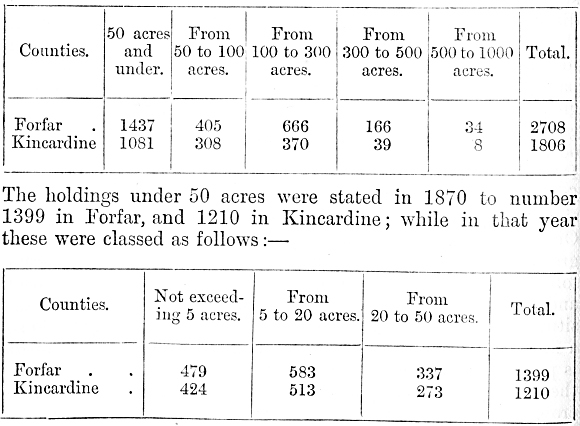
In Forfar, in 1875, the percentage of holdings under
20 acres in extent was 41; above 20 and under 100 acres, 27; and above
100 acres 32. In Kincardine the corresponding figures were 50, 29, and
21. In the first of these three classes of holdings, Forfar stands
nineteenth in Scotland, in the second seventeenth, and in the third
thirteenth. Kincardine stands respectively, twelfth, fifteenth, and
nineteenth.
Buildings, Drains, Fences, and Roads.
Buildings.—The extensive improvements effected on
the leading properties since 1855 in the way of building, draining,
fencing, and road making, have already been fairly well indicated, and
therefore, to say much more here would be superfluous. As to building,
it may safely be said that few counties have made more rapid progress
within the last twenty-five years than Forfar and Kincardine. On many
estates in both counties the farm buildings were pretty good long before
1855, but on the majority of properties they were decidedly behind the
age, not so much perhaps in size as in comfort and convenience. Every
year of the last twenty-five, however, has witnessed improvements on all
hands, and so, perhaps, will every year for some time to come. As leases
expire proprietors either erect new steadings, or enlarge, improve, and
modernise old ones. The tenant in all cases performs the carriages free
of charge, and sometimes also pays a certain percentage on the outlay.
The more general custom now, however, is for the proprietor to erect
houses under an arrangement as to rent agreed upon when the tenant
enters the farm. In almost all cases where new steadings are built,
large wholly or partially covered cattle courts are provided, while
these valuable erections invariably form a prominent feature in
improvements effected on old steadings. The majority of farmers seem to
favour wholly covered courts, but still a good many skilful men prefer
them partly open. In both counties there are still a good many
old-fashioned inefficient steadings, without covered courts, and many
other conveniences that characterise new farm offices, but these are
gradually disappearing. In farm dwelling-houses, too, there has been
great improvement since 1855 ; and, generally speaking, both counties
are fully abreast with the times in this as in most other respects. In
Forfarshire, in particular, there is a large number of farmers'
residences almost mansion-like, both in dimensions and in surroundings.
Few counties have so many resident proprietors. They are indeed very
numerous, and therefore, as might be expected, there are in these
counties a great many gentlemen's seats, many of them imposing mansions,
embosomed in beautiful policies. The houses of crofters and small
tenants are, comparatively speaking, not as a rule equal to those of
larger farmers, but in these also there has been great improvement since
1855. The supply of labourers' cottages is not yet complete, but it has
been increased largely within the last twenty-five years. It is now
rather better than in most other counties north of Perth. In driving
threshing-mills, water is used wherever it can conveniently be obtained;
but still, on a very large number of farms, steam has to be employed.
Drains and Fences.—As indicated in the notes of
our supposed tour a very large sum of money has been expended in these
counties since 1850 in the draining and fencing of arable land. In the
former, in particular, a great deal has been done in both counties, not
only in the draining of new land but also in the redraining of old land.
As in the case of buildings, less or more draining is usually arranged
for at the beginning of leases, tenants always performing carriages and
generally also paying an increased rent or a certain percentage of
interest, generally 5 per cent. In addition, however, to what has been
done in this way by proprietors, the tenants have themselves since 1855
effected a very large extent of drainage. On the whole, it may be said
that both counties are now pretty well drained; but in some localities
still further drainage would considerably improve the quality and value
of the land. Tiles are now used for the most part. Though a great deal
has also been accomplished in fencing within the last twenty-five years,
these counties are probably further behind in this respect than in any
other. The Deeside districts of Kincardineshire are well fenced, mostly
by substantial stone dykes erected by the proprietors since about 1845
or 1850; while there are also some other parts of this county and some
portions of Forfar very fairly supplied with fences,—partly dykes and
hedges, but mostly wire,—but taking the lower districts of the two
counties as a whole, they are greatly deficient in permanent fencing.
Both proprietors and tenants seem more than ever alive to the great
advantages of sufficient fencing on a farm, and there is every reason to
believe that the want in this respect will speedily be supplied. A very
large extent of fencing is being erected every year.
Roads.—Both counties are exceptionally well
provided with roads—alike with farm, district, and county roads.
Probably nowhere in Scotland are the roads more easily maintained or of
better quality than in Kincardineshire, while Forfarshire is but very
little, if any, behind in this respect. The cost of maintenance, charged
against the county rates is below the average in Scotland generally.
Indeed, in some parishes in Kincardineshire, it does not exceed 3d. per
£1—l½d. on proprietors, and 1½d.
on tenants and occupants. The turnpike roads of Forfarshire are over 190
miles in length.
Grain Crops.
The following table shows the number of acres under
all kinds of grain crops at various times since 1854:—
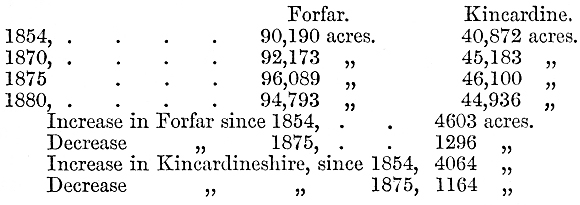
It will be seen that both counties increased rapidly
in the area under grain from 1854 to 1875, the comparative increase
being greater in Kincardine than in Forfar. In common with most other
counties in Scotland these two show a decline in the corn area during
the last few years, the decrease in this respect being represented by a
more than corresponding increase in the extent under grass. The
percentage of the total area of Forfar under corn crops in 1870 was
16.2, and this year 16.6, which places this county eighth in this
respect in Scotland. The percentage in Kincardine in 1870 was 18.2, and
this year 18.1, which places it fifth. In the Board of Trade returns the
counties of Scotland are classed as "pastoral," "corn," and "mixed"
counties. Forfar and Kincardine are ranked as "corn" counties; and among
these, which also include Aberdeen, Banff, Berwick, Elgin, Fife,
Haddington, Nairn, Orkney, and Ross and Cromarty, Forfar stands sixth as
to its percentage under corn, while Kincardine ranks fourth, Fife coming
first with 26.4, Haddington second with 25.3, and Berwick third with
21.6. As to the yield and quality of grain these counties hold their own
pretty well with Scotland generally. In the better parts of Forfarshire
a great deal of very fine wheat is grown; while, in both counties,
barley and oats of the very best quality are produced. The variable
climate makes considerable difference in the times of sowing and of
harvesting between the higher and lower districts. Wheat is sown as soon
as possible in the autumn and winter, and the other varieties as soon
after the middle of March as the state of the land and weather permit.
Most of the grain is now sown by machinery. Drill machines are used
almost exclusively in some of the earlier parts, and with these very
small quantities of seed suffice, thin sowing being largely practised in
Forfarshire. In the earlier parts harvest commences between the 10th and
31st of August, and in the later districts between the 1st and middle of
September. Cutting is almost wholly performed by reapers, and has been
so for several years. It may be interesting to note that the original
inventor of this now indispensable farm implement—the Rev. Mr Bell—was a
native of Forfarshire, and that his invention was first tested publicly
on the farm of Powrie near Dundee. It may also interest and, perhaps
surprise some to know that in parts of Forfar the reaper succeeded
directly to the old-fashioned hand hook, the intermediate scythe never
having been adopted. The work of the harvest is pushed on with great
energy, and often finished in a very short space of time, sometimes,
indeed, in less than a month. On one large farm in Strathmore last
season 200 acres were cut in ten days with two reapers. The cost of
harvesting is usually reckoned at from 17s. to 20s. per acre. Taking all
the varieties together, exclusive of beans and peas, the value of the
grain crop in Forfar may be estimated at about £8 per acre. In the
better localities it is of course considerably higher, but making full
allowance for the falling off in the later and poorer parts, this figure
pretty nearly represents the average value.
The following table shows the average fiars' prices
for the different varieties of grain in both counties from 1872 to 1878,
both inclusive:—
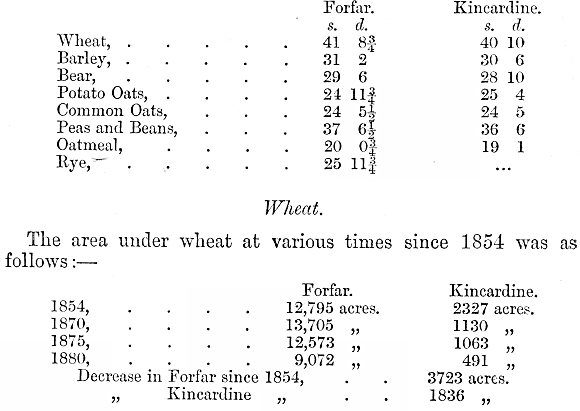
These figures show a very large decrease in the
production of wheat, and indicate clearly that cultivation of this
variety of grain is not nearly so profitable as formerly. It may have
been that ten or twenty years ago wheat was grown on land or at an
elevation not suited to it. To some extent at least, we think that had
actually been the case. By a liberal enough estimate, the extent of land
in Forfarshire calculated to suit the cultivation of wheat, has been
stated at 70,000 acres. Under the six-shift rotation this would give
11,555 acres of wheat every year, or 2150 less than the area under wheat
in 1870, and 2483 more than that last season. The extent in
Kincardineshire considered adapted to wheat is about 4000 acres, which,
under the seven-shift rotation, the most general system in the wheat
growing farms of Kincardine, would give barely 600 acres of wheat every
year. The falling off in the area, however, is due mainly to other
causes, chiefly foreign competition and a decrease in the yield per
acre. There is no doubt that the reduction in the average price of
wheat, caused by foreign competition, has more to do with the decrease
in the area under wheat than any other influence; but it is equally
certain that the profits from wheat have in some degree been curtailed
by a slight but pretty general falling off in the yield per acre. It is
the belief of most farmers, whose experience of wheat growing extends as
far back, that compared with about 1850, the yield of wheat now is less
by from 2 to 3 or 4 bushels per acre. This need hardly be matter for
surprise, for although farmers now, as a rule, manure their land very
liberally, they are, with very few exceptions, groping under a somewhat
dull light, if not altogether in the dark, in the nourishing of their
exhausted land by chemical preparations. It is clearly seen that
continuous wheat growing cannot be accomplished with anything like
success unless conducted by those having an intimate knowledge of
chemistry; and for the same reasons it follows that prolonged wheat
growing in a rotation cannot be carried on with undiminishing success
without the aid of chemistry. Farmers are gradually becoming more and
more alive to the importance of having a knowledge of at least the
elements of the science of agriculture; but unfortunately few of them
have within their reach the means of obtaining such knowledge. If our
mixed system of husbandry is to continue to flourish as it has done in
the past, it would seem to be absolutely imperative that farmers should
be armed with the powerful aid of science. It would be well for the
country if education on all branches of science bearing on agriculture
were within the reach of every young man who intends to make farming his
profession. But we must not digress further. The yield of wheat in an
ordinary year ranges from 3 to 5 qrs., weighing from 60 to 62 lbs. per
bushel. The average would perhaps be about 28 or 30 bushels per acre.
The average yield of straw would be about 40 stones per qr., worth say
14s. Taking the average yield of wheat at 30 bushels, and the price
at £2, 2s. 9d. per qr. (the average of the fiars' prices
for the ten years ending 1878), the total value of an acre of wheat
would be about £9, 16s. 3d. Wheat generally follows potatoes in
the rotation, and is sown as soon as possible after that crop has been
got out of the land, between the end of October and 1st of January. The
coarser varieties are more extensively grown now than formerly. Little
of the Fenton variety is grown now compared to what was at one time.
Clubhead and other red varieties are more in favour. The amount of seed
given ranges from 2 to 4 bushels per acre. Forfar stands second in
Scotland, next to Fife and Haddington, in regard to the area under
wheat. Kincardine ranks eighteenth.Barley.
The extent under barley at various times since 1854
is shown in the following table:—
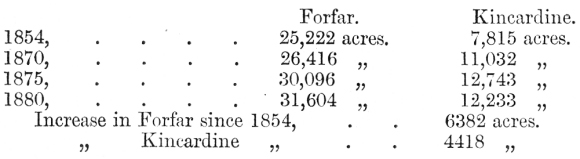
The figures show an increase of more than double the
decrease in the area under wheat. The counties of Fife and Forfar are by
far the largest barley growing counties in Scotland. They usually have
about the same acreage under this variety of grain, but this year Forfar
has the advantage by about 1500 acres. Kincardine stands ninth. On the
whole, barley is perhaps the most profitable variety of grain grown in
these counties. Along with potatoes it is undoubtedly the mainstay in
Forfar, and also in the earlier and better parts of Kincardine. Where so
much feeding is carried on as in these counties, a large supply of good
straw is indispensable; and there is no doubt that, but for the coarse
quality of its straw, a much larger area would be put under barley than
at present. The yield of barley varies from 4 to 6 qrs., the average
being between 36 and 40 bushels per acre. The weight per bushel ranges
on an average from 50 to 54 lbs., 56 lbs. being frequently reached. The
general quality of the barley grown in these counties is undoubtedly
very high. Since 1850 the yield of barley has increased by from 4 to 8
bushels per acre, which has been brought about by the more thorough
draining of the land, the use of more artificial manure and feeding
stuffs, and by better cultivation. From each quarter of barley there
would be about 20 stones of straw, worth perhaps 11s. The average price
of barley for the ten years up to 1878 was 30s. 9d. per quarter.
Supposing 36 bushels were the average yield, the total value realised
from an acre of barley would be about £9. Barley is grown on most farms
after turnips, and is sown between the middle of March and end of the
first week in May. From 2 to 4 bushels of seed is allowed to the acre. A
very large proportion of common barley is grown, but most farmers sow a
portion of Chevalier, Cheyne, or some similar variety.
Oats.—The following table shows the acreage under
oats at different times since 1854:—
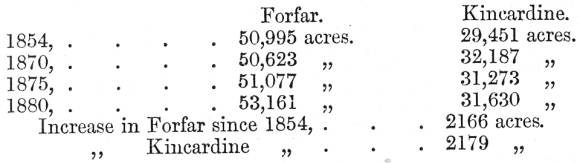
In Forfar there has been less alteration in the area
under oats than any other crop during the last twenty-five years.
Indeed, until within the last five years, it had scarcely increased any.
In Kincardine there has been a pretty gradual and rather more rapid
increase. The greater area under oats is due more to the reclamation of
new land than to its substitution for any other crop. Forfar stands
fourth and Kincardine fourteenth in regard to the extent under oats,
Aberdeen coming first and Banff second. The yield of oats varies
greatly, ranging from as low as 3 to as high as 9 qrs. per acre. The
average would probably be from 36 to 46 bushels per acre. The weight per
bushel averages from 40 to 43 lbs. On the better land much higher
weights are often obtained. From 8 bushels of oats the yield of straw
would be about 24 stones, worth from 12s. to 15s. The average price of
oats for the ten years ending 1878, was £1, 4s. 8d. per qr. The total
value thus obtained from an acre of oats, that yields 46 bushels, would
be about £10, 9s. 10d. Oats are grown mostly after lea, but also largely
after turnips, and in some cases after potatoes. The quantity of seed
varies from 3 to 6 bushels per acre. They are sown between the middle of
March and the end of April. The varieties most largely grown are Early
Angus, English Birley, Sandy, Potato, Black, Pedigree, and other newer
"varieties.
Rye, Beans, and Peas.—The area under rye since
1854 has been exactly tripled in Forfar, the extents being 111 and 333
acres. It has increased in Kincardine from 62 to 82 acres. Beans are
grown pretty largely on some farms, but there is little change in the
area under them since 1854. The extent in Forfar that year was 690, and
last season 605 acres. In Kincardine the area in 1854 was 474, and in
1880 464 acres. In Forfar there were 138 acres in 1854, and 18 in 1880
under peas; and in Kincardine 77 acres in 1854, and 36 last season.
Hay, Grass, and Permanent Pasture.
The following table shows the area of hay and grass
under regular rotation in various years since 1854:—
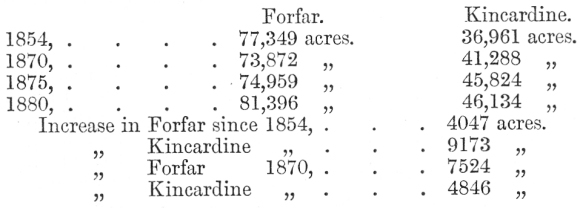
It will thus be seen that latterly a greater extent
of land has been allowed to lie longer under grass than ten years ago.
This is due mainly to the increase in the cost of labour, and to the
fact that experience has shown that turnips are less liable to damage
from "finger and toe" when the land is worked in the six-shift rotation,
which includes three years grass, than in the five-shift system, in
which there are only two years grass. The increasing of the area under
grass also helps to lessen the manure bills, which, of course, is also
an important consideration Near the larger towns in Forfar the grass
land is mostly preserved for cutting, a ready sale and high price being
obtained from cowfeeders for all the hay and fresh grass the farmers can
raise. For this purpose at least three crops are got in one season.
Throughout both counties a pretty large quantity of hay is made, though
not so much, in comparison with the area under grass, as in some other
counties. The yield of hay ranges; from 1¼ to
2 tons, the average on well managed farms being about 1¾
ton, worth about £4 per ton or £7 per acre. The greater part of the
grass land is sown out with barley. In the districts too high and late
for barley the grass seeds are sown with oats. The mixture of grass
seeds sown varies greatly. It. usually includes from 16 to 22 lbs. of
rye grass and from 6 to 10 lbs. of different kinds of clover seeds per
acre. Forfar stands fourth and Kincardine eleventh in Scotland in
respect to the area under grass in rotation.
In both counties there is a pretty large extent of
permanent pasture or grass not broken up in rotation, exclusive of heath
or mountain land. The area in Forfar has increased from 27,225 in 1854
to 27,719 acres this year. In Kincardine the extent has decreased from
13,029 in 1854 to 5797 acres in 1880.
Root Crops.
Turnips.—The extent under turnips at various
times since 1854 was as follows:—
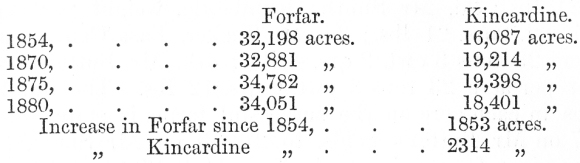
It will be seen that the area under turnips in both
counties had increased gradually up till a few years ago, and that
latterly it has been falling off somewhat. This is no doubt mainly due
to a large breadth being put under potatoes since 1875, and. to a still
greater increase in the area under grass. As previously noticed, many of
the wheat growing farmers have recently been altering from the six to
the seven shifts, mainly with the view of lessening the labour and
manure bills, and of avoiding damage to turnips from "finger and toe."
In the parts where wheat is not grown a large number of farmers are,
with the same view, giving up the five shifts in favour of the "easy"
six with three years grass. These changes, at the same time, involve a
decrease in the area under turnips. In regard to the area under turnips
Forfar ranks second, and Kincardine ninth in Scotland,, Aberdeen being
the highest by nearly 60,000 acres. Generally speaking, the turnip crop
in these counties is both heavy and of excellent quality, though perhaps
barely equal in either respect to the famous crops grown on the granite
soils of Aberdeenshire. The yield varies from 14 to 30 tons per acre.
Even as many as 36 tons are grown sometimes. The average would perhaps
range from 16 to 18 tons. Calculating from the prices obtained within
the last eight or ten years, the average value, if sold to be consumed
off the farm, would be about £1 per ton or £16 to £18 per acre, less the
cost of lifting and conveying to the nearest railway station. If
consumed on the land by sheep, the price obtained ranges from £7, 10s.
to £11, 10s. per acre. If consumed on the farm by cattle the price
varies from £8 to £14. Swedes bring from 15s. to 30s. more per acre than
yellows. Near the larger towns very high prices are generally realised
from the cowfeeders, most farmers in these parts having liberty to sell
all the produce off their farms. In the neighbourhood of Dundee as much
as £22 per acre is very frequently obtained. The cost of growing an acre
of turnips, of course, varies with the rent of the land, the amount of
manure given, and other circumstances.
The report of the judges in the turnip competition in
connection with the Stormont Union Agricultural Association (1880) has
just been issued. The results are as follows:—1st, Mr Playfair, Coupar
Grange, weight per acre 23 tons 15 cwts. 1 qr. 21 lbs.; 2d, Mr Smith,
Drumbeltie, weight per acre 23 tons 6 cwt. 2qrs. 21 lbs.; 3d, Mr Tasker,
East Camno, weight per acre 23 tons 3 cwt. 2 qrs. 4 lbs.; 4th, Mr Buttar,
Corston, weight per acre 23 tons 3 cwt. 0 qrs. 12 lbs. The number of
turnips in each acre on the successful farms is stated at from 20,747 on
Mr Buttar's fields, to 21,940 on Mr Smith's. The manure given for
turnips varies from 10 to 20 tons of farmyard manure per acre, with a
mixture of artificial manure, consisting of guano, dissolved bones, or
bone meal, and a little superphosphate of lime and potash, amounting in
value to from £2 to £4 per acre. In some cases where most of the
farmyard manure is given to potatoes, the yellow turnips get nothing but
artificial manure. Coprolites are being tried to a limited extent. At
Balhousie, Mr Cowe has been specially successful both in the growing of
turnips and potatoes. For turnips he gives from 12 to 15 loads of
farmyard dung per acre, with the following mixture of 10 cwt.—2½
cwt. of guano, 1½ cwt. of bone meal, 4 cwt. of
crushed bones, and 2 cwt. of dissolved bones. Turnips are sown between
the 10th of May and middle of June, some even later. A very large
proportion of swedes is now grown, a small quantity of soft varieties
being sown for early use. A great portion of the turnip crop is consumed
every year by sheep, mostly on the turnip field, but partly also on
grass fields. Many farmers store the greater part of their turnip crop
in good time, but still, as a rule, too little attention is given to
this. The turnip crop is, with the exception of potatoes, the most
costly one grown, and yet, many farmers leave their turnips exposed to
the whole winter's frost.
Potatoes.—The area under potatoes at various
times since 1854 was as follows:—
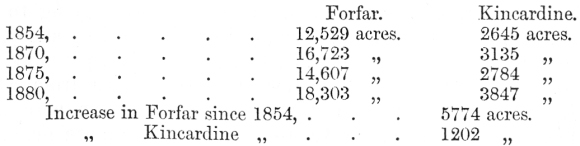
Forfar stands third and Kincardine fourteenth in
Scotland in regard to the area under potatoes. Perth comes first with
21,414, and Fife second with 18,640 acres. It will be seen that within
the last five years there has been a very large increase in the area
under potatoes. Of all the crops grown this is by far the most costly.
In some seasons the cost of the seed amounts to as
much as £5, 10s., and in others it might not
cost more than £3. There is no doubt that potatoes is the most
speculative crop grown by farmers. It is uncertain alike as to yield and
value. In a good year as many as 10 and 12 tons will be lifted on well
managed farms, while in other seasons on the same land the yield may be
less by a half or three-fourths. In a pretty good season a fair average
for both counties would be 5½ or 6 tons per
acre, while it may be reduced by one-half or more by a short period of
unfavourable weather, or, indeed, rendered of very little value by
disease. Prices again vary from £2 to £10 per ton. It often happens, as
this year, that when a full average yield is obtained, and when there is
little or no disease, the price is so small, under £3 per ton, that the
crop cannot be disposed of to advantage. The average yield this year
would perhaps, be about 6½ or 7 tons;
but the price as yet being under £3 per ton, the whole yield of the two
counties, if sold just now, would do little if anything more than meet
the actual outlay in its production. On some farms, however, the yield
reaches as much as 10 or 12 tons, and in these cases from £30 to £40 per
acre will be realised. Last year the average yield was barely one-half
of what it is this year, and yet the price was so much higher that the
crop, taken as a whole, was worth more money than this year. For a crop
of barely one-half the weight of this year's crop, some Forfarshire
farmers last year obtained no less than from £45 to £48 per acre. A
large farmer near Montrose pointed out a field on his farm to us which,
the one year it was under potatoes, had brought him £60, and the other
over £1000. When disease breaks out, and it has occurred very frequently
in recent years, the price for sound potatoes rises so rapidly and to so
high a point, that those who are fortunate enough to escape the disease
obtain something like a windfall. It is doubtful if, during say the last
two rotations, or ten or twelve years, potatoes have been on the whole a
paying crop. Most farmers, who have long experience with them, say they
have not. The speculative element, however, is no doubt a charm to some.
It would seem that each hopes that he may be one of the fortunate few
destined to have a large and sound crop in a year of disease. The wheel
of fortune has undeniable attractions to many. There is no doubt that
during the last few years, when almost all other sources of profit to
the farmer would seem to have for the time become dry, potatoes,
wherever they have been extensively grown, have proved a most important
mainstay. Last year, in Forfarshire for instance, some farmers, who had
little or no grain to sell and made small profits from stock, realised
so much for potatoes that after all the year, most calamitous as it was
to British farming generally, was to them a profitable one. Another
point in favour of the crop is that it is an excellent preparation for
wheat, which is, in almost all parts suited to it, grown after potatoes.
In Kincardine only small patches of potatoes are grown. Potatoes require
liberal manuring, and also run up a very heavy bill for labour. The
expense of planting is being lessened by the adaptation of mechanical
appliances, but as yet planters have not come into general use. Diggers,
however, are to be found on every potato farm. From fourteen to fifteen
loads of farmyard manure are allowed to the acre, with only a little
artificial manure in some cases, but in general a mixture costing from
25s. to 75s. per acre. A few farmers give even more than this. The light
manures most generally used for potatoes are guano, bones,
superphosphates, and potash. The farmyard manure is found to be more
efficacious in the case of the potato crop when driven straight from the
court to the drills, than when it has lain on the field for a time. In
general potatoes are grown after oats; but in some cases they follow
lea, and in these latter instances they often receive nothing but
artificial manure, of which they get a mixture costing from £4 to £5 per
acre. Some farmers spread the dung on the stubble field, and plough it
in during the autumn and winter, but the majority apply it in the drills
in spring. Many farmers are using less artificial manure for potatoes
than formerly, believing that forcing by light manures increases the
liability of the crop to fall a victim to disease. Potatoes are planted
as early in the spring as is convenient. About one-half ton of seed is
allowed to the acre. The varieties most largely grown are champions,
regents, and Victorias. The crop is lifted as early as possible in
October. Sometimes it is sold before being lifted, either by the ton or
the acre. When the price is low, as it is this year, many store potatoes
in pits, and wait in hopes of an improvement in the state of the
markets. A pretty large quantity of potatoes are given to stock when
they are cheap or damaged by disease.
Other Green Crops and Fallow.—Under other
varieties of green crop last season there were 1085 acres in Forfar, and
414 in Kincardine. Mangold 7, carrots 37, cabbage, kohl-rabi, and rape
66, vetches, &c, 975 acres in Forfar—and carrots 28, cabbage, &c, 15,
and vetches, &c, 371, in Kincardine. The area under these crops in
Forfar in 1854 was 835, and in Kincardine 218. Vetches are used mostly
in assisting to feed the cattle stock when the grass begins to fail.
Only a small area is left under bare fallow. The extent in Forfar was,
in 1854, 623, and this year 694 acres ; the figures in Kincardine being
319 and 141.
Cattle.
The following tables show the number of cattle of
different classes in the two counties at various times since 1854:—
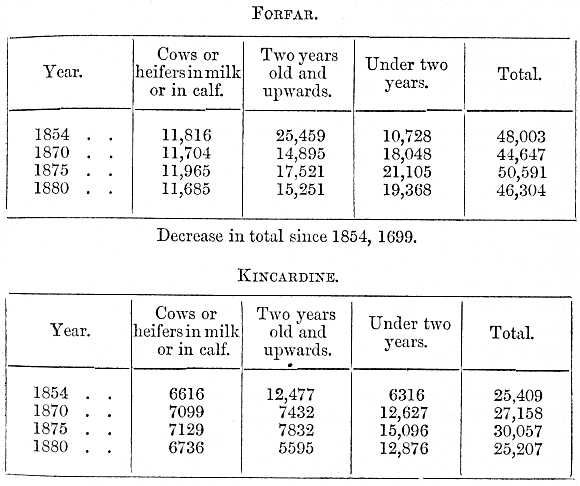
Decrease in total since 1854, 202.
In the returns of 1854, the class "Under two years" comprises calves
only.
It will be seen that the number of cattle in
Forfarshire twenty-five years ago, was considerably greater than now.
This is mainly due to the dreadful manner in which rinderpest devastated
the herds in that county in 1865-66. To recount the progress of that
terrible scourge would perhaps serve no good end. Suffice it to state
that wherever it appeared it swept away almost every animal of
the cattle tribe, dealing out ruin to many a man who would
otherwise have been in comfortable circumstances. It also spread into
the Mearns and some other parts of Kincardineshire, but this county, as
a whole, suffered less severely than its neighbour in the south. There
is no doubt that it gave a very serious-check to the agriculture of
Forfarshire, more particularly to-rearing cattle. Had not many of the
landed proprietors come forward and very generously subscribed to help
the more necessitous to tide over the sad calamity, the consequences
might have been even more serious than they were. Apart from their
pecuniary loss, many even of the more spirited farmers were so
discouraged by the destruction of their fine stock, that for years they
were unable to set to work in thorough earnest to replace what had been
so ruthlessly swept away. At last, however, this feeling, and in most
part also the pecuniary loss, would seem to have been got over, for the
farmers in Forfarshire and the Mearns have for several years been
devoting themselves, with all their wonted energy and success, to
rearing and feeding cattle. In the former the lost ground has not yet
been wholly made up, but there is reason to believe that the increase in
the next ten years will be greater than in the last. The recent rapid
growth of the herds of polled cattle will be afterwards noticed.
In dealing first with the ordinary farm stock, we may
state at the outset that, in the system of breeding, rearing, and
feeding, there is hardly any difference between the two counties. In
neither the one nor the other is breeding pursued quite so largely as
some twenty-five years ago. Latterly, it has been on the increase, but
still it may safely be said that too few cattle are bred in both
counties. There can hardly be any doubt that with freedom from disease,
breeding would pay fully as well on the higher lying and lighter soils
as would either feeding entirely, or partly feeding and partly breeding.
In the later districts at present a good many farmers keep a breeding
stock, and sell off their surplus cattle in lean condition either as
yearlings or two-year-olds, the buyers being generally farmers in the
neighbouring districts. A much larger number keep partly a breeding and
partly a feeding stock. These breed from one-fifth to one-half of the
number of cattle they feed and buy in the remainder at sales or markets.
The great body, however, of the farmers of both counties keep only as
many cows as supply the farm with milk, and perhaps rear from eight to
twelve calves. On many large farms, indeed, not more than three, four,
or five calves are reared. The total number of cows in each county is
about equal to five for every holding above five acres in extent, and on
a very large number of extensive farms the actual stock of cows kept
does not exceed that. The general custom is to buy in lean stock either
in spring, summer, or autumn, and feed them off during the winter and
spring months. The majority are bought in when from fifteen to eighteen
or twenty months old, and, being fed off in six or eight months, are
thus little more than two years old when slaughtered. Some farmers
prefer older cattle, and either keep the cattle they buy in for two
seasons, or buy in two-year-olds and feed them off when a little over
three years. About twenty years ago very few cattle were fed off at so
early an age as two, but now the majority of farmers prefer animals that
suit this rapid system of feeding. By far the greater number of the
home-bred cattle, which are superior to those bought in, are sent to the
butcher when from two to two and half years old, while on the other hand
the majority of those bought in are not fed off till about three years
old. The large majority of the bought in stock come from Ireland, and
are nearly all shorthorn crosses. They are usually large for the price
paid, but they are often rough, and are frequently so badly used in the
journey from their native isle to their ultimate destination, that they
take some time to recover. They are, as a rule, in every respect
inferior to the home-bred cattle, but they are very often the only class
of cattle to be had. They are brought over by Irish dealers, from whom
the farmers in these counties buy them either in markets or at sales,
generally the former. Latterly a few farmers have been trying Canadian
cattle, which are being sold regularly in Glasgow in large numbers. They
are large, but rough and old. They are bought at small figures, however,
and those who have tried them say they have paid well. A few Caithness
crosses have also been brought into Kincardineshire for several years,
while from England and even the eastern states of the European
Continent, occasional lots are introduced. The extent of grass is
limited in the wheat-growing districts, and a very large number of the
bought in cattle do not enter the counties till well through the summer
and in autumn. Generally speaking, the home-bred stock consist of
crosses between either pure-bred shorthorn or polled bulls and cross
cows, the latter being in most cases crosses between these two valuable
breeds. There is no doubt that since 1855 the ordinary cattle-stock,
taken as a whole, have improved greatly, partly from the more general
use of well-bred bulls, partly from more careful selection of cows, and
partly also from better housing and feeding. The early maturing
properties of cattle have received more attention latterly than some
twenty years ago, with the result that home-bred cattle are generally
fed off a year sooner than formerly.
There is so little variety in the system of feeding
pursued, that a few sentences will suffice on this point. On the large
majority of farms, cattle get no artificial food on the fields in summer
so long as grass is plentiful, but as soon as it begins to fail they
receive supplies of green food, such as tares, either on the fields or
in the courts. Then during the greater part of the winter they (we refer
to cattle being prepared for the butcher) are fed solely on turnips and
oat-straw or hay, getting for about six weeks or two months before being
sold a liberal supply of cake, linseed, or cotton, or a mixture of both,
perhaps with the addition of bruised oats and barley. That is by far the
most general system. Others, however, feed much more rapidly, giving a
supply of cake or bruised grain, or both, during the greater part of the
grass season, as well as throughout the whole winter. Some even give
cake to their home-bred stock from the time they are six weeks old till
they are sold to the butcher, and also to their bought in stock as soon
as they are brought home. When turnips are scarce, and when potatoes are
plentiful and cheap, the latter are given freely to feeding cattle,
while the supply of oat-straw has often to be supplemented by hay. The
breeding stock are generally kept in lean condition, and receive no
artificial food. There is little doubt that the feeding of cattle is now
carried on more extensively in both counties
than twenty-five years ago, and that the quantity of feeding stuffs,
such as cake and grain, consumed by feeding stock has increased
enormously since 1855. It should be pointed out that a large number of
cattle is prepared for the butcher in these counties every year that is
not credited to them in the Board of Trade returns. These returns being
collected in spring, cannot include those animals bought in during the
summer and autumn, and sold off before the end of April. The number of
cattle actually fed in these counties is therefore much larger than the
Board of Trade returns indicate. It is hardly possible to give a general
estimate of the weights of fat cattle sold in Forfar and Kincardine.
They vary greatly; two-year-olds range from 5½
to 8½ cwt., and three-year-olds from 6 to 9½
cwt.
There are few points of more importance in connection
with the live stock department of farming than the economising of the
turnip crop, and there are perhaps few matters in which among farmers
generally there is more room for improvement. Latterly many farmers in
these counties have been giving much of their attention to the subject,
with results that cannot fail to be beneficial. There is no doubt
whatever that, generally speaking, farmers would find it to their
advantage to give fewer turnips and more feeding stuffs to the cattle
they are preparing for the butcher. Mr Buttar, Corston, Coupar-Angus,
has for several years been following the pulping system, by which he has
been able to economise his turnip crop to a remarkable extent. Formerly,
Mr Buttar kept scarcely any but feeding cattle, which he bought in
towards the end of summer and during autumn, and fed off by spring, the
greater number being sold off in winter. When housed for
the winter the cattle were by degrees introduced to the pulped food, and
when they had fairly taken to it the following was given:—
Mixture for Ten Feeding Cattle for One Day.
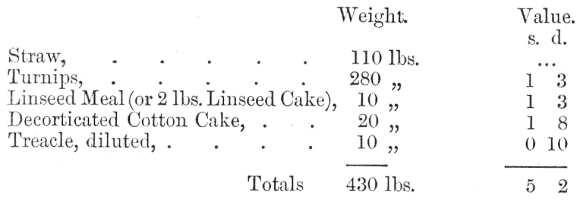
After two months, 20 lbs. of crushed grain, maize,
oats, and barley are added, bringing the total weight to 450 lbs., and
the total to 6s. 10d.—an average weight of 45 lbs., and an average cost
of barely 8¼d. per day. The mixture is given
in two meals a day, morning and evening. Mr Buttar also tried the
keeping of store cattle, and finding pulping better adapted to this
class of stock than to feeding cattle he now feeds only a few. He buys
in lean cattle when about eighteen months old, in the autumn, selling
off the majority in spring in good condition but not fat, and retaining
a number of the best for feeding on grass in summer. For the first two
months they are in the house the lean cattle get the following:—
Mixture for Ten Store Cattle for One Day.
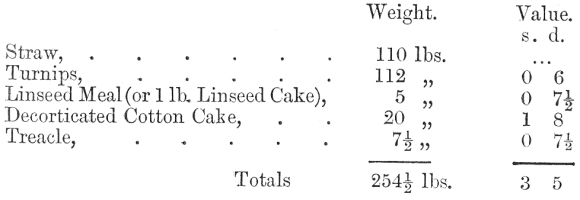
After the first two months the mixture is increased
by about one-third, or to the value of say 5s. 2d., making the average
maximum cost about 6¼d. per day. The mixture
is given in three meals when it has been raised to the maximum quantity.
The following shows the relative cost of the pulping, and the ordinary
systems of feeding store cattle: —
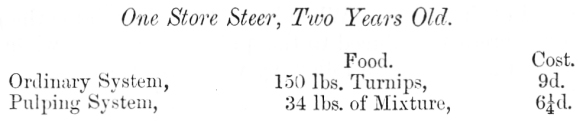
The pulped mixture is made up each forenoon, and
allowed to lie till next day before being used. A layer of straw is laid
down first, then turnips, then cake, and lastly the diluted treacle. The
heap is at once turned over three times, and then left untouched for
close on, but never more than, twenty-four hours. In two hours two men
and a boy make up a mixture for a day's feed to over 120 head of cattle.
The pulping and bruising apparatuses are driven from the turbine wheel
of the threshing-mill, so that there is no extra cost for motive power.
The cattle relish the mixture very much and thrive admirably upon it.
The straw in the mixture, and the supply always within reach of the
cattle, is balanced by the manure.
Polled Cattle.—Probably no more interesting
chapter in a history of the agriculture of these counties could be
written than on the breeding of polled Aberdeen and Angus cattle. It is
a subject of much importance, and has a history of peculiar interest.
The materials, too, are plentiful. In a report such as this, however,
unless it were to be enlarged to the dimensions of a volume, it would be
impossible to enter anything like fully into the matter. A very brief
account must suffice. In a word, it may be stated that the black polled
cattle, now known as the polled Aberdeen and Angus breed, are the direct
descendants of the ancient Angus "Doddies," and
Buchan "Humlies," the native polled cattle of the north-east of
Scotland. There have been much discussion and dissension as to whether
Forfarshire or Aberdeenshire has the better claim to be considered the
cradle of the improved breed; but into that question we do not intend to
enter, nor need we dilate upon the value and importance of this fine
breed, which is every year making greater and greater strides in
popularity, and which may safely be said to have before it a brilliant
and useful future. It is pretty certain that even before the advent of
the present century, the excellent beef producing qualities of the
polled breed had been discovered, and to some degree developed by method
and care in breeding and rearing. It is well authenticated that, about
the beginning of the century, it had attained to considerable popularity
all over the north-east of Scotland, and that soon after several polled
herds were founded in the ancient little county of Angus and elsewhere.
Twenty-five years ago—at the commencement of the period to which this
report specially refers—there were in Forfarshire a large number of
polled herds, valuable, and in several cases very distinguished herds.
Chief among these were the herds of the late Mr Hugh Watson, Keillor;
the late Mr R Scott, Balwyllo; Mr Bowie, Mains of Kelly; the late Mr
Fullerton, Mains of Ardestie; Lord Southesk; Mr W. Whyte, Spott; Mr J.
Lyell, Shielhill; Mr W. Buxton, Farnell; the late Mr James Mustard,
Leuchland; and Mr Goodlet, Beauchamp; while just across the border into
Perthshire were the herds of Mr T. Ferguson, Kinnochtry, and Mr James
Leslie, Thorn. By that time a few herds that in their day had done much
good, had ceased to exist. Among these must be specially noted the herd
of the late Lord Panmure, whose name, through the famous bull Panmure
(51), will for ever be associated with the glossy blacks. Rinderpest
almost annihilated the Forfarshire polled stocks, and the majority of
those herds named have become things of the past. The only ones now
remaining are those at Mains of Kelly, Spott, Kinnochtry, and Thorn; but
within the last fifteen years, the ranks of breeders have been recruited
by the Earl of Airlie, the Earl of Strathmore, Mr Thomas Smith, Powrie;
Mr William Smith, Stone o' Morphie; and Mr Ferguson Balunie. Lord
Southesk, after a long interval, has also just procured materials with
which to found a fresh herd. It may safely be said that the rinderpest
scare, great as it was, has completely died out. Forfarshire is fast
returning to its old love, and numerous as were its polled herds in Hugh
Watson's time, there is every prospect of their being still more
numerous at no distant day.
No one will deny that the credit of being the first
to commence the systematic improvement of the polled breed belongs to
the late Mr Hugh Watson. The intimate friend and occasional host of Sir
Walter Scott,—the associate of the late Mr John Booth, Mr Wetherell, and
other noted agriculturists, most of whom are now no more,—one of the
most extensive, enterprising, and skilful farmers that have ever held
land in Forfarshire, Mr Watson was a strikingly intelligent and
accomplished man. He lived in advance of his time; and, like many other
pioneers who would seem to have made their earthly pilgrimage
prematurely, did not a little to facilitate the onward march of his
fellow-men. In 1808 he commenced a herd of polled cattle. The foundation
consisted partly of six cows and a bull left to him on the farm of
Keillor by his father, and partly of ten of the best polled heifers and
the best polled bull he could find in the great fair at Trinity Muir,
Brechin. Unfortunately, there is no very complete record of Hugh
Watson's practice in the breeding and rearing of his favourite blacks.
The most we know of his method of breeding is, that he "put the best to
the best, regardless of affinity or blood." He evidently pursued
in-and-in breeding to a considerable extent, and also aimed at rearing
up separate and distinct families. He devoted a good deal of attention
to the preparing of animals for shows, and in the hottest contests of
the day he generally carried off the lion's share of the honours. After
a brilliant and useful career of over fifty years his fine herd was
dispersed in 1860. Shortly before, pleuro-pneumonia had dealt it a heavy
blow, and in consequence it did not show to advantage. Moreover, the
times were then unpropitious for polled cattle, and the prices obtained
were comparatively low. The two highest priced cows went to the late Mr
W. M'Combie of Tillyfour and Mr Thomas Ferguson, Kinnochtry, at £64 and
£58, 10s. respectively. That Keillor blood has
exercised a powerful influence in establishing the improved polled breed
there can be no doubt; but as to the real extent of that influence we
cannot stop to inquire.
Of the other early breeders few had a better grasp of
the important subject in hand, or really did more to develop and
perpetuate the good qualities of the polled breed, than the late Mr
William Fullerton, Mains of Ardestie (formerly Ardovie). Had he done
nothing else than establish the foundation of the celebrated Queen
tribe, his name would have been indelibly associated with the breed as
one of the most prominent of its earlier improvers. From his cow "Queen
of Ardovie" (29), by "Captain" (97), and calved in 1836, he founded a
famous and valuable strain; and from her in direct descent we have the
Prides of Aberdeen, the Vines, the Duchesses, the Charmers, the
Victorias, and the Dandies, the first of which, in the hands of the late
Mr M'Combie of Tillyfour and others, attained a fame and value
unrivalled by any family, excepting perhaps the Ericas of Ballindallocli.
Then as to the Balwyllo herd, which was long one of the largest and best
known in the country, we have in several existing herds unmistakable
testimony of its exceptionally high character. Mr Scott's well-known
bulls, "President" (205), "President 2d" (54), and "President 3d" (246),
all appear in the pedigree of the 270 guinea cow "Pride of Aberdeen
9th," in the possession of Mr Auld, Bridgend; while the Balwyllo Queens
have long been well known. On the death of Mr Scott, his mother, who
still survives, carried on the herd successfully, but unfortunately the
plague made sad havoc here also. Both Mr Fullerton and Mr Scott won many
show-yard honours, both in local and national shows. The former lost no
fewer than eighty fine animals from pleuro-pneumonia. The Shielhill herd
produced many excellent animals, notably the bulls "Prospero" and "Tom
Pipes," which were victorious both at the Highland Show at Perth in
1861, and at the Royal Show at Battersea in the following year. Mr
M'Combie stated that he believed no purer stock existed in Forfarshire
than the Leuchland herd, and that he "often admired its purity, style,
and condition," the late Mr J. Mustard having been a moderate but
judicious feeder. This herd also fell a victim to rinderpest. The
earlier Kinnaird herd had a long and useful career. From a very early
period in the century there had been a pure herd of Angus cattle at
Kinnaird; but it was not until the present Lord Southesk succeeded that
the stock was brought out to full advantage. Mr M'Combie says that,
before being annihilated by the plague in 1866, the Kinnaird herd was
"almost the best in the land," and adds that "Lord Southesk spared no
expense in purchasing the finest animals, and had an able assistant in
his brother, the Hon. Charles Carnegie," a gentleman who is not only an
enthusiastic admirer of the breed, but has also an intimate knowledge of
its history and pedigree. The best testimony to the character of Lord
Southesk's herd is to be found at Ballindalloch in the celebrated Erica
family, one of which, "Echo," has just been brought back to the home of
her ancestors by Lord Southesk at the handsome sum of 200 guineas. The
descendants of "Fanny of Kinnaird" (330), are also in high repute. Of
several other defunct Forfarshire polled herds, good testimony is still
to be found in different stocks throughout the country. The Thorn herd
came prominently to the front many years ago. In 1864, Mr Leslie's bull
"President 4th" (368), out of Mr Buxton's "Flower of Strathmore" (479),
and got by Mr Scott's "President 3d" already referred to, was first as a
yearling at the Highland Show at Stirling, and first at the same show at
Inverness the following year. This fine bull was sold by Mr Leslie at a
long price, and was used at Tillyfour.
The Mains of Kelly herd is the oldest now existing.
Founded in 1810 or 1811 by the late Mr Bowie, this celebrated herd has
had a long and brilliant career, made almost romantic by its deadly
struggles and narrow escapes in the days of rinderpest and pleuro-pneumonia.
The actual foundation on the female side was a cow picked up on Mr H. A.
F. Carnegie's property of Spynie and Boysack. From this cow, named "Boysack,"
"Jenny" (55), "Rose of Kelly" (828), and other famous animals were
descended. It is from its achievements in the male line that Mr Bowie's
herd stands out the most prominently. Indeed, it is not too much to say,
that in this respect it has had few if any equals. "Cupbearer" (59),
spoken of as one of the finest polled bulls ever seen, and his equally
famous half-brother "Hanton" (228) are as household words among breeders
of polled cattle. The former, out of "Rose of Kelly" (828), and got by
"Pat" (29), was a noted showyard winner. In 1852 he was purchased by
Lord Southesk at £60, and at Kinnaird he produced many meritorious
animals, including the celebrated showyard bull "Druid" 225. "Hanton,"
also got by "Pat" and out of " Lizzie" (227), was purchased in 1854 by
the late Mr M'Combie of Tillyfour for £105, and he too was the sire of
many excellent animals. Indeed, Mr M'Combie says that "Hanton" with Mr
Watson's "Angus" (45), and with "Panmure" (51) was, in the male line,
his " herd's fortunes." "Hanton" won several showyard honours, including
the first prize at Paris in 1856, where he was placed before "
Cupbearer," who was the older by two years. By rinderpest and pleuro-pneumonia,
Mr Bowie's herd was reduced from ninety-three to twenty-one, but since
then it has almost regained its wonted strength, and numbers over fifty
head. The Victorias, a branch of the Queens of Ardovie, are the most
famous tribe now in the herd, the other leading strains being the
Jennets, the Marthas, and the Lizzies.
In seniority, Mr Whyte's herd at Spott comes next. Mr
Whyte has been breeding polled cattle for about thirty years, and many
of his animals have in reality a longer line of distinguished ancestry
than their recorded pedigrees indicate. A careful judge and enthusiastic
admirer of polled cattle, he has done a great deal in an unostentatious
way to improve the properties of the breed and to add to its popularity.
Most of his stock trace back on the male side to "Othello" (319), bred
by Mr Lyell, Shiellhill, and got by "Tom Pipes," the winner of the first
prize at the Highland Show at Perth in 1861.
Lord Airlie commenced the breeding of polled cattle
about twenty years ago, but it was not till about 1865 that he began to
devote his attention to the subject in thorough earnest. Deeply
interested in all matters affecting agriculture, his lordship devotes
special attention to the breeding of polled cattle, and in a
comparatively short time he has succeeded in bringing his herd to the
front. Among his first purchases were " Victoria of Kelly" (345) from Mr
Bowie, "New Year's Day" (1124), and "Jessica 2d," and several heifers
from Mr Whyte, Spott; while in 1870 and the following year his herd was
largely augmented by important purchases at Mulben, Aldbar, The Burn,
Spott, Thorn, and Mains of Kelly. Subsequently he made selections from
the Easter Tulloch and Johnston Lodge, the Gavenwood, Ballindalloch, and
Tillyfour herds. At the late Mr M'Combie's sale at Alford, in 1874, he
secured at high figures four of the best bred cows and heifers sold,
some of them being of the famous Pride tribe, while at the dispersion of
the Tillyfour sale last August he made the following very important
purchases:— "Pride of Aberdeen 5th" (1174), at 135 guineas; "Pride of
Aberdeen 23d" (calf), at 35 guineas; and "Sybil 1st," at 110 guineas.
The first was the only daughter of the original "Pride" in the
catalogue, and though in her thirteenth year, looked fresh ,and useful.
She has bred several very fine animals, including the "Shah," for which
Mr Ferguson, Kinnochtry, obtained the first prize at the Highland Show
at Dumfries in 1878, "Lilias" of Tillyfour, and "Pride of Mulben," for
which Sir George Mac-pherson Grant, Bart. of Ballindalloch, paid 91
guineas at the dispersion of the Mulben herd. The "Pride" calf is out of
"Royalty" (3053), a very heavy, handsome Pride cow, which was bred by
Lord Airlie, from whom she was purchased by the late Mr M'Combie, and
which at the Tillyfour sale was taken out by Mr Duff of Hatton at 80
guineas. Her other daughter, "Pride of Aberdeen 15th," went to Sir
Dudley Coutts Marjoribanks, Bart. of Guisachan,
at 105 guineas. "Sybil 1st" was bred at Baads, got by the prize bull
"Sir William " (705), and among other honours won the first prize as a
cow at the Highland Show at Edinburgh in 1877, and the first prize and
the challenge cup for the best animal of the breed at the Aberdeen Show
the same year. She is now in her eighth year, but looks remarkably fresh
•and lively. Her daughter, "Sybil 2d," won in the cow class •last summer
(1880) at the Royal Show at Carlisle, and the Highland Show at Kelso,
and also at the Aberdeen Show, where she likewise won the "M'Combie
Prize" for the best polled -animal shown, her chief opponent being the
Marquis of Huntly's famous bull, "Monarch." Animals of so rare merit as
these three can hardly fail to leave their mark upon the herd. Many
coveted showyard honours have lately fallen to the Cortachy herd. At the
last Highland Show the first prize, both in the yearling and
two-year-old heifer classes, went to Lord Airlie, the winner in the
latter class "Pavillion" [We regret to have
to state that since the above was written, this fine heifer ("Pavillion")
has died.] (3772), bred by Mr Hannay of Gavenwood, out of
"Patience of Corskie" (1932), 'and got by "Clansman" (398), having also
headed the heifer class at the Royal Show at Carlisle, and for the
second time won the cup for the best polled animal exhibited at the
Angus and Mearns Show. In addition to these, the Ericas and other noted
tribes are represented in the herd. On the male side, Lord Airlie has
drawn largely upon Ballindalloch blood. At a draft sale in the autumn of
1876, seven cows averaged over 41 guineas each; six two-year-old
heifers, 32½ guineas; and four yearling
heifers, 43½ guineas; while the famous
"Juryman of Ballindalloch," who was used in the herd with great success,
was bought by Mr Grant, Advie, at 57 guineas. Another draft sale was
held at Glamis last September,, when forty-three animals brought an
average of £30, 3s. each.
Though comparatively young, Lord Strathmore's polled
herd is one of the choicest and most valuable in the country. Pounded in
1876, it has been rapidly brought into a prominent position. None but
animals of really high merit, both in breeding and character, were
bought; and as his lordship did not hesitate to pay pretty long figures,
the very best material was obtained at the outset. The first purchases
were made at the Mulben, Ballindalloch, and Drumin sales in 1876;
subsequent selections being made at Advie, Gavenwood, Tillyfour, and
elsewhere. The herd now numbers eleven females and three bulls; the
females being—"Beauty of Glamis" (3515), "Beauty 1st of Glamis" (3314),
"Blanche of Advie" (3588), "Cowslip of Glamis"
(3313), "Echo," late "Evelyn" (4119), "Ellen 2nd of Mulben"' (2358),
"Ellen 1st of Glamis" (3311), "Julia," by "Elcho'" (595), "Mina
5th" (3844), "Sweetheart" (1689), and "Violet of Montbletton."
The valuable sire, "Elcho" (595), bred at Ballindalloch and belonging to
the Erica tribe, presides over the herd, and is to be assisted by
"Bismarck 2nd" and "Knight of the Legion," two very fine young bulls
purchased at the dispersion of the Tillyfour herd at 72 and 40 guineas
respectively.. In September last a draft of the herd was sold jointly
with a draft from the Cortachy herd. Lord Strathmore's lot of twenty-two
animals brought an average of close on £36 each.
Mr Thomas Smith's herd at Powrie is one of the
largest, and. also one of the best, in the country. It numbers close on
sixty head, and combines excellent blood with high individual merit..
The handsome cow, "Ruth," purchased at the Tillyfour sale in 1878, has
done well here, having produced a pair of beautiful heifers. From Easter
Tulloch at various times some very good. animals have been obtained,
including " Mayflower 2nd," the mother of that charming little cow,
"Witch of Endor" (3528),, for which Sir Dudley Coutts Marjoribanks paid
155 guineas at the Tillyfour dispersion sale; "May 2nd" (3727), "May
3rd"' (3728), " Levity" and " Old Jean," the latter a wonderfully fresh
cow of twelve years. The "Mayflower" cow had a very fine-heifer calf
last season, while "May 2nd" herself, a very tidy compact cow of rare
symmetry, has an excellent yearling heifer in the herd. One of the
sweetest cows in the herd is "Naomi" (3730), bred by Mr M'Combie
of Easter Skene, out of "Prudence" (1809) by "Clansman" (398), and got
by " Bachelor of Ballindalloch" (690). For a few years Mr Smith's
stock bull has been "Norman" (1257), bred at Cortachy and got by
"Juryman" (404), while at the Tillyfour dispersion sale he was fortunate
enough to secure at a small figure Lord Huntly's well-known Highland
Society winner, "Monarch" (1182). Mr William Smith's herd at Stone o'
Morphie is not large, but also contains both good blood and high
individual merit. Mr W. Smith has bred many very good animals.
"Griselda" (3877), the highest priced animal at the joint sale held last
September by the Earls of Airlie and Strathmore, was bred at Stone o'
Morphie. Her sire was "Timour 3rd" (1287), a bull that has produced some
excellent stock to Mr Smith. He was bred by Mr F. G. Forsyth Grant of
Ecclesgreig.
The Balunie herd is small but very choice. It was
founded in 1876 by the purchase of "Dido," a heifer, at the Cortachy
sale, the price being 38 or 39 guineas. She was then rather small, but
has turned out well. Her dam went to Kinnochtry at the same time at 69
guineas, and was bought two years before at Tillyfour at 76 guineas. At
Balunie, "Dido" has produced three heifer calves, all got by the "
Shah," and all animals of exceptional merit. Indeed, last summer Mr
Ferguson refused 100 guineas for her and the heifer calf at her foot.
His second purchase was one of the "Heather Blossom" twin heifer calves,
sold at the Corskie sale in 1877, the price being 33 guineas. This
calf's dam went, at the same time, to Mr Pearson of Johnston Lodge at
111 guineas, and its own brother, "Warrior," to the Marquis of Huntly at
155 guineas. She, too, has done well at Balunie, having, along with
"Dido's" heifers, won several local showyard honours. Her first calf,
unfortunately, died; but last season she produced a very pretty heifer.
The remainder of this small but promising herd consists of three females
bred at Kinnochtry.
Mr Thomas Ferguson's herd at Kinnochtry, though in
Perthshire, is so close to the Forfarshire boundary that we may take a
passing glance at it. This valuable herd numbers no fewer than
seventy-eight head, and contains many very fine animals. It was founded
in 1835. Four years after, "Young Favourite" (61), a daughter of "Old
Grannie (1), was purchased, while a few more years brought in the old
grey-tailed cow of Keillor, now known as "Favourite 2nd." From the
former animal the Baronesses and Princesses, are descended, and from the
latter the Favourites. These tribes still form by far the majority of Mr
Ferguson's herd, which is thus, more than any other herd, composed of
Keillor stock. Mr Ferguson has won many victories in the showyard. At
the Highland Show at Dumfries in 1878 his stock bull the "Shah," bred at
Tillyfour, was first in the old bull class, and a Baroness heifer first
in the two-year-old heifer class; while, at the same show at Kelso in
1880, a Baroness bull, of his own breeding and got by the "Shah," headed
the two-year-old class. He has also frequently obtained very high prices
for animals bred at Kinnochtry. At the Highland Show at Perth in 1879 he
sold some young heifers and a young bull for exportation to the United
States of America. At Gwynd the representatives of the late Mr Pearson
have still some very good polled cattle.
Kincardineshire has also played a not unimportant
part in the developing and establishing of the improved polled breed.
The late Mr R. Walker, Portlethen, was, for over fifty years, one of the
leading breeders of polled cattle in the country. He obtained his first
bull, "Colonel," in 1818, and had at that time a stock of good
nonpedigreed black polled cows, most of them having a brown stripe along
the back and also partially light-brown ears. By 1826 his pedigreed herd
was fully established, and he carried it on with great success as long
as he lived. It usually numbered from 80 to 100, but sometimes comprised
as many as 110 or 115. The greater portion was dispersed in 1874, but a
part was retained and is still successfully carried on by his son, Mr R.
B. Walker, who succeeded him in the Mains of Portlethen. The late Mr
Walker's success in the showyard was quite exceptional. Mr M'Combie
says—"It would be endless to attempt to sum up his victories—local,
national, and international—they are spread over such a large surface."
Mr Walker bred a large number of celebrated animals, both male and
female. Among his more noted bulls was "Fox Maule" (305), got by
"Marquis of Keillor" (212), and out of "Matilda Fox" (302), bred at
Mains of Kelly, and got by the famous "Cupbearer" (59). "Fox Maule" won
many showyard honours, and is described by Mr M'Combie as "one of the
best polled bulls ever exhibited." The " Banks of Dee" is also said to
have carried everything before him in showyards, while, in one season,
"his descendants gained seven first and one second prize." One of the
best animals in the herd at the time of its dispersion was "Madge"
(1217), which was secured by Mr William Macdonald for the Marquis of
Huntly. This fine cow has herself achieved many victories, while her
stock have been perhaps still more successful. Her son, "Monarch," now
at Powrie, won first prize both at the Aberdeen and Highland Shows in
1880; while, at the former, the special prize for the best family of the
breed, consisting of a cow and two or more of her own produce, was
awarded to "Madge" and her stock, against a very fine group of "Ericas"
from Ballindalloch. "Madge" was bred at Tillyfour.
The late Mr Hector, Fernyflat, was long an extensive
and successful breeder of polled cattle. He secured the best of blood,
and produced stock of a very high character. He won many prizes at both
local and national shows. Mr Hector was recognised as one of the best
judges of black polled cattle of his day. After his death the herd was
carried on by his son-in-law, Mr Arthur Glennie, who succeeded to
Fernyflat. The latter died in 1875, and in the following year the herd
was dispersed. Among others who for some time bred polled cattle in this
county, we may mention the late Sir Alexander Burnett, Bart. of Leys;
and his son, Sir Thomas Burnett, Bart.; and Mr P. Davidson of Inchmarlo.
Colonel M'Inroy, The Burn, has for a long time had some good polled
cattle; while, latterly, Lord Clinton has been breeding a few.
Mr F. G. Forsyth Grant of Ecclesgreig, St Cyrus, has
a small but very good herd, containing some excellent Forfarshire blood
from Balwyllo, Mains of Kelly, and elsewhere. He was the breeder of "Timour
3rd" (1287), a bull that, in the neighbouring herd of Mr W. Smith, Stone
o' Morphie, already noticed, got some very fine heifers. At Johnston
Lodge, Mr Pearson has a valuable herd, numbering fifty head. Most of the
cows belong to Ballindalloch, Bothiemay, and Balwyllo strains; while the
bulls used were bred at the Thorn, Portlethen, Tillyfour, and Gavenwood,
the one bred by Mr Hannay being now in use. One of the most important
purchases was the fine cow, "Heather Blossom," at the Corskie sale in
1877 at 111 guineas. The herd was founded in 1869, and has been
successfully and carefully conducted.
Sir Thomas Gladstone, Bart., of Fasque, has a herd
that displays good breeding and excellent character. It numbers about
thirty head. At the Balwyllo sale in 1863, the cow, "Eugenie" (458) and
the bull "Randolph" (389), were purchased, and from these the main
portion of the herd is descended. The cow's granddaughter, "Eugenie"
(3910), a thick massive fresh looking ten-year-old cow still in the
herd, has produced no fewer than eleven calves, the majority being
females, also still in the herd. Herself a good looking cow, her stock
as a lot would be very difficult to beat, being strong, thick, well
formed, and richly covered with flesh, and good milkers. Some of them
have carried everything before them in the local shows. There is also
some Easter Skene blood, through "Nigris," in the herd. Sir Thomas has
been lucky with his bulls. At a sale at Portlethen in 1869, Mr Murray,
his local factor, secured at a small figure the bull calf "Adrian," and
so well did that animal turn out, that at Kelso in 1872 he headed a
strong class of aged bulls, and was considered one of the most complete
bulls seen for years. At the Aboyne sale last year (1879), Mr Murray
purchased, also at a small price, the bull calf "Diamond," by "Waterside
King" (870), and out of "Daylight" (1478), by "Clansman" (398).
This bull has also done remarkably well, being a large, handsome,
stylish bull. He won the cup for the best pure bred animal in the
Kincardineshire Show last summer, and will in all probability gain still
higher honours.
By far the largest polled herd that exists now, or
has ever existed, is that owned by Mr James Scott, of Easter Tulloch.
For a long time Mr Scott has been breeding black cattle, and partly
through the prolific character of his stock, and through purchases, his
herd had a few years ago assumed great dimensions. It numbered at one
time not far short of 200 head. Within the last two years over fifty
head have been sold, chiefly at Aberdeen, but still the herd is by far
the largest of its kind existing. And not only is it large, but it also
contains many animals of more than average individual merit, and of
really good breeding. His herd is invariably kept in lean condition, and
it is seldom that he feeds for the showyard. His stock has, however,
carried off many prizes, while in the possession of others. The highly
satisfactory manner in which Easter Tulloch stock thrive and breed with
those that purchase them is quite proverbial, and this is no doubt
mainly due to the moderate, indeed almost spare, system of feeding
pursued by Mr Scott, and also to the fact that his cattle spend much of
their time in the open fields. There is a good deal of variety in the
herd, containing as it does representatives of the Kinnochtry, Southesk,
Balwyllo, Keillor, Ballindalloch, Tillyfour, Portlethen, Fernyflat, and
several other herds. One of his own oldest tribes is the Blue Bells,
descended on the female side from "Bess," a cow bred by Mr Robert Scott,
Upper Tulloch, and on the male side from "King Henry" (390), bred by
Lord Southesk, out of "Kathleen of Kinnaird" (339), a well-known prize
winner and got by "Windsor" (221), the famous "Tillyfour," son of "Hanton,"
for which Lord Southesk paid £180 in 1858 to the late Mr George Brown,
Westerton. Some very fine bulls were bred from the Blue Bells, notably
"Bluebeard" (648), the winner of the first prize in the two-year-old
class at the Aberdeen Show, and also at the Highland Show at Inverness
in 1874. He was one of the best two-year-olds ever seen in the Aberdeen
Show, and it is to be regretted that his career was curtailed by foot
and mouth disease, to which he fell a victim in his third year. But of
all the really good animals bred by Mr Scott, and descended from his
stock, perhaps the most celebrated is the beautiful three-year-old cow
"Witch of Endor" (3528), already referred to. She was one of the fine
group with which the late Mr M'Combie "swept the field" at the Paris
Exhibition in 1878. Got by the Easter Skene bull "Valiant" (663), she is
out of "Mayflower 2nd, of Easter Tulloch" (3521), now at Powrie, and got
by "Emperor of Easter Tulloch" (396), which was bred at Ballindalloch.
Shorthorns.—Shorthorn breeding has almost ceased
to exist in Forfarshire. It was never pursued to any great extent, but
some time ago there were a few fair-sized and well-bred herds in the
county. The largest, and perhaps also on the whole the best, was that
carried on for about thirty years, first at Kincraig near Brechin, and
latterly at Old Montrose, by Mr Charles Lyall. Among his first purchases
were four animals from the late Captain Barclay of Urie, while from
other herds well-bred females were subsequently obtained. The stock
consisted of mixed Booth and Bates blood, and Mr Lyall having frequently
gone to the noted English herds for his bulls, the best strains were
engrafted upon his herd. Among the sires used were Lord Dunmore's "Crown
Prince" (28,281), and Colonel Kingscote's "Duke of Dursley" (25,953),
the latter having been the last bull used in the herd. The herd had
become a large and very flourishing one about 1860, but in 1865
rinderpest killed no less than fifty-six, leaving only a very few that
were enclosed in a garden surrounded by a high wall. With these few and
others purchased, a fresh start was made, and in a short time a large
and very good herd was again established. In October 1874, however, it
was dispersed. The average obtained for thirty-eight head was about £30.
Mr Lyall has still a few shorthorn cows, but has not again entered into
shorthorn breeding with thorough earnest. With animals of his old herd
he won many prizes. Previous to the outbreak of the rinderpest, Lord
Airlie had a good shorthorn herd for some time at Cortachy; while others
who bred a few shorthorns for a time have also given them up. The chief
shorthorn breeders now are Mr Arklay of Ethiebeaton, Monifieth; Mr
Granger, Pitcur, Kettins; Mr Hume, Barrelwell, Brechin; and Mr Arnot,
Mains of Glamis. The herds of these gentlemen, however, are small. Mr
Arklay's stock bull "Master Toddles" (40,331), was highly commended in a
very strong class at the Highland Show at Kelso in 1880.
Though shorthorn breeding is now carried on only to a
very limited extent in Kincardineshire, yet this county figures
prominently in the early history of the shorthorn in Scotland'. Probably
no name is so closely associated with the introduction of the
fashionable "red, white, and roan" into the north of Scotland as that of
the late Captain Barclay, from whose celebrated herd at Urie the
ancestors of a great many of the shorthorns now in the northern counties
were obtained. Captain Barclay's herd was founded in 1829 by the
purchase of " Lady Sarah," the best cow at Mason's famous sale at
Chilton. Subsequently, selections of well-bred cattle were made, and a
very choice herd established. In 1836 or 1837 these were sold off; but
soon after, Wetherell, the great auctioneer, was commissioned to select
in England and send to Urie a foundation for a fresh herd. Ten heifers
were sent, and it is stated that they were not of very high merit. A
stock bull, however, "Mahomed" (6170), a son of the old cow "Lady
Sarah," was brought back, and his influence produced a wonderful effect.
From these ten heifers a great number of the shorthorns now in the North
of Scotland are descended, and there is no doubt that their good
qualities are largely due to the "Mahomed" cross.
Horses.
The following figures show the number of horses in
the two-counties at various times since 1854:—
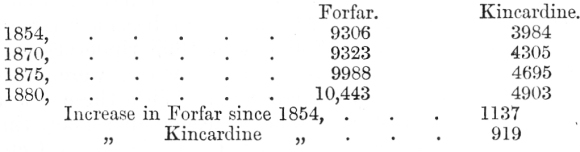
There is an apparent slight decrease in the number of
horses in Forfarshire this year as compared to twenty-five years ago,
but in reality this is not so. The Board of Trade returns prior to 1869
included horses belonging to all classes of the community, and now they
include none but those owned by occupiers of land. About twenty-five
years ago, the number owned by occupiers of land did not exceed 9500, or
nearly 1000 fewer than were returned last spring. In Kincardineshire, as
will be seen, there has been a pretty large increase. Of the horses
returned in Forfar this year, 8451 are used solely for agricultural
purposes, the other 1992 being unbroken horses and mares kept for
breeding purposes. The corresponding figures for Kincardine are 3863 and
1040. On most farms, as many horses are bred as maintain the force
required; but breeding for sale is carried on only to a very limited
extent. The exorbitant prices reached for horses a few years ago gave a
great spurt to breeding for a time; but, with the recent fall in prices,
matters have in this respect resumed their normal condition. It is
seldom that horse breeding is found to be profitable on farms where the
ordinary mixed system of husbandry is pursued.
There is perhaps no part of the country where men and
horses accomplish more work than in these counties. Both are well fed
and well housed, and are perhaps quite as well worked. On the heavier
soils, from 50 to 60 acres of land are allotted to each pair of horses,
the extent in the lighter districts ranging from 70 to 80. Since 1855
there has undoubtedly been great improvement in farm horses, mainly
through the introduction of superior Clydesdale stallions, in which
respect the agricultural associations and many of the landed proprietors
have done good service to the country. The farm horses, as a rule,
partake much more than they did twenty years ago of the Clydesdale
stamp. They are, generally speaking, of a very good class, strong,
active, and hardy.
Throughout both counties there are a good many
well-bred Clydesdales. The best stud unquestionably is that which Lord
Strathmore has carried on at Glamis, with so much success and such great
benefit to the country for well nigh twenty years. This stud was founded
in 1869 by the purchase of "Maggie" (404) then two years old, and
shortly afterwards of other two mares from the celebrated stud of Mr
Anderson, Gillespie. The first stallion used was "Lofty 4th" (461), and
from him and these mares several excellent foals were raised, all of
which were sold with the exception of "Miss of Glamis" (406), the dam of
"General Lee." In 1871 the "Prince of Renfrew" (664) was used, being
followed the next two seasons by the famous horse "Clansman" (150),
whose sudden death put an untimely end to a very useful career. The
present stud horse, the "Thane of Glamis" (855), got by "Clansman," was
next obtained, and from him, as from the others, some very good stock
has been produced. The stud at present numbers eight mares, all
well-bred, of good form and in the best breeding condition. They are as
follows:—"Maggie of Glamis" (404); "Miss of Glamis" (406); "Susie of
Glamis" (408); "Flora of Glamis" (410); "Duchess" by "Thane of Glamis"
(855); "Darling," also by the "Thane"; "Countess," by "Farmer" (286);
and "Victoria" by "Victor" (895); and out of "Maggie" (404). Mr Watson,
Ochterlonie, not far from Glamis, has a few very good Clydesdale horses,
and has been winning prizes at the Glasgow Show with fillies of his own
breeding. Mr Whyte, Spott, who is a good judge of horses as well as of
cattle, has also bred some very good horses; while Mr Bruce, Jordanston,
Meigle, and others throughout Forfar, have two or three good Clydesdale
mares. In Kincardine there are a good many well-bred Clydesdale horses,
at Johnston Lodge, Pittengardener, Fasque, Portlethen, and elsewhere;
but there are no studs kept for the special purpose of breeding. Mr
Baird established a very fine stud at Urie a few years ago, paying very
high prices for his animals; but they were all dispersed recently. The
late Mr Walker, Portlethen, who was an excellent judge of all kinds of
stock, always kept a very fine lot of horses on his farms, the majority
of them being either jet black or grey in colour.
Sheep Farming. Sheep farming is carried on
extensively in both counties. The hills are, on the whole, fairly well
adapted for it. The winter is somewhat severe on the higher reaches, and
there is rather too much black ground for the extent of green land. With
very few exceptions the sheep-runs are safe and sound. The Grampian
range in Forfarshire is intersected by several extensive and beautiful
glens, drained by numerous waters and streamlets, alongside which, and
on all the lower stretches, there is a good deal of excellent green
pasture. Half way up the heights there is, as a rule, hardly any
vegetation excepting heather ; while a little higher in many cases we
find little or nothing covering the rocky surface. The scenery displayed
in some of these glens is very grand, and in the summer they are popular
resorts for tourists and other pleasure seekers. The extreme west of the
hilly division of the county is bound in by Glenisla, the parish of
which extends to 41,375 acres. In this large glen there are some good
arable farms, several very good grazings, and a large extent of
excellent shooting ground. The smaller glen of Lintrathen lies on the
south-east, while on the north-east of it, again, Glen Prosen and Glen
Clova stretch away back past the top of Lintrathen, and join Glenisla on
the watershed near the boundary of Perthshire. Of these glens, Glen
Clova is rather the best. Its flora is remarkably rich, containing as it
does many rare plants. The haughs by the watersides are cultivated and
held mostly in small farms, on which a good many cattle are bred and
sold as yearlings, or when eighteen months old, to farmers in the lower
parts of the county. Most of these small tenants also keep a number of
blackfaced sheep, and rear greyfaced lambs, which they sell to the
larger sheep farmers. There is a large extent of green land in Clova,
the hillsides in some parts being ' partially green up to a high
elevation, while almost to the tops the heather is mixed with "month" or
"moss" grasses. In Glen Prosen, the lower portion in particular, there
is also a good deal of green land. Glen Moy and Glen Ogle are offshoots
from Glen Clova, and they too contain some good land, and also carry
some very fine flocks. The greater part of the northwestern portion of
the hilly range is occupied by Glenesk and Lethnot, the former being the
largest glen in the county. Generally speaking, these glens also contain
less green land than Clova, the greater portion being covered with
heather, mixed here and there with month or mosses. On the lower parts,
how-ever, there are many bogs and swamps, which, when surface drained,
afford rich pasture. Passing into Kincardineshire, the hilly range
retains its black heathy aspect on the heights all through Glendye, and
as far north-east as the junction of the parishes of Durris, Fetteresso,
and Glenbervie. As in Glenesk and Lethnot, there is a good deal of green
land in the valleys in the Kincardine range; but here also the hill tops
as well as the sides far down are covered almost solely by heather. It
is, however, a peculiar but proverbial fact, that the heather in Glendye
is of. finer quality than in most other parts of the Grampian range. It
is supposed to be sweeter, and not so rough and strong as in the greater
portion of the higher hills in Forfarshire. The larger part of the hilly
range of both counties is devoted to sheep farming; but in Forfarshire
there are several extensive deer forests, the dimensions and number of
which have been considerably increased since 1855.
The following table shows the number of sheep in both
counties at various times since 1854:—
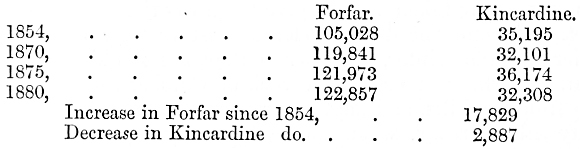
It would seem that the number of sheep in Forfarshire
has been gradually increasing, and it is equally clear that latterly
Kincardine has been going the other way. Between 1854 and 1870 there had
been an increase in Kincardine, the number in 1869 having been 41,031.
The increase in the arable area of the cattle stock is no doubt partly
to blame for the decrease in the sheep stock since 1870. A good many
farmers who for several years after the outbreak of rinderpest fed or
wintered a large number of sheep, have now abandoned this system, and
keep cattle for all. The sheep stock paid pretty well, but many farmers
found that under sheep their land was beginning to produce too much
straw, and that the grain was becoming lighter in weight than formerly.
As in regard to cattle, the stock kept and general system of management
in the two counties are very simi-lar. The Blackfaced breed has the
field almost entirely to itself. Occasionally a few Cheviots have been
kept, but at present there are no regular flocks of this breed. The
stock consists mainly of Wethers of different ages, bought in as
lambs at the great Lanark market. Breeding is carried on only to a very
limited extent. Most of the small tenants along the foot of the hills
keep small flocks of blackfaced ewes, and from these and Leicester tups
they raise a very good class of greyfaced hoggs, which they generally
sell to be fed on arable farms in the lower parts of the county. A few
of these small tenants rear purebred blackfaced lambs, and of these the
wethers are sold to larger farmers to make part of their stock, while
the ewe lambs are retained by themselves to replenish their ewe stocks.
On the lower and greener parts of the larger grazings, a few ewe stocks
are also kept. The largest breeding stock belongs to Mr William Whyte,
Spott, who, with his father and brother,, also owns the largest general
flock. Mr Whyte's flock of ewes numbers about 1000 head, and they are of
a very high character. He is careful to use good tups and also feeds
well, and thus rears a class of wethers that are invariably about the
best reared in the northern half of Scotland. The system of management
will perhaps be best understood from a brief sketch of the treatment a
flock receives from the time it is bought in till it is sold off as two
and a half or three and a half year olds. When taken home from Lanark
the lambs are washed or dipped. For a short time they are kept on clean
land preserved specially for them, care being taken not to give them too
rich pasture at the. outset. If commenced on moderate pasture they are
usually hardier for the winter, than when they are fed highly at the
outset. In the first or second week of October they are taken down from
the hills, and kept on grass in the lower parts of the county till
February, when they get a daily supply of turnips, the cost of this
system of wintering ranging from 4d. to 10d. a head per week. They are
returned to the hill about the second week in April, and are clipped
about the 20th of June, being taken down again about the first or second
week of October, and wintered on grass as the first winter, excepting
that if they are not to be sold three and a half years old they receive
no turnips. When they are to be sold off when two and a half years old,
they are wintered almost as well as when hoggs, receiving a liberal
supply of turnips. In their second and third years they are dipped
before being sent to the wintering. A much larger number is now sent off
when two and a half years old than formerly, which is in the main the
result of a more liberal system of feeding during winter, and of the
early maturing properties of the breed being made the subject of more
special care. When sold the large majority are in pretty high condition,
many almost fit for slaughter, the general time for selling being about
the middle of October. The large majority are sold at local markets,
some being sold at home by auction and others sent to auction marts.
From the higher reaches the whole stock have to be withdrawn during from
six to twelve weeks according to the character of the weather; but on
the-
lower and better parts, a good many wethers and ewes
are retained during almost the whole winter, being shifted only when a
very severe snowstorm sets in. Generally speaking, sheep are much better
wintered now than twenty-five years ago, and on the whole there has been
a slight improvement in the character of the stock, though even as far
back as 1855 a very high class of sheep was kept in these counties. The
only changes in the system pursued since 1855, are that a greater number
of sheep are bred, and that a much larger number of the wethers are now
sold off at two and a half years old. Indeed, nearly one-half of the
whole stock is now sold off at that age. Breeding stocks, of course,
require rather more careful management than the wether flocks. The tups
are let loose about the 22d of November. The ewes are taken to low
ground for a short time when their regular runs are deficient in
pasture, or when there is a heavy snowstorm on the hills; but they
receive no turnips. In a good year a lamb for almost every ewe is reared
in some flocks, ninety per cent. being about the average. Among lambs
the annual death-rate is about five per cent., and among older sheep
from two to three. In exceptionally bad seasons, of course, the loss by
death is much greater than this, but on the other hand it is sometimes
less. Of every one hundred wether lambs bought at Lanark, probably about
ninety are sold when two and a half or three and a half years old. The
death-rate among ewes is not, as a rule, much higher. Ewes are generally
sold as "casts" when four or five years old, most generally five. Ewes
are a week or two longer in being clipped than wethers. The average
yield of wool from ewes would be from 3 to 3½
to 4 lbs.; from hoggs, 3½ to 4¾
lbs.; and from wethers, 4 to 5½ lbs.,
sometimes even as much as 6 lbs. The whole stock on some of the better
farms, when well wintered, averages close on 5 lbs. a head of unwashed
wool. The large majority, however, are rather below that. The dipping
mixture used, to which a little castor oil is occasionally added, costs
from a 1d. to 2d. a head. None are smeared now. The wintering of hoggs
or lambs from the middle of October till the second week in April, costs
from 7s. to 10s. a head, the average being about 8s. or 8s. 6d. For a
shorter period, and without turnips, older sheep cost from 3s. to 5s. a
head. The rent of sheep farms has risen fully as much as that of arable
land since 1855. It has increased by about 25 per cent. since 1860. For
grazings on which sheep cannot be kept during winter, the rent averages
from 3s. to 4s. per head of the stock the farms maintain; while for
breeding and wintering land it ranges from 6s. to as much as 10s. a
head. For one large farm in the northeastern division of the county of
Forfar, now rented at £400, the rent paid thirty years ago consisted of
one hundred three-year-old wethers. Shepherds' wages have almost doubled
during the past twenty-five years. In the winter season each shepherd
has from 400 to 500 sheep under his charge, the "hirsels" in summer
ranging from 500 to 1000 each. The duties of the shepherds have been
lightened greatly since 1855 by the erection of a large stretch of ring
fencing, erected mostly by the proprietors, the tenants paying interest
on the outlay. Many of the grazings have also been greatly improved
within the past twenty-five years by surface draining, effected partly
by the proprietors, but mostly by the tenants. Very few sheep are lost
by drowning, and both counties are on the whole remarkably healthy for
stock. It is seldom that disease of any kind breaks out among the
flocks, but occasionally braxy causes loss when great care is not taken
to shift the hoggs and wethers in good time for wintering. At Lanark the
wether lambs cost from 11s. to 15s. a head, and when sold at three and a
half years old bring £2 or more, while they weigh on an average about 58
lbs. Some of the better stocks, such as those of the Messrs Whyte, Mrs
Kennedy, Glenmoy, and others, often reach 64 lbs. a head. In Glendye,
Sir Thomas Gladstone, Bart. of Fasque, has the largest single sheep
stock in either county. It numbers about 4000 head, from 700 to 800
being ewes and the remainder hoggs and wethers. The large majority of
the surplus wether stock go to the southern counties to be finished for
the butcher; but during the last fifteen or twenty years a pretty large
number are fed on arable farms in Forfar and Kincardine, on grass,
turnips, hay, cake, and grain.
Throughout the arable districts of both counties a
large number of sheep of different kinds are reared and fed. A good many
arable farmers also hold grazings; and in addition to wintering their
hoggs on their arable land, also feed on it a number of their wethers.
Other farmers, who have no hill grazings, buy in wethers for feeding;
while a still larger number breed for themselves a lot of cross-bred
lambs. Some buy in cast blackfaced ewes early in autumn, and from these
and Leicester tups, rear greyfaced lambs, which they fatten and send to
the butcher in June and July, The ewes are also highly fed all the time,
and are usually fit for slaughter within a month after the lambs leave
them. A number of farmers have for some years been rearing a very fine
class of lambs from half-bred ewes and Shropshire tups. With this kind
of stock Mr Buttar, Corston, has been exceptionally successful. He buys
in about 200 cast half-bred ewes (crosses between Cheviot ewes and
Leicester tups) at the St Boswell sales about the middle of September,
taking care to select those hailing from high-lying sound land. When
taken home they are dipped and put on clean pasture, not too luxuriant
at the outset. For about a month or so before the rams are let loose,
and during all the time they are out, the ewes are kept on the best
grass on the farm, a little rape being provided for them when possible,
the object being to put the ewes into a rapidly improving condition at
the rutting season. This, Mr Buttar finds, has a powerful influence in
increasing the crop of lambs. When within about six weeks of the lambing
time the ewes get a supply of turnips, about 1 ton to the 100 ewes per
week; when turnips are scarce, a little bran or brewer's grain is given.
The ewes are thus strong for the lambing and full of milk, which gives
the lamb an excellent start. During the whole season the extra food is
continued, each ewe and its lambs getting, in boxes on the fields, about
2 lbs. a day of a mixture of bran, linseed, and cotton cake, and some
bruised oats. By this liberal system of feeding, the ewes and lambs
fatten at the same time, and go away together, the last being usually
sent away about the end of June or first of July. The cost of the
feeding from the time the ewes are bought in, say the 15th September to
the end of January, is about 4d. a head per week, and from the 1st of
February to the end of June, by which time both ewes and lambs have been
fed and slaughtered, about 1s. a week for each ewe, including what the
lamb's consume. In a specially good year two lambs are reared for every
ewe; this was done on Corston last season; but the average is about
three lambs for every two ewes—300 lambs for 200 ewes. The lambs sell at
an average of about £2 a head; they often bring more; while, including
the wool, the ewes bring about 10s. a head more than their purchase
price. This would give an income from the 200 ewes of about £700 to meet
feeding and other expenses—a profitable transaction certainly. And in
addition to this, it should be remembered that, through such liberal
feeding on the fields, the land must be greatly enriched. Mr Buttar
keeps about fifty pure-bred Shropshire ewes, and rears his own tups.
From experience he has been led to use none but tup lambs among his
half-bred ewes, allowing one tup for every 30 ewes. Several other
farmers throughout the two counties also pursue a liberal and skilful
system of rearing and feeding cross-bred ewes and lambs, and as a rule
it leaves a satisfactory profit.
In Forfar there are several very good flocks of
Border Leicesters, notably those belonging to the Earl of Dalhousie; Mr
Cowe, Balhousie; Mr Goodlet, Bolshan; Mr Lyall, Old Montrose; and Mr
Tailor, Bed Castle, Arbroath, and others. Lord Dalhousie's flock numbers
about eighty ewes, of the best strains in the country. Mr Cowe's stock,
numbering over fifty, are descended from five very fine ewes, selected
fifteen years ago from the flock of the Messrs Clark, Oldhamstocks. Both
these flocks show excellent breeding, good shapes, and fine quality. Mr
Goodlet's flock, one of the best in the country, was established in 1863
by selections chiefly of Mellendean blood, subsequent additions being
made of Courthill, Costerton, Castlemains, and Blainslie strains, while
high-priced tups from the Polwarth, Blainslie, Castlemains, and
Mellendean stocks have been used. The Bolshan shearling tups brought the
highest average obtained at the Perth Border Leicester sale in 1880. At
Kinnochtry a large and very fine flock of Border Leicesters is kept;
while Mr Johnston, Cairnbeg, Laurencekirk, has a very well-bred stock,
tracing mostly to the flocks at Oldhamstocks and Castlemains. At Powrie
near Dundee, Mr Thomas Smith has a large and very fine flock of English
Leicesters. It numbers about 120 ewes, and has been bred at Powrie for
thirty-five years. Tups are introduced at high prices from the best
English stocks, and the general character of the flock is indeed very
high. The animals are beautifully formed, stylish, and of very fine
quality.
The rapidity with which crosses from Shropshire tups
are gaining in popularity gives special importance to the few very fine
stocks of pure Shropshires kept in Forfarshire. That belonging to the
Earl of Strathmore is both the largest and best. Shropshires were first
brought to Glamis about 1862, with the view of breeding lambs to fatten
on turnips, and of seeing whether or not they would suit the climate.
The trial was most successful. They were found to suit the climate well
and to please the butchers admirably, being "heavy killers" and full of
lean mutton. Therefore in 1867 a visit was made to the great annual sale
at Shrewsbury, and twenty one-year-old ewes and a couple of rams were
purchased as a foundation for a flock at Glamis. The ewes came from the
celebrated flock of the late Mr Price Bowen, and were by the famous tup
"Maccaroni," while the rams were bought from the Messrs Crane. In the
following year another lot of twenty ewes was bought, including the
first prize yearlings at Leicester; and at the same time a ram was
purchased from Mr Mansell, and got by " Conservative," who was the sire
of the first prize ewes at the Highland Show at Dumfries in 1878. Again,
in the following year the highly-commended ram at the Royal Show at
Manchester was purchased at 40 guineas, and from him was bred the first
prize ram and also the first prize ewes at Kelso, and also the first
prize ewes and the second prize ram at the Royal Irish Show at Belfast
in 1880. In 1870 the renowned "Standard Bearer," the first prize winner
at the Royal Show at Bedford, was introduced; while about the same time
about forty yearling ewes were purchased, all got by the famous
"Cardinal," also a first Royal winner. Then followed "Potentate," the
first prize old tup at the Royal Show at Cardiff, and in 1873 a ram was
hired from Mr Mansell at £105. This latter animal, after being used at
Glamis for some time, was taken back by Mr Mansell, and fed for the
Royal Show at Bedford, where he carried off the first prize in the aged
class. He was afterwards called " Bedford Hero," and from him was bred
the first prize ram at the Royal Show at Birmingham, and also the dams
of the first and third prize rams at the Royal Show at Carlisle in 1880.
The next purchase was Mansell's No. 4, 1877, a tup that has done much
wood in the flock. In 1879 a ram named "Trouster" was bought from Mr
Napper of Lochcrew, Ireland; while, in 1880, Mr Shelton's
highly-commended ram at Carlisle was bought. The flock at present
consists of about a hundred ewes and their produce. The rams are sold
when about eighteen months old at the autumn sales. The top prices are
invariably obtained. In 1879 a number of young tups were sent to the
Birmingham sales, and there they also fetched the highest average. The
flock is carefully kept, and is of an exceptionally high character. As
already stated, the Earl of Airlie has a small flock of Shropshires,
mostly descended from the Glamis flock, while others throughout the
county have some good specimens of this valuable and rising breed.
It is worthy of mention that, with a pen of crosses
between pure-bred Shropshire rams and half-bred ewes, Mr Buttar, Corston,
carried everything before him at the Scotch and English Fat Stock Shows
in 1879.
Swine and Markets.
Bearing and feeding swine receive but very little
attention, less, indeed, than farmers might find it profitable to bestow
upon them. The following table shows that in both counties there has
been a large decrease in the number of pigs kept since 1854:—
|
|
|
|
|
Forfar. |
Kincardine. |
|
1854, |
|
|
|
8442 |
3395 |
|
1870, |
|
|
|
6516 |
2617 |
|
1875, |
|
|
|
6918 |
2795 |
|
1880, |
|
|
|
5132 |
2196 |
|
|
Decrease
in Forfar since 1854 |
3310 |
|
|
Decrease in Kincardine
since 1854 |
1199 |
Both counties are well provided with markets for all
kinds of stock and farm produce. Trinity Muir
Fair, held near Brechin, is one of the most important stock markets in
the country. Auction marts, held in most of the chief centres, are now
to a large extent diverting the buying and selling of stock from
markets.
Labour.
These counties are, generally speaking, fairly well
supplied with labourers of all classes. In many parts the supply is
less. than twenty-five years ago, but still it is not, as a whole,
far-short of the demand. Farmers in the neighbourhood of towns-find that
the factories and other works draw away many of their best labourers.
One reason why town work is preferred to farm labour is, no doubt, that
in connection with the former the house accommodation is far superior to
that provided on most farms. These counties are better supplied with
farm cottages than most other counties in the north, excepting Boss and.
Cromarty, great improvement in this important respect having; been
effected during the past twenty-five years. There is still, however, a
great deal to be done, and until the supply of cottages is considerably
increased there is every prospect of the number of farm labourers
continuing gradually to decline. The position of farm servants can never
be anything like satisfactory until ample facilities are provided for
their entering into married life. In the meantime, owing to the want of
farm cottages, a very large number of Scottish farm-servants have no
such prospect to brighten and elevate their lives. On all the larger
farms in these counties there is less or more cottage accommodation. On
some it is now ample or almost so, but on others it is greatly
deficient. Perhaps fully one-half of the servants are married, and
these, as a rule, live in cottages on the farms on which they are
employed. When there is not sufficient cottage accommodation on the
farm, the wives of the married servants have to reside in villages,
perhaps a pretty long distance from where their husbands are engaged.
Nearly all the single mem are lodged in " bothies," a few being boarded
with married men and a very few kept in kitchens. As a rule, the bothy
comprises a general sitting and cooking room, and a bed-closet for every
one or for every two men, with, in some cases, a small store or pantry.
In a very few instances there is also a small reading room. Bothies,
like cottages, have been greatly improved during the past twenty-five
years, but in not a few cases they are still somewhat deficient in
accommodation and comfort. As a rule, the bothies are cleaned out and
the beds made every day by a woman engaged for the purpose. In some
cases,, however, the men, who are almost always their own cooks, also
have to perform these other services. On several farms female outdoor
servants also live in bothies, while on others they are lodged either in
the farm kitchen or with married servants.. The wages of ploughmen at
present vary from £25 to £35 a year, according to the capabilities of
the men, with board and lodging. The average would probably be about
£28, 10s. for general ploughmen and cattlemen, grieves and foremen with
partial charge getting from £2 to £5 more. Men who are not capable of
building stacks in harvest and such work get perhaps £3, £1,
10s., or £2 less. The perquisites usually consist of about 6½
bolls (140 lbs. each) of oatmeal, valued at about £7, 12 gills of new
milk daily from Martinmas to Whitsunday, and 18 gills daily from
Whitsunday to Martinmas, the yearly value being estimated at £7; a cart
load of coals, valued at from 15s. to £1; and from 3 to 4 bolls, or from
10 cwt. to 1 ton, of potatoes, worth from £2 to £4. Only in some cases
do single men get potatoes. The money value obtained by married servants
for their work for a year would thus be as follows:—
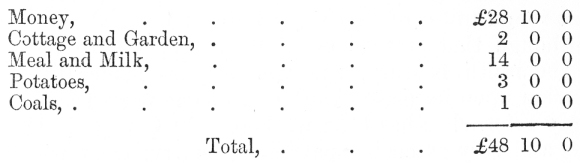
In some cases married men are allowed the use of a
cow instead of a supply of milk and other perquisites. Shepherds obtain
about the same wages and terms as ploughmen. During the last three years
wages have fallen about 25 per cent., but still the present rate is
about 75 per cent. higher than that about 1850. Out-door female workers
get 1s. 3d. per day, or 5d. more than 1850. For potato-lifting they get
2s. per day, exactly double what they obtained for this class of work
thirty years ago. In harvest they receive 3s. 4d. a day, with perhaps an
allowance of beer and bread once or twice a day. Women for house work
get from £10 to £16 a year, with board and lodging. Farm-servants are
engaged mostly for a year from Martinmas to Whitsunday; a few engage
privately, but the majority attend feeing markets in the different
localities. As a rule, married men remain long periods in one farm, but
single men change frequently. The meals of men who live in bothies
consist mainly of oatmeal brose and oatmeal porridge, but some sell a
portion of their meal and buy coffee, bread, herrings, and other
commodities. Married men in cottages live very similarly to married men
in towns. Generally speaking, the farm-servants in these counties are
sober, industrious, and efficient workmen. The Forfarshire ploughmen,
indeed, are proverbial for their industry.
Other Industries.
The commercial industries of these counties,
especially of Forfar, are of vast importance and of various character.
We can do no more here, however, than by a few facts and figures
indicate their wide extent and great value.
There are no coal-beds in either county. There are
small quantities of iron and lead, but not enough to make mining
profitable. For a short time many years ago iron was quarried in Edzell
and lead in Glamis and Glenesk. Both counties contain some limestone,
and in various parts of Forfar it has been worked pretty extensively for
agricultural and building purposes. The stone quarries are numerous. In
Forfar a great many freestone quarries are worked regularly, and employ
a large number of men. The stone, mostly belonging to the sandstone
formation, is, as a rule, of good quality but various texture. It
endures the influence of weather admirably. The ancient round tower of
Brechin is built of Forfarshire freestone, and although that strange
erection is supposed to have stood since the ninth century, the weather
has made little or no impression upon its mason work. In some parts the
slate vein formerly referred to has been worked. At Carmyllie there is a
famous and very extensive pavement quarry, from which very large
quantities of beautiful stone are shipped from Arbroath to many parts of
the United Kingdom. The stone, a greyish-blue sandstone, is of very fine
quality. At this and other quarries machinery is extensively used in
cutting and dressing the stones. The proprietors of pavement quarries
are finding concrete a rather formidable opponent.
Forfarshire contributes more than one-half of the
total production of linen in Scotland. As early as 1727 it had the lead
with 595,821½ yards, valued at £13,980, 10s.,
and all along it has not only maintained but even improved its position.
In 1822 the number of yards of linen produced was estimated at
22,629,553. Mr A. J. Warden, in 1867, stated the number of flax, jute,
and hemp factories in Forfarshire to be 108, with 7715 nominal horse
power, 278,564 spindles, 11,329 power looms, and 46,571 persons
employed. Of these works, Dundee had 72, while there were 18 in the
Arbroath district, 6 in the Montrose district, 6 in Forfar, 4 at Brechin,
and 2 at Carnoustie. In that year the total number of similar works in
other parts of Scotland was 89, with 77,237 nominal horse power, 109,015
spindles, 8580 power looms, and 30,624 persons employed. There are a
great many other works throughout Forfarshire, such as iron foundries,
implement factories, tanneries, tobacco manufactories, breweries and
distilleries, flour and meal mills, sawmills, &c. The manufactories of
Kincardine are not extensive. There are several tanneries, breweries,
and distilleries, and a few woollen and linen factories.
Kincardine has little or no shipping, but that of
Forfar is extensive. At Dundee shipbuilding was carried on largely even
at the commencement of the present century. In 1856, when wooden
shipbuilding had reached its height, there were six firms engaged in
this work at Dundee. Iron shipbuilding began at Dundee in 1838, the
building of wooden steamships having commenced in 1823. During 1878
twelve vessels were built at Dundee, three being sailing vessels (two of
iron and one of wood) and nine steamers of iron. Their gross tonnage was
8094. In the same year a wooden sailing vessel of 104 tons was built at
Arbroath, and one iron steamer of 50 tons at Montrose. The number of
sailing vessels registered at Dundee on the 31st December 1878 was 150,
and their tonnage 69,132, there being also fifty-one steamers with a
gross tonnage of 23,934. At Arbroath there were at the same time
fifty-three sailing vessels and two steamers registered, the gross
tonnage of the former being 10,009 and the latter 247. At Montrose
sixty-seven sailing vessels and nine steamers were registered, the
tonnage of the former being 12,532 and the latter 2233. In 1878, 1308
British vessels, with a gross tonnage of 364,721, and 247 foreign
vessels, having a gross tonnage of 61,293, entered Dundee harbour; while
there cleared out 1261 British vessels, with a tonnage of 344,228, and
215 foreign vessels, with a tonnage of 54,469. In Arbroath 330 British
and 47 foreign vessels, with a respective tonnage of 36,561 and 8306,
arrived; while there sailed 328 British and 47 foreign vessels, with a
respective tonnage of 36,940 and 8345. At Montrose 588 British, with a
tonnage of 64,110, and 92 foreign vessels,, with a tonnage of 28,516,
arrived; while there sailed 576 British and 95 foreign vessels, with a
respective tonnage of 60,766 and 25,952.
At the various villages and towns along the
Kincardineshire coast a large number of boats are employed at herring
and other fishing. The salmon fishings of the county are valuable,
yielding, as they do, a rental of £7000 on the coast, £700 on the North
Esk, and £450 on the Dee. The fishing-boats number in all about 524, and
with the nets and lines are valued at £28,000. There are about 116,000
cod and ling taken, and of herrings about 27,000 barrels. Forfarshire
derives much value from the sea. The Montrose district stands seventh in
Scotland in regard to the number of boats. In 1878 the number of boats
in the Montrose district was 684, the number of fishermen and boys 1218,
the number of fishcurers 41, the number of coopers 109, the value of the
boats £26,389, the value of the nets £22,770, and the value of the lines
£7249, making a total estimated value of £56,408. The barrels of herring
cured or salted in the same year numbered 29,936, while there were
93,034 cod and ling taken partly by vessels and partly by open boats.
|



