|
By John M'Neilage, Fernburn, Kilcreggan.
[Premium—Twenty Sovereigns.]
Dumbartonshire is a small county, lying chiefly on
the western seaboard of Scotland. Though twenty-fifth in respect of
size, it is one of the first Scottish counties in respect of interest
and importance, possessing as it does features of note for intelligent
men of every class. To the historian, it presents, besides much else,
clear intimation of Roman supremacy and civilisation; to the geologist,
it exhibits a variety of rock formations, and one or two special
phenomena, such as Dumbarton Castle rock and the ancient sea-margins of
Roseneath and Cardross. The economist can find in it an epitome of all
the industries; the tourist will remember it as the county of Loch Long
and Loch Lomond; and the agriculturist will be interested to note that
it combines, as perhaps no other county does, three principal branches
of his profession, viz., sheep, dairy, and arable farming. It is chiefly
in the last capacity that we mean to treat of the shire at present. Our
purpose is, to give an account of the various modes of farming pursued
within it, and report on the progress made by the agricultural and other
industries during the last five-and-twenty years. To this end, we will
commence with a few general notes and statistics. The county covers,
exclusive of water and foreshores, a space of 154,542 acres, and
comprises twelve parishes. Unlike most other counties, it is not an
undivided whole, but consists of two portions, removed apart six miles.
The western, or principal portion, containing ten parishes, lies along
the waters of the River and Firth of Clyde. In shape it
rudely resembles a segment of a circle, cut off by an irregular broken
line; and in length, between extremes, it measures about 35 miles, in
breadth 18 miles. Its boundaries are - on the
north, Perthshire; on the east, Stirlingshire and Loch Lomond; on the
south, Lanarkshire, and the River and Firth of Clyde; and on the west,
Loch Long and Argyllshire. Of the 138 miles, which measure the bounds of
its landward portion, 82 are along water—a circumstance having an
important agricultural bearing, as it infers a great part of the land to
lie on the slope, and, in so far as the water is sea-water, it implies
an amelioration of the winter climate.
The eastern, or smaller division of the county,
containing two parishes, is an irregular, somewhat oblong tract of land,
covering 19,030 acres; its length 12 miles, and its breadth averaging 4½
miles. Its boundaries are—Stirlingshire and Lanarkshire, the
former enclosing on the north, the latter on the south.
Geology, &c.—The county is one which presents
both Highland and Lowland scenery in their perfection. The two northern
parishes are little else than a region of lofty rugged mountains and
wild glens, forming a landscape which has much wild grandeur, but little
of a pleasant green nature on its face. The southern division presents a
striking contrast, being altogether of a lower, greener, and more
undulating character. The reason for this contrast must be sought for in
the geological history of the two divisions. The northern one,
comprising Arrochar, Luss, and a great part of Row and Roseneath
parishes, is the oldest; and consists of mica schist, which apparently
has at one time been upheaved by violent volcanic pressure, and
subsequently subjected to glacial and other powerful watery influence,
giving it the wild ridge and valley aspect it now has.
The valleys run from north-west to south-east.
Between Tarbet and Luss, dikes of greenstone, felspar, and porphyry have
been thrust through seams in the mica schist. Clay beds, formed at the
same time as the schist rocks, from the more finely ground particles of
the original granite, afterwards became, by the action of pressure and
heat, the slate formations of Luss and Roseneath.
The southern portion of the county, divided from the
northern by a line drawn from the south-west corner of Roseneath to a
little north of Ross Point on Loch Lomond, belongs mostly to a later
formation, viz., the sandstone. This formation produces a much less
steep and rugged landscape than the other; and the eye can easily
detect, by the change from wild heath and abrupt slopes to green fields
and gentle undulations, where the schist of the north gives place to the
sandstone of the south. The parishes included in this latter formation
are Cardross, Bonhill, Kilmaronock, Dumbarton, West Kilpatrick, and part
of
East Kilpatrick. Between the schist and the sandstone
there intervenes a narrow stripe of transition rock, in the shape of
graywacke, which, entering the county at the south-west corner of
Roseneath, passes north-east to Rossdhu on Loch Lomond. The sandstone
reveals itself, first, in that breadth of conglomerate rock, or Old Red
Sandstone, which enters the county at the extreme south-east of
Roseneath, and passes north-east parallel to the graywacke, including in
its area great part of Cardross, Row, and Bonhill parishes. The hill of
Ardmore, in Cardross, lies on the southern boundary of this formation;
it takes in the Killeter range on the north; and the island of
Inchmurrin, in Loch Lomond, is also part of it. Proceeding south, and
above the Old Red, and evidently distinct from it, we find abundance of
various kinds of sandstone. In Kilmaronock, both grey edge freestone and
flag freestone prevail. The whole eastern section of Cardross lies on
that red sandstone, whereof great part of the Vale of Leven towns are
built. Quarries for building material are found at Dalreoch and Renton.
In East and West Kilpatrick yellow sandstone underlies great part of the
soil, existing, not in a uniform mass, but revealing itself here and
there.
In this quarter the sandstone has been rent and
overlaid by the trap rocks, forming the Kilpatrick Hills. The same rock
seems also to be found in Duncryne Hill in Kilmaronock, and Dumbarton
Castle rock—those huge cones rising so solitarily from the surrounding
plains. The eastern wing of East Kilpatrick, and the whole eastern
division of the county, belong to the Coal Measures. Limestone,
whinstone, coal, bituminous shale, and small beds of ironstone are found
in these districts. Cumbernauld parish is formed of a series of ridges
of trap rock, running from east to west in parallel lines; a
considerable quantity of yellow sandstone is also found within it.
It is computed that there are in Dumbartonshire
99,400 acres of mountain land. The rest of the county is divided among
the several soils as follows :—Loam, 6050 acres; clayey soil, 30,970
acres; sandy or gravelly soil, 25,520 acres; peat soil, 720 acres : and
a very little marl.
Climate.—With respect to the meteorology of the
shire, we regret our inability to give any statistics or scientific
information; but, of the main section it may, we think, be affirmed that
it is moderately fortunate, both as regards heat and moisture. It is
pretty well sheltered from the east winds, which are so detrimental on
the opposite coast; and though its situation on the western seaboard
exposes it to moist winds from the Atlantic, yet this is not without its
compensating circumstances. For, if the sea occasionally causes rain in
summer, it also brings neat in winter. That season is generally
comparatively mild in all the seaward
parishes, the snow never lying long in the inhabited parts of Roseneath,
Row, and Cardross. The northern portion of the county, with its high
cloud-attracting hills and wind-swept glens, is doubtless well rained
upon, and snowstorms, when they come, are apt to be severe.
The climate of the detached section is also somewhat
less genial than in many parts of Scotland. In the Cumbernauld portion
of it especially, the temperature, owing to the height at which the
whole district stands, is generally cool; its situation also exposes it
to east winds from the one sea and west winds from the other, on which
account rainy weather is apt to be prevalent.
Population, &c.—According to the census returns
of 1881, the population is 75,333 souls, giving an average of 279
persons to the square mile. It is, however, very unevenly distributed.
The parishes of Arrochar and Luss cover more than one-third of the whole
area of the county, and yet they have but one-sixtieth part of the
population. The crowding of the inhabitants into the southern portion
is, in part, owing to the more arable and habitable nature of those
parts; but the chief reason is, of course, the extensive industries
carried on in the Vale of Leven, Dalmuir, and elsewhere. The Yale of
Leven itself contains three-eighths of the whole population.
The large population on the arable part of the shire,
and its contiguity to Glasgow, have caused a great amount of dairying to
be carried on within it. There is hardly a farmer in the southern
parishes who is wholly an arable farmer; the attention of the majority
is divided between the dairy and the field. It should be stated, that
for much of the permanent pasture, which is such a useful adjunct to a
dairy-farm, farmers of to-day, in Dumbartonshire, are indebted to the
labours of their ancestors. Steep, rocky places, which no one now thinks
of cultivating, have, in olden times, been diligently farmed.
Consequently, they now constitute good pasture land, being covered with
grass, instead of heather and sprits. In fact, traces of an anterior
cultivation are met with all through the county. On the Kilpatrick
braes, on the hillsides of Row and Roseneath, and even on the rugged
mountain slopes of Loch Long, there are patches of green, and traces of
the plough, which show the spots whence, in the middle of last century,
the household had its meal, and very often the smuggler his malt. By way
of more effectively presenting a view of the agriculture of the county,
we mean to treat of it in sections of one or two parishes each, going
over these in geographical order. In accordance with this method, we
will begin with an account of the systems of farming-pursued in
Arrochar and Luss Parishes.
The district included in these two parishes is a land
of towering-rugged mountains and remote glens—a land of wild heath and
barren rock, sparsely populated by men, but well inhabited with sheep.
Along the whole eastern side of the district lies the far-famed Loch
Lomond; and the proudest rival of Ben Lomond, to be seen for miles
around, is Ben Vorlich, in the parish of Arrochar—a mountain rising 3094
feet above the level of the sea. The parishes combined make a total of
57,676 acres—an acreage equal to more than a third part of the whole
extent of the county. Yet, from a purely agricultural view, the district
must be deemed of little importance. In Arrochar parish, arable farming
is reduced to a few inconsiderable patches about the various hotels and
sheep-farmers' houses; and in Luss, the dozen or so medium-sized farms,
from Luss village downwards to the Fruin, comprise the whole of the
arable land. The district derives the greater part of its wealth and
importance from the extensive sheep farming that is carried on within
it. All of it belongs to one proprietor (Sir James Colquhoun), and is
parcelled out into sheep-farms of various sizes, carrying-stocks ranging
from 400 to 2500 sheep.
The mountains of the district are nearly all of one
geological formation, but between one and another of them great
differences in height and external aspect are to be observed. The hills
above Luss, in particular, are lower in elevation and greener in
appearance than any of those further up. Some slopes are quite covered
with heather, giving a dark unrelieved aspect to the landscape ; while
others are so rugged and devoid of vegetation, as to suggest a doubt
whether anything can subsist upon them. However, such hills are by no
means so profitless as they appear. Innumerable shelves occur on their
rugged sides, bearing patches of good grass, quite accessible to sheep.
The greenness of some hills is, in great part, owing
to the prevalence of brackens—a species of vegetation much disliked by
the flock-owner, as it kills good grass, and is itself quite uneatable
by sheep. He would much prefer heather, as, besides allowing grass to
grow amongst it, it affords a bite to the flock in the winter and spring
months. However, the complaint is, that heather is dying out—being
allowed to grow too old. In different seasons, sheep feed on different
kinds of vegetation. In spring time, a species of bayonet grass comes
up, which, supplemented with a little sprits and young heather,
constitutes their sustenance for a time. In summer, a variety of good
grasses present themselves; and in winter, the remainders of the
summer's grass, with a free use of heather, tide the flocks over till
the spring. In the summer, the sheep sleep on the mountain tops, and in
the morning may be seen running down in a body to commence feeding on
the lower slopes. Working, or rather eating their way up, they are found
near the hilltops in the heat of the day, because there they enjoy
greater freedom from flies. In winter, they haunt the lower slopes of
the hills.
A curious fact in the natural history of sheep, is
the attachment they have to their own hillside, and the sagacity with
which they can distinguish it from any other. Lambs that have only been
six months on the ground, and then have spent other six months wintering
in remote regions, on returning to their native farm, in a short time
find their way back each one to his original spot. It is probably very
much owing to this characteristic that a flock always divides itself
into distinct lots or companies. On no farm of any extent does the whole
body of the sheep mass together, and range the pasture promiscuously.
Every flock naturally divides into as many distinct companies as there
are separate hillsides on the farm. These detachments of sheep are
called "hirsels;" and on the same hillside will the same "hirsel" be
found grazing day after day, the members of it hardly ever wandering,
though unconfined on all sides. If they do stray, the ease with which
they can be ordered into their proper places proves the strength of this
preference for their native spot. The shepherd merely gives a loud
whistle in the hearing of the wanderers, and immediately each one,
alarmed, moves off, and makes straight for his own grazing ground. This
circumstance, and the fact that the hill which sheep are lambed upon, is
the one on which they will best thrive, also gives rise to another
noticeable feature of sheep-farming, viz., that however often a farm
changes its tenant, it hardly ever changes its stock. The same stock, or
its descendants, is found year after year on a farm, though meanwhile
perhaps two or three different occupiers have held it. An incoming
tenant always takes over the existing stock at a valuation, and
experience has proved this to be the only advisable plan. We have heard
of a case in which the new tenant, thinking the valuation too high,
preferred to stock the farm with animals from the outside; but the
mortality among the new comers was so great, as clearly to prove the
danger of transplanting sheep to a strange hillside. Such facts are
perhaps familiar to all acquainted with sheep-farming; but as they are
interesting in themselves, and may possibly prove new to some readers,
we think they should find a place here.
Sheep stocks in this district range, as we have said,
from 400 to 2500 in number—from 1200 to 1400 being an average stock; and
as for the breed of sheep in vogue, it is, of course, the "Blackfaced"
all over. One or two of the stocks are of the ewe kind, but all the rest
are mixed ewe and wether stocks, from some of which part of the wether
lambs are sold. A few of the tups are reared at home, but the majority
are bought in at the autumn sales, from breeders in Campsie, Fintry, and
the south generally. They are sent to the hill about the 24th of
November —one tup to thirty ewes being the proportion generally
observed. Tupping time is a very taxing season to the shepherds, who
must be on the hill every day regulating matters. Sometimes a ram
wanders away in the night time to a neighbouring flock, causing the
shepherd a long journey and much trouble to bring him back. For fear of
breeding in, tups are not used more than two seasons on the same
hillside, and after another two years on a different hillside, their
place is filled with fresh comers. After tups are taken from the hill,
they are fed on oats and Indian corn on the low grounds. A period of
calm weather and frost is much desired by flockmasters at tupping time,
as the contrary circumstances have an effect in rendering the ewes
barren. A proportion of barren ewes there always is, especially among
the young ones or "gimmers;" but at speaning time, a result of three
lambs to four ewes is usually obtained. Young ewes begin to bear at two
years old. Draft ewes in this district are not sent away at any
particular age; but after their fourth crop of lambs is perhaps the
commonest time. Lambing time comes on about the middle of April, and
constitutes another anxious season to the shepherds, who, for the space
of a fortnight, can hardly ever be off the hill. The wether lambs are
cut between the 20th and 30th of May, and speaning time for all the
lambs is about the end of August.
From that period onwards till the end of October, a
great exodus of sheep stock goes on throughout the district. First comes
the departure of the wether shot lambs. These seldom go to the butcher,
but are sold through the medium of the Perth sales, the Glasgow market,
and sometimes by private bargain, to farmers and graziers, who buy in
every year to keep up a flying stock. Until recently a fair was held at
Luss in the end of August, at which great numbers of these lambs were
disposed of; but the growing popularity of Perth and other sales has
caused this fair to become extinct.
A great departure of three-year old wethers next
takes place throughout the district. On some of the smaller farms these
are sold off all at once; but on the larger farms they go away in lots,
according as they come into condition for the market. The majority of
these find their way, via Balloch, to the Glasgow market, and are
mostly bought up by fleshers in town. Last year (1883) they drew 37s.
per head or thereby; twenty-five years ago their price was 10s. less.
Draft ewes are disposed of through the same medium, and soon are
distributed throughout those numerous Lowland farms, whence cross lambs
are supplied to the spring and summer markets. The last great detachment
of sheep stock which leaves this district consists of hoggs going away
to winter quarters. The inclemency of the weather on these mountain
sides necessitates the removal of the tenderer members of the flock to
more genial regions during the cold months.
About the end of October, most of the hoggs are
drafted off to moor edges in Stirlingshire, vacant pastures in
Lanarkshire, Renfrewshire, &c, and especially to Fife. This last-named
shire has been a good deal run upon of late years as a place of
wintering for hoggs. Compared with other districts, it has been found
greatly more healthy, the mortality there being not much over half what
it is in other parts.
Hoggs in the lower portion of the district are
despatched by train from Balloch; those in the upper regions are driven
to Crianlarich, on the Callander and Oban line, and thence trucked to
winter quarters. Each hogg, between travelling expenses and payment for
its keep from 1st November till 1st April, costs the farmer about 7s.
This charge forms a very heavy item in the flock-owner's yearly
expenditure. Fife hoggs go away about the middle of October.
Clipping and dipping are important operations on a
sheep farm. Clipping begins about the 17th of June for hoggs, wethers,
and yeald ewes; milk ewes are not clipped till a month later. Of wether
fleeces, a good clipper will accomplish about sixty in a day, beginning
at nine o'clock and ending at six; of milk ewe fleeces, ten more, on
account of the better rise of new wool to be found on them. The average
yield of wool is 4½ wether fleeces and 6 ewe
fleeces respectively to the stone of 24 lbs.
The wool is generally sold on commission by a
wool-broker in Glasgow. Dipping operations are performed about the end
of October. This method of preserving sheep from disease and vermin has,
in Dumbartonshire, almost wholly superseded smearing. Dipping
compositions of several kinds are used, varying in strength according to
the height at. which the sheep will range. The operation is performed in
a large trough, at the upper end of which is an inclined platform,
sparred to prevent the hoofs from slipping. On this platform the sheep
run up after being dipped, and while there all the superfluous drippings
run off and flow back into the trough. Milk ewes and wethers are dipped
once a year; but lambs get a dip or two more, being dipped when speaned
in August, and then again in October, and generally again when they
return from winter quarters. Into the October dip of lambs a half pound
of grease is put, as a protection from cold. Clipping and dipping being
times when all the flock are supposed to be present, an opportunity is
then taken of counting them over, and these are the only times when the
numbers of large flocks are accurately known.
A bill of mortality, which never fails to be filled
up, tends to make this counting a lighter task than it would otherwise
be. All the year round, causes are at work which produce a death-rate in
the flock. About the month of October, and even earlier, the disease
called "braxy" begins to attack the lambs. This disease is supposed to
be brought on most frequently by eating grass covered with hoar frost.
About 2 lambs in 20 are lost by it before going to wintering, and at
winter quarters still further losses are sustained—1 lamb in 20 being
generally sacrificed to "braxy" in Fifeshire, and perhaps double that
number in other places. In the springtime, when dry east winds prevail,
the disease called "trembling" usually sets in, and takes off its quota
; and on every extensive farm a number of sheep are lost every year,
nobody knows how, only the numerous bogs, caverns, and swollen burns,
which exist in these mountain districts, supply a likely explanation.
Upon the whole, a frosty winter is better for sheep than an open one,
for supposing they grow lean, their health remains more firm; whereas in
some of the wet stormy winters we have had of late years, the mortality
among every kind of stock has been such as to swallow up all the profit,
and make sheep-farming a failure.
The extensive sheep-farming of this district is not
carried on without a good deal of hired assistance. On some smaller
holdings the farmer is his own shepherd; on some larger ones, he and his
sons are equal to the task of management; but in the generality of
cases, one or two hired shepherds are employed. These are partly
married, and partly single. The first named are paid at the rate of from
£12 to £20 a year, with from one to three cows, and generally leave to
rear a stirk; also an allowance of meal, and if peats are not to be had,
also coals, and liberty to plant potatoes with the cows' manure. Single
shepherds get about £12 per half year, with bed and board.
The farmers themselves are a very intelligent,
courteous class of men. Most of them take a hand in the common duties of
the farm. Rents have risen and fallen within ten years, and the rate
just now per sheep is from 3s. to 4s.
Arable Farming in Luss Parish.
At the south end of the parish, from the village of
Luss downwards, round the shoulders of the Shantron Hill, and by the
sides of the Fruin, a tract of land is found suitable for arable
farming. On the banks of the stream, and on the level tract along the
loch side, sandy alluvial soil prevails, of a fine porous nature, and
great depth, needing no drains. On the slopes of the hill above, plats
of the same soil occur, but in general the higher grounds consist of a
mixed clayey and mossy soil, on a tilly bottom. The average size of
farms is a hundred acres each; and the rotation followed is the
six-years' one. Very good crops are sometimes raised on the alluvial
lands by the Fruin.
Potatoes.—The ground there is specially well
adapted for potatoes, and 9 or 10 tons of "red bogs" is a result quite
attainable in a good year. However, "Champions" and "Walker's" earlies
are the sorts more commonly planted, with a yield in general of 6 or
7 tons per acre. A market for potatoes is found in Helensburgh and
the Vale of Leven. Except on farms which have dairies, turnips are not
much cultivated. Manure is carted from Alexandria and elsewhere, and on
some farms is liberally applied—from 25 to 30 tons an acre, with 3 or 4
cwt. chemicals being the allowance.
Oats.—"Hamilton" and "Flemish" oats are the
varieties most popular in the district. The yield varies, from 30 to 60
bushels per acre, according to the position of the field; and the weight
ranges from 36 to 41 lbs. per bushel. Wheat and barley, which were once
somewhat prevalent, have now ceased to be sown.
Hay.—Hay is a crop that yields well on the
alluvial lands by the Fruin—about 2 tons an acre being attained. The
clover thrives finely on these lands, almost choking the grass; and
subsequently the pasture proves excellent. Hay is a very saleable
commodity, there being such a number of public works, &c, in the Vale of
Leven and so many gentlemen with carriage horses in Helensburgh.
Dairying.—Dairying is carried on to some extent
on farms at the extreme south of the parish. From 12 to 20 cows are kept
on each of these, and milk is conveyed every morning to dealers in
Renton and elsewhere. The other farms keep no dairies, unless the few
milk cows necessary to supply the household can be called such. On these
farms a few young cattle are reared every year, and are readily bought
by dealers and graziers. The majority of the tenants here are sheep as
well as arable farmers, having a tract of moorland attached to their
holdings capable of carrying 300 or 400 sheep. The management of their
flocks is conducted in much the same fashion as we have described in the
preceding pages.
Roseneath and Row Parishes.
These parishes being contiguous, and possessing many
features in common, may suitably be treated of together. Roseneath is a
very compact, self-contained parish, bounded as it is on three sides by
the sea, and on the fourth or north side by a march dike between two
proprietors. It lies within a peninsula, which narrowly misses being an
island—the peninsula, namely, which separates the water of Loch Long
from those of the Gare-loch, and which, at its point of junction with
the mainland, is only a mile in breadth. The parish is in length about 7
miles, in breadth about 2 miles, and, excluding water and foreshores,
contains 8462 acres, whereof about one-fifth is arable. Physically
considered, Roseneath is a long, elevated tableland of slaty rock,
heath-covered on the higher slopes and the top, but lower down well
cultivated, and wearing a belt of green nearly all round. A portion of
the peninsula at the south end, divided off by a shallow dale, is of a
red sandstone formation. On the broad level lanks of this formation are
found Roseneath Castle, with its fine old woods and the extensive fields
and fine steading of the home farm.
This latter is the largest arable farm in
Dumbartonshire, extending to 473 acres arable, and is at present let
under a nineteen years' lease. For many years prior to 1859 this farm
was in the hands of Mr Lorne Campbell, chamberlain to His Grace the Duke
of Argyll. Mr Campbell was a first-rate agriculturist, as well as a wise
estate manager, and his name is still well remembered in the district.
He also took a somewhat prominent part in Highland and Agricultural
Society affairs, and was their enumerator for Dumbartonshire when the
Society first began to gather agricultural statistics.
Soil.—The soil on this red sandstone portion is
of a more excellent kind than prevails throughout the rest of the
parish. It is a deep, sandy soil, resting on a bottom of gravel or
conglomerate rock. Patches of clay occur at intervals through it. The
rest of the parish consists partly of a medium soil tending to clay, and
partly of a light sandy soil; both kinds of soil rather thin, and
resting sometimes on clay, but more commonly immediately on the rock.
Around the shores of the peninsula, a strip of sharp land is found very
suitable for green crop. One of the best farms in the parish, viz., the
"Clachan," is largely composed of this soil. Much of it, however, has
been taken away from the other farms by the growth of the coast villages
of Kilcreggan, Cove, Clynder, and Peaton.
Row parish is about 8 miles long and 3 miles broad,
and, excluding water and foreshores, contains 20,126 acres, of which
about one-fifth is arable. A belt of land along the Gareloch, and
another tract in the bottom of Glenfruin, comprise all that is arable in
this parish. The remainder, constituting four-fifths or thereby of the
whole, is unreclaimed heath, suitable for sheep.
Soil—-The soil on the arable lands of the
Gareloch is, toward the north, of a medium kind, upon a bottom of blue
clay; southward, about the town of Helensburgh, stiffer soil occurs,
resting partly on till and partly on grey freestone. The shore lands are
of a genial, sandy nature, but the extensive feuing consequent upon the
growth of Helensburgh and Row village has rendered these lands almost
wholly unavailable for farming purposes. Agriculture, therefore,
confined to the uplands, has been somewhat less happily situated,
especially as regards green crop. However, a compensation for this is
found in the good market for dairy produce, which such places as
Helensburgh and Row have opened up.
In Glenfruin, a considerable tract of deep alluvial
soil is met with. Sharp, light soil, on a gravel and till bottom,
constitutes the remainder of the arable portion. The greater part of the
land in this district is valued at 20s. per acre, the best land rising
in value to £3 or thereby. Farms commonly range from 90 to 190 acres
arable.
The six-years' rotation is the general estate rule,
and is followed with such variations as are common in these times. On a
great number of farms, not only arable and dairy, but also sheep
farming, is carried on; a piece of moorland, capable of grazing from
three to four hundred sheep, being attached to the holdings.
Oats.—"Hamilton," "Potato," and "Sandy" oats are
the kinds prevalent in the district. About 4 bushels are taken to seed
an acre, new seed being usually brought in every second or third year.
To encourage crop at starting, and obviate danger of the grub-worm, one
farmer top-dresses with ½ cwt. nitrate
and salt per acre; and another harrows his ground level before sowing,
and afterwards top-dresses with ammonia and nitrate. On the best farms
48 bushels per acre of a crop is realised; on the others from 12 to 20
bushels less. The weight varies from 37 to 42 lbs. per bushel. In Row
parish the bulk of the thrashing is done by the travelling mill. Into
Roseneath this institution has not yet penetrated, the principal farmers
there having good mills of their own. A considerable quantity of the
grain is sold as horse corn; a part of it is also milled, and some meal
sold. The smaller farmers have not generally much straw to sell, but a
good deal of this commodity is disposed of by the larger farmers to
gentlemen with carriage horses, and others.
Wheat.—Wheat is a very scarce grain in the
district. It is perhaps not found statedly on any save the Roseneath
home and "Clachan" farms, where very good crops of it are raised.
Hay.—Sowing for this crop takes place on some
farms about a week after oat sowing, when seed—to the amount of 2
bushels perennial rye-grass and 5 or 6 lbs. clovers—is put in. " Timothy
" meadows are becoming somewhat common, the unprofitableness
of green cropping inducing a number of farmers to
devote areas of their land to the raising of successive crops of Timothy
grass. One farmer's method is to clean his ground very thoroughly, then
sow it down with Italian and Timothy seeds, including clovers, crop for
three or four years in succession, top-dressing each time with long dung
or dung and nitrate of soda. Ryegrass hay yields from 25 to 50 cwt. per
acre. This is a crop easily sold, there being such a number of carriage
and other horses kept in Helensburgh and the coast villages of the
locality.
Potatoes.—The district is now more a late than an
early growing one, so much land adapted for the latter having been taken
away by the increase of populous places. It has, however, one farm
within it long noted for early potato culture, viz., the Roseneath home
farm. Forty years ago, ere the Ayrshire early potato trade had
developed, Mr Lome Campbell, tenant of that farm, was one of the first
suppliers of potatoes to the early market in Greenock. Every year he had
smacks regularly plying to convey potatoes from the field to the town.
These were retailed from the boat-side. In the year 1849 or 1850, off a
14 acre field, Mr Campbell's drawings grossed £560 or thereby. In
raising potatoes this eminent agriculturist adhered strictly to the
six-years' rotation arrangement, always making them the second crop
after lea. He never applied aught to the crop save farm-yard manure.
Under a succeeding tenant, Mr John Marjoribanks, good crops of potatoes
were also raised—12 tons per acre being not an uncommon return. Mr
Marjoribanks very often planted the crop in lea ground. He dosed it well
with bone dust and guano—applying 8 cwt. per acre, in the proportion of
2 parts bone dust to 1 of guano. Under the energetic and skilful
management of the present tenant, Mr Thomas Kerr, the farm bids fair,
seasons favouring, to sustain its former reputation in this as in other
respects. Mr Kerr uses but a small quantity of artificial stuffs,
believing firmly in the virtues of good farm-yard manure.
A considerable breadth of "Dalmahoys" and other early
sorts are found on his, and on some of the other farms in the district;
but, as we intimated, early growing is a subordinate feature of farming
here. The "Regent" and the "Champion" are now the, prevalent kinds. The
first to introduce "Champions" into Roseneath parish was Mr Robert Orr,
Meikle Aiden Farm, who, eight or nine years ago, set a few acres of
them. Since then they have become very prevalent, farmers feeling them
to be the most dependable crop they could raise. A good deal has been
done in this district in the way of planting potatoes in lea ground. One
method is, to turn the land over with the trench plough, thereby burying
the turf out of the way of the drill plough; then scatter dung upon this
ploughing, and in spring harrow over the ground, and draw drills at a
different angle. Another and speedier method is, to furrow the land very
deeply with a common plough, drawn by three horses; then broadcast dung,
&c, all as before. From 15 to 30 tons farm-yard manure, and from 5 to 8
cwt. chemicals per acre, are applied for this crop—dung being sometimes
ploughed in. Digging of early potatoes begins in the end of July;
"Champions " are not ready till the middle of October. Potatoes are
consumed in Greenock, Helensburgh, and the several villages of the
locality. Part of them are sold personally by the farmer to shops and
families, the rest being disposed of through dealers and commission
agents.
Turnips.—A great quantity of turnips are grown,
both of the "swede" and yellow varieties. In Glenfruin, however, no "swedes"
are sown. Some farmers have more turnips than potatoes, having to feed
large numbers of milk cows during the winter. On some farms turnips are
raised with short dung, of which about 20 tons an acre are allowed,
supplemented with chemicals to the amount of 5 cwt. for yellow turnips,
and 2 or 3 cwt. more for "swedes." This crop yields from 15 to 25 tons
per acre throughout the district. The "Swedish" part of the crop causes
a good deal of trouble, on account of its liability to disease after
being lifted. The method one farmer adopts, and which he finds very
successful, is to pit them with the shaws on them, taking care not to
break the skin in any way. Another plan is, to leave the crop in the
ground, and earth it up with the double-reisted plough. A few turnips
are sold off the larger farms, but in general this crop is all required
for feeding purposes.
Beans and Cabbage.—Beans are not very prevalent
as a crop. On many farms, where they have been tried, they have proved
discouraging. This is more especially the case in Rose-neath parish.
Cabbage is becoming more common, and, if set in good farm-yard manure,
thrives very well.
Manure.—Farmers get manure from Helensburgh and
Greenock. The latter is the chief resource of Roseneath farmers, the
greater number of whom import from one to five boat-loads of Greenock
dung every year. Imported city dung costs about 2s. per ton; long dung,
from 3s. to 4s. more. Considerable use is also in Roseneath parish made
of sea-ware. In tempestuous weather large quantities of it are usually
cast up on the shores opposite the several farms. Farmers in Glenfruin
drive manure from the Yale of Leven and from Helensburgh. They also
employ lime to some little extent as a top-dressing for grass.
Dairying.—Dairying is largely prosecuted in the
district. Stocks range from 15 to 30 cows. Nearly all the dairies are
engaged in supplying sweet milk to the populations of
the various towns and villages of the locality. Milk is despatched twice
a day in summer, and is usually sold to the consumer directly by the
farmer. In winter many of the milk carts go only once a day, customers
being fewer. The great body of these customers are Glasgow families on
their annual coasting sojourn, who require large quantities of dairy
produce.
The cows are out all night from the beginning of June
till the end of September. In Roseneath the method of winter feeding for
long pursued on one of the principal dairy farms was as follows:—Two hot
meals daily; a pailful each time of boiled turnips, with
¾lb. bean-meal added; also three fodder-ings
of straw and raw turnips, 5 turnips per head being allowed each time. In
summer the cattle get a bean-meal drink daily. In the Helensburgh
district a higher style of feeding is pursued, three hot meals per day
being given, with draff, cotton-cake, &c, added to the bean-meal.
From 8 to 12 quey calves are reared on most farms
every year, more rearing being done now than was fifteen years ago.
Calves get warm milk for three weeks or thereby, and thereafter skimmed
milk and linseed, or other similar food.
The moorland attached to some holdings in Roseneath
is used for no other purpose than summer grazing to stirks. A portion of
these are sold at Carman Fair, or otherwise, as three-year-old queys in
calf. Good prices are obtained for them, from £10 to £15 each being the
range. A number of them are also taken into the byre in lieu of cows
drafted out. These latter are usually sold to dealers and cowfeeders
from the city, who are always on the lookout for saleable cattle. Old
cows and cattle generally, from the Roseneath district, are preferred by
cowfeeders and others, as, from their comparatively more hardy
upbringing, they thrive better when put on richer feeding.
Sheep.—In Row parish one or two large sheep farms
are to be found, which are carried on in much the same way as has been
described in the section relating to Arrochar and Luss parishes. The
sheep stocks carried on the hill grazings attached to the arable farms
number from 150 to 400, and are mainly of the blackfaced breed. Some are
mixed ewe and wether stocks, and some are ewe stocks with Leicester
rams. The produce of these latter are, to a great extent, sold fat to
Helensburgh and other butchers, and a number of them are disposed of for
hogging purposes. On some farms "braxy" has been so virulent as to cut
off half of the lambs; and one farmer contemplates giving up sheep stock
altogether, and adopting cattle in their stead. On some farms a hundred
or so cross lambs are bought in in September, and wintered on the
foggage.
Horses.—In Row a great number of horses are bred,
every farmer rearing a foal or two in the year, and goodly number of
stud-book Clydesdales are found in the parish. In Roseneath, however,
horse rearing for a long time has been little practised. The farm horses
kept are of a mixed character, but some stables show a collection of
very strong useful animals.
Cardross Parish.
This is one of the most fertile and highly cultivated
portions of Dumbartonshire. The parish is in length 7 miles, in breadth
2 ½
miles or thereby, and, exclusive of water and foreshores, contains 8264
imperial acres, of which about three-fourths are arable. Advantageously
situated as it is for the trade of such populous places as Helensburgh,
Dumbarton, and Glasgow; its soil good, and its whole exposure sunny and
pleasant, naturally it has become a centre of busy skilful farming, and
through its length and breadth has been brought under the plough.
Its general description is that of a long tract of
level land along the Firth of Clyde, with a background of gently
ascending uplands, rising to a moderate height behind; the whole clothed
with greenness, and studded with mansions, villas, and numerous
farm-houses. The uplands are of a very undulating-nature, so much so
that on the farm of Ardoch, towards the east of the parish, there is no
single field that can be all seen at once. The scenery of the lower
portion has two striking features, viz., the hill of Ardmore, a strange
irregular headland, protruding very oddly from the main body of the
parish; and secondly, that immense breadth of land laid bare by the
receding tide. At ebb tide the waters of the Firth retire from
¼
to 1¼
mile beyond high water-mark, leaving an immense breadth of
foreshore.
By the Ordnance Survey, Cardross is stated to have
2655 acres of foreshore, while no other parish in the county has more
than 360.
Soil.—The soil of the main body of the parish is
a sandy loam of a variable depth, and a very red colour. The prevalence
of this hue is owing, no doubt, to the presence of the red sandstone
element, which formation abounds greatly in the district. All along the
shore this soil rests immediately on the sandstone, and as the fields
are very level, and the rock near the surface, drainage is a matter of
considerable difficulty. Drains, in some cases, are cut twelve inches
into the freestone. On the second tier of fields this soil becomes very
deep, and porous in the bottom, requiring comparatively little drainage;
on the uplands it is thinner, and rests on a bottom of till.
Samples of other soils are also found. Patches of
moss occur in the uplands, and patches of clay among the sandy fields of
the shore; while, towards the eastern boundary of the parish, an area of
a stiff clayey nature is found, suitable for growing beans, or for
brickmaking purposes. The average value of land is £2, 5s. per acre.
Farms range in size from 100 to 200 acres. The six-years' rotation is
the rule on some Cardross estates, but on others the tenant is not bound
to any course of cropping. On some of the best land a rotation is
pursued of two potato crops, two hay crops, and one corn crop, in the
following order:— 1st, potatoes out of lea or stubble land; 2nd, oats;
3rd, potatoes with dung; 4th, hay; 5th, hay.
Oats.—"Hamilton," "Potato," and "Sandy" oats are
the varieties chiefly grown, "Hamilton" being the favourite kind. On the
level lands seed, to the amount of 4 bushels per acre, is sown, but on
the uplands a bushel more is thought needful for a good crop. A mixture
of imported and homegrown seed in equal proportions is, in general, sown
every year; sometimes the crop is top-dressed with 3 cwt. chemicals per
acre. Harvest begins in the first week of September on lands near the
shore, on the uplands about ten days later. In an average season the
yield on the lowlands will be 48 bushels per imperial acre, on the
uplands 12 bushels less. The weight varies from 38 to 42 lbs. per
bushel. The strip of land round the corn-field, necessary to be cleared
for a roadway to the reaping-machine, is sometimes sown with vetches for
the cattle, and sometimes with an earlier kind of corn. The greater part
of the thrashing in this parish is done by the travelling mills. Farmers
in general use all their own oat straw on the premises, foddering their
dairy stock with it, and selling the greater portion of their hay. The
oats are to a considerable extent made into meal, some farmers regularly
supplying shops and private families with the commodity. A proportion
goes for horse corn, and a quantity is bought up by the local miller and
other grain merchants. A chance sample of grain comes to be sold as seed
corn.
Wheat.—A considerable breadth of wheat is grown
in the parish—chiefly on the lower grounds. Its place in the rotation is
always after the potato crop. Sometimes police manure is ploughed in as
a fertiliser for this crop. Wheat sowing takes place about the second
week of October, when from 3 to 4 bushels "Hunter's White" or
"Woolly-ear" are taken to seed an acre. Seed is imported every year.
Wheat harvest comes on about the end of August; and a crop of from 3 to
3 ½
quarters per acre,
weighing 60 lbs. per bushel, is usually realised. Sometimes the yield
reaches 6 quarters, and sometimes it falls as low as 18 bushels. Wheat
is all sold in Glasgow, either directly to a grain
merchant, or through a commission agent. Of late, the profits arising
from wheat have been very insignificant, and less of it is now grown in
this parish. The good price obtained for the straw, however, somewhat
balances the deficiency.
Hay.—This is a crop that yields well in the
district. About 2 bushels "perennial ryegrass," 5 or 6 lbs. clover seed,
and a little "Italian" per acre are commonly sown for it. It is usual to
top-dress for this crop either in winter with short dung, or in spring
with 3 cwt. hay manure, or 2 cwt. nitrate and bones per acre. Hay-making
is commenced on some of the earlier lands in the first week of July, and
the yield will average 35 cwt. per acre. A ready sale for hay is found
throughout the district; great quantities are sold off the rick to
public companies in the Vale of Leven, cowfeeders, gentlemen with
carriage horses, and others; and altogether farmers will dispose of
two-thirds of their hay. The cattle are usually put on the clover about
the begining of September. Sometimes the clover is cut, and given to
them green, and sometimes it is dried, and put up for future use.
Potatoes.—This crop is a very prominent feature
of farming in the parish. From an early period, Cardross was famed for
its potatoes, and till this day it retains its reputation as one of the
earliest potato-growing parishes north of Ayrshire. The stated place for
potatoes is the second crop of the rotation, but sometimes, in the
interests of a healthy crop, they are made the first. When planted in
lea ground, they are manured with merely 10 cwt. guano or chemicals per
acre. When potatoes are to be planted in stubble land, it is a very
usual practice to plough in from 25 to 30 tons of farm-yard manure per
acre, burying the dung only a moderate depth. In the spring time the
land is harrowed and deeply drilled, and the crop started with 10 cwt.
chemicals per acre. All the farmers believe in letting the manure lie
six weeks or thereby on the land before ploughing. Another plan is, to
plough stubble land very early, and when frosty weather comes broadcast
a like quantity of manure upon it, letting it lie there till the time
for harrowing and drilling. This system of ploughing in the dung is
becoming very prevalent, as it saves labour, and hastens on operations
in spring. Some farmers, however, adhere to the old method of putting
manure in the drills: 25 tons of long dung and 5 or 6 cwt. chemicals per
acre being the usual quantities allowed. Eight tons per acre is counted
a good return of this crop. Early potatoes are commonly ready for
digging by the middle of July. In general, all the earlies, and a great
part of the late sorts, are sold by the acre to dealers from Helensburgh,
Dumbarton, Greenock, &c.; but sometimes the farmer digs his earlies
himself, and sells them through a commission agent. "Champions" and
"Magnum Bonums" are pitted, to be sold off gradually during the winter
and spring months. Potato pits are covered—firstly, with a layer of
straw, secondly with a coating of earth, and lastly with another layer
of straw, to defend them from the rain, &c. It should be added, that the
potato culture of this parish includes the growing of all the kinds from
the earliest to the latest. "Red Bogs" and other early sorts are found
chiefly on the shore lands ; on the uplands equal proportions of
"Regents," "Champions," and "Magnum Bonums" are to be seen.
Turnips.—From 5 to 10 acres of these are grown on
farms here; but farmers on the shore lands do not sow so many as those
on the uplands. A quantity, both of "swedes" and softer turnips, are
raised. The best way to "catch a braird" is found to be by ploughing the
stubble land early in winter, and in spring working it with the grubber
two or three times. As in other places, a difficulty is found in
preserving turnips after they are out of the ground, a plan, recommended
by a farmer here, is to store them in good dry weather in a shed—putting
them up in steep pits not too wide, and covering them with a thin
coating of earth or well-drawn straw. By this means they are kept both
warm and airy, and so prevented from heating.
Beans.—On the stiff lands to the east of the
parish a few acres of these are grown. The method is to make them the
first crop of the rotation. Dung is ploughed into the lea, and the beans
are sown broadcast, harrowed, and otherwise treated the same as corn.
Sometimes they are sown in drills, and started with 8 cwt. bean manure
per acre.
Manure.—A considerable quantity of manure is made
in the various farm-yards, owing to the number of cattle kept. This is
supplemented by imported manures from Helensburgh, Dumbarton, and
especially Greenock. From this last-named place nearly every farmer
takes in three or four boat-loads of long and short dung every year. The
home manure being the richest, is applied as far as possible to the
early potato crop. Police dung, sea-ware, or compost is sometimes spread
on hay stubbles, by way of improving next year's grass.
Dairying.—Dairying is largely prosecuted in the
district. From 15 to 35 cows are kept on each farm, and the produce—
chiefly in the form of fresh butter and butter milk—is sold in
Helensburgh and Dumbarton. Some of the dairies are in the sweet milk
trade, sending that commodity to the above named towns and to Glasgow.
In summer, butter is made five times a week; in winter, only three or
four times, and is sold off the cart to shops and private families. Cows
are well fed, getting bean meal twice a day all the year round. In
winter, when housed, they get three hot meals per day, each time a
pailful of boiled turnips, mixed with bean meal and draff. Besides these
hot meals, they get three fodderings of hay or oat straw, generally with
raw turnips or potatoes superadded. On the best farms the cattle are out
for a few hours every day, even in the winter months. A considerable
amount of rearing goes on on every farm. From eight to twelve of the
best calves— calved from December to July—are reared for that purpose.
Calves get warm milk for a month, and thereafter for three or four
months a preparation of calf-meal. Many, however, still use porridge and
milk, supplemented with linseed, as a nourishment for calves. Cast cows
are usually sold to cowfeeders in Greenock and other places. They are
very often disposed of after their third calf.
Sheep, &c.—A large number of sheep and other
feeding stock are grazed in the parish. The principal sheep stock is
that of Colin Campbell, Esq. of Camieseskan, who, on the grounds of
Camieseskan House and the hill above, keeps a mixed stock of 16 score
greyfaced and 20 score Leicester sheep. For the benefit of the flock, a
tract of reclaimed land on Colgrain Hill is cropped every six or seven
years with corn, followed next year by grass and rape. This latter mixed
crop will graze twelve sheep per acre, the ordinary pasture four. At
tupping time, which comes on in the end of September, one ram to
forty-five ewes is the proportion observed. Tups are all Leicesters. At
speaning time, a result of three lambs to every two ewes is usually
obtained. The ewes are grazed up till the middle of November; from that
time till the grass is ready again, they get each ½
lb. Indian meal refuse (or as it is called "Paisley meal"), with chopped
straw and pulp turnips daily, increasing the "Paisley meal" from
½lb. to 1½ lb. when
lambing time draws near. This "Paisley meal" is found superior even to
oilcake as food for milk ewes. Lambing time comes on about the end of
February. The greyfaced tup lambs are castrated about six weeks after
birth. All the produce of the greyfaces are sold fat to the Helensburgh
butchers, beginning with those from nine to twelve weeks old. Ewes are
drafted out after their third or fourth crop of lambs, and sold by
auction at the Dumbarton weekly sales. About 110 greyfaced lambs are
bought in every year from the stock of Mr Cowan of Lurg, Fintry. The
Leicester flock at Camieseskan has long enjoyed a reputation for its
sterling qualities, and purchasers are readily found for tups and shot
lambs. The rams are sold in September, bringing good prices. Some
farmers keep a regular stock of Leicester or other sheep ; others buy in
a hundred or so greyfaced hoggs or three-year old blackfaced wethers,
putting them on the foggage, and selling them about the New Year. Scope
for feeding sheep is also found in the extensive breadths of rape and
grass which are raised off the early potato land. After that crop is
lifted in July, the ground is sown with grass and rape, which in
favourable circumstances soon springs up, and is available for pasture.
From a piece of potato land which he had sown with rape, and
subsequently pastured for four or five months with hoggs, a farmer
recently raised a crop of oats. Corn after potatoes does not usually
thrive well, but this time the yield proved excellent. The permanent
pasture of Cardross Park is under a flying stock of bullocks, and so
also is the grazing ground of one or two farms where no dairy is kept,
or where otherwise there is scope for pasturage.
Horses.—The farm horses are mostly of the
Clydesdale breed, and are a strong, handsome class of animals. A
considerable number are reared in the district, the good prices
obtainable for pure bred Clydesdales being a powerful inducement.
Other Industries.—The only other industries of
note carried on in the parish are the Turkey-red dyeing and bleaching
industries of Renton; but these will be considered under the heading
"Industries of the Vale of Leven."
Bonhill and Dumbarton Parishes.
Bonhill parish occupies a tract of land round the
south-west corner of Loch Lomond. The Vale of Leven, with its fine
breadth of level plain, runs through the centre of it, and its eastern
and western boundaries are found along the summits of the heights which
flank Loch Lomond and the Vale on either side. Great part of the ground,
therefore, lies on the slope, some of it having an eastern and some of
it a western exposure. The parish is 5 miles long and 2 miles broad,
and, excluding water, covers an area of 8373 acres, of which about
five-sixths are capable of cultivation. But a great part of the best and
most arable land is not available for agriculture. This is a parish of
public works, and great mansion-houses, where, consequently, land has
other uses to serve than the raising of crops. Of mansion-houses there
are no fewer than six within it, some of them old, all of them large,
magnificent residences standing amid extensive policies. The pleasant
situation of the parish by Loch Lomond is, no doubt, the principal
reason for such a collocation of fine mansions. Public works are found
chiefly in the Vale of Leven. There the Messrs Orr Ewing have their
large Turkey-red dyeworks. Around these and other establishments the
populous towns of Alexandria and Jamestown have sprung up, and within
the last twenty years have increased so greatly as to almost completely
absorb all the arable land in the Vale. Agriculture, therefore, driven
from the plain, has been forced to betake itself to the heights, chiefly
those of the eastern side, up which it has made surprising progress.
Soil.—The soil in the Vale of Leven, where there
still remains one large farm, is of a sharp gravelly nature, resting on
a very porous subsoil. This land requires no drains ; indeed, the
complaint is that it disposes of the moisture too quickly. The soil on
the western slopes is principally a light loam, with a clay element
through it, resting on a bottom of grey freestone. Areas both of a peaty
and a heavy clayey nature are also found. On the eastern side both grey
and red freestone prevail. In the upper regions these formations come
very near the surface, and are covered with a light sandy soil mixed
with soft earth. A dampness, caused by surface water, and by springs
bursting out of the freestone, renders some portions of these uplands
very unhealthy, so much so that grass gets choked with fog after the
first year. The highest fields have a covering of a light mossy soil,
and the lowest slopes consist of medium soil resting on a bottom of red
till.
Dumbarton is the parish immediately adjoining
Bonhill on the south-east. It lies wholly on the east side of the River
Leven. The parish is historically the most interesting, and provincially
the most important in the county, containing as it does the famous
Castle rock, and old town of Dumbarton, which is the capital of the
shire, the place where justice is dispensed and other public business
conducted. The parish is 5 miles long and 2 miles broad, and, excluding
water and foreshores, contains 8290 acres, of which something less than
a quarter is arable. The greater portion of the parish is an extensive
moor, presently under a large flock of blackfaced sheep. The arable part
is found in the Vale of Leven and on its eastern slopes.
Soil.—The soil in the Vale is a strong loam,
resting partly on sand and partly on clay—a soil different from that
which prevails at the north end of the valley, and not so suitable for
green crop. On the lower slopes light loam resting on the same subsoils
occurs, while on the uplands tracts both of heavy land and light mossy
soil are found. The value of land in the district averages £2 per acre,
the best land being rented at £3. Farms are usually about 160 acres in
extent, though some are nearly double that acreage. Both cropping and
dairying are vigorously prosecuted, the industrial towns in the vicinity
supplying a convenient market for produce. The six-years' rotation is
the formal lease regulation, but in effect no uniform course of cropping
is followed throughout the district. On some farms a five-years'
rotation is pursued; and on others an approach has been made to
continuous cropping, with the accompaniment of a very liberal
application of manure.
Oats.—"Hamilton" oats is the most prevalent kind.
In general farmers sow a mixture of home and imported seed every year,
but entirely new seed is on some farms sown every second or third year;
4 bushels per acre for the heavy land, and 5 bushels for the lighter
soils, is the amount used in sowing. To obviate the danger of the grub
worm, as well as to procure an early harvest, one farmer sows his oats
very early—about the end of February—and rolls the ground well. As a
means to the same end, some farmers harrow the ground prior to sowing
the seed. The yield varies from 42 to 60 bushels per acre, according to
soil and season, and the average weight will be 40 lbs. per bushel. On
lower farms harvest begins in the first week of September—a week later
on the uplands. A great part of the thrashing is done by the travelling
mill. Top-dressing of corn is not common, but sometimes the lea corn
crop is encouraged by ploughing in an allowance of police manure. A
great part of the corn grown in the district is consumed on the various
farms, either as meal or horse corn. Most farmers also dispose of a
little of these commodities to customers; and one farmer sells his grain
statedly for seed corn.
Wheat.—On the level lands of the Vale a
considerable amount of wheat is grown. "Hunter's White," "Woolly-ear,"
and "Squarehead" are the favourite varieties; sometimes police manure is
ploughed in for this crop. Wheat sowing takes place in the beginning of
October, when seed to the amount of 3 bushels per acre is put in. The
average yield will be 28 bushels per acre, and the weight 60 lbs. per
bushel. At the present price of wheat, one farmer means to use his
wholly for feeding purposes in the dairy. Wheat straw finds a ready
market in the district, owing to the amount of litter required for
carriage horses.
Hay.—For this crop various quantities and
proportions of seed are sown. In one instance, 3 bushels perennial
ryegrass and 5 lbs. clover per acre is the mixture used; in another, 1½
bushels Italian, 1 bushel ryegrass, and 5 lbs. red, white, and
alsyke; and in another, 2½ bushels
ryegrass, including Timothy and Italian seeds, and 5 lbs. clover. The
yield varies from 25 to 30 cwt. per acre. On some lower farms the clover
is so luxuriant as to be almost an inconvenience, causing repeated
teddings of the hay in order to dry it. As in other parishes, farmers
here sell great part of their hay, foddering their dairy stock almost
entirely with corn straw. Sometimes the crop is top-dressed with a
mixture of nitrate and bones, but such treatment is not general. One
farmer varies his five-years' rotation by taking a second crop of hay,
top-dressing the stubbles of the first crop with 15 tons police manure
per acre. He finds this as effectual a way of keeping the land in
condition as pasturing for a year would be.
Potatoes.—On all farms a considerable amount of
potatoes are grown. The very early sorts are only found on a few farms ;
but "Walker's Earlies," "Regents," and "Champions" are general crops.
Manure for potatoes is very commonly put in the drills, about 25 tons
long dung and 5 cwt. chemicals per acre being the quantities allowed.
The ploughing in of the dung is also not an uncommon practice. When this
is to be done, all the farm-yard manure is put on the stubble at the end
of the year. After lying on the ground for six weeks, it is ploughed in;
in spring the ground is harrowed, and drills for the potatoes drawn at
right angles to the previous ploughing. A farmer in the district
recently green-cropped a cold-bottomed field seven years continuously,
ploughing in the manure in this way, and starting the potatoes in spring
with 10 cwt. bone meal and salt in equal proportions per acre. This
treatment has resulted in making what was once the worst pasture on
the farm to be nearly the best. A return of from 8 to 10 tons per
acre of potatoes is usually obtained. Much of the potato land here is
very unhealthy, necessitating a smart uplifting of the crop for fear of
disease. The majority of the potatoes are consumed in the towns of the
Vale of Leven. Farmers generally dispose of the earlier sorts by the
acre to dealers or agents, reserving the "Champions" and other late
sorts for gradual sale to shops and private families. The sowing of rape
on the early potato land, which we saw practised to some extent in
Cardross parish, is not attempted here. The headriggs also are merely
kept clean, and manured in preparation for the wheat or corn crop.
Turnips.—On each of the lower farms about 2 acres
"Swedish" and 4 acres yellow turnips are raised, but on the uplands "swedes"
are not found. It is not an uncommon procedure to plough in the manure
for this crop, and start it in the spring with 5 or 6 cwt. chemicals per
acre. Police manure is very often used for this purpose, about 25 tons
per acre being allowed; and if the same weight of turnips is obtained in
return, the crop is counted a fair one. Few turnips are sold, the
quantity raised being usually no more than suffices to feed the cattle
in the winter months. On some farms a quantity of beans and cabbages are
regularly grown. Beans are harvested about the beginning of October, and
yield on an average 40 bushels per acre. These two crops are used
exclusively for feeding purposes in the stable and dairy.
Manure.—Besides farm-yard manure, whereof a great
quantity is made in the district, long and short dung is largely
obtained from Dumbarton and other towns of the Vale of Leven. A
considerable portion of the byre manure made in Alexandria is not
available for agricultural purposes, being bought up by public works, to
be used in dyeing. Police manure costs 1s. per ton, other manure from
1s. 6d. to 3s. more. Gas lime is made use of on some of the mossy lands;
and a compost, made of road scrapings, weeds, ditch cleanings, &c, is
sometimes spread on the young grass, with a view to improve the hay
crop.
Dairying.—An extensive dairy business is
prosecuted throughout the district. Stocks are very large, in some cases
amounting to 48 head of cattle; but 25 is an average number. Constant
sale for sweet milk is found in Dumbarton, Bowling, and the towns of the
Vale of Leven. About half of the farmers dispose of their milk wholesale
to a dealer in town, the other half retail theirs personally to private
families. Generally the dealer comes twice a day to the farm and lifts
the milk. In the evening he takes away only as much warm milk as is
bespoken by customers, leaving the rest to be lifted on the morrow as
skimmed milk and cream. As the supply of milk has to be kept up winter
and summer alike, farmers are often under the necessity of buying in a
few back calving cows at the beginning of winter.
On all the farms a number of young beasts are reared
every year—10 or 12 of the best queys, calved from February till May,
being preserved for the purpose. The calves get warm milk for three
weeks, and thereafter a mixture of pease meal or linseed meal and milk,
gradually diminishing the quantity of milk. A few farmers rear
exclusively with a view to keep up stocks, selling no queys. They farrow
and feed off a number of the older cows every year, filling their places
with a like number of queys brought in at 2½
years of age. In general, however, a number, both of young and mature
milk cows, are disposed of yearly. Dealers and cowfeeders readily buy
them, either by private bargain or at the Dumbarton weekly sales. With a
view to improve their stocks, several farmers have availed themselves of
bulls bred in the famous Auchendennan herd. Of this herd some account
will be found further on. Its headquarters were in the parish of Bonhill.
Sheep, &c.—Besides milk cows, a number of sheep
and other stock are grazed in the district. One or two farmers do a
little business as graziers, having tracts of pasture land on which they
graze Ayrshire stots, back calving cows, and sheep. Some farmers also
buy in a hundred or two grayfaced hoggs in September, wintering them on
the foggage till April. If. is in this district that the chief
cattle-dealing business of the shire goes on. Dumbarton tryst, once a
great cattle fair, though now somewhat shrunken in importance, is held
on the 1st Wednesday of June on Carman Hill. At this fair great numbers
of milk cows, bullocks, and horses are wont to change hands.
An important horse fair, popularly known as the "Moss
of Balloch," is held annually at that place on the 15th of September;
and for the last year or two, a weekly sale has been held at Dumbarton
on Wednesday, where milk cows and other kinds of cattle are sold.
The Industries of Dumbarton. Dumbarton is a
considerable town of 14,172 inhabitants. Its existence reaches back to a
very early period. So long ago as 1221, it had become large and
important enough to be formed into a royal burgh; and for many years
previous to that time it was doubtless a populous place, deriving its
name, and the reason of its existence, from the famous Castle rock.
Nevertheless, the Dumbarton of to day, venerable though it be in years,
has no appearance of antiquity. It is altogether a handsome, modern,
busy town, the capital of a shire, and the seat of an extensive
shipbuilding trade. Modern Dumbarton dates from thirty years ago. At
that time, a spirit of renovation and progress seized the town, and in
the course of a few years made such improvements on its aspect, that one
of its eighteenth century inhabitants would hardly recognise it. As the
zeal for improvement was great, so the need for it was equally so. The
town was neither well watered, lighted, guarded, or cleansed. Owing to
the brisk shipbuilding trade, even then going on, it had also become
much too small for its population; and for a town which depended so
entirely on the building of ships, to have such a shallow, unnavigable
river as the Leven then was, was a sign either of poverty or lack of
enterprise. An influential body of the citizens was in favour of
improvements in all these respects; but a pertinacious number for awhile
frustrated their efforts. At last, in 1854, a new progressive council
adopted the Harbour Act, empowering them to raise public funds for
improvement of the river. In 1857, a still more progressive council
obtained from Parliament a special Burgh Act, giving them authority to
levy taxes for a comprehensive set of improvements, including a water
scheme. Previous to that time, by the energetic action of some
capitalists, the limited accommodation difficulty had been met, many new
buildings having been erected in the town, and a whole new suburb added
across the Leven; and thus, in the course of a few years, Dumbarton had
transformed herself, and from being a small antiquated place, on the
banks of an unnavigable river, had become an extensive modern town, well
appointed in every respect, and provided with a good waterway to the
open sea.
As a market town, and the seat of a sheriff court,
Dumbarton doubtless derives some wealth and importance ; but the main
foundation of its prosperity is the extensive shipbuilding carried on
within it. A development of this industry is the chief fact in the
modern history of the town. Old firms have grown to many times their
original dimensions, many new firms have arisen, and a general increase
in wealth and population has resulted.
The two principal building yards are owned by Messrs
William Denny & Brothers and Messrs Archibald M'Millan & Sons. These are
well-known firms, who since their establishment have contributed a
respectable quota to the immense sum total of Clyde shipbuilding. Messrs
Denny & Brothers are a very old firm, beginning business back in one of
the earlier decades of the century. Their history has been one of
development and progress. In 1844, when the application of iron to
shipbuilding had begun to revolutionise the trade, the firm was one of
the foremost in adopting the new material. In 1845 they launched 3 iron
steamers, and in 1847 no less than 6. Their business increased year by
year ; and comparing the two 6-year periods, ending 1850 and 1856
respectively, we find that in the first they launched 26 vessels, of a
gross tonnage of 6003, and an aggregate nominal horse-power of 1327; in
the next period they launched 35 vessels, of a gross tonnage of 28,591,
and an aggregate horse-power of 6142—that is, the ships built were not
only more numerous, but also much larger. In 1867 the firm removed to a
larger and more convenient yard, on the north side of the river, called
the Leven Shipyard. This yard at first covered 15 acres, and provided
accommodation for building six 3000 ton vessels. It had within it a
tidal basin capable of receiving two large steamships, with space for
shifting. By the side of this basin were erected shear-legs capable of
lifting 50 tons. In this yard, for many years, the firm carried on an
extensive and growing business. In course of time, however, they began
once more to find themselves straitened for room ; and in 1881 they
acquired, and annexed to the Leven Shipyard, a 27 acre area of land
immediately to the east. In this they formed another tidal basin of much
greater capacity than the last, and erected thereat shear-legs twice as
powerful as the former—lifting 100 tons. Thus their yard now covers 42
acres, and is provided with two tidal basins or docks, and two pairs of
powerful lifting apparatus. They have room within it to build,
simultaneously, seven steamers of from 350 to 600 feet long, and each
from 2000 to 8000 tons gross; and have space, besides, for the
construction of eight paddle steamers or barges—of which the firm have
always a few on hand. These latter are chiefly for customers in India,
China, Buenos Ayres, and the colonies, to which places they are shipped
in pieces, ready for reconstruction. A branch from the North British
Railway runs through the yard, and a complete system of portable
railroads—narrow gauge (by Decan-ville, France)—forms a network all over
it. This latter is for the use of workmen in all the departments, and
does away with the necessity for hand barrows, jankers, &c. Other
appliances, completing the equipment of the yard, are electric lighting
and telephonic communication. The furnace sheds are illuminated by
electricity; and arrangements are being contemplated for lighting up by
the same means the counting-house, drawing office, joiners' and
upholsterers' shops, as well as ships in course of construction on the
stocks. Telephonic communication has been completely established between
the counting-house and all the shops and departments of the yard, as
well as with the private residences of all the partners. Establishments
in town, with which the firm have constant dealings, such as Dennyston
Forge, Hardie & Gordon's Foundry, and Denny & Co.'s Engine-works, are
also in like manner connected with the counting-house; and in a few
weeks hence direct telephonic communication will be established with
Glasgow. Since the early days of the firm shipbuilding has made rapid
strides, and has grown a very great and scientific trade. Messrs Denny &
Brothers have ever been forward to adopt such useful inventions and
improvements as have from time to time arisen, either in modes of
working or in styles of constructing and finishing vessels.
The following figures, kindly furnished by the firm,
will give an idea of the progress of their business, and of the
Dumbarton shipbuilding industry in general, during the last quarter of a
century:—In 1861 there were employed in the yard 879 hands; in 1884 the
number of employees was 1826. The average number employed during the
five years ending 1865, was 1023 ; the average number during five years
ending 1883 was 1409. During the period of
five years ending 1865, there were launched 45,716 tons; during the
period of five years ending 1883, the tonnage launched was 96,100.
The other large shipbuilding yard in town is owned by
Messrs Archibald M'Millan & Sons. This is a very long-established firm,
the senior partner of it being the oldest shipbuilder on the Clyde. The
firm have acquired special fame as builders of sailing vessels, and on
several occasions have turned out the largest ships of that class. The
industry has grown on their hands so much that they have twice had to
extend their yard greatly. Their employees have increased from 200 in
the year 1853 to over 1000 in 1883 ; and the average rate of wages paid
has risen from 15s. to 25s. per week. In the ten years ending 1856, they
launched 17,988 tons ; in the ten years ending 1875 the tonnage launched
was 71,500 tons; while for the last few years their annual output has
been 14,000 tons. From first to last, the firm have built 312 vessels of
all descriptions, making an aggregate of 230,000 tons. Two other kindred
firms which have arisen are Messrs Birrel and Stenhouse, who started in
1871; and Messrs M'Kellar & Co., dating from 1872. At a busy season the
combined employees of these number about 1000. When trade is brisk, it
thus appears that the aggregate number of hands employed in Dumbarton
yards in recent years is something like 4000. Thirty years ago, the sum
total of workmen did not much exceed 2000, a fact showing great
development and progress.
Engineering and founding are important adjuncts of
shipbuilding. Both industries are vigorously prosecuted in Dumbarton.
The most important engineering establishment is that of Messrs Denny &
Co. The firm began operations in 1851. Since then they have increased to
four times their original dimensions, and just now are putting extensive
additions to their already large premises. They produce the largest and
highest class of engines and boilers required at the present day. Of
late years they have employed 800 men.
Messrs Paul, another engineering firm, have also
developed their business considerably. In 1860 they took a new
departure, entering into the steam crane and winch trade. In the making
of these and other labour-saving apparatus for shipboard, they have
acquired considerable celebrity ; and in 1867 took a prize at the
Exhibition for a steam windlass and winch which they exhibited. In 1866
they extended their premises, and added boiler-making to their other
business, and again in 1875 they further enlarged their workshops. Their
staff of workmen has increased in number, growing latterly to 200 hands.
Levenbank Foundry and Engine Work was started in
1856. By alterations at various times, it has been made three times its
original size, and at busy seasons gives work to 160
men.
Dennyston Forge, a large well-furnished work, was
started in 1855. At that time it was provided with three Nasmyth
hammers, the heaviest weighing 5 tons, and could turn out forgings 12
tons in weight. In 1865 the establishment was made three times larger,
and provided with other two hammers, the heaviest weighing 10 tons,
being the only one of the weight in Scotland. Ten years later, when
another Nasmyth hammer was added, the number of these powerful
implements in operation in the Forge was nine, and forgings up to 20
tons in weight could be turned out.
Besides these mentioned, which are the principal
firms of the town, there are several brassfounders, saw-mills, rope and
tan works, &c, some of which have been started by the expansion of
shipbuilding, and all of them benefited by it. The valuation roll and
census returns corroborate this account of progress. The following are
the valuations of the burgh at three periods since 1856. For 1856-57,
£12,881, l1s. 2d.; 1859-60, £18,622, 10s. 8d.; and 1883-84, £55,101,
11s. 6d. The following are the census returns for the last thirty
years;—In 1851 the population of the burgh was 4590, in 1861 it had
increased to 8268, in 1871 it was enumerated at 11,423, and in 1881 it
was ascertained to have reached 14,172.
The Industries of the Vale of Leven. The Yale of
Leven, with its fine verdant plain, its winding river, and picturesque
hills on either side, has a natural beauty about it, which, in the
absence of any other feature of interest, would make it well worth
visiting. In effect, however, the scenery of the Vale is one of its
least noticeable features, as huge public works and populous towns have
long been so conspicuous as to quite eclipse nature. The Yale of Leven
is, in fact, one of the most busy and thickly-inhabited districts in
Scotland. Four populous villages are found within it, viz., Jamestown,
Bonhill, Alexandria, and Benton, the combined inhabitants of which, in.
1881, numbered 15,603 souls. These find employment chiefly in the great
Turkey-red dyeing and calico-printing establishments carried on on the
banks of the river Leven. The existence of these establishments is to be
accounted for by the constant supply of pure soft water which that river
affords, thus enabling the bleaching, dyeing, and printing processes to
be prosecuted at all times. From an early period the Vale was celebrated
for it bleachfields. Dal-quhurn was started as a work of that
description in 1715. The first printwork was commenced at Levenfield in
1768, and in 1776 another one, called the Cordale, was established.
Dyeing is applied to cloths and yarns, and includes
the following operations:—Bleaching goods to give a clear bottom ;
saturating them repeatedly in olive oil and soda ; mordanting to give
affinity for dyeing stuffs; dyeing by madder, garancine, or alizarine;
and cleaning or brightening by soap, in boiler, under pressure. Printing
is done chiefly by machinery, though block printing has revived to some
extent. The cloths and yarns are mostly bought in from Lancashire
manufacturers, and when finished are sold both for home and foreign
trade. Of yarns and cloths exported, by far the largest portion are sold
as plain Turkey-red ; the remainder are printed with designs peculiar to
the taste of the Hindoos and Mahommedans, consisting of peacocks,
elephants, &c. Within the last twenty-five years wonderful improvements
have taken place in connection with the processes of Turkey-red dyeing
and calico printing, and in the adoption of these the Vale of Leven
firms have certainly not been behind. One of the chief of those
improvements was the adaptation of artificial alizarine to dyeing
purposes. In early times madder, a vegetable extract, was the agent
employed, subsequently garancine, a preparation of madder, was made use
of; but in 1868 alizarine was discovered, an agent better adapted than
any of the former for producing a bright fast colour. By substituting
alizarine for madder, dyers did not exchange one colouring agent for
another—they merely availed themselves of a purer quality of the same
element; for the colouring principle is one and the same in madder,
garancine, and alizarine, only in the last it exists in its purest and
most concentrated form. Alizarine is extracted from coal-tar.
Of the five firms in the dyeing and printing trades,
three of them carry on Turkey-red dyeing and printing. These are— Messrs
Archibald Orr Ewing & Co., Messrs John Orr Ewing and Co., and Messrs
Stirling & Co. The other two firms—Messrs James Black & Co. and Messrs
Guthrie & Co.—are chiefly engaged in madder printing alone. In addition
to garment and muslin goods, these latter firms produce great quantities
of furniture prints, cretonnes, twills, figured dimity, chintzes, &c.
The last twenty-five years have witnessed a remarkable expansion of the
Vale of Leven dyeing and printing industries. From time to time
additions have been made to all the works, and the buildings of the
three larger firms now cover an area of 10 acres each. These larger
works have branch railroads carried through them, to convey coal and
export goods. In 1876 we find the three dyeing and printing firms—Messrs
A. Orr Ewing and Co., Messrs J. Orr Ewing & Co., and Messrs William
Stirling and Co.—employing 6000 work people, paying £150,000 per annum
in wages, and producing, when in full operation, 10,000 pieces cloth and
25,000 lbs. of yarn daily.
In 1857, on the three works presently owned by Messrs
A. Orr Ewing & Co., there were employed 1223 persons,—the amount
disbursed, in wages and tradesmen's accounts, was £44,000 per annum or
thereby. In 1878, on the same works, upwards of 2000 people found
employment, and £90,000 was paid in wages and tradesmen's accounts. This
firm, when in full operation, turns out over 12,000 lbs. of yarn and
nearly 5000 pieces of cloth per day,—a larger amount than was produced
in Great Britain in 1843. Messrs John Orr Ewing & Co. now produce over
eight times the amount they did in 1860. In 1876, they consumed 32,130
tons of coal, and in wages paid £54,460. Their business has increased
considerably since then, and they now employ 1600 hands, which is double
the number employed twenty-five years ago. At Dalmonach Printworks
(Messrs Black & Co.) there are at present employed from 800 to 900
persons; twenty-eight years ago, the number was 613. The firm have
twenty-five printing machines, printing from one to sixteen colours, and
capable of producing 25 million yards printed goods in a year. At Messrs
Guthrie & Co.'s print-work there were employed twenty-eight years ago
308 people; when busy, the number now is 600. In fact, it has been
computed that the number of employees and output of goods have at least
doubled in twenty-five years. In 1835 the amount paid in wages by all
the firms in the Vale was something like £8800; the sum disbursed in
1856, for the same purpose and for tradesmen's accounts, was £132,000 or
thereby. In 1875 the payments for like purposes would reach £200,000;
and at the present time (1884), it is calculated that the expenditure
upon wages and accounts cannot be much under £300 000.
This great expansion in the industries of the Vale of
Leven has brought about a corresponding increase in the population. In
1851, the inhabitants of Cardross and Bonhill parishes, where the Vale
of Leven villages are found, numbered 11,221; in 1861 they had increased
to 13,227. In 1871 the census returns from the villages alone reveal a
total of 10,247 inhabitants. Ten years later this total had grown to
15,603, and it is believed that if these four villages—Jamestown,
Bonhill, Alexandria, and Renton—were now enumerated, their combined
populations would amount to something like 18,000.
The number of new houses erected, and old ones
rebuilt, gives the whole district a new aspect. Public works,
dwelling-houses, &c, are all of a red colour; the former being
constructed of brick, the latter chiefly of the red sandstone abounding
in the locality. Messrs A. Orr Ewing & Co. are extensive
property-holders, having built the greater part of those substantial
well-appointed houses which constitute the village of Jamestown. This
firm have also, of late, made considerable additions to their already
extensive works; and so likewise have Messrs William Stirling & Sons.
Kilmaronock Parish.
This is largest arable parish in Dumbartonshire. Its
length is 6½ miles, its breadth 4 miles, and
its extent 10,325 acres, of which about five-sixths are arable. The
parish presents a great variety of surface. The western end of it is of
a very undulating nature,—the land rising and falling twice between Loch
Lomond and the upper boundary, so that some farms have a northern and
some a southern exposure. Going eastwards, it loses this undulating
character, and becomes a wide plain, sloping slowly downwards to Loch
Lomond. At the eastern end, in the angle formed by the River Endrick and
the Loch, there is an alluvial tract so level as to require drainage by
machinery.
Soil.—The soil of the parish is, to a great
extent, of a light sandy description, and of a red sandstone hue, very
thin, and resting partly on the aforesaid rock and partly on a bottom of
red till. Patches of it are of a more clayey nature ; and towards the
east of the parish a tract of distinctly heavy soil occurs resting on a
tilly bottom. In the centre of the parish a large area of moorish land
is found, interspersed with peat mosses; and in the extreme north-east
there lies the alluvial level we have spoken of. This last, despite the
difficulties attaching to drainage, is very superior arable land, and is
valued at a rate the highest of any in the
parish, viz., £2, 10s. per acre. The rest of the land ranges in value
from 15s. to 25s. per acre. Farms vary in size from 90 to 150 acres. The
rotation followed is commonly the six-shift, though on most farms there
are fields which lie out in pasture for a much longer time than that
rotation admits of.
Oats.—A great variety of oats are tried in the
parish, but "Hamilton" and "Flemish" are the prevalent kinds. Seed is
sometimes completely renewed every second year. The yield varies from 30
to 48 bushels per acre, and the average weight will be 40 lbs. per
bushel. The number of cattle kept on some farms leaves little either of
the grain or the straw for the market, but of the corn sold the greater
part goes to feed horses. Some farmers sell a quantity of meal to shops
and families.
Wheat, &c.—Wheat is a grain quite unknown in the
district, and barley, which was once a staple crop, is now almost
obsolete. The reasons for the discontinuance of barley are to be found
in the unprofitable figure to which it is now reduced, and the fact that
barley straw makes very poor fodder.
Hay.—The yield of hay varies from 30 to 40 cwt.
per acre. A great part of the land is capable of growing good hard-grown
hay, and the raising and selling of this crop forms a considerable item
in the rural economy of the parish. About 2½
bushels ryegrass seeds, mixed with a sprinkling of Timothy and Italian,
and 5 or 6 lbs. clover, is the quantity used by some farmers to seed an
acre. Top-dressing with chemicals is somewhat freely practised. One
farmer recently sowed down a good part of his land with Timothy grass,
and cropped it continuously for eight years, top-dressing with police
manure every second year. Hay is disposed of in Alexandria, Dumbarton,
Tarbet, and other places, near and remote. In the delivery of large
orders of hay, farmers assist each other.
Potatoes.—The earliest sort of potato grown in
the parish is "Walker's," but of these only a few are planted. The
raising of seed potatoes for early growers was once a prominent feature
of farming here; but, though this branch of potato culture is still to
some extent prosecuted in the mossy lands of the parish, it has now
given place, in the majority of cases, to the growing of "Champions" and
other late and hardy kinds, for general purposes. The great prevalence
of disease, seven or eight years ago, is the reason for this departure
from the raising of the earlier potatoes. From 6 to 8 tons per acre is
counted a fair return in this crop. Manure is generally put in drills,
and the amount applied varies from 25 to 30 tons per acre. A proportion
of chemicals continues to be used, but the general feeling in this
parish is somewhat against these manures. One farmer, however, after a
number of experiments, has come to be strongly in favour of potash, used
singly, as a fertiliser for potatoes. In a potato field, manured in
drills after the usual fashion, he reserved a few drills where he
applied nothing but potash. He found that this part not only yielded as
fair a return of potatoes, but also bore as good a crop of corn next
year. This circumstance, combined with the fact that potash is a cheaper
commodity to buy than good byre or stable manure, has made him strongly
in favour of it, and this year he has set his potatoes with nothing
else, applying 7 cwt. per acre. The majority of potatoes grown are
consumed in the Yale of Leven, being usually sold through a commission
agent, who for his services receives 1s. per bag of 2 cwt. One farmer,
with a number of cattle to feed, uses his potatoes for that purpose
whenever they fall below 6s. per bag.
Turnips.—Both Swedish and other turnips thrive in
the parish, though on some farms, where the soil is thin, the former
sort is not grown. About 4 lbs. per acre of seed is sown, and a crop
varying from 15 to 25 tons is obtained. Turnips are sometimes pitted in
heaps of a cart-load in each. Some farmers sell a portion of their
turnips in the Yale of Leven, but in general this crop is all required
for feeding purposes at home.
Beans and Mashlum.—A moderate breadth of beans
and mashlum is also to be found in the parish. Dung is ploughed in for
both crops, and a result of 40 bushels beans, and 32 bushels mashlum,
per acre is usually obtained. A method sometimes adopted for mashlum is
to broadcast dung on the ploughed land, harrow it over, then draw a
light furrow for the seed.
Manure.—The bulk of the manure imported into the
parish is short dung from Glasgow and the Vale of Leven. Glasgow police
manure, delivered in Kilmaronock, costs 3s. per ton. Farmers also deal
considerably in chemicals—the backwardness of the soil having tempted
them into a pretty free use of these manures. If lime could be had, it
would be preferable to chemicals. Lime was forty years ago the mainstay
of farmers in this parish, but the costliness of it for many years back
has prevented its use.
Dairying.—From 12 to 20 milk cows are kept on the
majority of farms, and by the sale of dairy produce farmers derive a
great part of their income. The greater number send sweet milk to
Glasgow every morning by train. Some supply the same commodity to
families in the Vale of Leven, and a great number churn the milk, and
sell butter, &c, in the populous towns of the Vale. The cost of
conveying sweet milk to Glasgow by rail is three farthings per gallon.
Farmers have a standing grievance against railway officials, in regard
to the rude way their butts are used on the return journey. The
disrespect manifested by all carrying companies towards "empties," is
fully illustrated in the abused condition of these butts. For three
months in summer the price obtained from milk dealers in Glasgow is 6d.
per gallon, in mid winter 5d. more. From the other dairies a milk cart
with butter and milk is in summer despatched, three or four times a
week, to Renton, Alexandria, &c. In winter only one or two expeditions
will be made, or perhaps none at all. Butter milk is in part devoted to
the feeding of calves. Rearing of dairy and feeding stock goes on to a
considerable extent. On one or two farms rearing is the exclusive
business done with cattle. One farmer has as many as 60 beasts, housed
in winter, and several others have from 40 to 50. Bull calves, calved
before March, are reared and sold at two years old, as bullocks, to
dealers and graziers. Those calved after that month never thrive so
well, and so are not made use of in that way. Queys are brought in at
two years old, and are for the most part taken into the byre, instead of
cows drafted out for sale. Milk cows are seldom kept till they are old;
they are usually sold when mature to cowfeeders. These transactions
generally take place about January. The principal stock in the parish is
that of Mr Reid of Portnellan. The ancestors of this stock came from
Ayrshire seventy years ago, being brought thither by Mr Reid's father.
It is one of the few herd-book stocks in Dumbartonshire, and has a wide
reputation. Mr Reid's bulls are bought by breeders from Ayrshire, to
whom the qualities of the stock are known by-tradition. He likewise
rears and finishes off a number of Ayrshire bullocks, and buys in a
number of cows in the spring, with 36 a view
to selling them off in October as back-calvers. Cattle fairs are held at
Drymen in the east of the parish in April and May, and at Balloch in the
west in October. It is customary for dealers to come round previous to
these occasions and buy up marketable cattle, engaging with the farmer
to have them to hand on the day of the fair.
Kilpatrick Parishes. The district comprised in
these two parishes is a very populous one, both as regards men and
cattle. Well-filled villages and large dairies are the prominent
features of it. Its contiguity to Glasgow is the chief reason for its
large population. The district includes an extensive area of low country
and a tract of hilly land. The Clyde bounds it for a considerable
distance towards the south, and its northern boundary is found along the
summit of the Kilpatrick Hills. These hills begin at Dumbuck, in the
extreme west of the district, very near the Clydeside. Going eastward,
they recede farther and farther from the river, leaving a triangular
space of land between. This latter constitutes the arable part of the
parishes. The whole district, excluding water and foreshores, covers an
area of 16,847 acres, of which about four-sevenths are arable. The
Kilpatrick Hills are of a moderate height, and have a rather green
appearance, a circumstance owing to previous cultivation, probably in
days when they were parcelled out among a number of small lairds. The
lowlands between the heights and the Clyde are of a very undulating
character. In East Kilpatrick the whole face of the country resolves
itself into a number of knolls, with broad hollows between. These knolls
are for the most part earthy throughout, and are composed in some cases
of stiff clay mixed with boulders, and in other cases they consist of
fine sand of a great depth.
Soil.—The soil along Clydeside is a strong loam,
with a sandy element through it, suitable for grass or grain—not so
suitable for green crop. Higher up, in the western parts of West
Kilpatrick, a breadth of sandy loam occurs. Eastwards the soil grows
stiff, and rests on a tilly bottom. On the main body of East Kilpatrick
areas both of sandy loam and stiff clayey land are found. The whole
northern farms of these parishes, lying along the base of the Kilpatrick
Hills, have a soil of a light loam, not unmixed with boulders, and
resting immediately on the whinstone. The average rate per acre for land
is £2, 5s., the Clydeside lands rising in value to £1 more. Farms range
in size from 100 to 150 acres, though one or two are nearly 300 acres in
extent.
Rotation.—More cropping is done in the western
parish than in the eastern one. In the latter, great part of the land on
every farm lies out in pasture for seven or eight years at a time. The
part, however, devoted to tillage is on that account apt to be somewhat
continuously cropped, ploughing of hay stubbles being a common
occurrence. The need for plenty of pasture for the large dairy stocks
kept, and the aptitude of the soil for growing good grass, are the
reasons for this limited tillage. In West Kilpatrick, the six-years'
rotation prevails, though on some of the best farms a four-years' shift
has been used. Fields here and there are also allowed to lie out in
grass for a period of years.
Oats.—"Hamilton" and "Potato" oats are the kinds
prevalent in the district. Seed is very commonly renewed every three
years. The yield varies from 36 to 60 bushels, according to soil and
season, weighing from 38 to 42 lbs. per bushel. The encouragement of the
corn crop, by top-dressing or ploughing in manure, is not often
practised, though sometimes farmers in East Kilpatrick use a soap-waste
compost as a top-dressing to needful spots. Harvest comes on in the
Clydeside farms about the beginning of September, on the higher grounds
perhaps ten days or a fortnight later. The greater part of the thrashing
in this district is done by the travelling mill, every farmer having
three or four services of it in a season. After reserving for home
consumption, the balance of the oats is generally sold in Glasgow,
either to grain merchants or for horse corn. A considerable amount of
straw also finds a market in that city. Little meal is sold by
Kilpatrick farmers.
Wheat.—Wheat is largely sown on the lower farms.
The place for wheat in the rotation is always after green crop.
"Woolly-ear" is the variety mostly in favour, whereof about 3 bushels
are taken to seed an acre. Wheat sowing begins about the end of October.
The crop is sometimes top-dressed with a little nitrate, but the chief
fertiliser allowed is the unexhausted manure of the green crop. Wheat
harvest arrives about the end of August, when from 32 to 48 bushels per
acre are realised, weighing in a good year over 60 lbs. per bushel. The
grain is all sold to the merchants in Glasgow, and the straw finds a
ready sale as litter ; some of it also goes to manufacturers as stuffing
for mattresses.
Say.—For this crop something like 2 bushels
perennial ryegrass, 5 lbs. red clover, and 2 lbs. white are sown. Alsyke
is by some farmers used, and by others avoided, the latter alleging that
the cattle do not like it. Haymaking commences about the 3rd of July on
the best lands. Considerable use is made, throughout the district, of
timber centres or "bosins" in the building of ricks. These "bosins" are
composed of three uprights, from 7 to 9 feet high, joined together at
the top, and at the bottom expanded about 3 feet apart. Around this
extinguisher-shaped stand the rick is built, and by reason of the
hollowness caused in its centre dries much more quickly. As a further
means to speed and economy in the management of the hay crop, may be
mentioned the large open sheds which some steadings are provided with.
These sheds may be about 75 feet long and 30 feet wide, and consist
merely of pillars 14 feet high, and 12 feet or thereby apart, supporting
a galvanised iron or slate roof. In these some 25 tons of hay can be
stored, with as much safety and half the labour necessary to build a
stack. The hay is not stored in a solid mass; it is put so as to leave
transverse lanes through it every 12 or 14 feet, so that ventilation is
secured. "Timothy" meadows are somewhat common in the district. On the
home farm of Milngavie Mains (A. Campbell Douglas, Esq.), a 23 acre
field has been sown down with "Timothy" and perennial rye-grass. This
was top-dressed two years ago with short dung from the neighbouring
town, and the two crops raised since then have averaged nearly 3 tons
per acre. One of the principal farmers in East Kilpatrick has also sown
down part of his land with "Timothy" grass, and has cropped it for six.
years in succession. He top-dresses every second year with 15 tons per
acre farm-yard manure, the other years he applies a top-dressing of 4
cwt. of nitrate per acre. The yield last year was 5 tons, and this year
he realised a return of 4 tons per acre. A farmer in West Kilpatrick has
also for many years had a very good "Timothy" meadow. This field, which
extends to 6 acres, was overspread, near the beginning of his lease,
with harbour dredgings to the depth of 4 inches. The cost was somewhat
heavy at the time, but the result has fully justified it. With the aid
of a little top-dressing, he has yearly had a return of from 4 to 5 tons
per acre of hay. A feature of farming in the western parish is the use
made of liquid manure in the raising of grass. A barrel cart for
applying the liquid, and a pumping apparatus at the dung-stead for
filling the barrel, are appurtenances of every farm. In the spring the
liquid is sprinkled on the grass lands, and in summer it is applied at
intervals to the pasture, improving its appearance in a few days. This
is the only part of Dumbartonshire where such a process is carried on,
and the reason probably is, that the abundance of liquid available, on
account of the very large dairies kept, gives farmers special facilities
for the practice.
Potatoes.—A few "Red Bogs" and other early sorts
are planted, but generally speaking early growing is not a feature of
farming here. Thirty years ago it was a very noticeable feature, farmers
in the district having the first chance of the early market, but since
the railway has brought Ayrshire and Cardross within a few hours'
distance of Glasgow, Kilpatrick has found itself outdone. The former
place is able to have potatoes to hand a fortnight, and the latter eight
days earlier, than the best farms of these parishes. In the western
division a few "Red Bogs" are met with, but in general the "Regent" is
the earliest potato raised, and between it and the "Champion" the potato
land is divided. Growing potatoes in lea was, fifteen years ago,
somewhat freely practised, and is still occasionally done, but the
results have not proved very favourable. About two-thirds of the green
crop break is planted with potatoes, which on a good many farms will
mean from 20 to 27 acres. Dung is most generally put in drills, except
on some steep places, where it is ploughed in. About 25 tons farm-yard
manure is applied for the crop, supplemented by chemicals. One farmer's
method is to spread 35 tons farm-yard manure as early as possible on the
stubble land. He ploughs this in in the month of February, and in spring
he starts the crop with 4 cwt. Cross's potato manure to the acre. This
method he finds more favourable for the wheat crop. Uplifting of "Red
Bogs" takes place about the end of July; the "Regents" are dug six weeks
later. From 8 to 10 tons per acre of a crop are usually realised. A part
of the potatoes on every farm is sold growing to a dealer from Glasgow.
The selling of a part through a commission agent is also becoming
common. "Champions" and other kinds, reserved for future use, are put up
in the open field in pits, composed of 2½ bags
to the lineal yard. These are covered in the same way as was described
for the parish of Cardross. Bowling and other villages in the district
consume a considerable part of the potato crop, but the bulk of it finds
its way to Glasgow.
Turnips.—No great breadth of turnips is raised in
this district, the amount grown by each farmer being little more than
suffices for winter feeding to his own cattle. From 5 to 8 acres are
sown on every farm. Manure for turnips is always put in drills, and from
4 to 5 tons less is applied than for potatoes. On some lands "swedes"
are apt to go wrong with a disease that renders them so hard as to be
almost past boiling. Both kinds of turnips are pulled and cleared off
the ground by the middle of November. One method of preserving turnips
practised in this district is, to put them up in pits 4½
feet wide, cover them first with a coating of dry straw, and then with a
layer of potato shaws.
Beans and Cabbage.—On most farms 1 or 1½
acres of cabbage are grown, and on many farms an extent of 2 or 3
acres of beans is also found. The cabbage are generally of the
"Drumhead" kind, and are treated very much after the gardener's method,
being dibbled in 2 feet apart. About the end of September they are ready
for cutting, and a portion of them is given daily to the dairy stock
till they are exhausted.
Beans are chiefly used as feeding for horses.
Commonly they are not thrashed at all, but boiled on the stalk along
with the turnip, being previously crumped in the cutting machine.
Manure.—On account of the number of cattle kept,
a considerable amount of manure is made on each farm. Further supplies
of dung are obtained from Glasgow and neighbouring villages, being
driven therefrom at intervals of leisure, and binged up. On some of the
East Kilpatrick holdings, where sandy loam prevails, nothing but long
dung is used, police manure being found almost useless. On the stiffer
lands considerable quantities of the latter kind of manure are used with
good effect as a top-dressing for grass. Good use has also in some cases
been made of harbour dredgings. Manure in this district is at present
plentiful and cheap.
Dairying.—Dairying on a very extensive scale is
carried on. Stocks in general range from 25 to 35 head of cattle, though
some farmers have 40 and even 60 milk cows. A few dairies are engaged in
the making of butter, but the great majority are sweet milk dairies.
Glasgow is the chief destination of the produce, to which a great
quantity is sent daily. The milk is delivered early in the morning
(sometimes about 6 o'clock) to a dealer in town; the last night's
milking being sent in as skimmed milk and cream. In winter 1s. per
gallon is the price obtained ; in summer when milk is more plentiful,
and many consumers are out of town, the price falls to 8d. per gallon.
In order to deliver their milk, farmers have a journey of from 6 to 8
miles to make every morning. This necessitates very early rising on the
part of all concerned—3.30, or a quarter of an hour earlier, being the
time at which most farmer's households are astir. On many of the farms,
where stocks are not so large, and where grass is more plentiful, the
cows are out all night from June till August. After that, the darkness
of the morning makes the gathering of them more a matter of time and
difficulty, and so they are not left out during the night. In the larger
dairies, where grass is scarcer, and where also much time would be spent
gathering the stocks, the cattle are housed up at night all the year
round. The latter arrangement obtains more especially in West
Kilpatrick. The necessity which presses upon farmers to have the
greatest amount of milk to hand in the shortest time, combined with the
scarcity of pasture, also gives rise, in the western district, to
another noticeable feature, namely, the almost entire absence from the
byres of young cattle of all kinds. The stocks are not kept up by
rearing; they are flying stocks, composed of mature cows, bought in when
in calf or milk. These cows are not allowed to calve again, but are
farrowed and sold to the butcher, being fed well with that view. Thus a
constant buying and feeding off of milk cows goes on throughout the
parish. Paisley weekly sale is the principal mart for the purchase of
these cows, and a constant market for fed-off beasts is found in
Glasgow. In East Kilpatrick, where grass is more plentiful, more rearing
goes on, some half a dozen of the best calves being kept for the purpose
every year. A considerable number of cattle are also bought in,
especially about the beginning of winter, when farmers have usually to
buy a few back-calving cows, to keep up the winter's supply of milk.
Dairy cattle are extremely well fed, especially in the western parish.
In that district, owing to the disproportion between the size of the
dairies and the amount of the pasture, a system of feeding more
resembling a cowfeeder's than a farmer's is carried on. The cows get
draff and bean meal mixture, even in summer. In winter they generally
get three hot meals of turnips, bean meal, and draff, with three straw
fodderings and one of hay daily. Small potatoes are also given them
during that season.
Horses.—Horse breeding is prosecuted to some
extent in the district. Some remarks on this subject will be found in
the section relating to the "Clydesdale Horse."
Sheep, &c.—Grazing of sheep, bullocks, and other
stock is largely carried on, especially in East Kilpatrick. The
Kilpatrick Hills are chiefly under sheep, and suit that class of stock
very well, covered as they are with a mixture of heather, bent, and good
grass. Some farmers summer graze cattle on them, and winter sheep. Mr A.
Campbell Douglas pursues the following system:—He buys in at two years
old from the Falkirk Tryst three score Highland bullocks and queys,
winters them on the lower grounds, and puts them on the hill grazing in
summer; and after another winter on the low lands, feeds them off for
the market. On the hill where these bullocks and queys have grazed in
summer, he winters sheep. Sheep stocks on the Kilpatrick Hills are
mostly ewe stocks. They number on an average 600 each. Leicester tups
are bought in from good breeders. The produce are all disposed of in the
Glasgow market, partly for hogging purposes and partly for the butcher.
Ewes are drafted out at five years of age, and are sold for crossing
purposes to Lowland farmers. They bring from 2s. to 4s. more from this
quarter than those from northern farms. Hoggs are usually wintered on
some of the arable farms of the district. The blackfaced breed has been
greatly improved here, during the last twelve years, by careful
selection of rams from good stocks. Among successful breeders may be
mentioned Mr Archibald Coubrough, High Craigton Farm, who during recent
years has won no less than nine medals at local or Highland and
Agricultural Society's Shows.
Other Industries.
This is a very industrial region. At Knightswood, and
Garscube in East Kilpatrick, coal mines have been in operation for
nearly a generation. Twenty-five years ago it is computed there were
from 200 to 300 miners employed in the parish. About fifteen years
thereafter the number had risen to nearly 900, consequent upon the
opening at Garscadden of seven new pits by Messrs Merry & Cunningham.
These pits were both for coal and ironstone mining. A year ago, however,
with the exception of the Chapel Hill Colliery, they were abandoned, on
account of the unprofitable figure to which iron was reduced. At the
Chapel Hill Colliery from 50 to 60 men and boys are still employed, and
the output averages 250 tons per week. There are also several bleach and
dyeworks in the parish. As a sample of the progress made by these, it
may be stated that the Burnbrae Dyeing Co., which twenty-eight years ago
employed 50 hands, now employ 400. But perhaps the most notable
industries in all respects are those of Clydebank and Dalmuir, in West
Kilpatrick. In these places are to be found the extensive shipbuilding
yards of Messrs Thomson and Messrs Napier, Shanks, & Bell; the repairing
yard and workshops of the Clyde Trustees; the colossal machine work of
the Singer Manufacturing Co.; the premises of the North British Chemical
Co.; and other works.
Messrs Thomson established themselves at Clydebank in
1872. When in full operation they employ nearly 3000 men. Their yard
covers 50 acres, and is one of the first on the Clyde as regards size
and completeness. It includes both engineering and boiler-making
departments, and has within it a dock capable of receiving the largest
vessels. Among the modern and effective appliances wherewith the yard is
replete, may be mentioned a pair of shear-legs capable of lifting 120
tons and travelling 40 feet, and a steelyard weighing from 28 lbs. to
120 tons. They have turned out, since their establishment at Clydebank,
400,000 tons of shipping. In this sum total is included almost all the
magnificent steamers of the "Cunard" line and Macbrayne's Highland
service. The "America," their latest achievement, is one of the fastest
vessels afloat.
Messrs Napier, Shanks, & Bell began operations in
1877. The first years of their term of existence were coincident with a
depression in trade, nevertheless they have turned out a respectable
amount of work. They have built 4 large " Clan " line steamers, 3
steamers for Japan, 2 for the River Plate, &c.; and altogether have
turned out about 40,000 tons. They employ, when at their busiest, 1100
hands, and are famed for their substantial work.
The North British Chemical Co. make three-fourths of
all the iodine used; they also manufacture the bromide, carbonate,
nitric acid, and sulphates of commerce; and employ about 100 hands.
Mr Spencer, of the "Vulcan" Forge, Dalmuir, began
business in 1881. He turns out both iron and steel forgings in a
finished state, and at the present slack season employs 20 men.
The Clyde Trustees' workshops were established at
Dalmuir in 1866. The repairing of the large fleet of dredgers and hopper
barges employed in their ceaseless river workings, is the business
carried on there. Their staff has grown from 63 to 242 hands, all select
men, and steadily employed.
The "Singer" Manufacturing Co. are not yet in full
operation. Their works are most extensive, covering 40 acres, and are
very handsome and well built. They include a gas-work and commissariat
department. The company have also a locomotive engine of their own, and
the length of their private rails reaches 5 miles. They employ at
present 2500 males and 800 females, and turn out 10,000 machines per
week. With them is incorporated the Babcock & Wilcox Co., a firm
producing patent unburstable boilers, and said to have six months' work
before them.
Around these large industrial establishments a new
village has lately sprung up. Twelve years ago, the old classical
village of Yoker was the only populous place in the locality, but
shortly after that time building took a start two miles westward, and
has gone on, till now it has resulted in another large handsome village,
viz., Clydebank. In the year 1871 the population of the neighbourhood
was only 462 ; in 1881 it 'had increased to 2752; while in all
probability it has now grown to nearly 4000. The annual valuation in
1871 was £1512; while last year it was within a few pounds of £15,000.
About two miles inland from Clydebank is to be found Dun-tocher, with
its three or four large silent mills. Forty years ago, this locality was
the scene of a most prosperous cotton-spinning and weaving industry,
carried on by Mr William Dunn. After his death a variety of causes
conspired to discourage the industry, and twenty-two years ago it became
extinct. In 1874 James Carlisle, Sons, & Co., thread manufacturers,
bought the Faifley Mill, and have run it since, employing about 130
hands. In the neighbourhood is found Auchentoshan Distillery, where
spirits are still made with peats in the old fashion. About a dozen
hands are here employed, and the output averages 250 puncheons yearly.
Kirkintilloch Parish.
Kirkintilloch parish is the westmost portion of the
detached part of Dumbartonshire. The parish is of a somewhat rectangular
shape, 5 miles long, and averaging 2½
miles broad. It is bounded on the north side by the River Kelvin, and on
the south for some distance by the River Luggie, and may be roughly
described as a tableland rising between the valleys of these two rivers.
The surface of the parish is of a rather undulating nature, here and
there rising into hills, and is almost wholly arable. The best soil is
that lying in the Kelvin Valley, a strip of fine strong loam of a deep
alluvial nature, very good for growing corn, turnips, or grass, but not
so well adapted for potatoes or wheat. Above this, on the slope, there
is a strip of gravelly soil suitable for potatoes. Eastward from
Kirkintilloch, there is an area of light, kindly soil, very good of its
kind, but hardly of sufficient depth, and resting on a tilly bottom.
Southward, towards Woodilee, there is a stretch of heavy clayey land
with a close bottom; but the great body of the parish eastward has a
surface of light moorish earth, interspersed with knolls of clay. The
soil here cannot be said to be of a superior kind, being cold and damp,
not adapted for wheat or early potatoes. It is, however, relieved with
occasional patches of a kindlier nature, which give the farmer more
advantage. The value of land in this parish varies from £1 to £3. Farms
range in size from 60 to 150 acres, though one or two of them are much
larger. They carry from 15 to 25 cows, and keep three or four horses
going. The farmers are all hard-working men, and in field and dairy are
usually well assisted by their families, though most of them keep a
ploughman and dairymaid. The six-years' rotation is that nominally
followed in the district, but a variety of circumstances have of late
conduced to render that rotation unsuitable, and we believe the majority
of farmers now follow whatever course suits them best. One farmer
pursues an eight-years' rotation, manuring twice in the shift. Many
others have adopted a system in which a succession of two or three hay
crops plays a principal part; while a few have varied the process, by
ploughing hay stubbles, and making an attempt at continuous cropping.
Potatoes.—The potatoes grown in this parish are
chiefly of the later sorts. In the mossy lands to the east of the parish
great quantities of seed potatoes are raised. On some farms "Regents"
and "Red Bogs" are found, but the "Champion" is by far the most grown.
The ground is prepared for the potatoes in the usual way, and manured to
the amount of 24 tons long dung and 3 or 4 cwt. chemicals per acre, put
in drills. Sometimes the manure for the potato crop is sown broadcast
and ploughed in, and the crop started in the spring with an increased
supply of chemicals. This is found to save time and labour. The average
yield in a good season is from 8 to 10 tons per acre. A market for
potatoes is found in Glasgow and neighbouring towns and villages. Potato
culture, however, is not a very encouraging branch of farming here. The
soil and climate are naturally somewhat unkindly; this circumstance made
the potato disease so specially virulent in this district during the
late bad seasons, that in eight years there has only been one really
favourable potato crop. In consequence of this, a diminished breadth is
now grown, and the planting of the earlier sorts has been all but
abandoned.
Turnips.—The turnips raised are chiefly of the
softer kinds, "swedes" being little in favour. The level lands along the
Kelvin are very suitable for this crop ; a few, however, are grown on
every farm, being so essential for feeding purposes in the dairy. They
are manured to much the same amount as potatoes, and will yield about 15
tons per acre in an average season.
Wheat.—The quantity of wheat grown in the parish
was never very large, but it has of late become less and less, on
account of the bad seasons. In an average year, about 32 bushels per
acre would be realised, weighing 60 lbs. per bushel, but in a bad year
it might fall to 18 bushels.
Oats.—This grain is extensively grown, being well
adapted to the soil and climate. The kinds chiefly sown are "Hamilton,"
"Sandy," and "Providence" oats. The average yield will be 36 bushels per
acre, weighing 40 lbs. per bushel. Harvest begins in the east of the
parish about the first week of September—in the west end a week earlier.
Corn seed is in general changed every year, but there is one instance in
which the farmer has sufficient variety of land to get all the benefit
of a change without importing seed from the outside. The travelling
thrashing mill visits the district, but gets hardly so much patronage as
in other parts of Dumbartonshire. In general, little more meal is made
than suffices for the farmer's household; the bulk of the corn goes to
feed horses—either his own or his customers'—or is sent to the grain
merchant in Glasgow.
Hay.—This is an important item of farming in this
locality. Being a crop both easily raised and easily sold, and more
adapted, in its growing state at least, to the wet seasons we have had
of late, it has naturally come to be an important one to the farmer, in
days when other crops are failing him. "Perennial ryegrass" and "Clover"
seeds is the staple sowing, "Timothy" hay being little in favour as yet;
and it is a common custom to take two crops in succession off the same
sowing. The second crop is usually top-dressed with short dung or other
manure. The average return of hay will be about 30 cwt. per acre. The
tendency of the small clover seed to become nonproductive, through being
too deeply buried, is obviated in one instance by the farmer rolling the
ground well before sowing the seed, and after it is sown harrowing it
over with a bush harrow. By this means the tiny seed is kept near enough
the surface to have a chance of springing. Immense quantities of hay are
in this district sold off the rick; contractors in Glasgow and
elsewhere, coalmasters and cowfeeders, &c., are the merchants. In the
latter end of August orders of 10 tons and upwards are being daily
delivered ; and as no individual farmer has means within himself of
conveying such a quantity within a reasonable time, it is the prevalent
custom for each farmer to help his neighbour. A great many farmers sell
the whole of their hay, and fodder their beasts with oat straw.
Manure.—Long and short dung is imported from
Glasgow and elsewhere—farmers in the west using the canal as a means of
transit, those in the east the railway. Gas lime is also a good deal in
requisition, as it is found very beneficial for improving the pasture.
Chemical manures are likewise used in due abundance, though of late with
a good deal of grumbling at their non-efficiency.
Dairying.—Dairying is the chief system of farming
in this parish. Proximity to such populous places as Kirkintilloch,
Kilsyth, Glasgow, Coatbridge, and the numerous mining villages of the
Monkland district, has made a market for all kinds of dairy produce ;
consequently every farmer has become a dairyman, and finds his milk
trade the most profitable part of his business. Dairy stocks range from
15 to 30 cows—all, of course, of the Ayrshire breed. About one-half of
the farmers ply the sweet milk trade—the other half sell butter milk and
butter. Glasgow is the chief destination of sweet milk, to which a few
send it by rail, but the majority prefer to deliver it personally; in
which case they are under a necessity of bestirring themselves very
early in the morning—about 4 o'clock or thereby—and drive a milk cart
daily to the city, some of them going a distance of 9 or 10 miles. Three
kinds of milk are sent in, viz., sweet milk, skimmed milk, and cream.
These are valued over head at one price per gallon, which price varies
according to the season—in summer being about 5d. per gallon, in winter
9d. or 10d. The chief market for butter milk is found in Kirkintilloch,
Kilsyth, Coatbridge, and the various villages of the Monkland district.
Butter is churned three times a week in summer, twice in winter, and a
like number of expeditions is made on the cart to the market, The milk
is retailed on the street, and the butter is sold by the "print" or the
lb. to private families, or in lots to shopkeepers. Sometimes butter is
powdered, and sold by the keg. In midsummer the dairy cattle lie out all
night, but about the beginning of September farmers begin to take them
in, and by the end of the month they are all housed up for the winter.
An element which in this district enters largely into the feeding of
milk cows is cabbage. From a half to a whole acre of them is grown on a
good many farms. In the interval between the end of the hay foggage and
the uplifting of the turnips, they are found very suitable for feeding
dairy stock, and have besides an improving effect on the milk. For
winter feeding, besides turnips, draff, linseed meal, and cake are the
stuffs employed. Of these latter the cattle get a little, even in
summer. A considerable amount of rearing is carried on in the district,
most of the calves calved between December and June being kept for the
purpose. One or two farmers in the sweet milk trade do not rear any. The
calves, after being kept for a short time, are sent to Glasgow, where
there is a ready sale for veal. Stots in this district are sold when two
years old to graziers. Queys are either sold when three years old in
calf, or are taken into the dairy to fill up vacancies caused by the
removal of older animals. The proceeds of the sale of dairy cattle form
a considerable item in the income of the farmers in this quarter.
Horses.—Farm horses are in the main of the
Clydesdale sort, and a good deal of attention is paid by some farmers to
the breeding and rearing of them.
Other Industries.—Kirkintilloch is very
agricultural, but not exclusively so. Various other industries are
carried on within it. In particular, there has of late years been a
great development of coal and ironstone mining—Messrs Baird & Co. and
other proprietors having opened in the east of the parish over a dozen
pits, chiefly for ironstone. In the town of Kirkintilloch, also, several
industries have within ten or fifteen years sprung up, such as weaving,
ironfounding, and chemical manufacturing. In consequence of this the
town was kept busy, even through the recent dull times, and much
increase in its size and population has resulted. The neighbouring
village of Lenzie has also largely increased within the last dozen
years, having come greatly into favour with the Glasgow folks as a
country residence. The census returns give clear proof of the progress
of the parish in industrial and other respects—a population that in 1871
was 8527, and in 1861, 8179, having in 1881 grown to 10,590.
Cumbernauld Parish.
Cumbernauld is the neighbouring parish to
Kirkintilloch— both combined forming the detached portion of
Dumbartonshire. In an agricultural respect, this parish possesses many
features in common with Kirkintilloch, and therefore, though it be
considerably the larger parish, we shall say the less upon it. The
parish is of an irregular shape, 7 miles long, and 3½
miles broad. Its general description is that of an extensive tract of
plain country, rising gradually higher toward the east, very flat and
uncultivated in its eastern regions, but westward more green and
undulating. In the eastern end there is an extensive tract of heath
called Fannyside Moor ; patches of heather are here and there
discernible among the farms ; a great part of the arable land tends to
grow heather if let alone; and upon the whole it is evident that the
face of the country here for miles around was once waste moorland.
Soil.—The predominating soils in Cumbernauld are
moss and clay, both of them of a cold and damp nature, very unfavourable
to good farming. Towards the north-western boundary, there is a tract of
kindlier soil, but it is rather thin, and rests on a cold bottom. A
sample of distinctly superior land is, however, found on the farm of
Auchenkiln, near the centre of the parish —deep loamy soil, where almost
the only wheat in the parish is grown, and which is capable of yielding
about 10 tons per acre of potatoes. The eastern portion of the parish
is, as a whole, much the poorer district. In
the western part, the rotation of crop is chiefly the six-years' shift,
but eastward tillage becomes less and less common, some of the land
being so poor as to require 3 acres per head to graze a cow. Another
disadvantage is the damp nature of the climate. The whole district
stands at a high altitude (about 730 feet above sea-level), and is
exposed to both east and west winds, on which account it gets a large
share of cold and wet. Summer frosts are common; harvest is very late in
the east end of the parish, not coming on till the third week of
September; and in the springtime, we have been told that farmers here
are sometimes curling while those in other places are busy ploughing.
Altogether, it is evident that agriculture in Cumbernauld is carried on
under rather disadvantageous circumstances, and a style of farming such
as we find in other parts of the county is not to be looked for here.
The best land in the parish is rented at 30s. per acre. Farms range in
size from 100 to 250 acres, though in some cases reaching 400 acres. In
the western parts, where the soil is more favourable, the six-years'
rotation is, as we said, pursued more or less; but eastward, on the
poorer portion, a rotation in which green crop plays a less important
part is largely followed. A system of six or seven years' pasture,
followed by two corn crops, and one or two hay crops, is in vogue. Gas
lime is ploughed into the land for the first corn crop, and the hay
crops are top-dressed with the same material, or with chemical manures.
Corn.—The varieties of oats chiefly sown in the
parish are "Sandy" and "Tom Finlay." The average yield will be 30
bushels per imperial acre, and the weight about 40 lbs. per bushel. As
in the neighbouring parish, much of the thrashing is done by the
farmer's own mill, the travelling mill getting very little employment.
Some tenants at their own expense have erected steam thrashing mills.
Hay.—Perennial ryegrass mixed with clover seeds
is the common sowing, and the yield will average about 30 cwt. per acre
with top-dressing, or without it 20 cwt. The same ready sale for hay,
and the same bustle in delivering it, prevail in this parish, as we
explained in Kirkintilloch.
Potatoes.—The "Champion" is by far the most
popular potato, being found most effectual in resisting disease. About 4
acres of "Champions" to one of the earlier sorts is grown through the
parish. From 15 to 20 tons dung and 3 to 4 cwt. chemicals per acre are
applied to the potato crop, and the yield will reach 6 or 7 tons per
acre in an ordinary season. This is, however, an average statement—on
some farms the figures will be much higher, both as regards manure and
yield. On the farm of Auchenkiln, for instance, so liberal is the
application of manure, and so kindly the soil, that a yield of over 10
tons per acre of potatoes is sometimes realised. Potatoes are usually
pitted, and sold off gradually through the winter.
Turnips.—About 8 acres or so of Aberdeen yellow
or "Purple-top" turnips are grown on every farm—as many, and no more,
than is necessary for winter feeding for the cattle. The ground in the
parish is not very well adapted for turnips, the stiff land taking
enormous labour to bring it into condition for them, and the mossy land
being in a wet year so boggy as to give no green crop a chance.
Manure.—Since tolls were abolished, a greater
quantity of manure has been brought into the parish, but previously the
import of it was comparatively small, and consisted to a large extent of
chemical stuffs. Now, however, long and short dung, and especially gas
lime, are being imported more abundantly, though the amount is still
somewhat inadequate. Liming is one of the principal needs of the soil
here; lime abates its stiffness, and supplies an antidote to its
coldness, but the price of lime (14s. per ton) has been too prohibitive
these many years back to allow of its being freely used. Plenty of
limestone exists, and forty years ago a limestone quarry was carried on
in the parish, from which farmers were well supplied with lime at a
cheap rate, but since this concern stopped little liming has been done.
Dairying.—Dairying is carried on to the same
universal extent as in Kirkintilloch. On account of the remoteness of
the parish from Glasgow and other populous places, the greater part of
the farmers churn their milk, and sell butter and butter milk in Kilsyth,
Coatbridge, and other mining villages. This class of dairy produce not
being under a necessity of being delivered early in the morning, is more
suitable for dairymen in remote districts. Despite the distance,
however, some of the farmers send sweet milk to Glasgow, several of them
driving 14 miles every morning for the purpose of delivering their milk.
Other Industries.—The only other industries of
consequence carried on in the parish are whinstone quarrying and
fireclay mining. Seven years ago, the latter industry was begun by the
Glenboig Fireclay Co. opening a pit in the neighbourhood of the
Caledonian Railway Station. Here they have also extensive works for
grinding, burning, and manufacturing the clay. Whinstone suitable for
making causeway blocks, kerbstones, &c, is found in great abundance in
the parish, and an old, and of late years a growing business in the
quarrying and dressing of causeway material has been carried on. Two
hundred men find employment at present in the quarries at Condorrat,
worked by Mr Faill. Two extensive industries which once prevailed in the
parish, it may be mentioned, are now extinct, viz., handloom weaving and
flax-growing. In 1841 it is calculated there were 600 looms going in the
parish; but after that time this industry declined, and became all but
extinct, owing to extensive machine-weaving works being started. About
the date to which this report extends, flax-growing was a prominent
feature of farming in the parish. About £18 per acre was realised off
this crop, and on farms unsuitable for green crop flax was no bad
substitute for potatoes as a part of a rotation. Foreign competition,
however, reduced the price of flax below the possibility of profit, and
the growing of it has now altogether ceased.
General Remarks, &c.
In this section we mean to make a series of remarks
on the various crops, &c, with a view to bring out the difference
between the present and the past. A perusal of the foregoing-accounts of
the several parishes shows a considerable uniformity among those of them
that are arable. In each of them there is a diversity of soils, a
gradation in the size of farms, and a vigorous prosecution of dairying.
In each of them the potato is the principal green crop, and the oat the
principal white crop. The dearest land in the county is probably that
found on some of the Clydeside farms of West Kilpatrick, where £3, 7s.
6d. is paid for an acre. The earliest green crop land is no doubt that
of Cardross shore-fields, where the potatoes are dug about the middle of
July; for white crop the earliest ground is found in West Kilpatrick, on
some farms of which haymaking is commenced by the first week of the same
month. The area available for tillage is now much less than it was in
1857. In that year there were in Dunbartonshire 40,277 acres under a
rotation of crops ; in 1883 the breadth under rotation was only 28,510
acres—i.e., a third less. The increase of towns, mansions, and
public works since the former year accounts for this great decrease of
the arable land. In 1861 there were 6321 dwelling-houses in the county;
in 1883 these had increased to 15,567; and when public works, churches,
railways, &c, are further taken into account, this great diminution in
the arable land is quite explicable.
Oats.—The "Hamilton" oat is that which prevails
most extensively in Dumbartonshire. It is moderately early, and grows
good long straw. The greater part of the oats grown in the county is, we
believe, consumed by horses. Farmers everywhere have a good market for
horse corn, consequent upon the growth of industrial towns and coast
villages, with their posting establishments, gentlemen's carriages, and
contractors' carts. But while this department of business has grown
large and important on the farmer's hand, another branch has decreased,
and become insignificant, viz., the sale of meal. Farmers generally
report that this has fallen off to a trifle. A change has passed upon
the diet and domestic management of the people. The universal adoption
of baker's bread has rendered oat cakes obsolete; the growing popularity
of tea as an evening meal has banished the "halesome parritch " even
from the farmer's table, and though porridge and milk are still
prominent on the breakfast table of the working and middle classes, yet
the meal is no longer purchased from the farmer. Instead of buying in
from him at the time of new meal a substantial quantity, as was the
thrifty custom of former days, consumers now supply themselves with
stones or half stones of it at the grocer's, and the grocer in turn is
supplied by some merchant in Glasgow. A few figures from the books of
the Roseneath parish miller will illustrate the shrunken condition of
the Dumbartonshire farmer's meal market. In the season 1848-49, the
miller passed through his hands 1217 or thereby bolls of meal at 140
lbs. per boll. In the season 1854-55 his turnover was 733 bolls or
thereby, while for the last twelve years the amount has never much
exceeded 360 bolls. In 1852, the tenant of South Ailey farm sent to the
mill grain equal to 55 bolls of meal; in 1870 the portion reserved for
the mill produced 25 bolls meal; while in 1883 no more grain than
sufficed for 11 bolls of meal, was sent to the mill. In 1857 the tenant
of Little Aiden farm brought home from the mill 110 bolls of meal in
1871 his supply of meal was 74 bolls, while in 1883 it had fallen to 17
bolls. These figures show the very limited nature of the farmer's meal
transactions under the altered condition of the times. That in
circumstances of an increased population, the farmers sale of meal
should have become so insignificant, betokens a great alteration both in
regard to the quantity of the article that people use and in their way
of procuring it.
Wheat.—The chief wheat-growing parishes are
Cardross and West Kilpatrick, but more or less of it is grown in every
arable parish, except in Kilmaronock or Kirkintilloch and Row. Wheat in
this county is never raised off summer fallow land—green crop always
precedes it. The shire, however, does not approach the front rank in
growing this crop. In weight and colour of grain it falls behind the
eastern counties. In a year when Mid-Lothian yields 44 bushels per acre,
Dumbarton only produces 32 bushels. There were last year 1124 acres
under this crop, as contrasted with 2141 acres in 1857.
Barley and Bere.—There were in the last-mentioned
year 1077 acres under barley in the county; in 1883 the breadth under
this crop only amounted to 224 acres. This great falling off in the
raising of barley is to be accounted for, no doubt, by the three
following circumstances, viz., the limited area of land now available
for cropping in general, the indifferent profits arising from this kind
of produce, and the fact of the inferiority of its straw. As
illustrative of the prices of grain, &c, we here subjoin figures,
showing the average fiars' prices for two periods of five years.
For the two five-year periods, ending respectively
1862-1883—
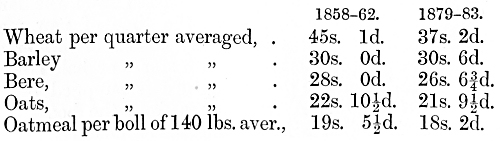
Potatoes.—In 1857 the breadth in the county under
potatoes amounted to 2500 acres; in 1881 there were no less than 3304
acres under this crop. It thus appears that, while by reason of the more
limited area available for cultivation, every other crop has suffered
curtailment, potatoes have not only held their own, but increased by 800
acres. This betokens a great development of potato culture. In fact, the
raising of this crop might almost be called the keynote of
Dumbartonshire arable farming during the past quarter of a century.
Other crops, such as grass and turnips, have been curtailed to give it
scope ; and it is with a view to raise good potatoes, and plenty of
them, that such innovations as the green-cropping of lea and hay-stubble
land have been brought into practice. It is the requirements of the
potato crop, also, that have given the chemical manure merchants such a
run of custom. The good market made available, by the growth of the
populations of the shire and the surrounding district, has been the
chief cause for this extensive potato culture. In some years very good
prices were obtained. For a special crop, a farmer twenty-five years ago
received £60 per acre, and £38 per acre has been quoted as a sum
received about ten or twelve years ago. Of late, however, this crop has
received a check. There were last year only 2425 acres of potatoes in
the county, i.e., 900 acres less than in 1880. The prevalence of
disease, especially among the earlier sorts, and the low figure to which
this kind of produce has fallen, on account of the greater quantity now
flowing into the market from remote districts, have mainly contributed
to thus diminish the crop. Dumbartonshire as a whole is not an early
growing county. In Cardross earlies are, of course, plentifully grown,
and on several areas of choice land throughout the rest of the county
they are also statedly raised; but the "Regent" and other of the later
sorts have been found most suitable for the majority of farms. Within
the last two or three years the ravages of disease, have frightened
farmers into a general adoption of the "Champion," which is now the most
popular potato in the county. "Magnum Bonums" and "Reading Heroes" are
also well represented.
Turnips.—There were last year 1470 acres of
turnips in the county; twenty-seven years ago the turnip crop covered
2622 acres. Were it not the feeding necessities of dairy stock, we
believe the acreage of turnips would be much less, as Dumbartonshire
farmers have to a great extent ceased to raise them for purposes of
sale. The chief use for turnips throughout the county is to feed milk
cows; very few sheep or bullocks are turnip-fed in this county.
Beans.—This crop has also assumed much smaller
dimensions. There were last year 391 acres under it, compared with 632
acres in 1857. It is with beans, probably as it is with turnips —they
have ceased to be an article of sale, and are grown chiefly for home
consumption.
Hay, &c.—There were last year 14,484 acres under
rotation of grasses in the county; twenty-eight years ago the breadth
under these was 20,691 acres. This diminution is, no doubt, owing mainly
to the decrease in the area of the arable land ; but it is also to some
extent referable to the more continuous cropping now practised—a great
part of the land formerly worked on the six-years' rotation being now
wrought on a five or even a four-years' shift. The area under rotation
grasses last year was 1200 acres greater than that in 1881. We find that
this increase has been mainly obtained by restricting the potato crop.
Last year, when the rotation grass area was 1200 acres greater than in
1881, the breadth under potatoes was less by 880 acres. The extent under
permanent pasture was also nearly 400 acres greater than in the former
year ; thus showing that a movement in the direction of more grass and
hay crop had set in.
Permanent Pasture.—Of permanent pasture there
were last year 18,407 acres in the county. This is a pretty steady
quantity in the agricultural returns. During the last seven years the
lowest amount returned was that in 1882, viz., 17,673 acres; the highest
is that of last year, viz., 18,407 acres. The greater part of this
amount is made up of those fields and areas of land which on every farm
are allowed to lie out in pasture for the benefit of the dairy stock. In
some parishes more of such pasture lands are found than in others. East
Kilpatrick and Cumbernauld probably show the greatest proportion of such
grass lands. There is a very fine tract of permanent pasture to be seen
on Roseneath home farm—an area of land, 16 acres in extent, called
Kilcreggan Green. This Green was once diligently farmed, but since
Waterloo, at any rate, it has not seen the plough, and it has for long
been one of the finest specimens of grass to be found anywhere. Many a
pic-nic and excursion party has dined and danced on its pleasant sward.
Meadows of bog hay, such as we find in Luss, Glenfruin, and Kilmaronock,
are also included in this return of permanent pasture.
Reclamation, &c.—There were last year 46,917
acres under crops, bare fallow, and grass. This represents the total
area within the county devoted to arable farming. This acreage would
have been much less were it not for the reclaimed land, which from year
to year has been added. To our knowledge, there have been some 500 acres
of reclamation done within the last thirty years. The most of this work
is in the Row and Roseneath district. The land reclaimed has been mainly
mossy upland. Twenty-five years ago, 50 acres of such land were taken in
hand on the farm of Torr, Row. The landlord (Sir James Colquhoun) opened
the drains, the tenant (Mr Duncan M'Farlane) supplied tiles and filled
in the drains. The ground was partly moss and partly loam. Mr M'Farlane
applied to it 40 barrels of lime per acre—lime being 1s. 4d. per barrel.
When first turning it over, he had two men going behind the plough
trimming the furrow and removing stones. The land was put through a
course of cropping, growing specially good turnips; and, upon the whole,
neither landlord nor tenant have had reason to regret the trouble or
expense connected with the undertaking. Another good sample of
reclamation is to be found in the improvements effected on the farm of
Mamore, Roseneath, by which about 100 acres have been added to the
arable land. The proprietor (the Duke of Argyll) executed fencing and
drainage, the tenant (Mr James Clement) doing cartages, and agreeing to
pay 5 per cent. on the landlord's outlay. Drains were made 2 feet 6
inches deep and 15 feet apart, and laid with tiles 3 inches in the bore.
Mains were dug 3 feet 6 inches deep, and laid with tiles 4 to 6 inches
in the bore. Mr Clement ploughed up the land, and applied to it between
40 and 50 barrels of lime per acre—lime being £1 per ton without
cartage. About £20 per acre was expended to bring the ground into
condition. After a course of crops, the land was laid out in pasture,
and Mr Clement has the satisfaction of knowing that, whereas the farm
when he came to it, ten years ago, could hardly carry a dozen cattle, it
is now able to graze 80 head. Mr Matthew Howie, Clachan farm, Roseneath,
has also brought into arable condition a rough tract of land called
Campsail Hill. This tract, extending to upwards of 50 acres, was
subjected to preliminary blasting and draining in his predecessor's
days, but considering how it was infested with whins and stones when Mr
Howie took it in hand fourteen years ago, his work has all the merit of
a reclamation. In West Kilpatrick, about 30 acres of marsh lands have
been reclaimed through the operations of the Clyde Trustees.
Manures.—The past twenty-five years have
witnessed a great change and advance in respect to manures. More manure,
and of better quality, is now being made in the farm-yards, the higher
style of feeding adopted for milk cows resulting in an improvement in
this respect. More long and short dung is also being imported by
farmers. Formerly importation was done after a somewhat cautious
fashion, and in some districts consisted mainly of city dung. Now great
quantities of the better manure are being imported, some farmers using
no other. But the greatest difference between the past and the present
is observable in the universal use now made of chemical manures. Thirty
years ago, small quantities of guano were being imported by farmers, but
their mainstay as an extra fertiliser was lime. Now lime is in almost
entire abeyance, and chemicals are in varied and abundant use by nearly
all farmers, crops sometimes being raised with nothing else. In
districts where tolls or freights have made the importation of good
old-fashioned dung rare, the portable artificial stuffs have been made
to do duty instead, which must be accounted an evil. The over-cropping
which has sometimes been practised has also made the use of chemicals
necessary as a stimulant to nature; and lastly, the prevalence of
ungenial weather has induced farmers to resort to them, by way of
encouraging crops under adverse conditions. The discovery and
application of chemical manures is no doubt one of the beneficent
improvements of modern times; nevertheless the limit of moderation and
usefulness has in recent years been sometimes overpassed. Many farmers
are now expressing a less favourable opinion of these manures, and
resolving upon a more temperate use of them in the future.
Leases, Rotation, &c.—Nineteen years' leases are
the rule throughout the county. The new tenant gets possession of houses
and pasture at Whitsunday, the outgoing tenant being bound to sow down
the land with grass seeds for his benefit. Rents are paid at Whitsunday
and Martinmas. The regulations of some newer leases are not nearly so
stringent as in old ones. Tenants on some estates have perfect freedom
as to rotation of crops, and on others the exigencies of the times have
more or less tended to make rotation rules a dead letter; so that
tenants in general have now more liberty. The six-years' rotation was
formerly that prevalent in the county, and it still holds good to a
great extent, but five and four years' courses of cropping are now
pursued on a large proportion of the land, and the uniformity in farm
management which once obtained is much broken.
Steadings and Roads.—On some estates succession
arrangements have prevented additions and improvements being done, but
in general steadings are good and of modern construction. On the Luss
and Kilmahew estates (the first owned by Sir James Colquhoun, the second
by John W. Burns, Esq.) the farm buildings are exceptionally good.
Steadings on the former underwent a thorough renovation twenty-five
years ago. Of late years much work has also been done by the proprietors
in Roseneath parish in the way of building and improving farm steadings.
In particular, a first-rate new steading has been erected on Clachan
Farm, provided with a hay-shed, covered court, and steam thrashing mill.
The interior of the byre is done with cement—floor, grupes, and stall
divisions being all of that material. The milk-house shelves, &c, are
also of cement—thus insuring coolness. On the Gartshore estate,
Kirkintilloch—the property of the late Mr Whitelaw's trustees—great
improvements in the way of fencing, draining, building, and planting
have within the last six years been executed, chiefly under the
management of Mr Park, factor. Throughout the county not a few of these
useful adjuncts to a farm, viz., hay-sheds, have been erected, the
prevalence of wet summer weather having rendered them necessary. The
shire is in general well supplied with farm and county roads. The Roads
and Bridges Bill has proved a boon to some farmers, and a grievance to
others. Those who formerly had no toll to pass with produce, now find
the road tax a heavy burden.
Servants.—There were at last census 2055 persons,
other than farmers themselves, connected with agriculture in the
county—of these 207 were farmers' sons. There were in all 410 farmers,
whereby it appears that nearly every second farmer had a son to assist
him in the work. Agricultural labourers numbered 1015, and female
servants 745. Twenty-five years ago, it is computed there were in the
county 1988 men servants employed in farms. This proves, we think, that
holdings are now not only fewer, but that they are managed with fewer
hands. Wages have greatly risen during the period of our report. The
most notable rise is in the price of female labour. Dairymaids have
doubled their hire, £20 to £24 per annum being now the fee of a good
one; whereas formerly, £10 to £12 would suffice. From 20s. to 22s. is
now a married ploughman's weekly wage ; twenty-five years ago from 14s.
to 16s. would be deemed sufficient, with a free house. An unmarried
ploughman, boarded in the house, is now paid at the rate of £16 or £17
per half year; formerly he was thought well paid with £10. Out-door
workers, such as hoers and weeders, now get from 1s. 8d. to 2s. per day,
as compared with 1s. or 1s. 3d. in previous times. Harvestmen now
receive from 4s. to 5s. per day. Though servants have thus had their
wages so much raised, we are bound to report that, as a whole, they have
not been equally careful to improve the quality of their work. We have
heard frequent complaints of the faithlessness and useless-ness of
servants. It is alleged that, as a class, they have degenerated. We are
informed of several cases in which masters have engaged three or four
servants in succession, not one of whom appeared. When they do begin
work, it is not long till many of them manifest traits of character
which render them an affliction. There is a case in which a farmer had
to relinquish a lucrative milk trade, simply because he could not get
servants combining competency and honesty. Of course, there are good and
bad in every rank and profession ; but it would appear from the
testimony of well-informed persons, that among farm-servants the bad is
beginning to preponderate to a greater extent than formerly. In the
management of their business there is now a general tendency among
farmers to shorten operations and minimise labour. Connected with this
subject, may be mentioned the general adoption of labour-saving
machines, which has taken place throughout the county during the last
twenty-five years. The most notable of these is perhaps the
reaping-machine. Employed at first by only one or two of the larger
farmers, it has gradually gained popularity, till now there is hardly a
farmer in the county without it. It has alike rendered obsolete the
reaping hook of the Irish gangsman and the more modern scythe. Another
very useful labour-saving apparatus is the raking-machine. This, though
a comparatively simple contrivance, is a very serviceable one. The steam
travelling thrashing mill is also a notable farm machine. The bulk of
the thrashing in the county is now done by it. It began to go its rounds
twenty-five years ago, and since then it has gradually gained favour. At
first it was a cumbrous affair drawn by horses, but latterly steam has
been applied to its locomotion. The wearing done of so many tenant's
thrashing mills, and the greater speed of the traveller's work, are
probably the main reasons for such an adoption of it. A day's service of
it will result in the thrashing of from 40 to 60 quarters, and will cost
the farmer in all about £5,—£2 or thereby being for the use of the
machine, and the balance for the necessary staff of workers. Sometimes
corn is passed into it off the stook.
Farmers.—By the census returns of 1881, it
appears that there are in all 383 occupants of holdings in the county;
in 1857 the number was 593. In thus appears that agriculturists as a
body have decreased to less than two-thirds of their former number. The
explanation of this circumstance is no doubt found in the diminution of
the arable land—so many farms being blotted out by the increase of
populous places ; and in the greater size of holdings—a general movement
in that direction having been made by landlords some years ago. In every
parish farms have been doubled or tripled in extent, by the annexation
of adjoining ones; and in many cases one tenant now holds as much land
as formerly sufficed for three or four. Another notable fact in this
connection is the change which has passed upon the personel of the
tenantry during the past twenty-five or thirty years. In every part of
the county, farms, formerly held by one family from generation to
generation, have passed into the hands of strangers. In Roseneath and
Kirkintilloch parishes, for example, hardly a remnant remains of the old
tenantry. This has come about partly by natural causes, and partly by
the more commercial spirit in which proprietors now manage their land.
Dairying.—There were in 1883, 7072 milk cows and
heifers in Dumbartonshire; in the year 1857 these only numbered 5159.
Milk cows have thus during twenty-five years increased by nearly 2000.
The reason for this is found in the great development of dairy farming
which that period has witnessed. The number of cows kept has changed
from 5159 to 7072, and the method of managing them has also greatly
altered. Formerly very few farmers in the county lived by the sale of
sweet milk. Dairy produce was disposed off in the form of butter and
cheese; much milk was also devoted to the rearing of young cattle. The
population of the shire was comparatively small, and many of the
non-agricultural portion kept cows, whereby they were independent of the
farmer. Glasgow also, being a much more circumscribed place, could get a
sufficient supply of milk without going beyond her own district. But
now, since such a number of populous places have sprung up in the
county, since Glasgow has locally extended herself several miles nearer
to some portions of Dumbartonshire, and since the railway has brought
other parts within an easy distance of the city, a great sweet milk and
fresh butter industry has arisen and developed year by year. The making
of cheese has, in consequence, been wholly dropped, and the portion of
milk devoted to calf-rearing has been reduced to a minimum. The sweet
milk trade has been mostly taken up by farmers in the near neighbourhood
of towns and villages; those in remoter parts have become purveyors of
butter and butter-milk. The dairying industry, thus arising by the
increase of population, has become one main source of income to the
farmer. The flow of ready money secured by it is one reason why so many
have adopted it. Realising its profitableness, the landlord has raised
the rent; and the "good market for dairy produce" has become a usual
feature in the advertisement of a Dumbartonshire farm. Neverthless,
there are not wanting signs that this branch of farm industry has now
reached an acme. The supply all over the county is about equal to the
demand, and the cost price and selling price of produce have now
approached pretty closely together. As an article of commerce, dairy
produce has been remarkably steady in price. For the last twenty-five
years it has never fluctuated, but risen gradually, till now its value
is 30 per cent. enhanced. Twenty-five years ago, milk was retailed at
something like 1s. per gallon, now the price of a gallon is 1s. 4d.
Fresh butter formerly was 1s. per lb., now its price per lb. is 1s. 6d.,
rising to 1s. 10d. or 2s. in the winter months. A noticeable result of
this development of dairying is the higher style of feeding now adopted
for cows. Bean meal, draff, and oilcake are now used to an extent not
dreamed of at the beginning of the period on which we are reporting.
Indeed, an opinion is expressed that proper bounds have been exceeded in
this respect, and that cattle would be healthier and longer lived if a
more natural style of feeding were resorted to. The scarcity of grass
is, on many farms, the reason for such an artificial style of feeding
cattle. Desirous of cropping as well as dairying, farmers cannot afford
as much pasture land as the stock would require, and so are forced to
supplement with draff, bean meal, &c. Side by side with a vigorous
prosecution of dairying, an extensive rearing of young cattle goes on
throughout the county. There were last year within it 3991 cattle under
two years of age. This would perhaps mean about 2000 calves, which
represents one-third or thereby of the whole produce. Under present
auspices, calf-rearing is less happily carried on than of yore. Large
milk-selling and generous treatment of the calves cannot well go
together. Both the calf and the customer want the warm milk, and of
course as the former can produce the ready money he gets the article. In
West Kilpatrick, where, as we have described, dairying is carried to a
height, calves are found so much in the way that they are not reared at
all.
Exhibitions of live stock are held annually at
Dumbarton, Helensburgh, and Kirkintilloch; the first open to the county,
the second to the western district only, and the third divided into two
sections, the one confined to the parish, and the other open to all
comers. Concerning the general quality of the Ayrshire stock exhibited
at these shows, there is some difference of opinion. As might naturally
be expected, in a county so devoted to dairy-farming, it is not so much
the rearing of fancy animals as the attainment of a heavy supply of milk
that is aimed at; hence very frequently at the shows the best animals
are not those reared in the county, but those purchased at Ayr and other
shows famed for this class of stock. A herd, however, which has always
come well to the front in local and Highland and Agricultural Society
Shows, is that of Mr John Martin of Auchendennan, in Bonhill. This herd,
the dispersion sale of which was such an event in the agricultural
world, was founded fifteen years ago by Mr Martin. Ambitious to have as
fine a selection of Ayrshires as Scotland could produce, he spared
neither labour nor expense in the undertaking. He collected his stock
from all the best breeders, looking to style and substance. Convinced,
in course of time, that cattle after the fashionable show pattern were
not fitted to serve useful purposes in the dairy, Mr Martin remodelled
his stock, so as to produce animals of a better and more profitable
type. Most of the calves were reared. Bulls were sold yearlings by
auction, bringing from £8 to £18 each, and in some cases more. The
heifers were brought to calf, calving at 2½ or
3 years old. Old cows were also sold, bringing good prices. The fame of
Mr Martin's herd brought buyers from all quarters to these sales ; and
many of the yearlings were bought by farmers in the county; others had
the services now and then of " Old Burn-house" or other of his famous
bulls. At the dispersion sale, on the 15th April 1884, the herd was
scattered all over the country, many of them going to England. Some
extraordinary prices were obtained, of which the following are
samples:—29 cows gave an average of £19, 8s.
8d. each; 19 three-year olds gave £20, 12s. each on an average—the
highest individual price being 40 guineas for "Betty
II." of Orchardton; 14 two-year olds gave an average of £14, 18s.
each; and 15 quey stirks made the good average of £12, 4s. each. Amongst
the bulls equally high prices were realised. The three-year old
"Quicklime" made 60 guineas, and the two-year old "Midian" 20 guineas;
16 bull stirks gave the very substantial average of £16, 7s. 7d. each—
the highest individual price being 26 guineas; while 20 calves made an
average of £3, 6s. 2d. each—individual animals amongst them going as
high as £7 or £8 each. Other Dumbartonshire herds, which have made their
mark at shows, are those of Portnellan (referred to in the Kilmaronock
section of the paper), Tillichewan, and Aitkenbar farms, in the Vale of
Leven district, and that of Milliken in East Kilpatrick, and a number of
dairy herds in the same locality, all of a very high standard of
excellence.
Horses.—There were last year in the county 1785
horses connected with agriculture; 545 of these were kept solely for
breeding purposes. In 1857 there were in all 1826 horses connected with
agriculture. The decrease thus indicated in the number of agricultural
horses is a parallel fact to the decrease of farms, which is also known
to have taken place in the county. An element in the horse class which
has very much increased since twenty-five years ago, is milk cart
ponies. The increase of them is, of course, owing to the great
development of dairy farming. The "Clydesdale" is the chief farm horse
in Dumbartonshire. As his history and doings are a subject of
considerable importance, we here subjoin a separate account of it.
Clydesdale Breeding in Dumbartonshire.
For more than a quarter of a century Dumbartonshire
has occupied a prominent place as a horse-breeding district. Important
and largely attended horse fairs are held annually at the Moss of
Balloch, and Carman Hill, near the town of Dumbarton ; and although the
latter has somewhat fallen into disfavour during recent years, the
former, held in September, still continues to be largely patronised.
Horses are also a prominent feature of the exhibitions of live stock
held at Dumbarton, Helensburgh, and Kirkintilloch. These shows have
contributed not a little to the advancement of agricultural enterprise
in breeding ; and the district selection of a well-bred stallion since
1875 has also greatly furthered this important, and now fairly
profitable department of the farming interest. The whole eastern
district of the county is noted for horse breeding; and the portions of
the western sections remarkable in this respect are the parishes of
Cardross, Luss, Dumbarton, and the Kilpat-ricks. About forty years ago
horse-breeding was vigorously carried on in the parish of Roseneath.
Mainly through the efforts of the late Mr Lome Campbell, good horses
were made use of. The Messrs Orr, of Meikle Aiden Farm, had a fine breed
of grey mares, which frequently were successful competitors at local
shows; and from these mares a rather noted race of superior horses, bred
by Mr Duncan M'Farlane, Torr, Helensburgh, had their origin. The first
great impetus the breeding of heavier Clydesdale animals in the western
district received was about the year 1855, when Mr John Glen, Lettrualt,
Helensburgh, introduced "Clydesdale Tam" (175), a Lanarkshire horse
descended from two famous prize-takers. " Clydesdale Tam" was patronised
by Mr Lorne Campbell, Mr Duncan M'Farlane, and others. The produce of
this horse were generally animals of quick, fiery disposition, but
distinguished by the superior excellence of their feet and legs. The
writer has distinct recollection of a remarkably smart mare named
"Nancy," owned by the Messrs Campbell, Little Aiden, Kilcreggan, the
daughter of this horse; and a description of her may give an idea of the
class of Clydesdales reared in the county about thirty years ago. She
was a good brown, with a slight "ratch" on face, and dark coloured legs
: her limbs were well formed and beautifully planted, while the feet
were very good and sound. The great difference between her and the
fashionable style of Clydesdales now was the absence of a great quantity
of hair about the legs, a feature which is a doubtful advantage to the
draught horse. So active was she that she was occasionally run in
hackney carriages, and this activity was inherited by all the progeny of
"Clydesdale Tam" (175). Mr Lorne Campbell also
bred a mare after the same sire, which was sold at Mr
Marjoribanks' displenishing sale in 1875, a remarkably fresh old mare.
The greatest of all the descendants of the horse in question, however,
was "Garibaldi" (312), bred by Mr Lorne Campbell, and sold when three
years old to the late Mr John Barr, Bar-rangray, Erskine. This horse was
the progeny of a Kintyre mare, and gained first prize when three years
old at the Highland and Agricultural Society Show at Perth in 1861, but
unfortunately died shortly afterwards. His best known descendants were
the noted mare "Rosie," owned by the Duke of Hamilton, and winner of
first prize at the Highland and Agricultural Society and other Shows,
and "Young Garibaldi" (972), popularly known as "Brewster's ring-eyed
horse." Off "Clydesdale Tam" (175), the energetic tenant of Torr had two
mares, named respectively "Jess" and "Mall." The first of these was dam
of two horses which became first prize winners at the Highland and
Agricultural Society Shows, viz., "Lord Clyde" (478) and "Prince of
Wales" (670). The last-named horse gained the Renfrew district premium
in 1866, and was exported to Australia. "Clansman" (150) and "Glenlee"
(363) were amongst his sons; and when we point out that the former was
sire of "Pride of Scotland" (602), and the latter of "Belted Knight"
(1395), we have established such a connection between the best of the
past and the best of the present as will make valid the claim of
Dumbarton to be a select breeding district. "Lord Clyde" (478), it may
be further pointed out, was the great-grandsire of the mare "Moss Rose,"
the centenary champion of 1884. "Mall," the second mare at "Torr"
referred to, was dam of "Sir James" (782), a horse of good reputation,
which also found his way into Highland and Agricultural Society premium
lists. Shortly before the beginning of the period reported on, Mr D.
Riddell became tenant of Kilbowie, Duntocher, and for many years this
was the headquarters of one of the largest stallion-owning
establishments in Scotland. Mr Morton, who was tenant of Dalmuir Farm,
was also a famed breeder about twenty-five years ago. It was at his farm
that "General" (322), the sire of the famous horse "Prince of Wales"
(673), sold when eighteen years of age by public auction for £945, was
foaled; and on the same farm, about fifteen years later, the showyard
favourite "Bessie Bell" first saw the light. Mr William Park,
Balquhanran, Dalmuir, was also a famous breeder a quarter of a century
ago. His name frequently appears in prize records, and as breeder of
"London Maggie" (84), the famous prize-taker; he enjoyed a world-wide
reputation. In the earlier years, the leading horse breeders in the
eastern district of the county were the Messrs Moffat, Shirva,
Kirkintilloch, and Anderson, Smithston, Cumbernauld. These gentlemen
were breeders and owners of high class animals, which found their way
into the records of the largest exhibitions, and the descendants of
which are amongst the most noted of present day sires; for example, "Darnley"
(222), a son of one of the Shirva horses. During the whole of the
preceding quarter of a century, the name of Garscadden Mains has been
familiar to all fanciers of the Clydesdale breed. Here Mr Alexander
Buchanan and his son David have owned and reared many prize winners at
Dumbarton, Glasgow, and the Highland Society's Shows. Perhaps the most
famous animals which have hailed from this farm were the mare "Garscadden
Maggie" (41), winner of first prize at the Highland and Agricultural
Society's Show at Aberdeen in 1876, and third at Edinburgh in 1877; and
the Stallion "Druid" (1120), winner of first prize at Highland and
Agricultural Society's Shows at Dumfries in 1878, and. at Kelso in 1880,
and first and champion cup at the Royal International Show at Kilburn in
1879.
The second great impetus the general breeding of
Clydesdales received was about 1866, when the well-known sire " Samson "
(741), (locally known as " Logan's " twin), was for two seasons located
in the county, previous to his going to be "Keir" stud horse. Many fine
mares were left by this horse, and three entire horses, all named "
Young Samson," and numbered respectively 1373, 1374, and 1375 in the
Clydesdale Stud-Book. The two latter were bred by Mr M'Farlane off the
mares formerly referred to, and both went to the island of Bute ; the
former was bred by Mr Glen, Lettrualt, Helensburgh, and was exported
when rising three years old. He, however, left his mark on the mares in
the county by proving the sire of "Roseneath Rosie" (422), bred by Mr
John Marjoribanks, Roseneath Farm, and sold at his displenishing sale in
1875 to Mr Thorn of Barremman, and while in his possession, the dam of
the well-known mare "Mary Gray," which became the property of Mr
Lawrence Drew, Merryton, and in his hands gained numerous premiums both
in England and Scotland. She was sold at the Merryton sale, in April
1879, to Provost Waddell, Bathgate, and with him also secured many
prizes until she died 1882. In 1871 the Auchendennan Clydesdale stud was
founded, and it soon became apparent that the banks of Loch Lomond were
to be the seat of a first-class breeding stud of Clydesdale mares. In
1874 the first grand success was achieved in the birth of "Prince George
Frederick" (644), which gained numerous showyard premiums, including two
first prizes in his native country, and the sweepstakes at Chicago,
Illinois, in 1882. The crowning success of the stud was achieved in
1879, when its representatives gained first premiums in three out of
five female classes at the Highland and Agricultural Society's Show at
Perth as well as fourth in the only other class in which they were
exhibited. In the autumn of that year, a draft sale was held and amongst
noteworthy prices realised were the following: "Damsel," foaled on the
farm 1875; sire Crown Prince (207), dam Darling (241), £525. "Effie
Deans," bred in Galloway, three years old, £210. "Annot Lyle," bred in
Ayrshire, yearling, £231. The first of these mares was exhibited eleven
times at all sorts of shows, and was ten times first and once second,
viz., when a yearling at Glasgow in 1876. "Effie Deans " was exhibited
seven times, and was six times first at different national shows. "Annot
Lyle" was the champion yearling filly of 1879. In 1883 the stud was
again strongly represented in the showyards. "Alice Lee" and "Diana
Vernon," the latter own sister to Damsel, being first and third at the
Royal Show at York, and second and third at Glasgow in May. Both were
sold at very high prices, for exportation to Adelaide, South Australia,
before the Highland Society's Show came round in July, and with two high
class stable companions, went to form an addition to the stud owned by
Hart Brothers, Beefacres Farm, Paradise. "Damsel" was also, in 1879,
purchased by a New Zealand fancier, and landed there in safety.
In April 1884 this fine stud was brought to the
hammer, and sold without reserve. The attendance of the public was very
large, and the following sale list records the prices realised:— "Knockdon"
(242), 14 years old, and in foal, £52, 10s.; "Ranee" (244), 12 years
old, yeld, £105; "Lady Peveril," 4 years old, yeld, £283, 10s.; "Bride
of Lammermoor" (2506), in foal, £320, 5s.; "Swertha" (2505), in foal,
£299, 5s.; "Barbara," in foal, £168; "Jeanie Deans" (246), 9 years old,
and in foal, £139; "Lady of Avenel," 3 years old, with foal at foot,
£73, 10s.; "Darling"(241), 16
years old, and yeld, £78, 15s.; "EffieDeans,"
£52, 10s. "Edith Plantagenet," yearling filly, never exhibited, £315;
"Lord Fitzlyon" (1747), £100, 16s.; "Sir
Hildebrand," yearling colt, never exhibited, £204, 15s.; "Magnus Troil,"
yearling colt, never exhibited, £44, 2s.
The following list of horses which have been engaged
to travel the county under arrangement with a local committee, and on
very favourable terms, will show that some of the best animals of their
class have left their progeny in the county. The district society was
formed in 1875, and in that year "Topsman" (886) was secured. In 1876,
"Disraeli" (234), the first prize three-year old of his year, was
engaged, but the results of his breeding were not equal to the
expectations entertained of him. In 1877 and 1878 his sire "Farmer"
(286) was the chosen of the committee, and, true to his reputation, the
county now reaps the benefit of this selection. "Ivanhoe" (396), which
in the two preceding years was the Glasgow premium horse, was in 1879
the Dumbarton Society horse, and then the enthusiasm of the breeders
flickered for two years, and no Society horse was engaged. In 1882 the
brisk American demand for Clydesdales caused a revival of the
enthusiasm, and the happiest choice of all, made by the Dumbarton
Committee, was brought into the county, viz., "Belted Knight" (1395),
the sire of the highest priced yearling ever sold. The yearling referred
to was "Edith Plantagenet," bred by Mr Houston, Whiteleys, Dumbarton. In
1883 the Keir bred horse "Newman" (2305) was chosen, and this year
"Belted Knight" (1395) has again been engaged on very high terms, viz.,
£120 premium—80 mares guaranteed at £2 each at service, and £3
additional for every mare left in foal.
In conclusion, it may be stated that no county of the
same dimensions sends out more gentlemen, who are entrusted by their
brother breeders with the onerous duty of judging at shows. The names of
Messrs Martin, Auchendennan; M'Farlane, Torr; Calder, Colgrain; Fleming,
Tillichewan; Reid, Port-nellan; Simpson, Drumfork; Renwick, Dalmuir ;
Brock, Barns of Clyde; Buchanan, Garscadden Mains; Wilson, Langfaulds;
M'Nair, Westerton; Coubrough, Craigton; Houston, Whiteleys; M'Kinlay,
Ardoch; and others, will at once occur to those interested in Clydesdale
breeding.
Summary of Changes, Improvements, &c.
The past five-and-twenty years has been a period of
innovation and unrest all the world over. A spirit of revolution has
been at work, altering and re-altering the face of things, and in the
Dumbartonshire agricultural world this spirit has had full sway. Great
alterations and developments have taken place, which it would astonish a
farmer of former times to look upon. We have noted these to some extent
in a previous part of the report, and we shall here merely summarise and
bring them into one view. The main cause of these changes has been the
great increase of population in and around the county, consequent upon
industrial progress. Between 1851 and 1881 the population of the whole
county increased from 46,995 to 75,333; old towns and villages extended
themselves greatly, and new ones sprang up. The contiguous towns of
Glasgow and Greenock have also grown immensely; and teeming populations
have arisen in Coatbridge and the Monk-land district, adjoining the
eastern section of the county. By this means, new and convenient markets
for produce have been opened up, quickening the pulse of agriculture.
Bents have risen, and farming altogether has become a faster and more
competitive business. Some departments of it have increased to great
proportions, others have dwindled and become extinct. A large return and
a quick one has more and more become the farmer's aim, leading to the
adoption of many new methods and machines.
The following, we think, are the chief changes,
developments, and improvements which have taken place. There has,
firstly, been a change in rents and prices. Rents in general have risen
25 per cent. in as many years. Eight or ten years ago they went by the
run, a rash and venturous spirit having seized competitors for farms. In
not a few cases, landlords who had thus let farms at a fancy figure, had
shortly to take them off the tenant's hands, or else to substantially
reduce the rent. Wages, as we before related, have gone up to a marked
degree—men's having advanced 30 per cent. or thereby, and females'
having almost doubled. Tradesmen's accounts have risen over 20 per cent.
Formerly a set of horse shoes cost 4s. or thereby, now 6s. is very often
paid. A new cart was formerly purchased for £11, now it costs £14.
Movement has also taken place in the values of cattle and produce.
Twenty-five years ago, a good milk cow would be priced at £8 or £9, now
from £17 to £20 has to be paid for such an animal. A good farm horse,
that would sell formerly for £25, will now fetch £50 or thereby. Of
late, the foreign demand for pure bred "Clydesdales" has had a very
elevating effect on the value of that class of stock; farmers with good
mares have found the rearing of these animals one of the best paying
stocks on the farm. The variation in the prices of grain does not,
however, bear such a favourable aspect on the farming interest. Wheat,
in the face of an increasing cost of production, has fallen from 42s.
per quarter in 1857, to 33s. 6d. in 1883 ; and this year (1884), we
believe, a further fall is announced. Barley, bere, and oats per
quarter, and oatmeal per boll, are each about 1s. less than they were
twenty-five years ago. Hay has not moved much from its old price, viz.,
from £4 to £5 per ton. Potatoes, for a considerable number of years,
constituted one of the farmer's most valuable crops, fluctuating,
however, so that profits were variable. Sometimes £30 was obtained for
an acre of early potatoes, sometimes the price fell to £20, but
generally £4 or £5 more was realised. Of late, however, potato prices
have become very depressed, and for two or three years £20 per acre has
not often been obtained. Dairy produce has all along been one of the
most lucrative commodities on the farm. Prices have risen from 30 to 50
per cent. Milk, twenty-five years ago, was 1s. per gallon retail, now
the price is 1s. 4d. Butter, during the intervening period, has risen
from 1s. to 1s. 6d. per lb. retail. The sale of milk, the sale of milk
cows, the sale of horses, and for a considerable number of years the
sale of potatoes, have thus been the most profitable branches of the
Dumbartonshire farmer's business. There has also been a considerable
change in the size of farms, a movement in the direction of larger
holdings having taken place all through the county. There has been a
considerable change in details of farm management to the six-years'
rotation having to a great extent been set aside; and machinery having
also been largely adopted, to the exclusion of manual labour. There has
been a change too, in the sources from which the farmer draws his
income, milk and potatoes having become fruitful sources, whereas grain
and meal have become of much less account. Markets at a distance have
likewise to a great extent been exchanged for markets at the door.
The following are the two principal developments
which have supervened. First, there has been a development of potato
culture. The extent of this development we have before indicated. It has
drawn in its wake an increase of ploughing, an increase of chemical
manuring, and such innovations as the green-cropping of lea and
hay-stubble land. There has, secondly, been a development of
dairy-farming. This has brought about a much higher style of feeding in
the dairy, and an advance in the quantity and quality of manure.
The following we would set down as the chief
improvements effected during the past five-and-twenty-years. There has,
firstly, been a considerable amount of reclamation done; to our
knowledge, some 500 acres have been thus treated. There has been a
substantial improvement in steadings. There has been a general adoption
of useful labour-saving machines. Contact with these has taught farmers
to be something of mechanics, in like manner as working with artificial
manures has given them a smattering of chemistry. There has been an
improvement in farm implements—ploughs, harrows, grapes, forks, &c,
having become neater and more effective. There has been an improvement
in live stock. Dairy cattle are better fed, and of greater size, than
they were thirty years ago; and with respect to both horses and cows,
farmers are now more careful in mating, so as to improve the breed.
There has, lastly, been an improvement on the farmers themselves. They
have grown more skilful and enterprising both as regards crops and
cattle. They have also become more refined and gentlemanly in their
ways. Their steadings, as a rule, are clean and orderly, many of their
dwellings being fronted with well-kept flower gardens. We have pleasure
in testifying that, as a class, we found them kindly, courteous, and
intelligent. To the farmers in general we beg, in conclusion, to tender
thanks for their cordiality and readiness to impart information; but our
obligations are more especially due to all those gentlemen connected
with the agricultural or other interests of the county who, by revision
services or otherwise, have assisted us in preparing this report. |



