View our terms and conditions for use of our web site and our privacy policy. Visit Electric Scotland's Aois Community, our social networking site. Find our contact information and learn more about us. The Home Page of Electric Scotland ES Common Header Bar
This is where you'll find a comprehensive resource on Scottish accommodations. Electric Scotland's Article Service where you can both read articles and post your own. Beth's Newfangled Family Tree is a monthly publication giving genealogy advice as well as what's hapening on the Scottish Scene around the world. This is where you'll find around 300 books on Scottish history that we've published on the site. Our pages where you'll find books and articles about Robert Burns and his work. Gives you some information on the business scene in Scotland. This is where you can view Scottish events around the world and add your own. Learn about the history of Clans and Families of Scotland and the Scots-Irish. The personal site of Alastair McIntyre where he's posted his own mini biography as well as his travel journals. 5 volumes worth of biographies relating to Significant Scots. A weekly newsletter about the political scene in Scotland from the Scots Independent Newspaper. Lots of Scottish recipes along with contributions from our visitors. Play our collection of online games. 6 volume Gazetter on the place names of Scotland. This is our page for trying to give you advice on Genealogy. A FAQ where you go to get answers to frequently asked questions. Information and pictures about Historic places in Scotland such as castles and other properties. Main index page for our very large history section. Children resources including over 800 children's stories and lots of online and offline games. A bit of a catch-all page where you find loads of pages about music, haggis, scots language, culture, religion, humor and lots more. Our nature page where you can explore information on Scottish Wildlife, Plants, Flowers and lots more. Our weekly newsletters archive. Thousands of pictures of Scotland for you to enjoy. Loads of poetry and stories for you to enjoy with many contributions from visitors to our site. Our very own Webcard program which you can use to send online postcard to friends and relatives. Huge resources about the Scots Diaspora around the world and here is where you can find this information. A continually building information resource on the Scots-Irish who emigrated to Ulster and then onto many parts of the world, especially the USA. Create your own family tree with our special software. You can also import and export gedcom files. Our web-based scottish search engine which is a free resource for Scottish companies as well as Scottish organisations around the world. Current Scottish News headlines and links to Scottish news resources. A range of services, both big and small, that we currently offer. Our Tartan pages, giving you access to information on Tartans as well as tartan search engines. Sponsored by House of Tartan. Our travel section where we have loads of suggested tours of Scotland as well as old historic travel books. A wee collection of videos some of which we've produced ourselves. Learn about the last 100 pages we've added to our site which is updated daily.

Click here to get a Printer Friendly Page
 

Send Flowers

Art Lessons
by Donna Flood
Drawing on the Right Side of the Brain


Lesson One - The Seeing of Edges

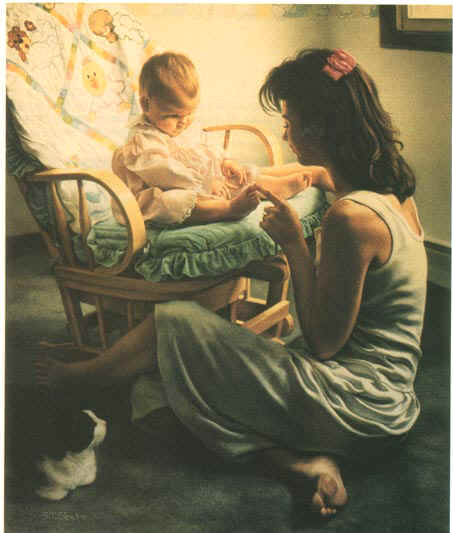
"This Little Piggy"  by S. Thomas Sierak, an American Artist
"This Little Piggy"  by S. Thomas Sierak, an American Artist

In looking for a way to "turn off" the dominant left brain and "turn on" your nondominant right brain the following is a good exercise. It will force a cognitive shift and suppress the left brain completely.

Kimon Nicolaides, in his 1941 book, "The Natural Way to Draw," shows the pure contour method to improve a student's use of both senses, sight and touch. He asked that they imagine they were touching the form as they worked. To go a step further on the tactile thought it was my practice to take an actual object of whatever the class was drawing. Pass the object around to the students and with touching it there was a stronger communication to their brain as to its qualities whether, soft, hard, furry, bumpy, crumbly, etc. For instance, right around you, the keys on your computer are hard, so is the material on your mouse, also the desk in front of you is hard.

Paper is hard. A pen is too. However, if you feel them slowly and carefully you will see there is a distinctly different registering of the surface of the objects going to your brain for you to consider.

Once these objects are recorded as tactile one's brain also registers this and we begin to get into the right brain. The left brain cannot or will not work at it, and becomes suppressed. Without further explanation here is the exercise:

Set up the best conditions for making a switch from left to right brain:

1. Total silence, talking by the students or the teacher locks students into left mode.

2. Music

3. Better yet, a visual pattern movement such as dance with good music

4. Find a place you can be totally uninterrupted for twenty minutes, set an alarm if possible. If you don't care about keeping track of time (a Left mode function) omit the alarm.

5. Tape down a piece of paper to the table (absolutely necessary).

6. You are now going to draw your hand without seeing what you are doing.

7. Turn your body completely away from the paper so you cannot see the hand drawing.

8. Do not peek at your drawing. The minute you do you will slip out of the right brain. The impulse will be great but you must resist looking no matter how overwhelming it is.

9. Focus all your attention on observing the hand you are drawing as you draw.

10. Focus your eyes to some part of your hand, observing ever variation and undulation of the edge. As your eyes move, move your pencil at the same slow pace on the paper, creeping a Millimeter at a time.

11. Match the movement of the pencil exactly with your eye. One or the other may attempt to speed up, don't let it happen.

12. The left brain will say, "Stop this stupid stuff right now! We don't need to look at things this closely. I've already named everything, this is boring - if you don't stop, I'll give you a headache." Ignore this complaining, simply persist. You do not care if the drawing looks like a hand. After you are finished remember how you felt. Did you become enthralled with what you saw? Next when you go again to this state will you recognize it.


Return to Art Index