|
IT may be assumed to be a generally accepted proposition
that every creature has its own appointed use and purpose, and has its place
in the whole scheme of creation; yet it is also true that we constantly hear
animals,—beasts or birds,—spoken of as belonging to one or other category of
the noxious or innocuous. We have indeed a somewhat unpleasant word to
designate the former, a word that has travelled far from its original
meaning; we call them ‘vermin.’ When, however, we give the matter closer
consideration, it will be found by no means an easy task to draw hard and
fast lines separating, as it were, the sheep from the goats. We find it to
be a matter of proportion, circumstances, and surroundings, just as ‘dirt’
was properly described as matter in the wrong place.
In India, in districts where
game is still plentiful, the tiger is looked upon by the native cultivator
as a benefactor who keeps down the wild animals that devastate his fields;
but when game is scarce or non-existent, and the tiger preys systematically
on his cattle, he is addressed with opprobrious epithets, and the assistance
of the Sahibs is invoked for his destruction. Here in our own country we
have got into a way of loosely classing certain beasts and birds as
'vermin,' to be destroyed in every way possible without further trial, and
of this habit it may be of interest to consider a few examples.
To take first our own larger
carnivora, the fox, the badger, and the otter, there is undoubtedly
something to be said on both sides of the question. It must be admitted at
once that in the sheep-farming Highlands of to-day the fox is a nuisance,
and cannot be tolerated, but in the Lowlands the case is different. Leaving
aside entirely the question of fox-hunting as a sport, the balance of
evidence on the whole seems in favour of the fox. His chief food is usually
the rabbit, and surely there are more than enough of these for him and for
us; but he is also fond of much smaller game, such as field mice and voles,
for which he hunts assiduously, as well as of beetles and other of the
larger insects ; on the whole, the verdict of an intelligent agricultural
jury will be 'not guilty.'
To turn to another of our
larger carnivora, the badger, this is a long-suffering animal which, on
account of ignorant prejudice, has been so persecuted that it is now rare in
Scotland, although comparatively plentiful in some districts of England,
where its harmlessness is probably better understood. An omnivorous feeder,
living on roots, vegetables, fruits, beetles and insects, reptiles and mice,
with a special love for honey and wasp-grubs, he is decidedly useful on the
whole; his fondness for an occasional change in the way of a nest of young
rabbits being about the sole charge that can fairly be brought against him.
The case of the otter, the
next of our larger animals, is not quite so plain. Where fish are plentiful
his diet consists almost entirely of them, and at times he destroys more
than he consumes. In his favour it is to be recorded that eels are a special
favourite with him, and there is certainly no worse enemy than the eel to
salmon and trout in their early stages. When fish are scarce, the otter
contents himself with frogs, young rabbits, indeed with anything he can come
by. There is on the whole, therefore, not very much to be said in his favour;
but his mode of life and nocturnal habits enable him to take pretty good
care of himself; indeed the otter is more plentiful than many people
imagine, and there is not much fear of his extermination for a long time to
come.
It must be conceded that it
is difficult to make much of a case in favour of the wild cat on the score
of usefulness, under present-day conditions ; their numbers, however, are
now so few that they can do little damage in the wild and remote localities
where they still exist. A few mountain hares or grouse are surely not too
high a price to pay for the continued existence of such a magnificent type
as a member of our Scottish fauna.
Much the same is the argument
in favour of a lenient judgment of that beautiful and graceful animal, the
marten, which one fears is still nearer to the vanishing point. Like the
wild cat, and unlike the otter, they are easily trapped, and the only hope
for them is that some of our larger proprietors may extend protection to
them in time.
For the polecat, one fears
that it is already too late to put in any plea ; but if, as seems probable,
our tame ferret is a domesticated race of the polecat, it is likely to be
with us in this form for many a day.
In the case of the stoat
there is much more and stronger evidence for the defendant. It cannot for a
moment be denied that it is a some what dangerous neighbour for game of all
kinds, yet it must be kept in mind that the stoat is a determined foe of the
rat, as well as of the lesser rodents generally, and the rat is perhaps the
worst enemy of all, both to the game preserver and to the farmer. The
growing plague of rats is becoming a very serious, and even threatening
evil, and it may be fairly urged that the stoat in moderate numbers is, on
the balance of evidence, entitled to a verdict of 'not proven,' at least.
For the little weasel the
case is stronger still; the farmer has no better friend, and those who
remember the plague of voles which not so long ago caused much damage over
large areas of Scotland, will surely agree that here we have a distinctly
useful member of the community. It may be noted in passing that few seem to
know that in the far north the weasel, like the stoat, becomes white in
winter, and is the M. nivalis of Linnaeus. This has also been known to occur
in Switzerland, although not in Great Britain. The so-called 'blood-sucking'
propensities of this family are now admitted to be altogether imaginary.
So much has been recently
written concerning the squirrel and its malpractices that it is unnecessary
to say more than that it has been abundantly proved to be most destructive
in young plantations, and must be kept rigorously down. Sad, too, to say the
squirrel seems of late to be developing a vitiated taste for the eggs and
young of small birds, of which I have had specific proof. Mention has
already been made of rats and voles, but a plea must be recorded for the
water vole, usually and wrongly called the water rat. This pretty little
creature, more of a beaver in miniature than a rat, is a vegetarian and must
be classed as innocuous, excepting in the rare cases where his tunnelling
may endanger the embankments of streams or reservoirs, or where in severe
winters he causes damage to the osier-beds by barking their shoots.
Turning now to our British
birds, we find a long list against whom sentence of death, even to
extermination, has been ruthlessly decreed. That grand bird the erne, or sea
eagle, is already gone as a breeding species; his congener, the golden
eagle, survives in some numbers owing to the protection accorded to him in
some of the larger properties in the north, and such is also the case with
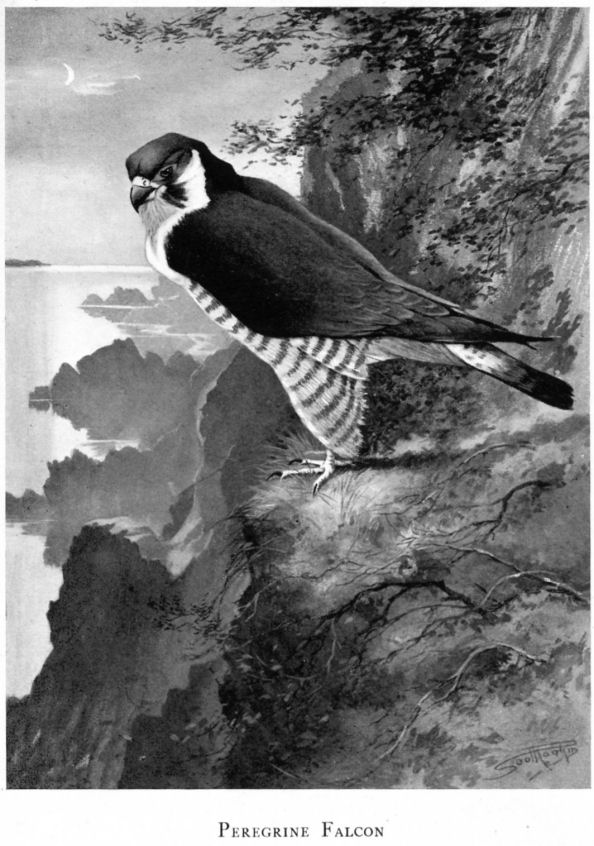
the peregrine falcon. It is sad that one cannot say the same for the osprey.
One after another of its former stations have been cruelly robbed and
harried, so that it is to-day doubtful whether the osprey may still be
retained in our list of British breeding species. The kite, too, with the
exception of a very few in Wales, watched and guarded day and night, is
gone, and so also are practically the harriers.
Of those of our birds of prey
still remaining to us, the common buzzard is certainly deserving of
protection. Feeding chiefly on moles, mice, voles, the smaller reptiles and
insects, the good service it renders may well be placed against a very
exceptional delinquency in the shape of a young rabbit or hare. In quite as
great a measure is this the case with the kestrel, whose graceful hovering
flight as it pursues its constant hunt for mice and voles forms so
interesting a note in our country landscape, yet to how many of our keepers
are these useful birds merely 'hawks,' and therefore to be slain at sight?
One would think that it would
hardly be necessary to put in a word of defence for our owls, yet how often
do these, too, hang in the keeper's museum in pitiful if mute protest
against ignorance and incompetence? For the raven one would merely say that
it were a pity that so grand a bird should be exterminated, but the hooded
or carrion crow is a nuisance, with difficulty to be kept within bounds,
coming as they do in flocks on migration from the north; and the jackdaw of
late years appears to increase so rapidly that there, too, a stringent check
seems called for.
Two others of the Corvidae,
the magpie and the jay, are each so beautiful an addition to our
woodlands that, in moderation, they surely repay the little they cost. The
rook question is a much larger one. In some quarters their increase seems to
have passed all bounds of moderation. They have also developed new and
unpleasant habits and appetites, hunting and destroying nests and eggs like
their near relatives, the crows. On the other hand, their good deeds must
not be forgotten, and the conclusion seems to be that the true balance in
numbers must be sought for. The sparrow pest is another subject of much
interest to agricultural and gardening readers; if the gamekeepers would
spare a few of the sparrow-hawks, and such lovely summer visitors as that
fine little falcon the hobby, it would help; but as things are at present,
the only remedy seems to lie in the way of co-operation and destruction.
Much more might be written on
the balance of nature and man’s constant interference, but the above may,
perhaps, serve to cause some who have the power of life and death over these
creatures to pause and weigh the evidence more carefully before irrevocable
sentence is pronounced. It is pleasant to know that there is already a
marked improvement in this direction among the more intelligent keepers.
Within a few miles of where these lines are written, the peregrine, the
buzzard, the raven and the badger all breed yearly, and one can but hope
that, before long, such will be the rule and not the exception. |



