I discovered that meeting T.C. Smout is considered, by
some, akin to meeting God. The retired Professor of Scottish History from
the University of St Andrews was staying with friends in London (Ontario)
after being brought over as guest speaker at the University of Western
Ontario in 1999. He had kindly agreed to speak to a Scots-Canadian group
in Toronto on October 1st on "The History of the Caledonian
Forest - Myth and Reality".
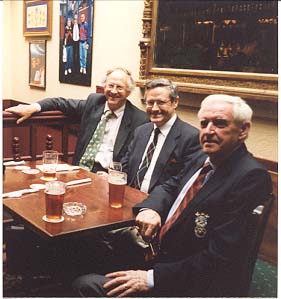
Dr T.C. Smout, Alan McKenzie & Neil Fraser
The mention of Professor Smout within the academic
community evokes an awesome response so, when my husband and I were asked
to meet the guest speaker at the train station and give him a brief tour
of the city before the luncheon, we felt we should learn more about the
respected historian and prolific author who is Historiographer Royal in
Scotland and Director of the Institute for Environmental History at the
University of St Andrews. We later learned that even he was unaware that
someone had actually written a book "In Praise of T.C. Smout".
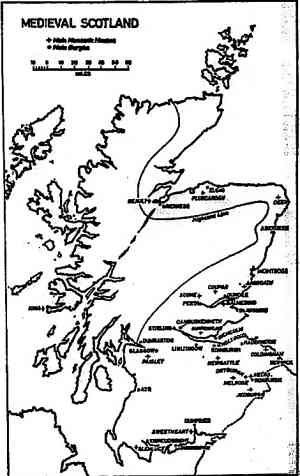 Collins
Encyclopaedia of Scotland (1994) offers the following explanation of
Scotland’s early tribal organisation:
Collins
Encyclopaedia of Scotland (1994) offers the following explanation of
Scotland’s early tribal organisation:
"Each social system borrowed from the other so that, in
Professor T.C. Smout’s definition, Highland Society was based on kinship
modified by feudalism and Lowland society on feudalism tempered by
kinship. The difference is most clearly shown by the feudal insistence on
succession by the eldest son as opposed to the ancient Dalriadic system of
tanistry; amongst the clans the latter continued to be invoked long after
general acceptance of primogeniture, thus affecting both Highland heraldry
and ‘official’ chiefly pedigrees.
"Historians, though, are cautious about juxtaposing a
national ‘clan system’ with the feudal system since this would suppose an
ethnic homogeneity which history emphatically denies. Dalriadic Scots,
later Irish, Picts, Britons, Norsemen and English all held sway at
different times and, along with Normans and Flemings, are represented in
the progenitors of the various clans. Thus, the Grants and the Frasers are
among those of Norman origin, while the Sutherlands and the Murrays are
among those of Flemish origin…."
Professor Smout commented on the dramatic changes to
the Toronto skyline since his visit 30 years ago. At the luncheon, he
explained, with humour, how the post of Historiographer Royal was copied
from European custom, and how the grand yearly honorarium of £600 was
reduced over a period of time to £200, then £60, then £25, at which time
the recipient suggested it wasn’t worth accepting. The suggestion was, of
course, adopted and the appointment (for life) remains unpaid, although it
carries great prestige and, he pointed out, it comes with a beautiful
scroll presented by The Queen.
Without notes, he then went on to explain how the Scots
learned from their experiences in Europe and brought that knowledge back
to Scotland which, for its small size and population, has produced more
Scots in other parts of the world than ever lived in Scotland [the
worldwide population of people with some Scots ancestry has been estimated
by some historians as high as 90 million]. He pointed out that the Scots
were experienced fighters, having opted for service abroad as mercenary
soldiers to European royalty, long before the Jacobite rebellions of 1715
and 1745, which led to Culloden in 1746. In A History of the Scottish
People 1560-1830, he writes: "Life for the tenants and sub-tenants was
primitive and grim : nothing could be more misplaced than the glamour with
which the fanciful have sometimes invested these strata of Highland
society before the ’45."
Many of the officers and men who later joined Highland
regiments did so because they were paid for their service. To the surprise
of some in the audience, Professor Smout made specific reference to the
Fraser Highlanders, whose success in helping to secure Canada for the
British was later romanticized by Sir Walter Scott (1771-1832) and Major
General David Stewart of Garth (1772-1829). There were lots of questions,
but no one asked about his prepared speech on the Caledonian forest, which
he subsequently presented at the University of Guelph. My husband blamed
me for getting him started on the subject of the Scots mercenary
tradition, and the fact that we gave him a copy of The Fraser
Highlanders before the luncheon. On the way back to the train station,
I asked what happened to the Caledonian forest and he replied, with a
wink, that it existed for a relatively short period of time and
disappeared 5000 years ago!



