|
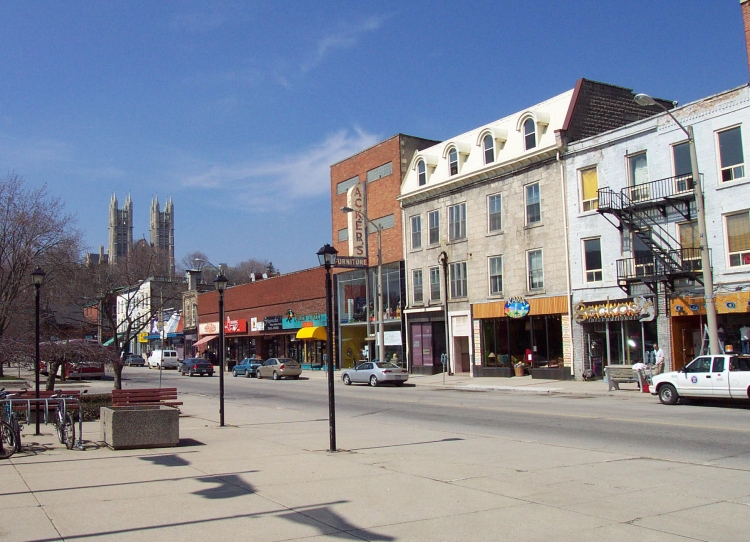
Carden Street, one of
Guelph's earliest thoroughfares, was made in 1828 and named after Sir
Robert Carden, a Director in the Canada Company. Through much of Guelph's
history, Carden Street was a thriving area of commerce for the City of
Guelph. Today, Carden Street still hosts a number of eclectic shops and
restaurants as seen in this photograph of the street taken in April 2002.
|
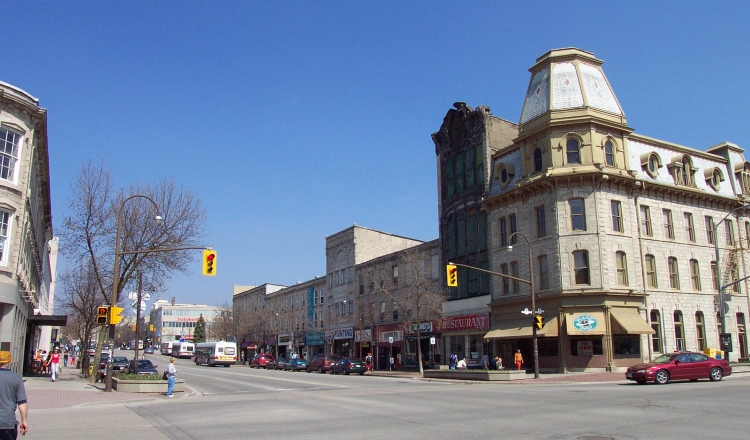
Wyndham Street is
another early Guelph street and, like Carden Street, was laid in 1828.
This street is named after George Francis Wyndham, an English Earl. The
south end of the street, or what is now known as Lower Wyndham, was known
as Huskisson Street until its name was changed in 1956. Huskisson Street
was named after William Huskisson, Colonial Secretary. |
St. George's Square remains
a central hub of the City of Guelph. Public transportation, for instance,
still congregates in the Square as it has done since 1895 when George
Sleeman first introduced electric streetcars to the Royal City.
Interestingly, this meeting of buses is an issue that is receiving much
attention today and it may well be that the Square will soon fade as the
City's main transportation hub. Since the building of large malls, such
as the Stone Road Mall in the 1970s, much commercial activity has
gravitated to the City's edges. |
|
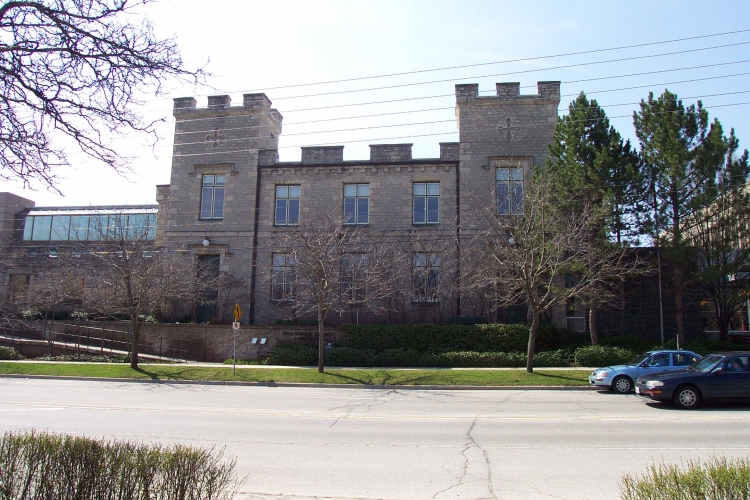
The Courthouse. The
Wellington County Courthouse located at 74 Woolwich Street is the oldest
surviving public stone building in Wellington County and was built between
1841 and 1843. With later additions, particularly the addition of offices
in 1980-1981, this building is a curious hybrid, integrating new space
with the older section of the building. The successful blending of the
architecturally old and new even won the designers a Guelph Arts Council
Bronze Plaque Heritage Award. The Courthouse is thought to have been
designed by Thomas Young and is done in the Scottish castellated style. |
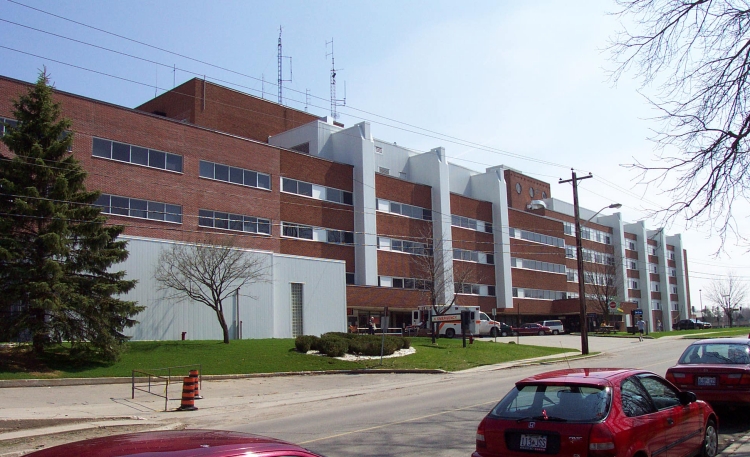
Guelph General
Hospital. Since registering its first patient, Harriet Hiscock
for dysentery in August 1875, the Guelph General Hospital has been
offering health care services to Guelphites for the past 127 years. After
the construction of St. Joseph's Hospital in 1861, several Guelph
businessmen began planning for the construction of a non-denominational
hospital. By Act of Parliament, March 19, 1861, the hospital corporation
was established but it was not until 1873, when Dr. William Clarke offered
the land on Delhi Street for a price of $1000 that work on the hospital
began in earnest. Initially projected to be built for under $8000,
the hospital exceeded its budget and was finally built at a cost of
$9871.49. By the end of its first year of operation, the hospital had
admitted 44 patients. Last year, Guelph General admitted more than 8,800
in-patients. |
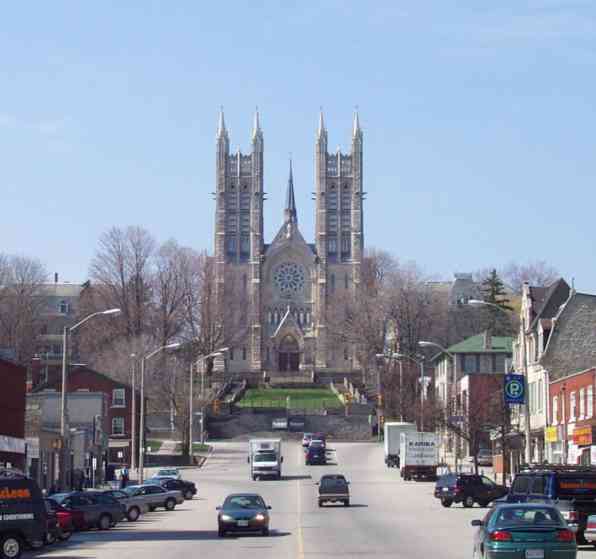
Church of Our Lady.
"On this hill would one day
rise a church to rival St. Peter's in Rome"
So John Galt wrote in the deed transferring the land on which the Church of Our Lady would
one day stand. As he noted in his autobiography, "a beautiful central hill
was reserved for the Catholics, in compliment to my friend, Bishop
MacDonnell, for his advice in the formation of the [Canada] company."
Arguably the City of Guelph's most recognizable building, the Church of
Our Lady of Immaculate Conception towers over Guelph and is visible from
miles around. After an aborted attempt to begin construction of the Church
in the middle of the 1860's, its construction began in earnest in 1874
with the selection of the architect Joseph Connelly. The Church was
completed in full in 1926 with the addition of its two towers. In 1958 a
new entrance from MacDonnell Street was constructed but aside from this,
the exterior appearance of the Church has changed very little since 1926. |
|
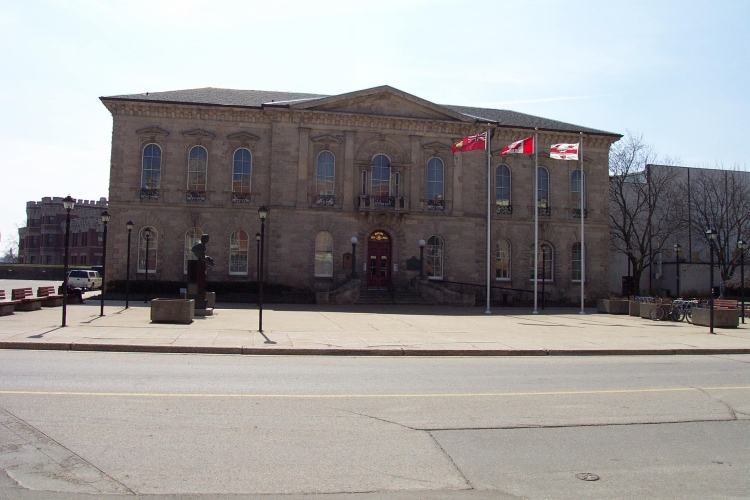
City Hall, Designed by
William Thomas in 19th century Renaissance Revival style, the cornerstone
for Guelph's City Hall was laid in September, 1856 and the building was
completed the following year. In June 1978, the exterior of City Hall and
the Annex behind it was designated historically significant by the Local
Architectural Conservation Advisory Committee (LACAC). |
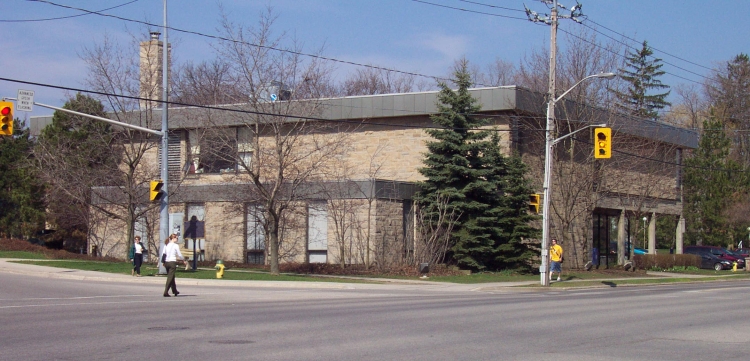
Guelph Public Library. The
present main branch of the Guelph Public Library was completed in 1965,
replacing the Carnegie Library building that had stood on the same spot
since 1905. The Library is currently working on the building of a new main
branch but it is still early in the process. Major decisions such as the
site selection and the size of the new building are presently
being carefully considered. |
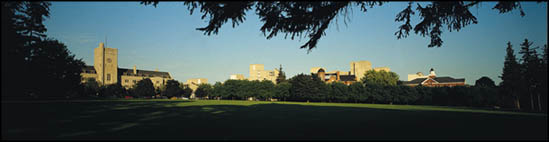
University of Guelph. The University of
Guelph is perhaps Guelph's best known symbol outside of the
City. Established as a university proper in 1964, the U of G has a much
longer history, dating back to the inception of the Ontario Agricultural
College in 1874. Today, the University consists of six colleges and boasts
almost 17,000 full and part-time undergraduate and graduate students. The
University has a national profile and consistently rates high in several
categories of the annual review of Canadian colleges and universities
published by MacLean's magazine. |