|
Regarding WHISKY by Aeneas MacDonald
By Frank R. Shaw, FSA Scot, Atlanta, GA, USA, email:
jurascot@earthlink.net
 The
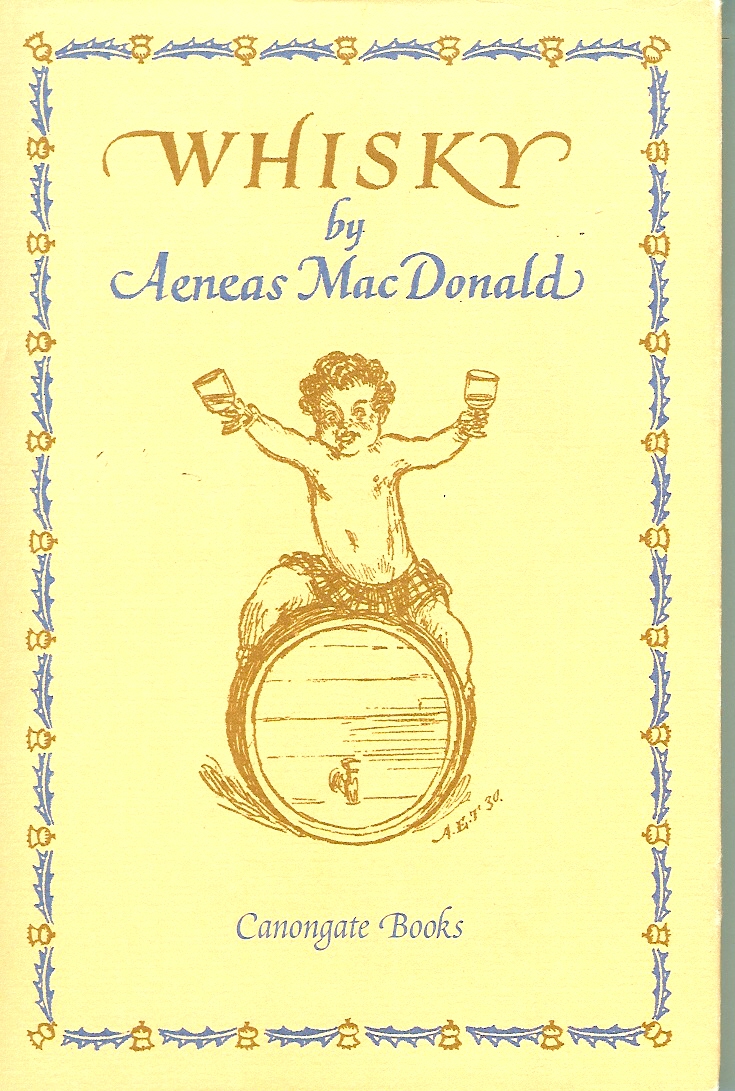
book cover on the little epistle entitled Whisky by Aeneas
MacDonald says, “Ian Buxton is a former Marketing Director for Glenmorangie.
Author of Whisky: History, Hints, & Tips and
co-author of The Whisky Companion, he writes regularly for
Whisky Magazine (UK) and Fine Expressions (UK)
among other titles.” It is a joy and an honor to welcome this whisky
authority to the “chat” pages of A Highlander and His
Books. The
book cover on the little epistle entitled Whisky by Aeneas
MacDonald says, “Ian Buxton is a former Marketing Director for Glenmorangie.
Author of Whisky: History, Hints, & Tips and
co-author of The Whisky Companion, he writes regularly for
Whisky Magazine (UK) and Fine Expressions (UK)
among other titles.” It is a joy and an honor to welcome this whisky
authority to the “chat” pages of A Highlander and His
Books.
A good friend of mine, Dave McDaniel, is the
“official” barkeep for our meetings of the St. Andrew’s Society of Atlanta.
He spoke highly of the book titled Whisky and presented me
with a copy. I was so impressed with it and your 24 pages of “An
Appreciation” regarding the book, I wanted to review the book and “chat”
with you about it since Aeneas MacDonald died in 1996.
Q: This book on whisky was written in
1930 by George Malcolm Thomson, a Scot, naturally, who was born in Leith,
and he adopted the pseudonym of Aeneas MacDonald for the book. Most of us
are familiar with Sir Walter Scott’s use of the phrase “The author of
Waverley” instead of his real name because of his duties in the court
system. Why would Thomson do so? Is there a parallel to Scott in his
decision? Tell us about the name Aeneas MacDonald and the part that name
played in the history of Scotland.
A: Thomson, who had already published
under his own name, used a pseudonym for two reasons: firstly, his mother
was a confirmed abstainer from all alcoholic drink and he didn’t wish to
embarrass her; secondly, the book was published by the Porpoise Press of
Edinburgh, which he had established, and he didn’t want people to think that
it existed simply to publish his work! Both quite unusual, but very
honourable, reasons when you think about it.
The original Aeneas MacDonald was one of
the famous “seven men of Moidart” – the Jacobites who came with Bonnie
Prince Charlie to start the ’45. MacDonald was the banker to the Jacobite
army. He survived and eventually returned to Paris, though not before being
tried for treason and condemned to death. Thompson was a confirmed
Nationalist and wanted a name from Scottish history.
Q: Seventy-seven years is a long time for
any book to be still found on shelves for sale, especially a book entitled
Whisky which would appeal to a smaller audience than say a
best selling author. Many best selling authors today will probably not be
remembered 77 years from now. What do you attribute this success and
longevity to?
A: Well, to be truthful, the book was
largely forgotten, except amongst a tiny group of whisky enthusiasts; whisky
book collectors and several writers about whisky. I like to think we
realized its significance as a wonderful piece of writing and the first book
about whisky written for the drinker, as opposed to the industry. There was
a small but passionate debate about the author’s identity and that set me to
wondering if I could find out and bring the book back to life.
It has an appeal today due to the growth
of interest in single malt Scotch, which makes it very relevant to a new
audience. It also happens to be very well written and satisfying in its own
terms.
Ironically, the reprint has already sold
more copies than the first edition. If you can find one, snap it up –
they’re very collectable.
Q: You are acknowledged as one of the
world’s foremost authorities on whisky, and I have found your articles
interesting and stimulating. What led you into this field of work and into
writing about whiskey?
A: I don’t know about being a “foremost
authority”. I like to think of myself as an “amateur of whisky” in the
Holmesian sense of an “amateur detective”! Anyway, I’m glad you’ve enjoyed
the articles (I just wish they paid better).
I started writing about whisky a few
years ago as an offshoot from my consultancy work in the distilling industry
and because I was arrogant enough to think I had something distinctive to
say. One or two publications liked the work and it grew from there.
Q: It is evident you have a deep
appreciation for Aeneas MacDonald, a graduate of Edinburgh University. What
is there about the man who authored “over twenty books” and his writings
that impacted your life and impressed you so much?
A: It’s really just Whisky.
I was very struck by the passion and poetry of that book and its continued
relevance.
Q: Are there any of his other books you
would recommend to our viewers? If so, please list two or three.
A: Sadly most of his other work hasn’t
aged too well, though his accounts of the economic condition of Scotland in
the 1920s and 30s are valuable social documents. It’s out of print (like all
his other work) but if you can get Scotland – That Distressed Area,
it’s a vivid account of Scotland at that time.
Q: MacDonald’s book was first published
in 1930. Why was it important for Canongate Books in Edinburgh to republish
in 2006?
A: Canongate are in many ways the
spiritual successor to the original publishers, Porpoise Press of Edinburgh
(who closed just before the War). Based in Scotland, Canongate have an
enviable reputation for the quality of their writers and whilst not in any
way being insular or parochial in their approach, they seek to stimulate
great writing (and publishing) from an Edinburgh base.
Q: On the title page, we find a youngster
sitting atop a wooden cask with a glass of whisky in each hand. What,
briefly, is the story behind this drawing?
A: This is a reproduction from the first
edition. I like to think he is one of the angels who take the angel’s share
of maturing whisk. In homage to the book, the picture has been used by Loch
Fyne Whiskies (visit their excellent website) for their “Living Cask”
bottling.
Q: My ancestors came from the Isle of
Jura in the mid 1750s and settled near the Cape Fear River in what is now
Bladen County, NC. I noticed on the “Key to Map of Distilleries” that the
Jura distillery was not listed. Why is this? I have visited the wonderful
wee island and toured the distillery where the single malt Jura is made.
What do you know about Jura single malt that you can share with us in a few
lines?
A: The map is correct: Jura isn’t shown
as a distillery because the original distillery there had long been closed
and demolished by 1930! The present distillery wasn’t built until 1963 and
originally existed as a ‘packing malt’ for blends owned by the Mackinlay
company.
The whisky from the present-day
distillery was originally made in a generic Speyside style (not the heavily
peated style that the island location might lead one to anticipate).
However, it has changed hands many times since it was built – not least,
last week when it was sold as part of Whyte & Mackay to United Spirits of
India – and now it is producing a wider range of single malts which are
quite widely available.
Q: Can you give us an interpretation of “acqua
vitae”, “uis gebeatha”, and “usquebaugh” in regards to
whisky”?
A: “Aqua vitae” is the Latin and
“usquebaugh” (various spellings) the Gaelic for “water of life”.
Q: I read somewhere, and failed to note
the source, that Sir Walter Scott had an extensive wine and whisky cellar.
Do you know if it is true that at one time his cellar consisted of 350 dozen
bottles of wine and thirty-six bottles of spirits? I wish I had footnoted
the source since it would be a good quote. Have you ever run across that
reference?
A: Sorry – don’t know this. Sounds as if
it could be true though. Is it in Saintsbury “Notes from a Cellar Book”?
Q: MacDonald writes about Robert Burns on
pages 40-41 in his book. What is your opinion of the cause of death of the
National Bard in light of what has been written about him by his first
biographers and what is generally accepted today?
A: Sorry, don’t have the faintest idea!
Q: Where does the name “Dionysos Bromios”
come from and what is its meaning for today’s world?
A: DIONYSOS was the Greek god of wine,
wilderness and vegetation. I found the following explanation of “bromios” on
the web.
BRO’MIUS (Bromios), a surname of Dionysus,
which some explain by saying, that he was born during a storm of thunder and
lightning (Diod. Iv. 5; Dion Chrys. Or.27); others derive it from the nymph
Brome, or from the noise of the Bacchantic processions, whence the verb
bromeazesthai, to rage like a Bacchant (Ov. Met. Iv. 11; Orph. Lith. Xviii.
77). There is also a mythical personage of this name (Apollod. Ii. 1 S5).
I like the reference to supporters of
Bacchus!
This is typical of Thomson – flowery,
poetical and calling up ancient authorities to support his argument. I’m not
sure it means very much to today’s audience however, the study of Greek
mythology having been largely abandoned. Thomson was writing for a educated
elite who would have appreciated the classical allusions.
Q: With Scotch now made in many
countries around the world, what is the percentage made by the top five
Scotch producers and what percentage is consumed by the top five consumers?
A: Well, of course, “Scotch” is only
made in Scotland but you’re right, lots of countries make fine whisky. I
think the Scotch Whisky Association have some interesting statistics on
their excellent web site at
www.scotch-whisky.org.uk
So far as blended Scotch whisky goes,
the market is dominated by Diageo (Johnnie Walker, J&B) and Pernod Ricard (Chivas
Regal, Ballantines). Smaller independent companies have a better share of
single malt.
Q: I was intrigued by the section on one
being his own “blender”. How widespread is this practice, do you do it, and
would you explain it to our readers?
A: I don’t think it’s at all
widespread, though it should be. Ideally, you can blend your own whisky in
an oak cask (a ‘quarter cask’ is ideal if you can get one) but it takes up a
lot of space, is expensive and you might not like the results! I ‘blend’ odd
ends of bottles in a giant bottle that I have and keep experimenting. It
doesn’t age any further and there’s no wood effect, but it’s fun. Watch out
that you don’t put too much Islay in there – it’s very pervasive.
Q: Thank you for your promptness and
courtesies in assisting me with this wonderful wee book on whisky. Is there
something else you can share with us regarding anything about whisky – a
closing word, a story, an incident, or a favorite quote? A last word from
you to our readers would be appreciated.
A: Thank you. I always enjoy the
(alleged) last words of Humphrey Bogart: “I should never have switched from
Scotch to Martinis.”
As for stories, during an incident on
November 3, 1953, Dylan Thomas returned to the Chelsea Hotel in New York and
exclaimed “I’ve had 18 straight whiskies. I think this is a record”. He then
collapsed and subsequently died.
(FRS: 6-5-07) |