A Highlander And his books
A Chat With Hugh Douglas
Author of Robert Burns: The Tinder Heart
By
Frank R. Shaw, FSA Scot, Atlanta, Georgia,
USA
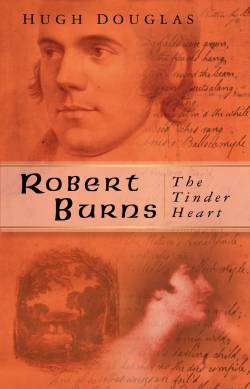 Q: Please tell us how you came to
love Burns as you do. Where did it start? What keeps the fires burning
after all these years? Q: Please tell us how you came to
love Burns as you do. Where did it start? What keeps the fires burning
after all these years?
A: Robert Burns was always part of my life for I was
born only a few miles from his birthplace at Alloway, and my family have
lived in that area for generations. A number of my ancestors are buried in
Alloway’s auld haunted kirkyard, including one who was born in 1759, the
same year as the Poet. My background was a farming one similar to that of
Burns too, although I never longed to become a farmer.
We took it for granted that Burns was 'our' poet, and learnt many of his
poems off by heart from earliest schooldays. The words of even the very
Scottish ones presented no problem because this was the language we spoke
every day. It was a fire that, once lit, could never be quenched. Burns’
poems still stir something in me.
Q: To use a quote on your book jacket, was Burns "not so much a
conspicuous sinner as a man who sinned conspicuously"?
A: Well, from the story I tell in The Tinder Heart,
that cannot be denied. He was always open and frank in his direct approach
to women, his relationships with them, and the way he accepted what
resulted from his contact with them - whether a love child or a poem. I
wish others were as honest as Robert Burns.
Q: You state in the preface of the book that "biographers have followed
the mores of their own day, rather than his, so that for two centuries his
sex life has been denied, glossed over, or bowdlerized out of
recognition…" to the point that "the real Robert Burns has been lost." Why
is this? What is the real story?
A: We all reflect the age we live in, it’s hard not to.
But Burns was ill served by many of his biographers in the century after
he died. Some tried to ‘cover up’ for him, others tried to make his life a
sermon warning the rest of us to avoid his ‘wickednesses.’ Few set him
against his own age or the community in which he lived. And when a writer
like Catherine Carswell came along in the 1930s and tried to reveal the
real Robert Burns, she was attacked on all sides by Burnsians - to such a
degree that one major Burns publication actually refused to review her
book. It is interesting that two of the biographies, which paved the path
for modern lives of the Poet, were written by foreigners, one by a
Frenchman, Auguste Angellier, and the other by a German, Hans Hecht.
Q: Why do you think Dr. James Currie, Burns’ first major biographer, a
staunch teetotaler, as well as a contemporary of Burns, perpetrated the
misguided legend that Burns was a drunkard and how could such a myth go
unchallenged by those who knew him best?
A: He tried to draw a veil over what he considered to be the Poet’s
failings. He even destroyed a lot of material that would have been useful
to future biographers.
Q: You state "love was the most single element in Burns’ folk-song
writing." Many Burns authors seem to think that he had to be in love with
someone, not just his Bonnie Jean, for his muse to inspire him to write
the beautiful poems and songs he wrote. What is your response to that
statement?
A: Many topics and diverse people inspired his muse. First of all
don’t let us lose sight of the fact that Robert Burns was more than a
writer of songs. Much more. He wrote on the good things as well as the
failings of the world around him. Just read 'The Two Dogs' and see how he
could reach to the heart of the landlord-tenant relationship. Or 'Holy
Willie’s Prayer' and appreciate the hypocrisy around him. Or 'To a Mouse'
and understand he was not writing a sentimental set of verses about a poor
little mouse whose nest had been turned over by the plough. 'To a Mouse'
was an anguished cry from his own troubled mind. I could go on, but won’t.
Just read a few of his poems and you will understand the man’s humanity.
But the songs - that’s another stroke of genius. He could fashion a song
to fit on old tune, a new tune, a traditional air, and the inspiration so
often came from contact with another human being, often a lassie. Women,
from his wife Jean Armour, to lovely Clarinda who was too far above him
socially ever to become more than a correspondent, equally inspired great
songs. ‘Ae Fond Kiss’ written to Clarinda stands alongside ‘Of a’ the
airts the Wind can Blaw’ which Jean inspired. But in between there were
dozens of other gems. Love inspired Burns the song-writer always.
Q: Burns wrote Jacobite songs and verse. Was he a real Jacobite or did
he just support the Stuart cause intellectually?
A: Not really a Jacobite is my verdict. He talked about his ancestors
who suffered for Prince Charlie’s Cause, and he wrote a number of Scottish
songs with a Jacobite theme. He was impetuous and once scrawled a little
verse on a windowpane at Stirling, that heartland of Scotland’s history.
But it is interesting that he went back later and smashed the pane of
glass. Burns’ Jacobitism was Scottishness, with a republican tinge.
Q: I have always been intrigued by Burns’ "Scottishness". In an era
when "every pressure was being put on people in all walks of life to
repress their Scottishness and adopt English ways", why do you think Burns
insisted on writing in the Scottish dialect? How much influence did his
Scottishness have on him as poet and man? Would he have been the poet as
we know him today without his self-evident Scottishness?
A: Burns could write beautiful English as in lines like
Pleasures are like Poppies spread:
Your seize the flow'r, its bloom is shed…
But the broad Scottish brogue of Ayrshire was his mother tongue, and he
was more at home writing in it. That honest language helped to make him
what he was - and is.
Q: If you were given the task of completing his death certificate in
today’s world, knowing what you do about Burns, which puts you in a very
select category even though you are not qualified as a medical doctor,
what would you list on his death certificate as the primary and secondary
causes of his death?
A: Illness brought on by overwork in his youth, the hard life of a
farmer and exciseman. I certainly would not blame it on drink or women -
both were freely indulged in Burns’ time, and few died of them.
Q: Finally, thank you for writing this book. Is there anything you
would like to say to the over 70,000 subscribers to The Family Tree
that we have not covered?
A: I’ll leave you with an interesting thought: it seems to me that
Scots come in two varieties, those who cannot flourish outside Scotland
and those who flourish only when they leave their homeland as so many
American Scots did. Burns was one of the former; his fellow Ayrshireman,
James Boswell, was the latter. The world is a richer place thanks to both
of them, and we should be grateful to them. Here's to their immortal
memory! |



