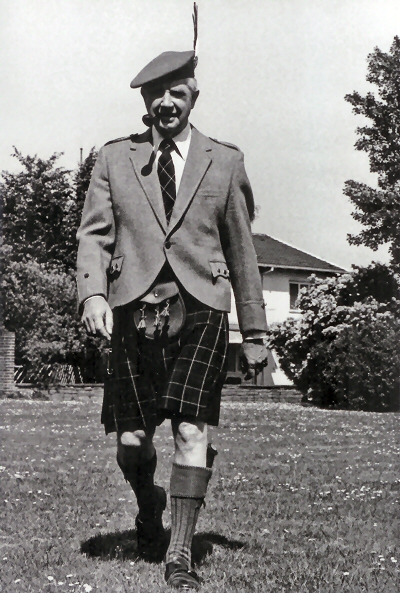
Frank R. Shaw, FSA Scot, Atlanta, GA, USA
 Q: With so many books out on this topic over
the last couple of years, why did you choose to write another
one? Why is your book different from the others?
Q: With so many books out on this topic over
the last couple of years, why did you choose to write another
one? Why is your book different from the others?
A: Our book is original and revolutionary in
that we argue and document that the real roots of liberty and
freedom extend many centuries before John Locke and the
English Whigs of the 1600s to the radical political thought of
the ancient Celts, John Duns Scotus (c.1290s) and the Arbroath
Declaration (1320). No other book has presented an integrated
account of the ancient Celts, the formation of Scotland, John
Duns Scotus, the Scots’ fight for independence, the role of
the Scottish people and philosophy in the formation of America
and the role of Scottish philosophy in the march of democracy,
human progress and human rights in the 20th and 21st
centuries.
Garry Wills’
Inventing
America
(1978) did locate the recent source of some of
the intellectual thought of Jefferson’s Declaration of
Independence in the Scottish Enlightenment of the 1700s. Wills
failed to place this historical connection in the larger
context of ancient Celtic and medieval Scottish history and to
mention the Declaration of Arbroath and the critical role of
Scotus. A broader view of history found in Duncan Bruce’s
The Mark of the Scots
(1996) does relate the Declaration of
Independence and the Scottish Enlightenment to the Declaration
of Arbroath but not to the ancient Celts, Irish and Scots.
Neither work relates the ancient and medieval periods,
Jefferson and the Declaration of Independence to the
historical development of human rights that followed the
creation of the American Republic. Arthur Herman’s
How the
Scots Invented the Modern World
(2001) incorrectly located the origin of the
doctrine of the “consent of the governed” in George Buchanan.
Herman’s error was the result of not grounding his research in
ancient Celtic and Scottish history and medieval Scottish
history. His erroneous comments about the Declaration of
Arbroath, the National Covenant, Scottish religion and Celtic
culture originate as well in focusing on the Scottish
Enlightenment as if it appeared “presto.” Edward Cowan’s book,
‘For Freedom Alone,’ The Declaration of Arbroath, 1320
(2003), made excellent contributions to the
specific history of the Arbroath Declaration but erred in
failing to mention John Duns Scotus and in finding the origin
of Scottish liberty in the Scottish Wars of Independence
rather than in ancient Celtic and Scottish history.
Q: How important is John Duns Scotus and his
writings to the thesis of your book?
A. Absolutely critical. The great Celtic
theologian was the finest mind of the middle ages, far more
brilliant than Aquinas, and he was the first person in history
to write of the doctrine of “consent of the governed.” This
writing was in the late 1290s, quickly became well known in
Scotland and Europe and was the intellectual and spiritual
foundation of the rebellion of William Wallace (c.1270-1305)
and the author of the Arbroath Declaration (1320), Bernard de
Linton. Scotus’ theory of human society was to revolutionize
not only the thought but the practice of the Western world.
Q: One of you lives in Florida and the other in
California. How did you communicate to write a 435-page book?
What were some of the problems you encountered by being so far
apart?
A: It was a very interesting process for all of
us. Alexander (Alec)
and his wife, Gloria, would write and type the chapters
(Chapters 1-18) and mail them to me. I would then input them,
mail them back to the Klieforths and they would proof them
further. While this laborious process was going on, I was
writing my own chapters (Chapters 19-35) which were then read,
proofed and edited by wife, Louise, and the Klieforths. We
communicated by mail and phone. The labor of the project was
not only in the writing but in the proofing and editing. This
issue would have occurred regardless of our locations. The
advantage of being on different parts of the continent is that
we worked at our own pace without deadlines and without
getting in each other’s way. It worked beautifully.
Q: I remember reading your original
manuscript sometime back, so I’m interested in knowing from
the time you first discussed writing the book, how long did it
take you to complete it from beginning to end?
A: Alec and I corresponded on issues of
Scottish history beginning in the 1980s and in November 1999
we agreed to create the manuscript. We labored on it for five
years with publication in 2004. It was a labor of love: it was
written for the Scots, past, present and future. Alec and I
have written over twenty books (independently of each other)
but this project was the most difficult, intense and
rewarding.
Q: There are 50 pages of chronology in the
book, the most comprehensive I have ever seen. Why so long?
A: The chronology in the original draft was
over 100 pages long and I seriously edited it down for the
final publication. It is long as I wanted to note the complex
inter-connections between the Romans, Celts, Irish, Scots,
Americans and the English over three thousand years. Secondly,
I wanted to help readers who were new to Scottish and American
history to be able to follow the flow of historical events.
Thirdly, the chronology is simply fascinating.
Q: What are some of the books and authors you
mainly relied on for your research?
A: We are in debt to many past and current
authors. I have mentioned Wills’
Inventing
America
(1978), Bruce’s
The Mark of
the Scots,
Herman’s
How the Scots Invented the Modern World
and Cowan’s book,
‘For Freedom
Alone,’ The Declaration of Arbroath, 1320.
Father Allan Wolter, the world’s authority on Scotus, provided
guidance in understanding Scotus’s thought in the context of
social and political freedom. Duncan MacNeill, the author of
The Scottish Realm
and
The Art and
Science of Government Among the Scots
(both are out-of-print), was valuable for his
lucid analysis of Scottish society and the brilliance of the
Scottish Constitution. Alexander Broadie’s
The Shadow of
Scotus
was very helpful. We take great pleasure in bringing Scotus
and MacNeill to the attention of the world.
Q: How did the two of you come to work on this
book as co-authors? How long have you known each other? Who
came up with the idea to write the book? Please tell us a
little about your relationship.
A: We met at Clan Leslie meetings in
Charleston, South Carolina in the early 1980s and corresponded
about Scottish matters. We both had the same idea to do the
book in 1999. Alec focused on Chapters 1-18 and I focused on
Chapters 19-35 but we read, proofed and edited each other’s
chapters.
Q: How did you go about getting your book
published? How did you settle on University Press of America?
A: University Press of America reviewed our
manuscript and offered us a contract that we accepted. UPA has
a proud history of publishing scholarly works and did a
beautiful job of producing ours. The UPA staff has been a
delight to work with on this project.
Q: Is there another book coming from the two of
you or perhaps individually? If so, can you give us an idea of
what it will be about?
A: I am starting a book comparing constitutions
of different nations and regions, such as the European Union,
and I will use the lessons of constitutional governance in
Scotland, particularly the wisdom of John Duns Scotus, George
Buchanan and Duncan MacNeill, as standards for other nations
to follow.
Q: Are you both active in the Scottish
community? If so, please tell us a little something about your
Scottish activities.
A: Alec is the founder and first Chieftain of
the American Clan Leslie Society. He has been a vibrant and
steadfast leader in Scottish-American activities for decades.
My wife, Louise, and I are members of Clan Munro and Clan
Leslie.
Q: On my part, it has been a good
experience working with you over the past two years. Thank you
for the courtesies extended to me. Is there a final word for
our readers?
A: I would use the trite but true
saying: Know Your History. Every person of Celtic and Scottish
blood and background should understand the heroic epic of the
Scottish peoples in expanding freedom and democracy over the
past three thousand years. The democratic revolution that
began in Scotland was the mightiest revolution in the history
of the world. This revolution is not yet complete and we are
the witnesses to this dramatic evolution. (FRS: 11-08-2004)