|
 N
almost every instance in Scotland (where such instances are far too
frequent), of the abandonment of an ancient fortified dwelling for a
mansion in the modern style, one has to deplore the inferiority of the
new position to the old. It may have been defensive, rather than
aesthetic, features in the ground that guided early architects in their
selection of house-sites, but it puzzles one to understand the motive
which so often prompted their successors in the nineteenth century to
disregard both considerations. In no place that I have visited is the
result more to be lamented than at Colinton, once the principal
residence of the Foulis family. Perched high upon the steep and wooded
east bank of the Water of Leith, the old castle of Colinton, now a
roofless ruin, commanded views of exquisite beauty in every direction.
The silvan glories of the river valley lay beneath it on the west; on
the east the eye might range to the Castle Rock of Edinburgh; while on
the south front a terraced garden lies close up to the castle wall,
providing a fascinating foreground to the majestic grouping of the
Pentland range. A bridle path climbs the shaggy brae from a ford on the
river to the castle gate, and an avenue of limes in the bottom rear
their lofty tops, yet not so high as to intercept the view from the
terrace. N
almost every instance in Scotland (where such instances are far too
frequent), of the abandonment of an ancient fortified dwelling for a
mansion in the modern style, one has to deplore the inferiority of the
new position to the old. It may have been defensive, rather than
aesthetic, features in the ground that guided early architects in their
selection of house-sites, but it puzzles one to understand the motive
which so often prompted their successors in the nineteenth century to
disregard both considerations. In no place that I have visited is the
result more to be lamented than at Colinton, once the principal
residence of the Foulis family. Perched high upon the steep and wooded
east bank of the Water of Leith, the old castle of Colinton, now a
roofless ruin, commanded views of exquisite beauty in every direction.
The silvan glories of the river valley lay beneath it on the west; on
the east the eye might range to the Castle Rock of Edinburgh; while on
the south front a terraced garden lies close up to the castle wall,
providing a fascinating foreground to the majestic grouping of the
Pentland range. A bridle path climbs the shaggy brae from a ford on the
river to the castle gate, and an avenue of limes in the bottom rear
their lofty tops, yet not so high as to intercept the view from the
terrace.
All this rare amenity was
sacrificed when, about the end of the eighteenth century, the Colinton
estates were broken up and this portion was bought by Sir William
Forbes, an Edinburgh banker, who deliberately caused the old castle to
be dismantled, and built himself a commodious, but unromantic, mansion a
couple of hundred yards away, shutting himself out of sight of the
wooded valley, the delectable terrace and garden, and even of the
towering Pentland Hills. On the death of Sir William Forbes, Colinton
House was purchased by James, third son of General Sir Ralph Abercromby.
He was elected Speaker in 1835, and was created Lord Dunfermline in
1839. Dying in 1868, he left Colinton to his only child, the wife of
Colonel J. M. Trotter.
The garden remains as of
yore, smiling up to the sightless windows of the keep, and lovingly
tended by its present owners, Colonel and Mrs. Trotter of Colinton. It
has long been noted for the magnificent holly hedges which enclose it,
whereof Joseph Sabine, F.R.S., contributed a detailed description to the
Horticultural Society of London in 1827
(Transactions, vol. vii.
194). He stated that these hedges had been planted between 1670 and
1680—"certainly not later than the latter year"; so that at the present
time of writing they can be nothing less than 228 years old. At the time
of Sabine's visit their height varied from 25 to 28 feet, tapering from
a basal diameter of 15 feet to 2 feet at the top. Their present height
is from 35 to 40 feet, the basal diameter being in some places as much
as 21 feet, the lower branches layering themselves freely and forming an
impenetrable rampart. The garden hedges extend in all to a length of
1120 feet, and must have been planted originally with about 4500
hollies. They are clipped at the end of March, which the gardener, Mr.
John Bruce, considers the best season, holding that, if the clipping be
delayed till July, as most authorities recommend, there is not time for
the young growth to ripen before the winter frosts.
Mr. Bruce knows what he is talking about, having had charge of these
hedges for thirty-five years; but his employer, Colonel Trotter, takes a
different view, believing that June is the best month for pruning
evergreens.
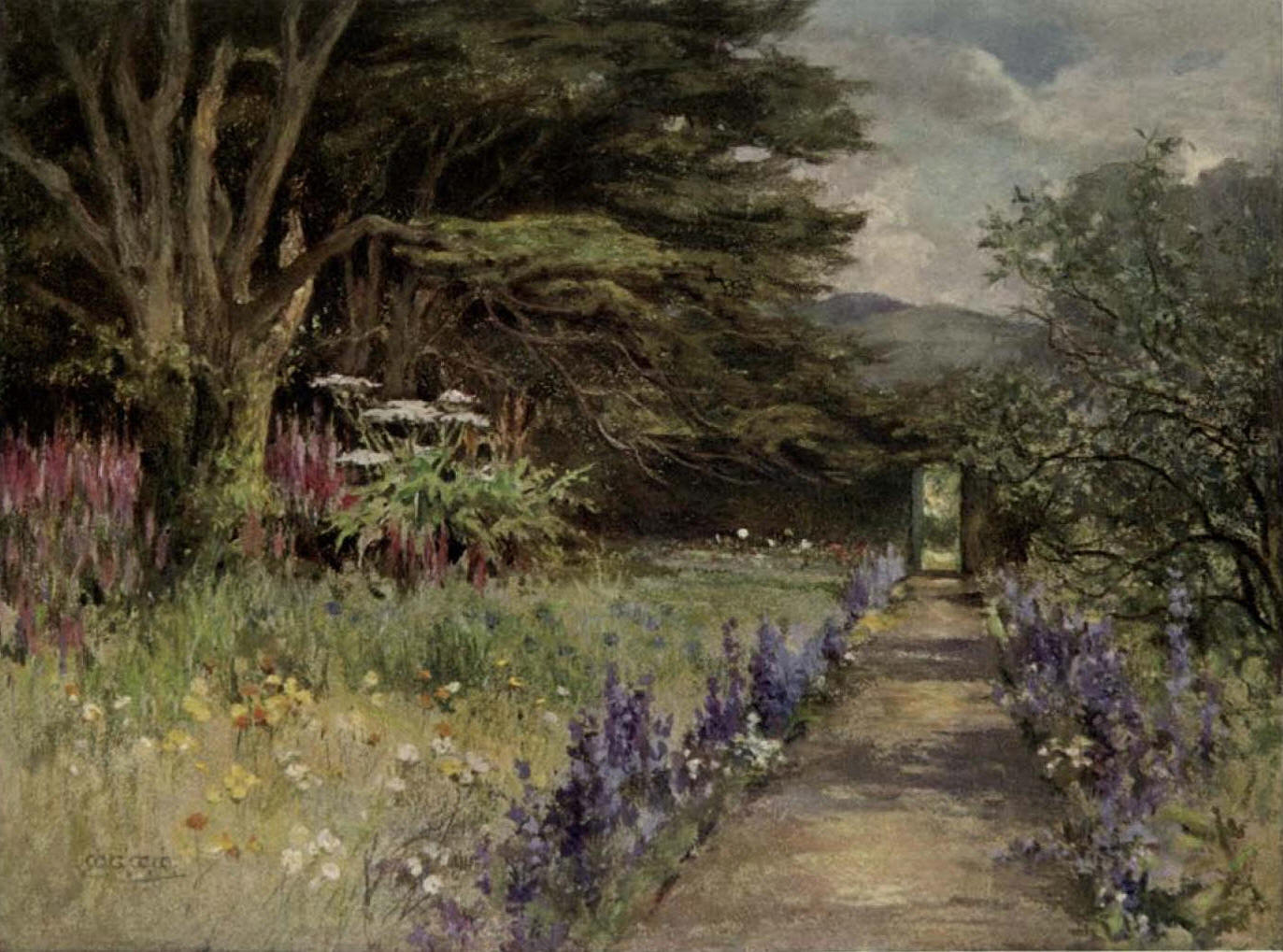
The effect of these lofty
walls of dark foliage would be somewhat sombre, were the borders not
well furnished with bright flowers. In parts of the garden Colonel
Trotter relies much for colour on poppies and other annuals, which, at
the time Miss Wilson made her study, made but a poor show, owing to the
dismal weather of the summer of 1907.
Beside the shrubbery
walks outside the garden there are some nice plants of Berberis Wallichi,
Spircea flagelliformis and other flowering plants, among which is
to be noted an unusually large and symmetrical bush of Spircea (Neillea)
opulifolia. |