|
 ARIOUS
are the elements which go to make a perfect garden, each of them
appealing in its degree to different persons according to their
temperament and training. Not very numerous are those competent to
criticise the technicalities of cultivation, but the pleasure is very
complete which their knowledge enables them to derive from a visit to a
collection so large and intelligently tended as Mr. William Robinson's
at Gravetye Manor or Canon Ellacombe's well-stored grounds at Bitton
Vicarage. Historic association or romantic tradition appeals to a larger
number, and these will be as agreeably moved by gazing on the bleak
formality of Diane de Poictiers' garden at Chenonceaux as by the
enchanting groves into which they pass through Ibn-l-Ahmar's Gate of
Pomegranates in the Alhambra. ARIOUS
are the elements which go to make a perfect garden, each of them
appealing in its degree to different persons according to their
temperament and training. Not very numerous are those competent to
criticise the technicalities of cultivation, but the pleasure is very
complete which their knowledge enables them to derive from a visit to a
collection so large and intelligently tended as Mr. William Robinson's
at Gravetye Manor or Canon Ellacombe's well-stored grounds at Bitton
Vicarage. Historic association or romantic tradition appeals to a larger
number, and these will be as agreeably moved by gazing on the bleak
formality of Diane de Poictiers' garden at Chenonceaux as by the
enchanting groves into which they pass through Ibn-l-Ahmar's Gate of
Pomegranates in the Alhambra.
For such persons the
ample grace of the gardens at Hatfield will be enhanced by their
antiquity, and the recollection that the pleached lime-trees and
venerable mulberries were planted for the delectation of Robert
Cecil, first Earl of
Salisbury, when he became the reluctant owner of that manor, having been
compelled by King James to receive it in exchange for beloved Theobalds
in 1607.
Perhaps a majority of
practical people agree with Mr. Andrew Lang's opinion that "gardens were
devised by Providence for the pottering peace of virtuous eld," and are
satisfied with a garden if it soothes their senses by a tasteful
disposition of trees, and shrubs, and flowering herbs. The nearest
approach to perfection is attained in a garden where the eye is
gratified by beauty of form and colour, and the mind is stimulated by
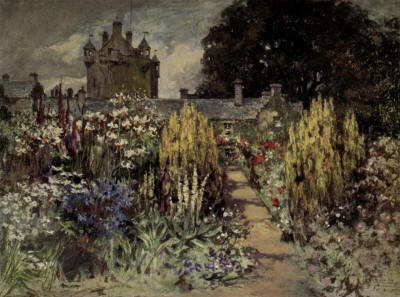
historic association; and such is the case at Cawdor Castle. It is as
impossible, one would think, to visit this seat of the ancient Thanes
and remain indifferent to the strange narrative which men claim to be
its history, as it would be to derive no pleasure from the contrast of
masses of bright blossom with the grim grey towers which overlook them.
Cawdor Castle stands in
the midst of that rich strath which stretches from the foot of
Carn-nan-tritighearnan, or the Cairn of the Three Lords, to the sea. On
the east, dark Findhorn battles his way to the Moray Firth through the
gorges of Altyre and Relugas; on the west, the little Nairn prattles and
sparkles along its pebbly channel, parallel to the greater river. We are
fully four hundred miles north of Greenwich here, yet the climate of
this region, summer and winter, is perhaps the most delightful of any
part of the British Isles. No wonder that possession of this choice
territory was fiercely contested in days when the sword was stronger
than the pen.
The Thanes of Cawdor
claimed descent from that brother to whom Macbeth, Mormaer of Moray,
yielded the thanedom when he usurped the throne of Scotland in 1040; but
it was not until 1454 that the family rose to be important in the person
of Thane William, who was appointed by James II. to administer the broad
lands of Moray, forfeited to the Crown on the fall of the great house of
Douglas in that year.
Thane William's castle at
that time was at Invernarne, now called Nairn; but he had also a hunting
lodge some six miles inland at Old Cawdor. The narrow tower of Nairn
appearing inadequate for his new and lucrative dignity, he determined to
build a larger stronghold. More prudent than the generality of Scottish
lairds, he laid by the necessary cash in a strong box before a single
stone was laid, deliberating the while on the choice of a suitable site.
The problem, it may be supposed, occupied much of his thoughts, waking
and sleeping. One night a brilliant suggestion came to him in a dream,
which bade him bind the treasure on the back of an ass, turn the beast
loose at Old Cawdor, and found his castle wherever it should first lie
down. In the age of faith, nothing could be more natural than that the
Thane should fulfil literally the instructions received in a dream, and
this he did to the letter.
Now the ass, being
heavily laden with cash, which tradition reports was contained in an
iron chest, did not wander far. It browsed its way slowly to a knoll
below the confluence of Alit Dearg and the Rierach Burn, whereon grew
three hawthorns, under one of which it lay down. The castle keep was
built round the tree, which sceptics may handle and see at this day, dry
and sapless it is true, but still hard and sound, rooted in the floor
and built into the vaulted roof of the donjon. Beside it lies the iron
coffer which once held the treasure, and from time to time guests in the
castle gather round these venerable relics and quaff—"Success to the
hawthorn tree," though it has borne neither leaves nor flowers these
four hundred and fifty years.
This keep is but the core
of the vast pile which now frowns down upon the beautiful garden
represented in Miss Wilson's painting. The greater part of the castle as
it stands was the work of Colin Campbell in 1639. How the Campbells came
to Cawdor is explained in several versions of a tradition, differing in
detail, but agreeing in the main facts. Here, briefly, is one account of
the transaction thoroughly in keeping with the times.
Thane William, builder of
the keep, was succeeded by his son William, who had five sons, all of
whom were childless, except John, who married Isobel Rose of Kilravock.
John died in 1498, shortly after the birth of his only child, Muriel,
who, succeeding to the thanedom and its ample revenues, instantly became
an object of supreme interest to other powerful landowners. Among these
was Archibald, second Earl of Argyll, who was particularly anxious to
find suitable matches for his younger sons. Being Lord High Chancellor
of Scotland and a prime favourite with James IV., Argyll obtained from
that monarch the ward of Muriel's marriage. But the child's three uncles
were not disposed to admit Muriel's succession, which they claimed as
limited to heirs male. They refused, therefore, to surrender the babe to
Argyll, who straightway adopted means to enforce his rights in the old
manner. He sent his vassal Campbell of Innerliver, [Innerliver or
Inverliever was purchased in 1907 by the Commissioners of Woods and
Forests in order to form a State forest. It extends to about 13,000
acres.] with sixty clansmen, to capture his ward. Concealing themselves
in the wood of Cawdor, they waited till the nurse brought out baby
Muriel, scarcely more than a year old, for an airing near the castle.
The ambush was a success ; the child was easily taken, but not before
the nurse, with a wholesome suspicion of Highland ways, had bitten off a
joint from the little finger of her charge, in order to her better
identification in future possible contingencies.
The Campbells struck out
for distant Lochowe with their precious little prisoner; but the nurse
ran back to rouse the castle. The uncles set forth hot-foot in pursuit
of the kidnappers, overtook and attacked them with a superior force.
Inverliver, seeing his men overpowered, shouted—"'S fhada glaodh o'
Lochow! 'S flzada cobhair o chlann dhoaine!" That is, "It's a far cry to
Lochowe! and succour is far from my lads in their danger!" Then he had
recourse to an ingenious ruse. Having caused the baby to be stripped and
her clothes stuffed with straw, he thrust the bundle under a large camp
kettle inverted, taking care that the enemy should have full view of the
latter part of the proceeding. Then he set his seven sons round the
kettle, charging them to defend it to the death, and, drawing off the
survivors of his band, escaped with them and the babe into the wilds of
Monadh Lia.
The seven young men all
perished at their appointed post; but when the bereaved uncles raised
the kettle—b! there was nothing but a bundle of straw and some baby's
clothing.
When Muriel was brought
to Lochowe, the nurse's sagacity in mutilating her was justified.
"What shall we do," asked
Campbell of Auchinleck, "if she dies before she is of marriageable age?"
"She can never die,"
answered Inverliver, "so long as a red-haired lassie can be found on the
shores of Lochowe!"
Muriel remained in
custody of the Campbells till the year 1510, when, being twelve years of
age, she was duly married to John, third son of the Earl of Argyll, from
which union the present Earl Cawdor is tenth in direct male descent: and
that is how the Campbells came to Cawdor.
Other and later memories
people the landscape that rolls, ridge upon ridge, away to the bleak
expanse of Monadh Lia. Every glen cherishes its tradition of the
terrible spring of 1746, when, after the sun of the Stuarts had set for
ever in blood and tears on the fatal moor of Uulloden, Cumberland's
troops were dispersed in pursuit of the broken clans. Scores of stout
fellows, many of them grievously wounded, were hunted down like
hill-foxes and butchered in cold blood. Their children's children will
still point out to you the very spots where the horrid work went on, so
grievously was Lord President Forbes mistaken when he wrote to
Walpole—"If all the rebels, with their wives, children, and dependants,
could be rooted out of the earth, the shock would be astonishing, but
time would commit it to oblivion."
It were well, perhaps,
could that month's work be blotted from the records of the British army;
but let us not forget another deed of blood committed in this district
about the same time. Two or three miles west of Lord Cawdor's shooting
lodge of Drynachan is the place of Pall-a-chrocain, whereof the laird
MacQueen died in 1797. He was of gigantic stature, six foot seven
inches, they say, in Highland brogues (which have no heels), and a
mighty hunter before the Lord. In the winter of 1743-4 a woman was
crossing the hill between Cawdor and the Findhorn with her two children,
when she was set upon by a large wolf, which carried one of them away.
The alarm was sounded; the laird of MacIntosh summoned a " tainchel " or
great hunting to assemble at Fi-Giuthas, not far from Pall-achrocain.
MacQueen, of course, was invited; indeed, no such hunting could be
reckoned complete without that individual and his famous dogs. But on
the appointed morning the laird of Pall-a-chrocain failed to appear at
the right time. The party waited—the MacIntosh swore—the early morning
was the only time when there was a chance of picking up the trail of the
nocturnal marauder. At last, Pall-a-chrocain was seen striding across
the heather towards them at a leisurely pace. MacIntosh addressed him
pretty sharply, complaining that he had kept them all waiting.
"Ciod e a' chabhag?
(What's the hurry)," said Pall-a-chrocain, coolly; whereat the impatient
hunters gave an angry growl and the chief waxed still more indignant.
"Sin e clhuib! (There it
is then !)," said the delinquent, and, throwing back his plaid, flung
down the wolf's head at their feet. He had stolen a march upon his
friends; but it seems that they were bent on business, rather than
sport, for it is recorded that they were all delighted, and that the
Maclntosh rewarded Pall-a-chrocain by giving him the land of Seanachan
"for meat to his dogs."
This appears really to
have been the last wolf killed in all Scotland, for, although Pennant
assigned to Sir Ewen Cameron the honour of having put an end to the race
in 1680, the animal slain on that occasion was only the last in
Lochaber. |




