|
"'O the broom and the bonny,
bonny broom,
The broom o' the Cowdenknowes '-
And aye sae sweet as the lassie sang
In the bucht milking the ewes."
[Southerners will miss the
rhyme unless they follow the Scots in pronouncing "ewes" as "yowl," for
thus the sound of the Anglo-Saxon eown has been pronounced in the
northern dialect, as it has been in many other words.]
 OW
the old lilt ran in my head as I travelled one hot morning in June from
Galashiels to Lindean, for the golden broom was in full glory on the
river banks—such glory, that if it were a tender exotic, requiring
careful coddling and nicety of soil, I think we should build glass
houses for its accommodation, as now we do for costly orchids. Truly, it
seemed vain to seek in garden ground for colour more pure or fragrance
more perfect than were so lavishly offered in field and hedge and
hanging copse, for what can excel the broom in splendour or the
may-blossom in scent? Nor could there be devised a more charming
contrast to the glowing gold of the broom than the cool tint of
field-geraniums, which sheeted the railway embankments with purple. OW
the old lilt ran in my head as I travelled one hot morning in June from
Galashiels to Lindean, for the golden broom was in full glory on the
river banks—such glory, that if it were a tender exotic, requiring
careful coddling and nicety of soil, I think we should build glass
houses for its accommodation, as now we do for costly orchids. Truly, it
seemed vain to seek in garden ground for colour more pure or fragrance
more perfect than were so lavishly offered in field and hedge and
hanging copse, for what can excel the broom in splendour or the
may-blossom in scent? Nor could there be devised a more charming
contrast to the glowing gold of the broom than the cool tint of
field-geraniums, which sheeted the railway embankments with purple.
But Miss Wilson having
set up her easel in the angle of land formed by the confluence of
Ettrick Water with the Tweed, it was my business to follow and
supplement with plodding pen the work of her swift pencil. My goal was
Sunderland Hall, the pleasant abode of Mr. Scott Plummer, a modern
mansion set in a park of ancient trees, with a garden that looks much
older than the house. If it be a merit, and I hold it to be no slight
one, that a garden should have a distinct character of its own, that
merit may be justly claimed for the garden of Sunderland Hall. It is set
upon the steep ground rising abruptly from the north side of the house.
Here is none of that tiresome affectation which thrusts the garden
proper out of sight and prepares a few formal borders as a set-off to
the architect's design. The garden here is part and parcel of the
dwelling, a suite of roofless apartments as it were, into which you can
pass at any moment through a pretty gate of wrought iron, with no more
trouble than going upstairs. Upstairs, however, you must go, for, as
aforesaid, the ground is very steep, and is cut into a series of
terraces, plentifully stocked with choice flowering plants in luxuriant
health. The sense of moving through a suite of apartments is confirmed
by the solid walls of clipped yew which sub-divide the slope in all
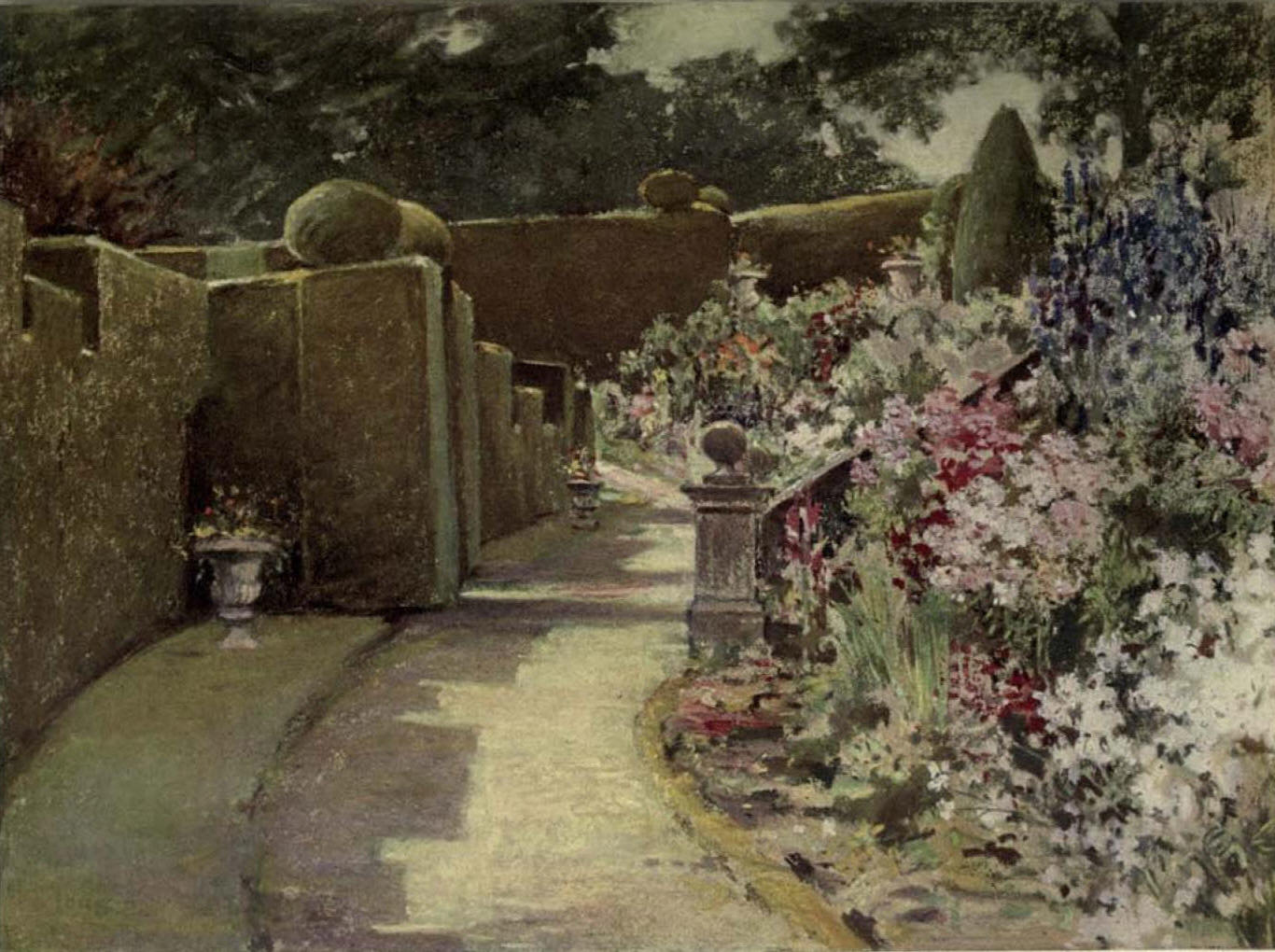
directions, and by the carpet-like texture of the
fine sward under foot.
There are also retaining walls of stone, one of the delightful features
which remain in memory being a fine specimen of the Austrian copper
rose, whereof the brilliant garlands were charmingly set off by the grey
masonry to which the plant is trained. It . is a cruel misnomer that
this fine briar is called "copper," for there is nothing metallic in the
intense, yet velvety, glow of the petals. It is a rose unmatched in
colour by any other, and would be far more commonly grown had not
fashion decreed that persons of position (and others) must spend the
sweet o' the year in sun-baked streets, thereby stimulating florists to
the production of late-flowering varieties. It would be impossible to
have clipped yew in better condition than those under charge of Mr.
Harvey, the head gardener; and, forasmuch as experts differ as to the
best seasons for clipping evergreens, persons whom it may concern may
care to note that it is his practice to clip them in August. In the
kitchen ground there is a feature which I have not seen elsewhere,
namely, apple-trees closely planted and trained into an arch over-head,
forming a long pergola. This must be a charming object when the trees
are in blossom, for the boughs form their own support, and there is none
of that too obtrusive structure which nears the effect of many a
pergola. Whether this method of training is culturally to be commended
for the production of fruit, the present deponent cannot affirm; but
perhaps that is of little account on upper Tweedside, which is a cold
district, ill-suited for the orchard industry. Yet have apple-trees long
been grown there, for Merlin the Wizard apostrophises one of them in a
poem preserved in the Black Book of Carmarthen. After his flight from
the field of Ardderycl (Arthuret, near Carlisle), where the Pagan cause
was finally overthrown by the Christian leader Rydderch Hael, A.D. 573,
Merlin took up his abode in the Caledonian Forest, and, after living
there for "ten years and forty," was buried at Drummelzier, where
Powsail Burn joins the Tweed. The following passage occurs in his lament
for the lost cause.
"Sweet apple tree, growing
by the river!
Whereof the keeper shall not eat of the fruit;
Before I lost my wits I used to be round its stem
With a fair, playful maid, matchless in slender shape."
[Vivien of the legend and of Tennyson's idyll.]
But it is a fatal thing
to begin prosing about the memories, historic and prehistoric, of this
Border country. Merlin is not the only wizard who has cast his spell
upon it, for we are here upon the outskirts of Ettrick Forest, whereof
Washington Irving, nursed among the pathless forests and broad rivers of
the New World, received so chill an impression when he visited Walter
Scott at Abbotsford.
"I gazed about me," he
wrote, "for a time with mute surprise. I beheld a mere succession of
grey, waving hills, line beyond line, as far as my eye could reach,
monotonous in their aspect, and so destitute of trees that one could
almost see a stout fly walking along their outline ; and the far-famed
Tweed appeared a naked stream, between bare hills, without a tree or a
thicket on its banks. And yet such had been the magic web of poetry and
romance thrown over the whole, that it had a greater charm for me than
the richest scenery I had ever beheld in England."
Yet Dorothy Wordsworth
discerned in this landscape a physical charm of which her father was not
sensible.
"In one very sweet part
of the vale," she notes in her journal, "a gate crossed the road, which
was opened by an old woman who lived in a cottage close to it. I said to
her —'You live in a very pretty place.'—'Yes,' she replied, `the water
o' Tweed is a bonnie water.' The lines of the hills are flowing and
beautiful; the reaches of the vale long. In some places appear the
remains of a forest, in others you will see as lovely a combination of
forms as any traveller who goes in search of the picturesque need
desire, and yet perhaps without a single tree; or at least, if trees are
there, they should be very few, and he shall not care whether they be
there or not."
The "magic web" lies as
close and glitters as fair as when these words were written nearly
ninety years ago; and the same hands that wove it wrought the earliest
stages in transforming the physical landscape. When Scott began planting
trees at Abbotsford, almost every vestige of the Caledonian forest had
vanished from Tweedside, and the land wore that naked aspect which
disappointed Washington Irving. But no one visiting Tweeddale and
Teviotdale nowadays can complain that they are treeless. Fine timber
adorns the parks, broad woodlands clothe the slopes, and the silvan
glories of the river side are such as Scott dreamt of, planned, but
lived not to realise. For he was the pioneer of replanting; there,
between Sunderland Hall and Galashiels, are the woods he reared with so
much zeal and forethought; it is to him that the traveller owes, not
only the intellectual charm of the Border land, but much of its scenic
beauty also.
Waiting at the pretty
little waterside station of Lindean for the train from Selkirk, one
cannot but recall events which made that place the last scene in a
gallant life. William, son of Sir James Douglas of Lothian, is known in
history as the Knight of Liddesdale; but the prowess he displayed, not
only against the English in the war of independence, but also on French
battlefields, gained him also the prouder title of the Flower of
Chivalry. He won back from the English the Douglas estates on the
Border, but in 1346 he was taken prisoner at the battle of Durham, along
with King David II., whose hot-headed folly in provoking that conflict
went nigh to sacrificing for good and all the hard-won liberty of his
country. For six years the Flower of Chivalry drooped in a dungeon of
the Tower of London. Better had he drooped to death; for, despairing of
freedom, he turned traitor, and bargained with King Edward for release,
receiving broad lands in Annandale, which he was to hold as an open door
for the passage of English armies.
Meanwhile another William
Douglas had returned to Scotland and became the champion of her cause.
This was the son of Archibald "the Tineman," who was killed at Halidon
Hill in 1333, when young William was made the ward of his godfather, the
Knight of Liddesdale, and was sent to France to be educated. Returning
in 1351 to take up his lordship (he afterwards became first Earl of
Douglas), William found that the Flower of Chivalry had not only annexed
a good deal of his ward's property, but had allowed his estates to be
overrun by Englishmen. The Knight avoided meeting his godson; but one
day the young lord found him hunting in Ettrick forest, where he—the
young lord—had sole right of the chase, inherited from his uncle the
"good Sir James of Douglas," Bruce's right-hand man. No man knoweth what
ensued. Certain it is that where two men bearing the name of William
Douglas met, only one, and he the younger, rode away, leaving the elder
stark in the greenwood. The place where the Knight fell, only a little
way from Sunderland Hall, is called Williamhope to this day. [The suffix
"hope," so common in this district, is the Norse equivalent of the
Gaelic "glen."]
They carried all that
remained of the Flower of Chivalry down to Lindean Church, where the
body rested that night; which must serve as an excuse for so much
irrelevancy on the part of him who has undertaken to write about
gardens.
Loitering on the station
platform, I came upon matter germane to horticulture, for I found the
stationmaster, another Mr. Harvey, to be a keen and skilful amateur. In
his garden flourish many plants quite out of the common run, such as
Incarvillea delavayi, Primula denticulata (masses of it), some very
choice larkspurs, notably a pale blue one called "life-guardsman," for
which Mr. Harvey observed with a sigh that he had paid far more money
than he ought. How many of us might make similar confession, had we the
candour! |