|
 HE
old house of Leckie stands about six miles west of Stirling on that fair
wooded slope which makes the foot-hills of the precipitous Lennox range,
separating it from the flat Carse of Menteith, through which lowland
Forth, deep-cradled in willowy banks, winds her eastward way to meet her
Highland sister, impetuous Teith. Apt emblems, these two rivers, of the
two races of men whose confines lay along their course of yore. The
Teith, poured from the great lochs of Vennachar and Lubnaig, rushes out
upon the plain with as much tumult as did of old the Highland caterans,
swarming from mountain and glen to drive a prey: the Forth—silent,
sullen, profound—flows with scarcely perceptible current, yet moves as
resistlessly as men of Saxon blood to the appointed end. HE
old house of Leckie stands about six miles west of Stirling on that fair
wooded slope which makes the foot-hills of the precipitous Lennox range,
separating it from the flat Carse of Menteith, through which lowland
Forth, deep-cradled in willowy banks, winds her eastward way to meet her
Highland sister, impetuous Teith. Apt emblems, these two rivers, of the
two races of men whose confines lay along their course of yore. The
Teith, poured from the great lochs of Vennachar and Lubnaig, rushes out
upon the plain with as much tumult as did of old the Highland caterans,
swarming from mountain and glen to drive a prey: the Forth—silent,
sullen, profound—flows with scarcely perceptible current, yet moves as
resistlessly as men of Saxon blood to the appointed end.
A beautiful old house,
designed for that combination of domestic ease with defensive qualities
that was the aim of Scottish architects in the hazardous reign of Queen
Mary. On the east side a wing has been thrown out to meet the more
exacting requirements of the eighteenth century; but even that did not
serve to satisfy a modern household, and in the nineteenth century a
brand new mansion was erected; the ancient home, with all its chequered
association, was evacuated, the green "pleuse" and flowery borders were
ploughed up, and the old house was applied to the accommodation of
workmen and their families.
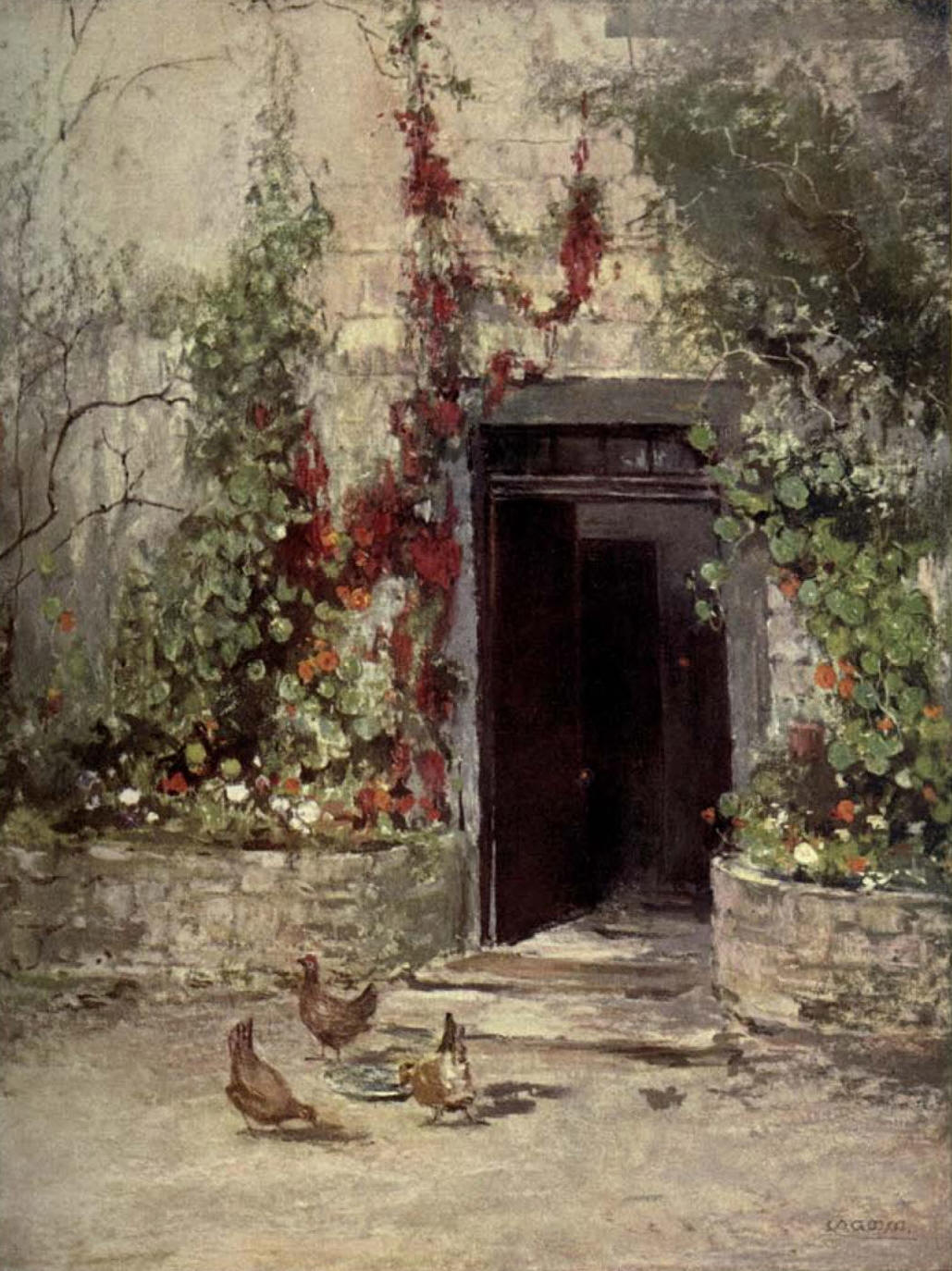
Yet it was not upon the fine new terraces or
among the flaunting parterres that Miss Wilson's choice of a subject
fell, but under the time-worn walls, where a few flowers still linger,
though the former inmates have passed away. The house, so far as it is
inhabited, now serves for a working man's dwelling; and readers may be
disposed to dispute its claim for a place among Scottish gardens.
Indeed, it affords no example of successful cultivation. The flowers are
but those whose constitution enables them to survive neglect and run
wild; but the drawing illustrates so well those gleams and flashes of
colour which we sometimes see reflected from a forgotten past, that I
could not find it in my heart to put it aside.
In this instance the colour comes from two
species of Tropaeolum—namely, the annual Indian Cress (T. nasturtium),
and the perennial T. speciosum, which cottagers sometimes call, by easy
transposition of consonants, the "petroleum plant." Both of these are
natives of South America, and, like many others
from the same region, adapt themselves with
remarkable readiness to the cool soil and humid air of the north. The
exquisite beauty of the perennial species, with its delicate leafage,
festoons of carmine blossom and blue berries, has been the despair of
many English amateurs; for there are very few places south of Yorkshire
where it will consent to flourish. Yet it is very capricious;
establishing itself sometimes in the most unexpected way and in the
least likely environment. Thus in Mrs. Benson's beautiful garden at
Buckhurst in Sussex, on a dry, hot soil, this tropaeolum has possessed
itself of some of the borders, over-running shrubs and walls as wantonly
and irresistably as in any Scottish cottage garden.
Leckie, like most places in this central
plain of Scotland, is rich in historic association. It belonged once to
King Robert the Bruce, who, in 1326, gave half the lands to his ancient
ally Malcolm, Earl of Lennox, receiving in exchange two plough-gates of
land at Cardross on the Clyde, [Not Cardross on the Forth, which is only
a few miles east of Leckie.] where he built himself a country house and
spent his declining years in the usual pursuits of a country
gentleman—hunting, hawking, farming and yachting. It was at Leckie that
Prince Charlie lay after Lord George Murray had routed General Hawley at
Falkirk. It was the last house he occupied in the Lowlands, setting
forth thence in the dark days of January, 1746, on his ill-starred march
to the north, where his star was to be quenched for evermore on Culloden
Moor. |