|
 NE
writing about daffodils should foreswear poetic quotation, were it only
in common consideration for his readers. Nevertheless there is one
practical point connected with this favourite flower rendering excusable
a reference to a passage in the greatest of English poets. When
Shakespeare wrote of daffodils. NE
writing about daffodils should foreswear poetic quotation, were it only
in common consideration for his readers. Nevertheless there is one
practical point connected with this favourite flower rendering excusable
a reference to a passage in the greatest of English poets. When
Shakespeare wrote of daffodils.
That come before the
swallow dares, and take
The winds of March with beauty.
He had in mind, not the
March of our calendar, but March old style, which, according to Julian
reckoning, was in the seventeenth century, ten days in retard of the
Gregorian dates. Although the Scottish Privy Council decreed the
adoption of the new style from 1600, it was not until 1751 that the
British Parliament followed suit, passing an Act in that year which set
matters in order by the omission of all dates between the 2nd and the
14th of September, 1752. Thus when The Winter's Tale was produced in
1611, Shakespeare's month of March corresponded to the period
now noted by us as
extending from 11th March to 10th April, both inclusive. This puts the
poet's chronology in harmony with our present experience: for the common
daffodil is never at its prime till the beginning of April, even in
early districts. In backward districts the full flush is not to be
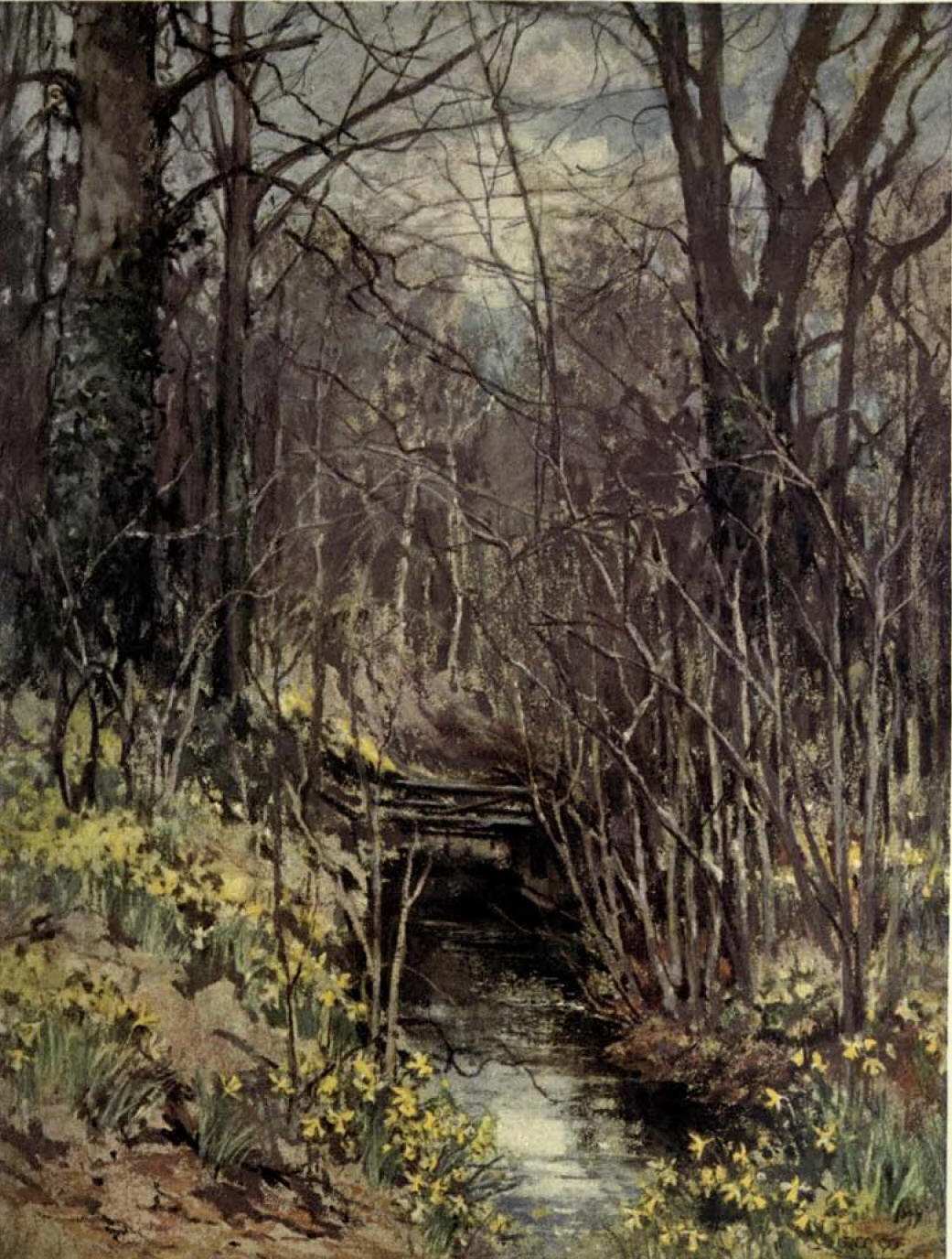
expected before the middle of the month. It was on the 2nd April that
Miss Wilson made her study of daffodils at Monreith, and they would have
made a braver show had she been able to wait till the following week.
There is no plant, not
even the rose, which has undergone more frequent transformation at the
hands of the hybridiser than the daffodil; but the natural species were
perfect before man took to playing pranks with them, and I confess to
thinking the new varieties no improvement on the old types. Those which
have run riot through the Monreith woods are the common sort, Narcissus
pseudo-narcissus, which is probably a native of England, and certainly
revels in the humid climate of Scotland. One wants nothing better; yet
there are some varieties of this species which it would be folly to
reject. The one known as bicolor, for instance, with a golden tube and
broad, ivory-white segments, is quite as beautiful and as easily
naturalised as the type, but it flowers a fortnight or three weeks
later. Then there are the miniature forms, minor, nanus, and minimus,
with tube and segments alike of rich golden yellow. These should be
grown in borders, with such contemporary flowers as hepaticas,
chionodoxa, early squills and dog-tooth violets. As for the double
varieties, out upon them! To quote Perdita once more
I'll not put
The dibble in earth to set one slip of them.
The sculptured design of
this flower is so admirable that it is sheer sin to let it be disfigured
by doubling.
Talking of daffodils, one
cannot but breathe a thanksgiving to Nature for that she has furnished
them with an infallible protection against the well-nigh omnivorous
rabbit. One would suppose that the succulent green blades, pushing up
through winter-slain herbage, were just the diet to whet the unholy
appetite of these brutes. But they know better than to set a tooth to
them. As the protective agent in certain plants is very obscure, perhaps
I may be allowed to quote here what I have said elsewhere on this
matter.
"In regard to daffodils,
they appear to be protected, not by any chemical poison, but by a purely
mechanical agency which has been brought to light by the researches of
the Rev. W. Wilks, editor of the Royal Horticultural Society's Journal.
In February, 1905, he heard from a nurseryman, who grows daffodils for
the flower trade, that men and boys employed to gather the flowers
suffered from poisoned hands. He explained that after the men had been
at work a little while, their hands became sore, gatherings forming
under the finger-nails and wherever the skin was broken or chapped. This
statement having been confirmed by another daffodil-grower, one of the
largest in the trade, Mr. Wilks instituted research into the cause, and
came to the conclusion that the irritant in the sap of the daffodil is
not a true poison at all, but that the mischief is caused by small
crystals of lime, called raphicles, of which the sap is full. He
recommends that people employed to gather daffodils should oil their
hands before setting to work, and rub tallow under their finger-nails."
Monreith has been in
possession of the same family for 427 years. That it has been for a
considerable part of that period a home of flowers, there is the
evidence of a fine piece of tapestry to prove. This was the work of the
wife of the third baronet (he died in 1771), who set herself to depict
in applique the flowers growing in the castle garden. They were laid on
a maroon ground to serve as a carpet—literally a parterre—for the castle
drawing-room. A laborious task, but evidently a labour of love, so
faithfully are the dame's favourites set out in a design of remarkable
grandeur. A large basket of flowers forms the centre; smaller groups
fill the four corners, and round the carpet runs a continuous wreath
looped with ribbons.
Stowed away in a lumber
room, this fine piece of work was unearthed thirty years ago. Moths had
played havoc with the ground cloth, but the needlework was almost
intact, and the colours fresh : skilful hands were set busy relaying the
flowers upon cloth of an old gold colour, and the piece now hangs on the
wall of the ante-room in the modern house of Monreith. Among the flowers
most easily recognised in the design are the madonna lily (which refuses
to flourish with us now), the Isabelline lily, clove carnations,
mullein, lupine, hyacinth, red primrose, auricula, polyanthus, guelder
rose, anemone, moss rose, scarlet lychnis, pink geranium (its leaves
variegated with white), convolvulus, sunflower, sweet-William, scabious,
and Canterbury bells, whence one is able to form a good notion of the
furniture of a Scottish garden in the eighteenth century. Strange to
say, the common daffodil is not among them ; the only representative of
the family being that double form of narcissus incomparabilis which goes
by the homely name of Butter-and-eggs.
No doubt many of the
flowers still adorning these grounds are borne on the same roots which
furnished patterns for the gentle artist a century and a half ago ; for
there is no fixed limit to the life of some of the humblest herbs. The
oxlip may outlive the oak which overshadows it; yonder massive sycamore
may be but a child in years compared with the celandine that stars the
bank at its foot, and who shall declare the "expectation of life" in the
lowly stonecrop that creeps beneath our feet. The green mound, whereon
stands the keep of the old castle, breaks out each spring on its south
side with a constellation of white violets, wide-spread on the slope.
They have long outlived the memory of her who planted them, for it is
more than a century since the castle was inhabited. On the terrace at
Monreith there is planted in clipped box the Psalmist's note of
warning—Homo quasi flos egreditur et conteritur; but those who covet
length of days might willingly exchange terms of life with "the hyssop
that springeth out of the wall." |