|
 HE
whole plan and purpose of this book being to illustrate types of
Scottish horticulture, the grandiose and elaborate have received no
preference over the unpretending and simple. Any space of Scottish soil,
be its dimensions calculable in roods or in acres, will serve our turn,
so that it be an abode of flowers well tended, or at least, unspoilt, by
its owner. HE
whole plan and purpose of this book being to illustrate types of
Scottish horticulture, the grandiose and elaborate have received no
preference over the unpretending and simple. Any space of Scottish soil,
be its dimensions calculable in roods or in acres, will serve our turn,
so that it be an abode of flowers well tended, or at least, unspoilt, by
its owner.
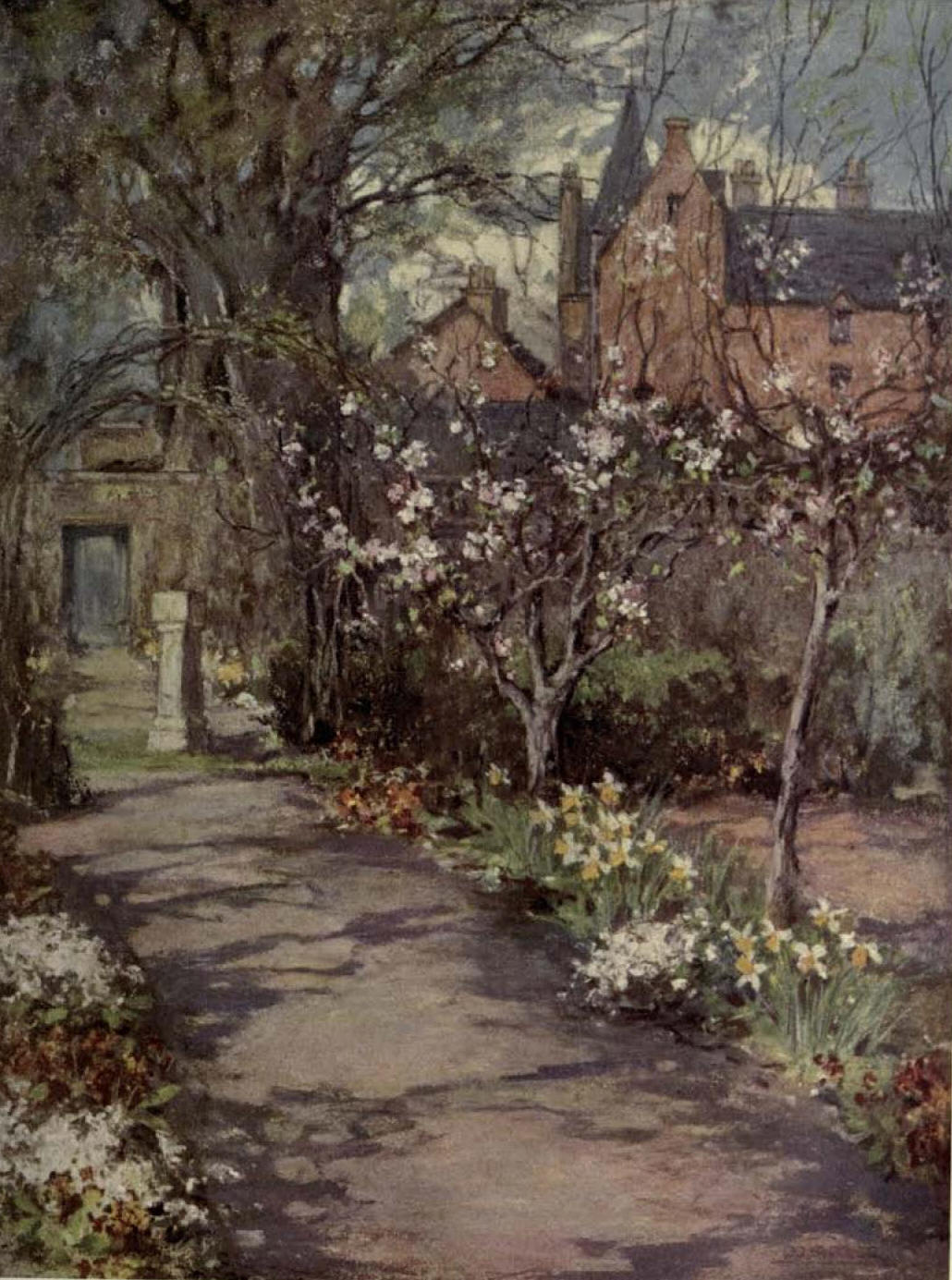
Simple, indeed, is the
garden design at Gartincaber—a plain rectangle sloping pleasantly to the
sun; at the upper-end a sixteenth century tower, with nineteenth century
additions naively contrived; at the lower-end a clear pool, not ample
enough to aspire to the title of "loch," yet, shadowed by dark firs on
the far side, too comely to bear the common Scottish term "a stank."
This walled enclosure is laid out in the old manner, subdivided by
crossed paths, with a sun-dial at the crossing; kitchen herbs and small
fruits in the four quarters,
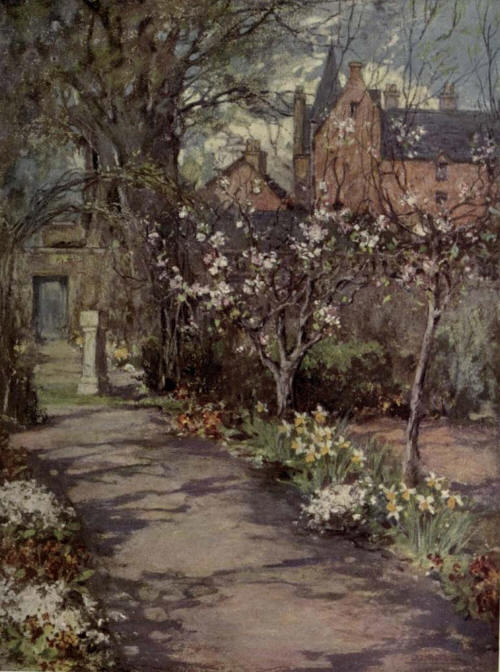
with narrow selvage of
flowering things, overhung here and there by aged apple trees. Nothing
can have been further from the designer's intention than landscape
effect: use, not ornament, was his purpose, flowers being admitted in
grudging concession to feminine frivolity ; but age has brought about
delectable results—age, and the affectionate tending of generations.
Lofty holly hedges, such as John Evelyn praised, screen the litter in
such corners where litter must be; a few massive sycamores add dignity
to the scene in winter and shade from summer heat, without, as it seems,
impoverishing the borders, for these teem with blossom to the very feet
of the trees. But they are flowers of modest requirements—winter
aconites and snowdrops, daffodils and wind-flowers, bloodroot, violets
white and purple, primroses and oxlips of many hues—all old friends, the
older the better to be loved. On this mid-April morning in a late—a very
late—season, what strikes one as most notable is the abundance of double
white primroses on usually long footstalks, surely a strain peculiar to
the place.
I have dwelt on the
simplicity of this garden, but every yard of it bears witness to
affectionate care, and in one respect this affection has evinced itself
in a manner reflecting agreeably the classical taste of a bygone age.
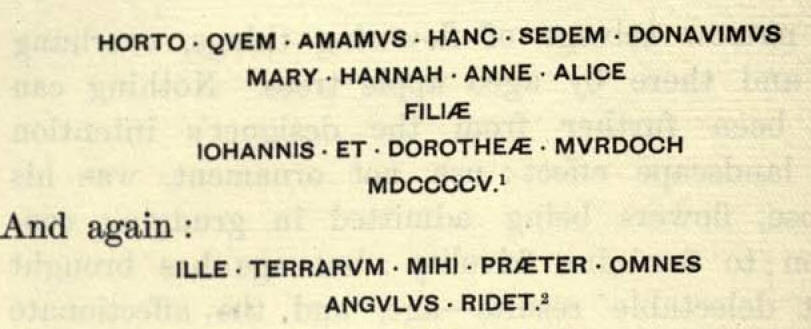
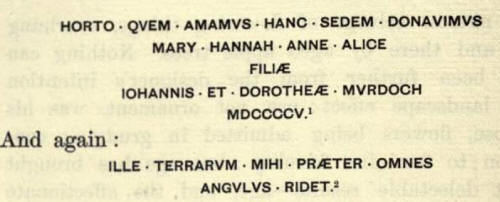
Thus at the foot of the slope has been placed a wide stone bench,
whereof the back bears this inscription:
The sun-dial in the
middle of the garden is also inscribed with many legends, and bears on
its base a dedication to Mr. and Mrs. Burn-Murdoch "on their golden
wedding," from their grandchildren, Lorna, Dorothea, Ian, Marion, and
Colin.
It is no modern trait in
the family, this pretty taste for inscribing stones. During the four
centuries or thereby it has stood, the house of Gartincaber has owned no
other lord than a Murdoch, and the dormer windows bear legends in
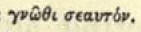
relief; on one, NOSCE TEIPSVM 3, surmounted by a thistle; on
another a tag from Juvenal:

under a man with a bent
bow.
1. Mary, Hannah, Anne,
Alice, daughters of John and Dorothy Murdoch, have presented this seat
to the garden which we love. 1905." Horto nobis dilecto had been a more
graceful rendering.
2 "This little corner
pleases me better than all the world beside." Horace, Odes ii. 6.
3"Know thyself"—the Attic
 . "Oh Athenians, your wisdom
reaches us across the centuries! We hear your murmured messages—' Know
thyself,' `Nothing in excess!' We who have travelled so far, and yet so
little, we who are still scaling the heights you reached—Athenians, we
salute you!" . "Oh Athenians, your wisdom
reaches us across the centuries! We hear your murmured messages—' Know
thyself,' `Nothing in excess!' We who have travelled so far, and yet so
little, we who are still scaling the heights you reached—Athenians, we
salute you!"
The Diary of a Looker-on,
by C. Lewis Hind.
4 " Death alone discloses
how feeble are the bodies of men."—Juvenal, Sat. x, 173.
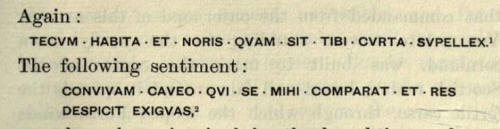
may have been inspired by
the haughtiness of some affluent neighbour ; the lord of Doune, perhaps,
whose great castle, though now in ruins, still scowls defiance from the
further shore of Teith.
Even the latest addition
to the old house bears its appropriate legend, the gable of the new
drawing-room bearing one well expressing the spirit which has attached
this family to its ancient home:
I - DWELL - AMONG • MY -
OWN - PEOPLE, 3
Of the two avenues which,
planted at right angles to each other, lead up to the house, the
northern, consisting of two double rows of beeches, has been sorely
wrecked by gales, but the west avenue is still intact, a remarkable and
far-seen feature in the landscape. Running along the comb of a ridge, it
is composed of lime trees which appear to be about 100 or 120 years old.
The two rows are only fifteen feet apart; and the trees, set very
closely in the rows, have been drawn up to the height of a hundred feet.
There is no nobler prospect in Scotland, none richer in historic
association, than
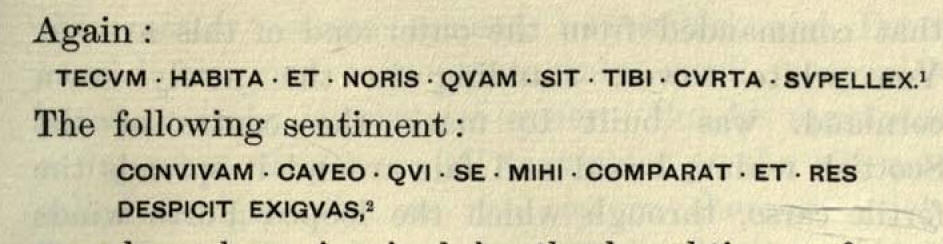
1. "I Live by yourself, and
you will find out how ill-furnished is your mind." Persius, iv. 52.
2 "I am on my guard
against the guest who draws comparisons between himself and me, and
contemns my slender means."
3 Kings iv. 13.
that commanded from the
outer end of this avenue. Yon white tower, standing in the newly sown
cornland, was built to mark the centre of the Scottish realm; broad and
fair around it spreads the fertile cause, through which the looped Forth
winds its leisurely way. You may trace its gleams till they are lost in
the blue haze on the east, where the sunlit Ochils, Stirling Castle, and
Polmaise woods arrest the eye, only a little nearer than blood-boultered
Bannockburn and Falkirk. All along the southern horizon stretch the
flat-topped Lennox Hills and Campsie Fells, their outline presenting
marked contrast to the tumultuous range on the north, where Ben Ledi and
Stuc-a'chroin still wear their snowy hoods. Far on the west Ben Lomond
rears its cloven cone, commanding outpost of the Highland host. Every
feature in the landscape has its story for the understanding eye, from
northward Ardoch, where Julius Agricola has left enduring memorial of
his conquest in the earthen ramparts of his camp, to nearer Kippen on
the south, where Prince Charlie's Highlanders crossed the Ford of Frew
when last Great Britain felt the throes of civil strife.
A word about the Murdochs
of Gartincaber. They trace their descent from one Murdoch, who rendered
yeoman service to Robert the Bruce in his hour of need. In the early
spring of 1307, the King of Scots was hiding in the Galloway hill
country with a few hundred followers. King Edward's troops beset all the
passes: escape seemed impossible, and Bruce caused his men to separate
into small companies, so as to make subsistence easier. But he appointed
a day when they were all to muster at the hill now called Craigencallie,
on the eastern shore of lonely Loch Dee. Here, in a solitary cabin,
dwelt a widow, [The name Craigencallie signifies in Gaelic "the old
woman's crag," and is cited in evidence of the truth of the legend.] the
mother of three sons, each by a different husband, and named Murdoch,
Mackie and MacLurg.
The King arrived first,
and alone, at the rendezvous. Weary and half-famished, he asked the
widow for some food ; nor asked in vain, for, said she, all wayfarers
are welcome for the sake of one. "And who may that one be?" asked the
King.—"None other than Robert the Bruce," quoth the goodwife, "rightful
lord of this land, wha e'er gainsays it. He's hard pressed just now, but
he'll come by his own, sure enough."
This was good hearing for
the King, who made himself known at once, was taken into the house and
sat down to the best meal he had eaten for many days. While he was so
employed, the three sons returned, whose mother straightway made them do
obeisance to their liege lord. They declared their readiness to enter
his service at once, but the King would put their prowess as marksmen to
the test before engaging them. Two ravens sat together on a crag a
bowshot off; the eldest son, Murdoch, let fly at them and transfixed
both with one arrow. Next, Mackie shot at a raven flying overhead, and
brought it to the ground, and the King was satisfied, although poor
MacLurg missed his mark altogether.
In after years, when the
widow's words had been fulfilled by Bruce coming to his own and being
acknowledged King of Scots, he sent for the widow and asked her to name
the reward she had earned by her timely hospitality.
"Just gie me," said she,
"you wee bit hassock o' land that lies atween Palnure and Penkiln"—two
streams flowing into Wigtown Bay.
The King granted her
request. The "bit hassock," being about five miles long and three broad,
was divided between the three sons, from whom descended the families of
Murdoch of Cumloden, Mackie of Larg, and MacLurg of Kirouchtrie.
Cuniloden remained the property of the family of Murdoch till 1738, when
it was sold to the Earl of Galloway to discharge an accumulation of
debt. The fine shooting of the founder of the family is commemorated in
the arms borne by his descendants, and duly enrolled in the Lyon
Register, viz., Argend, two ravens hanging palewise, sable, with an
arrow through both their heads fess-wise, proper.
In the Justiciary Records
of Scotland there is brief record of a horrible outrage perpetrated upon
Patrick Murdoch of Cumloden in 1605. Robert and John, sons of Peter
M`Dowall of Machermore, a near neighbour of Cumloden, were arraigned
upon a charge of having seized Murdoch and his servant Peter M'Kie, and
cut off their right hands. Peter M`Dowall was accepted as surety for his
sons, who were liberated on their father's undertaking that they would
appear for trial at Kirkcudbright, after receiving fifteen days' notice.
But the M'Dowalls were a powerful clan. When the case was called at the
assizes, a jury could not be empannelled, twenty-seven persons who were
summoned preferring to pay the statutory fine rather than serve ; and we
hear no more either of the malefactors or their victims. |