|
 RAVELLERS
have been heard to utter unkind things about the climate of Edinburgh,
which has been much the same, I suppose, for the last thousand of years;
and those who have not visited the city may have been deterred from
doing so by its by-name of "Auld Reekie," which its inhabitants do not
resent, albeit that of the "Modern Athens" may be more alluring. In
truth, both the climate and the atmosphere are compatible with
horticulture of a very high class; for the first is no worse than the
rest of the east coast, where there is no dearth of fruits and of
flowers, and the second is singularly free from smoke for a town of
317,459 inhabitants. Edinburgh earned its name of Auld Reekie from no
internal murkiness; it was conferred by a famous golfer of the
eighteenth century, James Durham of Largo, who, from his home in Fife,
used to watch the chimneys of the capital, and, as Robert Chambers
records, "was in the habit of regulating the time of evening worship by
the appearance of the smoke of Edinburgh. When it increased in density,
in consequence of the good folk preparing supper, he would say, 'It is
time, noo, bairns, to tak the buiks and gang to our beds, for yonder's
Auld Reekie, I see, putting on her nightcap." And the nickname was
confirmed and made irrevocable by a later and greater authority than
James Durham. "Yonder stands Auld Reekie," says Adam Woodcock to young
Roland Greeme, "you may see the smoke hover over her at twenty miles
distant, as the goshawk hangs over a plump of young wild ducks." [The
Abbot, chap. xvii.] RAVELLERS
have been heard to utter unkind things about the climate of Edinburgh,
which has been much the same, I suppose, for the last thousand of years;
and those who have not visited the city may have been deterred from
doing so by its by-name of "Auld Reekie," which its inhabitants do not
resent, albeit that of the "Modern Athens" may be more alluring. In
truth, both the climate and the atmosphere are compatible with
horticulture of a very high class; for the first is no worse than the
rest of the east coast, where there is no dearth of fruits and of
flowers, and the second is singularly free from smoke for a town of
317,459 inhabitants. Edinburgh earned its name of Auld Reekie from no
internal murkiness; it was conferred by a famous golfer of the
eighteenth century, James Durham of Largo, who, from his home in Fife,
used to watch the chimneys of the capital, and, as Robert Chambers
records, "was in the habit of regulating the time of evening worship by
the appearance of the smoke of Edinburgh. When it increased in density,
in consequence of the good folk preparing supper, he would say, 'It is
time, noo, bairns, to tak the buiks and gang to our beds, for yonder's
Auld Reekie, I see, putting on her nightcap." And the nickname was
confirmed and made irrevocable by a later and greater authority than
James Durham. "Yonder stands Auld Reekie," says Adam Woodcock to young
Roland Greeme, "you may see the smoke hover over her at twenty miles
distant, as the goshawk hangs over a plump of young wild ducks." [The
Abbot, chap. xvii.]
Of fresh air and light
there is no lack in modern Edinburgh. One longs to bring back Sir
William Brereton, were it but to cause him to recant the harsh judgment
he passed upon the city in 1636.
"The sluttishness and
nastiness of this people is such that I cannot omit the particularizing
thereof. . . their houses and halls and kitchens have such a noisome
taste, a savour, and that so strong, as it doth offend you so soon as
you come within their wall; yea, sometimes when I have light from my
horse, I have felt the distaste of it before I have come into my house;
yea, I never came to my own lodging in Edinburgh, or went out, but I was
constrained to hold my nose, or to use wormwood, or some such scented
plant."
Much more and worse has
this stern old Puritan to reproach the sanitation of Edinburgh withal;
but that was more than two centuries before Sir Henry Littlejohn
appeared on the scene. [Sir Henry was chief sanitary authority in the
city for forty-six years, retiring under the Civil Service age
regulations in 1906 with a remarkable record of good work to his credit,
and, it is to be hoped, many years of well-earned repose before him.]
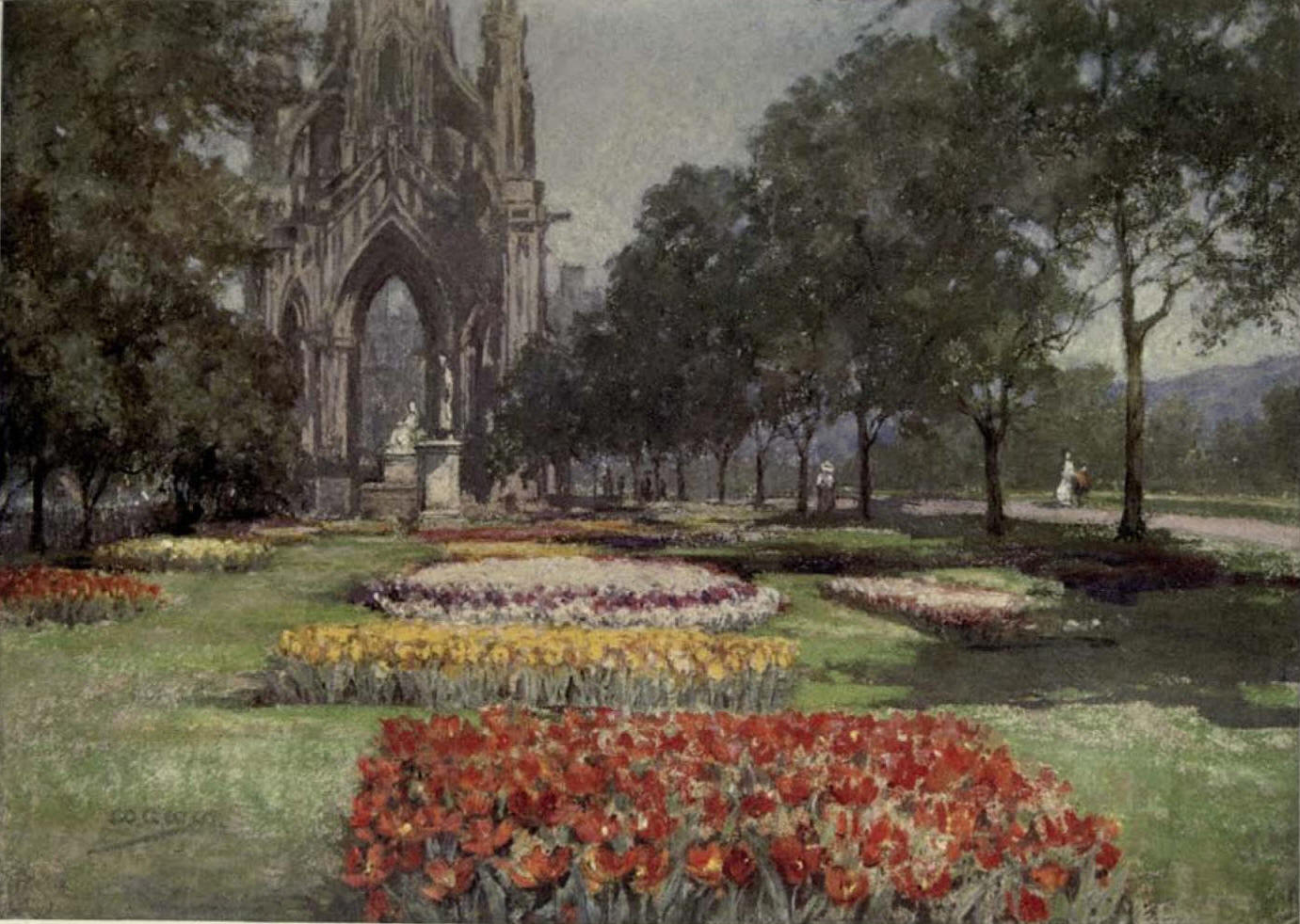
The series of Scottish
garden types would be far from complete if it did not include a town
garden, and certain it is that we Scots owe much gratitude to the
municipal rulers of our metropolis for the admirable manner in which the
ground along the south side of Princes Street is beautified. Miss
Wilson's view is taken in the eastern garden, between the Doric temple
on the Mound, upon which John Ruskin erewhile discharged the fluent
vials of his wrath, and the great monument which, perhaps, owes its
magnificence even more to the degree in which Sir Walter Scott's
personal character endeared him to his countrymen as a man than to their
recognition of his accomplishment as a poet. Adam Black, founder of the
well-known firm of publishers, undoubtedly deserved well of his
fellow-citizens, for he was twice Lord Provost of Edinburgh, and
worthily represented that city in Parliament ; but when they resolved to
commemorate him they acted somewhat unkindly in erecting his statue in
such near proximity to the canopy which soars over the homely figure of
"the Shirra," and practically eclipses the lesser monument.
Impressively beautiful as
she is in a degree beyond any other city in the British Isles, Edinburgh
might have become still more so had men foreseen what modern methods of
sanitation have rendered possible. When the city wall was razed after
the middle of the eighteenth century, before the New Town had come into
existence, the hollow between the Old Town and Princes Street was
occupied by the Nor' Loch, a sheet of water which formed an important
part of the military defences of the city, but which we may well imagine
had become the offensive receptacle of the waste products of a growing
population. Accordingly it was drained away, and a matchless opportunity
for landscape gardening was lost for ever. Still, the great glen
remained, capable of conversion into a green valley with pleasant
groves; but all this was irremediably marred when, in 1844, the North
British Railway was driven through the old bed of the loch, filling all
the air with smoke and dreadful noise.
Down to this time, the
eastern part of this ground had been let to a nurseryman or
market-gardener; but the Town Council now resumed possession, building
the terraces and parapets and forming the walks which complete the
design of the Scott memorial. More and more care and money was applied
to the adornment of what became known as East Princes Street Gardens,
until, under the administration of Mr. John M'Hattie, they now present a
really remarkable example of spring and summer gardening in the formal
manner. All the greater credit is due to Mr. M'Hattie and his staff for
this result because of the stormy position which these gardens occupy,
fully exposed to the pitiless easterly gales which blow in from the
North Sea with relentless persistency.
Miss Wilson's study was
made in spring when tulips and wall-flowers display their vigorous hues.
The effect is softer in summer, when the tints blend with gentler
gradation, but in autumn the borders flame out again with a blaze of
chrysanthemums, carrying one well into the dark days which intervene
before the coming of the crocuses.
In 1876 the Corporation
acquired the West Princes Street Gardens, hitherto reserved for the
proprietors of houses ex adverso. These grounds are of very great
extent, lying right up to the foot of the Castle Rock, and, although
bisected by the broad railroad, have been converted into a veritable
pleasaunce, less formal in manner than the East Gardens. Under Mr.
M`Hattie's care, great improvements have been effected; hardy trees,
shrubs, and herbs have been liberally planted, and many borders are
devoted to spring and summer bedding. Warmly must the Corporation and
their servants be congratulated on the result of their enterprise. They
have turned the land at their disposal to the very best account, and
created a brilliant foreground to the Old Town and the Castle such as
those who remember Princes Street Gardens forty years ago could never
have anticipated. We can only sigh after the departed Nor' Loch when we
reflect what a feature it might have been made when purified and
committed to Mr. M`Hattie's skilful hands to work into his landscape. |