|
 N
the year of grace 1270 or thereabouts Sir Aymer Maxwell of Caerlaverock
granted to his third son, Sir John Maxwell, the lands of Nether Pollok
in the county of Renfrew, from whom the present owner, Sir John Stirling
Maxwell, is twenty-third in direct descent, through his grandmother, who
married Archibald Stirling of Keir. Six hundred and thirty-seven years
have wrought much change in nearly every part of King Edward's realm,
but nowhere has the landscape undergone more wholesale metamorphosis
within a like period than in the valley of the White Cart. N
the year of grace 1270 or thereabouts Sir Aymer Maxwell of Caerlaverock
granted to his third son, Sir John Maxwell, the lands of Nether Pollok
in the county of Renfrew, from whom the present owner, Sir John Stirling
Maxwell, is twenty-third in direct descent, through his grandmother, who
married Archibald Stirling of Keir. Six hundred and thirty-seven years
have wrought much change in nearly every part of King Edward's realm,
but nowhere has the landscape undergone more wholesale metamorphosis
within a like period than in the valley of the White Cart.
When Sir John Maxwell
took possession of his estate in the thirteenth century, Glasgow was a
modest hamlet, clustering round the brand-new cathedral of Bishop
Joceline; it has now overflowed upon 11,861 acres on both banks of the
Clyde, which winds through the municipal area for a distance of five
miles and a half.
It is not only the land
surface which has altered in appearance, forest and crag making way for
closely packed dwellings and factories; the Clyde and its lower
tributaries were allowed to become so foully polluted that a lifeless,
evil-smelling current flows where once the silvery salmon thronged up
from the firth and innumerable water-fowl flocked for food. That is in
process of being remedied by a painstaking municipality; but who shall
purge the sky of the smoke rising from the hearths of 780,000
inhabitants and the reek belched from a thousand factory chimneys and
gas-works?
Nor is that all that must
be reckoned. In a wide circle round Glasgow have arisen police-burghs
Kinning Park, Govan, Partick, Pollokshaws, Cathcart, etc.—each with a
population exceeding that of many a mediaeval city, each with its
smoke-producing industries, and only a little further afield is Paisley
with 87,000 inhabitants, Johnstone with 12,000, Port-Glasgow with
18,000, Greenock with 68,000, all combining to darken the air; and, as
though that were not enough to discourage horticulture, all the land
unbuilt on is threaded with railways, honeycombed with coal-pits,
studded with smelting furnaces, pouring forth volumes of smoke night and
day. So it has come to pass that from whatever quarter the wind sets, it
is charged with the products of combustion—in other words, with coal
smoke.
This, as every forester,
gardener and amateur can testify, is a relentless foe to almost every
kind of vegetable life. Strange to say, mosses and lichens, humblest in
the scale, succumb first, so that in all this region stones and tree
stems are devoid of that kindly covering which always gathers upon them
in a pure atmosphere. The next to suffer .are.. trees themselves; for
although many fine elms, beeches, oaks, sycamores, ash, and even pines
survive in this wide strath, these grew to maturity under conditions
very different from those now prevailing, and the growth of young trees,
especially conifers and oaks, is sorely checked and blighted by carbon
deposit and sulphurous fumes.
Nevertheless,
horticulture dies hard; the instinct of every man owning a garden is to
obey the primaeval command "to dress it and to keep it"; and Miss Wilson
has chosen a scene in the garden at Pollok as an example of what
combined skill and resolution may accomplish in the most forbidding
environment.
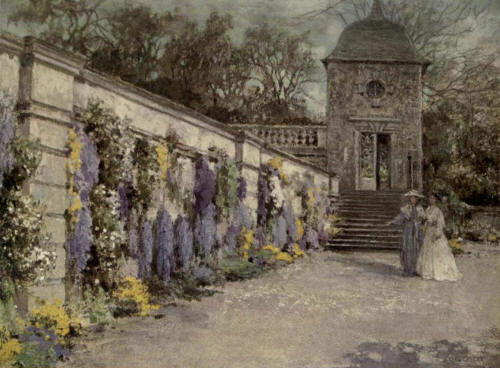
The subject of the
picture is a terrace wall, constructed only five or six years ago of
ashlar masonry, with slits purposely left between some of the joints for
the insertion of suitable flowering plants.
The park of Pollok is but
a green oasis round which Glasgow and the neighbouring burghs have
flowed like a dark and rapidly rising tide. Yet here, on this terrace
wall, within constant sound of steam hooters and whistles, steam hammers
and pumps, you may see alpine flowers blooming as profusely and with
colours as clear as they do on the loftiest solitudes on earth and in
the purest atmosphere. The chief display when this picture was
painted—in May—came from the varieties of Aubrietia with their hanging
cushions of purple and mauve, and golden Alyssum. Common things, these,
yet priceless in their effect and unfailing in the reward they make for
attention to their simple wants. A month later, the purple and gold had
been dimmed; a rose-coloured mist had spread along the wall, created by
different kinds of dwarf Dianthus and Silene, with the common sea-thrift
of our shores; while through the mist shone stars of Arenaria and many
species of saxifrage and stonecrop. Dwarf bell flowers, also, spread
blue curtains over the stones, among the most effective being the
glaucous variety of Campanula garganica, known as hirsuta, C. pusilla
and the hybrid "G. F. Wilson," C. muralis, which must now be sought for
under the preposterous title of C. portenschlageana.
All these are anybody's
flowers, anybody's, that is, who has the wit to raise them from seed,
for they are not particular as to soil (though most of them show
gratitude for an admixture and occasional top-dressing of old lime
rubbish), or climate, as their luxuriance in this Glasgow atmosphere
amply testifies. But among these commoner things are herbs, if not of
greater beauty, of greater rarity. Specially to be commended are the
little Himalayan Potentilla nitida, with silvery leaves and delicate
flesh-coloured flowers, like miniature Tudor roses; Myosotis rupicola,
an exquisite forget-me-not which likes to be wedged tightly into a rock
crevice; our native purple saxifrage S. oppositifolia, the
golden-flowered S. sancta from far Mount Athos, the fragrant S.
apiculata, thickly set with panicles of sulphur-coloured blossoms,
exactly the hue of a wild primrose, in early spring; and, earliest and
finest of all, the snowy-petalled S. Burseriana. Then the encrusted
section of rock-foils, bewildering in variety, delight in such a
position, growing into such exquisite bosses and wreaths that one almost
grudges the profusion of their bloom, which conceals the delicate
carving of their foliage.
It is wonderful how
readily these and other mountaineers adapt themselves to their
unpromising environment. The truth is that, like the red deer, they have
taken to the mountain tops because they have been crowded out of the low
country, where they were overwhelmed in competition with other herbs; so
they survive only in places where their constitution enables them to
endure conditions unfavourable to rank vegetation. A notable and
oft-quoted example of this is the common thrift, which is found all
round our coasts at sea level and on the summits of some of our highest
mountains, both these situations being unfavourable to the majority of
lowland vegetation; but one may search in vain for a single specimen of
thrift between these two extremes. That it would thrive anywhere is
proved by the ease with which it may be cultivated in gardens at any
level; cultivation, in this instance, amounting to no more than the
suppression of competing vegetation. In planting a terrace wall like
that at Pollok it is necessary to raise seedlings or cuttings which may
be inserted while still small in the crevices of the masonry. After
being settled in their places they drive their roots to almost
incredible distance into the solid earth behind the wall, which protects
them alike from summer drought and trying variations of temperature iii
winter, while the vertical surface ensures rapid drainage and protection
from frost.
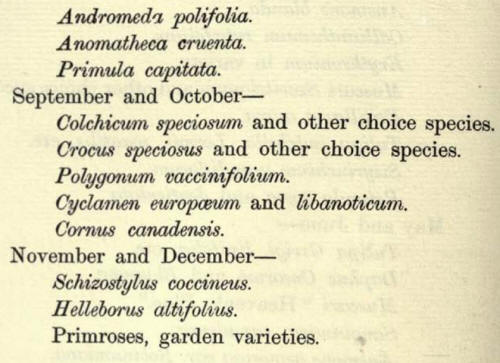
The narrow border at the
wall-foot provides a congenial home for choice bulbous and other plants,
which, if carefully selected, may keep up a continuous display almost
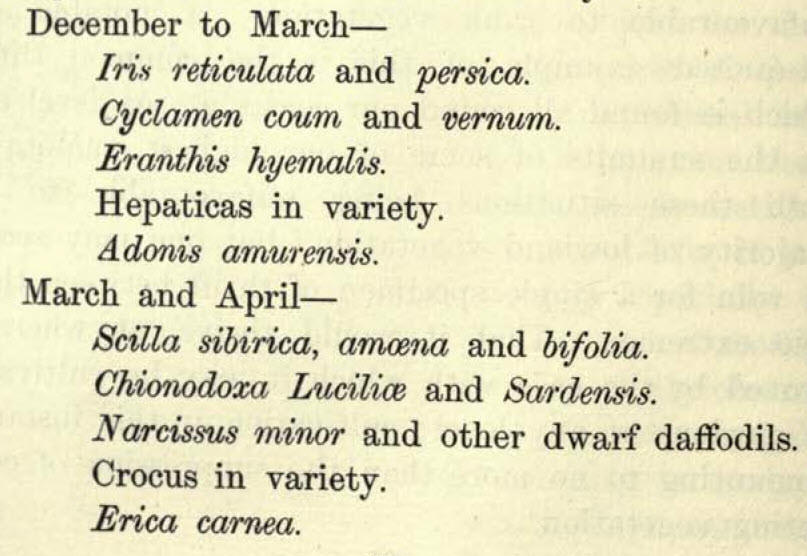
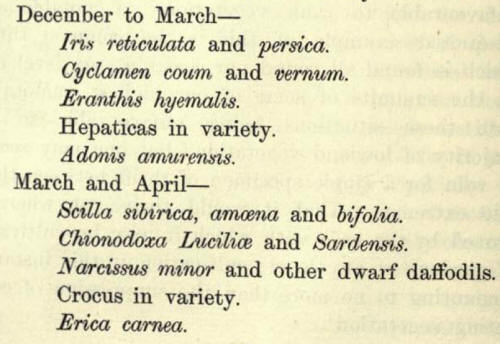
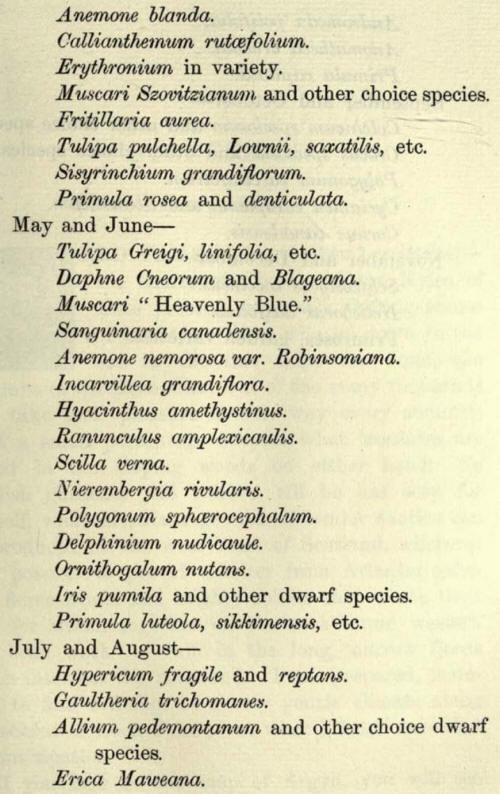
throughout the year. The list of suitable plants for this purpose might
be made a long one. The following one contains suggestion for a small
collection which may be added to at pleasure, suitable for a northerly
climate.
 |