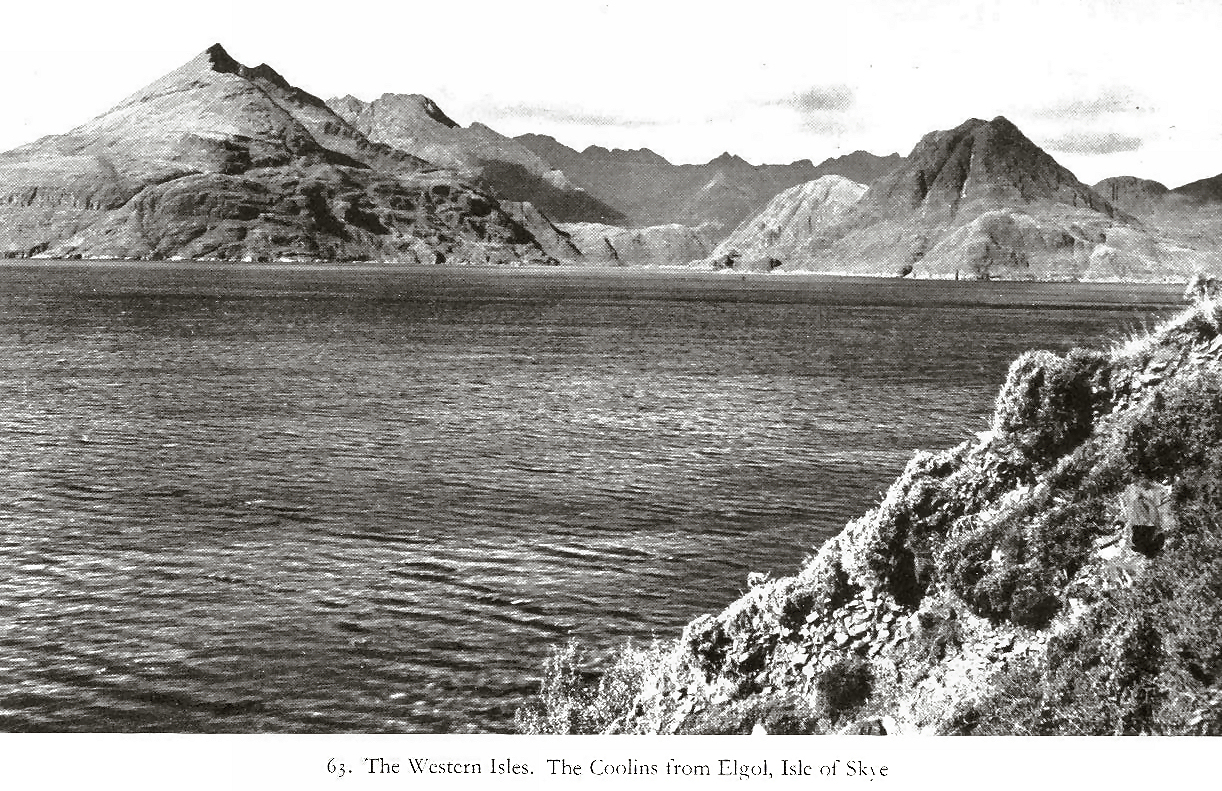
|
The
question of the origin and distribution of the Highland flora is one that
cannot be answered with any certainty. We can, however, speculate with
some accuracy upon the main events leading up to its present development.
To find
the answer I shall take you back to those far days when man was still more
ape than human and was hunted rather than the hunter.
In that
distant epoch Ireland was united to Britain and Britain to the Continent.
The Highlands of those days were much higher than they are now, and must
have had many impressive peaks rivaling the Alps in splendour.
The
mountains had an Alpine flora just as they have today, and the far north
had an ancient Arctic flora which was continuous round the whole of the
northern regions of the globe. The rest of the country was covered by a
flora allied to that of tropical regions of today.
The
climate in those far away times was warm and dry, and the Britain of those
days was a very different place from what it is today.
Gradually, however, the climate changed. The Polar Ice Sheet extended
farther and farther southward, and glaciers developed in the high Scottish
mountains. The existing flora migrated slowly southward before the
advancing menace of ice, snow and extermination. In the course of time,
the whole of Britain north of the Thames was covered by a huge ice sheet.
The
ancient Arctic and Alpine plants were either destroyed or found survival
in flight and formed the flora of southern England and northern France.
These plants were the ancestors of our present Alpine and Arctic floras.
The world they lived in must have been very grim indeed. An enormous ice
barrier must have stretched across the southern Britain much like the
great Antarctic Ice Barrier today. During the long winter, the whole
country was gripped by terrible frost, but the existing vegetation was
saved from complete extermination by a deep snow mantle. In the short
summer vast dust clouds swept up by terrific winds obscured the sun. The
now disappeared south of the Ice Sheet, and the hardy Arctic plants
starred the ground with their flowers, much as the Northern Tundra
scintillates with colour in our present epoch.
We are,
of course, unable to tell if all the plants to the north of Thames were
destroyed. In Greenland today many high peaks stand above the Ice Sheet
as bare rock and it may be that in Scotland the higher peaks were free of
ice and snow in the summer period. Hardy Alpine species may have been
able to survive the rigorous conditions which must have prevailed in those
exposed positions.
The Ice
Sheet was not stationary during the whole of the Great Ice Age. Periods
of milder weather intervened during which the ice retired temporarily.
Glaciers and minor ice sheets still covered the Highland mountains even in
these mild periods. The great ice rivers gouged out deep valleys which
today are filled by beautiful lakes like that of Loch Einich and the sea
lochs of Long Long, Loch Fyne and Loch Linnhe. Rocks and earth were
shaved and rasped off the mountains and deposited as huge moraines over
the lower lands.
Gradually
the climate became less rigorous and throughout the course of long
centuries, the Ice Sheet retreated farther and farther northwards. As
conditions became warmer, other plants intruded into the mix Alpine and
Arctic flora and being better suited to the changing conditions, gradually
forced them out of the lower lands. Thus the old flora retreated with the
ice age, climbing the mountains and seeking refuge on the inaccessible
crags and cliffs.
Rivers,
lakes and naked precipices acted as barriers to the retreating flora and
these unfortunates, their progress stopped, would have been exterminated
by more enterprising lowland plants. For this reason many of our native
Alpine plants are restricted to very small areas. The Drooping Saxifrage
found only on Ben Lawers, the Purple Oxytropis in Glen Clova, the Alpine
Lychnis on Little Kilrannoch and the rare Menziesia confined to the Sow of
Atholl, all owe their very restricted range to the vagaries of that long
retreat from the warm southlands.
Today our
British mountains have a flora very similar to that of Scandinavia and the
Arctic regions. Many species also occur on the Rocky Mountains of Canada
and America.
There are
a few species which are also found in Alpine Switzerland, e.g. the Moss
Campion, the Snow Gentian and the Mountain Dryas. These plants probably
belonged to the original Alpine flora and were found on both Swiss and
British mountains before the commencement of the Ice Age.
That our
theory is based upon good reasons is supported by the fact that in many
places in southern England ancient peats and deposits are found in which
the remains of an old Arctic flora is mixed with the bones of such Arctic
animals as lemmings, seals and mammoths. This proves that the Arctic
flora once covered the south of England.
What
immense vistas of time are opened up before us, as we contemplate the eons
that have passed since the commencement of the Great Ice Age! How amazing
to think that our present Scottish flora owes its peculiar distribution to
events that took place almost before man had entered the scene! Yet,
during the whole vast interval, natural selection has been acting
relentlessly to mould the plant more and more to its habitat and life
conditions. How many species have been eclipsed and exterminated during
this period and how many new species have been evolved!
We must
remember that the process has not stopped. In the world of Nature change
is the dominating note; this means either progress and success or
decadence and extinction. If we study the present flora of any particular
area, we can see the whole process in action. Year by year certain
species extend their realm, and year by year others decrease in numbers
and finally disappear. Thus the Heather in many places fights a losing
battle with the Bracken, which in turn is replaced by the Birch, and
finally by Pine Forests. Fire or man destroys the Pine Forests and the
Heather again invades the area. Thus we see that the green mantle
covering the earth is not static, but is perpetually changing.
In the
same way the length of the corolla, the depth of colour, the perfume, the
size and the form of the flower are continually changing. In this case
the change is much more gradual and more subtle, but in the infinite time
at the disposal of Nature, new species, new genera and new families are
constantly being evolved, and from the ashes of the old flora new and more
vigorous floras arise. Thus we see what immense periods of time have
passed since the magnificent orchids were evolved from their green
flowered, scentless, inconspicuous progenitors, or the perfumed lily arose
from the rush-like ancestors.
Thus, my
readers, if you have the patience to study the methods and processes of
Nature, what fascinating fields are opened up before you. The more we
know about a single species, the less we seem to know about it, until we
find that a single lifetime is completely inadequate to discover all the
mysteries and hidden wonder of even a single species. But, if we can help
to unfold only a few of these hidden pages we shall find a fascinating
story written there.
We shall
realize, even more so, that beyond and above the great plan of Nature
there must be a Master Minds to whom the mystery of life is no mystery and
who is evolving some unknown perfection out of chaos and disorder.
Through the beauty of the flowers, we gain a greater and nearer insight
into that mysterious thing called Life, which can alone create.
You will
then find, as I have done, that the most beautiful and glorious works of
God are to be found in the Plant World. The grandeur of trees, the
splendour of the Rose, the chaste beauty of the Lily, the strange form of
the Orchis, the perfume of the Violet and the glorious colour of the
Heather and Bluebell, where in all the works of God or man shall we find
their equal?
Upon this
note I will end this humble account of the Plant World, hoping that some,
at least of my readers, will found something of interest and instruction
within its pages. |