 8m
SE of Dumfries
on the B725. Tel: 01387 770244 8m
SE of Dumfries
on the B725. Tel: 01387 770244
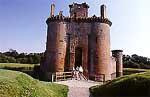
Caerlaverock (Lark's Nest), one of
Scotland's finest castles, is everyone's idea of a medieval fortress.
The scene of two famous sieges this moated castle has a children's
adventure park, model siege engine and nature trail in its grounds.
Caerlaverock
Castle is first mentioned in records in the 1220’s. This was not the
castle we see today but a wooden fortification some 200 meters to the
south. This was abandoned probably because of the unsuitability of the
ground and the new castle was built on its present site around 1270.
The Maxwell’s who built it were one of
the most important families in Scotland at this time. In 1296 Edward I
of England, ’Hammer of the Scots’ invaded Scotland and forced many
Scots to swear fealty to him in the Ragman Roll. Among these were
Herbert de Maxwell and his son John.
But the Scots soon began to rebel against
Edward. In 1300 he invaded Galloway, one of the centres of resistance,
and Caerlaverock was one of the prime targets for his wrath. The siege
of Caerlaverock is one of the most well known incidents of this time
because of a detailed written account by a member of the besieging army.
Edward of England came with 87 knights
and 3000 men. Siege engines were sent for from the castles of Lochmaben,
Carlisle, Roxburgh, Jedburgh and Skinburness. The siege didn’t last
long and Lord Maxwell’s garrison of 60 men soon surrendered. Some were
hanged form the castle walls and the rest were allowed to walk free. The
castle remained in English hands until 1312.
The keeper of the castle was none other
than Sir Eustace Maxwell, demonstrating the borderer's remarkable
ability to make the most from both sides. In 1312 he declared for Robert
Bruce, King of Scots. He was besieged in the castle but held out. Robert
I granted him a charter of annual rent for demolishing the castle in
line with Robert Bruces policy of destroying all stronghold that could
be used by an invading force.
The accession of David II to the Scottish
throne in 1329 and the re-opening of hostilities between Scotland and
England was a sign for Sir Eustace to change his allegiances once again.
The Maxwells were loyal to the Balliols and not to the Bruces and when
in 1332, Edward Balliol was crowned King of Scots at Scone Sir Eustace
repaired and garrisoned Caerlaverock and placed it at Balliols disposal.
The story is obscure until about 1356
when Roger Kirkpatrick is recorded as having returned the whole of
Nithsdale to the Scottish Crown. Much of the castle as it is today was
completed in the late fifteenth century by Herbert Maxwell,first Lord
Maxwell and his son Robert second Lord Maxwell. Caerlaverock Castle once
again figured in the conflicts between Scotland and England in the
sixteenth century.
In 1542 James V visited the castle before
the Battle of Solway Moss, which resulted not only in defeat for the
Scots, but also in the capture by the English of Robert, Fifth Lord
Maxwell. He was released shortly thereafter, Lord Maxwell was again
captured in May 1544 and his castle surrendered to the English.
In the following year it was retaken by
the Scots. In 1570 it was again besieged, this time it is said that the
Earl of Sussex threw down the castle although there is very little
evidence he did. In 1593, Robert, eight Lord Maxwell, was recorded as
making ‘great fortifications and has many men working at his house’.
Peace was brought to the borders for the first time in centuries when in
1603 James IV’s accession to the English throne as James I.
This tranquillity led to a new confidence
among the marcher lords. Robert Maxwell, created first Earl of Nithsdale,
set about building a new house within Caerlaverock's walls. The result
was an elegant modern mansion. Within six years his confidence was
betrayed.
The Earl of Nithsdale was one of Charles
I’s staunchest supporters, but the king told him to look to himself
when the truce with his Scottish subjects broke down in 1640. The Earl
carried on resistance against the Covenanting army led by Lieutenant
Colonel John Home, garrisoning his castle with 200 soldiers. They
gallantly held out for thirteen weeks in the summer of that year until,
seeing the hopelessness of their position, they surrendered with the
king’s permission. After the 1640 siege, the castle was partially
dismantled by the Covenanters and thereafter fell into decay.
See Burke's Peerage & Gentry for additional information |



