|
Kinloch Castle - a brief history
(Our thanks
to Andy Raw for sending this in)
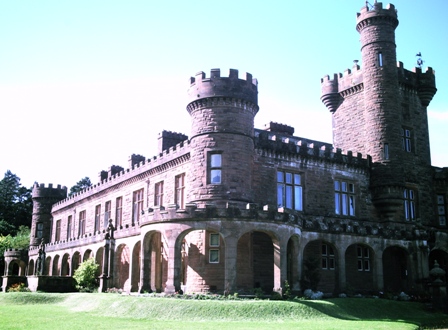
In 1891 at the tender age of twenty one George Bullough,
son John Bullough and grandson of James Bullough, inherited the Isle of
Rum, together with half of his father's company, the other half going to
George's half brother Ian Bullough. George was a 6' 8" Old Harrovian, who
had served as a Cavalry Officer and was a natural athlete. He was a man
who had all the world could offer.
His grandfather James Bullough had founded the
manufacturing company Howard & Bullough in 1856. This was the source of
the family’s extreme wealth. The company expanded under James Bullough's
son, John Bullough, and at it's peak the vast Globe Works in Accrington,
Lancashire, employed half of the town's population.
John Bullough began to surround himself with the
trappings of the new wealthy industrialist elite, and took the lease on
the Isle of Rum as a shooting estate in 1879 from his friend Lord
Salisbury. His wealth increased, and he eventually bought the freehold to
his own private shooting estate in 1888 for the sum of £35,000.
At this time, accommodation was in the traditionally
styled Kinloch House, sited under the present remains of the swimming
pool, close to the site of Kinloch Castle. This building was of a much
simpler and more modest design, built in the 1820's by Dr. Lachlan McLean
of Gallannach, the man responsible for the Clearance of the island between
1825 and 1826.
John Bullough enjoyed the lifestyle of the part-time
Highland Laird for a mere five years, both on Rum and his estate of
Meggernie, Glen Lyon, Perthshire, however the changes he brought about
last to this day. His program of planting, importation and breeding of
deer, and the construction of shooting lodges are still very evident on
the island. His love of the Highlands may also be seen in his remarriage
at the age of 55 to the 18 year old Alexandria (Alec) Marian MacKenzie of
Stornaway, the Isle of Lewis, in 1883. It is rumoured that George's
fondness for his stepmother had developed beyond the bounds John Bullough
viewed to be appropriate, at which point George was sent on an extensive
world tour!
On inheriting the island, George set about building an
impressive mausoleum for his father at Harris, on the South Western side
of the island. This naturally beautiful and dramatic site was turned into
a fitting memorial to an industrious and powerful man, and his son brought
craftsmen across from the mainland to construct the Roman-style mausoleum
built into the hillside overlooking the sea. The finest mosaic and
vitreous tiling was used to decorate a building Mithras herself would have
been impressed by. On completion, and with understandable pride, George
showed the building to guests. One made the rather unfortunate and unkind
comment that it resembled a public lavatory, causing George to order it's
immediate dynamiting (it is assumed after disinterring his father's
remains!) and the construction of a new Greek-style mausoleum nearby that
today houses the remains of John together with those of Sir George and his
wife Lady Monica.
At 21, George was a very rich man, with annual
dividends from his inherited shares amounting to £300,000, not to mention
many other assets. He wanted to live the same fantasy lifestyle his father
had begun to create for himself as a holidaying Laird, but was not content
with Dr. McLean's modest lodge, which was beginning to show its age. He
began to formulate plans for a Castle suitable for his self-perceived
standing. A site was sought initially at Harris nearby his father's
mausoleum, but as a pre-requisite for the site was safe mooring for his
221 foot yacht, The Rhouma, and the rocky and exposed Coastline at Harris
was known as Wreck Bay, it was clear that another site had to be found.
Kinloch, at the head of the natural harbour of Loch
Scresort, was decided upon, and work began clearing Dr. McLean's Kinloch
House. The foundation stone for his dream retreat Highland shooting lodge,
Kinloch Castle, was laid in 1897. Work continued for the next 3 years,
with 300 men employed in the construction of the Castle from Annan
sandstone shipped from Dumfries-shire, and the landscaping of extensive
pleasure gardens formed from 250,000 tonnes of the finest quality imported
Ayrshire soil for his exotic gardens. The industry between the mainland
and Kinloch over those three years is a picture that the mind struggles to
envisage when looking at the calm tranquillity of Loch Scresort today.
The building was designed to accommodate his
eccentricities, and is adorned with furnishings from all over the world,
collected on his world tour, whilst exploring aboard the Rhouma, or gifted
by Emperors. His menagerie included heated pools housing pet alligators &
giant turtles which he kept to amuse and titillate his many guests. A
conservatory (now gone) was filled with hummingbirds which flew into the
building through the open French doors.
George Bullough like most young men today enjoyed all
the latest gadgets. He had the foresight to install cutting-edge
technology and the most modern conveniences of the era, including his own
hydroelectric power station for his electric lighting (which it was
boasted could light Glasgow, the only other populated area in Scotland
with electric light at that time), marble topped radiators offering
central heating, air conditioning, double glazing, elaborate power showers
that today's finest spas could only hope to emulate, and an Orchestrion -
the ultimate music centre of its time. It was also the first house of its
kind with a telephone system. This must have been an amazing feat,
combining organisation, creative ingenuity and unimaginable amounts of
money.
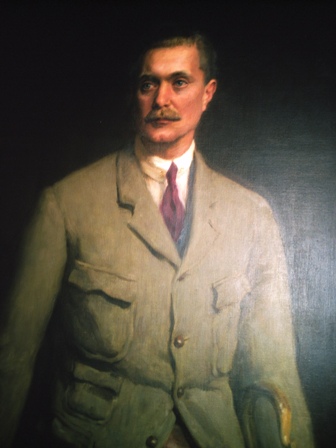
Sir George
Most of these items are still in full working order and
still flabbergast visitors more than a century later. Sir George, elevated
to the Baronetcy in 1916 following a £50,000 interest free loan to the
Government, and latterly accompanied with his wife Lady Bullough, held
many lavish soirees at Kinloch Castle on their own closed Isle of Rum,
inviting guests from far a field to dance in his ballroom and to shoot
deer and game on his estate. Today only the names in the Game Books can
hint at who was invited, and what took place at these parties. There are
many rumours of just how outlandish these get-togethers were and gossip
has it that many celebrities of the era visited (Sir George's half
brother, Ian Bullough, was married to
Lily Elsie, the Sienna Miller of her time!)
Sadly time has taken its toll on Kinloch Castle and the
very fabric of this magical listed building is at risk of crumbling to the
ground. The present owners, Scottish Natural Heritage, are not in a
financial position to take on the major repairs desperately needing to be
done to save this snapshot of a decadent lifestyle at its zenith.
The Kinloch Castle Friends Association was formed in July 1996 and is
a Registered Scottish Charity. The purpose of the Association is "for the
benefit of the public, to advance education, and restore, preserve and
improve Kinloch Castle including its furnishings and fitments".
In 2003 the building was runner-up on the
BBC “Restoration” TV series. The programme asked viewers to vote for a
building that they felt deserved lottery funding to restore it. The Castle
polled 143,000 votes. This was an astounding number of votes when you
consider the population of the Isle of Rum is approximately 25. Kinloch
Castle narrowly missed out on the prize money of more than £3 million, but
narrowly unfortunately also means no money! However it did attract the
attention of
Prince Charles. This has led to the involvement of
the Phoenix Trust. They are presently creating
proposals for SNH regarding the future of the castle. |



