 In
Linlithgow
off the M9. 01506 842896 In
Linlithgow
off the M9. 01506 842896
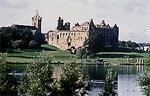
Birthplace of Mary Queen of Scots. All
the Stewart kings lived here and later it housed Cromwell, Bonnie Prince
Charlie and, after Culloden, the Duke of Cumberland. Mary of Guise
declared of Linlithgow she had "never seen such a princely
palace".
Linlithgow Palace first appears in
records in November 1301 when the Kings Bedchamber was prepared for
Edward I of England, who had invaded Scotland in support of John
Balliol’s claim to the throne. In 1302, because of its ideal siting as
a military base, the English King set about transforming it into a
secure stronghold.
This castle was built mainly from wood
and earth. During the siege of Stirling Castle in 1304 the English used
Linlithgow as their main supply base. After the Battle of Bannockburn,
in 1314, Linlithgow returned to Scottish hands.
In 1337 the ‘peill’ was granted to
John Cairns by king David II with orders to build it up for the Kings
coming. This he did and King David held court their in 1343 and in later
years. Repairs to the kings manor are also recorded during the reign of
Davids successor, Robert III (1390-1406).
Nothing remains of the early manor house
except the name peel’. In 1424 a disastrous fire destroyed most of the
town of Linlithgow as well as the parish church and the manor house.
King James I set about a programme of building which resulted in the
royal palace much as it is today.
By 1430 £2440 Scots are recorded as
being spent by John de Waltoun, the Master of Works, and, by June 1428
the place was habitable enough for the king to spend some days there. A
high rate of expenditure was maintained until the kings assassination in
1437.
James II made little use of his fathers
palace before his death at Roxburgh in 1460.
His son, James III(1460-88) made some
necessary repairs before the reception for the fugitive King Henry VI of
England. In 1469, James III married Margaret, the daughter of Christian
I of Denmark, and both Linlithgow Palace and Doune Castle were included
in her marriage portion.
Queen Margaret died in 1486, and her
husband , James III, was killed fleeing the battlefield at Sauchieburn.
Their son, James IV, came to the throne at age 15, and almost at once
took the reigns of government.
By the time of his death in 1513 the
transformation of Linlithgow into a modern royal residence was virtually
complete. The most significant of the new works was the completion of
the west range, closing of what had formerly been the open side of James
I’s palace.
In 1503 King James IV married Margaret
Tudor, the daughter of King Henry VII of England. At that time
Linlithgow Palace was settled on the queen as a dower house. On 9
September 1513, the peace with England having foundered, James IV faced
the earl of Surrey’s army on Flodden Field, where he fell along with
many of the Scottish nobility.
It is said that Queen Margaret waited for
his return in the look out post above the north-west turnpike stair,
known today as Queen Margaret's bower.
In 1534 the mason Thomas French was
instructed by James V to complete the palace and it is around this time
that the new entrance in the south wall was built.
In 1537, James V married Mary of Guise -
Lorraine and she is reported as comparing Linlithgow to the noblest
chateaux in France.
In august 1540 the keeper of Linlithgow
was executed on a trumped up charge, it is said, so that the king could
acquire his large personal fortune.
Finally after the disaffection of many of
the Scottish nobility and the routing of his army by the English at the
Battle of Solway Moss in 1542, James withdrew, a broken man, to
Falkland, where he died on 14 december, only six days after the birth of
a daughter, Mary, to the queen at linlithgow.
Linlithgow palace is perhaps best known
as the birthplace of Mary, Queen of Scots, but she only occasionally
resided there.
In 1607, during the reign of James VI, it
was reported that the North range of the palace was falling down. This
was not rebuilt until 1618 when work began on one of the finest
Renaissance facades in Scotland which was completed in 1624.
Charles I(1625-49) stayed here in 1633.
After his execution the Scots proclaimed for Charles II, and Oliver
Cromwell spent the winter of 1650 here.
After the restoration of Charles
II(1660-85) a warrant was issued in 1663 to have the English defences
levelled. In 1745 Prince Charles Edward Stuart was the last royal to
stay here soon after, January 1746, troops of the Duke of Cumberlands
army were billeted in the palace and marched out in february 1746 and
left it burning.
It has remained roofless and uninhabited
since.
See Burke's Peerage & Gentry for more information |



