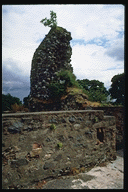
 Lochwood
Tower (or Lochwood Castle), the seat of the Johnstone Clan, lies a few
miles southwest of Moffat in Dumfriesshire, Scotland. It is located in
upper Annandale.
Lochwood is situated in the Parish of Johnstone, which takes its name
from (or gave its name to) Lochwood's owners. The name Lochwood is
derived from a forest (wood) near an ancient lake (loch), which later
became a bog known as Lochwood Moss. Parts of the forest still exist in
the form of thousand-year-old oak trees (the "Royal Oaks")
which grow adjacent to the Lochwood Tower site. Lochwood
Tower (or Lochwood Castle), the seat of the Johnstone Clan, lies a few
miles southwest of Moffat in Dumfriesshire, Scotland. It is located in
upper Annandale.
Lochwood is situated in the Parish of Johnstone, which takes its name
from (or gave its name to) Lochwood's owners. The name Lochwood is
derived from a forest (wood) near an ancient lake (loch), which later
became a bog known as Lochwood Moss. Parts of the forest still exist in
the form of thousand-year-old oak trees (the "Royal Oaks")
which grow adjacent to the Lochwood Tower site.
Today Lochwood is in an advanced state of
ruin. During the 1960s, Alastair M.T. Maxwell-Irving, FSA Scot. cleared
away much of the vegetation growing on the ruin and conducted an
archeological survey.
During the 1980s, the present Chief of
the Johnstones, the Earl of Annandale and Hartfell, cleared away the
rubble caused by the collapsing tower, restored the two-chambered
vaulted basement (one of which chambers was the dungeon), and cemented
the remaining walls firmly in place. At this time he found various
artefacts, including the original iron yett (gate) to Lochwood. In 1547
the English soldier Sir Thomas Carleton described Lochwood as a fair
large tower with a barnekin (surrounding stone wall), hall, kitchen and
stables all within the barnekin. On the outside, the tower measures 43
feet 4 inches from east to west, and 34 feet from north to sourth.
The floor plan of the tower was slighly
L-shaped, with a spiral staircase in a wing in the northeast corner. The
remains of the courtyard, surrounded by the barnekin, averages
approximately 150 feet from north to south, and 95 feet from east to
west.
It appears that the first Johnstone land
holding in Scotland may have been further south, as the first such known
land was at the southern end of Annandale. Gilbert, son of John (Gilleberto
filio Johannis), later known as Sir Gilbert de Jonestone, received from
William Bruce, Lord of Annandale, the use of a parcel of land with a
building between the years 1194 and 1214. It is possible that the land
in Annan was not the first or only parcel held by the Johnstones.
In any event, it is not known when the
first Johnstone occupied Lochwood. On the Lochwood site are the remains
of a Norman-style motte and bailey castle the type of wooden
fortification on a hill which was common before the days of stone
castles. It is generally believed that the existing three-tiered motte
was built by Sir Gilbert de Jonestone or his father John, although this
cannot now be established conclusively. In fact, it is possible the the
Johnstones did not occupy the Lochwood site until after the Black
Douglas Rebellion of 1455, in which the Johnstones assisted the King in
putting down the most powerful family in Scotland. This would not be
surprising, as during most of the fourteenth century Annandale was
either a war zone or under actual English military occupation. Also, for
long periods of time, Annandale was under the dominion of the Black
Douglases.
The Exchequer Rolls of the mid 1450s
contain an entry for the landholdings of the estate of Adam Johnstone of
Johnstone (d. 1454) which list Johnstone-tenement, Bel-tenement, and
Kirkpatick. Lochwood is not mentioned by name, and it is possible that
the Johnstones were not in possession of Lochwood at this time.
The stone castle of Lochwood was probably
constructed during the lifetime of John Johnstone of Johnstone, who was
Chief from 1454 through 1493, although this is not certain. The first
known reference to the stone tower of Lochwood, by name, was in November
1476, in a Latin document in which John Johnstone of that Ilk (Johannes
Johnnestoune de eodem) conveyed the five-merk lands of Wamphray to his
son John. (W. Fraser) The document was written and signed at Lochwod.
From then on, Lochwood is frequently
mentioned in connection with the Anglo-Scottish frontier. The English
captured Lochwood by stealth in 1547, when a woman inside opened the
gate at dawn. They found the castle very well provisioned and held
Lochwood until 1550, burning it as they left. In 1585 Lochwood was
burned again, this time by the rival Maxwell family, destroying the
Johnstone charter chest and jewels. In his gallows humor, Robert Maxwell
stated that he burned Lochwood so that Lady Johnstone might have light
to put on her hood!
By the late 1600s, Lochwood was outmoded
as a residence and its owner, the Earl of Annandale, spent most of his
time in Edinburgh on government business. The Marchioness of Annandale
was at Lochwood as late as June 1706, and she wrote a letter from there
to the Earl of Marchmont. However, by this time Lochwood's days as the
chief home of the Johnstones were over. It was probably abandoned soon
afterward, and is said to have burned a few years later.
Impressions would like to thank Jeffrey
M. Johnstone for his help in compiling this brief history. Check out the
Clan Johnstone page for
further information. |



