View our terms and conditions for use of our web site and our privacy policy. Visit Electric Scotland's Aois Community, our social networking site. Find our contact information and learn more about us. The Home Page of Electric Scotland ES Common Header Bar
This is where you'll find a comprehensive resource on Scottish accommodations. Electric Scotland's Article Service where you can both read articles and post your own. Beth's Newfangled Family Tree is a monthly publication giving genealogy advice as well as what's hapening on the Scottish Scene around the world. This is where you'll find around 300 books on Scottish history that we've published on the site. Our pages where you'll find books and articles about Robert Burns and his work. Gives you some information on the business scene in Scotland. This is where you can view Scottish events around the world and add your own. Learn about the history of Clans and Families of Scotland and the Scots-Irish. The personal site of Alastair McIntyre where he's posted his own mini biography as well as his travel journals. 5 volumes worth of biographies relating to Significant Scots. A weekly newsletter about the political scene in Scotland from the Scots Independent Newspaper. Lots of Scottish recipes along with contributions from our visitors. Play our collection of online games. 6 volume Gazetter on the place names of Scotland. This is our page for trying to give you advice on Genealogy. A FAQ where you go to get answers to frequently asked questions. Information and pictures about Historic places in Scotland such as castles and other properties. Main index page for our very large history section. Children resources including over 800 children's stories and lots of online and offline games. A bit of a catch-all page where you find loads of pages about music, haggis, scots language, culture, religion, humor and lots more. Our nature page where you can explore information on Scottish Wildlife, Plants, Flowers and lots more. Our weekly newsletters archive. Thousands of pictures of Scotland for you to enjoy. Loads of poetry and stories for you to enjoy with many contributions from visitors to our site. Our very own Webcard program which you can use to send online postcard to friends and relatives. Huge resources about the Scots Diaspora around the world and here is where you can find this information. A continually building information resource on the Scots-Irish who emigrated to Ulster and then onto many parts of the world, especially the USA. Create your own family tree with our special software. You can also import and export gedcom files. Our web-based scottish search engine which is a free resource for Scottish companies as well as Scottish organisations around the world. Current Scottish News headlines and links to Scottish news resources. A range of services, both big and small, that we currently offer. Our Tartan pages, giving you access to information on Tartans as well as tartan search engines. Sponsored by House of Tartan. Our travel section where we have loads of suggested tours of Scotland as well as old historic travel books. A wee collection of videos some of which we've produced ourselves. Learn about the last 100 pages we've added to our site which is updated daily.


Click here to get a Printer Friendly Page
 

Send Flowers

Castles of Scotland
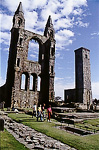
St Andrews Cathedral


St Andrews CathedralIn St Andrews on the A91. Tel: 01334 472563

The remains still give a vivid impression of the scale of what was once the largest cathedral in Scotland. Climb St Rule's Tower for a magnificent view of the town and visit the Cathedral's collection of Celtic and medieval carved stones.

Legend says that Saint Rule (or Regulus) was the guardian of the relics of St Andrew at Patras in Greece in the Fourth century.

After being warned by an angel that Constantinople was going to remove them, Regulas resolved to take them elsewhere. His boat was wrecked off the Fife coast and the bones of Saint Andrew were brought to Kilrimont and interred in a shrine.

The early history of St Andrews is uncertain but there was a monastic community their during the reign of Oengus, King of Picts, who ruled between 729 and 761. In 943 King Constantine II abdicated the throne to become leader of the monastic community.

Shortly before this time Kilrimont became the headquarters of the Scottish Church because Ionas leadership had become impracticable because of Norse raids along the west coast in 849.

In about 1070 Malcolm III married the Saxon Princess Margaret. She was deeply religious and founded a Benedictine priory at Dunfermline and her devotion to St Andrew was shown when she provided the Queens ferry over the Forth for pilgrims to the shrine. She was later canonised as a Saint.

Margaret’s son Alexander I made three attempts to appoint bishops to Kilrimont to help reform the church. The third attempt proved successful when Robert became bishop in 1123 and introduced a community of Augustinian canons in 1144.

At this time the name Celtic place name Kilrimont was changed to St Andrews and applied to Bishop Roberts new cathedral priory and the new burgh which he established in its shadow.

In 1160 Bishop Arnold started building the cathedral concentrating on the Eastern end which contained the most important parts. The work took many years. By the 1270’s most of the nave to the west was completed when a great gale blew down the west front.

The outbreak of the Wars of Independence with England in 1296 prevented consecration of the completed building until 5 July 1318, four years after Robert the Bruces victory at the Battle of Bannockburn. It was then carried out with great ceremony in the presence of the King.

In 1378 again disaster struck when the upper part of the west front was destroyed by a great fire.

The reformation of the Scottish Church in 1560 had a devastating effect on the cathedral priory and other churches in the town. By then much of the damage had been done when John Knox preached in the parish church the congregation were moved to tear down the rich medieval furnishings of the cathedral.

The church seems to have been abandoned almost immediately and was soon to be used as the local quarry.


Return to Castles of Scotland

