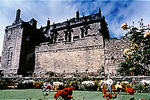
 At
the head of Stirling's
historic old town off the M9. Tel: 01786 450000 At
the head of Stirling's
historic old town off the M9. Tel: 01786 450000
Considered by many to be the grandest of
all Scotland's castles. The castle architecture is outstanding - the
Great Hall and gatehouse of James IV, the marvellous Renaissance Palace
of James V and the Chapel Royal of James VI. The Castle has strong links
with Mary Queen of Scots. She was crowned in the Chapel in 1543 and
narrowly escaped death by fire in 1561. Her son, the future James VI,
was baptised here in 1566. Medieval kitchens display.
Open all year seven days a week,
April to September 9.30am to 6.00pm. October to March 9.30 am to 5.00
pm. Last ticket sold 45 minutes before closing.
Probably the most strategically important
medieval castle in Scotland, Stirling changed hands more often than any
other Scottish Castle.
The castle first comes to prominence
during the reign of Alexander I (1107-24) when he dedicated a chapel
there, he died at the castle in 1124 and was succeeded by his brother
David.
When William the Lion was captured by the
English at Alnwick, he was compelled by Henry II to sign the Treaty of
Falaise in 1174, which stated that the six most important castles in
Scotland should be garrisoned by English soldiers.
In 1189 the castle was returned to
Scottish hands. Forty years after the Treaty was signed King William
returned to Stirling where he died in December, 1214.
It was during the Wars of Independence
that Stirling really came to prominence. After his triumphal capture of
Berwick in 1296, Edward I of England took Stirling with ease.
In the following year the forces of
William Wallace gathered at Stirling bridge and overthrew the English in
the famous victory.
However, the castle was once again in
English hands a year later. When the Scots again laid siege the
Governor, John Simpson, appealed for support from Edward this was
refused and on surrender of the castle Sir William Oliphant was
entrusted with custody.
In 1304 the castle was the last
stronghold in the patriots hands and in April of that year Edward began
his great siege. For three months the defenders held out until their
imminent starvation, rather than the success of Edwards tactics, forced
them to surrender.
For ten years the castle was held by
Edwards forces until in 1313 Edward Bruce blockaded the fortress and
forced Edward II to meet King Robert the Bruce’s forces at Bannockburn.
Once again the Scottish forces inflicted
a heavy defeat upon the English and the castle was surrendered to King
Robert.
King Robert then set about destroying the
fortifications of Stirling to prevent it being used as a English
garrison. But after the defeat at Halidon Hill Stirling was once again
under English control.
In 1337 the strengthened castle was
besieged by Sir Andrew Moray, but was relieved by Edward III. Recapture
by the Scots was not long delayed for in 1342 the garrison was forced to
yield. With the accession of the Stewart's Stirling once more became a
Royal abode.
In 1452 James II murdered William 8th
Earl of Douglas at Stirling and threw his mutilated corpse out of a
window.
On the 9th of September 1543 the young
Queen Mary was crowned in the chapel royal at Stirling. On her return to
Scotland from France in 1561 Queen Mary asleep in her bed at Stirling
was almost overcome by smoke when a candle set fire to the curtains in
her room.
In 1566 Stirling was once again chosen as
the refuge of a royal infant when the two month old Prince James(later
James VI) was transported there.
In 1651 General Monk who was in charge of
Cromwell's forces, sieged Stirling and the Governor was forced to yield
after a mutiny by his garrison. After the restoration the castle
reverted to the Earl of Mar and his heirs, but the privilege was
withdrawn after George I suspected them of having Jacobite sympathies.
Subsequent keepership was held by the
Crown until in 1923 King George V restored it in favour of the Earl of
Mar and Kellie. |



