View our terms and conditions for use of our web site and our privacy policy. Visit Electric Scotland's Aois Community, our social networking site. Find our contact information and learn more about us. The Home Page of Electric Scotland ES Common Header Bar
This is where you'll find a comprehensive resource on Scottish accommodations. Electric Scotland's Article Service where you can both read articles and post your own. Beth's Newfangled Family Tree is a monthly publication giving genealogy advice as well as what's hapening on the Scottish Scene around the world. This is where you'll find around 300 books on Scottish history that we've published on the site. Our pages where you'll find books and articles about Robert Burns and his work. Gives you some information on the business scene in Scotland. This is where you can view Scottish events around the world and add your own. Learn about the history of Clans and Families of Scotland and the Scots-Irish. The personal site of Alastair McIntyre where he's posted his own mini biography as well as his travel journals. 5 volumes worth of biographies relating to Significant Scots. A weekly newsletter about the political scene in Scotland from the Scots Independent Newspaper. Lots of Scottish recipes along with contributions from our visitors. Play our collection of online games. 6 volume Gazetter on the place names of Scotland. This is our page for trying to give you advice on Genealogy. A FAQ where you go to get answers to frequently asked questions. Information and pictures about Historic places in Scotland such as castles and other properties. Main index page for our very large history section. Children resources including over 800 children's stories and lots of online and offline games. A bit of a catch-all page where you find loads of pages about music, haggis, scots language, culture, religion, humor and lots more. Our nature page where you can explore information on Scottish Wildlife, Plants, Flowers and lots more. Our weekly newsletters archive. Thousands of pictures of Scotland for you to enjoy. Loads of poetry and stories for you to enjoy with many contributions from visitors to our site. Our very own Webcard program which you can use to send online postcard to friends and relatives. Huge resources about the Scots Diaspora around the world and here is where you can find this information. A continually building information resource on the Scots-Irish who emigrated to Ulster and then onto many parts of the world, especially the USA. Create your own family tree with our special software. You can also import and export gedcom files. Our web-based scottish search engine which is a free resource for Scottish companies as well as Scottish organisations around the world. Current Scottish News headlines and links to Scottish news resources. A range of services, both big and small, that we currently offer. Our Tartan pages, giving you access to information on Tartans as well as tartan search engines. Sponsored by House of Tartan. Our travel section where we have loads of suggested tours of Scotland as well as old historic travel books. A wee collection of videos some of which we've produced ourselves. Learn about the last 100 pages we've added to our site which is updated daily.

Click here to get a Printer Friendly Page
 

Send Flowers

Castles of Scotland
Tantallon Castle


Tantallon Castle3m E of North Berwick off the A198. Tel: 01620 892727

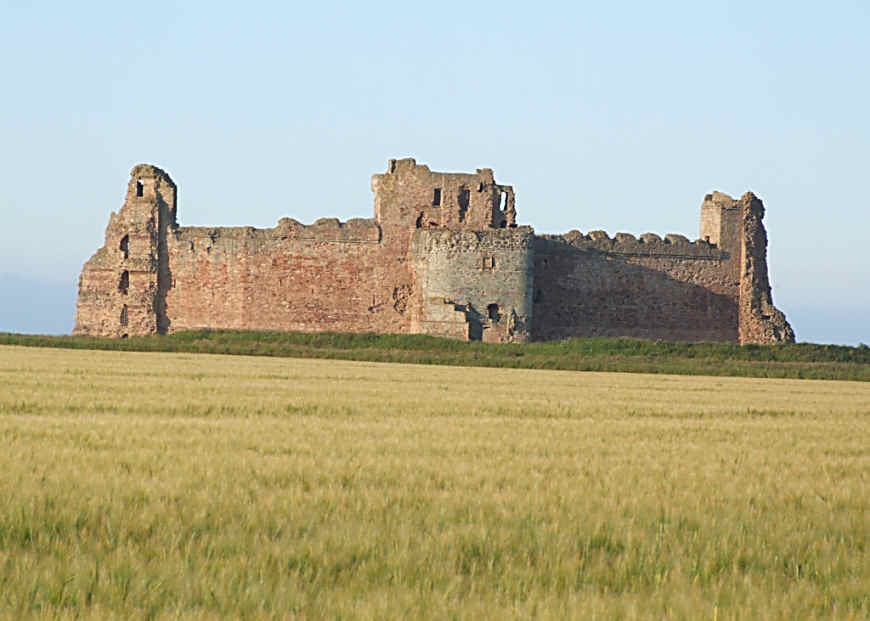
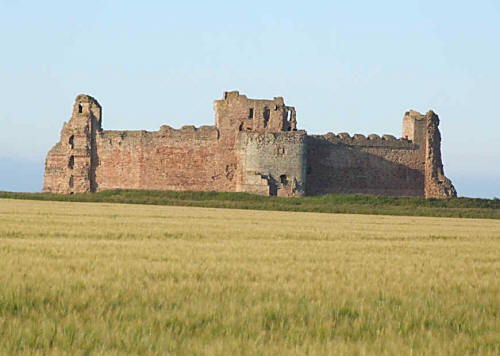
Set on the edge of the cliffs, looking out to the Bass Rock, this formidable castle was a stronghold of the Douglas family. It features earthwork defences and a massive 50ft-high 14th-century curtain wall with towers. Display includes replica gun.

The coastal fortress of Tantallon Castle was built around 1350 by William 1st Earl of Douglas, nephew of Good Sir James’, and originally based on a French Chateaux.
Before 1357 William had married Margaret, sister of Thomas, Earl of Mar, and they had a son, James. Later, William took as his mistress his brother-in-laws widow, also Margaret, who had assumed the title of Countess of Angus and Mar. she too bore him a son, George.

William died in 1384 and his heir, James, the second Earl, was killed four years later at the Battle of Otterburn. This unhappy turn of events prompted the countess of angus to promote the claim of her son, George, to her share of the douglas inheritance.

In 1389 she resigned her Earldom of Angus in favour of George, who became the first Douglas Earl of Angus and lord of Tantallon Castle. Thus the Battle of Otterburn resulted in the division into two of the mighty House of Douglas.

The head of the main line now was Archibald, illegitimate son of the Good Sir James’, Known to the English as the Black Douglas’ because of his grim countenance in warfare. His descendants became the Black’ Douglases, while the Douglases of Angus became known as the Red’ Douglases.

In 1491, Archibald, the 5th Earl, entered into a treasonable act with Henry VII of England to deliver James IV into English hands. When this became known, Archibald was ordered to confine himself to his castle at Tantallon, here he prepared for a lengthy siege.

By October James IV was at Tantallon. An artillery train was brought from Edinburgh Castle, other military equipment from Leith, and seamen were dispatched from Largo, on the Fife coast, to bring the Kings Ship, The Flower, to blockade the castle from the sea.

The records do not show the outcome of the siege, however, Archibald was once more in favour with the king when he received a present from the king of a black velvet gown for christmas.

In 1528 King James V besieged Tantallon for 20 days but failed to take it by force but in 1529, while Archibald the 6th Earl was in England, King James V bribed the garrison into surrender and Tantallon was delivered to the king. He immediately set about rebuilding Tantallons defences, which were not completed until 1543.

This can be seen because of the green hued stone that was used in the rebuilding works.

In 1651 Cromwell ordered General Monk to take Tantallon Castle and stop a force of 30 moss-troopers who it is said had caused more damage to Cromwell's troops than the whole of the Scots army.

So with a force numbering between 2,000 and 3,000 men he besieged Tantallon for 12 days. Finally with the castle almost in ruin it was taken.

The ruination caused by this bombardment can still be seen today. In 1669 the barony was sold to Sir Hew Dalrymple but he made no effort to make the castle inhabitable.

At the end of the 19th century Sir Walter Hamilton Dalrymple began to arrest the decay and did much to safeguard the fabric of the castle until it came into state care in 1924.


Return to Castles of Scotland