On
Loch Ness nr Drumnadrochit
on the A82. Tel: 01456 450551
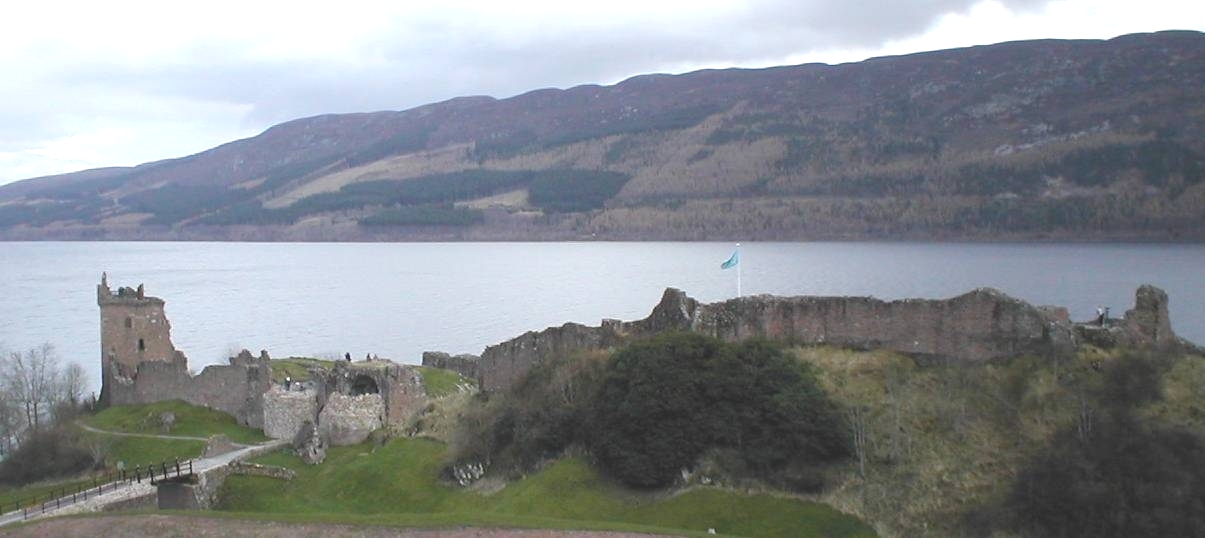
The impressive ruin of Urquhart Castle
sits on a rocky promontory with commanding views along Loch Ness. One of
the largest of all Scottish castles, Urquhart has seen many battles and
sieges throughout its 500-year history as a medieval fortress. Evidence
of the siting of some kind of fortified residence on the promontory goes
back to Pictish times during a missionary visit by St Columba about AD
580. The holy man called at the home in Glen Urquhart of an elderly
noble Pict named Emchath and converted him and his household to
Christianity.
The first record of a castle at Urquhart
comes more than 600 years after Columba’s visit. By the year 1250 Alan
Durward was lord of Urquhart. As brother-in-law of King Alexander III,
Alan was one of the most influential men in Scotland, widely recognised
as the power behind the throne. The stronghold that Alan established at
Urquhart continued to be of strategic importance throughout the Wars of
Independence with England sparked by the untimely death of Alexander
III.
Soon after the Wars began in 1296, the
English Army captured Urquhart. Within two years, the castle was back in
Scottish hands during the resistance, led by William Wallace. Over the
next half century it changed hands many times.
Urquhart’s stirring history continued
with frequent raids by the Macdonald Lords of Isles in the 15th and 16th
centuries. In 1509, the Chief of Clan Grant was granted the castle. It
was last inhabited by Government troops following the Jacobite Rising of
1689.
The Urquhart Castle Project, a £4
million scheme to improve visitor facilities, car parking and access to
the castle, is currently being carried out by Historic Scotland. The new
visitor centre will allow us to tell the story of Urquhart Castle to
over 250,000 visitors each year.
Open all year. Sun. morning open
9.30am. Last ticket sold 45 minutes before closing.
The Royal Castle of Urquhart existed
during the reign of William the Lion (1165-1214), though at that time it
may well have been a wooden fortification. The Anglo-Norman, Alan
Durward was the first recorded Lord of Urquhart, and he refashioned the
castle during the reign of Alexander II (1214-1249). On Durward's death
in 1268, the castle and lands passed to the Comyn's, Lords of Badenoch.
In 1296, during the Wars of Independence,
the castle was held by the English, but it fell into Scots hands. By
1303, however, it had been retaken by Edward I of England. The year 1308
saw the forces of Robert the Bruce bring Urquhart back into the control
of the Scots.
King Robert then passed the castle on to
Sir Thomas Randolph, later to become the Earl of Moray. In 1333 Urquhart
successfully resisted the English Invasion after the defeat of the Scots
at the Battle of Halidon Hill.
The castles keeper at that time was Sir
Robert Lauder, who held the castle until it was handed back to the
Scottish Crown in 1346.
In 1395, MacLean of Lochbay was keeper of
the castle. After the death of James I in 1437, the MacDonald's tried,
unsuccessfully, to take Urquhart.
They returned in 1452, in support of the
Black Douglas’ rebellion, and seized the castle, forcing the Crown to
recognise them as castle keepers.
The defeat of the Black Douglas’ rebels
in 1458 led to the MacDonald's entering into the Treaty of Ardtornish-Westminster
in 1461.
Their intent was to divide the Scots
Kingdom with Edward IV and the Black Douglas’.
Urquhart consequently passed into Crown
hands, and in 1476 was held by the Earl of Huntly.Keepership was passed
to John Grant by James IV in 1509. After the death of James IV in 1513,
at Flodden, the castle was taken by the MacDonald's of Lochalsh, but
returned to the Crown in 1516.
In 1545 the MacDonald's and their allies
the Cameron's of Lochiel, took the castle, and burned Glen Urquhart's
homesteads to the ground. The castle was plundered and badly damaged by
the Covenanter's in 1644, but underwent repairs to the cost of 200 merks
in 1676.
In 1689, a whig garrison held out for 2
years against the Jacobites.
To prevent it being used as a Jacobite
base, Urquhart was blown up in 1691.
This comment system
requires you to be logged in through either a Disqus account
or an account you already have with Google, X, Facebook or
Yahoo. In the event you don't have an account with any of
these companies then you can create an account with Disqus.
All comments are moderated so they won't display until the
moderator has approved your comment.



 On
Loch Ness nr
On
Loch Ness nr