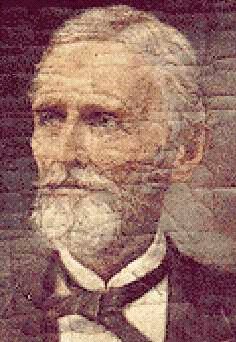
| Jefferson Davis was born in Todd County, Kentucky on June 3.
It is unclear whether the year was 1807 or 1808. He wrote an acquaintance in 1858 that
"there has been some controversy about the year of my birth among the older members
of my family, and I am not a competent witness in the case, having once supposed the year
to have been 1807, I was subsequently corrected by being informed it was 1808, and having
rested upon that point because it was just as good, and no better than another."
Jefferson was the tenth child of Samuel Davis. Samuel was not wealthy but his oldest son
became well-to-do and helped young Jefferson to attend academies in Kentucky and
Mississippi. Jefferson served in the military
at a frontier post in Illinois and in Wisconsin. He became a war hero after the Black Hawk
War in 1832. He married Sarah Taylor, but within three months the couple both fell ill
with malaria and Sarah died. In 1845, after becoming a successful planter, he married Varina Howell. Also in
1845 Jefferson was elected by the people of Mississippi to the House of Representatives.
In 1853, Jefferson served President Franklin Pierce as his Secretary of War. Following
Pierce’s presidency, Jefferson was elected by Mississippi to the Senate. It was while
Davis was serving as a Senator that the state of Mississippi resolved to secede.
In January, 1861, Davis delivered his Speech
Before the Senate On Withdrawal From the Union. He made rebuttal to those that cited
the Declaration
of Independence in declaring that all men are created free and equal. He noted that
one of the charges against King George III of England made in the Declaration of
Independence was that the King’s army was stirring up insurrection among the
colonists’ slaves. He also reminded the Senate in his address before them that the Constitution
itself discriminated against "persons as property" by designating them with that
title and by allowing their representation "as a lower caste" only in the
numerical proportions of three-fifths. These facts made those documents inadequate to
address the slavery issue. The issue for Davis was state’s rights. On
February 18, 1861, Jefferson Davis was named president of the confederacy. Davis assumed
his duty and on April 12, 1861 shots were fired at Fort Sumpter, South Carolina beginning
the Civil War.
The Civil War was the result of the state’s
determination to secede
and the federal government’s refusal to allow them to leave. Jefferson Davis had
always taken a strong position on the sovereign rights of states, and of the full right of
states in the union to secede. In fact, he had spoken out in support of Massachusetts’
right to secede when that state had considered the option in a dispute some period prior
to the division between the northern and southern states. Jefferson Davis adamantly
believed in the inalienable right of the people of the states in the Union to determine to
withdraw their joining and secede. Even today in our government, representatives of each
states have in their purpose not only to guide issues concerning national policy, but
their primary responsibility is to serve in the interests of the people of the individual
states from which they are elected.
This war was horrible in many ways. The period of the Civil
War is one of the most tragic and profound times in our country’s history. In a civil
war, unlike a war between nations, a country is divided against itself. Davis believed
that war should consist solely of combat between organized armies. He was against the
killing of civilians and the destruction of private property during hostilities. Davis
proudly proclaimed after the war, "I am happy to remember that when our army invaded
the enemy’s country, their property was safe. Although many of his counselors favored
more aggressive invasion into enemy territory, Davis resisted. There were actually many
fantastic new ideas for weaponry such as Gabriel J. Rain’s
torpedo introduced to Davis, most were not pursued due to Davis’s reluctance to
bring unnecessary harm to innocent civilians.
Davis received abundant abuse. During and after the war, the
New York Times depicted him as a murderer, a cruel slaveowner whose servants ran away, a
liar, a boaster, a fanatic, a confessed failure, a hater, a political adventurer, a
supporter of outcasts and outlaws, a drunkard, an atrocious misrepresenter, an assassin,
an incendiary, a criminal who was gratified by the assassination of Lincoln, a henpecked
husband, a man so shameless that he would try to escape capture by disguising himself as a
woman, a supporter of murder plots, an insubordinate soldier, an unwholesome sleeper, and
a mean-spirited malingerer.
Immediately after the war, authorities put Davis in jail at
Fortress Monroe, where he was held for two years without a trial. He was released on a
bond of $100,000 secured by a northerner named Horace Greeley when the military handed him
over to a criminal court. Although attempts were made to implicate him in the
assassination of Lincoln and charges of abuse to prisoners were investigated, he was never
brought to trial or convicted of any crime. Davis’ attorneys had successfully argued
that the 14th Amendment exempted him from prosecution. After his release, he
traveled to Canada and Europe in an attempt to regain his health, then returned to
Mississippi. After the war he became a symbol for the lost cause. He withstood much
criticism and denigration, but he never apologized for his belief in state’s rights.
He asked for no pardon and refused to denounce his people or their cause.
He retired to Beauvoir
(French for "beautiful view"), his newly purchased home on the Gulf of Mexico in
Biloxi, at the age of 70. He spent the rest of his life writing his memoirs, which he
titled, "The Rise and Fall of the Confederate Government." He died while in New
Orleans on December 6, 1889.
His wife Varina sold the central portion of the estate at
Beauvoir to the state of Mississippi for use as both a memorial to Davis and for a
Confederate Veteran’s home. The Veteran’s Home operated from 1903 until 1957,
caring for a total of 2,000 soldiers and widows. Beauvoir now operates as a museum and is
soon to open the Jefferson Davis Presidential Library.
Jefferson Davis never wavered in his faith in state’s
rights and his theory that the founding fathers of our country required that the federal
government’s right to govern fully rested upon the consent and will of the people
being governed.
 |



