| The Battle of Gettysburg: Day 2 The Union lines were positioned on high ground in the form of a fishhook,
allowing quick repositioning of troops from one place to another. The Confederate forces
were posted along Seminary Ridge, in Gettysburg, and north of Culp’s Hill, forming a
large semicircle.
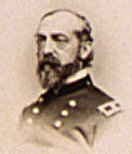
| At Union headquarters, General Meade was planning for an
attack from Culp’s Hill, but the plan was abandoned when Slocum reported the hill was
excellent for defense but not for offense. So Meade concentrated on figuring out Lee’s
next move. Along Cemetery Ridge, Sickles wasn’t content with the position of his
Third Corps. Without permission from Meade, Sickles moved his 10,000 man Third Corps out
from Cemetery Ridge at 3 P.M.. In parade formation, the Third Corps marched out to
Emmitsburg Road and dangerously close to the enemy. Sickles had created a bulge in the
Union line, and left Little Round Top undefended. Watching the Sickles expose the Union
left, Hancock said “Wait a moment, you’ll see them tumbling back.” Meade
rode out to Sickles and told him the formation could be attacked from three sides. The
dissappointed Meade said to Sickles “General, I am afraid you are too far out.” |
 |
Lee’s plans for the second day were to attack Culp’s
Hill with Ewell’ corps, and with Longstreet’s corps, attack Cemetery Ridge
“en echelon” up the Emmitsburg road. Lee presumed an attacking line in the form
of an oblique angle would cause the Union lines to fall back, beginning from the Union
left to right. Although Lee intended for the attack to begin in the morning, it was 11
A.M. before he sent orders out to begin movement. General Longstreet procrastinated
because he was hesitant to attack the Union lines, and preferred the defensive role. It
took several hours for Hood and McLaws troops to march southward along Seminary Ridge and
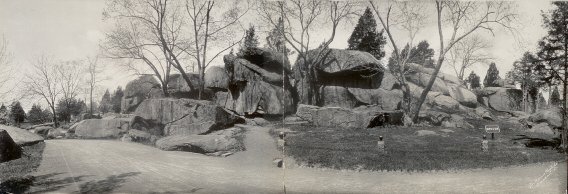
massed artillery at Emmitsburg Road. Close by, they found Sickles positioned along
Emmitsburg Road, the Peach Orchard, and a mass of boulders known as Devil’s Den. With
the artillery, Longstreet began a massive bombardment of the Union lines. Around 4 P.M.,
Longstreet sent Hood’s division forward leading the echelon attack.
The Sedgwick’s Sixth Corps, the largest corps of the
army, arrived after a marching all night for 35 miles. Meade replaced the Fifth Corps with
Sedgwick’s and sent the Fifth Corps to support Sickles who was under fire from
Longstreet.
At last the tardy Stuart and his cavalry arrived at
Gettysburg after like Sedgwick, an all night march. Stuart presented to Lee the 125 wagons
he had captured at the cost of leaving the army blind. Lee was disappointed, but forgave
Stuart.
A portion of the Confederates fought in Devil’s Den,
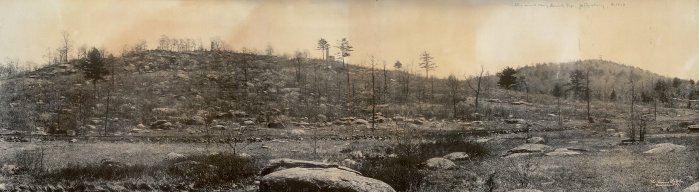
while the others charged Little Round Top. Moments earlier, Little Round Top was
undefended. General Warren saw the Confederates could easily capture the hill and place
cannons on it to destroy the entire Union line. Immediately he sent Colonel Vincent’s
brigade from the Fifth Corps to hold Little Round Top. On the extreme left of the Union
line was, the 20th Maine, commanded by Colonel Chamberlain. Chamberlain had orders to
“hold the ground at all costs.” The rebels began assaulting Little Round Top.
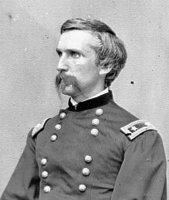 |
After the ammunition was nearly
out, Chamberlain ordered the left of the 20th of Maine to fix bayonets and charge into the
Confederate right. General Warren sent another detachment of the Fifth Corps, 140th New
York, to support Little Round Top. Outnumbered, Oates withdrew his Confederate forces. If
the rebels had taken control of Little Round Top, they could have place cannon on it, and
destroyed the Union army. |
Around 5:30 P.M. Longstreet sent McLaw’s division
against Sickles’s corps in the Peach Orchard. The Union forces retreated to the
Wheatfield and Plum Run. The attack ended when the men of McLaw’s division were too
tired to fight. During the retreat, Sickles was hit in the leg by a shell fragment. When a
rumor that he was dead was going around, Sickles put a cigar in his mouth and puffed on it
to show his men that he was still alive. Meade gave to Hancock, Sickles’s command of
the Third Corps.
Critical Thinking |
Did
Sickles’s move from the Union line give Longstreet an advantage, or did it earn the
Union army a precious hour by surprising Hoods and McLaws, giving time for the Sixth Corps
to arrive? |
Longstreet’s part in the Lee’s echelon attack
ended, next up was A.P. Hill with Anderson’s and Pender’s division. Anderson’s
men charged forward and reached Cemetery Ridge. Hancock ordered 1st Minnesota to
counterattack. They charged forward and fell back, suffering 82 percent casualties, but
giving Hancock ten minutes to reinforce Cemetery Ridge. Pender’s division never
attacked. Lee ordered Pender to support, not to attack. Pender was wounded by a shell, and
his second in command, General Lane, decided not to charge.
Finally, it was Ewell’s turn to attack. He sent Johnson’s
division into Culp’s Hill. Johnson only gained ground at the base of Culp’s
Hill. Next, Ewell sent Early’s division into the low ground between Cemetery Hill and
Culp’s Hill and they broke through the Union lines. But when reinforcements didn’t
arrive, and the Union forces counterattacked, Early retreated.
Thus ended Lee’s echelon attack. Each side lost about
10,000 men, and Lee had broken the Union line two times, but each time they failed because
of a lack of reinforcements. Lee believed the Union line, after two attacks, was very
weak. So, he decided to attack once more. The offensive was to be preceded by a massive
bombardment which would soften up the Union defenses, then Pickett’s division would
charge the center of the Union lines.
That night, Meade held a meeting. The corps commanders voted
to hold their lines instead of attacking. Meade predicted that since Lee had attacked the
left and right flanks, he would attack the center of the Union line the next day. Lee
probably believed the Union center was weak from providing reinforcements to the left and
right. |




