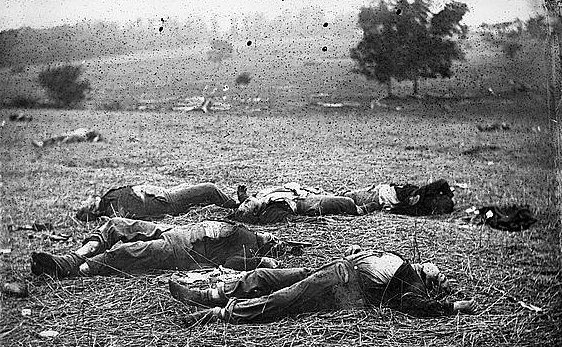
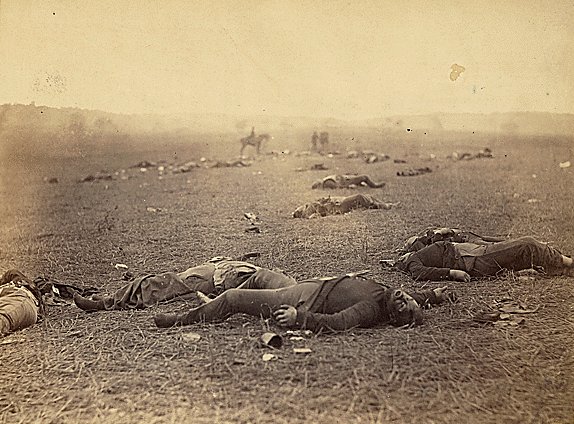
| When the smoke cleared... When the battle was over, the Army of the Potomac suffered 23,049 casualties.
The Army of Northern Virginia suffered 28,000 casualties. With a total of 51,000
casualties, the Battle of Gettysburg is bloodiest battle in American history. In an area
of 25 square miles, the battle was fought with 172,000 men and 634 cannon. 569 tons of
ammunition was expended, and 5,000 horses were killed.
The Patriot Daughters of Lancaster
(Hospital Scenes After the Battle of Gettysburg)
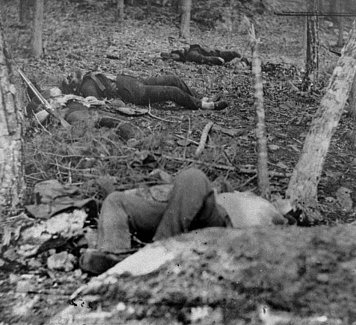
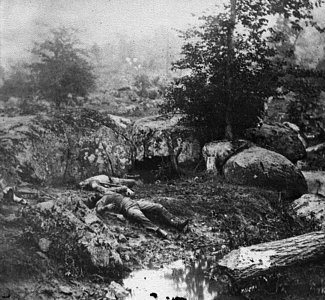
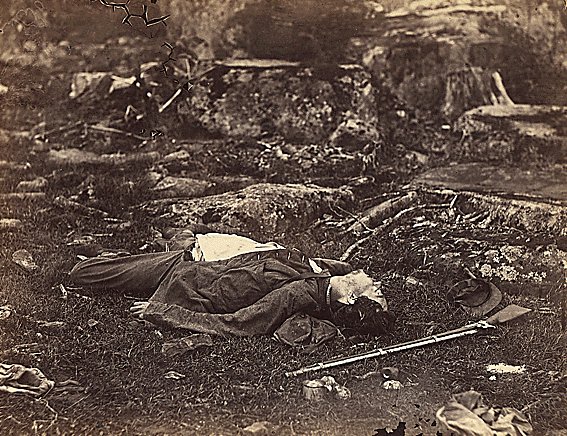
"And then, these scenes themselves, who can adequately describe them? Houses
demolished, fences destroyed, tall forest trees mowed down like so many stalks of hemp;
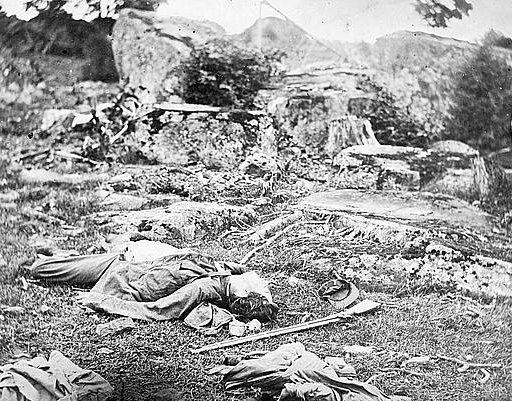
artillery wagons crushed, broken muskets scattered in every direction, unused cartridges
in immense numbers, balls of all kinds, ramrods and bayonets, bits of clothing, belts,
gloves, knapsacks, letters in great quantities all lying promiscuously on the field; dead
horses in great numbers, some torn almost asunder by cannon balls, some pierced in the
side by grape shot, and others with their legs completely shot away; some noble chargers
apparently kneeling in death, thir necks, crested with flowing manes, gracefully arched,
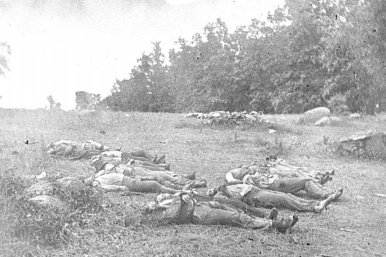
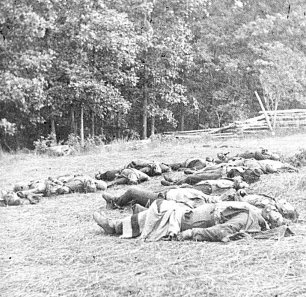
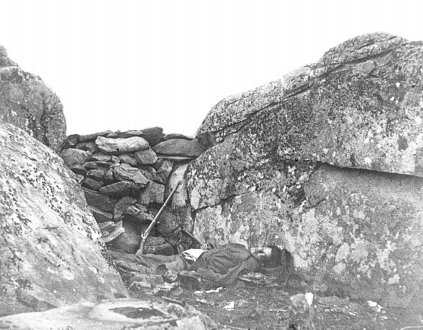
as if still proud of the riders on their backs. And then many of the human dead, whose
mutilated bodies, still unburied, where lying around in all positions. Some with their
hands gently folded over on their breasts, others reclining gracefuly on their elbows, and
other still leaning against trees, stumps or stones, as if wrapped in the arms of sleep,
and given over sweet dreams."
Retreat to Virginia
On July 4, 1863, the 86th anniversary of the American
Independence, the Confederate army waited for a counter-attack that never came. Around
noon, it began to rain and washed away the blood. During the night, Lee retreated for
Virginia. Some Union soldiers blocked Lee’s escape by destroying a bridge at the
Potomac River, preventing his army from getting back to Virginia. Meade had decided not to
attack Lee, but slowly pursued him. Although Meade had lost a fourth of its army to
casualties, he was provided with reinforcements, boosting his army strength up to 85,000.
Lee had lost a third of his army to casualties, and his army strength was further reduced
by stragglers and deserters, leaving him with 35,000 men. On July 13-14, Lee’s men
had rebuilt the bridge and crossed the Potomac River and went back onto Confederate soil.
President Lincoln had seen the Confederate invasion as an
opportunity to destroy the Army of Northern Virginia. When Lincoln heard of Lee’s
escape, he wrote to Meade: “my dear general, I do not believe you appreciate the
magnitude of the misfortune involved in Lee's escape. He was within your easy grasp, and
to have closed upon him would, in connection with our other late successes, have ended the
war. As it is, the war will be prolonged indefinitely. If you could not safely attack Lee
last Monday, how can you possibly do so South of the river, when you can take with you
very few more than two thirds of the force you then had in hand? It would be unreasonable
to expect, and I do not expect you can now effect much. Your golden opportunity is gone,
and I am distressed immeasurably because of it.”
Dispatch from Halleck to Meade July 14
I need hardly say to you that the escape of Lee’s army without another battle has
created great dissatisfaction in the mind of the President, and it will require an active
and energetic pursuit on your part to remove the impression that it has not been
sufficiently active heretofore.
Meade to Halleck July 14
Having performed my duty conscientiously and to the best of my ability, the censure of the
President conveyed in your dispatch of 1 P.M. this day, is, in my judgment, so undeserved
that I feel compelled most respectfully to ask to be immediately relieved from the command
of this army.
Halleck to Meade July 14
My telegram stating the disappointment of the President at the escape of Lee’s army
was not intended as a censure, but as a stimulus to an active pursuit. It is not deemed a
sufficient cause for you application to be relieved.
Meade wasn't the only one to submit a resignation. Depressed,
Lee asked Jefferson Davis to be relieved of command, only to be denied. The Confederacy
paid a terrible price at the Battle of Gettysburg. Lee had lost a large number of men who
were difficult to replace, wasted precious ammunition and supplies, and reduced the moral
of his army. Lee’s army never recovered its losses, and all Confederate hopes of
winning the war were gone with it. Because the Army of Northern Virginia would never
invade the Union again, the Battle of Gettysburg is also known as the High Water Mark of
the Confederacy. From that point on, the major battles of the American Civil War were
fought in the west.
 |




