 While
the lower parts of South Carolina had been settled for many years,
Greenville County remained part of the old Cherokee hunting grounds and
white men were strictly forbidden to enter the area. The Cherokee ceeded
these lands to South Carolina in 1777. The Indians remained in their
mountain homeland for several years after signing their grant, however, and
not many white people ventured into the beautiful Cherokee country before
the Revolution. While
the lower parts of South Carolina had been settled for many years,
Greenville County remained part of the old Cherokee hunting grounds and
white men were strictly forbidden to enter the area. The Cherokee ceeded
these lands to South Carolina in 1777. The Indians remained in their
mountain homeland for several years after signing their grant, however, and
not many white people ventured into the beautiful Cherokee country before
the Revolution.
The first white settler in present Greenville
County was Richard Pearis, an Irishman, who came from Virginia about 1765 as
a trader. He married a Cherokee woman and became so highly thought of by the
Cherokee tribe that tradition records their repeated gifts to him of land
that finally covered a tract 10 miles square. On part of this estate now
stands the city of Greenville and Paris Mountain, it's name a corruption of
Pearis. The enterprising settler called his acres "Great Plains.' He
built a home, a mill, storehouses, and a trading post, and lived the life of
a prince. He served with the British forces in the French and Indian War and
had the distinction of being the first Britisher to enter Fort Dusquesne.
When the Revolution began, Pearis's allegiance was sought by both sides. It
is said that he had promised his help to the Americans, but, disappointed at
the military rank offered him, turned to the King's party. He was probably
more disappointed in how the Cherokee Indians were being treated. Held
prisoner in Charles Town nine months, he became on his release a captain of
the loyalist militia and attained the rank of colonel after performing
several daring exploits. While he was in prison (1776) his plantation was
captured and destroyed by Colonel John Thomas's Spartan regiment, on the
grounds that it was a Cherokee and Tory stronghold. Ironically enough, after
the fall of Charles Town, May 1780, Colonel Pearis received the
'submissions' or surrenders of General Andrew Pickens and, possibly, of
Colonel Thomas. After the Revolution, Pearis settled in the Bahama Islands
on a grant from the British Government.
 Greenville
County was established in 1784. From this time thousands of settlers
migrated to the area. It's name is variously said to honor General Nathanael
Greene of Revolutionary fame or to recall Isaac Green, an early settler.
Most evidence points to the last inference. Greenville
County was established in 1784. From this time thousands of settlers
migrated to the area. It's name is variously said to honor General Nathanael
Greene of Revolutionary fame or to recall Isaac Green, an early settler.
Most evidence points to the last inference.
Lemuel J. Alston, a brother of Governor
Joseph Alston, the husband of the beautiful and ill-fated Theodosia Burr,
came to the county in 1788. He bought 400 acres, 'a portion of the former
plantation of Richard Pearis, and including his mill seat,' and there in
1797 laid out a village called Pleasantburg. Alston built a stately mansion
in his little town, sure that settlers would soon be attracted, not only
because of the proximity to the mountains, but because of the dawning
possibilities for planting cotton and building mills. Edward Hooker, who
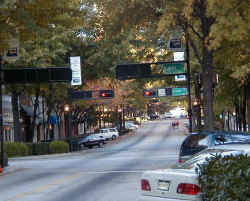
visited Pleasantburg in 1806, gives this picture: "We. . . arrived at
Col. Alston's home, which is the most beautiful I have seen in South
Carolina. The mansion is on a commanding eminence which he calls Prospect
Hill. From the village six hundred yards distant, there is a spacious avenue
formed by two handsome rows of sycamore trees."
 In
1816 Alston sold his holdings to Vardry McBee. Born in Spartanburg County in
1775, McBee was called 'The Father of Greenville.' He leased the Alston
house to Edmund Waddell for a hotel and summer resort until 1835, when he
made it his own home, famous for hospitality until his death in 1864 at the
age of 89. McBee's gifts included lands for the first four churches and the
first academies. A constructive thinker, he recognized the potential sources
of wealth in the country's climate and water power, and erected on the Reedy
River one of the earliest cotton mills. He was instrumental in removing
Furman University from Edgefield to Greenville in 1851, and in securing for
Greenville in 1853 its first railroad, the Columbia and Greenville, later
serving as its president. Pleasantburg flourished as a resort, connected
even in its early days by what were then considered good roads leading
toward western North Carolina and Tennessee, and toward Charleston and
Augusta. The falls of the Reedy River were soon utilized to furnish power
for iron works, corn, and cotton mills. Robert Mills commended the community
in 1825 for its beautiful site, its two well-kept taverns, and its new
courthouse. 'So much wealth, intelligence and leisure are collected annually
at the village,' said Mills, that he could not but 'anticipate a favorable
result to the interior of South Carolina.' Pleasantburg then had 500
inhabitants. In 1831 a progressive fever seized the town and its placid
existence as a summer resort was disrupted by restless activity; stores,
mills, and foundries sprang up. Citizens now wished their courthouse town to
bear the county name. Accordingly, in 1831, little Pleasantburg vanished in
the incorporation of Greenville and future industrialism was foreshadowed in
the stir that replaced quietude. A busy factory, the predecessor of modern
Camperdown Mills, usurped the young people's favorite swimming hole,
opposite the site of Pearis's old mill. In
1816 Alston sold his holdings to Vardry McBee. Born in Spartanburg County in
1775, McBee was called 'The Father of Greenville.' He leased the Alston
house to Edmund Waddell for a hotel and summer resort until 1835, when he
made it his own home, famous for hospitality until his death in 1864 at the
age of 89. McBee's gifts included lands for the first four churches and the
first academies. A constructive thinker, he recognized the potential sources
of wealth in the country's climate and water power, and erected on the Reedy
River one of the earliest cotton mills. He was instrumental in removing
Furman University from Edgefield to Greenville in 1851, and in securing for
Greenville in 1853 its first railroad, the Columbia and Greenville, later
serving as its president. Pleasantburg flourished as a resort, connected
even in its early days by what were then considered good roads leading
toward western North Carolina and Tennessee, and toward Charleston and
Augusta. The falls of the Reedy River were soon utilized to furnish power
for iron works, corn, and cotton mills. Robert Mills commended the community
in 1825 for its beautiful site, its two well-kept taverns, and its new
courthouse. 'So much wealth, intelligence and leisure are collected annually
at the village,' said Mills, that he could not but 'anticipate a favorable
result to the interior of South Carolina.' Pleasantburg then had 500
inhabitants. In 1831 a progressive fever seized the town and its placid
existence as a summer resort was disrupted by restless activity; stores,
mills, and foundries sprang up. Citizens now wished their courthouse town to
bear the county name. Accordingly, in 1831, little Pleasantburg vanished in
the incorporation of Greenville and future industrialism was foreshadowed in
the stir that replaced quietude. A busy factory, the predecessor of modern
Camperdown Mills, usurped the young people's favorite swimming hole,
opposite the site of Pearis's old mill.
 With
the arrival of the railroad in 1853, Greenville's growth was assured. In the
years preceding the War between the States, the community was a hot-bed of
Union sentiment with Benjamin F. Perry, respected throughout the State, as
the leading spirit. When war broke out, no battles were fought in the
vicinity and the city did not lie in Sherman's path. Wayside hospitals were
established and women labored to comfort and supply the needs of war-weary
Confederate soldiers. The mountainous area surrounding Greenville was
overrun by deserters. In organized bands they preyed so persistently on the
property of citizens that Major A. D. Ashmore requested a cannon to destroy
one of their blockhouses in the 'Dark Corner'. In June 1865,
President Andrew Johnson appointed Perry provisional governor of South
Carolina. James L. Orr of Anderson County succeeded him the following
November. With
the arrival of the railroad in 1853, Greenville's growth was assured. In the
years preceding the War between the States, the community was a hot-bed of
Union sentiment with Benjamin F. Perry, respected throughout the State, as
the leading spirit. When war broke out, no battles were fought in the
vicinity and the city did not lie in Sherman's path. Wayside hospitals were
established and women labored to comfort and supply the needs of war-weary
Confederate soldiers. The mountainous area surrounding Greenville was
overrun by deserters. In organized bands they preyed so persistently on the
property of citizens that Major A. D. Ashmore requested a cannon to destroy
one of their blockhouses in the 'Dark Corner'. In June 1865,
President Andrew Johnson appointed Perry provisional governor of South
Carolina. James L. Orr of Anderson County succeeded him the following
November.
How Greenville Was Formed
Greenville was formed from Washington
District in 1798. In 1769, nine judicial districts were
established---Charleston, Georgetown, Beaufort, Orangeburg, Ninety-six,
Camden, and Cheraws. Records were kept at Charleston until 1780. In 1790,
the capital was moved from Charlston to Columbia, although some functions
remained at Charleston until after the Civil War. In 1795, Pinckney and
Washington districts were created and three years later the nine districts
were divided into twenty-four in the following manner:
Ninety-Six District: Abbeville, Edgefield,
Newberry, Laurens, and Spartanburg (all formed in 1795)
Washington District: Pendleton and Greenville
Pinckney District: Union and York
Camden District: Chester, Lancaster, Fairfield, Kershaw, and Sumter
Cheraws District: Chesterfield,
Darlington, and Marlborough
Georgetown District: Georgetown and Marion
Charleston District: Charleston and Colleton
Orangeburg District: Orangeburg and Barnwell
Districts were changed to counties in 1868.
|